Radioactive pollution of Lake Malawi by Australian uranium company Paladin?
 The lake provides water for drinking and domestic use to millions of Malawians. Part of the lake is protected as a national park, and it is inhabited by more than 850 cichlid fish species found nowhere else on Earth.
Malawi: Paladin Accused of Discharging Uranium-Contaminated Sludge in Lake Malawi http://allafrica.com/stories/201412301012.html A coalition of Malawi civil society organisations (CSOs) has accused Paladin Energy Ltd, a company that is mining Uranium ore at Kayerekera in the northern district of Karonga over reports the mining company is secretly discharging into Lake Malawi uranium contaminated sludge from the tailings dam at the mining site.
Renowned human rights activist, Rafiq Hajat shared a report compiled by a members of the Natural Resources Justice Network (NRJN) in which it is alleged paladin is discharging uranium sludge from Kayerekera into Lake Malawi.
“A radius of 35 km from the Boma, you will be shocked to see fish of different species dead with some communities along the lakeshore collecting [the fish]. Collectiong as part of their relish. The cause not yet known. Reports from the Beach Village Chairman indicates that this started in late November but Government was not forth coming (sich)” reads part of the post.
Paladin had aroused the wrath of the coalition of the CSOs under the banner of Natural Resources Justice Network (NRJN) over reports which emerged late November that Paladin Energy was planning of discharging uranium mining sludge into the Sere and North Rukuru rivers.
The toxic substances that would flow from the tailings pond at the Kayelekera Uranium Mine into Lake Malawi 50 kilometers (30 miles) downstream include waste uranium rock, acids, arsenic and other chemicals used in processing the uranium ore, the coalition fears.
“It is rumored that Paladin secretly have started discharging the so called purified water and the trip was one of the verification. This is terrible news and may have catastrophic ramifications if not checked immediately.” Reads the statement shared by Hajat.
However, in a statement issued last month, Paladin Energy stated that water from its tailings dam at Kayelekera uranium mine which is discharging into the North Rukuru River poses no human or environmental risks.
The process has been reviewed and agreed by relevant agencies of the Government of Malawi, which is imposing conditions regulating critical water quality parameters, including uranium, consistent with international guidelines” a statement issued in November by Paladin Energy stated.
The company also said that it plans to start discharging the water in early 2015 and that reports it is discharging the contaminated wastes are not true.
Lake Malawi in eastern Africa is the world’s ninth largest lake, some 580 kilometers (360 miles) long, and 75 kilometres (47 miles) wide at its widest point. It extends into Malawi’s neighbours Tanzania and Mozambique.
The lake provides water for drinking and domestic use to millions of Malawians. Part of the lake is protected as a national park, and it is inhabited by more than 850 cichlid fish species found nowhere else on Earth.
Paladin Africa is the Malawi subsidiary of Australian mining giant Paladin Energy Ltd, with 15 percent owned by the Government of Malawi.
Last year, Paladin Africa’s Kayelekera Mine in Karonga produced 1,066 metric tonnes of U3O8, triuranium octoxide, a compound of uranium. One of the more popular forms of yellowcake, U3O8 is converted to uranium hexafluoride to make enriched uranium for use in nuclear power plants and nuclear weapons.
Fukushiama radiation reaching USA West Coast – at this stage, not a health problem


“My take home is always, don’t trivialize it or dismiss it, but also don’t exaggerate what the effects might be,” says Woods Hole’s Ken Buesseler.
Radiation from Fukushima is reaching the West Coast — but you don’t need to freak out, WP By Chris Mooney December 29 “…….many Americans have been concerned — sometimes overly so — that radiation from Fukushima, traveling through the vast Pacific ocean, would eventually make its way to the waters off the West Coast of the United States and Canada. And according to a new scientific paper just out in the Proceedings of the National Academy of Sciences, that has indeed happened.
The paper, by John N. Smith of Fisheries and Oceans Canada (a government agency) and several colleagues, is the “first systematic study…of the transport of the Fukushima marine radioactivity signal to the eastern North Pacific,” and concludes that radiation reached the continental shelf of Canada by June of last year, and has increased somewhat since.
But– and here’s the good news — the levels of radiation are very low, well below levels that public health authorities cite as grounds for concern. The radiation “does not represent a threat to human health or the environment,” reports the paper.
The new study is not the first to reach that conclusion. Continue reading
Slow journey of small amounts of Fukushima radiation in ocean to USA
Gary Griggs, Our Ocean Backyard: Tracking Fukushima radiation across the Pacific By Gary Griggs, Our Ocean Backyard 26 Dec 14, Radiation from the meltdown of the three reactors at the Fukushima Daiichi Nuclear Plant in March 2011 quickly entered the offshore ocean.
The radiation was detected in the water immediately. Several species of fish caught offshore in 2011 and 2012 had radioactive cesium levels that exceeded Japan’s seafood consumption levels, but overall concentrations have dropped since the fall of 2011………..
Anything picked up by the Kuroshio Current as it passes by Japan, whether tsunami debris, glass fishing floats, or radioactive contaminants, heads towards North America, but slowly, a little more than 5 miles every day on average.
At this speed, water moving from Japan in a straight path would take about three years or longer to get to the west coast. Shortly after the Fukushima Daiichi meltdown and radiation release, oceanographers projected that it would likely take until 2014 until it reached the West Coast of North America……
the nuclear bomb testing that went on in the Pacific from the 1940s to the 1980s, contributed hundreds of times more radioactivity to the oceans than Fukushima. There is also uranium dissolved naturally in seawater.
So Fukushima is not the largest contributor to radiation in the waters of the Pacific Ocean.
Although no U.S. federal agency has routinely monitored the offshore waters for radiation, scientists from Woods Hole Oceanographic Institution and Oregon State University have been analyzing samples intermittently since the March 11 disaster. On Nov. 10, 2014, Woods Hole announced that they had detected trace amounts of radioactivity that could be used to fingerprint Fukushima because of the presence of cesium-134………http://www.santacruzsentinel.com/environment-and-nature/20141226/gary-griggs-our-ocean-backyard-tracking-fukushima-radiation-across-the-pacific
Highly elevated radiation levels across North America might come from Fukushima

 Fukushima Radiation Up 50,000% With Elevated Radiation Reported Across North America http://chemtrailsplanet.net/2014/12/15/fukushima-radiation-up-50000-with-elevated-radiation-reported-across-north-america/, December 15, 2014 by: Ethan A. Huff, staff writer
(NaturalNews) Beta radiation levels are off the charts at monitoring sites all across North America, according to new reports. But experts are blaming these radiation spikes on practically everything except for Fukushima.
Data gathered from tracking units in California, Arizona, Illinois and elsewhere reveal radiation levels up to 50,000 percent higher than what was observed at the same time last year, and in some cases compared to levels seen this past summer.
EnviroReporter.com says the impacted Global Fukushima Radiation warningsites are scattered throughout the country and aren’t just confined to the West Coast. Readings taken near Los Angeles; Chicago; Montgomery, Alabama; and Madison, Wisconsin, reveal total beta counts per minute (CPM) greatly exceeding the 1,000 CPM threshold considered by the government to be problematic.
In Tucson, Arizona, for instance, a 460 CPM reading was recently taken, which is more than 10 times higher than the reading taken last year on November 27. Similarly, Phoenix, Arizona’s 735 CPM reading measured more than 21 times higher than last year’s reading.
San Diego appears to be one of the hardest-hit areas, with a CPM reading of 650, as of October 1. This figure is 60 times higher than it was last year on the same date, despite the fact that San Diego’s normal background radiation rate typically hovers around 20 CPM.
“U.S. Environmental Protection Agency RadNet radiation monitors have detected renewed surges in atmospheric readings of dangerous beta radiation across the country,” explains EnviroReporter.com about the seemingly inexplicable phenomenon.
“Over a dozen metropolitan test sites have registered four-month highs in EnviroReporter.com’s most recent comprehensive assessment.
Radiation testing site near Chicago records radiation levels thousands of times higher than maximum safety threshold
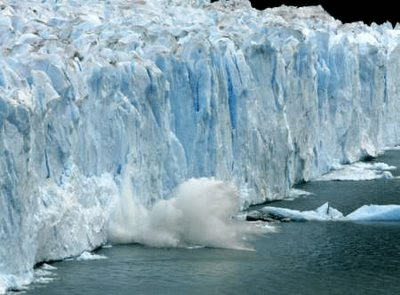
Arctic ice melting rapidly as solar radiation increases
 Arctic Ice Melting Due To Absorption Of Increased Solar Radiation http://au.ibtimes.com/articles/576820/20141222/arctic-melting-ice-solar-radiation.htm#.VJ20osA8 By India Ashok | December 22, 2014
In recent years, the Arctic region has been absorbing more and more of the sun’s radioactive energy, causing the rapid melting of ice in the region. Researchers have found a direct correlation in the rise of solar radiation being absorbed and the decrease in the mount of Arctic sea ice. Since 2000, scientists have observed that the reflective quality of the sea ice has been overwhelmed by the increased levels of absorption of solar radiation such that sea ice in the area has been shrinking at a consistently alarming rate. In fact, the overall climate of the Arctic region is reported to have undergone a marked increase in warmth.
Norman Loeb of NASA’s Langley Research Centre in Virginia has reportedly stated that the Arctic region experienced an increase of warmth in the climate of about five percent. In fact, scientists have concluded that the Arctic region is the only one in the world to have experienced such a rise in temperatures. NASA’s Clouds and the Earth’s Radiant Energy System (CERES) instruments, which have been placed on a few satellites are responsible for uncovering the data and measurements from which the Arctic climactic conditions can be analysed.
Leob went on to say that “Advances in our understanding of Arctic climate change and the underlying processes that influence will depend critically upon high quality observations like these from CERES.” What is confounding most scientists is that the Arctic region is comparatively showing more changes in its climate than any other region on the planet.
Mark Tschudi of the University of Colorado provided enough data that portrayed that since 2000, the Arctic region has lost a total of 1.4 million square kilometres of old ice. Further observation into the climactic conditions of the Arctic region only reinforce the theory that the marked temperature rise in the region is slated to continue increasing at this rate. While most would like to spend more time observing climactic patterns before venturing a root cause for such drastic changes, the possibly that global warming may have a hand in all this could not be ruled out.
To contact the editor, e-mail: editor@ibtimes.com
Savannah nuclear plant to draw massive amounts of water from the Savannah River.
 Nuclear expansion gets OK to drink deep from Savannah River Savannahnow.com By Mary Landers, 13 Dec 14 A massive water withdrawal permit issued for nuclear reactors under construction at Plant Vogtle will allow the nuclear power plant to pull an additional 74 million gallons of water a day from the Savannah River.
When the reactors come on line later this decade, the nuclear plant will use more river water than the cities of Savannah and Augusta combined.
The Georgia Environmental Protection Division issued the approval after the agency received more than 250 comments about the draft permit. By the agency’s own count 243 of those letters requested the permit be denied or delayed.
Despite the public outcry, EPD changed almost nothing in the final version of the permit, which was signed Dec. 5 and made public Tuesday on the EPD website.
“It seems to me they are just going to do what they wanted to do anyway,” said Kurt Ebersbach, senior attorney with the Southern Environmental Law Center. “While they’re happy to observe the process, it was not meaningful to the decision.”………….
Environmentalists have argued that water usage is an additional hidden cost of nuclear. A massive volume of water is needed for cooling, with a loss of up to 88 percent to evaporation in the process………………http://savannahnow.com/news/2014-12-12/nuclear-expansion-gets-ok-drink-deep-savannah-river
Warming of oceans brings hottest year on record
 Warm oceans keep world on course for hottest year December 16, 2014 Peter Hannam Environment Editor, The Sydney Morning Herald Ongoing record warmth in the world’s oceans has increased the likelihood that 2014 will be declared the hottest year since reliable data began more than a century ago, US and Japanese agencies say.
The warmth comes as conditions in the Pacific remain conducive to an El Nino event forming in coming months, Australia’s Bureau of Meteorology said.
Surface temperatures have exceeded El Nino threshold levels for several weeks, and the bureau estimates there is a greater than 70 per cent chance of such an event soon.
The first 11 months of the year were the warmest on record, with combined global land and sea-surface temperatures running 1.22 degrees above the 20th-century average, the US National Oceanic and Atmospheric Administration said.
This year will be the hottest on record – eclipsing 2005 and 2010 – provided December is at least 0.76 degrees above average, NOAA said…………http://www.smh.com.au/environment/climate-change/warm-oceans-keep-world-on-course-for-hottest-year-20141216-1287l2.html
Heating of Arctic oceans may cause dangerous solar radiation feedback loop
Rapid warming of Arctic may trigger dangerous solar radiation feedback loop http://www.sciencerecorder.com/news/rapid-warming-of-arctic-may-trigger-dangerous-solar-radiation-feedback-loop/ Delila James | Science Recorder | December 18, 2014 NASA scientists at the fall meeting of the American Geophysical Union in San Francisco presented what is just the latest dire prediction about the runaway effects of climate change.
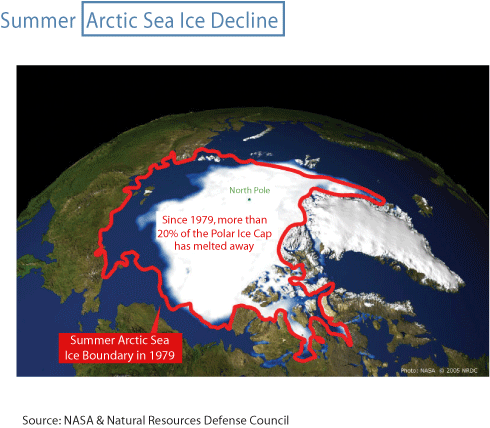
The researchers discussed a map created by satellites’ heat-sensing instruments showing the rate of solar radiation change in the Arctic, where the rate of heat absorption per square meter since 2000 has increased by more than 10 Watts of energy, according to a report by Wired. In some regions, such as the Beaufort Sea north of Alaska, the rate has increased as much as 45 Watts of energy per square meter.
For the past decade-and-a-half, NASA has been using satellite sensors called CERES to calculate how much solar energy is being absorbed by planet Earth as opposed to being reflected back into space. Every year the Arctic ice cap shrinks in the summer and grows in the winter. But because of the record loss of sun-reflecting sea ice in the Arctic seen in recent years, much of the winter ice cover now is thin—less than 6 feet thick, according to Wired.
So, when warm weather returns to the Arctic, the thin ice cover melts rapidly, causing the oceans to heat up. This then causes more ice to melt in a solar radiation feedback loop, in which the thinner the ice cover, the earlier in the summer it melts, which warms the ocean, which melts the ice, and so on.
Compared to 30 years ago, the annual summer melt in the Arctic comes seven days earlier, the Wired report said.
Atmospheric scientist Jennifer Kay of the University of Colorado, who collaborated in the research, said in a statement that CERES, which has only been collecting Arctic solar energy data since 2000, cannot be used to predict any long-term trends.
“Climate is usually considered to be a 30-year average,” Kay said.
Massive release of Fukushima radioactive water into Pacific Ocean
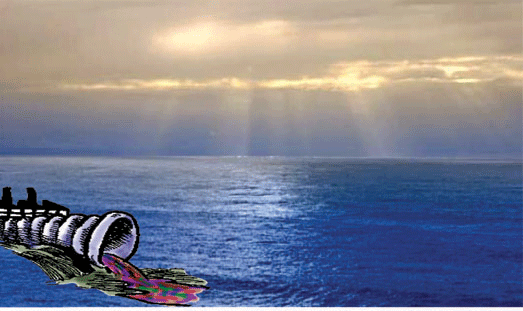 NRA head signals massive release of tainted water to help decommission Fukushima site
 As USA government ignores the issue, USA citizen scientists find Fukushima radiation in Pacific Ocean
Fukushima radiation found 400 miles west of Newporthttp://www.statesmanjournal.com/story/tech/science/environment/2014/12/10/fukushima-radiation-found-miles-west-newport-ore/20223771/ Tracy Loew, Statesman Journal On the last Sunday in November, Terry Waldron waded into the surf at Nye Beach in Newport and filled a plastic bucket from the frigid Pacific Ocean.
The salty water now sits in a laboratory across the country, at the Woods Hole Oceanographic Institute, awaiting testing on highly sensitive equipment.
Waldron is part of a corps of West Coast citizen scientists sampling ocean water near their homes for traces of radiation from the crippled Fukushima nuclear plant on the other side of the Pacific.
New data from Woods Hole shows very low levels of Fukushima radiation about 400 miles due west of Newport, as well as at other offshore sites along the West Coast.
At current levels, the radiation is not expected to harm humans or the environment.
But in the absence of federal monitoring, citizens such as Waldron have taken it upon themselves to test for its arrival on beaches. Continue reading
Highly radioactive mushrooms found in Tochigi Prefecture
 4158 bq/kg Mushrooms Found In Tochigi Prefecture , Simply Info, Dec 7 2014, Mushrooms from Tochigi prefecture tested and found to have 4158 bq/kg of cesium. The test was recently completed and shows that the problems of radioactive foods it not “over” and not isolated to Fukushima prefecture………..http://www.fukuleaks.org/web/?p=14189
Pacific Ocean is still the sewer for the nuclear industry’s wastes
SWR (German public television broadcaster), 2013 (emphasis added):
- 25:00 in — The dumping of nuclear waste in the sea was banned worldwide in 1993, yet the nuclear industry has come up with other ways. They no longer dump the barrels at sea; they build kilometers of underwater pipes through which the radioactive effluent now flows freely into the sea. One of these pipes is situated in Normandy [near] the French reprocessing plant in La Hague… The advantage for the nuclear industry? No more bad press… disposal via waste pipes remains hidden from the public eye, quite literally.
- 28:30 in — 400 km from La Hague [as well as] Holland [and] Germany… we find iodine… 5-fold higher tritium value than [reported] by the operator Areva. It’s now obvious why citizens take their own measurements.
- 30:15 in — Molecular Biologist: “The radioactive toxins accumulate in the food chain. This little worm can contain 2,000-3,000 times more radioactivity than its environment. It is then eaten by the next biggest creature and so on, at the end of the food chain we discovered damage to the reproductive cells of crabs… These genetic defects are inherited from one generation to the next… Cells in humans and animals are the same.”
- 32:00 in — The 2nd disposal pipe for Europe’s nuclear waste is located in the north of England… Radioactive pollution comes in from the sea. Their houses are full of plutonium dust… The pipe from Sellafield is clearly visible only from the air… nuclear waste is still being dumped into the sea. Operators argue this is land-based disposal… It has been approved by the authorities.
- 35:45 in — Plutonium can be found here on a daily basis, the toxic waste returns from the sea… it leaches out, it dries, and is left lying on the beach. The people here have long since guessed that the danger is greater than those responsible care to admit… Every day a smallexcavator removes plutonium from the beach… In recent decadesthe operator at Sellafield has tossed more than 500 kg of plutonium into the sea.
- 42:00 in — We take a soil sample… The result turns out to be alarming. The amount of plutonium is up to 10 times higher than the permissible limit.
Yahoo News, Dec 5, 2014: All this radiation from the [Fukushima] disaster has definitely not been isolated to just Japan. Researchers monitoring the Pacific Ocean, in which much of the radiation spilled into, have detected radioactive isotopes this past November just 160 km [100 miles] off the coast of California. So this story will continue to unfold for many years to come.
Radioactive water from Fukushima to Pacific Ocean increasing by 400 tons daily
TV: Attempt to stop flow of highly radioactive liquid at Fukushima “in doubt” — AP: Much of it is pouring in trenches going out into Pacific — Experts: Amount entering ocean “increasing by 400 tons daily” — Problem “so severe” it’s consuming nearly all workers at site — Top Plant Official: “Little cause for optimism” (VIDEO) http://enenews.com/tv-attempt-stop-flow-highly-radioactive-liquid-fukushima-doubt-ap-pouring-trenches-pacific-ocean-experts-amount-entering-sea-increasing-400-tons-daily-video?utm_source=feedburner&utm_medium=email&utm_campaign=Feed%3A+ENENews+%28Energy+News%29
NHK, Nov. 13, 2014 (emphasis added):
Radioactive water may still be entering tunnels — [TEPCO] faces another challenge in its effort to address radioactive water at the complex. It says highly contaminated water may still be flowing from reactor buildings into adjacent underground tunnels even after a work to stem the flow ended. The water in the tunnels is believed to be leaking into the sea… the firm began work in April to stem the flow of radioactive water between the reactor buildings and the tunnels… TEPCO finished the work on November 6th. But workers found that water levels in the reactor buildings and the tunnels are still linked…
ITAR-TASS, Nov 14, 2014: Radioactive water discharge from Fukushima Daiichi NPP into ocean continues; According to specialists, the volume of contaminated liquid that is leaking into the ocean is increasing by 400 tons daily— The repair operations… aimed at preventing radioactive water discharges into the ocean have yielded no result, the NPP operator [TEPCO] reported on Friday. The water… is still leaking into the NPP drainage system even after last week’s operations to stop the leak… [D]ue to the major damage of the plant’s infrastructure most of the water that is poured in… leaks into the drainage system and gets into the ground waters and then into the Pacific Ocean… The radioactive contamination level in the ground waters, according to TEPCO, is very high…
AP, Nov 12, 2014: Japan’s nuclear cleanup stymied by water woes… nearly all the workers are devoted to a single, enormously distracting problem: coping with the vast amount of water that becomes contaminated after it is pumped into the reactors to keep the melted radioactive fuel inside from overheating… The water becomes contaminated upon exposure to the radioactive fuel, and much of it pours into the reactor basements and maintenance trenches that extend to the Pacific Ocean.
The Guardian, Nov. 13, 2014: The man in charge of cleaning up the wrecked Fukushima Daiichi nuclear power plant has admitted there is little cause for optimism… The water problem is so severe that [Tepco has] enlisted almost all of their 6,000 workers… to bring it under control… “ I have no intention of being optimistic” [Fukushima Daiichi’s manager Akira Ono] told the Guardian… large quantities [of contaminated water] find their way to other parts of the site, including maintenance trenches connected to the sea… “The contaminated water is the most pressing issue – there is no doubt about that,” Ono said… “I cannot say exactly when, I hope things start getting better when the measures start taking effect.”
Russia’s underwater nuclear graveyard- the danger in the Arctic
Sunken Soviet Submarines Threaten Nuclear Catastrophe in Russia’s Arctic, Moscow Times. by Matthew Bodner Nov. 13 2014 While Russia’s nuclear bombers have recently set the West abuzz by probing NATO’s air defenses, a far more certain danger currently lurks beneath the frigid Arctic waters off Russia’s northern coast — a toxic boneyard for Soviet nuclear ships and reactors whose containment systems are gradually wearing out.
Left to decay at the bottom of the ocean, the world is facing a worst case scenario described as “an Arctic underwater Chernobyl, played out in slow motion,” according to Thomas Nilsen, an editor at the Barents Observer newspaper and a member of a Norwegian watchdog group that monitors the situation.

According to a joint Russian-Norwegian report issued in 2012, there are 17,000 containers of nuclear waste, 19 rusting Soviet nuclear ships and 14 nuclear reactors cut out of atomic vessels at the bottom of the Kara Sea.
For extra historical details see: Soviet Nuclear Submarine Wrecks at Bottom of Arctic Ocean (Video) Continue reading
Why Australia should be selling renewable technologies to India, not dirty coal and uranium
Australia, India’s dirty energy friend Instead of being India’s dirty fuel friend, Australia can build a sustainable energy relationship with India by helping boost India’s growing renewables industry. http://www.sbs.com.au/news/article/2014/11/10/comment-australia-indias-dirty-energy-friend By Ruchira Talukdar 10 NOV 2014 As heads of state prepare to arrive in Brisbane next week for the G20 summit where climate change will be conspicuous by its serious absence on the agenda, the Australian government is finalising paperwork to start exporting uranium – a highly risky fuel – and approving giant mines like Carmichael in central Queensland to ship coal – a climate change culprit – to India.
The Indian Prime Minister Narendra Modi is also preparing for a four day Australia tour alongside attending G20, including addressing a joint sitting of federal Parliament. It will be the first official visit by an Indian head of state in nearly three decades, marking the beginning of a strong phase in Australia-India relations. This new cooperation might sound like good news to the Indian diaspora in Australia and make regional cooperation experts enthusiastic, but its basis in extracting and exporting dirty and dangerous forms of energy to India needs to be questioned.India is a densely populated country with many living in poverty, inadequate infrastructure, and a lack of government planning to deal with complex weather systems. This makes it ill-prepared to deal with the scale of impacts from unchecked climate change on humans and ecosystems as highlighted in the latest IPCC report – decreased river flows, increased food insecurity from fall in food production, increased tropical diseases, sea level rise and mass human displacement. Neither are its 22 running nuclear power plants managed to avoid future disasters of the scale of Fukushima or Chernobyl, as a scathing 2013 report by the Indian national auditor general on the lack of nuclear safety in India showed. Continue reading
1 This Month



26 September – International Day for the Total Elimination of Nuclear Weapons


PLEASE OPPOSE HR 8255 AND S.3639 – bills would accelerate satellite deployment, with no environmental review or safeguards – https://ncstd5li.quorum.us/campaign/169331/
To see nuclear-related stories in greater depth and intensity – go to https://nuclearinformation.wordpress.com
-
Archives
- September 2026 (269)
- August 2026 (330)
- July 2026 (355)
- June 2026 (287)
- May 2026 (306)
- April 2026 (356)
- March 2026 (251)
- February 2026 (267)
- January 2026 (308)
- December 2025 (358)
- November 2025 (359)
- October 2025 (375)
-
Categories
- 1
- 1 NUCLEAR ISSUES
- business and costs
- climate change
- culture and arts
- ENERGY
- environment
- health
- history
- indigenous issues
- Legal
- marketing of nuclear
- media
- opposition to nuclear
- PERSONAL STORIES
- politics
- politics international
- Religion and ethics
- safety
- secrets,lies and civil liberties
- spinbuster
- technology
- Uranium
- wastes
- weapons and war
- Women
- 2 WORLD
- ACTION
- AFRICA
- Atrocities
- AUSTRALIA
- Christina's notes
- Christina's themes
- culture and arts
- Events
- Fuk 2022
- Fuk 2023
- Fukushima 2017
- Fukushima 2018
- fukushima 2019
- Fukushima 2020
- Fukushima 2021
- general
- global warming
- Humour (God we need it)
- Nuclear
- RARE EARTHS
- Reference
- resources – print
- Resources -audiovicual
- Weekly Newsletter
- World
- World Nuclear
- YouTube
-
RSS
Entries RSS
Comments RSS

