North Dakota’s proposal for tenfold increase in permissable level of radiation in waste –
 Controversy Surrounds Proposed Increase in Radioactive Waste Limits, KX News, Jan 23, 2015 By Ben Smith, Reporter A controversial proposal could allow state disposal sites to accept oil-waste with higher levels of radiation.
Freelance journalist Darrell Dorgan has seen three oil booms in North Dakota–he says a problem in all three has been the radioactive byproducts of oil production.
“The bottom line is that the state health department doesn’t know how much radioactive waste is generated in North Dakota either.” he says
Recently the Health Department held hearings about a proposal that would change the law, allow North Dakota landfills to accept waste ten-times more radioactive than the current standard………People like Dorgan would prefer to avoid the change all together..and make people’s health a priority over profits.
“It’s time just to halt this, take a deep breath, enforce the laws that are on the books to keep it at 5 Picocuries. Don’t ask me to increase it to 50 if you can’t keep track of 5.” he says
The State Health Department is accepting written comments on the proposal up until February 6th. http://www.kxnet.com/story/27919618/controversy-surrounds-proposed-increase-in-radioactive-waste-limits
Research into problem of uranium mining & processing causing contamination of groundwater
22-Jan-2015 Source Newsroom: SLAC National Accelerator Laboratory Newswise — Researchers at the Department of Energy’s SLAC National Accelerator Laboratory are trying to find out why uranium persists in groundwater at former uranium ore processing sites despite remediation of contaminated surface materials two decades ago. They think buried organic material may be at fault, storing toxic uranium at levels that continue to pose risks to human health and the environment, and hope their study will pave the way for better long-term site management and protection of the public and environment.
The contaminated sites, on floodplains in the upper Colorado River basin, operated from the 1940s to the 1970s to produce “yellowcake,” a precursor of uranium fuel used in nuclear power plants and weapons. In the 1990s, site surfaces were cleaned up, and remaining uranium in the ground was expected to flush out over time due to natural groundwater flow across the sites.
Senator Schumer urges for cleanup of old toxic uranium and thorium site
Schumer calls on agency to move ahead with steps toward nuclear cleanup Nassau LONG ISLAND Newsday January 19, 2015 By EMILY C. DOOLEY emily.dooley@newsday.com Investigating contamination at a former Sylvania Corning plant in Hicksville that processed uranium and thorium for nuclear fuel rods has stalled and Sen. Charles Schumer called yesterday on the Army Corps of Engineers to speed up the process.
He also pledged to fight for increased funding for the Army Corps program, which was created in 1974 to clean up contaminants from the nation’s early…[registered readers only] http://www.newsday.com/long-island/nassau/schumer-calls-on-agency-to-move-ahead-with-steps-toward-nuclear-cleanup-1.9823499
Turkey Point nuclear power plant guzzling precious drinking water
 Critics: Turkey Point Sucking Us Dry MIAMI (CBSMiami) Gary Nelson, 13 Jan 15 – The Turkey Point nuclear power plant was busy splitting atoms by Biscayne Bay Wednesday, and just down the street a Nuclear Regulatory Commission appeals Board was hearing a challenge to the cooling system at Turkey point.
Water to cool the nuclear reactors is hot, as hot as 104 degrees at times. The nuclear regulatory  commission has granted FPL a waiver, allowing the water to be hotter then regulations would normally allow.
Still, to keep the water even at the 104 degree limit, FPL has been allowed to pull as much as 100 million gallons of water a day from Everglades canals to cool the plant’s overheated cooling water.
Opponents say FPL, already sucking water from the aquifer-and now canals-is threatening environmental ruin. Click here to watch Gary Nelson’s report.
“The waters going to get more saline, it’s going to get denser, and it’s going to sink, and it’s going to further displace freshwater,” said Mayor Phillip Stoddard of South Miami. “It will mess up the Everglades and threaten the drinking water supply for Florida Keys residence.”
Miami-Dade farmer Mike Hatcher is among those battling FPL’s increased thirst. “It’s the water that we drink, it’s the water that I and my fellow farmers use to grow the crops,” Hatcher said. “It’s the water that we use for recreation.”……
Barry White of the group Citizens Allied for Safe Energy, said citizens have reason to be worried. “Eventually, they’ll pay for it in higher water bills and in the quality of life here,” White said. “There is not enough water and land to support so much.”
It is considered unlikely that the Nuclear Regulatory Commission’s appeals panel will overturn the agencies earlier decision. In any event, opponents vow to fight on. A decision from the panel is expected within a few weeks. http://miami.cbslocal.com/2015/01/14/critics-turkey-point-sucking-us-dry/
“Blind Faith” – book reveals the toxic nuclear legacy in Port Hope
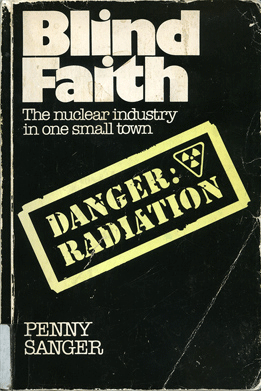
 Blind Faith: The Nuclear History of Port Hope, Ontario http://www.mintpressnews.com/MyMPN/author/driches/ January 15, 2015 By Dennis Riches
Radiation is invisible, and it has always been imbued with a diverse range of magical powers in science fiction. Ironically, in a very real sense, radiation does make people invisible. Once groups of people have become victims of a radiological contamination, they are, in addition to being poisoned (or being traumatized by the possibility that they have been poisoned), marginalized and forgotten. Their traditions and communities are fragmented, and they are shamed into concealing their trauma. When contamination occurs, there is a strong impulse even among many victims to not admit that they have been harmed, for they know the fate that awaits them if they do.
Thus it is that hibakusha (the Japanese word for radiation victims) become invisible. When a new group of people become victims, such as in Fukushima in 2011, they feel that they have experienced a unique new kind of horror. For them, for their generation, it is new, but for those who know the historical record, it is a familiar replay of an old story. The people of Fukushima should know by now that they are bit players who have been handed down a tattered script from the past.
A case in point is “Blind Faith,” the superb 1981 book by journalist Penny Sanger, about the small irradiated Canadian town of Port Hope on the shores of Lake Ontario. In the 1970s, it faced (and more often failed to face) the toxic legacy of processing first radium, then uranium for nuclear weapons and nuclear power plants.
Russia’s lethally radioactive Lake Karachay
Lethal lake in Russia could kill you http://www.aol.com/article/2015/01/16/lethal-lake-in-russia-could-kill-you/21131073/ It’s being called the most polluted spot on the planet. While Russia’s Lake Karachay might look pretty in a painting that’s as close as you ever want to get to it.
In 1990, the US organization “Natural Resources Defense Council” got their hands on a formerly secret soviet publication that revealed quote “astronomically” high radioactive pollution.
The lake sits in western Russia near the border of Kazakhstan. Nearby is Mayak, formerly known as Chelyabinsk one of the country’s largest nuclear production sites.
The reports say for years Chelyabinsk dumped about 120 million curies of radioactive waste to give you an idea of how much that is — it’s two and a half times the amount of radiation released in Chernobyl.
Add on top of that the Kyshtym nuclear disaster in 1957 said to be on of the world’s worst ever, a drought and strong winds blowing radioactive waste around.
The NRDC said that sitting on the lake’s shores for just an hour would be long enough to kill you!

Case against nuclear powers unfolds at the International Court of Justice in The Hague,
 The Marshall Islands’ latest nuclear test – Marshall Islanders are well-acquainted with the horrors of the nuclear arms industry. Belen Fernandez, Aljazeera, 18 Jan 15
The list of accused is as follows: the United States, Russia, Britain, China, France, India, North Korea, Pakistan, and Israel. Israel has made the cut despite fervently denying possession of a nuclear arsenal.
The spectacle is unfolding at the International Court of Justice in The Hague, the main judicial organ of the United Nations. A recent New York Times article on the Marshall Islands’ “near-Quixotic venture” quotes Phon van den Biesen, head of the country’s legal team, on the ultimate aim of the effort: “All the nuclear weapons states are modernising their arsenals instead of negotiating [to disarm], and we want the court to rule on this.”……….
The diminutive nation happens to be the site of no fewer than 67 US nuclear bomb tests in the 1940s and 50s, during an almost 40-year period in which the US administered the Islands under a UN trusteeship. As Greenpeace notes, one of these tests involved a bomb 1,000 times more powerful than the one dropped on Hiroshima in 1945.
Such machinations have predictably resulted in thorough environmental contamination and continuing health complications for the local population, ranging from radiogenic cancers to babies born without bones.
As Marshallese nuclear survivor Lemeyo Abon told the UN Human Rights Council in 2012: “After the [US] testing programme we’ve had to create new words to describe the creatures we give birth to.”
Lexical fallout aside, other US contributions to Marshallese culture include the Ronald Reagan Ballistic Missile Test Site on Kwajalein Atoll, which continues to generate revenue for US corporations.
The widespread territorial displacement necessitated by the previous era of fanatical nuclear testing meanwhile highlights the irony of Marshallese government support for the US-funded entity that displaces and otherwise oppresses Palestinians……….. http://www.aljazeera.com/indepth/opinion/2015/01/marshall-islands-latest-nuclear-201511352947395615.html
US Department of Defense – the Global Polluter
 This article might be 4 years old, but nothing has changed. My only question about it, is that Russia is surely equal with USA at the top of the military pollution list?
US Department of Defense is the Worst Polluter on the Planet Project
Censored October 2, 2010 The US military is responsible for the most egregious and widespread pollution of the planet, yet this information and accompanying documentation goes almost entirely unreported. In spite of the evidence, the environmental impact of the US military goes largely unaddressed by environmental organizations and was not the focus of any discussions or proposed restrictions at the recent UN Climate Change Conference in Copenhagen. This impact includes uninhibited use of fossil fuels, massive creation of greenhouse gases, and extensive release of radioactive and chemical contaminants into the air, water, and soil. Continue reading
The nuclear bomb as the start of a new era – the Anthropocene Age
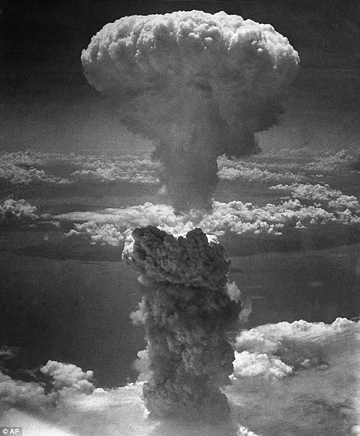
the beginning of the Anthropocene could be considered to be drawn at the moment of detonation of the world’s first nuclear test: on July 16th 1945. The beginning of the nuclear age, it marks the historic turning point when humans first accessed an enormous new energy source — and is also a time level that can be effectively tracked within geological strata, using a variety of geological clues
Did the Anthropocene begin with the nuclear age?, Science Daily January 15, 2015 Source:University of Leicester
….. the Anthropocene, a new epoch in Earth history proposed by the Nobel Prize-winning atmospheric chemist Paul Crutzen just 15 years ago. Since then the idea has spread widely through both the sciences and humanities.
But if the Anthropocene is to be a geological epoch — when should it begin?……..
Now, members of the international working group formally analysing the Anthropocene suggest that the key turning point happened in the mid-twentieth century. This was when humans did not just leave traces of their actions, but began to alter the whole Earth system…….
It included the start, too, of the nuclear age, when artificial radionuclides were scattered across the Earth, from the poles to the Equator, to be leave a detectable signal in modern strata virtually everywhere.
The proposal, signed up to by 26 members of the working group, including lead author Dr Jan Zalasiewicz, who also chairs the working group, and Professor Mark Williams, both of the University of Leicester’s Department of Geology, is that the beginning of the Anthropocene could be considered to be drawn at the moment of detonation of the world’s first nuclear test: on July 16th 1945. The beginning of the nuclear age, it marks the historic turning point when humans first accessed an enormous new energy source — and is also a time level that can be effectively tracked within geological strata, using a variety of geological clues……… http://www.sciencedaily.com/releases/2015/01/150115083044.htm
Czech government faces costly cleanup of radioactive uranium mine site
Government earmarks 4.5 billion Kč to remove uranium mining damage in Stráž, Prague Post, Stráž pod Ralskem, North Bohemia, Jan 9 (ČTK) — The Czech government will earmark 4.5 billion Kč for 2015 to 2017 to remove damage caused by the environmentally unfriendly method of uranium mining in Stráž pod Ralskem, Industry and Trade Minister Jan Mládek told journalists. The process is estimated to cost about 50 billion Kč and last until 2037.
Uranium mining took place in Stráž pod Ralskem between 1967 and 1996 having contaminated over 370 million cubic meters of underground water with four million chemicals on an area of 27 square kilometers.
 The situation is even more complicated because the contaminated land is near the large drinking water reservoirs in northern and central Bohemia.
The contaminant content is 50 grams per liter, but it should be seven grams per liter, said Tomáš Rychtařík, the head of the state-run company Diamo that is in charge of land reclamation.
The land reclamation process began in 1996, its costs at around 20 billion Kč so far.
Mládek said the government is not considering resumption of uranium mining in the said area.
The Cabinet is mulling mining activity in Brzkov in southern Moravia, where it is possible to get over 3,000 tons of uranium. At present any activity would be loss-making and so the cabinet will leave a decision on the issue to a government to emerge from the next parliamentary election……….. http://praguepost.com/czech-news/43739-uranium-mine-area-being-reclaimed#ixzz3OfwXa2G2
80 miles from Sellafield nuclear facility, radiation is found in food
 Radiation found in food 80 miles across the border from Cumbrian nuclear-plant Sellafield Daily record, Jan 07, 2015 By Jennifer Hyland
NUCLEAR waste released from the Cumbrian reprocessing site has made fish and shellfish caught off the Dumfriesshire coast radioactive. RADIATION has been found in food 80 miles across the border from a Cumbrian nuclear-plant a report has revealed.
Nuclear waste released from the Cumbrian reprocessing site has made fish and shellfish caught off the Dumfriesshire coast slightly radioactive.
And fish-fans in Dumfriesshire have the highest exposure to nuclear radiation of anyone north of the Border.
Despite Sellafield nuclear station being situated 80 miles away, the new report reveals that the nuclear power station is still having an impact on Scotland, reports the Daily Mail. And although the levels are within safe EU limits, Sellafield and Scottish nuclear power stations have infiltrated the food chain here.
Traces of radiation were found in fruit, potatoes and vegetables near to Dounreay nuclear power station in Caithness, in the far north-east of Scotland .
Whilst in Chapelcross, in Dumfriesshire, nuclear radiation has made its way into the milk.
Where as at Faslane, near Helensburgh, Dunbartonshire, the destination of Britain’s nuclear submarines where liquid radioactive waste is discharged into the Gareloch,
beef has been revealed to contain a small amount of radiation……..
- The unborn children of pregnant women living within 550 yards of the Hunterston B site, in North Ayrshire – one of Scotland’s two working nuclear power stations -would received the highest dose there.
Dr Richard Dixon, director of Friends of the Earth Scotland, said: “There is no safe level of radiation. Nuclear technology… poses an ongoing threat to public health.”………http://www.dailyrecord.co.uk/news/health/radiation-found-food-80-miles-4931653
USA’s new rules for Nuclear power plants, gas pipelines, endangered species
New regs for Monday: Nuclear power plants, gas pipelines, endangered species The Hill, By Tim Devaney – 01/09/15 Monday’s edition of the Federal Register contains new energy conservation standards, protections for endangered and threatened species, safeguards for nuclear power plants and rules for interstate natural gas pipelines.
Here’s what is happening:
Efficiency: The Department of Energy is delaying a review of the energy conservation standards for commercial and industrial fans and blowers.
The Energy Department’s Office of Energy Efficiency and Renewable Energy last month released a provisional analysis estimating the energy savings and economic impact that would result from new energy conservation standards for industrial fans and blowers. While the agency did not propose efficiency rules at the time, it noted this review could lead to future rulemaking.
But the Energy Department said Friday it is extending the comment period through Feb. 25 to give stakeholders more time to consider the potential changes.
Gas: The Federal Energy Regulatory Commission (FERC) is delaying new rules for interstate natural gas pipelines and public utilities……..
Endangered: The Fish and Wildlife Service (FWS) is delaying new protections for dozens of endangered species……….
Nuclear: The Nuclear Regulatory Commission (NRC) is considering new safeguards at nuclear power plants.
The NRC announced Friday it will review a petition that requests the agency check to the structure of nuclear power plants for concrete degradation. The petitioner suggests better identification techniques.
 The public has 75 days to comment. http://thehill.com/regulation/229010-new-regs-for-monday-nuclear-power-plants-gas-pipelines-endangered-species
The distinctive “fingerprint” of the Fukushima radiation fallout
The real fallout from Fukushima, Maclean’s Colby Cosh January 8, 2015 On the verge of the new year, scientists from the federal Department of Fisheries and Oceans issued the first systematic report of measurements on the spread of radioactive seawater from Japan’s damaged Fukushima nuclear reactor to the coast of British Columbia. …….Accurate measurements of the Fukushima plume are possible because humans wisely stopped testing nuclear weapons in the atmosphere in 1980. There is still a “fallout background” of radiation lingering in the world’s oceans from these nuclear tests—and, of course, from those two nuclear explosions that did not quite have the character of tests. But every kind of radioactive isotope has a different rate of decay, usually expressed as a “half-life,” and the short-lived ones from nuclear testing are all gone.
This means that the 2011 Fukushima disaster left a distinctive “fingerprint” of fast-decaying radioactives that cannot be attributed to any other source. So that’s what the scientists measuring the plume look for—fanning out between Vancouver Island and Japan on Canadian Coast Guard oceanographic vessels, gathering up seawater from various depths, and pumping it through ion exchangers to extract the telltale radioactive cesium that spewed out of the damaged reactor.
In 2011, the measurements along the B.C.-Japan line looked just like usual. But the levels of cesium-134, which can only have come from Fukushima, suddenly increased about 1,500 km off the continental shelf when samples were taken in 2012. In 2013 the “fingerprint” of Fukushima seems to have reached the shelf itself.
Cesium-134 degrades fast. What physicists and doctors have been concerned about is the equal amount of cesium-137 spilled at Fukushima: that isotope has a half-life of 30 years, so most of whatever reaches B.C. now will be around for a while. The radiation emitted by the fallout background—the cesium-137 presently left in the ocean by past nuclear testing—works out to about one becquerel per cubic metre of seawater. That figure has now doubled. The total peak level of ocean radioactivity off Canada’s Pacific Coast is expected to reach somewhere between three to five becquerels per cubic metre before beginning to drop back down……..
Overall, the authors of the paper expect the Fukushima plume to make B.C. ocean water as radioactive as it was in the 1980s…….
Plutonium from Fukushima in the Pacific Ocean
VIDEO: Fukushima corium found in Pacific — Flowing into ocean after hydrogen dissolves nuclear fuel — Scientist: We’ve actually seen plutonium floating on surface; “We have no control over this accident… they’ve got leaks everywhere” http://enenews.com/video-fukushima-corium-found-pacific-hydrogen-dissolving-nuclear-fuel-plutonium-detected-surface-ocean-water?utm_source=feedburner&utm_medium=email&utm_campaign=Feed%3A+ENENews+%28Energy+News%29
2014 Conference on Radioecology and Environmental Radioactivity (final link at bottom of page), K. Buesseler, E. Black, and S. Pike of Woods Hole Oceanographic Institution; T. Kenna of Lamont-Doherty Earth Obseratory; P. Masqué of Autonomous University of Barcelona, Sept 12, 2014 (emphasis added): Plutonium Isotopes In The Ocean Off Japan After Fukushima— The Fukushima Dai-ichi nuclear power plants (NPPs) are known to be an unprecedented accidental source of 137Cs, 134Cs and other volatile radionuclides to the ocean. Much less is known however about the extent of input of refractory radionuclides such as plutonium to the environment. Limited available data from land soils and vegetation, suggest at least some atmospheric delivery of particulate Pu… In 2011, in surface ocean waters, we found ratios 240Pu/239Pu >0.3, which implies a component of Fukushima Pu had been delivered to the ocean… Fukushima derived Pu was not found deeper in the water column.
Woods Hole Oceanographic Institution, Science Made Public — Fukushima Radiation:
- 51:00 — Ken Buesseler, Woods Hole senior scientist: People have a hard time with radiation risk because we can’t taste it, we can’t smell it… we have no control over this accident.
- 5900 – Question: I’m wondering about the corium and whether anything you’ve detected in the water is coming form the core, the meltdown?
- 59:30– Buesseler: Great question… What I’m thinking of are things like plutonium uranium, the fuel itself… We’ve actually seen, I’d say a trace amount of plutonium, I’ve seen two talks on that… It doesn’t come out as a gas, it’s in the ocean, probably because of all that cooling water they put on there. Hydrogen makes it very acidic… it dissolves some of the materials and bring that back into the ocean… We haven’t yet taken that into the seafood… [It] may have come out in the hot acidic water, that’s been — still to this day btw – they’re putting on 100s of tons of water a day to cool those reactors and only recovering about half of that water… They have to cool that thing for decades, for years certainly and that takes water and they’ve got leaks everywhere.
Buesseler and other scientists are calling for more monitoring of Pacific Coast radiation
 Scientists: Test West Coast for Fukushima radiation Tracy Loew, USA TODAY March 9, 2014 SALEM, Ore. — Very low levels of radiation from the Fukushima nuclear disaster likely will reach ocean waters along the U.S. West Coast next month, scientists are reporting.
Current models predict that the radiation will be at extremely low levels that won’t harm humans or the environment, said Ken Buesseler, a chemical oceanographer at the Woods Hole Oceanographic Institution who presented research on the issue last week.
But Buesseler and other scientists are calling for more monitoring. No federal agency currently samples Pacific Coast seawater for radiation, he said.
“I’m not trying to be alarmist,” Buesseler said. “We can make predictions, we can do models. But unless you have results, how will we know it’s safe?”……………
There are three competing models of the Fukushima radiation plume, differing in amount and timing. But all predict that the plume will reach the West Coast this summer, and the most commonly cited one estimates an April arrival, Buesseler said.
A report presented last week at a conference of the American Geophysical Union’s Ocean Sciences Section showed that some Cesium 134 has already has arrived in Canada, in the Gulf of Alaska area.
Cesium 134 serves as a fingerprint for Fukushima, Buesseler said.
“The models show it will reach north of Seattle first, then move down the coast,” Buesseler said.
By the time it gets here, the material will be so diluted as to be almost negligible, the models predict. Radiation also decays. Cesium 134, for example, has a half-life of two years, meaning it will have half its original intensity after that period.
In Oregon, state park rangers take quarterly samples of surf water and sand at three locations along the coast. The water is analyzed for Cesium 137 and iodine 131. Both of those already exist in the ocean at low levels from nuclear testing decades ago.
The monitoring began in April 2012, when tsunami debris began arriving along the Oregon coast. So far, all of the tests have shown less than “minimum detectable activity,” or the least amount that can be measured.
Results of the most recent samples, taken in mid-February, won’t be available until mid-March, Oregon Health Authority spokesman Jonathan Modie said.
Washington does not test ocean water for radiation.
“We have none happening now and we have none planned,” said Tim Church, communications director for the Washington State Department of Health. “Typically that would be something that would happen on the federal level.”
California regularly samples seawater around the state’s nuclear power plants to determine whether the plants are impacting the environment. Those results all are below minimum detectable activity.
Some citizens and scientists are taking sampling into their own hands. Cal State Long Beach marine biologist Steven Manley has launched “Kelp Watch 2014,” which will partner with other organizations to monitor kelp all along the West Coast for Fukushima radiation.
And Buesseler recently offered the services of his lab at Woods Hole in Massachusetts.
His project — titled “How Radioactive Is Our Ocean?” — will use crowd-sourced money and volunteers to collect water samples along the Pacific Coast, then ship them across the country to be analyzed.
So far, results are in for two locations in Washington and three in California. They show that the plume has not yet reached the coast.
Meanwhile, West Coast states are winding down their tsunami debris response efforts.
Oregon’s coastline is seeing less debris from the tsunami this winter than in the past two years, Oregon State Parks spokesman Chris Havel said.
If that doesn’t change, officials likely will disband a task force that was mobilized to deal with the debris.
Last year, Washington suspended its marine debris reporting hotline.
Loew also reports for the (Salem, Ore.) Statesman Journal http://www.usatoday.com/story/news/nation/2014/03/09/scientists-test-west-coast-for-fukushima-radiation/6213849/?utm_content=buffer51957&utm_medium=social&utm_source=twitter.com&utm_campaign=buffer
1 This Month



26 September – International Day for the Total Elimination of Nuclear Weapons


PLEASE OPPOSE HR 8255 AND S.3639 – bills would accelerate satellite deployment, with no environmental review or safeguards – https://ncstd5li.quorum.us/campaign/169331/
To see nuclear-related stories in greater depth and intensity – go to https://nuclearinformation.wordpress.com
-
Archives
- September 2026 (269)
- August 2026 (330)
- July 2026 (355)
- June 2026 (287)
- May 2026 (306)
- April 2026 (356)
- March 2026 (251)
- February 2026 (267)
- January 2026 (308)
- December 2025 (358)
- November 2025 (359)
- October 2025 (375)
-
Categories
- 1
- 1 NUCLEAR ISSUES
- business and costs
- climate change
- culture and arts
- ENERGY
- environment
- health
- history
- indigenous issues
- Legal
- marketing of nuclear
- media
- opposition to nuclear
- PERSONAL STORIES
- politics
- politics international
- Religion and ethics
- safety
- secrets,lies and civil liberties
- spinbuster
- technology
- Uranium
- wastes
- weapons and war
- Women
- 2 WORLD
- ACTION
- AFRICA
- Atrocities
- AUSTRALIA
- Christina's notes
- Christina's themes
- culture and arts
- Events
- Fuk 2022
- Fuk 2023
- Fukushima 2017
- Fukushima 2018
- fukushima 2019
- Fukushima 2020
- Fukushima 2021
- general
- global warming
- Humour (God we need it)
- Nuclear
- RARE EARTHS
- Reference
- resources – print
- Resources -audiovicual
- Weekly Newsletter
- World
- World Nuclear
- YouTube
-
RSS
Entries RSS
Comments RSS

