Extremely high level of Cesium 134/137 in agricultural products near Minamisoma city
 Still 102,900 Bq/Kg of Cs-134/137 measured from Matsutake mushroom in Minamisoma city Iori Mochizuki Fukushima Diary, 9 Nov 14, According to Minamisoma city government, still extremely high level of Cs-134/137 is detected from agricultural products.
From their latest report of September, 102,900 Bq/Kg of Cs-134/137 was measured from Matsutake mushroom. The city government reports it was collected for self-consumption, but the ratio of Cs-134 and Cs-137 was not announced.
Also 28,240 Bq/Kg and 17,058 Bq/Kg were measured from other Matsutake mushroom samples.
2,094 ~ 14,140 Bq/Kg of Cs-134/137 were detected from “Inohana” mushroom as well.
Still high level of radioactive material is accumulated in mushroom in Minamisoma city.
http://www.city.minamisoma.lg.jp/index.cfm/10,1672,c,html/1672/h26.09.pdf
Armenian Communities Concerned over Radiation near Uranium Mines
Communities Concerned over Radiation near Uranium Mines Asbarez.com BY KARINA MANUKYAN 6 Nov 14 YEREVAN (ArmInfo.am)—The development of uranium ore-containing mines in Armenia is fraught with big environmental problems, Inga Zarafyan, Head of EcoLur, an environmental advocacy group, has told ArmInfo. Zarafyan says some legislative amendments in the country have enabled mining companies to gain profits even from deposits that were regarded as unprofitable before.
Uranium extraction operations may have a potential health impact on the local communities, the environmentalist says. Zarafyan warns about the high level of radon at the areas near the deposits that have been operated for a long period of time already. Operation of all these deposits is accompanied by dangerous emissions of radioactive waste, she explains.
Earlier in October, environmentalists warned about the exploration of the Azatek deposit located in Vayots Dzor region, which, as they claimed, contains uranium. According to EcoLur, expeditions in the 1960s and 1970s also indicated the presence uranium ore in the area.
Meanwhile, Zarafyan complained about the lack of official data on the risks of operation on radioactive deposits. “No one cares for the issue, unfortunately. Mining companies are silent, as it is not within their interests to speak of the risks. As for the Government, its silence is in favor of some officials who back those companies,” Zarafyan said.
Meanwhile, the situation has been exacerbated. A few years ago an Armenian-Russian Mining Company conducted uranium exploration in Armenia. Rosatom provided 3 million euros to that end. ……..http://asbarez.com/128649/communities-concerned-over-radiation-near-uranium-mines/
Worrying outlok for USA, as Climate Change Denier likely to head senate environment committee
Prominent climate change denier likely to head US senate environment committee, SMH, Tom Hamburger,November 6, 2014If approved, Inhofe would replace Chairman Barbara Boxer, D-Calif., an avowed environmentalist, producing one of the most stark post-election changes in the Capitol. Committee assignments will not be made until Senate party caucuses meet in Washington after the election recess………
Risk of tsunami – a threat to at least 8 countries with nuclear power plants
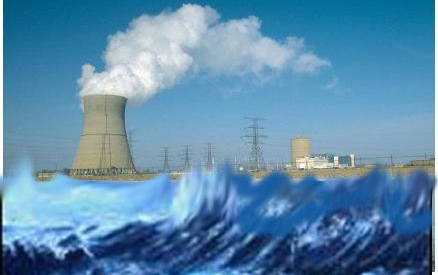 8 Countries With Nuclear Power Plants Most At Risk Of Tsunamis. Oil Price, By Andrew Topf | Tue, 04 November 2014 The tsunami that destroyed a nuclear reactor at Fukushima, Japan, caused a major re-think of nuclear power, which up to the accident in 2011, had been considered a relatively safe, clean form of electricity generation……..
UK’s Windscale nuclear disaster spread radiation much further than previously thought

 Windscale fallout underestimated Rebecca Morelle Science reporter, BBC News 6 Oct 2007 The radioactive fallout from a nuclear accident that rocked Britain 50 years ago was underestimated, scientists say.
In 1957, a fire at the Windscale nuclear reactor in Cumbria led to a release of radioactive material that spread across the UK and Europe.
But new research claims the incident generated twice as much radioactive material and could have caused more cancers than was previously thought.
The research was published in the journal Atmospheric Environment. Risky act
The Windscale site was home to Britain’s first two nuclear reactors – the Windscale Piles – which were constructed to produce plutonium and other materials for the UK’s nuclear weapons programme.
But the rush to build them when little was known about nuclear reactors led to what was at the time the world’s biggest nuclear disaster, although it was later dwarfed by Chernobyl and Three Mile Island.
On 10 October 1957, a failure to properly control the temperature of the graphite moderator within the Windscale No 1 pile sparked a devastating fire, which caused radioactive contamination to spew into the atmosphere.
The fire was eventually put out by restricting the air flow, and with water – a risky act which could have caused an explosion – but a radioactive cloud was already spreading far and wide.
At the time of the accident the levels and spread of the radioactive materials was estimated, and measures were put in place to limit radioactive contamination. But a new study carried out by John Garland, formerly of the UK Atomic Energy Authority, and Richard Wakeford, a visiting professor at the University of Manchester, suggests the contamination of the environment may have been much higher………http://news.bbc.co.uk/2/hi/science/nature/7030536.stm
Ponzi economics: endless growth in a finite ecology
Ponzi schemes are stable for a short while in their initial operations, but depend on unrestricted growth through finding ever-more new investors. Ponzis have to collapse because of their growth and they can’t exist without it.
To grow or not to grow
So it is with modern economics; growth is the central mantra, but no system dependent on finite resources can continue to grow forever.
 Modern economics count on Ponzi ecology ABC Science Capitalist economies suffer from
the lack of scope and accounting for all the environmental resources needed to make them work, argues Paul Willis. 5 Nov 14 Recently an ecologist friend of mine commented that modern capitalist economies are little more than elaborate Ponzi schemes, complicated frauds that can only end in their own spectacular collapse in direct proportion to their stratospheric success………
The problem with a Ponzi scheme is that it can only sustain paying profits in the initial stages, as long as an increasing number of new investors enter the scheme. Once there is a decline in the number of new investors, the profits cannot be paid to the older investors and the whole scheme comes undone with most investors losing their investment without seeing any profit………
Ecological flaws
A nuclear power station produces as much carbon dioxide as a gas-fired power station
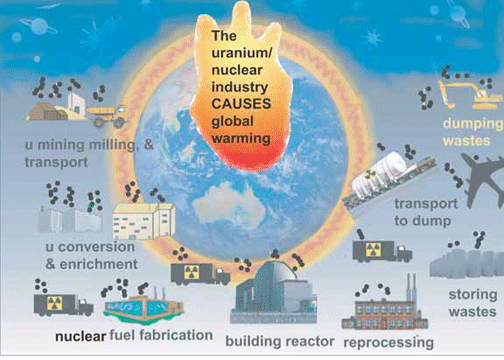 Nuclear power is dirty.http://gsihn.blogspot.com.au/ 3 Nov 14, Mining process of nuclear power creates serious environmental problems. Nuclear power is not free from carbon emission. Rowell claims that fossil fuels are required for mining uranium, building a nuclear power station, and disposing of radioactive waste; therefore “a nuclear power station produces as much carbon dioxide as a gas-fired power station” (3). Uranium is limited resource and will require deeper mining in the future, which will require increased amount of fossil fuels, producing increased amount of carbon dioxide. Soon, it will require more energy to extract uranium than producing energy from the resource. Uranium mining of 1,000 tons of uranium creates approximately 100,000 tons of radioactive tailings that have contaminated rivers and nearly one million gallons of liquid waste containing heavy metals and arsenic in addition to radioactivity; furthermore, “a new method of uranium mining, known as in-situ leaching, does not produce tailings but it does threaten contamination of groundwater water supplies” (“Dirty, Dangerous and Expensive: The Truth about Nuclear Power” 1). The mining process also affects miners who “experience higher rates of lung cancer, tuberculosis and other respiratory diseases (“Dirty, Dangerous and Expensive: The Truth about Nuclear Power” 1). The level of deterioration is extremely high, and it is doubtful that the nature can recover.
Waste disposal also creates a serious environmental problem. Amount of radioactive waste increases while lands to dispose of the waste are limited. The United States alone already accumulated 63,000 metric tons of highly radioactive spent fuel at reactor sites, and “another 42,000 metric tons will be produced by operating reactors” (“Dirty, Dangerous and Expensive: The Truth about Nuclear Power” 1). The wastes can be handled properly if there are enough repository sites. Totty states, however, that the U.S. does not have single permanent repository site after cancellation at Yucca Mountain in Nevada due to public safety (5). After failure to dispose of the existing inventory of spent fuel, “US taxpayers have already paid out $565 million in contract damages to nuclear utilities…[and] an additional billion dollars of damage payments are expected every year for the next decade” (“Dirty, Dangerous and Expensive: The Truth about Nuclear Power” 1). Nuclear power is not green, and environmental problems are accumulating without proper resolutions.
Work Cited
“Dirty, Dangerous and Expensive: The Truth about Nuclear Power.” Physicians for Social Responsibility: United States Affiliate of International Physicians for the Prevention of Nuclear War. Web.
Rowell, Alexis. “Ten Reasons Why New Nuclear Was a Mistake – Even Before Fukushima.”Transition Culture. Web. 15 March. 2011.
Totty, Michael. “The Case For and Against Nuclear Power.” The Wall Street Journal. Web. 30 June. 2008.
Resixdents near Magnuson Park not satisfied with inadequate radiation cleanup
Magnuson neighbors don’t trust Navy’s radiation cleanup Kirotv.com By Deborah Horne and Henry Rosoff, 21 Oct 14 SEATTLE — Tuesday night about 100 people told the Navy that the radiation cleanup efforts at Magnuson Park are not going far enough. The comments came during a forum at the park.
“The soil that’s been there is eventually going to come up, and is going to be contaminated,” said Peggy Maze Johnson.
Johnson and others at the meeting said cleanup crews only seem to be focusing on a few exposed areas near two building. “They need to start examining the whole of Magnuson Park,” she said……….
The ground got contaminated during World War II when the Navy used radium paint to make aircraft dials glow in the dark. To make matters worse, the radiation was discovered at least three years before residents were informed, leaving a residue of distrust.
“I don’t trust the Navy,” said Pollet. “Our residents have no reason to trust the Navy.”
Cindy O’Hare, who is overseeing the Navy’s cleanup, admits they botched their initial handling of the situation…….http://www.kirotv.com/news/news/magnuson-neighbors-dont-trust-navys-radiation-clea/nhpY8/
Fukushima nuclear radiation near to USA West Coast
 Fukushima radiation nearing West Coast http://www.statesmanjournal.com/story/tech/science/environment/2014/10/17/fukushima-radiation-nearing-west-coast/17437081/ Tracy Loew, Statesman Journal October 17, 2014 Radiation from Japan’s Fukushima nuclear disaster is approaching the West Coast, the Woods Hole Oceanographic Institution is reporting.
A sample taken Aug. 2 about 1,200 kilometers west of Vancouver, B.C. tested positive for Cesium 134, the Fukushima “fingerprint” of Fukushima.
It also showed higher-than-background levels of Cesium 137, another Fukushima isotope that already is present in the world’s oceans from nuclear testing in the 1950s and 1960s.
The sample is the first of about 40 offshore test results that will be made public next month, said Ken Buesseler, a chemical oceanographer at Woods Hole.
Further results, which Buesseler will release at a conference Nov. 13, will show offshore Fukushima radiation down the coast into California, he said, including some samples that are closer to shore. Continue reading
High radiation levels in Norway’s grazing animals, especially reindeer
 Radioactivity in Norway’s reindeers hits high The Local 06 Oct 2014 Much higher levels of radioactivity than normal have been found among Norway’s grazing animals, especially its reindeer population, a study revealed on Monday. Almost 30 years after the nuclear plant explosion in Chernobyl, this autumn, more radioactivity has been measured in Norwegian grazing animals than has been noted in many years.
Lavrans Skuterud said: “This year, there has been extreme amounts of mushroom. In addition, the mushroom season has lasted for a long time. And the mushroom has grown very high up on the mountains.”
Heating of Southern oceans much faster than previously thought
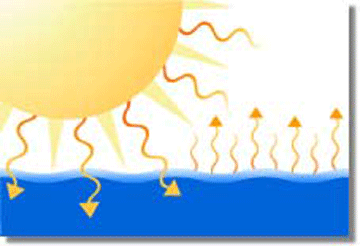 Oceans heating up faster than we thought: study, SMH October 6, 2014 Hannah Francis Oceans in the southern hemisphere are warming faster than anticipated, with implications for rising sea levels and climate modelling.
A team of scientists in California has studied rising temperatures of the southern hemisphere over the decades between 1970 and 2004, and recommended lifting estimates of ocean heat content by between 48 and 152 per cent.
Lead author Paul Durack said it was the first time scientists have been able to quantify how big the gap is between earlier estimates and the reality of rising ocean temperatures.
Sea temperatures are a crucial yardstick for global warming as the ocean stores more than 90 per cent of human-induced excess heat.
Higher sea level temperatures are also closely linked with rising sea levels, because water expands as it warms.
Ocean warming down to two kilometres below the surface accounts for around a third of the annual rate of global mean sea-level rises.
The study by Lawrence Livermore National Laboratory and the California Institute of Technology, published in the journal Nature Climate Change on Monday, attributed the missed estimates to a history of poor sampling of temperatures in the southern hemisphere oceans, which make up 60 per cent of the world’s oceans.
The region, which includes the Indian and South Pacific oceans as well as the South Atlantic and Southern oceans, has not been sampled nearly as frequently to date as oceans in the northern hemisphere…….. http://www.smh.com.au/environment/climate-change/oceans-heating-up-faster-than-we-thought-study-20141005-10qgfn.html#ixzz3FPcZ9tZW
Have the American people been told the truth about the radiation plumes from the damaged Fukushima plant and ocean contamination?
Communication problems exacerbate subject of radioactive threat
Is Fukushima to blame for West Coast defects and marine life diseases?
Monitoring the radioactive plume along the West coast of America
How Fukushima affected America and what you’re not being told Sally Painter Top Secret Writers 27 Sept 14 http://www.topsecretwriters.com/2014/09/fukushima-affected-america-youre-told/
Have the American people been told the truth about the radiation plumes from the damaged Fukushima plant and ocean contamination? The general public is suspicious and distrustful of the official line concerning the threat of radiation from the Daiichi plant disaster. This is especially worrisome since the Daiichi nuclear plant event has been rated the same Level 7 as the 1986 Soviet Union Chernobyl nuclear plant disaster. Continue reading
Very high abnormality rates in Fukushima insects eating radiation contaminated leaves
“Groundbreaking” study reveals Fukushima nuclear waste is poisoning wildlife: Up to 99% of offspring died after eating ‘low-level’ contaminated food — “Very high” abnormality rates including “severe and rare” deformities (PHOTOS) http://enenews.com/groundbreaking-study-fukushima-radiation-poisoning-wildlife-99-offspring-died-after-eating-food-low-level-contamination-severe-rare-abnormalities-photos?utm_source=feedburner&utm_medium=email&utm_campaign=Feed%3A+ENENews+%28Energy+News%29
PhysOrg, Sep 23, 2014 (emphasis added): In a previous study, the group [of university researchers] suggested that eating leaves with high levels of radiation seriously affected the pale grass blue butterfly. Their new study investigated the effect of eating leaves with much lower levels of radiation… Joji Otaki, University of Rukyus, says… “Our study demonstrated that eating contaminated foods could cause serious negative effects on organisms. Suchnegative effects may be passed down the generations… eating non-contaminated food improves the negative effects”…
AAAS, Sep 22, 2014: Fukushima radiation still poisoning insects — Eating food contaminated with radioactive particles
may bemore perilous than thought… The findings from Otaki’s group are “groundbreaking,” says Timothy Mousseau, a biologist at the University of South Carolina… there have been “almost no studies” on how ingestion of radiation-tainted foods affect wildlife.
Study by University of the Ryukyus and Nagasaki University researchers, published Sep 23, 2014: [We] examined the effects  of low-level-contaminated diets… The mortality rate increased linearly in accordance with an increase of the caesium… Remarkably, the mortality rate of the Koriyama group [.04 Bq per larva] was 53% [in the first generation]… We discovered various morphological abnormalities in the surviving adults… severe and rare abnormalities shown in Figure 5might imply the effects of a contaminated diet. Only three [that ate] Okinawa leaves [1760 km from Fukushima Daiichi] showed very minor morphological abnormalities… As observed in the F1 [first] generation, various morphological abnormalities were detected in the surviving F2 [second generation] adults… very high mortality and abnormality rates [were] recorded…low-dose effects were clearly detected… results suggest that low-dose ingestion of approximately 100 Bq/kg may be seriously toxic to certain organisms… The biological effects of ingesting the contaminated diets were more severe in the F2 generation…
Mortality Rates
- Koriyama [60 km from Fukushima Daiichi] F1 group and the Koriyama F2 group obtained from the Koriyama F1 adults were 53.0% and 79%, respectively
- Motomiya [also 60 km] F1 group and the Motomiya F2 group obtained from the Motomiya F1 adults were 31.2% and 99%, respectively… “very small number of surviving adults”
Prof. Otaki: Many theoreticians and politicians have claimed [that Fukushima has caused] no harmful biological effects… Even worse, some biologists have claimed that there are no biological impacts… to our surprise, leaves contaminated at relatively low levels… resulted in a mortality rate of more than 50%… Moreover, the sensitivity of the offspring generation increased, resulting in very high mortality rates… it is widely believed among modern biologists that insights obtained from one biological system are largely applicable to other systems…
Wild life affected by even low levels of radiation in Fukushima area
 Even Low Radiation Levels In The Fukushima Disaster Area Are Harming Animals http://www.businessinsider.com.au/even-low-radiation-levels-in-the-fukushima-disaster-area-are-harming-animals-2014-9 CHRIS PASH Butterflies eating food collected from around the Fukushima nuclear meltdown site showed higher rates of death and disease, according to a Japanese study.
Researchers fed groups of pale blue grass butterflies (Zizeeria maha) leaves from six different areas at varying distance from the disaster site and then investigated the effects on the next generation.
Feeding offspring the same contaminated leaves as their parents magnified the effects of the radiation.
But offspring fed uncontaminated leaves were mostly like normal butterflies and the authors say this shows that decontaminating the food source can save the next generation.
The 2011 meltdown at the Fukushima Dai-ichi nuclear power plant released substantial amounts of radiation into the surrounding area.
Humans were evacuated and no significant health effects have been reported but the scientists from the University of the Rukyus, Okinawa, are studying the impact on the area’s wildlife.
In a previous study, the group suggested that eating leaves with high levels of radiation seriously affected the pale grass blue butterfly.
Their new study investigated the effect of eating leaves with much lower levels of radiation, which had been collected in 2012, a year after the disaster, from six areas that were between 59kms and 1,760kms from the site.
Their study, published in the journal BMC Evolutionary Biology, showed that even in these comparatively low levels of radiation, there was an observable difference in the butterflies’ lifespan, depending on the dose of caesium radiation in their food. Butterflies fed leaves with higher caesium radiation doses were also smaller and some had morphological abnormalities such as unusually shaped wings.
Professor Joji Otaki, of University of Rukyus, says wildlife has probably been damaged even at relatively low doses of radiation.
He says the study demonstrates that eating contaminated foods can cause serious negative effects on organisms.
“Such negative effects may be passed down the generations,” he says.
“On the bright side, eating non-contaminated food improves the negative effects, even in the next generation.”
Radioactive pollution from Fukushima is becoming a wider problem
Japan Times: Fukushima plant plagued by problems as radioactive material bleeds into Pacific — Radiation level in groundwater now 25,000 times higher than when year began http://enenews.com/japan-times-fukushima-plant-plagued-problems-radioactive-material-bleeds-pacific-record-radiation-level-groundwater-25000-times-higher-when-year-began?utm_source=feedburner&utm_medium=email&utm_campaign=Feed%3A+ENENews+%28Energy+News%29
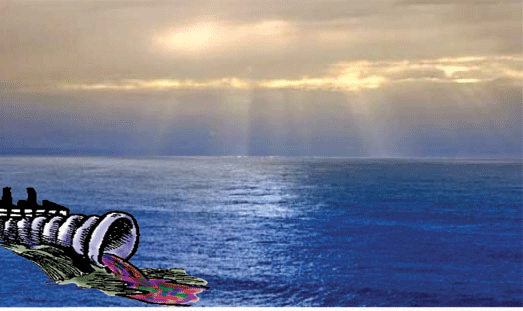
Japan Times, Sept 19, 2014: Tainted water problems still plague Fukushima, despite some positive signs — More than three years since [3/11] the Fukushima No. 1 power plant is still bleeding tons of toxic radioactive water into the Pacific Ocean… [It’s] developed into a wider problem that is stoking public concern… [Tepco] is still trying to find a way to deal with the plant’s utility trenches, which are filled with highly contaminated water. The trenches, which run beneath the plant, were built to house cables and pipes… installed to bring in seawater for cooling purposes… Leaving the tainted water in the trenches is risky. For instance, if another major quake hits and damages the trenches, the toxic water will escape and contaminate the groundwater. Tepco said the trenches… can’t be drained until the leaks from the buildings are plugged…
Asahi Shimbun, Sept 19, 2014: Local fishermen are crying foul over [TEPCO’s] latest plan to discharge processed contaminated water… into the ocean. TEPCO and the central government held the first explanatory briefing… Their explanation was apparently unconvincing. “I can’t believe anything TEPCO says,” one of the attendees said after the meeting… many members of local fisheries associations opposed the plan on the opening day of the briefing sessions… [Others] expressed concern over the plan’s safety. “If a critical problem should occur, (local fisheries) would be severely damaged,” [fisherman Yoshinori Sato] said. “They wouldn’t be able to recover.” Another member criticized the utility for burdening local fishermen with such proposals, asking, “How many times will we have to make a similar painful decision?”
While Japan’s media outlets are focused on the meetings between government/Tepco and the fishermen over the whether to allow ‘processed’ contaminated water releases, new Tepco data published September 18 reveals strontium-90 concentrations are at record levels in groundwater just 100 feet from the ocean. Gross beta has risen to 720 million becquerels per cubic meter (Bq/m³) — and according to Tepco’s most recent strontium-90 tests released September 10 (4 months after the samples were taken), strontium-90 comprises over 95% of the total gross beta at this location — resulting in a Sr-90 concentration of 695 million Bq/m³. At the start of 2014, 28,000 Bq/m³ of gross beta was detected in groundwater from the same well — now 8 months later, the levels are over 25,000 times greater.
1 This Month



26 September – International Day for the Total Elimination of Nuclear Weapons


PLEASE OPPOSE HR 8255 AND S.3639 – bills would accelerate satellite deployment, with no environmental review or safeguards – https://ncstd5li.quorum.us/campaign/169331/
To see nuclear-related stories in greater depth and intensity – go to https://nuclearinformation.wordpress.com
-
Archives
- September 2026 (269)
- August 2026 (330)
- July 2026 (355)
- June 2026 (287)
- May 2026 (306)
- April 2026 (356)
- March 2026 (251)
- February 2026 (267)
- January 2026 (308)
- December 2025 (358)
- November 2025 (359)
- October 2025 (375)
-
Categories
- 1
- 1 NUCLEAR ISSUES
- business and costs
- climate change
- culture and arts
- ENERGY
- environment
- health
- history
- indigenous issues
- Legal
- marketing of nuclear
- media
- opposition to nuclear
- PERSONAL STORIES
- politics
- politics international
- Religion and ethics
- safety
- secrets,lies and civil liberties
- spinbuster
- technology
- Uranium
- wastes
- weapons and war
- Women
- 2 WORLD
- ACTION
- AFRICA
- Atrocities
- AUSTRALIA
- Christina's notes
- Christina's themes
- culture and arts
- Events
- Fuk 2022
- Fuk 2023
- Fukushima 2017
- Fukushima 2018
- fukushima 2019
- Fukushima 2020
- Fukushima 2021
- general
- global warming
- Humour (God we need it)
- Nuclear
- RARE EARTHS
- Reference
- resources – print
- Resources -audiovicual
- Weekly Newsletter
- World
- World Nuclear
- YouTube
-
RSS
Entries RSS
Comments RSS

