Record concentration of radioactive Cesium in fish near Fukushima nuclear station port
Alarm at Fukushima Nuclear Plant: Radioactivity too High, National Japan News, By Ken Tanaka & Norihisa Taguchi 23 February 2014
“…….There are presently not enough sturdy, above-ground tanks that can be used take the water from the pits in which it is stored, TEPCO General Manager Masayuki Ono said at a news conference. Water has been leaking from the pits over the lst few weekends.“………Contaminated Water And Records Tokyo Electric Power Company (TEPCO) has revealed that it may not have enough space to store the contaminated water that began to leak from its nuclear Fukushima plant over the weekend.
The company is still facing problems dealing with the consequences of the 2011 Fukushima disaster, as it attempts to keep reactors and spent fuel pools in a safe state known as cold shutdown.
A record quantity of radioactive cesium – 7,400 times the country’s limit deemed safe for human consumption – has been detected in a greenling fish in the waters near the crippled Fukushima plant, two years after the nuclear disaster.
 TEPCO has also discovered a record 740,000 becquerels per kilogram of radioactive cesium in the fish, Kyodo News reported.
The operator installed a net on the seafloor of the port exit near the plant to prevent the fish from escaping. The bottom-dwelling greenling fish was found in a cage set up by TEPCO inside the port next to the Fukushima Daiichi plant, a utility official told AP on condition of anonymity.
The company also indicated that the previous record of cesium concentration in fish was 510,000 becquerels per kilogram detected in another greenling caught in the same area, TEPCO said.https://onewayjapan.com/News-National/2015/09-Alarm-at-Fukushima-Nuclear-Plant-Radioactivity-too-High.html
Radioactive isotopes blow around Europe still, from forest fires in Chernobyl areas
 Chernobyl Radiation Still Blows Across Europe http://www.earthweek.com/2015/ew150220/ew150220b.html Lingering fallout in the soil around Ukraine’s crippled Chernobyl nuclear power plant is still spreading over parts of Europe when local wildfires lift the contamination into the atmosphere.
Nearly 30 years after arguably the world’s worst nuclear accident, a new study led by the Norwegian Institute for Air Research used satellite images from 2002, 2008 and 2010 to detect three fires in the forests of Ukraine and Belarus near Chernobyl.
The findings were then compared with measurements of radioactive cesium-137 deposited on the area, and fed into models of air movements and fires.
Smoke from the fires was found to have carried between 2 and 8 percent of the cesium-137 in the soil as far south as Turkey and as far west as Italy and Scandinavia.
Even though the contamination was at nearly insignificant levels by the time it reached those areas, the researchers said better forest management and construction of fire breaks could help cut down on the Chernobyl area fires.
But they say the radiation seems to be inhibiting the decay of leaf litter on the ground that can help spark the blazes. The contamination may have killed off the key insects and microorganisms that promote natural breakdown of the leaves.
Threats for oil drillers and others, in the Arctic’s submerged radioactive trash from Russia
The Norwegian government has spent more than $126 million on Russian nuclear safety projects in the last two decades, according to the Norwegian Radiation Protection Authority.
The 17,000 dumped containers are also a potential disaster, creating a minefield for oil companies looking to drill in the area, particularly because the exact locations of most of the containers are unknown.
The Soviet Union Dumped A Bunch of Nuclear Submarines, Reactors, and Containers into the Ocean https://news.vice.com/article/the-soviet-union-dumped-thousands-of-nuclear-submarines-reactors-and-containers-into-the-ocean By Laura Dattaro February 21, 2015 The 1986 Chernobyl disaster in Ukraine remains one of the worst nuclear incidents in history and highlighted the risks of generating power by splitting atoms. But it’s not the only nuclear waste the Soviet Union left behind. Scattered across the ocean floor in the cold waters of the Arctic are nuclear submarines and reactors dumped by the Soviets up until the early 1990s.

Now, as energy companies are seeking to drill in those same waters, the Russian government has shown an interest in cleaning up its nuclear waste. But after decades of sitting on the ocean floor, some of the most dangerous pieces may be too unstable to remove, leaving the potential for radioactive material to leak, which could disrupt commercial fisheries and destroy aquatic ecosystems.
“Taking reactors and cutting out the bottom of your ships and letting them sink to the bottom is about as irresponsible as you can get when it comes to radioactive waste,” Jim Riccio, a nuclear expert with Greenpeace, told VICE News. “We’ve had some weird [behavior] in this country where we haven’t been all that great with it but nothing that rose to the level of what the Soviets had done.” Continue reading
Chernobyl radiation still causing mutations in plants and animals

 Strong effects of ionizing radiation from Chernobyl on mutation rates, Scientific Reports, Anders Pape Møller& Timothy A. Mousseau Scientific Reports 5, Article number: 8363doi:10.1038/srep08363 Received 25 September 2014 Accepted 16 December 2014 Published 10 February 2015
In this paper we use a meta-analysis to examine the relationship between radiation and mutation rates in Chernobyl across 45 published studies, covering 30 species. Overall effect size of radiation on mutation rates estimated as Pearson’s product-moment correlation coefficient was very large (E = 0.67; 95% confidence intervals (CI) 0.59 to 0.73), accounting for 44.3% of the total variance in an unstructured random-effects model. Fail-safe calculations reflecting the number of unpublished null results needed to eliminate this average effect size showed the extreme robustness of this finding (Rosenberg’s method: 4135 at p = 0.05). Indirect tests did not provide any evidence of publication bias.
The effect of radiation on mutations varied among taxa, with plants showing a larger effect than animals. Humans were shown to have intermediate sensitivity of mutations to radiation compared to other species. Effect size did not decrease over time, providing no evidence for an improvement in environmental conditions.
The surprisingly high mean effect size suggests a strong impact of radioactive contamination on individual fitness in current and future generations, with potentially significant population-level consequences, even beyond the area contaminated with radioactive material………http://www.nature.com/srep/2015/150210/srep08363/full/srep08363.html
Is a Connecticut nuclear facility changing the ecology of Long Island Sound by heat pollution?

 Suffolk legislator wants study on warming of LI Sound, NewsDay, February 17, 2015 By WILL JAMES AND RICK BRAND will.james@newsday.com,rick.brand@newsday.com A Suffolk lawmaker wants to know whether a Connecticut nuclear plant is warming the Long Island Sound and changing its ecology by discharging billions of gallons of heated water a day.
Legis. Jay Schneiderman (I-Montauk) has asked the county to spend $112,000 on a three-month study by Stony Brook University scientists that would examine the Millstone Power Station’s impacts on the Sound and… (subscribers only) http://www.newsday.com/long-island/towns/millstone-new-england-s-largest-nuclear-power-plant-could-be-warming-long-island-sound-says-pol-1.9948566
The world’s oceans in trouble: it’s US
How we ruined the oceans The Week, 14 Feb 15
How does global warming affect fish? As the oceans heat up, many species are migrating to cooler waters to survive. Some inevitably will fail in these new habitats. Warmer temperatures also make coral reefs more vulnerable to “bleaching,” a chemical process that drains the organisms of their brilliant colors and leads to their death. Other problems are caused directly by the burning of fossil fuels. With oceans absorbing a quarter of the world’s CO2 emissions, they have become 30 percent more acidic, causing inhibited shell growth in coral and crustaceans and reproductive disorders in fish. Power plant emissions — especially from burning coal — put tons of highly toxic mercury in the air, which settles into the ocean. The mercury is taken up by sea creatures and concentrated in predatory species. A recent study found that mercury levels in Pacific yellowfin tuna have been rising at a rate of 3.8 percent a year since 1998. “If it keeps going like that,” says co-author Carl Lamborg, eventually almost “every kind of fish is going to be potentially hazardous.”
What about plastic?
Our oceans contain an estimated 5.25 trillion pieces of plastic — most of them less than 5 millimeters wide — weighing a total of 269,000 tons. ……..
Why aren’t we doing more?
Like global warming, the plight of our oceans is an issue that affects every country in the world. But with each government beholden to its own voters — and its own fishing, plastic, and energy lobbies — it’s almost impossible to achieve any consensus. Ecologists insist it’s not too late to solve the problems affecting our oceans. Some schemes, such as the introduction of “safe zones” where fish can naturally replenish, have worked on a small scale and could be expanded. The authors of the Sciencestudy say it’s possible to reverse the current crisis, but political will is required. “The next several decades,” they say, “will be those in which we choose the fate of the future of marine wildlife.”
The dangers of a fishy diet
For decades, doctors and health officials have encouraged people to eat as much seafood as possible because of fish’s high levels of omega-3 fatty acids, which are good for heart and brain health. But in recent years that recommendation has been tempered, as emissions from factories and power plants have pushed mercury concentrations in oceans and fish up to potentially dangerous levels. Mercury is highly toxic and can cause neurological damage and accumulate in organs; in children and fetuses, it can lead to long-term cognitive disorders. Last year, the FDA updated its advice on fish to say that pregnant women and children should avoid eating tilefish, shark, swordfish, and king mackerel, and limit their consumption of white tuna — all of which contain particularly high levels of mercury because they’re at the top of the food chain. Consumer Reportsrecently criticized the FDA guidelines on fish consumption as inadequate, saying that anyone who eats 24 ounces or more of fish per week — or about six servings — “should steer clear of high-mercury choices,” and warning people not to eat canned tuna or sushi made from tuna. http://www.theweek.com/articles/538881/ruined-oceans
Russia’s sunken nuclear submarines pose danger in the Arctic
Discarded Russian submarines could cause a nuclear disaster in the Arctic JEREMY BENDER Business Insider, 14 Feb 15 The Arctic could become a site of future turmoil, and not just because of the emerging geopolitical tensions and militarization in the region.
Beyond concerns of a frozen conflict in the icy north, there is the additional fear that the Barents and Kara Seas could become the location of a slow-motion nuclear disaster. Until 1991 the Soviet Union used the seas as a junkyard where it would dispose of its nuclear waste.
Accordingto the Bellona Foundation, citing theNorwegian Radiation Protection Authorities (NRPA), the Soviet Union dumped “19 ships containing radioactive waste; 14 nuclear reactors, including five that still contain spent nuclear fuel; 735 other pieces of radioactively contaminated heavy machinery; 17,000 containers of radioactive waste,” and three nuclear submarines in the seas.
Disposing of nuclear waste and spent reactors at sea was actually a common practice around the world until the early 1970s. But the Soviet Union dumped a significant amount of material into bodies of water that were sometimes not that far from neighbouring countries.
Three scuttled nuclear submarines are the most dangerous of the disposals for the overall safety of the region — the K-27, the K-278, and the K-159, according to The Moscow Times. Of those, the K-27 is the one most likely to cause a Chernobyl-like event in which the casings of the reactors fail and dangerous amounts of radiation escape into the environment.
The K-27 is particularly risky, the BBC reports, due to its unique design. The submarine, which was launched in 1962, was experimentally developed with two previously untested liquid-metal cooled reactors. Soon after deployment the submarine began emitting high levels of radiation, poisoning its crew.
In 1981, the Soviet Union sunk the submarine in the Kara Sea. But the sub was scuttled at a depth of only 99 feet (30 meters), significantly below international guidelines………
“K-159 represents the biggest potential for emission, considering the levels of radioactivity in the reactors, compared with other dumped or sunken objects in the Kara Sea with spent nuclear fuel or radioactive waste,” Ingar Amundsen, the head of the NRPAtoldthe Barents Observer…….. http://www.businessinsider.com.au/potential-chernobyl-like-disaster-in-arctic-2015-2
Cumbria’s tourism, milk and cheese may give way to dirty nuclear industry
Tourism, Milk and Cheese or Nuclear? 13 FridayFeb 2015 by miningawareness Over 50 years after the Windscale-Sellafield disaster caused milk in a 200 sq. mile area to be officially too radioactive to drink, and milk brought 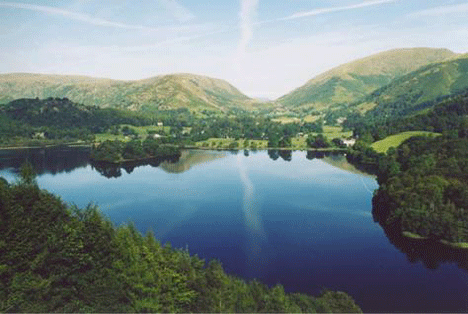 in from elsewhere, as recounted in the “Atomic Milk” documentary, http://youtu.be/hJnPWShSmKg Cumbria remains a major milk producer for the UK. Cows are grazing on the site of the proposed Moorside Nuclear Power Station, near Sellafield in Cumbria, UK.
Lillyhall, to the north, lost the chance for a Dutch cheese factory-showroom because Swedish Studsvik applied for a nuclear waste processing facility, next door, at the same time. Note, as well, that there won’t always be someplace else from which to bring in the milk, as the world is increasingly contaminated with long-lived radiation-contamination.
Moorside Nuclear reactors would be built by a Westinghouse (owned now by Toshiba) and GdF Suez (France) consortium. A proposed nuclear reactor, nearby at Braystones was canceled.
Would you rather have Sellafield Cheese or Appenzell Swiss Cheese?
Although Switzerland was contaminated by Chernobyl, Sellafield was contaminated by the Windscale fire, Chernobyl, as well as ongoing radioactive emissions, especially into the Irish Sea………..https://miningawareness.wordpress.com/2015/02/13/tourism-milk-and-cheese-or-nuclear/
For the first time, radioactive strontium found in Vermont Yankee Nuclear plant groundwater
 State Finds Radioactive Material In Vermont Yankee Groundwater, VPR, By JOHN DILLON • FEB 9, 2015 The Vermont Health Department says for the first time it has found the radioactive isotope Strontium-90 in ground water at the Vermont Yankee nuclear plant in Vernon……..While the health department says there is no immediate risk to health, Commissioner Harry Chen says the discovery shows the need for the state to closely monitor the site now and in the future……
Vermont Yankee shut down at the end of December and is now beginning the decades-long decommissioning process. http://digital.vpr.net/post/state-finds-radioactive-material-vermont-yankee-groundwater
Nuclear power makes worse the global water supply crisis that is being caused by global warming
 World has not woken up to water crisis caused by climate change: IPCC head, Planet Ark, 04-Feb-15 INDIA Author: Nita Bhalla Water scarcity could lead to conflict between communities and nations as the world is still not fully aware of the water crisis many countries face as a result of climate change, the head of the U.N. panel of climate scientists warned on Tuesday.
The latest report from the U.N. Intergovernmental Panel on Climate Change (IPCC) predicts a rise in global temperature of between 0.3 and 4.8 degrees Celsius (0.5 to 8.6 Fahrenheit) by the late 21st century.
Countries such as India are likely to be hit hard by global warming, which will bring more freak weather such as droughts that will lead to serious water shortages and affect agricultural output and food security.
“Unfortunately, the world has not really woken up to the reality of what we are going to face in terms of the crises as far as water is concerned,” IPCC Chair Rajendra Pachauri told participants at a conference on water security.
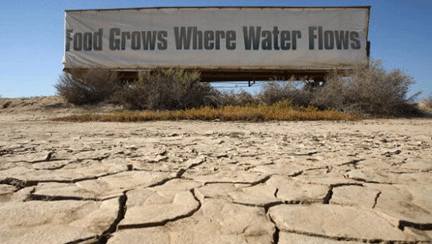
“If you look at agricultural products, if you look at animal protein – the demand for which is growing – that’s highly water intensive. At the same time, on the supply side, there are going to be several constraints. Firstly because there are going to be profound changes in the water cycle due to climate change.”
Development experts around the world have become increasingly concerned about water security in recent years.
More frequent floods and droughts caused by climate change, pollution of rivers and lakes, urbanization, over-extraction of ground water and expanding populations mean that many nations such as India face serious water shortages.
In addition, the demand for more power by countries like India to fuel their economic growth has resulted in a need to harness more water for hydropower dams and nuclear plants……….http://planetark.org/enviro-news/item/72777
World’s excess heat going largely into the Southern Oceans
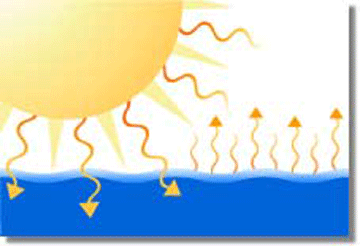 Southern oceans play major role in absorbing world’s excess heat, study finds February 3, Peter Hannam Environment Editor, The Sydney Morning Herald The world’s oceans are heating at the rate of two trillion 100-watt light bulbs burning continuously, providing a clear signal of global warming, according to new study assessing data from a global fleet of drifting floats.
The research, published on Tuesday in the journal Nature Climate Change, used data collected from the array of about 3500 Argo buoys from 2006-13 to show temperatures were warming at about 0.005 degrees a year down to a depth of 500 metres and 0.002 degrees between 500-2000 metres.
Oceans south of the 20-degree latitude accounted for two-thirds to 98 per cent of the heat gain during the period studied, with three giant gyres in the southern Pacific, Indian and Atlantic oceans largely responsible for drawing down the extra warmth.
“The global ocean heat content right now is the most reliable metric of that radiation imbalance” between the energy received from the sun and what is radiated back to space, said Susan Wijffels, an oceans expert at the CSIRO and one of the report’s authors………..
“The ocean is just vertically transferring the heat away from the surface to the depth,” Dr Wijffels said. “The ‘hiatus’ is not meaningful.”
Even with the relative slowdown in surface temperature increases, 14 of the world’s 15 warmest years on record have been in the 21st century, the World Meteorological Organisation said on Monday.
The United Nations body also confirmed that 2014 was the hottest year, edging out 2010 and 2005. The readings were based in part on United States agencies, including NASA which last month also declared 2014 as its warmest year.
John Church, another of the paper’s authors and also from the CSIRO, said the temperatures in the atmosphere – which accounts for just 1 per cent of the planet’s heat uptake – would rise sharply if oceans absorbed less of the heat……..
As it is, warming oceans are swelling in volume, lifting sea levels, and also affecting ecosystems, he said.
“If we want to avoid the worst impacts of climate change then we need to start taking some mitigation action,” Dr Church said. This included cutting carbon emissions and lifting renewable energy targets at home and overseas.
Future Argo missions will extend coverage to higher latitudes, including sea-ice zones, and reach depths of 6000 metres.
However, Dr Wijffels said Australia’s contribution is in doubt with about half of its Argo budget tied up with the Abbott government’s stalled higher education reform bills. Those funds run out “in a few months”, she said.
The Nature study was led by Dean Roemmich of the California-based Scripps Institution of Oceanography. http://www.smh.com.au/environment/climate-change/southern-oceans-play-major-role-in-absorbing-worlds-excess-heat-study-finds-20150202-133j2p.html
Danger in even controlled fires at Rocky Flats where soil is contaminated with plutonium
Plutonium fears hex planned prescribed fires at Rocky Flats wildlife refuge By Bruce Finley The Denver Post 29 Jan 15, The prescribed fires to restore overgrown forests and grasslands near homes in Colorado have hit a snag: plutonium and its perception at a former nuclear weapons site upwind of Denver.
West metro leaders are opposing a long-planned federal burn in March on 701 acres at Rocky Flats, once a Cold War bomb trigger factory, where plutonium contamination created an environmental disaster.
After a $7 billion cleanup, completed in 2005, Rocky Flats became a 4,000-acre national wildlife refuge, which still remains closed to the public.
Worried residents contend the controlled burn to improve grasslands for elk and raptors could have a deadly impact on people by releasing plutonium into the air……..http://www.denverpost.com/environment/ci_27415100/plutonium-fears-hex-planned-rx-fire-at-rocky
Paladin, Australian uranium mining company accused of radioactively polluting Lake malawi
Government officials in Malawi are upset about the situation. “I am very shocked with the situation I have seen after monitoring the mine here and all my questions to the Paladin boss have not been answered satisfactory”
Meanwhile international experts are starting to question the benefits of the Kayelekera mine
Australian Uranium Mining Company Accused of Contaminating Lake Malawi By Mayu Chang……Global Research, January 29, 2015 CorpWatch Paladin Energy, an Australian mining company, has been accused of discharging uranium-contaminated sludge into Lake Malawi, which supports 1.7 million people in three countries – Malawi, Mozambique and Tanzania. The company began uranium mining operations in Malawi in 2009 although it suspended operations last year after ore prices fell.
“It is rumored that Paladin secretly have started discharging the so called purified water. Reports from the Beach Village Chairman indicates that this started in late November,” wrote Rafiq Hajat of Malawi’s Institute for Policy Interaction on Facebook. “[At] a radius of 35 km from the Boma, you will be shocked to see fish of different species dead with some communities along the lakeshore collecting [the fish].”……………“Uranium is radioactive and that with open-pit mining, like the one to be conducted at Kayelekera, the soil drains into rivers and contaminates the water,” Titus Mvalo, a lawyer representing several civil society organizations in Malawi, told Inter Press Service in 2007. “When humans drink the water, it damages kidneys and causes cancer.”
At the time, the activist groups warned that the mine would pose a threat to Lake Malawi, Africa’s third largest freshwater lake, which is a major source of drinking water and fish for the country. Christopher Mwambene, the executive director of Coordination Union for Rehabilitation of the Environment (CURE), a Blantyre-based environmental NGO, estimated that catch from the lake provides 20 percent of the protein requirement for Malawi’s population.
Perhaps even more damning was the assertion that Paladin was planning to use lower standards to build the Kayelekera mine. “Paladin are certainly not meeting Australian standards and they would not get approval in Australia if they were to present the same EIS here.” Dr. Gavin Mudd, an environmental engineering professor at Monash University in Melbourne, told ABC television news in 2007.
Mudd says that uranium tailings (waste) are typically stored under the water table in Australia and Canada, to reduce the risk of contamination. In Malawi, however, Paladin chose to store the tailings above ground behind a specially contructed dam.
“What Paladin is proposing for Kayelekera is it will depend on what happens with the rainfall and climate, but every few years or so allowing the excess build-up of water to be discharged into the local river system and local water resources,” Mudd added.
“This dam is in a catchment area of the stream,” Reinford Mwangonde, the executive director of Citizens for Justice, an NGO in Malawi, told ABC at the time. “The stream runs into Lake Malawi. A number of people in the community depend on that river for domestic water purposes.”
Mudd’s predictions appear to have come true. On January 5, a heavy storm caused the liner in a Kayelekera run-off tank to rupture, releasing up to 500 cubic meters of waste…………….
Government officials in Malawi are upset about the situation. “I am very shocked with the situation I have seen after monitoring the mine here and all my questions to the Paladin boss have not been answered satisfactory,” Alex Major, the deputy chairperson of the Parliamentary Natural Resources and Climate Change Committee told a local town hall meeting on January 10.
Meanwhile international experts are starting to question the benefits of the Kayelekera mine. After visiting the country last July, Olivier de Schutter, the United Nations Special Rapporteur on the Right to Food, came out against the project. “The criticism is the deals could have been much more equitable, and could have allowed Malawi to use its resources better for the benefit of the population,” he told ABC television news in Australia.
In any case, today Malawi is no longer benefiting financially from Paladin’s operations. ……..
Experts says that the ultimate costs of the Kayelekera mine could be very high. “Uranium mining is associated with high environmental impacts and human health risks’” Fleur Scheele, then researcher at the World Information Service on Energy (WISE), an Amsterdam-based anti-nuclear organization, and author of a report on uranium mining in Africa published in 2011. “The costs of rehabilitation of the mining area are often many times higher than the total revenues derived during the mine’s entire lifetime.”http://www.globalresearch.ca/australian-uranium-mining-company-accused-of-contaminating-lake-malawi/5428142
Fukushima radiation in Pacific monitored by Canadian citizen scientists
 B.C.’s citizen scientists on alert for radiation from Japan, Vancouver Sun BY AMY SMART, TIMES COLONIST JANUARY 25, 2015 Since October, citizen scientists have been dipping buckets into the waters of B.C.’s coast, looking for fallout from the 2011 nuclear meltdown in Japan.
At the centre of the search are two man-made isotopes, Cesium-134 and Cesium-137, which act as “fingerprints” for radiation specific to the Japan disaster. Both isotopes were released when the reactors failed in the aftermath of an earthquake and tsunami, just as they were during nuclear testing in the mid-20th century.
 While Cesium-137 has a half-life — the time it takes for the radioactivity to fall to half its original value — of 30 years, Cesium-134’s is only two years. That means that if Cesium-134 is found in a sample, scientists can be certain it came from Fukushima.
“It’s been sufficiently long since atmospheric weapons testing last century or the Chernobyl disaster that we don’t see traces of [Cesium-134 from those sources] anymore,” said University of Victoria ocean chemist Jay Cullen. “So if we detect it in seawater or an organism, then we know that sample has been affected by Fukushima.”
The radiation is as close as 100 kilometres, with levels expected to peak over the next two years. But so far, members of the InFORM Network — citizen scientists, and representatives from academia, government and non-governmental organizations — haven’t found anything in seawater samples collected by volunteers at 14 coastal locations.
“The models of ocean circulation that the physical oceanographers have put together suggest that we are going to see it along the coast and we can expect it to arrive over the next couple of years, the heart of that contaminated plume,” said Cullen, who leads the network.
InFORM is also monitoring marine life, which can absorb radiation. The first results, from sockeye salmon and steelhead trout selected for their known migration paths, showed traces of Cesium-137, but no Cesium-134……….
John Smith, a senior research scientist with Fisheries and Oceans Canada, agrees that the health risks are likely to be “extremely low.” At its peak, the radiation in the plume is expected to be three to five becquerels per cubic metre of water. Canadian guidelines for safe drinking water impose a limit of 10,000 becquerels per cubic metre, he said.
For Smith, who began monitoring the plume’s spread in 2011, it provides a “dye test” for testing theories about ocean currents. The results will have implications for all kinds of models, including understandings of climate change, he said.
“This was a unique oceanographic event in that a large quantity of radioactivity was deposited into the ocean off Japan at a given moment in time and at a given location. It was a tremendous disaster. But it has provided an oceanographic tracer for currents that has never occurred before.”…….. www.vancouversun.com/health/citizen+scientists+alert+radiation+from+Japan/10758982/story.html
India’s solar plants above canals save water
INDIA BUILDS SOLAR PLANTS ATOP CANALS TO SAVE LAND, WATER. https://jpratt27.wordpress.com/2015/01/25/india-builds-solar-plants-atop-canals-to-save-land-water/As India moves to ramp up investment in solar power, it is exploring innovative places to install solar plants, including across the top of canals.
Last weekend, U.N. Secretary General Ban Ki-moon inaugurated a new “canal-top” solar energy plant in Vadodara district in India’s western state of Gujarat. “I saw more than glittering panels – I saw the future of India and the future of our world,” said Ban. “I saw India’s bright creativity, ingenuity and cutting-edge technology.”

Experts identify two major advantages in building solar plants atop canals: efficient and cheap land use, and reduced water evaporation from the channels underneath. business-standard.com
1 This Month



26 September – International Day for the Total Elimination of Nuclear Weapons


PLEASE OPPOSE HR 8255 AND S.3639 – bills would accelerate satellite deployment, with no environmental review or safeguards – https://ncstd5li.quorum.us/campaign/169331/
To see nuclear-related stories in greater depth and intensity – go to https://nuclearinformation.wordpress.com
-
Archives
- September 2026 (269)
- August 2026 (330)
- July 2026 (355)
- June 2026 (287)
- May 2026 (306)
- April 2026 (356)
- March 2026 (251)
- February 2026 (267)
- January 2026 (308)
- December 2025 (358)
- November 2025 (359)
- October 2025 (375)
-
Categories
- 1
- 1 NUCLEAR ISSUES
- business and costs
- climate change
- culture and arts
- ENERGY
- environment
- health
- history
- indigenous issues
- Legal
- marketing of nuclear
- media
- opposition to nuclear
- PERSONAL STORIES
- politics
- politics international
- Religion and ethics
- safety
- secrets,lies and civil liberties
- spinbuster
- technology
- Uranium
- wastes
- weapons and war
- Women
- 2 WORLD
- ACTION
- AFRICA
- Atrocities
- AUSTRALIA
- Christina's notes
- Christina's themes
- culture and arts
- Events
- Fuk 2022
- Fuk 2023
- Fukushima 2017
- Fukushima 2018
- fukushima 2019
- Fukushima 2020
- Fukushima 2021
- general
- global warming
- Humour (God we need it)
- Nuclear
- RARE EARTHS
- Reference
- resources – print
- Resources -audiovicual
- Weekly Newsletter
- World
- World Nuclear
- YouTube
-
RSS
Entries RSS
Comments RSS

