Much more powerful solar cells on the way
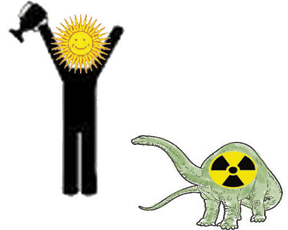 Solar Cells That Could Produce More Power Than Uranium http://www.energymatters.com.au/index.php?main_page=news_article&article_id=3814 27 June 13 New research from the Massachusetts Institute of Technology into graphene, one of the thinnest and most conductive photovoltaic materials in existence, could lead to the production of highly efficient solar panels that, weight-for-weight, could be capable of producing more energy than reactor-grade uranium.
In a paper published in the journal Nano Letters, MIT scientists describe the stacking of two atom-thick nanomaterials, graphene and molybdenum disulfide, to create a one-nanometre (billionth of a metre) thick solar cell capable of converting sunlight to energy at two percent efficiency.
Lead author of the research, Jeffrey Grossman, the Carl Richard Soderberg Associate Professor of Power Engineering at MIT, says while this is a very low number compared to conventional photovoltaic efficiencies, the solar cell is so thin that pound-for-pound the new material produces up to 1,000 times more power than current solar technology. Continue reading
Exelon tries (unsuccessfully) to blame wind energy for nuclear power’s commercial failures
 Exelon Still Blaming Wind PTC For Nuclear Challenges, Exelon Still Wrong About It Think Progress, By Adam James, Guest Blogger on Jun 27, 2013 Exelon recently shelved plans to expand nuclear capacity at their LaSalle and Limerick plants, taking a $100 million hit and once again reverting to the tired old strategy of blaming subsidized wind. The specific target of their ire is the Production Tax Credit (PTC). For wind, that is, not the one that they happily collect for nuclear.
Exelon is (again) wrong about the PTC, as anyone who read our last post already knows.
First, let’s look at the big picture. Wind power has been a tremendous boon for North America. Costs have fallen 90 percent since 1992, the domestic content of wind turbines has dramatically risen, and 75,000 people are employed in the industry. This growth is directly tied to the continued extension of the Production Tax Credit. Wind power is cheap and carbon free, making it good for consumers and the climate alike.
However, Exelon has decided that wind power is bad for their business. The argument they’ve been making is that because wind can collect tax credits for producing energy at times when demand for electricity is very low, electricity prices become negative as the generator pays consumers to take electricity. This hurts their other generators, like nuclear plants, who then have to sell at a loss. Buried in the story about Limerick and LaSalle is a very important point though: negative prices didn’t occur once in springtime.
We debunked this tale before, but I’ll recap the highlights here:……http://thinkprogress.org/climate/2013/06/27/2210711/exelon-still-blaming-wind-ptc-for-nuclear-challenges-exelon-still-wrong-about-it/?mobile=nc
International Energy Agency predicts bright future for solar and wind energy
 Quiz: What You Don’t Know About Solar Power http://environment.nationalgeographic.com/environment/energy/great-energy-challenge/solar-power-quiz/

Global Renewable Energy on Track to Soon Eclipse Natural Gas, Nuclear A new report predicts that renewable power energy generation will exceed that of gas and nuclear by 2016. Ker Than National Geographic June 26, 2013
 The future appears to be bright for renewable energy sources like solar, wind, and water.In fact, power generation from such renewables will exceed that of gas and nuclear by 2016, according to a report published Wednesday by the International Energy Agency (IEA).
“As their costs continue to fall, renewable power sources are increasingly standing on their own merits versus new fossil-fuel generation,” IEA executive director Maria van der Hoeven said in a statement. Continue reading
Renewable energy worldwide to overtake gas by 2016
The report comes on the heels of recent research suggesting the threat of climate change is greater than earlier estimates.
An IEA report released earlier this month warned the world is on track to surpass by more than double the two-degree Celsius warming goal set by the United Nations, unless urgent measures are taken.
The IEA’s recommendations include curtailing coal-fired power stations and phasing out fossil fuel subsidies.
Renewable energy use gaining worldwide:IEA http://www.theaustralian.com.au/business/breaking-news/renewable-energy-use-gaining-worldwideiea/story-e6frg90f-1226670621465 AAP June 27, 2013 RENEWABLES like solar and wind power represent the fastest-growing source of energy generation and will make up a quarter of the global power mix by 2018, the International Energy Agency IEA says. Continue reading
World looks to Germany in the energy revolution
the people of Berlin seem to gravitate towards an environmentally conscious energy discussion. Bike commuters abound, energy efficiency and environmental concerns are a tenant of the informed public. In the relatively hot summer – 37 degree highs on average – the most noticeable omission from most building’s energy profile is air conditioning……..
Germany spearheads global renewable energy awareness Mohammed Alshoai Saudi Gazette, 24 June 13 BERLIN – The streets of Berlin face a different kind of traffic than those of Riyadh: bicycle traffic, which speaks multitudes in a city cultured with environmental awareness, so much so that Energiewende – literally: energy transformation – has become a word recognized in every household and office building in the German capital.
Following the Fukushima incident in 2011, the Germans took an almost unanimous vote on moving away from nuclear energy and promoting renewables. This vote has lead to a consensus on nuclear phaseout, which has become a tenant of Energiewende, emphasized by the high public tension surrounding nuclear energy.

Rainer Baake, currently the director of Agora Energiewende and formerly State Secretary at the Federal Ministry for the Environment, Nature Conservation and Nuclear Safety said at a roundtable: “Nobody wants to get back into nuclear. It is very clear that everybody wants to expand on renewables.” Renewable energy is an economic, environmental and political concern in Germany, currently emphasized by their upcoming elections in September. The main sources of renewable energy in Germany are wind power, solar and photovoltaic cells, collectively making up between 23 and 25 percent of the European nation’s energy structure, according to Agora Energiewende, along with several government organizations in Berlin.
One current issue being discussed on a political level, Baake said, is the expansion of Germany’s grid system versus a capacity market bent on storing energy for low peak production times and high consumption seasons, particularly in Germany’s cold winters.
“Grids are much more important than storage,” Baake said, adding that it is a much more affordable option, where heating in winter attributes a peak demand of 80 gigawatts. Baake added that the price per megawatt has gone significantly down from €90 to €100 in 1998 to approximately €30 to €50 today. Continue reading
Wind and solar power the lowest cost options for Africa
Renewable Energy Becomes Cost Competitive in Africa http://designbuildsource.comau/renewable-energy-becomes-cost-competitive-in-africa By Marc Howe, 24 June 13 The African continent is witnessing a stunning surge in the use of renewable energy as supply sources such as solar and wind power emerge as the lowest cost options for developing countries still struggling with poor infrastructure.
South Africa plans to bring 6.9 gigawatts of renewable energy capacity into play by the end of this decade, awarding 2.4 gigawatts in contracts via the first two windows of its procurement program.
At the other end of the continent, Morocco has also launched its own swathe of ambitious renewable energy programs. It plans to develop 850 megawatts in wind capacity in the form of five projects, which the goal of installing two gigawatts in capacity by 2020.
In the area of solar power, Morocco is on track to build the world’s largest concentrated solar power plan in the form of the 500 megawatt Ouarzazate project. Phase one of the project is already under construction, while Phase two is in the midst of procurement.
Despite a sharp decline in total global investment in renewable energy in 2012, which fell to $244 billion from $279 billion the preceding year, the Middle East and Africa experienced aremarkable increase in regional spending, surging 228 per cent to hit $12 billion.
For rural African communities, renewable energy has become cheaper than diesel or coal-fired generators once fuel costs are taken into consideration as a result of limited refining capacity and poor pipeline networks.
“Certain categories of renewable energy have become the de facto least cost generation option when compared to conventional new build alternatives,” says Christopher Clarke, founding partner of Inspired Evolution Investment Management.
“The average price for wind in the last bid was 89 Rand cents per kilowatt-hour, which is cheaper than the equivalent cost of cleaner coal new build in South Africa.”
Wall mounted solar inverter and battery to be mass produced
SMA’s New Solar Inverter Incorporates Battery Energy Storage http://www.energymatters.com.au/index.php?main_page=news_article&article_id=3807 24 June 13 SMA’s latest inverter that incorporates a lithium ion battery has won an award at Intersolar Europe 2013 in Munich.
Sunny Boy Smart Energy is the first wall mounted solar inverter with an integrated battery to be mass produced. Continue reading
US electricity utilities see distributed energy as their killer
Solar panels could destroy U.S. utilities, according to U.S. utilities Grist By David Roberts
Solar power and other distributed renewable energy technologies could lay waste to U.S. power utilities and burn the utility business model, which has remained virtually unchanged for a century, to the ground That is not wild-eyed hippie talk. It is the assessment of the utilities themselves.
Back in January, the Edison Electric Institute — the (typically stodgy and backward-looking) trade group of U.S. investor-owned utilities — released a report [PDF] that, as far as I can tell, went almost entirely without notice in the press. That’s a shame. It is one of the most prescient and brutally frank things I’ve ever read about the power sector. It is a rare thing to hear an industry tell the tale of its own incipient obsolescence. Continue reading
US Dept of Energy investing more in solar energy research
DOE Expands Solar Research Capability by Energy Matters, 24 June 13, A new $135 million renewable energy research facility is the latest addition to the U.S. Department of Energy’s network of National
Laboratories.
The 182,500-square-foot Energy Systems Integration Facility (ESIF)
will allow researchers and manufacturers of promising renewable energy
systems to test and scale up their products in a real-world
environment by simulating a utility-scale energy grid……..
According to the DOE, solar generation in America has doubled in the
last four years, while the cost of solar power systems has fallen by
80 percent. Consolidating these gains depends in part on
next-generation inverter technology that is cheaper to produce and
better suited to smart energy
grids.http://www.energymatters.com.au/index.php?main_page=news_article&article_id=3804
Electricity utilities and the challenge of distributed solar energy
How can we boost distributed solar and save utilities at the same time? Grist, By David Roberts, 11 April 2013 Yesterday I wrote that solar PV and other distributed-energy technologies pose a radical threat to U.S. power utilities and the centralized business model they’ve operated under for the last century. This is, I hasten to add, according to the utilities themselves. So what should be done about it?
It’s complicated. On one hand, more distributed renewable energy is a good thing. It reduces carbon emissions, increases resilience, stimulates the growth of new industries with new jobs, and gives Americans a taste of energy democracy.
On the other hand, it just won’t do to have utilities view the spread of rooftop solar PV as an existential threat. Whatever you think of them, utilities still have tons of political power. If they want to slow the spread of distributed energy, they can. A lot.
So let’s look at their complaint. But one key thing to keep in mind as we do is that the utilities’ primary objective, the impetus behind the recent report from their trade group, Edison Electric Institute, is toprotect their business model and their profits. That’s what business groups do…….http://grist.org/climate-energy/how-can-we-boost-distributed-solar-and-save-utilities-at-the-same-time/
Rooftop solar power a boon for Japanese farmers
Japan’s Farmers To Benefit From Rooftop Solar Power http://www.energymatters.com.au/index.php?main_page=news_article&article_id=3802 21 June 13, Japan’s farming sector is making the switch to solar power, with the nation’s agricultural body announcing plans to spend AU$93 million installing 30 megawatts of solar on the rooftops of livestock barns and distribution centres.

The project is the initial phase of a plan by Japan’s National Federation of Agricultural Cooperative Associations (or Zen-Noh, for short), and Mitsubishi, to ultimately provide 200 megawatts of solar power capacity on farming facilities nationwide by the middle of 2015. Continue reading
USA chemist chain Walgreens goes solar, bigtime
 According to Australian solar provider Energy Matters, if a business is paying more than 20 cents per kilowatt hour for electricity; a commercial solar power system sized to daytime consumption can pay for itself in just a few years – after which, the electricity is essentially free
Walgreens To Add 200+ Solar Power Systems http://www.energymatters.com.au/index.php?main_page=news_article&article_id=3801, 20 June 13, Walgreens, the USA’s largest chemist store chain, says it will expand rooftop solar installations on its stores from 150 to more than 350.
With over 8,000 stores nationally plus distribution centers, Walgreens has substantial rooftop real estate; some of which it is putting to good use in harvesting power from the sun. The company started taking on solar panel projects in 2007.
According to the company, the addition of the 200-plus rooftop solar power systems will generate an estimated 13.5 million kilowatt hours annually, enough to meet the energy needs of around 1,400 households. Continue reading
5.7 million people employed in renewable energy

2012 was the second highest year ever for renewable energy investments – but being “second” doesn’t reflect installed capacity as prices for renewable energy equipment, particularly related to solar power, have plummeted.
Last year was another record year in terms of installed capacity; with 115 GW of new renewables put in place globally. However, 2012 saw the most significant change so far in the balance of renewable energy investment activity between developed and developing economies. Continue reading
World Bank is Mapping the Renewable Energy Revolution
 Mapping the Renewable Energy Revolution World Bank, June 17, 2013 STORY HIGHLIGHTS
A new World Bank program is helping developing countries map their renewable energy potential in a new way that produces rich, nationwidedata.
The project goes beyond existing solar and wind maps to provide the granular data governments need to understand the country’s fullresource potential and to pinpoint the best locations for serving thepopulation……..http://www.worldbank.org/en/news/feature/2013/06/17/mapping-the-energy-revolution
Youtube: Internet service by solar powered balloon
Solar And Balloon-Powered Internet For Everyone http://www.energymatters.com.au/index.php?main_page=news_article&article_id=3794 17 June 13 Google hopes to bring Internet access to the two-thirds of the world’s population that does not have it with the assistance of solar power and balloons.
Project Loon is a network of balloons travelling at 20 km above the Earth’s surface; each decked out with transmission equipment able to provide connectivity to a ground area about 40 km in diameter with download speeds comparable to 3G.
Project Loon’s balloon envelopes are made from polyethylene plastic standing fifteen meters wide by twelve meters tall when fully inflated. A parachute attached to the top of the envelope allows for a controlled descent whenever a balloon needs to be taken out of service.
A small box hanging below the balloon contains the electronics and radio antennas; plus batteries to store energy so the balloons can operate during the night.
Solar panels with a total capacity of 100 watts sit between the balloon and the hardware. Between the wind and sun, Project Loon is able to power itself purely through renewable energy.
One of the major challenges Google faced was how to control the balloons’ path through the sky. One balloon would be challenging enough and there will be hundreds of these in the future. While not providing much in the way of further detail, the company says it has found a way to do that, using just wind and solar power – along with some complex algorithms and serious computing power.
The Project Loon pilot test began this month when thirty balloons were launched from New Zealand; beaming Internet to a group of 50 pilot testers. The technology will be refined based on the results before the next phase.
New Zealanders interested in registering to be a Project Loon pilot tester for future test launches can sign up here.
“The idea may sound a bit crazy,” says Google’s official blog, “and that’s part of the reason we’re calling it Project Loon – but there’s solid science behind it.”
1 This Month
29 Jan. Thursday 7-8 p.m. Webinar – World’s Largest Nuclear Station in Port Hope, ON?
To see nuclear-related stories in greater depth and intensity – go to https://nuclearinformation.wordpress.com/


31st January – Challenging the War Machine – a DECLASSIFIED UK SUMMIT


Website of the Week
Now until to February 10, 2026 Radioactive waste storage in France: the debate is finally open! How to participate?
-
Archives
- January 2026 (288)
- December 2025 (358)
- November 2025 (359)
- October 2025 (376)
- September 2025 (258)
- August 2025 (319)
- July 2025 (230)
- June 2025 (348)
- May 2025 (261)
- April 2025 (305)
- March 2025 (319)
- February 2025 (234)
-
Categories
- 1
- 1 NUCLEAR ISSUES
- business and costs
- climate change
- culture and arts
- ENERGY
- environment
- health
- history
- indigenous issues
- Legal
- marketing of nuclear
- media
- opposition to nuclear
- PERSONAL STORIES
- politics
- politics international
- Religion and ethics
- safety
- secrets,lies and civil liberties
- spinbuster
- technology
- Uranium
- wastes
- weapons and war
- Women
- 2 WORLD
- ACTION
- AFRICA
- Atrocities
- AUSTRALIA
- Christina's notes
- Christina's themes
- culture and arts
- Events
- Fuk 2022
- Fuk 2023
- Fukushima 2017
- Fukushima 2018
- fukushima 2019
- Fukushima 2020
- Fukushima 2021
- general
- global warming
- Humour (God we need it)
- Nuclear
- RARE EARTHS
- Reference
- resources – print
- Resources -audiovicual
- Weekly Newsletter
- World
- World Nuclear
- YouTube
-
RSS
Entries RSS
Comments RSS
 nuclear-news