Big energy utilities move to stomp out home solar power
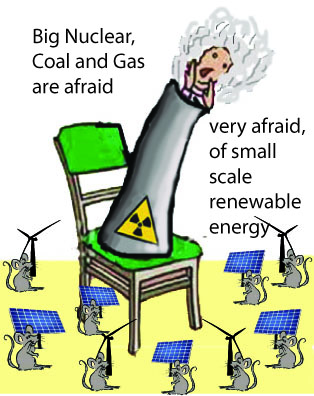 Renewables: A rising power. Ft.com By Pilita Clark, Environment Correspondent, 8 Aug 13……… “People think solar PV is only possible with subsidies and that is totally wrong,” says Karl Kuhlmann, the chief executive. “We’re happy that the industry is moving into an unsubsidised phase. It makes it simpler, better and totally independent from politicians.”
This is not quite true. The impact of cheap Chinese solar panels on western solar-panel makers has stirred political tensions, with trade rows over the threat of punitive tariffs erupting in the US and Europe…….
The more immediate threat to the nascent unsubsidised solar industry may be closer to home. In the US last month, Arizona’s largest utility, APS, asked regulators to look at imposing fees on people installing new rooftop solar systems to help pay for the cost of a grid they still use “essentially for free”.
“As the number of customers installing solar goes up, it drives rates even higher for non-solar customers, making the problem more difficult to solve,” it said in a statement. Utilities in other US states want similar action, infuriating solar companies.
Another outcry has broken out in Spain, the EU’s third-largest solar market after Germany and Italy, where the government last month also produced a proposal to impose new charges on rooftop solar owners.
“It’s really crazy,” says Mr Jornet. “They want me to pay for the electricity I take from my own solar panels. It’s amazing.”…….
Regulators still have to decide if the utilities will get their way. What does seem certain, however, is that the surge in solar power is changing energy markets in ways we have only begun to understand……http://www.ft.com/intl/cms/s/0/a41d86b4-ff9c-11e2-a244-00144feab7de.html#axzz2bb20LPZl
A solar diesel energy hybrid – an economic boon for developing countries
 Renewables: A rising power. Ft.com By Pilita Clark, Environment Correspondent, 8 Aug 13 Developing nations: Cheap solar could ‘leapfrog’ subsidies The plummeting cost of solar power systems is driving more than a surge in suburban rooftop panels in Bavaria and Barcelona.
It also promises to provide regular electricity to the 1.2bn people who have no access to it today. Low-cost solar panels could help them leapfrog traditional power grids in the same way parts of the developing world sidestepped fixed-line telecommunications networks and went straight to mobile phones.
An 80 per cent fall in the cost of solar panels since 2008 has opened up new business opportunities for companies such as Germany’s Donauer, which has just developed the D: Hybrid, a system that allows thousands of solar panels to be attached to the diesel generators that are a fixture in industrialising countries with rickety electricity systems. Continue reading
Solar powered lap-top is not costly
SOL – The Affordable Solar Powered Laptop http://www.energymatters.com.au/index.php?main_page=news_article&article_id=3879 8 Aug 13 SOL can be run entirely on the power of the sun and could make a big difference to education and communications in developing countries.
Developed by Canadian R&D corporation WeWi Telecommunications, Inc.; SOL is a laptop initially aimed at the 1 in 4 people in the world who have little to no access to reliable power.
Able to run 8-10 hours on a full charge, the laptop features an Intel Atom D2500 1.86 GHz Duo Core processor, 2-4 gigabytes of RAM and a 320 gigabyte hard drive; plus a 13.3 inch display, WiFi, 3G/4G modem and a camera. Multiple external ports extend SOL’s capabilities.
Cutting the cost of software to run the laptop has been achieved through the use of the free Ubuntu operating system.
While information on the capacity of the detachable folding solar panels doesn’t appear to be on the SOL web site; according to the FAQ, the battery can be fully recharged in a little over 2 hours.
Far from being a fragile device that wouldn’t survive long in target markets, WeWi claims it was developed with “durable, reinforced materials, complex military industrial design and architecture that are meant to keep the laptop in good shape.”
The standard unit is expected to sell for around USD $350 and a submersible version, approximately USD $400. It will be initially rolled out in Ghana before other markets. While geared towards developing nations; SOL will ultimately be available globally and the company intends developing “adventurer” versions of the laptop with enhanced capabilities.
WeWi Telecommunications, Inc originally launched as a B2B Internet Service Provider and then evolved into a global solutions provider with an advanced research division specializing in security, telecom and innovative energy products.
Read more on the Sol web site.
100,000 solar panels installed by UK supermarket chain
UK Supermarket Chain Installs 100,000th Solar Panel by Energy Matters, 26 July 13 Sainsbury’s says it has now installed 100,000 solar panels, representing 22MW capacity across 210 of its UK stores.
Enough to cover 35 football pitches; the company says the modules will reduce its carbon impact by an estimated 9,785 tonnes per year.
The company has also extended its renewable energy efforts to other technologies, including solar hot water and ground source heat pumps. A recently installed heat pump at its Crayford store supplies 30 per cent of that supermarket’s energy requirements…..http://www.energymatters.com.au/index.php?main_page=news_article&article_id=3859
Britons can cut their electricity bills, even make money, in switching to renewable energy
 if you feel like you’re getting taken for a ride every time you open up your energy bill then boycott the big six energy companies and switch to renewable energy today.
Battling the ‘Big Six’: The Best Way to Boycott Extortionate Charges from Energy Companies Greener Ideal, Gabriella Johnson is JULY 18, 2013 “……the recent  publication of a new in depth investigation into renewableenergy, ‘The Offshore Valuation’, has thrown out the gauntlet to renewable energy nay-sayers by attempting a complete economic evaluation of the offshore renewable energy resource available in the
UK, which produced some startling results.
Transforming UK Energy
According to the study, the UK could become a net electricity exporter and be generating the equivalent of a million barrels of oil by 2050 by developing just a third of the total tidal, wind and wave power available around the country.
This could have a huge number of benefits including insuring against the volatility of fossil fuel prices, creating over 140,000 new jobs and generating more than £30 billion in revenue through exporting electricity to Europe. Continue reading
Free solar power to 2 million poor citizens in Peru
 Peru to Provide Free Solar Power to its 2 Million Poorest Citizens http://inhabitat.com/peru-solar-power-program-aims-to-give-electricity-to-the-countrys-2-million-poorest-citizens/ by Timon Singh, 07/16/13 The country of Peru is looking to provide free electricity to over 2 million of its poorest citizens by harvesting energy from the sun. Energy and Mining Minister Jorge Merino said that the National Photovoltaic Household Electrification Program will provide electricity to poor households through the installation of photovoltaic panels.
The first part of the program aims to provide solar systems to 500,000 extremely poor households in areas that lack even basic access to the power grid. Unsurprisingly, it is a massive opportunity for domestic solar installers, and Merino has said that bidding for the contract will open later this year to fix the rest of the panels.
The project was first started in Contumaza, a province in the northeastern region of Cajamarca, where 1,601 solar panels were installed. The energy minister has said that when the project is finished, the scheme will allow 95% of Peru to have access to electricity by the end of 2016.
Speaking to the Latin America Herald Tribune, Merino said: “This program is aimed at the poorest people, those who lack access to electric lighting and still use oil lamps, spending their own resources to pay for fuels that harm their health.”
If Peru can do this for its people, it makes you wonder why more prosperous countries can’t do the same. Peru to Provide Free Solar Power to its 2 Million Poorest Citizens | Inhabitat – Sustainable Design Innovation, Eco Architecture, Green Building
Fiji’s solar expert grandmothers show the way
 AUDIO Fijian grandmothers educating locals on solar panel installation http://www.abc.net.au/news/2013-07-17/fiji-grandmothers-educating-younger-generation-on-solar-pane/4826594 Jul 17, 2013 A group of grandmothers in Fiji are educating the younger generation on solar panel installation to generate electricity in their villages.
The elderly women underwent training at the Barefoot College in India, an NGO that provides rural communities with training and education. Fiji’s Womens Minister, Dr Jiko Luveni, has told Radio Australia’s Pacific Beat program the training programme was specifically for grandmothers.
“The idea behind it is that these women are already established in the villages,” Dr Luveni said.
“They have their homes and they are not likely to leave the village as soon as they come back with their skill. Dr Luveni says the elderly women are now celebrated as solar experts and are supervising their young trainees as they install the solar equipment.
“After the training, it was these young people who actually installed the equipment in each house,” she said.
“The grandmothers were merely supervising what they did.
She says the initiative is bringing about various other social benefits to the villages.
“In this particular village that I went into, I could see that the moral of the villagers were boosted as they have a product that is an evidence of development in their villages,” Dr Luveni said.
“That village has gone into some income generating activity…They are more development oriented in their thinking.
“That particular village now has established a canteen and he young people are being recruited to help in the assemblage and installation of the solar equipment in those villages. Thereby, gaining an income,” she said.
Renewable energy, energy efficiency drive by NATO armed forces
 NATO Armed Forces Embrace Renewable Energy BRUSSELS, Belgium, July 11, 2013 (ENS) – The 28 member countries of the North Atlantic Treaty Organization are reducing the energy footprint of their defenseoperations as a priority, top NATO officials said this week.
NATO as a military and political organization, as well as individual allies, are working with alternative energy sources and developing multinational “smart energy” projects……. The DoD is seeking to develop solar,
wind, geothermal and other distributed energy sources on its bases both to reduce their $4 billion-a-year energy bill and to make them less dependent on the commercial electricity grid. Such on-site energy generation, together with energy storage and so-called smart-microgrid technology, would allow a military base to maintain its critical operations “off-grid” for weeks or months if the grid is disrupted, the DOD says…….. Continue reading
Impressive graphs tell the success story of Germany’s renewable energy
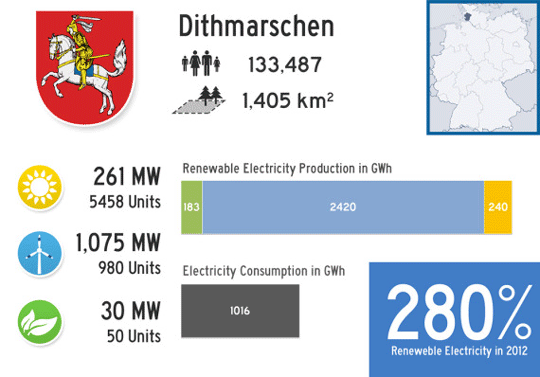
 I highly recommend this article. It shows with several excellent graphs, just how successful German counties are being in developing renewable energy and energy efficiency. The example below is of just one county
One of the most important details being missed by most of those common limited observations is the fact that the renewable energy success of the last decade was mainly driven by some pioneering regions, counties, and municipalities. Those local communities moved forward with conviction, while many others have remained dormant willingly or hindered by state governments that blocked investments by passing arbitrary anti-renewable regulations in favor of conventional power companies.
To showcase what we know about what is at least possible, here are the top 3 out of 295 Landkreise (Counties / administrative districts) in terms of the renewable share in their regional power mix. Most of their success is based on investments during the last 10–15 years based on technology that is now outdated
Germany: 100% renewable energy and beyond http://reneweconomy.com.au/2013/germany-100-renewable-energy-and-beyond-78310 By CleanTechnica on 8 July 2013 While many countries still discuss whether or not a 100% renewable energy system – or “just” a 100% renewable electricity supply – is even theoretically possible, Germans seem no longer bothered by such unscientific doubts. To make matters “worse,” some of them (including myself) are even convinced that a transition to a 100% renewable energy system can and should be accomplished within only a few decades’ time.
Some people might find this different perception of the problems we face to overcome the energy crisis of the 21st century so puzzling that they would rather choose to believe that the Germans have simply gone mad. Luckily, nothing could be further from the truth, and I’ve got a few nice examples that might explain the German mindset……
Another popular myth among so called “professional journalists” is that what is happening in Germany is due to on some kind of “big government” program. Obviously, this domestic narrative-driven reporting is not very interested in looking at important details that could explain the big picture. Continue reading
US electricity utilities see distributed energy as their killer
Solar panels could destroy U.S. utilities, according to U.S. utilities Grist By David Roberts
Solar power and other distributed renewable energy technologies could lay waste to U.S. power utilities and burn the utility business model, which has remained virtually unchanged for a century, to the ground That is not wild-eyed hippie talk. It is the assessment of the utilities themselves.
Back in January, the Edison Electric Institute — the (typically stodgy and backward-looking) trade group of U.S. investor-owned utilities — released a report [PDF] that, as far as I can tell, went almost entirely without notice in the press. That’s a shame. It is one of the most prescient and brutally frank things I’ve ever read about the power sector. It is a rare thing to hear an industry tell the tale of its own incipient obsolescence. Continue reading
Electricity utilities and the challenge of distributed solar energy
How can we boost distributed solar and save utilities at the same time? Grist, By David Roberts, 11 April 2013 Yesterday I wrote that solar PV and other distributed-energy technologies pose a radical threat to U.S. power utilities and the centralized business model they’ve operated under for the last century. This is, I hasten to add, according to the utilities themselves. So what should be done about it?
It’s complicated. On one hand, more distributed renewable energy is a good thing. It reduces carbon emissions, increases resilience, stimulates the growth of new industries with new jobs, and gives Americans a taste of energy democracy.
On the other hand, it just won’t do to have utilities view the spread of rooftop solar PV as an existential threat. Whatever you think of them, utilities still have tons of political power. If they want to slow the spread of distributed energy, they can. A lot.
So let’s look at their complaint. But one key thing to keep in mind as we do is that the utilities’ primary objective, the impetus behind the recent report from their trade group, Edison Electric Institute, is toprotect their business model and their profits. That’s what business groups do…….http://grist.org/climate-energy/how-can-we-boost-distributed-solar-and-save-utilities-at-the-same-time/
Rooftop solar power a boon for Japanese farmers
Japan’s Farmers To Benefit From Rooftop Solar Power http://www.energymatters.com.au/index.php?main_page=news_article&article_id=3802 21 June 13, Japan’s farming sector is making the switch to solar power, with the nation’s agricultural body announcing plans to spend AU$93 million installing 30 megawatts of solar on the rooftops of livestock barns and distribution centres.

The project is the initial phase of a plan by Japan’s National Federation of Agricultural Cooperative Associations (or Zen-Noh, for short), and Mitsubishi, to ultimately provide 200 megawatts of solar power capacity on farming facilities nationwide by the middle of 2015. Continue reading
USA chemist chain Walgreens goes solar, bigtime
 According to Australian solar provider Energy Matters, if a business is paying more than 20 cents per kilowatt hour for electricity; a commercial solar power system sized to daytime consumption can pay for itself in just a few years – after which, the electricity is essentially free
Walgreens To Add 200+ Solar Power Systems http://www.energymatters.com.au/index.php?main_page=news_article&article_id=3801, 20 June 13, Walgreens, the USA’s largest chemist store chain, says it will expand rooftop solar installations on its stores from 150 to more than 350.
With over 8,000 stores nationally plus distribution centers, Walgreens has substantial rooftop real estate; some of which it is putting to good use in harvesting power from the sun. The company started taking on solar panel projects in 2007.
According to the company, the addition of the 200-plus rooftop solar power systems will generate an estimated 13.5 million kilowatt hours annually, enough to meet the energy needs of around 1,400 households. Continue reading
Global Impact Award goes to Solar Aid
SolarAid Recipient Of £500,000 Google Award. http://www.energymatters.com.au/index.php?main_page=news_article&article_id=3783, 9 June 13, by Energy Matters Last week, SolarAid became the winner of a £500,000 Google Global Impact Award.We first covered SolarAid back in 2009. The group’s mission is make solar energy as widely available as possible to the poorest people in developing countries by providing affordable (and in some instances free) solar lighting.
Its core focus is the social enterprise, SunnyMoney. Lights are sold to local entrepreneurs; who then resell the equipment in their communities at a reasonable price. The approximate payback time of a basic light through savings on kerosene fuel is around 12 weeks. The group also offers a donate-a-light initiative; where donors can sponsor a light for a family.
SunnyMoney has sold over 338,000 lights in the last 12 months, growing over 550% year on year to become the largest seller of solar lights in Africa. In total, the organisation has distributed over a half a million solar lights. With the average household size in East Africa being five, SolarAid’s work has helped to transform the lives of over two and a half million people.
SolarAid says it will use the half a million pound prize to distribute 144,000 solar lights in rural Tanzania and recruit 400 school leavers to create a new generation of solar entrepreneurs.
“The support pledged by Google to the four Award winners will help SolarAid raise its profile, gain more supporters and ensure the injustice of living without clean light gets onto the world radar,” says SolarAid.
With 85% of Africans not having access to electricity, the entrepreneurial approach has massive potential – not just in lighting up lives, but improving health and creating employment. SolarAid has set a lofty goal of eradicating the kerosene lamp from Africa by 2020.
Google’s Global Impact Awards support nonprofits using technology and innovation to tackle tough human challenges.
Rapidly increasing popularity of solar panels, in Japan
 Japan’s post-Fukushima solar boom SMH, June 2, 2013 Domestic shipments of solar cells and modules in Japan leapt by their most in at least 30 years last fiscal year as government efforts to spur clean energy after the 2011 Fukushima disaster began to pay off.
Local shipments rose to 3,809 megawatts in the 12 months ended March 31 from 1,404 megawatts the previous year, the Japan Photovoltaic Energy Association said today on its website. The increase was the largest since 1981 when the figures were compiled for the first time.
The data underscore the popularity of solar in Japan as pressures mount to boost energy supplies after the Fukushima Dai-Ichi accident led to the shutdown of almost all the nation’s nuclear reactors. Japan started offering above-market rates in July for renewable sources such as solar and wind. Continue reading
1 This Month



31st January – Challenging the War Machine – a DECLASSIFIED UK SUMMIT


Website of the Week
Now until to February 10, 2026 Radioactive waste storage in France: the debate is finally open! How to participate?
-
Archives
- January 2026 (227)
- December 2025 (358)
- November 2025 (359)
- October 2025 (377)
- September 2025 (258)
- August 2025 (319)
- July 2025 (230)
- June 2025 (348)
- May 2025 (261)
- April 2025 (305)
- March 2025 (319)
- February 2025 (234)
-
Categories
- 1
- 1 NUCLEAR ISSUES
- business and costs
- climate change
- culture and arts
- ENERGY
- environment
- health
- history
- indigenous issues
- Legal
- marketing of nuclear
- media
- opposition to nuclear
- PERSONAL STORIES
- politics
- politics international
- Religion and ethics
- safety
- secrets,lies and civil liberties
- spinbuster
- technology
- Uranium
- wastes
- weapons and war
- Women
- 2 WORLD
- ACTION
- AFRICA
- Atrocities
- AUSTRALIA
- Christina's notes
- Christina's themes
- culture and arts
- Events
- Fuk 2022
- Fuk 2023
- Fukushima 2017
- Fukushima 2018
- fukushima 2019
- Fukushima 2020
- Fukushima 2021
- general
- global warming
- Humour (God we need it)
- Nuclear
- RARE EARTHS
- Reference
- resources – print
- Resources -audiovicual
- Weekly Newsletter
- World
- World Nuclear
- YouTube
-
RSS
Entries RSS
Comments RSS
 nuclear-news