Big climate change policy unlikely no matter who wins the White House

Big climate change policy unlikely no matter who wins the White House
 Amy Harder Don’t hold your breath for big climate policy changes — even if a Democrat wins the White House.
Why it matters: Congress is likely to remain gridlocked on the matter, leading to either more of the same with President Trump’s re-election or a regulatory swing back to the left no matter which Democrat wins — but far short of a legislative overhaul.
The big picture: Climate change is reaching a new high-water mark as a political concern for American voters, and Democratic presidential nominees are promising aggressive policies.
- That in and of itself is a sea change from prior elections. Even still, these worries and pledges are unlikely to translate into any major new laws in the next few years (at least).
Here’s why, with potential scenarios mapped out.
Trump wins re-election
While Trump is uniquely unpredictable in presidential history, he’s made it clear since moving into the White House that he’s not interested in pursuing any sort of actual climate legislation on Capitol Hill.
More of the same is most likely, in two important ways:
- More curtailing of environmental regulations — and defending them in court.
- More pressure on other actors — like companies, states and other countries — to take bigger action on their own as the void of U.S. presidential leadership grows.
Any Democrat wins
All Democrats have aggressive climate plans, but it’s an open question whether any would first push climate legislation over other priorities — especially health care………
Regardless of congressional priority, any Democratic president would swing Washington’s executive-action pendulum far back in the other direction. …..
A progressive Democrat wins
… like Bernie Sanders or Elizabeth Warren. ……This type of all-encompassing and hyper-aggressive legislation is unlikely to get universal support among Democrats (to say nothing of universal Republican opposition) — which makes them extremely unlikely to get through the Senate.
- This is because Democrats with more moderate ideologies or those representing energy-intensive states are unlikely to support the broader socioeconomic measures and such aggressive moves away from fossil fuels, partly because many of those jobs are represented by unions……..
A more moderate Democrat wins
… like Joe Biden, Amy Klobuchar or Michael Bloomberg.
I anticipate these politicians would be (relatively) more open to trying to work with Republicans on climate change than their progressive counterparts……
As Congress talks climate policy, carbon price gets no love
New lobbying urging Congress to support a price on carbon emissions is not convincing lawmakers to warm up to the policy.
Why it matters: A carbon price is widely considered one of the most economically efficient ways to tackle climate change. But, economics be damned, its politics remain deeply unpopular. https://www.axios.com/climate-policy-changes-unlikely-7ecf6cc3-c42c-4d7c-b492-41d73433a015.html?utm_source=newsletter&utm_medium=email&utm_campaign=newsletter_axiosam&stream=top
Climate action? – you simply couldn’t build enough nuclear reactors
 New Scientist 26th Feb 2020, Paul Dorfman, University College London Energy Institute, UK; Tom Burke,E3G; Steve Thomas, University of Greenwich, UK; Jonathan Porritt,
environmental campaigner; and David Lowry, Institute for Resource and
Security Studies. Reporting the decline of nuclear power generation, you quote Michael Shellenberger’s view that nuclear power is necessary to prevent climate change (8 February, p 20).
This view is truly dangerous. Climate change poses a number of unique challenges to humanity. One of the most difficult is that the world not only needs to get to a specific place
– a carbon-neutral global energy system – but also must get there by a specific time – the middle of the century. Otherwise the policy fails.
You simply couldn’t build enough nuclear reactors fast enough, even to
replace the existing reactors that will reach the end of their life by
2050, let alone to replace fossil fuels in the existing electricity system
or in the more electricity-intensive global economy we are currently
building. This would be true even if we were willing and able to overcome
all the other unsolved problems that nuclear reactors face. These include
their affordability, accidents, waste management, nuclear weapons
proliferation, the scarcity of talent and system inflexibility.
Antarctic ice walls protect the climate
|
Antarctic ice walls protect the climate, EurekAlert 27 Feb, UNIVERSITY OF GOTHENBURG Inland Antarctic ice contains volumes of water that can raise global sea levels by several metres. A new study published in the journal Nature shows that glacier ice walls are vital for the climate, as they prevent rising ocean temperatures and melting glacier ice.The ocean can store much more heat than the atmosphere. The deep sea around Antarctica stores thermal energy that is the equivalent of heating the air above the continent by 400 degrees. Now, a Swedish-led international research group has explored the physics behind the ocean currents close to the floating glaciers that surround the Antarctic coast. “Current measurements indicate an increase in melting, particularly near the coast in some parts of Antarctica and Greenland. These increases can likely be linked to the warm, salty ocean currents that circulate on the continental shelf, melting the ice from below,” says Anna Wåhlin, lead author of the study and professor of oceanography at the University of Gothenburg. “What we found here is a crucial feedback process: the ice shelves are their own best protection against warm water intrusions. If the ice thins, more oceanic heat comes in and melts the ice shelf, which becomes even thinner etc. It is worrying, as the ice shelves are already thinning because of global air and ocean warming”, says Céline Heuzé, climate researcher at the Department of Earth Sciences of Gothenburg University. The stability of ice is a mystery Inland Antarctic ice gradually moves towards the ocean. Despite the ice being so important, its stability remains a mystery – as does the answer to what could make it melt faster. Since the glaciers are difficult to access, researchers have been unable to find out much information about the active processes. More knowledge has now been obtained from studying the measurement data collected from instruments that Anna Wåhlin and her researcher colleagues placed in the ocean around the Getz glacier in West Antarctica. The ice’s edge blocks warm seawater……https://www.eurekalert.org/pub_releases/2020-02/uog-aiw022720.php |
|
Nuclear lobby attacks Australia’s Nuclear Prohibition laws
Jim Green, Online Opinion, 27 Feb 2020, https://onlineopinion.com.au/view.asp?article=20758&page=0
Nuclear power in Australia is prohibited under the Environmental Protection and Biodiversity Conservation (EPBC) Act 1999. A review of the EPBC Act is underway and there is a strong push from the nuclear industry to remove the bans. However, federal and state laws banning nuclear power have served Australia well and should be retained.
 Too cheap to meter or too expensive to matter? Laws banning nuclear power has saved Australia from the huge costs associated with failed and failing reactor projects in Europe and North America, such as the Westinghouse project in South Carolina that was abandoned after the expenditure of at least A$13.4 billion. The Westinghouse / South Carolina fiasco could so easily have been replicated in any of Australia’s states or territories if not for the legal bans.
There are many other examples of shocking nuclear costs and cost overruns, including:
* The cost of the two reactors under construction in the US state of Georgia has doubled and now stands at A$20.4‒22.6 billion per reactor.
* The cost of the only reactor under construction in France has nearly quadrupled and now stands at A$20.0 billion. It is 10 years behind schedule.
* The cost of the only reactor under construction in Finland has nearly quadrupled and now stands at A$17.7 billion. It is 10 years behind schedule.
* The cost of the four reactors under construction in the United Arab Emirates has increased from A$7.5 billion per reactor to A$10‒12 billion per reactor.
* In the UK, the estimated cost of the only two reactors under construction is A$25.9 billion per reactor. A decade ago, the estimated cost was almost seven times lower. The UK National Audit Office estimates that taxpayer subsidies for the project will amount to A$58 billion, despite earlier government promises that no taxpayer subsidies would be made available.
Nuclear power has clearly priced itself out of the market and will certainly decline over the coming decades. Indeed the nuclear industry is in crisis ‒ as industry insiders and lobbyists freely acknowledge. Westinghouse ‒ the most experienced reactor builder in the world ‒ filed for bankruptcy in 2017 as a result of catastrophic cost overruns on reactor projects. A growing number of countries are phasing out nuclear power, including Germany, Switzerland, Spain, Belgium, Taiwan and South Korea.
Rising power bills: Laws banning nuclear power should be retained because nuclear power could not possibly pass any reasonable economic test. Nuclear power clearly fails the two economic tests set by Prime Minister Scott Morrison. Firstly, nuclear power could not possibly be introduced or maintained without huge taxpayer subsidies. Secondly, nuclear power would undoubtedly result in higher electricity prices.
 Nuclear waste streams: Laws banning nuclear power should be retained because no solution exists to for the safe, long-term management of streams of low-, intermediate- and high-level nuclear wastes. No country has an operating repository for high-level nuclear waste. The United States has a deep underground repository for long-lived intermediate-level waste ‒ the only operating deep underground repository worldwide ‒ but it was closed from 2014‒17 following a chemical explosion in an underground waste barrel. Safety standards and regulatory oversight fell away sharply within the first decade of operation of the U.S. repository ‒ a sobering reminder of the challenge of safely managing dangerous nuclear wastes for tens of thousands of years.
 Too dangerous: The Fukushima and Chernobyl disasters results in the evacuation of over half a million people and economic costs in the hundreds of billions of dollars. In addition to the danger of nuclear reactor meltdowns and fires and chemical explosions, there are other dangers. Doubling nuclear output by the middle of the century would require the construction of 800−900 reactors. These reactors not only become military targets but they would produce over one million tonnes of high-level nuclear waste containing enough plutonium to build over one million nuclear weapons.
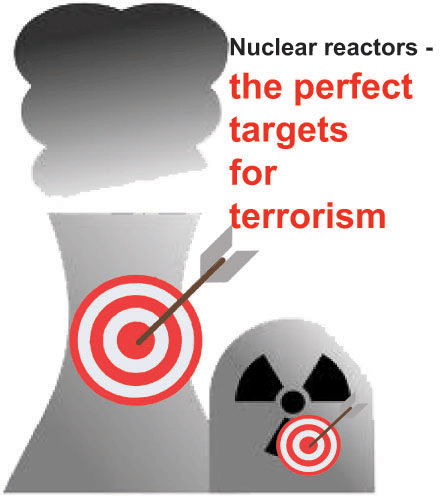 Pre-deployed terrorist targets: Nuclear power plants have been described as pre-deployed terrorist targets and pose a major security threat. This in turn would likely see an increase in policing and security operations and costs and a commensurate impact on civil liberties and public access to information. Other nations in our region may view Australian nuclear aspirations with suspicion and concern given that many aspects of the technology and knowledge-base are the same as those required for nuclear weapons.
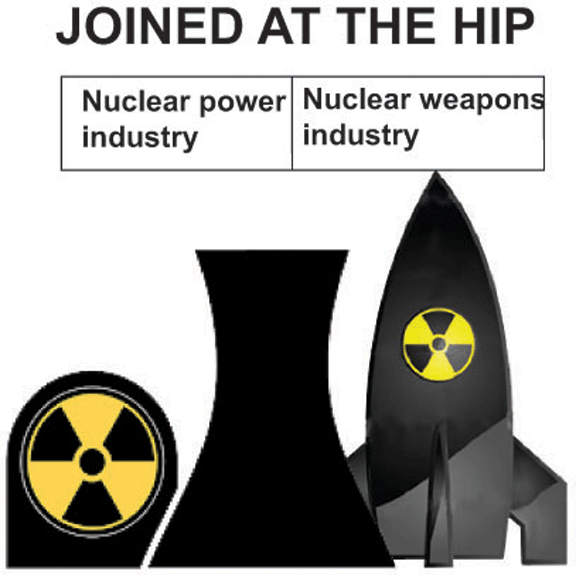 Former US Vice President Al Gore summarised the proliferation problem: “For eight years in the White House, every weapons-proliferation problem we dealt with was connected to a civilian reactor program. And if we ever got to the point where we wanted to use nuclear reactors to back out a lot of coal … then we’d have to put them in so many places we’d run that proliferation risk right off the reasonability scale.”
Too slow: Expanding nuclear power is impractical as a short-term response to climate change. An analysis by Australian economist Prof. John Quiggin concludes that it would be “virtually impossible” to get a nuclear power reactor operating in Australia before 2040. More time would elapse before nuclear power has generated as much as energy as was expended in the construction of the reactor: a University of Sydney report concluded that the energy payback time for nuclear reactors is 6.5‒7 years. Taking into account planning and approvals, construction, and the energy payback time, it would be a quarter of a century or more before nuclear power could even begin to reduce greenhouse emissions in Australia (and then only assuming that nuclear power displaced fossil fuels).
 Too thirsty: Nuclear power is extraordinarily thirsty. A single nuclear power reactor consumes 35‒65 million litres of water per day for cooling.
Water consumption of different energy sources (litres / kWh):
* Nuclear 2.5
* Coal 1.9
* Combined Cycle Gas 0.95
* Solar PV 0.11
* Wind 0.004
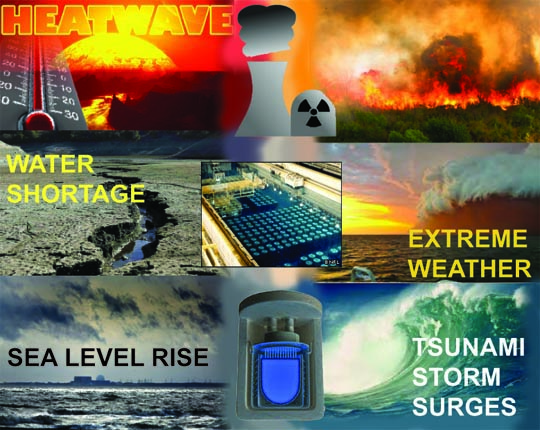
Climate change and nuclear hazards: Nuclear power plants are vulnerable to threats which are being exacerbated by climate change. These include dwindling and warming water sources, sea-level rise, storm damage, drought, and jelly-fish swarms. Nuclear engineer David Lochbaum states. “I’ve heard many nuclear proponents say that nuclear power is part of the solution to global warming. It needs to be reversed: You need to solve global warming for nuclear plants to survive.”
In January 2019, the Climate Council, comprising Australia’s leading climate scientists and other policy experts, issued a policy statement concluding that nuclear power plants “are not appropriate for Australia – and probably never will be”.
By contrast, the REN21 Renewables 2015: Global Status Report states that renewable energy systems “have unique qualities that make them suitable both for reinforcing the resilience of the wider energy infrastructure and for ensuring the provision of energy services under changing climatic conditions.”
 First Nations: Laws banning nuclear power should be retained because the pursuit of a nuclear power industry would almost certainly worsen patterns of disempowerment and dispossession that Australia’s First Nations have experienced ‒ and continue to experience ‒ as a result of nuclear and uranium projects.
To give one example (among many), the National Radioactive Waste Management Act dispossesses and disempowers Traditional Owners in many respects: the nomination of a site for a radioactive waste dump is valid even if Aboriginal owners were not consulted and did not give consent; the Act has sections which nullify State or Territory laws that protect archaeological or heritage values, including those which relate to Indigenous traditions; the Act curtails the application of Commonwealth laws including the Aboriginal and Torres Strait Islander Heritage Protection Act 1984 and the Native Title Act 1993 in the important site-selection stage; and the Native Title Act 1993 is expressly overridden in relation to land acquisition for a radioactive waste dump.
No social license: Laws banning nuclear power should be retained because there is no social license to introduce nuclear power to Australia. Opinion polls find that Australians are overwhelmingly opposed to a nuclear power reactor being built in their local vicinity (10‒28% support, 55‒73% opposition); and opinion polls find that support for renewable energy sources far exceeds support for nuclear power (for example a 2015 IPSOS poll found 72‒87% support for solar and wind power but just 26% support for nuclear power). As the Clean Energy Council noted in its submission to the 2019 federal nuclear inquiry, it would require “a minor miracle” to win community support for nuclear power in Australia.
The pursuit of nuclear power would also require bipartisan political consensus at state and federal levels for several decades. Good luck with that. Currently, there is a bipartisan consensus at the federal level to retain the legal ban. The noisy, ultra-conservative rump of the Coalition is lobbying for nuclear power but their push has been rejected by, amongst others, the federal Liberal Party leadership, the Queensland Liberal-National Party, the SA Liberal government, the Tasmanian Liberal government, the NSW Liberal Premier and environment minister, and even ultra-conservatives such as Nationals Senator Matt Canavan.
 The future is renewable, not radioactive: Laws banning nuclear power should be retained because the introduction of nuclear power would delay and undermine the development of effective, economic energy and climate policies based on renewable energy sources and energy efficiency. A December 2019 report by CSIRO and the Australian Energy Market Operator finds that construction costs for nuclear reactors are 2‒8 times higher than costs for wind or solar. Levelised costs for nuclear are 2‒3 times greater per unit of energy produced compared to wind or solar including either 2 hours of battery storage or 6 hours of pumped hydro energy storage.
Australia can do better than fuel higher carbon emissions and unnecessary radioactive risk. We need to embrace the fastest growing global energy sector and become a driver of clean energy thinking and technology and a world leader in renewable energy technology. We can grow the jobs of the future here today. This will provide a just transition for energy sector workers, their families and communities and the certainty to ensure vibrant regional economies and secure sustainable and skilled jobs into the future. Renewable energy is affordable, low risk, clean and popular. Nuclear is not. Our shared energy future is renewable, not radioactive.
More Information
* Don’t Nuke the Climate Australia, www.dont-nuke-the-climate.org.au
* Climate Council, 2019, ‘Nuclear Power Stations are Not Appropriate for Australia – and Probably Never Will Be’, https://www.climatecouncil.org.au/nuclear-power-stations-are-not-appropriate-for-australia-and-probably-never-will-be/
* WISE Nuclear Monitor, 25 June 2016, ‘Nuclear power: No solution to climate change’, https://www.wiseinternational.org/nuclear-monitor/806/nuclear-power-no-solution-climate-change
Dr. Jim Green is the national nuclear campaigner with Friends of the Earth Australia.
The Planet Is Screwed, Says Bank That Screwed the Planet
 The New Republic The New Republic A report from two economists at JP Morgan Chase pushes back against traditional economic wisdom on climate change. By KATE ARONOFF, February 25, 2020 JP Morgan Chase is the world’s leading financer of fossil fuel projects. And according to a report from within the company, recently leaked to the press, the world is seriously underestimating the adverse effects of climate change.
The 22-page report, entitled “Risky Business: the climate and the macroeconomy” and dated January 14, 2020, has been reported by multiple outlets since Friday as containing a gloomy assessment of the risk presented by climate change in the near future. But it also offers a withering takedown of how economists in particular have tended to think about the climate crisis, criticizing findings from several of the field’s experts by name, including a recent winner of the Nobel Prize in economics.
“We cannot rule out catastrophic outcomes where human life as we know it is threatened,” the report concludes. It’s a stunning bit of cognitive dissonance from a bank that is doing so much to fuel the crisis. It also shows a growing push for a more grounded assessment of the crisis than mainstream economics has offered in recent decades….
Essentially an informational document, the report—written by U.K.-based JP Morgan economists David Mackie and Jessica Murray—reviews a battery of academic literature on climate change. It examines several predictions of climate change’s impact on gross domestic product, including economist Richard Tol’s 2018 survey of 26 different climate models—one of the more comprehensive recent works. While Tol has links to organizations that have cast doubt on the scientific consensus around the climate crisis, as his own research has, the findings listed are not especially controversial. But the JP Morgan Chase report authors push back on those and other prominent predictions. “Most likely,” the authors conclude, “these estimates of the income and wealth effects of unmitigated climate change are far too small.”……..
The JP Morgan report doesn’t include clear recommendations for what the company’s own risk analysts should do with the information presented. “Most likely,” it states, “business as usual will be the path that policymakers follow in the years ahead”—something its authors say “opens the earth to a greater likelihood of a catastrophic outcome” than previously estimated. The report does not discuss the bank’s support for polluting industries, which have spent handsomely to block climate action at virtually every level of government.
“It is depressing that JP Morgan are trying to evade responsibility for this thorough and useful report that restates what climate scientists, Greta Thunberg, and Extinction Rebellion alike have been saying for some time now: that our very future as a species is at stake,” Rupert Read, who originally obtained the report, wrote in an email. “It would be so much better if they owned up fully to what is in this report. But then, that would of course require them to completely transform their business model.”
All that dissonance may be starting to wear thin. Ahead of its annual investor day Tuesday and under persistent pressure from Gwich’in Steering Committee and green groups, JP Morgan Chase said it would stop any new financing of drilling in the Arctic National Wildlife Refuge and expand restrictions on financing coal projects. https://newrepublic.com/article/156657/planet-screwed-says-bank-screwed-planet
|
|
USA fails to stop G20 finance ministers and central bank governors warning on climate change
|
Sources told the news agency that the statement of priorities included the importance of examining the implications of global heating for financial stability, as part of the work of the G20’s Financial stability Board, the steering group for international banking industry rules. The language represented a compromise to overcome opposition from US officials at the first major meeting of Saudi Arabia’s year-long presidency of the G20, according to the sources. An attempt to include references to the downside risks for global growth posed by the climate crisis was dropped……. The International Monetary Fund included climate-related disasters in a list of the risks facing a highly fragile recovery in the global economy this year. However, the increasing focus comes as US officials resist naming global heating as an economic risk, following Trump’s move at the outset of his presidency to withdraw the world’s largest economy from the Paris climate accords. https://www.theguardian.com/world/2020/feb/23/g20-sounds-alarm-over-climate-emergency |
|
USA at G20 tried to stop any mention of climate change
US blocking mention of climate change in G20 statement, diplomats say Independent UK, ‘Oliver O’Connell, New York, 24 Feb 20,
1 day ago G20 diplomats say the US is against mentioning climate change in the communique of the world’s financial leaders.
A new draft of the joint statement shows the G20 considering including it as a risk factor to growth.
Finance ministers and central bankers from the world’s 20 largest economies are discussing the main challenges to the global economy in Riyadh, Saudi Arabia, this weekend.
G20 sources told Reuters that the US was reluctant to accept language on climate change as a risk to the economy.
The US is represented at the meeting by treasury secretary Steven Mnuchin…….. G20 diplomats say the US is against mentioning climate change in the communique of the world’s financial leaders.
A new draft of the joint statement shows the G20 considering including it as a risk factor to growth. Finance ministers and central bankers from the world’s 20 largest economies are discussing the main challenges to the global economy in Riyadh, Saudi Arabia, this weekend.
Climate denialists using bots on Twitter to get their message across
|
Draft of Brown study says findings suggest ‘substantial impact of mechanized bots in amplifying denialist messages’ Guardian, Oliver Milman in New York @olliemilman, Fri 21 Feb 2020 The social media conversation over the climate crisis is being reshaped by an army of automated Twitter bots, with a new analysis finding that a quarter of all tweets about climate on an average day are produced by bots, the Guardian can reveal.The stunning levels of Twitter bot activity on topics related to global heating and the climate crisis is distorting the online discourse to include far more climate science denialism than it would otherwise. An analysis of millions of tweets from around the period when Donald Trump announced the US would withdraw from the Paris climate agreement found that bots tended to applaud the president for his actions and spread misinformation about the science. The study of Twitter bots and climate was undertaken by Brown University and has yet to be published. Bots are a type of software that can be directed to autonomously tweet, retweet, like or direct message on Twitter, under the guise of a human-fronted account…….. An analysis of millions of tweets from around the period when Donald Trump announced the US would withdraw from the Paris climate agreement found that bots tended to applaud the president for his actions and spread misinformation about the science. The study of Twitter bots and climate was undertaken by Brown University and has yet to be published. Bots are a type of software that can be directed to autonomously tweet, retweet, like or direct message on Twitter, under the guise of a human-fronted account…….. Trump has consistently spread misinformation about the climate crisis, most famously calling it “bullshit” and a “hoax”, although more recently the US president has said he accepts the science that the world is heating up. Nevertheless, his administration has dismantled any major policy aimed at cutting planet-warming gases, including car emissions standards and restrictions on coal-fired power plants……. number of suspected bots that have consistently disparaged climate science and activists have large numbers of followers on Twitter. One that ranks highly on the Botometer score, @sh_irredeemable, wrote “Get lost Greta!” in December, in reference to the Swedish climate activist Greta Thunberg……. ohn Cook, an Australian cognitive scientist and co-author with Lewandowsky, said that bots are “dangerous and potentially influential”, with evidence showing that when people are exposed to facts and misinformation they are often left misled. “This is one of the most insidious and dangerous elements of misinformation spread by bots – not just that misinformation is convincing to people but that just the mere existence of misinformation in social networks can cause people to trust accurate information less or disengage from the facts,” Cook said. .. https://www.theguardian.com/technology/2020/feb/21/climate-tweets-twitter-bots-analysis The stunning levels of Twitter bot activity on topics related to global heating and the climate crisis is distorting the online discourse to include far more climate science denialism than it would otherwise.ast |
|

Huge rise predicted for Britain’s seas and tidal rivers
 Times 23rd Feb 2020, Britain should be preparing for its seas and tidal rivers to rise by up to 6½ ft in the next 80 years, according to the scientist in charge of protecting Holland against flooding and sea level change. Peter Glas, head of Holland’s Delta Programme, which oversees long-term flood risk management, will tell a UK conference that the rise in the level of the Times 23rd Feb 2020, Britain should be preparing for its seas and tidal rivers to rise by up to 6½ ft in the next 80 years, according to the scientist in charge of protecting Holland against flooding and sea level change. Peter Glas, head of Holland’s Delta Programme, which oversees long-term flood risk management, will tell a UK conference that the rise in the level of theNorth Sea may accelerate sharply from 2050, potentially reaching 2 metres (6½ ft) by 2100. That is nearly double the Met Office’s worst-case
predictions. It follows research at Holland’s Deltares centre, commissioned by the Delta Programme, into the impact of rising sea levels on northern Europe. “The rise could potentially accelerate with effect from 2050, entailing far-reaching consequences,” said Glas’s latest report to the Dutch government, which he will cite at this week’s Floodex conference in Peterborough. The Delta report added that effects of “the more rapid melting of Antarctic ice sheets” had not yet been incorporated into the programme’s predictions. |
|
|
JP Morgan economists warn climate crisis is threat to human race
|
Leaked report for world’s major fossil fuel financier says Earth is on unsustainable trajectory, Patrick Greenfield and Jonathan Watts The world’s largest financier of fossil fuels has warned clients that the climate crisis threatens the survival of humanity and that the planet is on an unsustainable trajectory, according to a leaked document.The JP Morgan report on the economic risks of human-caused global heating said climate policy had to change or else the world faced irreversible consequences. The study implicitly condemns the US bank’s own investment strategy and highlights growing concerns among major Wall Street institutions about the financial and reputational risks of continued funding of carbon-intensive industries, such as oil and gas. JP Morgan has provided $75bn (£61bn) in financial services to the companies most aggressively expanding in sectors such as fracking and Arctic oil and gas exploration since the Paris agreement, according to analysis compiled for the Guardian last year. Its report was obtained by Rupert Read, an Extinction Rebellion spokesperson and philosophy academic at the University of East Anglia, and has been seen by the Guardian. The research by JP Morgan economists David Mackie and Jessica Murray says the climate crisis will impact the world economy, human health, water stress, migration and the survival of other species on Earth. “We cannot rule out catastrophic outcomes where human life as we know it is threatened,” notes the paper, which is dated 14 January. Drawing on extensive academic literature and forecasts by the International Monetary Fund and the UN Intergovernmental Panel on Climate Change (IPCC), the paper notes that global heating is on course to hit 3.5C above pre-industrial levels by the end of the century. It says most estimates of the likely economic and health costs are far too small because they fail to account for the loss of wealth, the discount rate and the possibility of increased natural disasters. The authors say policymakers need to change direction because a business-as-usual climate policy “would likely push the earth to a place that we haven’t seen for many millions of years”, with outcomes that might be impossible to reverse. “Although precise predictions are not possible, it is clear that the Earth is on an unsustainable trajectory. Something will have to change at some point if the human race is going to survive.” The investment bank says climate change “reflects a global market failure in the sense that producers and consumers of CO2 emissions do not pay for the climate damage that results.” To reverse this, it highlights the need for a global carbon tax but cautions that it is “not going to happen anytime soon” because of concerns about jobs and competitiveness. The authors say it is “likely the [climate] situation will continue to deteriorate, possibly more so than in any of the IPCC’s scenarios”. Without naming any organisation, the authors say changes are occurring at the micro level, involving shifts in behaviour by individuals, companies and investors, but this is unlikely to be enough without the involvement of the fiscal and financial authorities. Last year, analysis compiled for the Guardian by Rainforest Action Network, a US-based environmental organisation, found JP Morgan was one of 33 powerful financial institutions to have provided an estimated total of $1.9tn (£1.47tn) to the fossil fuel sector between 2016 and 2018. A JP Morgan spokesperson told the BBC the research team was “wholly independent from the company as a whole, and not a commentary on it”, but declined to comment further. The metadata on the pdf of the report obtained by Read said the document was created on 13 January and that the author of the file was Gabriel de Kock, executive director of JP Morgan. The Guardian has approached the investment bank for comment. Pressure from student strikers, activist shareholders and divestment campaigners has prompted several major institutions to claim they will make the climate more of a priority. The business model of fossil fuel companies is also weakening as wind and solar become more competitive. Earlier this month, the influential merchant bank Goldman Sachs downgraded ExxonMobil from a “neutral” to a “sell” position. In January, BlackRock – the world’s biggest asset manager – said it would lower its exposure to fossil fuels ahead of a “significant reallocation of capital”. Environmental groups remain wary because huge sums are invested in petrochemical firms, but some veteran financial analysts say the tide is changing. The CNBC money pundit Jim Cramer shocked many in his field when he declared: “I’m done with fossil fuels. They’re done. They’re just done.” Describing how a new generation of pension fund managers was withdrawing support, he claimed oil and gas firms were in the death knell phase. “The world has turned on them. It’s actually happening kind of quickly. You’re seeing divestiture by a lot of different funds. It’s going to be a parade that says, ‘Look, these are tobacco. And we’re not going to own them,’” he said. “We’re in a new world.”
|
|


All the world is betraying the world’s children, the World Health Organisation has found

|
Every country on Earth failing to provide world fit for children, landmark report warns‘Predatory marketing’ and wealthy countries’ high carbon emissions among chief concerns for health of future generations, says major WHO, Lancet and Unicef report Independent UK, Harry Cockburn, 20 Feb 20, Every country in the world is failing to protect children’s health, their environment and their futures, a landmark report for the World Health Organisation has found. The damning findings pull back the curtain on an increasingly fragile world in which unbridled industrialism is already sabotaging the lives of younger generations. The report, based on a commission of more than 40 child and adolescent health experts from around the world, said every child on Earth is now “under immediate threat from ecological degradation, climate change and exploitative marketing practices that push heavily processed fast food, sugary drinks, alcohol and tobacco at children”. Despite improvements in child and adolescent health over the past 20 years, progress has stalled, and is set to reverse,” said Helen Clark, the former prime minister of New Zealand and co-chair of the commission. The report, by the WHO, the United Nations Children’s Fund (Unicef) and the Lancet Commission, ranked 180 countries on the conditions they provide for a child to “thrive and survive”…….. The report said while wealthier countries generally have better child health and development outcomes it is them in particular who “threaten the future of all children through carbon pollution, on course to cause runaway climate change and environmental disaster”. When authors took per capita CO2 emissions into account, the rankings told a very different story. Norway ranked 156th, the Republic of Korea 166 and the Netherlands 160. Each of these countries emits 210 per cent more CO2 per capita than their 2030 target. The UK ranked 136th on this measure. The US, Australia and Saudi Arabia are among the 10 worst emitters. “It has been estimated that around 250 million children under five years old in low- and middle-income countries are at risk of not reaching their developmental potential, based on proxy measures of stunting and poverty. But of even greater concern, every child worldwide now faces existential threats from climate change and commercial pressures,” Ms Clark said. The authors of the report said: “Governments must harness coalitions across sectors to overcome ecological and commercial pressures to ensure children receive their rights and entitlements now and a liveable planet in the years to come.”…….
Dr Tedros Adhanom Ghebreyesus, the director-general of the WHO, described the report as a “wakeup call”. He said: “This report shows that the world’s decision-makers are, too often, failing today’s children and youth: failing to protect their health, failing to protect their rights, and failing to protect their planet…… To protect children, the independent commission authors call for a new global movement driven by and for children. Specific recommendations include: Stop CO2 emissions with the utmost urgency, to ensure children have a future on this planet; Place children and adolescents at the centre of our efforts to achieve sustainable development; New policies and investment in all sectors to work towards child health and rights; Incorporate children’s voices into policy decisions;……. Henrietta Fore, Unicef’s executive director, said: “From the climate crisis to obesity and harmful commercial marketing, children around the world are having to contend with threats that were unimaginable just a few generations ago. ….. https://www.independent.co.uk/environment/children-future-planet-world-health-organisation-report-climate-crisis-capitalism-advertising-lancet-a9343856.html |
|
All wars are serious, but this climate war could have the direst consequences

THE ONE WAR THAT THE HUMAN SPECIES CAN’T LOSE The New Yorker, By Robin Wright, 20 Feb 2020 “……… For almost a half century, I’ve covered wars, revolutions and uprisings on four continents, many for years on end. I’ve always been an outside observer watching as others killed each other. I lamented the loss of human life—and the warring parties’ self-destructive practices—from an emotional distance. In Antarctica, I saw war through a different prism. And I was the enemy. “ “Humans will be but a blip in the span of Earth’s history,” Wayne Ranney, a naturalist and geologist on the expedition, told me. “The only question is how long the blip will be.”
Last week, the temperature in Antarctica hit almost seventy degrees—the hottest in recorded history. It wasn’t a one-day fluke. Famed for its snowscapes, the Earth’s coldest, wildest, windiest, highest, and most mysterious continent has been experiencing a heat wave. A few days earlier, an Antarctic weather station recorded temperatures in the mid-sixties. It was colder in Washington, D.C., where I live. Images of northern Antarctica captured vast swaths of barren brown terrain devoid of ice and with only small puddle-like patches of snow.
The problem is not whether a new record was set, “it’s the longer-term trend that makes those records more likely to happen more often,” John Nielsen-Gammon, the director of the Texas Center for Climate Studies at Texas A. & M. University, told me this week……
The iceberg that I watched break off from Antarctica was part of a process called calving. It’s normal and a necessary step in nature’s cycle, except that it’s now happening a lot faster and in larger chunks—with existential stakes. The ice in Antarctica is now melting six times faster than it did forty years ago, Eric Rignot, an Earth scientist at the University of California, Irvine, and a co-author of a major study of the continent’s ice health, told me.
This month, an iceberg measuring more than a hundred square miles—the size of the Mediterranean island of Malta, or twice the size of Washington, D.C.—broke off the Pine Island Glacier (lovingly known as pig, for short) in West Antarctica. It then broke up into smaller “pig-lets,” according to the European Space Agency, which tracked them by satellite. The largest piglet was almost forty square miles.
The frozen continent is divided into West Antarctica and East Antarctica. (The South Pole is in East Antarctica.) Most of the melting and much of the big calving has happened in the West and along its eight hundred-mile peninsula. But, in September, an iceberg measuring more than six hundred square miles—or twenty-seven times the size of Manhattan—calved off the Amery Ice Shelf, in East Antarctica. Calving has accelerated in startling style. Two other huge soon-to-be bergs are being tracked as their crevices and cracks become visible from space. One is from pig in the West, the other is forming off the Brunt Ice Shelf in the East……….
“By 2035, the point of no return could be crossed,” Matthew Burrows, a former director at the National Intelligence Council, wrote in a report last year about global risks over the next fifteen years. That’s the point after which stopping the Earth’s temperature from rising by two degrees Celsius—or 3.6 degrees Fahrenheit—will be extremely difficult, if not impossible, in turn triggering “a dangerous medley of global disasters.”
And that, in turn, goes back to ice and its role in fostering human civilization. “What’s coming—or is happening—is the end of the earth’s stability,” Glendon told me. “In human terms, that means a return to migration, but in a population of not just a few million, but several billion.”
Before I went to Antarctica, I checked in with Donald Perovich, a geophysicist at Dartmouth who tracks sea ice. We got to talking about wars. “You can argue that in all wars, there are winners and losers. Afterward, societies go on. There’s an opportunity to recover and move forward. If you approach climate change as a war, there are some really severe consequences across the board,” he told me. “This,” he added, “is the one war we can’t lose.” https://www.newyorker.com/news/dispatch/antarcticas-ice-the-one-war-that-the-human-species-cant-lose?source=EDT_NYR_EDIT_NEWSLETTER_0_imagenewsletter_Daily_ZZ&utm_campaign=aud-dev&utm_source=nl&utm_brand=tny&utm_mailing=TNY_Daily_022020&utm_medium=email&bxid=5bea00ac3f92a404693b7a69&cndid=46508601&esrc=&mbid=&utm_term=TNY_Daily
Al Gore’s goal to beat climate change – get Trump out of office!
 Al Gore’s New Campaign To Save The Planet Is Focused On Getting Donald Trump Out Of Office
“For those of us concerned about the future of the Earth’s climate and balance, this election is extremely important,” Gore said.
Zahra HirjiBuzzFeed News Reporter – 19 Feb 20, Former vice president Al Gore is launching a voter registration campaign this week to increase voter turnout in November, focusing on young people concerned about the rapidly warming planet.This new effort by Gore, who starred in the 2006 climate documentary An Inconvenient Truth and won a 2007 Nobel Peace Prize for his climate activism, comes amid dire scientific warnings about the climate crisis and a new explosion in climate activism, driven mostly by young people skipping school and challenging politicians to take action. …
“Young people in particular have been both more concerned about climate than other age groups and traditionally less likely to vote in large percentages,” said Gore. “I want to do everything I possibly can to contribute to the registration and turnout and voting by those who are concerned about the climate crisis.”
The effort will initially focus on key battleground states. Gore will kick off with a voter registration rally on Wednesday at the Texas Southern University, a historically black public college in Houston, followed by visits to the University of Nevada, Las Vegas, on March 10 and the University of Pittsburgh on March 17. Voter registration drives are also being planned at eight additional college and university campuses in Florida, Michigan, Pennsylvania, and Texas over the coming months, and Gore plans to add more sites in the future.
And although he’s largely focused on influencing the presidential election, Gore will encourage voters to consider climate across the ballot…..
https://www.buzzfeednews.com/article/zahrahirji/al-gore-climate-voter-registration-2020
UK’s new nuclear projects headed to be submerged due to climate change?
 Speeding Sea Level Rise Threatens Nuclear Plants https://www.ecowatch.com/sea-level-rise-nuclear-plants-2645160125.html?rebelltitem=2#rebelltitem2 Climate News Network, Feb. 15, 2020 By Paul Brown
The latest science shows how the pace of sea level rise is speeding up, fueling fears that not only millions of homes will be under threat, but that vulnerable installations like docks and power plants will be overwhelmed by the waves.
New research using satellite data over a 30-year period shows that around the year 2000 sea level rise was 2mm a year, by 2010 it was 3mm and now it is at 4mm, with the pace of change still increasing.
The calculations were made by a research student, Tadea Veng, at the Technical University of Denmark, which has a special interest in Greenland, where the icecap is melting fast. That, combined with accelerating melting in Antarctica and further warming of the oceans, is raising sea levels across the globe.
The report coincides with a European Environment Agency (EEA) study whose maps show large areas of the shorelines of countries with coastlines on the North Sea will go under water unless heavily defended against sea level rise.
Based on the maps, newspapers like The Guardian in London have predicted that more than half of one key UK east coast provincial port — Hull — will be swamped. Ironically, Hull is the base for making giant wind turbine blades for use in the North Sea.
The argument about how much the sea level will rise this century has been raging in scientific circles since the 1990s. At the start, predictions of sea level rise took into account only two possible causes: the expansion of seawater as it warmed, and the melting of mountain glaciers away from the poles.
In the early Intergovernmental Panel on Climate Change reports back then, the melting of the polar ice caps was not included, because scientists could not agree whether greater snowfall on the top of the ice caps in winter might balance out summer melting. Many of them also thought Antarctica would not melt at all, or not for centuries, because it was too cold.
Both the extra snow theory and the “too cold to melt” idea have now been discounted. In Antarctica this is partly because the sea has warmed up so much that it is melting the glaciers’ ice from beneath — something the scientists had not foreseen.
Alarm about sea level rise elsewhere has been increasing outside the scientific community, partly because many nuclear power plants are on coasts. Even those that are nearing the end of their working lives will be radio-active for another century, and many have highly dangerous spent fuel on site in storage ponds with no disposal route organized.
Perhaps most alarmed are British residents, whose government is currently planning a number of new seaside nuclear stations in low-lying coastal areas. Some will be under water this century according to the EEA, particularly one planned for Sizewell in eastern England.
The agency’s report says estimates of sea level rise by 2100 vary, with an upper limit of one meter generally accepted, but up to 2.5 meters predicted by some scientists. The latest research by Danish scientists suggests judiciously that with the speed of sea level rise continuing to accelerate, it is impossible to be sure.
A report by campaigners who oppose building nuclear power stations on Britain’s vulnerable coast expresses extreme alarm, saying both nuclear regulators and the giant French energy company EDF are too complacent about the problem.
The report said: “Polar ice caps appear to be melting faster than expected, and what is particularly worrying is that the rate of melting seems to be increasing. Some researchers say sea levels could rise by as much as six meters or more by 2100, even if the 2°C Paris target is met.
“But it’s not just the height of the rise in sea level that is important for the protection of nuclear facilities, it’s also the likely increase in storm surges. An increase in sea level of 50cm would mean the storm that used to come every thousand years will now come every 100 years. If you increase that to a meter, then that millennial storm is likely to come once a decade.
Bearing in mind that there will probably be nuclear waste on the Hinkley Point C site [home to the new twin reactors being built by EDF in the West of England] until at least 2150, the question neither the Office of Nuclear Regulation nor EDF seem to be asking is whether further flood protection measures can be put in place fast enough to deal with unexpected and unpredicted storm surges.”
Climate change to continue hitting UK with bigger storms
 UK must prepare for more intense storms, climate scientists say UK must prepare for more intense storms, climate scientists say
Government urged to create more natural drainage systems to cope with impact of crisis, Guardian, Jonathan Watts 17 Feb 20, Britain must brace for more storms like Dennis and Ciara because rainfall will be more intense in a climate-disrupted future, scientists have warned.They said the government needed to increase the creation of more natural drainage systems if it wanted to avoid having to raise the level of sea and river defences every few years to counter the growing threat of flooding and storm surges. Storm Dennis killed at least three people and flooded many parts of the country at the weekend. Politicians from all parties have acknowledged the link to the climate crisis, but differ over how to respond. The new environment secretary, George Eustice, said on Sunday that the UK was already spending billions of pounds on flood infrastructure, but that there was a limit to how effective this could be in the face of a worsening threat…… Dr Mohammad Heidarzadeh, the head of coastal engineering and resilience at Brunel University, said the UK’s flood defences were not suited to the current situation, which is characterised by high frequency and high intensity climate events. “While the interval for major floods was 15-20 years in the past century in the UK, it has dramatically shortened to two-to-five years in the past decade. Therefore, it is no surprise that several flood defence systems were overtopped or damaged by flood water,” he said…… After Storm Desmond devastated parts of Scotland, the Lake District and Northern Ireland in 2015, scientists estimated human-driven change to the climate made extreme rain about 40% more probable. Similar attribution studies for the latest downpours will need more time, but the overall trends towards more extreme weather are well established. Compared with 50 years ago, the Met Office says the maximum daily deluge each year has risen by 17% from 64mm to 75mm, while the longest wet spell has increased from an average of 12.4 days to 12.9 days. https://www.theguardian.com/uk-news/2020/feb/17/uk-must-prepare-for-more-intense-storms-climate-scientists-say |
|
1 This Month
26 September – International Day for the Total Elimination of Nuclear Weapons





PLEASE OPPOSE HR 8255 AND S.3639 – bills would accelerate satellite deployment, with no environmental review or safeguards – https://ncstd5li.quorum.us/campaign/169331/
To see nuclear-related stories in greater depth and intensity – go to https://nuclearinformation.wordpress.com
-
Archives
- September 2026 (281)
- August 2026 (330)
- July 2026 (355)
- June 2026 (287)
- May 2026 (306)
- April 2026 (356)
- March 2026 (251)
- February 2026 (267)
- January 2026 (308)
- December 2025 (358)
- November 2025 (359)
- October 2025 (375)
-
Categories
- 1
- 1 NUCLEAR ISSUES
- business and costs
- climate change
- culture and arts
- ENERGY
- environment
- health
- history
- indigenous issues
- Legal
- marketing of nuclear
- media
- opposition to nuclear
- PERSONAL STORIES
- politics
- politics international
- Religion and ethics
- safety
- secrets,lies and civil liberties
- spinbuster
- technology
- Uranium
- wastes
- weapons and war
- Women
- 2 WORLD
- ACTION
- AFRICA
- Atrocities
- AUSTRALIA
- Christina's notes
- Christina's themes
- culture and arts
- Events
- Fuk 2022
- Fuk 2023
- Fukushima 2017
- Fukushima 2018
- fukushima 2019
- Fukushima 2020
- Fukushima 2021
- general
- global warming
- Humour (God we need it)
- Nuclear
- RARE EARTHS
- Reference
- resources – print
- Resources -audiovicual
- Weekly Newsletter
- World
- World Nuclear
- YouTube
-
RSS
Entries RSS
Comments RSS

