The insidious climate change danger – acidification of sea, land and air
 Earth on Acid: The Present & Future of Global Acidification http://www.geosociety.org/news/pr/12-89.htm GSA Annual Meeting & Exposition, Charlotte, North Carolina, USA, 4–7 November 2012 Boulder, CO, USA – Climate change and extreme weather events grab the headlines, but there is another, lesser known, global change underway on land, in the seas, and in the air: acidification.
It turns out that combustion of fossil fuels, smelting of ores, mining of coal and metal ores, and application of nitrogen fertilizer to soils are all driving down the pH of the air, water, and the soil at rates far faster than Earth’s natural systems can buffer, posing threats to both land and sea life. Continue reading
Nine Mile Point nuclear reactor remains shut
TV: Problem during reactor restart process at New York nuclear plant damaged by Sandy http://enenews.com/tv-problem-during-reactor-restart-process-at-ny-nuclear-plant-damaged-by-sandy
November 6th, 2012
Title: Nuclear industry studies Sandy’s impact on several reactors
Source: YNN (Syracuse)
Author: Candace Hopkins
Date: 11/05/2012
As Sandy barreled towards the northeast last week, staff at several nuclear plants were on high alert.
[…]
At Nine Mile, workers prepared the plants for high winds or power outages and extra manpower was called in. Monday night, high winds took down a pole, damaging the plant’s electrical grid. Unit two was forced to switch to its backup generator. Unit one was pushed offline altogether. Because of the planning, the staff was ready for the damage.
[…]
Nine Mile Point operators say the plants will be taking extra precautions to prepare equipment for high winds. Meanwhile, three other plants were also impacted by the storm. The NRC says the good news is no major damage was done.
Nine Mile Point One remains shut down after a secondary problem during the reactor restart process. Constellation Energy says it’s likely not related to Sandy. There was no threat to the public.
Russian nuclear submarine sheltered in Jacksonville, Florida, during Sandy storm
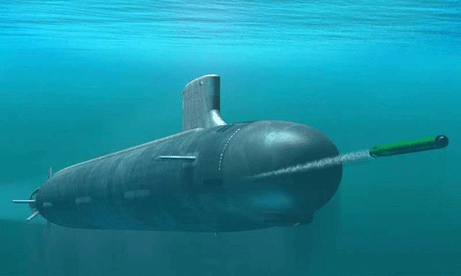 Russian nuclear sub given shelter near Florida during Sandy http://rt.com/usa/news/russian-nuclear-sub-gertz-097/ : 06 November, 2012, Defense officials say that a nuclear-powered Russian attack submarine sailed to within 200 miles of the United States last week and was granted safe harbor as Superstorm Sandy struck the East Coast.
According to a report published this week by defense commentator Bill Gertz, a Russian Sierra-2 class submarine was spotted recently not too far away from Kings Bay, Georgia, where the United States stations its own ballistic and cruise missiles, including six underwater-capable vessels also powered by nuclear energy. Continue reading
Hurricane Sandy and climate change
What Does Hurricane Sandy Show us about Shoreline Change? http://www.enn.com/climate/article/45168 5 Nov 12 Contrarians argue that Hurricane Sandy isn’t proof of climate change. But local scientists say the recent storm offers more damning evidence that Rhode Island’s weather and landscape are undergoing a long-term transformation — one with a steep cost in dollars and human health.
Perhaps the most significant and indisputable fact is that the Atlantic Ocean is warmer, so much so that a late-October storm didn’t lose steam over what should have been a colder sea. Instead, Sandy gained speed and strength as it headed north and became an enormous force of destruction. Continue reading
USA nuclear reactors not prepared for very high storm surges
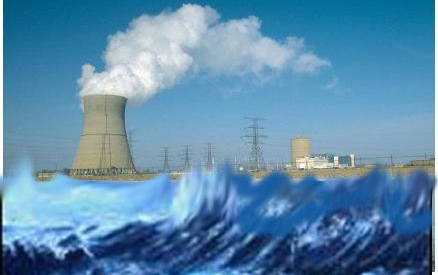 When the nuclear industry says that it can withstand conditions “beyond that historically reported,” we should want to know a lot more
United States came in second, behind Japan, as the country with the largest number of inadequately protected nuclear power plants. The 1938 New England hurricane triggered a storm surge as high as 25 to 30 feet, considerably higher than waves generated this week by Sandy. A wave that tall would easily overtake many nuclear plants on the East Coast, which on average lie about 20 feet above sea level, with minimal sea wall protection.
SANDY, FUKUSHIMA, AND THE NUCLEAR INDUSTRY New Yorker by Evan Osnos, November 2, 2012 When Hurricane Sandy hit the East Coast, it forced three nuclear reactors to shut down, including the Indian Point 3 plant along the banks of the Hudson, about twenty-five miles north of New York City. Three more reduced their output as a precaution. At
the nation’s oldest nuclear plant, the Oyster Creek facility, about thirty-three miles north of Atlantic City, operators faced an unusual event: wind, a rising tide, and the storm surge sent more water than normal into the plant’s water-intake system.
At the same time, the plant, which was already down for maintenance, lost its electrical
power from the grid. Operators called an “alert” that escalated the plant a step up from the lowest emergency level, and they turned to backup generators to keep cooling the reactor. Continue reading
First insurance companies, now even AMERICANS wake up to global warming!
On Oct. 17 the giant German reinsurance company Munich Re issued a prescient report titled Severe Weather in North America. Globally, the rate of extreme weather events is rising, and “nowhere in the world is the rising number of natural catastrophes more evident than in North America.” From 1980 through 2011, weather disasters caused losses totaling $1.06 trillion. Munich Re found “a nearly quintupled number of weather-related loss events in North America for the past three decades.”
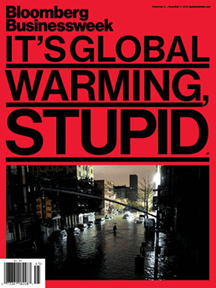 It’s Global Warming, Stupid Bloomberg Business Week By Paul M. Barrett November 01, 2012 Yes, yes, it’s unsophisticated to blame any given storm on climate change. Men and women in white lab coats tell us—and they’re right—that many factors contribute to each severe weather episode. Climate deniers exploit scientific complexity to avoid any discussion at all.
Clarity, however, is not beyond reach. Hurricane Sandy demands it: At least 40 U.S. deaths. Economic losses expected to climb as high as $50 billion. Eight million homes without power. Hundreds of thousands of people evacuated. More than 15,000 flights grounded. Factories, stores, and hospitals shut. Lower Manhattan dark, silent, and underwater.
An unscientific survey of the social networking literature on Sandy reveals an illuminating tweet (you read that correctly) from Jonathan Foley, director of the Institute on the Environment at the University of Minnesota. On Oct. 29, Foley thumbed thusly: “Would this kind of storm happen without climate change? Yes. Fueled by many factors. Is storm stronger because of climate change? Yes.”
Eric Pooley, senior vice president of the Environmental Defense Fund (and former deputy editor of Bloomberg Businessweek), offers a baseball analogy: “We can’t say that steroids caused any one home run by Barry Bonds, but steroids sure helped him hit more and hit them farther. Now we have weather on steroids.” Continue reading
In this climate challenged world, nuclear lobbyists have nothing to crow about
Having a grid that simply survives a category 1 hurricane without a Fukushima-sized nuclear disaster is nothing to crow about.
The astronomical cost of restoring power to millions of consumers is real, as is the potential danger still posed by a number of crippled nuclear power plants.
Oyster Creek Nuclear Alert: As Floodwaters Fall, More Questions Arise TruthOut , 01 November 2012 Gregg Levine, capitoilette | News Analysis“……If you thought all of these problems would cause nuclear industry representatives to lay low for a while, well, you’d be wrong: “Our facilities’ ability to weather the strongest Atlantic tropical storm on record is due to rigorous precautions taken in advance of the storm,” Marvin Fertel, chief executive officer of the Nuclear Energy Institute, a Washington-based industry group, said yesterday in a statement.
Fertel went on to brag that of the 34 reactors it said were in Sandy’s path, 24 survived the storm without incident.
Or, to look at it another way, during a single day, the heavily populated eastern coast of the Unite States saw multiple nuclear reactors experience problems. And that’s in the estimation of the nuclear industry’s top lobbyist.
Or, should we say, the underestimation? Of the ten reactors not in Fertel’s group of 24, seven were already offline, and the industry is not counting them. So, by Fertel’s math, Oyster Creek does not figure against what he considers success. Power reductions and failed emergency warning systems are also not factored in, it appears. Continue reading
The KOCHtopus strangles the truth on climate change – profit is their motive
 Koch Brothers and Their Amazig Climate Change Denial
  http://www.desmogblog.com/2012/10/22/koch-brothers-produce-counterfeit-climate-report-deceive-congress an upcoming junk study from a Koch-funded think tank that has taken on the format and appearance of a truly scientific report from the US Government, but is loaded with lies and misrepresentation of actual climate change science. The false report is a tentacle of the Kochtopus–with oil and industrial billionaires Charles and David Koch at the head. Continue reading
2012 – USA’s hottest year on record?
 US on course to notch record year of heat SMH, October 19, 2012 After a hot spring and a scorching summer, this winter is likely to continue a US warming trend that could make 2012 the hottest year since modern record-keeping began, US weather experts said Thursday.
Drought that ravaged much of the United States this year may spread in the coming months, said Mike Halpert at the National Oceanic and Atmospheric Administration’s Climate Prediction Center.
“The large majority of that drought we expect to persist,” Halpert said. “We even see drought expanding westward … into Montana, Idaho and part of Oregon and Washington.”
Dryer-than-usual winter weather is expected in much of the Pacific Northwest, with higher-than-normal precipitation predicted for the Gulf Coast, according to NOAA forecasts……There is enough data to predict a warm winter overall, said Deke Arndt, chief of climate monitoring at NOAA’s National Climatic Data Center.
The first nine months of 2012 were the warmest of any year on record in the contiguous United States, and this has been the third-hottest summer since record-keeping began.
“The main issues facing the US going into this (winter) outlook period stem from persistent heat and drought,” Arndt said at a telephone briefing. “It is likely that 2012 will be the warmest of the 118-year record for the contiguous United States.” http://www.smh.com.au/environment/climate-change/us-on-course-to-notch-record-year-of-heat-20121019-27uyc.html#ixzz29t6FaiSX
Rapid melting of ice in the Antarctic
parts of the Antarctic ice caps were melting at unprecedented rates.
“The role of scientists is not to be alarmists, and not to downplay the data, but simply to report it.”
Antarctic climate facing ‘rapid’ changes: chief scientist, The Age, October 16, 2012 -Australia’s chief Antarctic scientist says claims by climate experts about environmental changes in the southern continent are not alarmist.
The Australian Antarctic Division (AAD) told a Senate estimates hearing today “rapid changes” taking place across the icy land mass would have significant impact on global climate.
Changes in ocean flows and shifts in Antarctic ice cap levels were occurring at rates faster than at any other time in history, chief scientist Nick Gales said. ”That’s the part that is the most dramatic about the information we’re receiving,” he told the hearing. Continue reading
Nuclear power plants can’t cope with increasing heat, with climate change
 Climate change Millstone shutdown is a sign of broader power problem caused by climate change CT Mirror, September 24, 2012 By Jan Ellen Spiegel Waterford — Last month’s unprecedented 12-day shutdown of part of the Millstone Nuclear Power Station sent a shudder through the nuclear energy world.
Caused when the seawater used to cool the plant’s generating Unit 2 became too warm, it was the first time any U.S. nuclear plant was shut down because of intake water temperature problems.
Nuclear energy officials were concerned, but “I don’t know if we would say ‘surprised,'” said Richard MacManus, Millstone’s director of nuclear safety and licensing. He spoke as he stood alongside Niantic Bay, taking in the panoramic view of the massive Millstone facility and Long Island Sound, its source of water.
The shutdown capped a season of power reductions and other difficulties at several of the nation’s power plants — including non-nuclear ones — caused when summer heat and drought compromised the vast amounts of water needed to cool them. It has also set in motion a cascade of other potentially debilitating effects, all of which point to the likelihood that climate change has placed part of the U.S. power grid at risk.
Curiously, the industry and its watchers had seen it coming — for decades……… http://www.ctmirror.org/story/17512/millstone-shutdown-sign-broader-water-power-conflicts-climate-change
Global warming causing rapid decline in Arctic sea ice
Norwegian Arctic Summers Warmest in 1,800 Years
Summer temperatures on the Norwegian archipelago of Svalbard in the High Arctic are now higher than during any time over the last 1,800 years, including a period of higher temperatures in the northern hemisphere known as the Medieval Warm Period, according to a new study. In an analysis of algae buried in deep lake sediments, a team of scientists calculated that summer temperatures in Svalbard since 1987 have been 2 to 2.5 degrees Celsius (3.6 to 4.5 degrees F) warmer than during the Medieval Warm Period, which lasted from roughly 950 to 1250 AD. Scientists say this year’s record declines in Arctic sea ice extent and volume are powerful evidence that the giant cap of ice at the top of the planet is on a trajectory to largely disappear in summer within a decade or two, with profound global consequences. http://www.enn.com/wildlife/article/45024
Climate change brings storm, wave, threats to nuclear power plants
Millstone shutdown is a sign of broader power problem caused by climate change, CT Mirror, September 24, 2012, By Jan Ellen Spiegel “……As if warm water and lack of water haven’t produced enough hand-wringing at power plants this summer, scientists also are mindful that climate change includes sea level rise and increasingly violent storms. Millstone, literally at the water’s edge, has suffered storm-related power reductions over the years. MacManus said waves came over the seawall during Tropical Storm Irene, but water did not enter any buildings.
The NRC’s new chairwoman, Allison Macfarlane, has asked her staff to examine the effects of climate change on nuclear power plant operation.
But the industry bristles at the notion that it has ignored water issues. “It would be wrong to think that this is a sudden thing no one has ever thought about, no one has ever talked about,” said William Skaff, director of policy analysis at the Nuclear Energy Institute, the industry’s policy organization.
But others like John Rogers, co-manager of the energy and water project for the Union of Concerned Scientists, saw the Millstone shutdown and other incidents as wake-up calls.
“It’s clear that past energy choices in numerous instances are colliding with available water resources,” he said. “What this summer did was really underscore the potential for collision. In a lot of cases power plants got the water they needed. What we don’t know is who didn’t get the water.” http://www.ctmirror.org/story/17512/millstone-shutdown-sign-broader-water-power-conflicts-climate-change
Nuclear and coal power plants the victims of global warming
As the U.S. Warms, Power Plants Face New Water Limits Climate Central,By Andrew Freedman, 25 Sept The power sector is responsible for a large share — about 40 percent — of greenhouse gas emissions in the U.S., particularly thermoelectric-generating stations, such as coal-fired power plants. And so it is not without a hint of irony that a recent study concluded that the effects of global warming, particularly drought and heat waves, will increasingly limit the generating capacity of these power plants — thereby making them both contributors to and victims of global warming…
… In the U.S., power plant operators must comply with laws such as the Clean Water Act, as well as state regulations that prohibit nuclear and other plants from operating once water temperatures go above a certain threshold, Continue reading
Sea ice at record low – climate change nears crisis point
What the scientific community understands is that Arctic ice is melting at an accelerated rate — and that humans play a role in these changes.
includes VIDEO Arctic Sea Ice Levels Hit Record Low, Scientists Say We’re ‘Running Out Of Time’, HUFFINGTON POST Joanna  Zelman James Gerken
09/19/2012 As Arctic sea ice levels hit a new record low this month, scientists and activists gathered to discuss how to bridge the gap between scientific facts and the public’s limited understanding that we are, in their words, “really running out of time.”
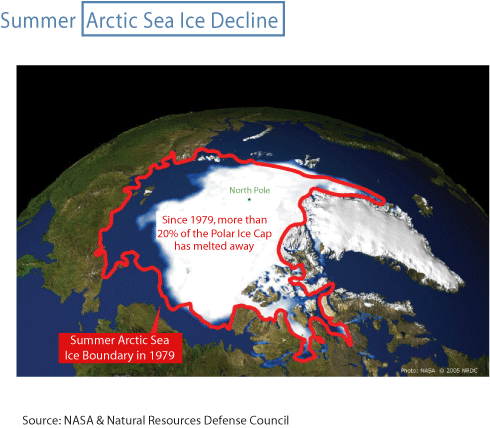
The National Snow and Ice Data Center (NSIDC) released preliminary findings Wednesday suggesting that on Sept. 16, Arctic ice covered just 1.32 million square miles — the lowest extent ever recorded. This minimum is 49 percent below the 1979 average, when satellite records began. Continue reading
1 This Month





PLEASE OPPOSE HR 8255 AND S.3639 – bills would accelerate satellite deployment, with no environmental review or safeguards – https://ncstd5li.quorum.us/campaign/169331/
To see nuclear-related stories in greater depth and intensity – go to https://nuclearinformation.wordpress.com
-
Archives
- October 2026 (29)
- September 2026 (339)
- August 2026 (330)
- July 2026 (355)
- June 2026 (287)
- May 2026 (306)
- April 2026 (356)
- March 2026 (251)
- February 2026 (267)
- January 2026 (308)
- December 2025 (358)
- November 2025 (359)
-
Categories
- 1
- 1 NUCLEAR ISSUES
- business and costs
- climate change
- culture and arts
- ENERGY
- environment
- health
- history
- indigenous issues
- Legal
- marketing of nuclear
- media
- opposition to nuclear
- PERSONAL STORIES
- politics
- politics international
- Religion and ethics
- safety
- secrets,lies and civil liberties
- spinbuster
- technology
- Uranium
- wastes
- weapons and war
- Women
- 2 WORLD
- ACTION
- AFRICA
- Atrocities
- AUSTRALIA
- Christina's notes
- Christina's themes
- culture and arts
- Events
- Fuk 2022
- Fuk 2023
- Fukushima 2017
- Fukushima 2018
- fukushima 2019
- Fukushima 2020
- Fukushima 2021
- general
- global warming
- Humour (God we need it)
- Nuclear
- RARE EARTHS
- Reference
- resources – print
- Resources -audiovicual
- Weekly Newsletter
- World
- World Nuclear
- YouTube
-
RSS
Entries RSS
Comments RSS

