Heat pollution in river due to Vermont Yankee nuclear power plant
Demonstrators take to the water to protest against Vermont Yankee By JOSH STILTS Brattleboro Reformer 09/17/2012 Marlboro residents Rose Watson and Laura Berkowitz share their boat with an unnamed protester during Saturday s Safe and Green flotilla.
More than 100 anti-nuclear activists gathered along the Connecticut River to tell the owners of the Vermont Yankee nuclear power plant to stop dumping the reactor s thermal discharge into the river.
VERNON — Dozens of protesters flocked to the Connecticut River Saturday afternoon to condemn the Vermont Yankee nuclear power plant and its owner, Entergy, for the reactor’s thermal discharge…… State Rep. David Deen, D-Westminster addressed the crowd and spoke about his concerns and those of fellow members of the Connecticut River Watershed Council.
According to a recent report from several hydrologists, the river’s temperature exceeded Vermont Yankee’s permit limit 58 percent of the time between May and October of 2006 through 2010. One of the group’s major concerns is the affect that the increased water temperatures is having on fish that use the Connecticut as their spawning grounds. Continue reading
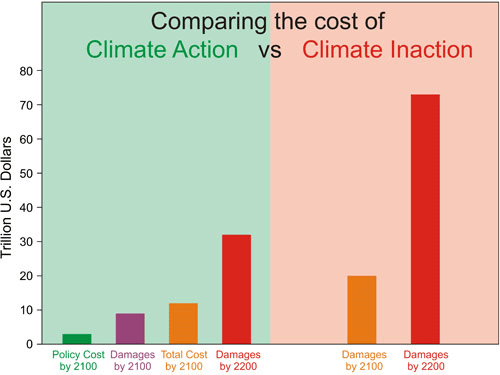
It will be very costly NOT to act on Climate Change
it is worth exploring the question, what would a world with >2°C global surface warming look like?
Global Warming Impacts
The 2007 IPCC Fourth Assessment Report (AR4) summarizes the magnitudes of impact of various degrees of warming here, and graphically….
This is Why Reducing Emissions is Critical
Realistically What Might the Future Climate Look Like? Sceptical Science 31 August 2012 by dana1981Robert Watson, former Chair of the Intergovernmental Panel on Climate Change (IPCC),recently made headlines by declaring that it is unlikely we will be able to limit global warming to the 2°C ‘danger limit’. This past April, the International Energy Agency similarly warnedthat we are rapidly running out of time to avoid blowing past 2°C global warming compared to late 19th Century temperatures. The reason for their pessimism is illustrated in the ‘ski slopes’ graphic, which depicts how steep emissions cuts will have to be in order to give ourselves a good chance to stay below the 2°C target, given different peak emissions dates
Clearly our CO2 emissions have not yet peaked – in fact they increased by 1 billion tonnes between 2010 and 2011 despite a continued global economic recession; therefore, the green curve is no longer an option. There has also been little progress toward an international climate accord to replace the Kyoto Protocol, which suggests that the blue curve does not represent a likely scenario either – in order to achieve peak emissions in 2015 we would have to take serious steps to reduce emissions today, which we are not. The red curve seems the most likely, but the required cuts are so steep that it is unlikely we will be able to achieve them, which means we are indeed likely to surpass the 2°C target. Continue reading
Temperatures rise as atmospheric greenhouse gases heat up the ocean
if global warming of the past decades was due to El Niño or another mechanism involving heat from the ocean, the ocean would have lost heat. But the heat content has gone up, not down. And it is well understood why: because we created a radiation imbalance by adding greenhouse gases to our atmosphere.
The signal of global warming caused by humans is very clear, despite attempts by certain parties to drown it out with a lot of noise.
 If 2013 breaks heat record, how will deniers respond?, New Scientist, 03 September 2012 by Stefan Rahmstorf With an El Niño on the way, 2013 could be the warmest year on record. But the climate-denial machine will keep on churning
IT HAS been another “normal” global-warming summer in the northern hemisphere. The US sweltered in the hottest July on record, following thehottest spring on record. More than 60 per cent of the contiguous US is suffering from drought, as are parts of eastern Europe and India. In the Arctic, sea ice cover is at a record low and the Greenland ice sheet shows what theUS National Snow and Ice Data Center calls “extraordinary high melting”. Global land temperatures for May and June were the hottest since records began in the 19th century.
Meanwhile, El Niño conditions are forecast to develop in the tropical Pacific Ocean, warming up ocean surface temperatures. Some observers have predicted that this will lead to record-breaking global temperatures next year.
If El Niño does arrive and temperature records are broken, there will inevitably be much discussion of the causes of the warming. So now is a good time to sort signal from noise in the global temperature records. Continue reading
Climate Change Denial and Conspiracy Theories
 Climate change deniers ‘are either extreme free marketeers or conspiracy theorists’ An Australian study says avid climate change deniers tend to be either extreme free marketeers or conspiracy theorists who believe the moon landing was faked or Princess Diana was murdered.Telegraph, By Jonathan Pearlman in Sydney 28 Aug 2012 The study, to be published in the journal Psychological Science, also found that those who reject the scientific consensus on the human contribution to climate change are more likely to to reject other scientific findings such as the linkage between tobacco and lung cancer or between HIV and Aids.
The paper, titled “NASA faked the moon landing – Therefore (Climate) Science is a Hoax: An Anatomy of the Motivated Rejection of Science”, was based on a survey of more than 1000 visitors to blogs dedicated to discussion of climate change.
“We find that endorsement of a laissez-faire conception of free-market economics predicts rejection of climate science,” the paper says. “We additionally show that endorsement of a cluster of conspiracy theories (e.g., that the CIA killed Martin Luther King or that NASA faked the moon landing) predicts rejection of climate science as well as the rejection of other scientific findings.”
The paper says that a staunch belief in free markets was an overwhelmingly strong factor in the rejection of climate science and was a stronger factor than conspiratorial thinking.
It surveyed people on attitudes to a range of conspiracy theories, including that the United States allowed the September 11 attacks to occur and that SARS was produced in a laboratory as a biological weapon.
The lead researcher, Professor Stephan Lewandowsky, from the University of Western Australia, said conspiracy theories are the “antithesis to scientific thinking” and those who believe them are more likely to reject the scientific consensus that humans contribute to climate change.
“Science is about weeding out bad ideas,” he told The Daily Telegraph. “With conspiracy theories, you start out with a theory and stick to it no matter what the evidence. So it is not that surprising that conspiracy theorists would not accept scientific propositions … If the scientific evidence is overwhelming and you don’t like the conclusion, you have to find a way to reject those findings.”…. http://www.telegraph.co.uk/earth/environment/climatechange/9503044/Climate-change-deniers-are-either-extreme-free-marketeers-or-conspiracy-theorists.html
Climate Change is affecting nuclear power plants

 How Climate Change May Affect Nuclear Power Plants http://theenergycollective.com/node/107461?utm_source=tec_newsletter&utm_medium=email&utm_campaign=newsletter August 29, 2012 Many nuclear power plants rely heavily on access to nearby sources of cold water to keep the system cool. Many of these power plants were built several decades ago and some of them are not well prepared for the warmer weather we are now experiencing.
At a twin-unit nuclear power plant in Illinois , temperatures exceeded what is allowed with current regulations by four degrees Fahrenheit.
Craig Nesbit a spokesman for Exelon, which owns the plant, stated the following about the recent incident:
“I’m not a climatologist. But clearly the calculations when the plant was first operated in 1986 are not what is sufficient today, not all the time.”
The cooling pond consists of a 2,500-acre (10 square kilometer) lake. For a cooling system like this to function properly, the heat dumped into the pond eventually has to move somewhere else. The warmer the weather the more saturated the air becomes, which means less energy is transferred away from the cooling pond. In a typical situation, cooling ponds loose their heat during the night, but because the temperatures these days have stayed above 90 degrees, the plant`s cooling system has been compromised.
The permitted level that originally was 98 degrees has now been increased to 100 degrees in order keep the power plant up and running.
The safety argument “is likely solid and justified,’’ stated David Lochbaum of the Union of Concerned Scientists, but “it is tough to argue (rationally) that warming water conditions are unforeseen.’’ That is a predictable consequence of global warming, he said.
Drought and water shortages, also caused by the change in weather, could potentially become a problem for nuclear power plants in the near future as well. A nuclear power plant`s cooling could become less efficient by water-shortages in much the same it does with increasing temperatures. Georgia, Alabama and similar states have to be extra careful with this in the coming years.
Human caused Climate Change is real – American Meteorological Society
 American Meteorological Society confirms Climate Change and Man’s Role http://www.enn.com/pollution/article/44884 Gina-Marie Cheeseman, August 31, 2012 Weathercasters in the U.S. not only tend to not ever mention climate change, but the majority of them do not even believe it is human-caused, as an article I recently wrote shows. However, that may change.
The statement goes in to detail about the effects of climate change, which include temperature increases. All of the 10 warmest years in the global temperature records up to 2011 have occurred since 1997, and 2005 and 2010 were the warmest years in more than a century of global records. Most of the observed warming in the U.S. has occurred in the West and in Alaska, but for the country as a whole there have been twice as many record daily high temperatures compared to record daily low temperatures in the first decade of the 21st century. Read more at ENN Affiliate, TriplePundit.
Nuclear power as a solution to Climate Change? not really possible or desirable
 Realistically the world might build 100 or so new reactors over the coming decade or so – .. Over this same period a similar number of existing reactors will reach the end of their lives and close, leading to a net growth rate close to zero.
Does the world need nuclear power to solve the climate crisis? Nuclear power looks expensive and repulsive compared to increasingly affordable renewable energy, argues Oliver Tickell, The Guardian, 20 Aug 12, “…..this is the question: does the world need nuclear power for us to solve the climate crisis, as Monbiot claims? To borrow a second thought, this time from Margaret Thatcher, must we accept that there is no alternative?….. Continue reading
Climate change heat might mean the end of the nuclear industry
Extreme Heat, Drought Show Vulnerability of Nuclear Power Plants Reactor shutdown in Connecticut is latest sign that nuclear energy would face challenges from climate change. By Robert Krier, InsideClimate News, 15 Aug 12, Will 2012 go down as the year that left the idea of nuclear energy expansion in the hot, dry dust?
Nuclear energy might be an important weapon in the battle against climate change, some scientists have argued, because it doesn’t emit greenhouse gases. But separate of all the other issues with nuclear, that big plus would be moot if the plants couldn’t operate, or became too inefficient, because of global warming. In June, InsideClimate News reported on the findings of Dennis Lettenmaier, a researcher at the University of Washington. His study found that nuclear and other power plants will see a 4 to 16 percent drop in production between 2031 and 2060 due to climate change-induced drought and heat.
The U.S. is getting plenty of both this year. Just Sunday, the Millstone nuclear plant in Waterford, Conn., had to shut down one of its two reactors because seawater was too warm to cool it. It was the first time in the plant’s 37-year history that the water pulled from the Long Island Sound was too warm to use.
So the question becomes, is the future already here?
Heat records have been falling by the thousands since spring, and on Aug. 9 theU.S. Drought Monitor map showed that 62.46 percent of the nation is under moderate to exceptional drought conditions. That’s down slightly from the peak of 63.86 percent last month, the highest percentage since the Drought Mitigation Center began producing the map in 2000. But the percentage of the country that is experiencing extreme to exceptional drought continued to rise and is now at 24.14 percent, almost a fourth of the country.
Much of the drought and unusual heat has been in areas that rely in part on nuclear plants: the upper Midwest, the Southeast and parts of New England.
When all of the nation’s 104 nuclear plants are fully operational, they supply about 20 percent of the energy generated in the United States. Those plants need water to operate, and in most cases, they need fresh water. There’s not a lot of fresh water to go around in much of the nation this summer, and that is putting nuclear energy to the test.
It’s also raising questions about how freshwater supplies should be managed in a world further taxed by climate change. Inevitably, there will be increased competition for water from a growing population, agriculture and the energy sector.
(Plants that use saltwater for cooling generally don’t have the same issues, because they never have a shortage of water. But the shutdown at Millstone shows they can still be vulnerable to heat waves.)
About 40 percent of the nation’s fresh water use goes toward energy generation, with nuclear energy considered a very water-intensive energy source….. http://insideclimatenews.org/news/20120815/nuclear-power-plants-energy-nrc-drought-weather-heat-water utm_source=feedburner&utm_medium=feed&utm_campaign=Feed:%20solveclimate/blog%20(InsideClimate%20News
List of USA’s nuclear power plants badly affected by extreme heat
Extreme Heat, Drought Show Vulnerability of Nuclear Power Plants By Robert Krier, InsideClimate News, 15 Aug 12, “……— The Vermont Yankee plant near Brattleboro had to limit output four times in July because of low river flow and heat. At one point, production was reduced to 83 percent of capacity.
— FristEnergy Corp’s Perry 1 reactor in Ohio dropped production in late July to 95 percent of capacity because of above-average temperatures.
— Operators of the Braidwood, Ill., nuclear plant 60 miles southwest of Chicago sought and were granted a waiver from the Environmental Protection Agency to raise the temperature of a cooling pond to 102 degrees—2 degrees above the established limit. The pond holds water cycled through the plant for cooling and then discharged. If the plant had not received the waiver, it would have had to scale back production in the middle of an intense heat wave. Kraft said the nuclear plants’ operating difficulties are part of a recurring pattern. In the summer of 1988, drought, high temperatures and low river volumes forced Commonwealth Edison to reduce power by 30 percent or shut down, in some cases, at the Dresden and Quad Cities plants in Illinois.
“That was the first wake-up call that plants would be vulnerable in a climate-disrupted world,” Kraft said.
There have been many more instances since:
— Europe, summer of 2003. During the heat wave that killed more than 30,000 people, France, Germany and Spain had to choose between allowing reactors to exceed design standards and thermal discharge limits and shutting down reactors. Spain shut down its reactors, while France and Germany allowed some to operate and shut down others.
— Illinois, summer of 2005. EPA and state officials considered easing thermal discharge standards because of drought, but a break in the weather made it unnecessary.
— Illinois, Minn., July 29 to Aug. 2, 2006. The Prairie Island (Minn.) plant had to reduce output by 54 percent. The Quad Cities, Dresden and Monticello plants in Illinois also cut power to moderate water discharge temperatures.
— Michigan, July 30, 2006. The Donald C. Cook reactors in Michigan were shut down during a severe heat wave because temperatures in a containment building exceeded the regulatory limit of 120 degrees.
— Southeast U.S, Aug. 5-12, 2008. The Tennessee Valley Authority lost a third of nuclear capacity due to drought conditions. All three Browns Ferry reactors in Alabama were idled to prevent overheating of the Tennessee River.
— France, July 2009. France had to purchase power from England because almost a third of its nuclear generating capacity was lost when it had to cut production to avoid exceeding thermal discharge limits.
— Southeast U.S., July, August 2011. The TVA reduced power at Browns Ferry to stay within discharge limits. At one point, all three of the reactors cut output to about 50 percent. Had the plant been operating at full capacity, the downstream temperature on the Tennessee River would have exceeded the 90-degree limit…. http://insideclimatenews.org/news/20120815/nuclear-power-plants-energy-nrc-drought-weather-heat-water?utm_source=feedburner&utm_medium=feed&utm_campaign=Feed:%20solveclimate/blog%20(InsideClimate%20News)
Hotter summers shut down nuclear power plants
 Heat Shuts Down a Coastal Reactor NYT, By MATTHEW L. WALD A reactor at the Millstone nuclear plant in Waterford, Conn., has shut down because of something that its 1960s designers never anticipated: the water in Long Island Sound was too warm to cool it.
Under the reactor’s safety rules, the cooling water can be no higher than 75 degrees. On Sunday afternoon, the water’s temperature soared to 76.7 degrees, prompting the operator, Dominion Power, to order the shutdown of the 880-megawatt reactor.
“Temperatures this summer are the warmest we’ve had since operations began here at Millstone,’’ said a spokesman for Dominion, Ken Holt. The plant’s first reactor, now retired, began operation in 1970.
The plant’s third reactor was still running on Monday, but engineers were watching temperature trends carefully out of concern that it, too, might have to shut down….. And higher water temperatures could lie ahead. The sound’s temperature usually does not peak until late August….. Power plants in the Midwest have also experienced problems as temperatures soared in recent weeks. In some cases, reactors shut down because the cooling water was too warm; in others, the ongoing drought had shrunken the body of water from which the cooling water is drawn, and the plant’s intake pipes were above the surface.
Last month the twin-unit Braidwood nuclear plant in Illinois needed special permission to keep operating because its cooling water pond reached 102 degrees as a result of low rainfall and high air temperatures. When Braidwood opened 26 years ago, it was designed to run at temperatures up to 98 degrees. http://green.blogs.nytimes.com/2012/08/13/heat-shuts-down-a-coastal-reactor/
Nuclear power plants can’t cope with increasingly hot summers
simply getting permission to suck in hotter water does not make the problem go away..
despite a myriad of potential problems and two decades of climate warnings, it is sobering to note that none of the US reactors were built to account for any of this
[The new reactors] they are still PWRs and they still require a large reserve of cool, circulating water to keep them operating and nominally safe.
 For Nuclear Power This Summer, It’s Too Darn Hot, Truth Out, 05 August 2012 By Gregg Levine, You know that expression, “Hotter than July?” Well, this July, July was hotter than July. Depending on what part of the country you live in, it was upwards of three degrees hotter this July than the 20th Century average. Chicago, Denver, Detroit, Indianapolis and St. Louis are each “on a pace to shatter their all-time monthly heat records.” And “when the thermometer goes way up and the weather is sizzling hot,” as the Cole Porter song goes, demand for electricity goes way up, too….. Take, for example, Braidwood, the nuclear facility that supplies much of Chicago with electricity: Continue reading
Heat danger, even when nuclear reactors are shut down
For Nuclear Power This Summer, It’s Too Darn Hot, Truth Out, 05 August 2012 By Gregg Levine, ”……when it comes to nuclear power, as global temperatures continue to rise and water levels in rivers and lakes continue to drop, an even more disconcerting threat emerges.
When a coal plant is forced to shut down because of a lack of cool intake water, it can, in short order, basically get turned off. With no coal burning, the cooling needs of the facility quickly downgrade to zero.
A nuclear reactor, however, is never really “off.”
When a boiling water reactor or pressurized water reactor (BWR and PWR respectively, the two types that make up the total of the US commercial reactor fleet) is “shutdown” (be it in an orderly fashion or an abrupt “scram”), control rods are inserted amongst the fuel rods inside the reactor. The control rods absorb free neutrons, decreasing the number of heavy atoms getting hit and split in the fuel rods. It is that split, that fission, that provides the energy that heats the water in the reactor and produces the steam that drives the electricity-generating turbines. Generally, the more collisions, the more heat generated. An increase in heat means more steam to spin a turbine; fewer reactions means less heat, less steam and less electrical output. But it doesn’t mean no heat.
The water that drives the turbines also cools the fuel rods. It needs to circulate and somehow get cooled down when it is away from the reactor core. Even with control rods inserted, there are still reactions generating heat, and that heat needs to be extracted from the reactor or all kinds of trouble ensues–from too-high pressure breaching containment to melting the cladding on fuel rods, fires, and hydrogen explosions. This is why the term LOCA–a loss of coolant accident–is a scary one to nuclear watchdogs (and, theoretically, to nuclear regulators, too).
So, even when they are not producing electricity, nuclear reactors still need cooling. They still need a power source to make that cooling happen, and they still need a coolant, which, all across the United States and most of the rest of the world, means water. http://truth-out.org/news/item/10707-for-nuclear-power-this-summer-its-too-darn-hot
Secrecy in USA on nuclear plants affected by hot weather
For Nuclear Power This Summer, It’s Too Darn Hot, Truth Out, 05 August 2012 By Gregg Levine, “……..Water that is increasingly growing too warm or too scarce. . . at least in the summer. . . you know, when it’s hot. . . and demand for electricity increases.
In fact, Braidwood is not the only US plant that has encountered problems this sultry season:
[A] spokeswoman for the Midwest Independent System Operator, which operates the regional grid, said that another plant had shut down because its water intake pipes were now above the water level of the body from which it draws its cooling water. Another is “partially curtailed.”
That spokeswoman can’t, it seems, tell us which plants she is talking about because that information “is considered competitive.” (Good to know that the Midwest Independent System Operator has its priorities straight. . . . Hey, that sounds like a hint! Anyone in the Midwest notice a nearby power plant curtailing operations?)
So, not isolated. . . and also not a surprise–not to the Nature Climate Change people this year, and not to the industry, itself. . . 17 years ago. The Electric Power Research Institute (EPRI), a non-profit group of scientists and engineers funded by the good folks who generate electricity (a group that has a noticeable overlap with the folks that own nuclear plants), released a study in 1995 that specifically warned of the threat a warming climate posed to electrical generation. The EPRI study predicted that rising levels of atmospheric carbon dioxide would make power production less efficient and more expensive, while at the same time increasing demand.
And climate predictions have only grown more dire since then….. http://truth-out.org/news/item/10707-for-nuclear-power-this-summer-its-too-darn-hot
Conservative USA think tank finds that human changed climate is real!
Climate results turn sceptic: ‘let the evidence change our minds’ The Age July 30, 2012, Leo Hickman THE Earth’s land has warmed by 1.5 degrees Celsius in the past 250 years and ”humans are almost entirely the cause”, according to a scientific study set up to address climate sceptic concerns about whether human-induced global warming is occurring. Richard Muller, a climate sceptic physicist who founded the Berkeley Earth Surface Temperature (BEST) project, said he was ”surprised” by the findings. ”We were not expecting this, but as scientists, it is our duty to let the evidence change our minds.”
He said he considered himself a ”converted sceptic” and his views had received a ”total turnaround” in a short space of time. ”Our results show that the average temperature of the Earth’s land has risen by 2½ degrees Fahrenheit over the past 250 years, including an increase of 1½ degrees over the most recent 50 years.
Moreover, it appears likely that essentially all of this increase results from the human emission of greenhouse gases,”Professor Muller wrote in an opinion piece for The New York Times.
The team of scientists based at the University of California, Berkeley, gathered and merged 14.4 million land temperature observations from 44,455 sites across the world dating back to 1753. Previous datasets created by NASA, the US National Oceanic and Atmospheric Administration, Britain’s Meteorological Office and the University of East Anglia’s Climate Research Unit had gone back only to the mid-1800s and used five times fewer weather station records.
The funding for the project included $US150,000 from the Charles G. Koch Charitable Foundation, set up by the billionaire US coal magnate who is a key backer of the climate sceptic Heartland Institute think tank. http://www.theage.com.au/environment/climate-change/climate-results-turn-sceptic-let-the-evidence-change-our-minds-20120730-23769.html#ixzz229AhMmUv
Sound and fury, but not science, behind UK’s anti wind energy lobby
But ‘the biggest threat to our valued landscapes is climate change. Onshore wind is the cheapest source of low-carbon power, and restricting its development would jeopardise our firm commitment to offer value for money to the consumer, as well as green energy.
Bashing wind, Environmental Rsearch, 28 July 12 A new report from the Campaign to Protect Rural England (CPRE) says on-land wind projects can threaten the ‘beauty and tranquility of much-loved landscapes.’… Continue reading
1 This Month





PLEASE OPPOSE HR 8255 AND S.3639 – bills would accelerate satellite deployment, with no environmental review or safeguards – https://ncstd5li.quorum.us/campaign/169331/
To see nuclear-related stories in greater depth and intensity – go to https://nuclearinformation.wordpress.com
-
Archives
- October 2026 (29)
- September 2026 (339)
- August 2026 (330)
- July 2026 (355)
- June 2026 (287)
- May 2026 (306)
- April 2026 (356)
- March 2026 (251)
- February 2026 (267)
- January 2026 (308)
- December 2025 (358)
- November 2025 (359)
-
Categories
- 1
- 1 NUCLEAR ISSUES
- business and costs
- climate change
- culture and arts
- ENERGY
- environment
- health
- history
- indigenous issues
- Legal
- marketing of nuclear
- media
- opposition to nuclear
- PERSONAL STORIES
- politics
- politics international
- Religion and ethics
- safety
- secrets,lies and civil liberties
- spinbuster
- technology
- Uranium
- wastes
- weapons and war
- Women
- 2 WORLD
- ACTION
- AFRICA
- Atrocities
- AUSTRALIA
- Christina's notes
- Christina's themes
- culture and arts
- Events
- Fuk 2022
- Fuk 2023
- Fukushima 2017
- Fukushima 2018
- fukushima 2019
- Fukushima 2020
- Fukushima 2021
- general
- global warming
- Humour (God we need it)
- Nuclear
- RARE EARTHS
- Reference
- resources – print
- Resources -audiovicual
- Weekly Newsletter
- World
- World Nuclear
- YouTube
-
RSS
Entries RSS
Comments RSS

