The significance of Antarctica’s melting ice shelves, in climate change
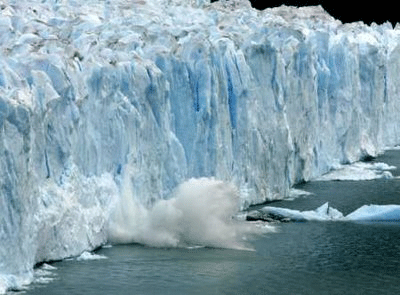 Why scientists are so worried about the ice shelves of Antarctica, WP, By Chelsea Harvey October 12 When it comes to climate change, Antarctica is one of the world’s major places of concern, mostly because of the sheer amount of ice it contains — enough to theoretically cause about 200 feet of sea-level rise if it were all to melt — not that anyone thinks that will happen anytime soon. Still, smaller parts could be destabilized, and understanding how the Antarctic ice sheet will react to future climate change is a big priority for scientists.
One important key to building this understanding is studying Antarctic ice shelves, which are large, floating platforms of ice — sometimes spanning hundreds or thousands of square miles — that form where where an ice sheet meets the ocean.
“They play an incredibly important role in constraining the flow of this land ice into the ocean,” says Luke Trusel, a postdoctoral scholar at the Woods Hole Oceanographic Institution, comparing ice shelves to the “cork in a champagne bottle.” If an ice shelf breaks off, it can unleash a flow of ice into the ocean from the ice sheet behind it, which can contribute to sea-level rise in a major way. Indeed, without ice shelves to provide buttressing, glaciers behind the ice shelves flow faster, pouring more and more ice into the ocean.
[Scientists declare an ‘urgent’ mission – study West Antarctica, and fast]
In order to get a better grip on how climate change could affect Antarctic ice shelves, Trusel and a group of other researchers conducted a study to see how rising air temperatures might affect surface melting in Antarctica. This is a process that can directly influence the destabilizing of ice shelves.
Past observations have shown that as ice melts on a shelf’s surface, the melted water starts to pool, or “pond,” and trickle down into imperfections in the ice, causing the cracks to deepen and widen — which can eventually cause ice shelves to collapse, unleashing the flow of land ice behind them.
“Increases in air temperature, and surface melt and ponding, has led to the abrupt and catastrophic collapse of a number of ice shelves,” says Trusel, lead author of the study, which was published Monday in Nature Geoscience. These collapses have mostly been observed on the Antarctic Peninsula, where the thinning and retreat of ice shelves has been particularly pronounced, thanks to higher-than-average warming in the area. The concern, though, is that more ice shelves that ring around Antarctica, including its colder regions, will start to give way as temperatures continue to rise and that other more inland parts of Antarctica will then follow suit.
The researchers used models to investigate the potential future impacts of two different climate scenarios: a “business-as-usual” trajectory, in which greenhouse gas emissions continue to rise throughout the century, and a more middle-of-the-road trajectory, in which emissions start declining before mid-century and there’s less associated global warming.
They found that under both scenarios, Antarctic-wide surface melt doubles by the year 2050, with the amount of meltwater produced coming close to 200 gigatons per year (a gigaton is a billion metric tons). This is a troubling finding, said Nerilie Abram, a researcher from the Centre of Excellence for Climate System Science at Australian National University who was not involved with the study, in an e-mail to The Post. But, she said, “I think that the more interesting result is to look at the huge divergence in predicted Antarctic ice melt during the second half of the century.”
After 2050, the projections for the two climate scenarios differ drastically. In the middle-of-the-road scenario, melt doesn’t increase much after mid-century. But in the business-as-usual scenario, melt continues to speed up, eventually hitting a rate of more than 600 gigatons per year by the end of the century.
“The most important results are … that we can see how quickly melting can evolve,” Trusel said. The results suggest that ice shelf surface melting increases exponentially with air temperature……….
One of the most important takeaways from the paper is “how important human action is on the climate of Antarctica,” Trusel added in a follow-up e-mail to The Post. Past observations show that humans have already altered the face of the continent, and the projections suggest that we have the power to continue doing so, he said.
“This shows that we do have a choice in how the Earth changes over the coming century,” said Abram, the researcher from Australian National University. “[We have] the option of a future where many of Antarctica’s ice shelves are still viable if we can curb emissions, compared to a future where many of Antarctica’s remaining ice shelves will probably have been lost if we continue our current emissions trajectory.” http://www.washingtonpost.com/news/energy-environment/wp/2015/10/12/why-scientists-are-worried-about-the-ice-shelves-of-antarctica/
Why all glass building facades will go out of fashion – the heat problem
All-Glass Facades Won’t Exist in Sustainable Cities, Davis Baggs, Sourceable, 13 Oct 15 “……..Glass alone cannot cover all contingencies, and the hotter the summer sun, the less successful it is. In winter in cold and even temperate climates high transmissivity (untinted) highly insulated glass units with Low-E coatings are typical and work very well. Problem is, in summer unshaded glass lets a lot of heat in, and the very factors that work for the building and occupants now works against them letting heat in and keeping it in, very efficiently overheating buildings and people all the better for the air conditioning engineers (whose fees are often based on the size of the air conditioning plants) and suppliers (who designed some of the major software tools engineers commonly use to design buildings).
So to overcome this, heat absorbing and reflective glasses were developed and to greater or lesser extent are used in all glass facades in climates where there is any bite at all in the summer sun.
Herein lies some of the problem; heat isn’t just ‘heat’. Solar energy does enter buildings by conduction (efficiently offset by insulated glass units or IGUs) from the atmosphere but the majority enters via direct and diffuse solar radiation.
If we make the glass reflective enough to stop enough solar radiation to avoid overheating of unshaded all-glass facades, we create strong rogue reflections that cause accidents and literally melt cars. So we wind the reflectiveness back and bump up the tinting levels to absorb the radiation in the façade and this is where the next problems begin…………..
The human body is up to four times more sensitive to radiant heat than any other form of heat. In fact, we are more than two times more sensitive to radiant heat than all of the other heat loss or gain pathways (convection, conduction, respiration, and evaporation) combined. The body is highly sensitive to even small changes in radiant temperatures; that’s why we love radiators, heated floors and mass surfaces in buildings to retain heat and keep us both warm and cool.
But as you tint glass, it progressively absorbs more and more heat itself and it becomes in effect a large plate radiator. The darker the tint, the more heat it both absorbs and then eventually re-radiates even when it’s double-glazed, such as in IGUs. Its important to note that this doesn’t cause the room air to heat up much, so its not picked up by the room temperature sensors of the HVAC, but it does heat people up easily and effectively, even through clothes.
Even a few degrees of radiant temperature can make a room very uncomfortable. A radiant temperature increase (or decrease) of five degrees can make the room feel eight degrees hotter (or colder) without changing the temperature in the room…….
Let me share my experiences of a building I visited in mid-winter (January) in the desert, midway between Dubai and Abu Dhabi. It was comprised of two 12-storey office towers of azure blue (heat absorbing) reflective (silver blue mirror look to the outside) double glazed IGUs linked by a three-storey entry podium of clear IGUs……
At midday, things got even more interesting. The outside temperature had risen to 35 degrees, the inside air temperature was still 21 degrees, but the outside skin of the building in the sun measured 65 degrees and the inside skin temperatures of the blue IGU in the offices were 35.4 degrees. Interestingly, the clear insulated glass podium was an astounding 37.2 degrees – because it was not reflective like the blue IGUs, it absorbed more heat……the solar intensity in UAE at that time of year is similar to Australia in summer….
Unshaded all glass buildings as we know them now, have no place in sustainable cities of the future. https://sourceable.net/all-glass-facades-wont-exist-in-sustainable-cities/#
New York Times Editorial: Teaching the truth about climate change.
 Misinformation about climate change is distressingly common in the United States – a 2014 Yale study found that 35 percent of Americans believe that global warming is caused mostly by natural phenomena rather than human activity, and 34 percent think there is a lot of disagreement among scientists about whether global warming is even happening…
http://www.environmentalhealthnews.org/t/3895203828349907399
Doctors plan global day of climate action

 Doctors urge climate action http://www.sbs.com.au/news/article/2015/10/11/doctors-urge-climate-action One of Australia’s peak medical bodies says political leaders must act on climate change to reduce serious health impacts. AAP
The Royal Australasian College of Physicians will hold a Global Day of Climate Action to put pressure on leaders at the coming United Nations climate talks in Paris in December.
Infectious diseases physician and senior lecturer at the Australian National University medical school, Dr Ashwin Swaminathan, said doctors are trying to raise awareness of serious health impacts caused by climate change. “Doctors want the community and our government representatives to know that health is at stake with climate change,” Dr Swaminathan said.
“The college recognises that climate change poses a risk to the health of all Australians across all regions.”
Health professionals have seen a spike in ambulance call-outs, hospital admissions and deaths during heatwaves, which are projected to increase further without checks on global emissions.
Dr Swaminathan said there will also be increases in water-borne and mosquito-borne diseases, with Australian disease specialists worried in particular about diarrhoea-causing bacteria and disease-carrying mosquitoes. Higher temperatures expand the areas in which these disease carriers can thrive.
Dr Swaminathan said the species of mosquitoes that can carry dengue fever, Ross River fever and Barmah Forest virus will be able to move further south in Australia under changed climate conditions.
Disease and climate change is attracting more attention from doctors. “It’s something that is becoming more discussed at infectious diseases forums,” Dr Swaminathan said.
The Royal Australasian College of Physicians has begun a Doctors for Climate Action campaign which, with the support of 50 medical organisations, is calling on world leaders to commit to meaningful targets for emissions reduction at the United Nations COP 21 Climate Change Conference in Paris.
Big El Nino weather period now on its way
As monster El Niño looms, the world rushes to get ready, New Scientist By Michael Slezak The world is preparing for a massive El Niño that could be the strongest since 1998. That event led to the deaths of an estimated 20,000 people and caused almost $100 billion of damage. The economic and human cost of this year’s event is already starting to mount.
El Niño emerges when winds blowing west across the Pacific weaken, and warm water spreads out east towards South America, dragging rainfall with it. As a result, chunks of Asia and Australia dry out, and rain is dumped on much of the Americas. The effects are felt further afield too, especially in Africa. El Niños are irregular, developing at intervals of two to seven years and lasting between nine months and two years……..
California, which is currently burning with the worst wildfire season in the state’s history, is expected to see more rain as El Niño develops, but it could go too far and cause floods, as it did in 1998.
The El Niño will intensify in the coming months and probably peak around February. The rains are yet to hit Africa and South America; marine impacts such as coral bleaching are expected to begin around December. https://www.newscientist.com/article/dn28296-as-monster-el-nino-looms-countries-around-the-world-rush-to-get-ready/
Extra $29bn pledged by World Bank to help poor nations adapt to climate change
 World Bank pledges extra $29bn to poorer nations for climate change fight http://www.theguardian.com/environment/2015/oct/10/world-bank-pledges-extra-29bn-to-poorer-nations-for-climate-change-fight
Jim Yong Kim, president of the World Bank Group, said it could boost funding by a third in response to client demand Dan Collyns The World Bank has pledged to boost by up to $29bn the financial assistance pledged to poorer nations to cope with climate change, bringing closer the possibility of reaching a target of $100bn a year by 2020.
Jim Yong Kim, the president of the World Bank Group, said it could boost funding by a third, from 21% to 28%, in response to client demand. He spoke at a meeting of the World Bank and the IMF in Lima, Peru.
“As we move closer to Paris countries have identified trillions of dollars of climate-related needs. The bank, with the support of our members, will respond ambitiously to this great challenge,” Kim said.
In 2014 rich countries and businesses provided close to two-thirds, nearly $62bn, of the “climate finance” which is part of the global climate change negotiations, before the Paris conference this December, according to the OECD.
Rachel Kyte, the World Bank’s special envoy for climate change, said the bank’s pledge coupled with commitments from Germany, France and the UK to double their climate finance and similar pledges from multilateral development banks in Asia, Europe and Africa meant the total pledges were “well on the way to $100bn”.
“It’s a global investment plan for moving the world towards [limiting temperature rises to] two degrees which represent trillions of dollars of investment opportunity,” she told the Guardian.
But Oxfam estimates only $2 billion of the total is going to the countries hardest hit by extreme weather caused by climate change, in the form of adaptation grants.
The charity’s climate change policy expert Isabel Kreisler said finance ministers should agree at least half of “public funding going towards the $100bn goal should be for adaptation”.
Most of the money is going to green energy investments such as climate-smart transport solutions, renewable energy and enhanced water security.
“We should now see climate finance as investment in the low carbon transition,” said Laurence Tubiana, the French ambassador for the COP21.
Finance ministers from the 20 countries most vulnerable to climate change, the V20, who held their inaugural meeting on Thursday, echoed calls to boost adaptation funding.
The countries range from Tuvalu, a Pacific island of 10,000 people, to Bangladesh and the Philippines.
Nuclear power facilities at risk from floods
 Flood Risk at Nuclear Power Plants, UCS
However, water can quickly turn dangerous when floods occur. Flooding can damage equipment or knock out the plant’s electrical systems, disabling its cooling mechanisms. This is what happened at the Fukushima Dai-ichi plant in Japan as a result of the March 2011 tsunami, causing severe damage to several of the plant’s reactors.
Floods due to natural causes
While tsunamis are not a significant risk for most U.S. nuclear power plants, there are other natural weather events that can lead to flooding. Heavy rain or snow can cause rivers to overflow, and tropical storms or nor’easters can cause storm surges that threaten coastal plants.
Floods from such natural weather events have caused problems at several U.S. nuclear power plants in recent years. In June 2011, unusually high water on the Missouri River, caused by a combination of heavy spring rains and Rocky Mountain snowmelt, inundated the Fort Calhoun plant in Nebraska. And in October 2012, flooding from Hurricane Sandy caused two New Jersey nuclear plants, Salem andOyster Creek, to shut down when high water levels threatened their water intake and circulation systems………
The NRC’s responsibility
Almost as worrisome as the threat of dam failure itself is the fact that the NRC apparently was aware of the increased risk for years before addressing it—and passages indicating this were blacked out in the 2011 report on its original release, according to an NRC engineer, Richard Perkins, who contacted the agency’s Inspector Generalin September 2012. The NRC had claimed that the redactions were necessary for security reasons, but Perkins asserted that the agency’s real motive was to avoid embarrassment.
The NRC should fulfill its responsibility to the public and act to ensure that the threat of flood risk is adequately addressed at our nation’s nuclear plants.http://www.ucsusa.org/nuclear-power/nuclear-power-accidents/flood-risk-at-nuclear-power-plants#.VhhFHOyqpHw
Displacement Solutions advocates on behalf of climate refugees
UN drops plan to help move climate-change affected people, Guardian, Oliver Milman, 7 Oct 15 “…….Advocates for displaced people argue that a new international framework needs to be created to help them, given that the UN refugee convention does not cover them because they are not fleeing persecution.
“I’d hope the UN would put a new apparatus in place. At the moment this is being dabbled in – there’s nothing systemic,” said academic Scott Leckie, founder of Displacement Solutions, an NGO that facilitates moving people displaced by climate change within their countries.
Leckie’s organisation focuses its work in five countries – Bangladesh, Colombia, Fiji, Panama and the Solomon Islands – but said climate displacement was a global problem, even in wealthy nations such as the US where people in Alaskahave had to move and Boston faces a future of being a “city of canals” because of sea level rises.
“Successful relocation is very complicated and there’s a real gap in how governments do this internally,” he said. “It may seem simple to move 30,000 people within Panama, for example, but when you get into it there is a variety of land and ethnic tensions.
 “The question for people on small islands is whether to stay or go, which is almost impossible to answer because the stakes are so high. Once you have people leave, you get a brain drain, investment dries up and you get into a vicious cycle of despair and poverty.
“This is solvable with political will and resources. There needs to be a coordinated human rights approach. Just as Australia takes in 12,000 Syrian refugees, there’s nothing stopping a further 1,000 places earmarked for people who have nowhere else to go in the Pacific islands.
“I think every country in the world responsible for CO2 emissions have some measure of responsibility for the predicament they’ve caused. Top of that list is Australia, given it is the worst per capita emitter in the world.” http://www.theguardian.com/environment/2015/oct/07/un-drops-plan-to-create-group-to-relocate-climate-change-affected-people
International Monetary Fund chief Christine Lagarde says now is the time for carbon tax
 Now ‘right moment’ for carbon tax, IMF chief Christine Lagarde says http://www.abc.net.au/news/2015-10-08/now-right-moment-for-carbon-tax-imf-chief-lagarde-says/6836532 The time is right for governments to introduce taxes on carbon emissions, which would help fight global warming and raise badly needed revenue, IMF chief Christine Lagarde says.
“It is just the right moment to introduce carbon taxes,” Ms Lagarde said at the annual meetings of the International Monetary Fund and World Bank in Lima, Peru.
The issue is in the spotlight two months from a key United Nations conference in Paris tasked with delivering a comprehensive carbon-cutting pact.
Besides discouraging pollution, Ms Lagarde said, taxing greenhouse gas emissions would have the added bonus of helping governments boost their revenues at a time when many countries have dipped heavily into their “fiscal buffers” to get through a prolonged rough patch for the global economy.
“Finance ministers are looking for revenues. That’s the fate of finance ministers,” she said.
“But it’s particularly the case at the moment because many have already used a lot of their fiscal buffers… and are always in need of some fiscal buffers in order to fight the next crisis.”
Ms Lagarde urged governments to tax carbon emissions rather than rely on emissions trading, a competing system already in place in Europe in which governments essentially issue permits to pollute that can then be traded on an open market. I know that a lot of people would rather do emissions trading systems, but we believe that carbon taxation would be a lot better,” she said.
Australia scrapped its carbon tax in July last year. The Government has a target of generating 23.5 per cent of the country’s electricity from renewable sources by 2020.
Ms Lagarde said revenues from carbon taxes could contribute to rich nations’ funding target of $US100 billion ($139 billion) a year by 2020 to help poorer nations fight the impacts of climate change.
The world was still $US38 billion short of that target last year, the Organisation for Economic Cooperation and Development said in a new report.
Ms Lagarde said it was also the “right moment” to eliminate energy subsidies, which the IMF says will cost the world $US5.3 trillion this year — 6.5 per cent of the global economy.
Pacific islands’ climate change refugees – a warning from Fiji’s Prime Minister
Fiji PM Warns Of Syria-Style Refugee Crisis If Rich Nations Don’t Do More On Climate,Thom Mitchell, New Matilda, 2 Oct 15 Frank Bainimarama has taken aim at advanced nations for ignoring the plight of Pacific Islanders in pursuit of short-term economic growth. Thom Mitchell reports.
The Fijian Prime Minister Frank Bainimarama has hit out at developing nations for their “unacceptable” progress in reducing carbon emissions as part of a speech to the United Nations General Assembly, in which he warned of a humanitarian refugee crisis on the scale of the current migration out of Syria if more is not done.
The talks come as Foreign Minister Julie Bishop seeks a place for Australia on the UN Security and Human Rights Councils, but Bainimarama warned that developed nations like Australia are not listening to the voice of Pacific Island nations, whose human rights are threatened by rising seas and hostile weather patterns.
“It is simply not acceptable for advanced economies to build a high standard of living on the degradation of the earth and the seas,” Bainimarama said.
The choices we face may be politically difficult in the short run, but the consequences we are already seeing – environmental degradation, unbearable heat, drought, powerful tropical storms and unpredictable weather patterns – are simply unacceptable,” he said.
“[Fiji] plans to move some 45 villages to higher ground, and we have already started.
“We have committed to resettle people from other low-lying, South Pacific Island States that face the prospect of being swallowed up by the rising ocean and falling inexorably to oblivion.
“Should that happen, the people of those Island States would be refugees as desperate and lost as the hundreds of thousands fleeing conflict in Syria and Iraq,” he said.
As New Matilda reported in June, experts in migration law, like those at the University of New South Wales’Kaldor Centre for International Refugee Law, are already warning that the “disasters on steroids” climate change will bring is likely to create a need for special refugee visas.
It is clear by now that international pledges nations have made through the United Nations climate change process will not be enough to keep the global rise in temperature to less than two degrees, which is the level accepted as ‘safe’ by Australia and around 200 other nations: https://newmatilda.com/2015/10/01/fiji-pm-warns-syria-style-refugee-crisis-if-rich-nations-dont-do-more-climate#sthash.hk0kghO3.dpuf
Global warming endangers world’s energy systems
 Why did this article not mention nuclear facilities – reactors, used fuel pools, waste containers,
 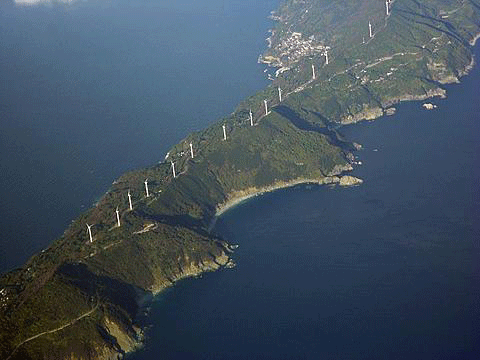 transport of radioactive trash – as being at risk from extreme climate events?
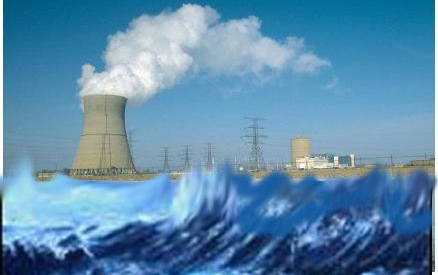 Energy systems, including fossil fuel power stations, distribution grids, and the networks that reach to people’s homes, are all at risk from effects such as flooding, severe storms and sea level rises, according to a new report from the World Energy Council, which brings together energy companies, academics and public sector agencies.
When energy systems fail, the knock-on effects on other aspects of modern infrastructure – from water and sewage to transport and health – can be catastrophic.
Experts point to the effects of Hurricane Sandy in New York to show that these effects are not limited to the developing world, where most of the serious consequences of climate change are expected to wreak havoc, but will be felt even in the most modern of cities.
Christoph Frei, secretary-general of the World Energy Council (WEC), warned that the question of the resilience of modern energy systems under the threat of imminent disaster must be treated as one of great urgency. “We are on a path where today’s unlikely events will be tomorrow’s reality,” he said. “We need to imagine the unlikely. Traditional systems, based on predicted events, no longer operate in isolation.”
The warning comes ahead of a UN climate summit in Paris later this year where developed and developing countries are expected to agree a deal on how to mitigate and adapt to global warming’s impacts………
WEC warned that the number of extreme weather events globally had risen by a factor of more than four in the past three decades, from about 38 events – such as major storms, heatwaves and flooding – to 174 events in 2014. The insurance industry has struggled to keep up, with global insured losses from natural catastrophes and man-made disasters reaching $35bn (£23bn) last year, with the losses of the uninsured exceeding $130bn.
Frei warned: “Current estimates for the cost of energy system adaptation do not fully account for the additional financing required to accommodate these new emerging risks.”………http://www.theguardian.com/environment/2015/oct/01/worlds-energy-systems-at-risk-from-global-warming-say-leading-firms
Still possible to contain climate change: Paris UN conference will be critical
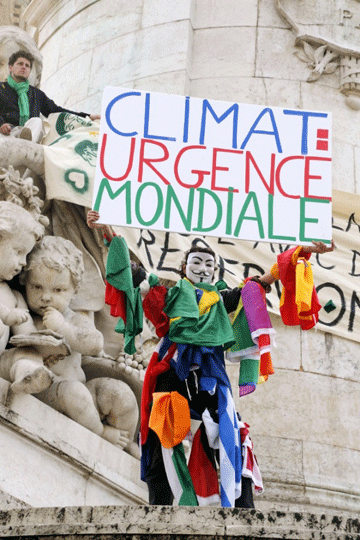
United Nations: ‘Too late’ for world if no climate deal in Paris, French president Francois Hollande says http://www.abc.net.au/news/2015-09-29/too-late-for-world-if-no-climate-deal-made-in-paris-france-says/6812138 Reaching a successful climate deal in Paris at the end of the year is the last chance to save the planet, France’s president Francois Hollande has warned.
Without “this decision in Paris … it will be too late for the world,” Mr Hollande said in his address to the UN General Assembly in New York.
The UN-led conference in Paris, which starts at the end of November, aims to seal a wide-ranging agreement to limit the worst effects of climate change.
Key points:
- Hollande optimistic after China, US sign “joint vision” ahead of Paris summit
- India to unveil its climate strategy on Thursday
- UN talks a key precursor to Paris summit at end of November
Despite the warning, Mr Hollande sounded a note of optimism after China and the United States signed a “joint vision” ahead of the Paris summit, and China committed to a domestic cap-and-trade carbon exchange.
“We have moved forward over recent months,” Mr Hollande said.
“Very strong declarations were made by those countries who are most responsible for global warming … the United States and China, which undertook commitments towards changing the situation.”
He also pledged that France would increase its financial commitment on climate from 3 billion to 5 billion euros ($4.8 billion to $8 billion) between now and 2020.
A week of climate events in New York ahead of the annual UN summit brought out new promises from governments and the private sector to slash greenhouse gas emissions blamed for global warming.
The United Nations offers one of the last opportunities for high-level talks before the Paris conference opens on November 30.
Still possible to contain climate change: experts Continue reading
Pope Francis not facing up to role of population growth in climate change
while the scientist applauded the pope’s overall message on the environment, he said Francis had undermined his own cause by failing to acknowledge the need for birth control and reproductive choice
 Pope’s climate push is ‘raving nonsense’ without population control, says top US scientist, Suzanne Goldenberg, Guardian , 24 Sept 15
Scientists applauded Pope Francis’s overall message on climate but criticised his failure to acknowledge the need for birth control.
Paul Ehrlich writes in Nature Climate Change that Francis is wrong to fight climate change without also addressing the strain from population growth on resources One of America’s leading scientists has dismissed as “raving nonsense” the pope’s call for action on climate change – so long as the leader of the world’s 1 billion Catholics rejects the need for population control.
In a commentary in the journal Nature Climate Change, Paul Ehrlich, a senior fellow at the Stanford Woods Institute for the Environment, argues that Pope Francis is simply wrong in trying to fight climate change without also addressing the additional strain on global resources from population rise. “That’s raving nonsense,” Ehrlich told the Guardian. “He is right on some things but he is just dead wrong on that.”
The critique in “Society and the Pope’s encyclical”, part of a special package from scientists on the encyclical, marked a rare note of dissent from scientists and campaigners. Many hope that the pope will drive home his call to action on poverty and the environment in his speech to Congress on Thursday.
Ehrlich, in his Nature Climate Change commentary, accuses Francis of a dangerous flaw in his indictment of consumerism and its effects on the poor and the environment. The pope had fallen for the usual clerical “obsession” with contraception and abortion – when he could have instead broken new ground on the Catholic church’s approaches to women’s reproductive rights and family planning.
The broadside exposes some of the difficulties of embracing a figure such as the pope – for those on the left as well as the right.
Conservative allies of the pope, on issues such as same-sex marriage and abortion, have balked at his denunciation of capitalism and call to action on climate change.
Those thrilled by the pope’s intervention on climate change – and Ehrlich counts himself among them – were troubled by Francis’s refusal to countenance the need to limit population, the scientist said. “It is crystal clear. No one concerned with the state of the planet and the state of the global economy can avoid dealing with population. It is the elephant in the room,” he said.
Ehrlich became a household name in the US nearly 50 years ago for warning of a global catastrophe because of population growth – a scenario he later conceded did not entirely materialise.
But while the scientist applauded the pope’s overall message on the environment, he said Francis had undermined his own cause by failing to acknowledge the need for birth control and reproductive choice……….http://www.theguardian.com/world/2015/sep/24/popes-climate-stance-is-nonsense-rejects-population-control-says-top-us-scientist
Dirty dangerous expensive nuclear power can’t save the climate
 Nuclear ≠ the solution! https://www.thunderclap.it/projects/31410-nuclear-the-solution
by Don’t Nuke the Climate
“Tell EDF: nuclear can’t save the climate: too dirty, too dangerous, too expensive, too slow #exposeEDF #EDFMenteurhttp://thndr.it/1iazwcm”
Thousands of people will join the climate negotiations, the COP 21, in Paris this year to discuss a new agreement. Under the expiring Kyoto Protocol, nuclear energy is rightly excluded from the possible solutions available to reduce greenhouse gas emissions. Yet the nuclear industry, in collaboration with certain nations, is lobbying for their dangerous and polluting technology to be seen as a climate-friendly option. This would obstruct real progress in protecting the climate.
An example of these lobbyists is EDF, world’s biggest electricity generator. Which is running many nuclear and coal plants all over the world and all French nuclear power plants. They are shamelessly using the context of climate negotiations to promote its nuclear electricity as climate-friendly and carbon-free… And EDF is also one of the big sponsors of the COP 21!

EDF’s argument is misleading: the nuclear industry does emit greenhouse gas, particularly during uranium mining! Nuclear power manifests a wide range of human rights violations, from the rights to life and health, to disproportionate impacts on indigenous peoples, women, children, and future generations. No matter what else EDF claims.
Join us in exposing EDF. Tweet or share in English, German, French, or any language (copy paste this in the text field):
- Tell EDF: nuclear can’t save the climate: too dirty, too dangerous, too expensive, too slow #exposeEDF #EDFMenteur
The French petition will be online before the 26th of September.
Melting Arctic permafrost adds to the $300 trillion economic costs of climate change
Emissions from melting permafrost could cost $43 trillion, Science Daily September 21, Source: University of Cambridge
- Summary:
- New analysis of the effects of melting permafrost in the Arctic points to $43 trillion in extra economic damage by the end of the next century, on top of the more than the $300 trillion economic damage already predicted.
- New analysis of the effects of melting permafrost in the Arctic points to $43 trillion in extra economic damage by the end of the next century, on top of the more than the $300 trillion economic damage already predicted.Increased greenhouse gas emissions from the release of carbon dioxide and methane contained in the Arctic permafrost could result in $43 trillion in additional economic damage by the end of the next century, according to researchers from the University of Cambridge and the University of Colorado.
In a letter published today (21 September) in the journal Nature Climate Change, the researchers have for the first time modelled the economic impact caused by melting permafrost in the Arctic to the end of the twenty-second century, on top of the damage already predicted by climate and economic models.
The Arctic is warming at a rate which is twice the global average, due to anthropogenic, or human-caused, greenhouse gas emissions. If emissions continue to rise at their current rates, Arctic warming will lead to the widespread thawing of permafrost and the release of hundreds of billions of tonnes of methane and CO2 — about 1,700 gigatonnes of carbon are held in permafrost soils in the form of frozen organic matter.
Rising emissions will result in both economic and non-economic impacts, as well as a higher chance of catastrophic events, such as the melting of the Greenland and West Antarctic ice sheets, increased flooding and extreme weather. Economic impacts directly affect a country’s gross domestic product (GDP), such as the loss of agricultural output and the additional cost of air conditioning, while non-economic impacts include effects on human health and ecosystems.
The researchers’ models predict $43 trillion in economic damage could be caused by the release of these greenhouse gases, an amount equivalent to more than half the current annual output of the global economy. This brings the total predicted impact of climate change by 2200 to $369 trillion, up from $326 trillion — an increase of 13 percent……..http://www.sciencedaily.com/releases/2015/09/150921112731.htm
1 This Month





PLEASE OPPOSE HR 8255 AND S.3639 – bills would accelerate satellite deployment, with no environmental review or safeguards – https://ncstd5li.quorum.us/campaign/169331/
To see nuclear-related stories in greater depth and intensity – go to https://nuclearinformation.wordpress.com
-
Archives
- October 2026 (19)
- September 2026 (339)
- August 2026 (330)
- July 2026 (355)
- June 2026 (287)
- May 2026 (306)
- April 2026 (356)
- March 2026 (251)
- February 2026 (267)
- January 2026 (308)
- December 2025 (358)
- November 2025 (359)
-
Categories
- 1
- 1 NUCLEAR ISSUES
- business and costs
- climate change
- culture and arts
- ENERGY
- environment
- health
- history
- indigenous issues
- Legal
- marketing of nuclear
- media
- opposition to nuclear
- PERSONAL STORIES
- politics
- politics international
- Religion and ethics
- safety
- secrets,lies and civil liberties
- spinbuster
- technology
- Uranium
- wastes
- weapons and war
- Women
- 2 WORLD
- ACTION
- AFRICA
- Atrocities
- AUSTRALIA
- Christina's notes
- Christina's themes
- culture and arts
- Events
- Fuk 2022
- Fuk 2023
- Fukushima 2017
- Fukushima 2018
- fukushima 2019
- Fukushima 2020
- Fukushima 2021
- general
- global warming
- Humour (God we need it)
- Nuclear
- RARE EARTHS
- Reference
- resources – print
- Resources -audiovicual
- Weekly Newsletter
- World
- World Nuclear
- YouTube
-
RSS
Entries RSS
Comments RSS

