State of the Climate – World Meteorological Organization
 WMO Press Release 21 March, 2016: State of the Climate: Record Heat and Weather Extremes
The year 2015 made history, with shattered temperature records, intense heatwaves, exceptional rainfall, devastating drought and unusual tropical cyclone activity, according to the World Meteorological Organization. That record-breaking trend has continued in 2016.
The WMO Statement on the Status of the Climate in 2015 gave details of the record land and sea surface temperatures, unabated ocean warming and sea level rise, shrinking sea ice extent, and extreme weather events around the world.
It was released to coincide with World Meteorological Day on 23 March, which has the theme “Hotter, drier, wetter. Face the Future.”
http://public.wmo.int/en/media/press-release/state-of-climate-record-heat-and-weather-extremes
(The key findings are listed here – and a link is provided to the Press Conference webcast)
WMO Press Release, 23 March 2016: World Meteorological Day. Hotter, Drier, Wetter. Face the Future
“The future is now,” said WMO Secretary-General Petteri Taalas
U.N. Secretary-General Ban Ki-moon has issued a rallying call on World Meteorological Day for decision-makers and all actors in society to “face the future now” and respond to the challenge of climate change and so avert its worst impacts and “lay the foundations for a world of peace, prosperity and opportunity for all.” …
On 21 March, WMO issued the full report on the Status of the Global Climate in 2015.
It also collaborated with Climate Central to reach out to television weather presenters, highlighting the main findings of the climate report, including with a package of high quality graphics.
http://public.wmo.int/en/media/news/world-meteorological-day-hotter-drier-wetter-face-future
Statement on the Status of the Global Climate in 2015
March 2016. The World Meteorological Organization (WMO) is the United Nations system’s authoritative voice on weather, climate and water. For over two decades, WMO has published annual assessments of the state of the global climate in the U.N.’s six official languages to inform governments about global climate trends and extreme and notable events at the national and regional levels. These assessments integrate and analyze information provided by leading climate data centers and by the world’s National Meteorological and Hydrological Services (NMHSs).
http://www.climatecentral.org/wmo-state-of-the-climate
(Read the Report Summary here – and note links provided to related videos, interactives, maps, images & other resources. The full 28-page report ‘WMO Statement on the status of the global climate in 2015’ can be downloaded here:http://library.wmo.int/pmb_ged/wmo_1167_en.pdf)
*******
Marshall Shepherd: 96% of American Meteorological Society members think climate change is happening.
March 24, 2016. You may have seen them. Media reports a few years ago claiming that a survey of the American Meteorological Society (AMS) refutes the consensus position regarding climate change. When I saw how that survey and the results were being twisted and distorted, I realized that people read things with an eye for what they want to believe, so-called confirmation bias. AMS Executive Director Dr. Keith Seitter even wrote on the AMS website clarifying the results andcondemning rampant distortion that was being spread. A full statement of the survey authors’ response to the horrific distortion of their findings can be found at this link. With such a mischaracterized response, the AMS felt that a new survey was needed. The preliminary results of that new report were released this week.
http://www.forbes.com/sites/marshallshepherd/2016/03/24/96-of-american-meteorological-society-members-think-climate-change-is-happening-says-new-report/#34f13dd13935 & http://www.environmentalhealthnews.org/t/5863920798415471994
Rockefeller to ditch oil, gas, holdings on ethical and economic grounds: criticises Exxon Mobil
Rockefeller Dumps Oil, Exxon Mobil Charity linked to the founder of Exxon Mobil’s precursor says it will ditch its oil and gas holdings. http://www.usnews.com/news/articles/2016-03-24/in-a-changing-climate-rockefeller-fund-dumps-oil-exxon-mobil-holdings Alan NeuhauserMarch 24, 2016,Citing “morally reprehensible conduct on the part of Exxon Mobil,” the Rockefeller Family Foundation – whose namesake, John D. Rockefeller, founded Exxon’s precursor, Standard Oil – will dump its holdings in America’s largest oil conglomerate, plus coal and tar sands companies, the charity announced Wednesday.
The nonprofit pointed to both economics and ethics: Amid a huge surplus of oil and sluggish global demand, oil prices are in the middle of a 19-month slump, spurring hundreds of thousands of layoffsfrom the energy sector worldwide. Climate change, meanwhile, has created a moral imperative to decrease the planet’s reliance on fossil fuels like oil, the fund said.
“While the global community works to eliminate the use of fossil fuels, it makes little sense—financially or ethically—to continue holding investments in these companies,” the charity said in a statement. “We must keep most of the already discovered reserves in the ground if there is any hope for human and natural ecosystems to survive and thrive in the decades ahead.”
Exxon was the only company the charity singled-out by name. Last year, award-winning investigations by InsideClimate News and the Los Angeles Times reported that Exxon had known about global warming as early as 1977 and accounted for it in its financials, even as it emphasized to lawmakers and the public that the science was in doubt.
The New York Attorney General’s Office is investigating whether Exxon lied to investors, and the hashtag #ExxonKnew has become a mainstay on social media.
“The company worked since the 1980s to confuse the public about climate change’s march, while simultaneously spending millions to fortify its own infrastructure against climate change’s destructive consequences and track new exploration opportunities as the Arctic’s ice receded,” the fund said of Exxon. “As a matter of good governance, we cannot be associated with a company exhibiting such apparent contempt for the public interest.”
[ALSO: Exxon Mobil Under Investigation for Climate Change Denial]
There are also financial imperatives, especially in the firm’s decision to turn away from coal and the tar sands: While coal-fired electricity is the nation’s greatest source of greenhouse gas emissions, the sector has also been stricken by a rash of bankruptcies as power producers have switched from coal to cheap and cleaner-burning natural gas. Last week, Peabody Energy, the world’s largest coal producer, indicated it was on the brink of going under.
Likewise, extracting crude from the tar-sands – largely concentrated in western Canada – emits far more heat-trapping carbon than conventional oil and gas drilling. But the process is also far more expensive, and with both low oil prices and the Obama administration’s rejection of the Keystone XL pipeline’s northern stretch last year, companies have pulled out from the sector.
The Family Foundation’s announcement comes a year and a half after another Rockefeller charity, theRockefeller Brothers Fund, revealed it would eliminate $860 million it held in oil, coal and other fossil fuels.
“History moves on, as it must,” the Family Foundation said.
Highest in 666 million years – today’s carbon emissions
Carbon emissions rate ‘highest in 66 million years’ ABC News, 22 Mar 16 ABC Science The rate of carbon emissions is higher than at any time in fossil records stretching back 66 million years to the end of the age of the dinosaurs, according to a new study that sounds an alarm about risks to nature from anthropogenic warming.
Key points
- During Palaeocene-Eocene Thermal Maximum 55.8 million years ago temperatures rose 5 degrees C
- Scientists analysed marine fossils to determine rate of carbon emissions at this time
- Rate of carbon emissions was 10 times slower than current emissions
The Palaeocene-Eocene Thermal Maximum (PETM) event — which drove temperatures up by an estimated 5 degrees Celsius and damaged marine life by making the oceans acidic — is often seen as a parallel to the risks from the current build-up of carbon in the atmosphere from burning fossil fuels.
On present trajectories, greenhouse gas emissions will heat up Earth 3 to 4 degrees Celsius by 2100.
“Of all the changes we have seen in 66 million years, this event is the one that most looks like anthropogenic, or man-made, warming,” said study co-author Professor Andy Ridgwell, a paleo-climatologist at the University of Bristol.
Aside from the huge impact that killed the dinosaurs, what we are seeing now is the fastest rate of climate change in 66 million years.
Professor Andy Ridgwell
The parallels are striking: massive carbon emissions, followed by rapid global warming and major loss of species.
Fifty-six million years ago, those extinctions took place mainly in the ocean. Today the so-called “sixth great extinction” is underway both in the sea and on land………http://www.abc.net.au/news/2016-03-22/carbon-emissions-‘highest-in-66-million-years’/7266032
World losing the battle against climate change: record-breaking heat
Record-breaking heat shows world ‘losing battle’ against climate change, ABC News 15 Mar 16 Alan Finkel tells Q&A Australia’s chief scientist has warned the planet is “losing the battle” against climate change, after new data showed February set a “completely unprecedented” record for the hottest month since global records began.
Meteorologist Dr Jeff Masters said although the absolute hottest month on record was July 2015, July and August tend to be 4C hotter than January and February because the large land mass in the Northern Hemisphere cools the planet during the northern winter.
Writing on the Weather Underground blog, Dr Masters and his co-author Bob Henson said February was exceptional because it was 1.35C hotter than the long-term average, while July was only 0.75C hotter than average.
“Perhaps even more remarkable is that February 2015 crushed the previous February record [set during the peak of the 1997-98 El Nino] by a massive 0.47C,” they wrote…….http://www.abc.net.au/news/2016-03-14/february-smashed-all-time-global-heat-record/7246356
Sea levels could rise to mind-boggling levels
This mind-boggling study shows just how massive sea level rise really is, WP. By Chris Mooney March 10 As our planet continues to warm, coastlines worldwide will retreat inland — in the long run, maybe by a lot. That means some coastal cities, in places like Florida — where Hillary Clinton and Bernie Sanders debated precisely this topic on Wednesday night — stand to lose quite a lot of land where people currently live and own property.
It seems doubtful that we can defend all of the many coastal zones that will be at risk. So is there any other way to head off sea level rise?
It may sound ridiculous to even contemplate. But in a new study just out in the open access journal Earth System Dynamics, scientists have actually published an idea for doing that and provided some calculations regarding the scale of what it would take. That scale turns out to be simply massive, ultimately rendering the idea about as unfathomable as the oceans themselves.
But then, that’s kind of the point.
Antarctic ice sheets melting: when will the tipping point be reached?
Tipping point: how we predict when Antarctica’s melting ice sheets will flood the seas https://theconversation.com/tipping-point-how-we-predict-when-antarcticas-melting-ice-sheets-will-flood-the-seas-56125 March 14, 2016 Antarctica is already feeling the heat of climate change, with rapid melting and retreat of glaciers over recent decades.
Ice mass loss from Antarctica and Greenland contributes about 20% to the current rate of global sea level rise. This ice loss is projected to increase over the coming century.
A recent article on The Conversation raised the concept of “climate tipping points”: thresholds in the climate system that, once breached, lead to substantial and irreversible change.
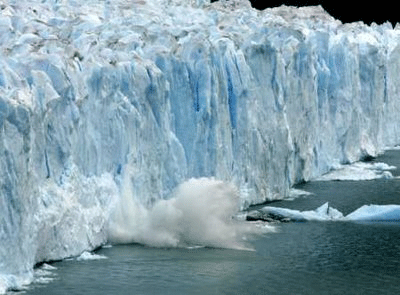
Such a climate tipping point may occur as a result of the increasingly rapid decline of the Antarctic ice sheets, leading to a rapid rise in sea levels. But what is this threshold? And when will we reach it?
What does the tipping point look like? The Antarctic ice sheet is a large mass of ice, up to 4 km thick in some places, and is grounded on bedrock. Ice generally flows from the interior of the continent towards the margins, speeding up as it goes.
Where the ice sheet meets the ocean, large sections of connected ice – ice shelves – begin to float. These eventually melt from the base or calve off as icebergs. The whole sheet is replenished by accumulating snowfall.
Floating ice shelves act like a cork in a wine bottle, slowing down the ice sheet as it flows towards the oceans. If ice shelves are removed from the system, the ice sheet will rapidly accelerate towards the ocean, bringing about further ice mass loss.
A tipping point occurs if too much of the ice shelf is lost. In some glaciers, this may spark irreversible retreat.
Where is the tipping point?
One way to identify a tipping point involves figuring out how much shelf ice Antarctica can lose, and from where, without changing the overall ice flow substantially.
A recent study found that 13.4% of Antarctic shelf ice – distributed regionally across the continent – does not play an active role in ice flow. But if this “safety band” were removed, it would result in significant acceleration of the ice sheet.
Antarctic ice shelves have been thinning at an overall rate of about 300 cubic km per year between 2003 and 2012 and are projected to thin even further over the 21st century. This thinning will move Antarctic ice shelves towards a tipping point, where irreversible collapse of the ice shelf and increase in sea levels may follow.
How do we predict when will it happen?
Some areas of West Antarctica may be already close to the tipping point. For example, ice shelves along the coast of the Amundsen and Bellingshausen Seas are the most rapidly thinning and have the smallest “safety bands” of all Antarctic ice shelves.
To predict when the “safety band” of ice might be lost, we need to project changes into the future. This requires better understanding of processes that remove ice from the ice sheet, such as melting at the base of ice shelves and iceberg calving.
Melting beneath ice shelves is the main source of Antarctic ice loss. It is driven by contact between warmer sea waters and the underside of ice shelves.
To figure out how much ice will be lost in the future requires knowledge of how quickly the oceans are warming, where these warmer waters will flow, and the role of the atmosphere in modulating these interactions. That’s a complex task that requires computer modelling.
Predicting how quickly ice shelves break up and form icebergs is less well understood and is currently one of the biggest uncertainties in future Antarctic mass loss. Much of the ice lost when icebergs calve occurs in the sporadic release of extremely large icebergs, which can be tens or even hundreds of kilometres across.
It is difficult to predict precisely when and how often large icebergs will break off. Models that can reproduce this behaviour are still being developed.
Scientists are actively researching these areas by developing models of ice sheets and oceans, as well as studying the processes that drive mass loss from Antarctica. These investigations need to combine long-term observations with models: model simulations can then be evaluated and improved, making the science stronger.
The link between ice sheets, oceans, sea ice and atmosphere is one of the least understood, but most important factors in Antarctica’s tipping point. Understanding it better will help us project how much sea levels will rise, and ultimately how we can adapt.
Exxon’s scandalous dishonesty about climate change
 Scandal! Exxon knew about climate change, boosted denialism, misled shareholders, went carbon heavy, Ecologist Bill McKibben 9th March 2016 One of the world’s biggest energy companies has been caught out in what may be the biggest ever climate scandal, writes Bill McKibben. Way back in the 1980s ExxonMobil knew of the ‘potentially catastrophic’ and ‘irreversible’ effects of increasing fossil fuel consumption, but chose to cover up the findings, spread misinformation on climate change, and go for high carbon energy sources……….
Exxon twisted the facts to further its own agenda
So here’s what happened. Exxon used its knowledge of climate change to plan its own future. The company, for instance, leased large tracts of the Arctic for oil exploration, territory where, as a company scientist pointed out in 1990, “potential global warming can only help lower exploration and development costs.”
Not only that but, “from the North Sea to the Canadian Arctic,” Exxon and its affiliates set about “raising the decks of offshore platforms, protecting pipelines from increasing coastal erosion, and designing helipads, pipelines, and roads in a warming and buckling Arctic.”In other words, the company started climate-proofing its facilities to head off a future its own scientists knew was inevitable.
But in public? There, Exxon didn’t own up to any of this. In fact, it did precisely the opposite. In the 1990s, it started to put money and muscle into obscuring the science around climate change. It funded think tanks that spread climate denial and even recruited lobbying talent from the tobacco industry.
It also followed the tobacco playbook when it came to the defence of cigarettes by highlighting ‘uncertainty’ about the science of global warming. And it spent lavishly to back political candidates who were ready to downplay global warming.
Its CEO, Lee Raymond, even travelled to China in 1997 and urged government leaders there to go full steam ahead in developing a fossil fuel economy. The globe was cooling, not warming, he insisted, while his engineers were raising drilling platforms to compensate for rising seas.
“It is highly unlikely”, he said, “that the temperature in the middle of the next century will be significantly affected whether policies are enacted now or 20 years from now.” This wasn’t just wrong, but completely and overwhelmingly wrong – as wrong as a man could be.
Sins of omission
In fact, Exxon’s deceit – its ability to discourage regulations for 20 years – may turn out to be absolutely crucial in the planet’s geological history. It’s in those two decades that greenhouse gas emissions soared; as did global temperatures until, in the twenty-first century, ‘hottest year ever recorded’ has become a tired cliché.
And here’s the bottom line: had Exxon told the truth about what it knew back in 1990, we might not have wasted a quarter of a century in a phony debate about the science of climate change, nor would anyone have accused Exxon of being ‘alarmist.’ We would simply have gotten to work.
But Exxon didn’t tell the truth. A Yale study published last fall in the Proceedings of the National Academy of Sciences showed that money from Exxon and the Koch Brothers played a key role in polarizing the climate debate in this country.
The company’s sins – of omission and commission – may even turn out to be criminal. Whether the company ‘lied to the public’ is the question that New York Attorney General Eric Schneiderman decided to investigate last fall in a case that could make him the great lawman of our era if his investigation doesn’t languish.
There are various consumer fraud statutes that Exxon might have violated and it might have failed to disclose relevant information to investors, which is the main kind of lying that’s illegal in this country of ours. Now, Schneiderman’s got back up from California Attorney General Kamala Harris, and maybe – if activists continue to apply pressure – from the Department of Justice as well, though it’s highly publicized unwillingness to go after the big banks does not inspire confidence.
Here’s the thing: all that was bad back then, but Exxon and many of its Big Energy peers are behaving at least as badly now when the pace of warming is accelerating. And it’s all legal – dangerous, stupid, and immoral, but legal.
Exxon finally admits global warming is occurring – but there’s no big problem………
The carbon tax and the political stonewall
In other words, we’re no longer talking about outright denial, just a denial that much really needs to be done. And even when the company has proposed doing something, its proposals have been strikingly ethereal. Exxon’s PR team, for instance, has discussedsupporting a price on carbon, which is only what economists left, right, and centre have been recommending since the 1980s.
But the minimal price they recommend – somewhere in the range of $40 to $60 a ton – wouldn’t do much to slow down their business. After all, they insist that all their reserves are still recoverable in the context of such a price increase, which would serve mainly to make life harder for the already terminal coal industry.
But say you think it’s a great idea to put a price on carbon – which, in fact, it is, since every signal helps sway investment decisions. In that case, Exxon’s done its best to make sure that what they pretend to support in theory will never happen in practice…….
Now the cover ups are being investigated – could Exxon be liable?
As with the tobacco companies in the decades when they were covering up the dangers of cigarettes, there’s a good chance that the Big Energy companies were in this together through their trade associations and other front groups.
In fact, just before Christmas, Inside Climate News published some revealing new documents about the role that Texaco, Shell, and other majors played in an American Petroleum Institute study of climate change back in the early 1980s. A trial would be a transformative event – a reckoning for the crime of the millennium.
But while we’re waiting for the various investigations to play out, there’s lots of organizing going at the state and local level when it comes to Exxon, climate change, and fossil fuels – everything from politely asking more states to join the legal process to politely shutting down gas stations for a few hours to pointing out to New York and California that they might not want to hold millions of dollars of stock in a company they’re investigating. It may even be starting to work.
Vermont Governor Peter Shumlin, for instance, singled Exxon out in his state of the state address last month. He called on the legislature to divest the state of its holdings in the company because of its deceptions:
“This is a page right out of Big Tobacco, which for decades denied the health risks of their product as they were killing people. Owning ExxonMobil stock is not a business Vermont should be in.”
The question is: Why on God’s not so green Earth any more would anyone want to be Exxon’s partner?
Action: BreakFree2016, May 4-15 – a global wave of mass actions will target the world’s most dangerous fossil fuel projects, in order tokeep coal, oil and gas in the ground and accelerate the just transition to 100% renewable energy. Across the world, people are showing the courage toconfront polluters where they are most powerful – from the halls of power to the wells and mines themselves. http://www.theecologist.org/News/news_analysis/2987359/epic_scandal_how_exxon_boosted_climate_change_denial_infiltrated_politics_misled_shareholders.html
World is warming faster than expected – Australian study
Dangerous global warming will happen sooner than thought – study, Guardian, Joshua Robertson, 10 Mar 16 Australian researchers say a global tracker monitoring energy use per person points to 2C warming by 2030. The world is on track to reach dangerous levels of global warming much sooner than expected, according to new Australian research that highlights the alarming implications of rising energy demand.
University of Queensland and Griffith University researchers have developed a “global energy tracker” which predicts average world temperatures could climb 1.5C above pre-industrial levels by 2020.
That forecast, based on new modelling using long-term average projections on economic growth, population growth and energy use per person, points to a 2C rise by 2030.
The UN conference on climate change in Paris last year agreed to a 1.5C rise as the preferred limit to protect vulnerable island states, and a 2C rise as the absolute limit.
The new modelling is the brainchild of Ben Hankamer from UQ’s institute for molecular bioscience and Liam Wagner from Griffith University’s department of accounting, finance and economics, whose work was published in the journal Plos One on Thursday.
It is the first model to include energy use per person – which has more than doubled since 1950 – alongside economic and population growth as a way of predicting carbon emissions and corresponding temperature increases.
The researchers said the earlier than expected advance of global warming revealed by their modelling added a newfound urgency to the switch from fossil fuels to renewables.
Hankamer said: “The more the economy grows, the more energy you use … the conclusion really is that economists and environmentalists are on the same side and have both come to the same conclusion: we’ve got to act now and we don’t have much time.”……..
The researchers suggested switching $500bn in subsidies for fossil fuels worldwide to renewables as a “cost neutral” way to fast-track the energy transition.
Wagner said pulling the rug from out under the fossil fuels industry was a move of “creative destruction” and “more a political issue rather than an economic issue”…….http://www.theguardian.com/environment/2016/mar/10/dangerous-global-warming-will-happen-sooner-than-thought-study
Even more serious than we thought – climate chnage and sea level rise
Sea level rise threatens larger number of people than earlier estimated, Science Daily, March 8, 2016
 Source:
- Aalto University
- Summary:
- More people live close to sea coast than earlier estimated, researchers have concluded after a new study. These people are the most vulnerable to the rise of the sea level, increased number of floods and intensified storms. By using recent increased resolution datasets, researchers estimate that 1.9 billion inhabitants, 28% of the world’s total population, live closer than 100 km from the coast in areas less than 100 meters above the present sea level.
-
- By 2050 the amount of people in that zone is predicted to increase to 2.4 billion, while population living lower than 5 meters will reach 500 million people. Many of these people need to adapt their livelihoods to changing climate, say Assistant Professor Matti Kummu from Aalto University.The study found that while population and wealth concentrate by the sea, food must be grown further and further away from where people live. Highlands and mountain areas are increasingly important from food production point of view, but also very vulnerable to changes in climate.
- Over the past century there has been a clear tendency that cropland and pasture areas have grown most in areas outside the population hotspots, and decreased in coastal areas. This will most probably only continue in the future, summarises Professor Olli Varis from Aalto University…….http://www.sciencedaily.com/releases/2016/03/160308105053.htm
Nuclear power protects the climate? Quite the opposite
 Climate protection through nuclear power plants? Hardly. http://thebulletin.org/commentary/climate-protection-through-nuclear-power-plants-hardly9170 18 FEBRUARY 2016 Lutz Mez Berlin Centre for Caspian Region Studies Freie Universität Berlin
The electrical power production sector accounts for about 28 percent of global anthropogenic carbon dioxide emissions and constitutes by far the largest source of greenhouse gas emissions. That is why supposedly carbon dioxide-free nuclear power plants have frequently been praised as a panacea for addressing climate change. However, in 2013 nuclear electricity contributed just 10.6 percent of global electricity generation, and because electricity represents only 18 percent of total global final energy consumption, the nuclear share is just 1.7 percent of global final energy consumption. Even if generation in nuclear power plants could be increased significantly, nuclear power will remain a marginal energy source. Therefore, the turnaround in energy systems has to prioritize energy efficiency and the use of renewable energy technologies and cogeneration plants, which do not cause any more carbon dioxide emissions than nuclear power plants.
From a systemic perspective, nuclear power plants are by no means free of carbon dioxide emissions. Today, they produce up to one third of the greenhouse gases that large modern gas power plants produce. Carbon dioxide emissions connected to production of nuclear energy amounts to (depending on where the uranium used in a reactor is mined and enriched) between 7 and 126 grams of carbon dioxide equivalent per kilowatt hour, according to an analysis by International Institute for Sustainability Analysis and Strategy co-founder Uwe Fritsche. For a typical nuclear power plant in Germany, the specific emission estimate of 28 grams has been calculated. An initial estimate of global carbon dioxide emissions through the generation of nuclear electricity in 2014 registered at about 110,000,000 tons of carbon dioxide equivalent—or roughly as much as the carbon dioxide emissions of a country like the Czech Republic. And this data does not even include the emissions caused by storage of nuclear waste.
In the coming decades, indirect carbon dioxide emissions from nuclear power plants will increase considerably, because high-grade resources of uranium are exhausted and much more fossil energy will have to be used to mine uranium. In view of this trend, nuclear power plants will no longer have an emissions advantage over modern gas-fired power plants, let alone in comparison to the advantages offered by increased energy efficiency or greater use of renewable energies.
Nuclear power plants may also contribute to climate change by emitting radioactive isotopes such as tritium or carbon 14 and the radioactive noble gas krypton 85. Krypton 85 is produced in nuclear power plants and released on a massive scale in the reprocessing of spent fuel. The concentration of krypton 85 in Earth’s atmosphere has soared over the last few years as a result of nuclear fission, reaching a new record. Krypton 85 increases the natural, radiation-induced ionization of the air. Thus the electrical balance of the Earth’s atmosphere changes, which poses a significant threat to weather patterns and climate. Even though krypton 85 is “one of the most toxic agents for climate,” according to German physicist and political figure Klaus Buchner, these emissions have not received any attention in international climate-protection negotiations down to the present.
As for the assertion that nuclear power is needed to promote climate protection, exactly the opposite would appear to be the case: Nuclear power plants must be closed down quickly to exert pressure on operators and the power plant industry to redouble efforts at innovation in the development of sustainable and socially compatible energy technologies and especially the use of smart energy services.
New Report Ties “Hottest Year on Record” to Human Toll of Disasters
Natural disasters made 2015 a miserable year for many people around the world. According to the United Nations’ Office for Disaster Risk Reduction, the statistics were brutal. At least 98.6 million people were affected by natural disasters ranging from droughts to floods, and the economic damage could have been as high as $66.5 billion. Using the data available from the Belgian non-profit Center for Research on the Epidemiology of Disasters (CRED), the UN reports that almost 23,000 people died from the 346 natural disasters reported across the world.
Massachusetts snowstorm causes Pilgrim nuclear station to be shut down
ENTERGY’S PILGRIM NUCLEAR POWER PLANT IS SHUT AS SNOWSTORM ENVELOPS MASSACHUSETTS, –Jim Ostroff, james.ostroff@platts.com Washington (Platts)–8 Feb 2016 Operators at Entergy’s 728-MW Pilgrim nuclear plant in Plymouth, Massachusetts, shut the unit early Monday morning as a precautionary measure, while a snowstorm swept through the state, a plant spokesman said.
The unit was operating at 12% of capacity just prior to being shut, according to the US Nuclear Regulatory Commission’s daily reactor status report Monday.
O’Brien declined to estimate when Pilgrim will restart and return to 100% capacity, saying this information “is market sensitive.”…(subscibers only ) http://www.platts.com/latest-news/electric-power/washington/entergys-pilgrim-nuclear-power-plant-is-shut-21901806?hootpostid=28068bc08898fb813f66296f084ba47f
The growing climate problem of data farms’ consumption of energy
the only long-term solution to the energy problem will have to involve significant cuts to our internet use at some point in the future. This could be through some kind of tax or charge on data use – for example, imposing a fee for uploading photographs on to Facebook – or even a straightforward rationing of activity

Global warming: Data centres to consume three times as much energy in next decade, experts warn 416.2 terawatt hours of electricity world’s data centres used last year was far higher than UK’s total consumption,The Independent Tom Bawden Environment Editor @BawdenTom 24 January 2016 The amount of energy consumed by the world’s data centres – the repositories for billions of gigabytes of information – will treble in the next decade, putting an enormous strain on energy supplies and dealing a hefty blow to efforts to contain global warming, experts say.
Whether you’re “liking” something on Facebook, streaming the latest Tarantino movie or posting an instagram from the pub, every internet activity involves huge amounts of data that needs to be stored somewhere. And as the “internet of everything” brings innovations such as driverless cars and high-definition video watches ever closer, the vast network of data centres that have sprung up in the past decade will spread.
This wouldn’t be a problem if these facilities – which range from a small room with a few servers to vast 150,000 square metre “farms” – didn’t consume such enormous amounts of energy.
- Already, data centres have mushroomed from virtually nothing 10 years ago to consuming about 3 per cent of the global electricity supply and accounting for about 2 per cent of total greenhouse gas emissions. That gives it the same carbon footprint as the airline industry.
- To put the size of this consumption into even sharper relief – the 416.2 terawatt hours of electricity the world’s data centres used last year was significantly higher than the UK’s total consumption of about 300 terawatt hours.Massive as data centre energy use may already be, this is nothing to what lies in store, analysts warn. Ian Bitterlin, Britain’s foremost data centre expert and a visiting professor at the University of Leeds, says the amount of energy used by data centres is doubling every four years – despite the innovations in hardware that massively increase their capacity to store data. As a result, analysts forecast that data centres will consume roughly treble the amount of electricity in the next decade.
One way to curb their carbon footprint is to increase the amount of renewable energy they use – a development that is already under way but has much, much further to go to offset the exponential growth in internet traffic, experts say. Even if the industry were able to shift to 100 per cent renewable electricity, the volume of energy they would need would put intolerable pressure on the world’s power systems.
- “If we carry on going the way we have been it would become unsustainable – this level of data centre growth is not sustainable beyond the next 10 to 15 years. The question is, what are we going to do about it?” says Professor Bitterlin.He points to a study focused on Japan which suggests that its data centres would consume its entire electricity supply by 2030 if growth continues at today’s rate.
“We need to be more responsible about what we use the internet for … Data centres aren’t the culprits – it’s driven by social media and mobile phones. It’s films, pornography, gambling, dating, shopping – anything that involves images. It’s a great example of the Jevons paradox – the easier you make it to consume the product the greater the consumption will be.”
- Unless there is some kind of game-changing breakthrough on data storage – such as the development of a far-superior alternative to silicon – the world’s internet use is eventually going to have to be significantly rationed. Professor Bitterlin added that a form of carbon known as graphene could potentially revolutionise data storage.But even with a revolution in data storage capacity, he believes the only long-term solution to the energy problem will have to involve significant cuts to our internet use at some point in the future. This could be through some kind of tax or charge on data use – for example, imposing a fee for uploading photographs on to Facebook – or even a straightforward rationing of activity; but he acknowledges that these kind of moves would probably be “political suicide”. Other measures – such as switching from colour to black and white photographs – could also go a long way to reducing data consumption.
Governments across the world, including the UK, are starting to wake up to the data centre problem at the same time as they encourage the roll-out of data-hungry broadband networks to ever remoter locations. The roll-out is primarily designed to help small businesses, but the bulk of the faster internet access is enjoyed by consumers. And some internet companies – such as Facebook, Google and Apple – are leading efforts to be more environmentally responsible. The measures being taken include housing data centres in cold climates – which dramatically reduces the energy needed to cool the facilities – with a ready supply of renewable energy. …..http://www.independent.co.uk/environment/global-warming-data-centres-to-consume-three-times-as-much-energy-in-next-decade-experts-warn-a6830086.html
Global warming is happening fast in the world’s oceans
World’s oceans warming at increasingly faster rate, new study finds
Ocean water has absorbed more than 90% of the excess heat and nearly 30% of the carbon dioxide generated by human consumption of fossil fuels,Guardian, Oliver Milman, 19 Jan 16, The world’s oceans are warming at a quickening rate, with the past 20 years accounting for half of the increase in ocean heat content that has occurred since pre-industrial times, a new study has found.
US scientists discovered that much of the extra heat in the ocean is buried deep underwater, with 35% of the additional warmth found at depths below 700 meters. This means far more heat is present in the far reaches of the ocean than 20 years ago, when it contained just 20% of the extra heat produced from the release of greenhouse gases since the industrial revolution.
The paper, published in Nature Climate Change, sheds further light on the vast quantities of heat being absorbed by the world’s oceans.
Ocean water, which has a much higher heat capacity than air, has absorbed more than 90% of the excess heat and nearly 30% of the carbon dioxide generated by human consumption of fossil fuels. The vast Southern Ocean sucked up 1.2bn tonnes of carbon in 2011 alone – which is roughly equivalent to the European Union’s annual carbon output…….
As the oceans warm, storm intensity increases and aquatic species are forced from their traditional ranges. Absorption of carbon dioxide has also made the oceans 30% more acidic, which is when the pH of the water drops, making it harder for creatures such as coral, oysters and mussels to form the shells and structures that sustain them.
Scientists have already declared that a third global coral bleaching event is currently underway, where corals whiten and die off due to extreme heat. An analysis of more than 620 studies last year found that the food chains of the world’s oceans are at risk of collapse due to climate change, overfishing and localized pollution. http://www.theguardian.com/environment/2016/jan/18/world-oceans-warming-faster-rate-new-study-fossil-fuels
Renewable energy can dramatically cut emissions – International Renewable Energy Agency
Some of those changes are already underway. Global clean energy investment attracted a record $329bn last year, according to a report released on Thursday by Bloomberg New Energy Finance.
The report noted the rise in clean energy investment came despite the drop in oil prices.

Rapid switch to renewable energy can put Paris climate goals within  reach http://www.theguardian.com/environment/2016/jan/16/rapid-switch-to-renewable-energy-can-put-paris-climate-goals-within-reach
Increasing renewables to 36% of the global energy mix by 2030 would provide about half emissions reductions needed to hold warming to 2C, says International Renewable Energy AgencyGuardian, Suzanne Goldenberg, 16 Jan 16
Countries can deliver on the promises of the historic Paris climate change agreement by rapid scaling up wind and solar power to 36% of the global energy mix by 2030, an international energy gathering will be told on Saturday.
The International Renewable Energy Agency (Irena) meeting in Abu Dhabi – the first major global gathering since Paris – is seen as an important test of countries’ readiness to put those plans into action.
Nearly 200 countries agreed to keep warming below 2C, and work towards a 1.5C limit, during the Paris climate negotiations last month. Some 187 put forward plans to cut greenhouse gas emissions.
Now comes the hard part, government officials admit: making good on those promises by translating emissions cutting targets into policies, and expanding access to clean energy technologies.
Irena said those goals were within reach – if countries move fast. Scaling up renewable energy to 36% of the global energy mix by 2030 would provide about half of the emissions reductions needed to hold warming to 2C. Energy efficiencycould make up the rest.
“The Paris agreement set a long-term vision for the deep reduction of global emissions and the need to decarbonise the energy sector,” Adnan Amin, Irena’s director general said in a prepared statement. “The Irena assembly must now take the next steps and establish a blueprint for action to meet our climate goals and set the world on a path to a sustainable energy future.”
In an effort to spur countries to action, an Irena report released on Saturday found doubling the share of renewables by 2030 would increase global GDP by up to 1.1% or about $1.3tn, and provide jobs for more than 24 million in the renewable sector.
The United Nations climate chief, Christiana Figueres, has said repeatedly she was looking to the Paris agreement to send a clear signal to the business community of a shift away from a fossil-fuel driven economy.
Some of those changes are already underway. Global clean energy investment attracted a record $329bn last year, according to a report released on Thursday by Bloomberg New Energy Finance.
The report noted the rise in clean energy investment came despite the drop in oil prices.
Irena officials said they hoped that the Paris climate accord would add momentum to the shift.
“We are not seeing climate change action as a cost, but starting to see it in terms of opportunities,” said Angela Kallhauge, Irena’s climate change officer.
1 This Month





PLEASE OPPOSE HR 8255 AND S.3639 – bills would accelerate satellite deployment, with no environmental review or safeguards – https://ncstd5li.quorum.us/campaign/169331/
To see nuclear-related stories in greater depth and intensity – go to https://nuclearinformation.wordpress.com
-
Archives
- October 2026 (19)
- September 2026 (339)
- August 2026 (330)
- July 2026 (355)
- June 2026 (287)
- May 2026 (306)
- April 2026 (356)
- March 2026 (251)
- February 2026 (267)
- January 2026 (308)
- December 2025 (358)
- November 2025 (359)
-
Categories
- 1
- 1 NUCLEAR ISSUES
- business and costs
- climate change
- culture and arts
- ENERGY
- environment
- health
- history
- indigenous issues
- Legal
- marketing of nuclear
- media
- opposition to nuclear
- PERSONAL STORIES
- politics
- politics international
- Religion and ethics
- safety
- secrets,lies and civil liberties
- spinbuster
- technology
- Uranium
- wastes
- weapons and war
- Women
- 2 WORLD
- ACTION
- AFRICA
- Atrocities
- AUSTRALIA
- Christina's notes
- Christina's themes
- culture and arts
- Events
- Fuk 2022
- Fuk 2023
- Fukushima 2017
- Fukushima 2018
- fukushima 2019
- Fukushima 2020
- Fukushima 2021
- general
- global warming
- Humour (God we need it)
- Nuclear
- RARE EARTHS
- Reference
- resources – print
- Resources -audiovicual
- Weekly Newsletter
- World
- World Nuclear
- YouTube
-
RSS
Entries RSS
Comments RSS

