Climate Change Threatening Mt Everest
Climate Change Is Melting Everest Research shows that higher temperatures around the world’s tallest peak are thawing its glaciers, which could spell doom for villages in the Khumbu Valley, Outside, By: Anna Callaghan Apr 12, 2016 “As a colorful circus of tents pops up at Everest Base Camp this spring, a pair of Ph.D. students will set up camp 1,000 feet downvalley, on the Khumbu Glacier, resuming a research project they started last year. Their goal: to determine just how quickly the world’s highest glacier is melting.From the Alps to the Andes, ice at high elevations is disappearing rapidly. On Everest, the effects of a warming planet are likely to manifest in two ways that affect climbers. First, the Khumbu Glacier will shrink, and parts of it could possibly become impassable for climbers. Someday, even Base Camp may have to be moved from its current location on the glacier to another spot nearby.
Second, the Khumbu Icefall between Base Camp and Camp I may see a higher frequency of rock and ice avalanches—like the one that killed 16 Sherpas in 2014. The Icefall naturally migrates downhill between three and four feet per day, but that could accelerate as temperatures rise. Earth’s average surface temperature has gone up by more than 1.5 degrees since the late 1800s, and two-thirds of that warming has taken place since 1975
“It doesn’t take a rocket scientist to work out that if you increase the temperature where ice is normally frozen to the bedrock, the hold is going to be weakened and become increasingly unstable and the ice is more likely to detach from the bedrock,” says Duncan Quincey, professor of geomorphology at the University of Leeds, in the UK. He is supervising the research of Owen King and Scott Watson, the Ph.D. students who will spend a few weeks on the glacier this spring. “In places like the Icefall we’ve seen these tragic accidents, and I think it’s fair to say it’s symptomatic of high-elevation warming.”……http://www.outsideonline.com/2067651/climate-change-melting-everest
Paris climate negotiations ahead of schedule
Paris Climate Deal Seen Taking Effect Two Years Ahead of Plan http://www.bloomberg.com/news/articles/2016-04-11/paris-climate-deal-seen-taking-effect-two-years-ahead-of-plan AlexJFMorales April 12, 2016
-
 Agreement will take effect when ratified by 55 nations
 -
`We will have a Paris agreement in effect by 2018′: Figueres

“You heard it here first: I think that we will have a Paris Agreement in effect by 2018,” Christiana Figueres, executive secretary of the UN Framework Convention on Climate Change, said during a question-and-answer session after delivering a lecture Monday at Imperial College London.
The prediction suggests that countries may initiate efforts to reduce greenhouse gas emissions earlier than expected, and increases the chances of meeting the pact’s ultimate goal of limiting the increase in global temperatures to 2 degrees Celsius (3.6 degrees Fahrenheit) since industrialization began.
“At some point the decision was made to remove that sentence,” Figueres said. That means the Paris deal will go into effect when it’s ratified by at least 55 nations representing at least 55 percent of greenhouse gas emissions, she said.Signing Ceremony Figueres said that at least 130 nations have pledged to sign the Paris Agreement at a ceremony at the United Nations in New York on April 22. That would eclipse the current record for the opening day of signing for a treaty of 119, held by the Law of the Sea, she said. Ten of those nations are also expected to ratify the deal at the same time.
Even so, she said the deal had come “10 years too late,” and that the world is now at “two minutes to midnight.”
New campaign ‘Two Degrees of Change’ urges female executives to demand action on climate change
New campaign enlists women in boardrooms to take up climate issue
UN-backed ‘Two Degrees of Change’ encourages female executives to demand action from their companies to stave off the threat of global warming, Guardian. Fiona Harvey 12 Apr 16, Women working in financial services are opening a new front in the battle against climate change, with the launch of a UN-backed initiative to take global warming concerns into business boardrooms.
Helena Morrissey, chief executive of Newton Investment Management and a long-time campaigner for women in boardrooms, is spearheading the new “Two Degrees of Change” initiative. Under it, women will be encouraged to raise climate issues with their company boards, and demand companies and investors take action to stave off the threat of dangerous warming.
The name comes from the pledge made by governments at the historic Paris climate conference in December to limit global warming to no more than 2C, which scientists say is the threshold of safety.
Morrissey, who set up the “30% Club” named for her target to see 30% of board seats in big companies going to women, told the Guardian: “This is about having more women in senior roles [in business] focusing on climate change and changing the narrative. We need female voices in our boardrooms on this.”
Shareholders would benefit, she said, as the risks of climate change are still poorly taken into account in many companies, and traditional financial services companies have yet to make the major changes likely to be necessary in strategy.
Morrissey added that many women were more aware of climate change as a pressing problem than men at the top of the financial services sector. “Women are often interested in these areas more than men, and interested in a long-term view,” she said. “Many women find themselves working within an established culture at old-fashioned companies.”
Forming a network dedicated to helping women would be beneficial for businesses as well as the climate, she said: “Women see how change can happen within their companies, but they need encouragement and empowerment to speak out.”
She was joined at the launch on Monday in London by Christiana Figueres, the UN’s climate chief who led the successful negotiations at Paris, and Rachel Kyte, former vice president of the World Bank leading on climate change and now senior representative for the UN on sustainable energy, as well as a roll-call of City women specialising in green issues.
Figueres also highlighted links between the issues: “There is a clear parallel between the progress we’ve seen on gender equality and climate change in the last six years. Evidence suggests a greater presence of women the boardroom and in senior leadership can help increase the corporate focus on climate change.”
The UN’s climate change arm, the UN Framework Convention on Climate Change, has championed the representation of women through its “Women for Results” grouping……..http://www.theguardian.com/environment/2016/apr/11/un-launches-campaign-to-enlist-women-in-boardrooms-to-take-up-climate-issue
Sea level rise has been underestimated – new ice studies suggest
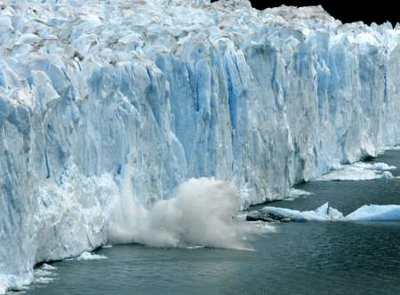 Ice melt studies say we underestimate sea level rise, Independent Australia Peter Boyer 11 April 2016, Are melting polar ice sheets as stable as we think, or have we missed something? If a couple of new ice studies are only partly right, we face massive disruption from sea level rise within decades.
SCIENTIFIC DEBATE about this has picked up in the wake of the March publication of two major research papers by scientists from the U.S., France, Germany and China.
A paper by James Hansen and 18 other climatologists in the open-access science journal Atmospheric Chemistry and Physics, examined ancient climate change to assess how that compares with today’s melting of Greenland and Antarctic ice sheets.
It argues that during this century, ice sheet meltwater spreading over parts of the Southern Ocean and the North Atlantic will increase the temperature variation between these cooler parts and warming regions, resulting in more violent storms.
The meltwater layer also acts as a transparent lid on warming ocean waters undermining polar ice sheets sitting on bedrock below sea level. The paper’s startling prediction is that consequent disintegration could bring several metres of sea level rise within 150 years and possibly by 2070.
A paper published last week in the science journal Nature, also examining past rapid changes, looked at how the Antarctic ice sheet might react to warming of atmosphere as well as ocean, and reached similarly disturbing conclusions.
U.S. scientists Robert DeConto and David Pollard studied the puzzle of how the massive Antarctic ice sheet shed large amounts of ice over relatively short time-frames in prehistoric warming events.
Their modelling showed that if today’s high carbon emissions continue, warmer air would add to the impact of warming seas. Fracturing ice shelves and coastal cliffs would bring rapid ice loss and contribute ‘more than a metre of sea-level rise by 2100’………https://independentaustralia.net/environment/environment-display/ice-melt-studies-say-we-underestimate-sea-level-rise,8866
World powers worried at effects of climate change, drought, causing conflicts
We’re running out of water, and the world’s powers are very worried, Reveal, By Nathan Halverson / April 11, 2016 Secret conversations between American diplomats show how a growing water crisis in the Middle East destabilized the region, helping spark civil wars in Syria and Yemen, and how those water shortages are spreading to the United States.
Classified U.S. cables reviewed by Reveal from The Center for Investigative Reporting show a mounting concern by global political and business leaders that water shortages could spark unrest across the world, with dire consequences.
Many of the cables read like diary entries from an apocalyptic sci-fi novel.
“Water shortages have led desperate people to take desperate measures with equally desperate consequences,” according to a 2009 cable sent by U.S. Ambassador Stephen Seche in Yemen as water riots erupted across the country.
On Sept. 22 of that year, Seche sent a stark message to the U.S. State Department in Washington relaying the details of a conversation with Yemen’s minister of water, who “described Yemen’s water shortage as the ‘biggest threat to social stability in the near future.’ He noted that 70 percent of unofficial roadblocks stood up by angry citizens are due to water shortages, which are increasingly a cause of violent conflict.”
Seche soon cabled again, stating that 14 of the country’s 16 aquifers had run dry. At the time, Yemen wasn’t getting much news coverage, and there was little public mention that the country’s groundwater was running out.
These communications, along with similar cables sent from Syria, now seem eerily prescient, given the violent meltdowns in both countries that resulted in a flood of refugees to Europe.
Groundwater, which comes from deeply buried aquifers, supplies the bulk of freshwater in many regions, including Syria, Yemen and drought-plagued California. It is essential for agricultural production, especially in arid regions with little rainwater. When wells run dry, farmers are forced to fallow fields, and some people get hungry, thirsty and often very angry.
The classified diplomatic cables, made public years ago by Wikileaks, now are providing fresh perspective on how water shortages have helped push Syria and Yemen into civil war, and prompted the king of neighboring Saudi Arabia to direct his country’s food companies to scour the globe for farmland. Since then, concerns about the world’s freshwater supplies have only accelerated……..
The water-fueled conflicts in the Middle East paint a dark picture of a future that many governments now worry could spread around the world as freshwater supplies become increasingly scarce. The CIA, the State Department and similar agencies in other countries are monitoring the situation.
In the past, global grain shortages have led to rapidly increasing food prices, which analysts have attributed to sparking the Arab Spring revolution in several countries, and in 2008 pushed about 150 million people into poverty, according to the World Bank.
Water scarcity increasingly is driven by three major factors: Global warming is forecast to create more severe droughts around the world. Meat consumption, which requires significantly more water than a vegetarian or low-meat diet, is spiking as a growing middle class in countries such as China and India can afford to eat more pork, chicken and beef. And the world’s population continues to grow, with an expected 2 billion more stomachs to feed by 2050……..
These problems are not just happening overseas, but already are leading to heated political issues in the United States. In the western part of the country, which Nestle forecast will suffer severe long-term shortages, tensions are heating up as Middle Eastern companies arrive to tap dwindling water supplies in California and Arizona………
Back in Yemen in 2009, U.S. Ambassador Seche described how as aquifers were drained, and groundwater levels dropped lower, rich landowners drilled deeper and deeper wells. But everyday citizens did not have the money to dig deeper, and as their wells ran dry, they were forced to leave their land and livelihoods behind.
“The effects of water scarcity will leave the rich and powerful largely unaffected,” Seche wrote in the classified 2009 cable. “These examples illustrate how the rich always have a creative way of getting water, which not only is unavailable to the poor, but also cuts into the unreplenishable resources.” https://www.revealnews.org/article/were-running-out-of-water-and-the-worlds-powers-are-very-worried/
Religious groups urge US lawmakers to approve funding for Green Climate Fund (GCF)
Faith groups call for more international climate funding The Hill, By Devin Henry – 04/11/16 More than 120 religious groups are encouraging lawmakers to approve President Obama’s proposed $750 million contribution to an international climate change fund.
In a letter to members of Congress, the groups say the  is an important way to “build resilience and stability in the face of the unavoidable impacts of climate change,” an issue they say their faith backgrounds call them to focus on.
The GCF is an international pool of money designed to help poor and developing countries cope with climate change. Obama has requested Congress provide $750 million for the fund in 2017. …….http://thehill.com/policy/energy-environment/275864-faith-groups-call-for-more-international-climate-funding
UN study of 1.5 degrees Celsius – it may not be feasible
U.N. panel to study a cap on global warming that may be out of reach http://www.reuters.com/article/us-climatechange-temperatures-idUSKCN0X81PH OSLO/LONDON | BY ALISTER DOYLE AND NINA CHESTNEY Top climate scientists will launch a study this week of how hard it would be to limit global warming to 1.5 degrees Celsius (2.7 Fahrenheit), although many of them fear it might be too late to reach that level.
The world’s average surface temperatures reached 1C (1.8F) above pre-industrial times in a record-hot 2015. They will rise by 3C (3.6F) or more by 2100 if current trends continue, many projections show.
A 195-nation climate summit in Paris in December asked the U.N.’s Intergovernmental Panel on Climate Change for a report in 2018 on limiting warming to just 1.5C. The IPCC began a three-day meeting in Nairobi on Monday to consider how to do that.
“Do we know how? No. It is definitely a moon shot,” Christiana Figueres, the U.N.’s climate chief, said at a conference in London on Monday.
Paris set a goal of limiting average surface temperatures to “well below” 2C while “pursuing efforts” for 1.5C. Documents prepared for the Nairobi meeting say scientific literature about 1.5C is thin.
Many scientists have barely focused on the 1.5C goal, reckoning it would require unrealistically deep cuts in emissions. Experts say the IPCC will comply with the Paris request, with misgivings.
“I don’t seek how they can say ‘No’,” David Victor, a professor of international relations at the University of California, San Diego, told Reuters. “But I don’t see how they say ‘Yes’ with a straight face.”
Some IPCC studies suggest 1.5C will be feasible if the world develops low-costtechnologies later this century to extract greenhouse gases from the atmosphere.
Many poor nations, fearing melting ice that will raise sea levels and swamp their coasts, campaign for “1.5 to stay alive”.
“My concern is that the 2018 report may have lots of information about how hard it will be to achieve 1.5C, and relatively little about the benefits,” Myles Allen, a professor at Oxford University, told Reuters.
He noted that countries pushing hardest for the 1.5C limit, including small, low-lying island states such as the Marshall Islands or the Maldives, wanted to stress the advantages.
Limiting warming to 1.5C rather than 2C would limit, for instance, sea level rise, the melt of Arctic sea ice, damage to coral reefs and the acidification of the oceans, according to IPCC studies.
(Reporting By Alister Doyle, editing by Larry King)
Big Oil spends up Big to thwart climate change action
The new report excludes so-called dark money, or money spent on think tanks and institutes,
 Trying to Put a Price on Big Oil’s ‘Climate Obstruction’ Efforts, Bloomberg, http://www.bloomberg.com/news/articles/2016-04-07/trying-to-put-a-price-on-big-oil-s-climate-obstruction-effort Eric Roston eroston
The sheer fuzziness of corporate influence prompted the project. Nations hold companies to different standards—or none at all—for disclosures of how they are trying to influence public policy and what it costs.
To come up with its numbers, Influence Map first had to define what “influence” actually means. The researchers adopted a framework spelled out in a 2013 UN report written to help companies align their climate change policies with their lobbying and communications strategies. It’s a broad approach to understanding influence that includes not only direct lobbying, but also advertising, marketing, public relations, political contributions, regulatory contacts, and trade associations.
The five subjects of Influence Map’s research use those organs to the opposite ends. ExxonMobil’s “direct spending on climate obstruction,” according to the report, may be $27 million a year. Shell’s estimated spending is $22 million. The American Petroleum Institute, the oil industry’s U.S. trade group, may spend up to $65 million a year, and two smaller groups—the Western States Petroleum Association (WSPA) and the Australian Petroleum Production & Exploration Association—are estimated to spend about $9 million together.
Investor groups that push for strong climate policies spend less than $5 million a year on advocacy, according to the researchers.
The report, “How Much Big Oil Spends on Obstructive Climate Lobbying,” is directed at investors who are starting to make more noise about the topic. Nineteen climate-minded investment groups have filed 45 resolutions with oil-and-gas companies related to climate change and greenhouse gases in 2016 alone, although nine of these resolutions were withdrawn after companies promised action or further discussion. The investors include the New York State Comptroller, the California State Teachers’ Retirement System, the Presbyterian Church in the U.S., and sustainability pioneer Trillium Asset Management.
Influence Map published alongside the report a three-stage methodology it used to calculate its estimates. First, the researchers isolated the specific outreach activities that can influence policymakers, using lobbying registers, Internal Revenue Service documents, and annual reports to estimate total spending. The next step was to estimate how much of that total is directed to climate issues. Finally, they analyzed the climate-related activity, scored it as either “supportive or obstructive” to climate policy, and to what degree.
The new report excludes so-called dark money, or money spent on think tanks and institutes, as identified by Drexel University sociologist Robert Brulle in 2013. Given current disclosure standards, the researchers were unable to determine how these groups are funded.
The conclusions come amid heightened scrutiny of oil companies’ public positions on climate issues. Bill McKibben, the writer and climate activist who founded 350.org, has endorsed the report, as have Governor Peter Shumlin of Vermont and Sonia Kowal, president of Zevin Asset Management.
Influence Map is funded by the Tellus Mater Foundation and the Joseph Rowntree Charitable Trust.
The five organizations scrutinized in the report had not seen it, but two responded to questions before deadline. ExxonMobil’s climate policy can be read here. A spokesman for the company said it has spent almost $9 billion on research that may boost energy supply, cut emissions, and improve efficiency.
A WSPA spokesman said the group educates the public “on the facts and science often left out of today’s climate storyline” and that its lobbying is in compliance with the California Fair Political Practices Commission.
The report was not published in a peer-reviewed journal. “But on first glance, it looks rigorous and well documented,” said Justin Farrell, a Yale sociologist who has conducted extensive research on conservative climate influence networks. “Given we know much less than we ought to about corporate influence on climate change misinformation,” he said, “any sort of honest effort by NGOs, academic research, or legal officials is a step in the right direction.”
Cloud study shows that global warming danger even more extreme
 Global warming may be far worse than thought, cloud analysis suggests, Guardian, Oliver Milman, 8 Apr 16
Researchers find clouds contain more liquid – as opposed to ice – than was previously believed, threatening greater increase in temperatures. Climate change projections have vastly underestimated the role that clouds play, meaning future warming could be far worse than is currently projected, according to new research.
Researchers said that a doubling of carbon dioxide in the Earth’s atmosphere compared with pre-industrial times could result in a global temperature increase of up to 5.3C – far warmer than the 4.6C older models predict.
The analysis of satellite data, led by Yale University, found that clouds have much more liquid in them, rather than ice, than has been assumed until now. Clouds with ice crystals reflect more solar light than those with liquid in them, stopping it reaching and heating the Earth’s surface.
The underestimation of the current level of liquid droplets in clouds means that models showing future warming are misguided, says the paper, published in Science. It also found that fewer clouds will change to a heat-reflecting state in the future – due to CO2 increases – than previously thought, meaning that warming estimates will have to be raised.
Such higher levels of warming would make it much more difficult for countries to keep the global temperature rise to below 2C, as they agreed to do at the landmark Paris climate summit last year, to avoid dangerous extreme weather and negative effects on food security. The world has already warmed by 1C since the advent of heavy industry, driven by CO2 concentrations soaring by more than 40%……. http://www.theguardian.com/environment/2016/apr/07/clouds-climate-change-analysis-liquid-ice-global-warming?CMP=share_btn_tw
America’s mayors speak out in support of Obama’s Clean Power Plan
Cities Speak Up to Save Obama’s Clean Power Plan, City Lab, A large coalition of U.S. mayors and local governments is coming to the EPA’s defense in the legal battle to cut carbon emissions from power plants. JULIAN SPECTOR @JulianSpector Mar 31, 2016
President Barack Obama’s flagship plan to fight climate change is getting a boost from city leaders across the country.
The National League of Cities, the U.S. Conference of Mayors, and a coalition of 54 local governments are filing arguments in federal court Friday morning in support of the Clean Power Plan, imploring the D.C. Circuit Court of Appeals to allow the Environmental Protection Agency to regulate greenhouse gases emitted from existing power plants.
The amicus brief, provided in advance to CityLab, argues that the EPA has a duty to protect the public from harmful pollution in ways laid out by the Clean Power Plan. Cities, meanwhile, are uniquely vulnerable to climate change and are already paying for its effects, they say.
These comments come days after the EPAoutlined its own arguments in defense of the plan, which is being challenged by 27 states and an assortment of coal and power industry groups. The rule would force changes in the power sector with a goal of cutting its emissions by 32 percent from 2005 levels by 2030. At stake is the scope of the EPA’s regulatory powers, but also the ability of the U.S. government to meet its commitments to fighting climate change, as agreed to in the Paris negotiations last December………
“President Obama’s Clean Power Plan is essential to reduce our nation’s greenhouse gas emissions,” Los Angeles Mayor Eric Garcetti writes to CityLab. “The Supreme Court must choose between helping cities fight climate change or standing squarely in their way.” http://www.citylab.com/politics/2016/03/epa-clean-power-plan-cities-supreme-court/476127/
Transition to renewable energy sector: the goal of these North American Oil and Gas Workers
Amid Price Plunge, North American Oil and Gas Workers Seek Transition to Renewable Sector TruthOut, 03 April 2016 00:00By Candice Bernd, “…….after years of working in an industry that one top climate scientist has called “the biggest carbon bomb on the planet,” Hildebrand came to realize that he was not the only oil worker in Alberta who felt “guilty about developing the infrastructure that is creating climate change.”
Opportunity in the Oil Plunge
Last spring, when oil prices began to fall, Hildebrand banded together with like-minded coworkers and began building an oil and gas worker-led nonprofit called “Iron & Earth,” which officially launched this month during a press conference in Edmonton. Through the nonprofit, the oil sands workers hope to help others who have been laid off diversify their skill sets and facilitate the necessary training to transition them to the renewable energy sector. They also want to help incorporate renewable energy projects into oil sands workers’ current scope of work…….
“We are a group of workers who not only want to diversify our work scope based on job need, but also based on a values-based mission, to ensure that we’re creating and building a future that’s going to be sustainable,” Hildebrand told Truthout. “The drop in oil prices was certainly a catalyst to help amplify these conversations, and created the pressure to … create a catch-all organization that’s going to make projects happen and get workers’ hands on some renewable energy projects.”
Moreover, not every oil worker with experience in Alberta’s oil sands needs to retrain in order to transition to the renewable sector, according to Hildebrand, who says a lot of trades are “directly transferable.” Hildebrand has worked on several renewable energy projects himself, including a biomass plant and the wind farm weather station that inspired him during his apprenticeship. “I didn’t require any retraining for that. All I required was the blueprints and the steel, and the facility to build it,” he said.
From Oil Sands to “Solar Skills”
Iron & Earth’s first project is its “Solar Skills” campaign to facilitate the retraining of 1,000 laid-off electricians from Alberta’s oil industry, to help build 100 solar installations on public buildings throughout the province beginning this fall. In the future, as the group takes on different campaigns focused on geothermal, biomass, biofuel and wind energy, they hope to attract other kinds of oil and gas workers, such as pipefitters and iron workers, as well as workers from other building trades, to retrain in those sectors………http://www.truth-out.org/news/item/35477-amid-price-plunge-north-american-oil-and-gas-workers-seek-transition-to-renewable-sector
By 2018 world must shift to zero carbon, to avoid extra dangerous global warming
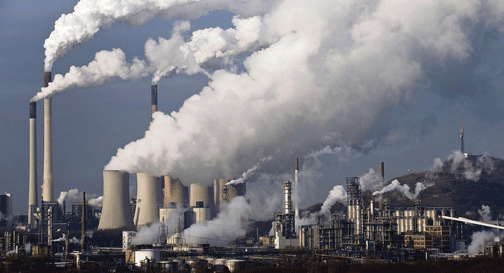
Shift to zero-carbon power must start by 2018 to avoid extra warming: study http://www.theage.com.au/environment/climate-change/shift-to-zerocarbon-power-must-start-by-2018-to-avoid-extra-warming-study-20160331-gnuy7x.html April 1, 2016 Peter Hannam Environment Editor, The Sydney Morning Herald The world must begin the shift to zero-carbon sources of electricity as soon as 2018 to avoid adding new fossil-fuel power plants that will lock in dangerous climate change, according to a team of Oxford University researchers.
Taking the average operating life of coal or gas-fired plants as 40 years, the world’s fleet of carbon-emitting power stations had already committed by 2014 a total of 87 per cent of the emissions required to ensure a 50-50 chance of reaching two degrees of warming compared with pre-industrial levels.
By 2017, the remaining stock of potential emissions will have been locked in, necessitating a transition to renewable or zero-emissions electricity from then on. Alternatively, radical technologies will be needed to sequester carbon dioxide or extract it from the atmosphere, the researchers including Australian Cameron Hepburn wrote in a paper published in Applied Energy journal.
“For policymakers who think of climate change as a long-term future issue, this should be a wake-up call,” the authors said in a statement. “Whether we succeed or fail in containing warming to 2 degrees is being determined by actions we are taking right now.”
The papers come in a week when environmental groups warned as many as 1500 coal-fired power plants are being planned or being built worldwide, scientists found coral bleaching in the Great Barrier Reef to be worse than first thought, and Antarctic ice sheets were declared to be melting faster than expected.
Electricity generation accounts for about one quarter of man-made greenhouse gas emissions and about one third of Australia’s total. The researchers assumed other emission sources, such as transport and agriculture, would track towards a 2-degree warming limit, an assumption “which may well be optimistic”, the paper notes.
Australia was one of almost 200 nations to sign up to limiting warming to a 1.5-2 degree range at the Paris climate summit late last year.
The lower end of that target has been well exceeded, the researchers argue: “Meeting a 1.5-degree target without [carbon capture and storage] or asset stranding would have required all additions to the electricity sector were zero carbon from 2006 onwards, at the latest”.
Malte Meinshausen, director of Melbourne University’s Climate & Energy College, said the research confirmed work by the International Energy Agency and others “that we now have enough fossil fuel infrastructure globally in place to emit a detrimental amount of carbon”.
“With the correct market signals in place – such as a price on carbon emissions – it will be more economical even for the utilities to abandon fossil fuel [plants] and switch to renewable investments instead,” Associate Professor Meinshausen said. “If the time for halting investments into new fossil fuel infrastructure is 2017 for the world, that time has been 10 years ago for Australia – the highest per-capita emitter in the developed world.”
As it happens, the combination of Australia’s flat or declining demand for grid-supplied electricity and the need to meet the mandated 2020 Renewable Energy Target (RET) means there is little likelihood of new coal or gas-fired power plants being built in this country for at least the next decade, said Dylan McConnell, a research fellow at Melbourne University’s Melbourne Energy Institute.
While there are several proposed gas projects and one black coal project in NSW at AGL’s Bayswater site, renewable energy ventures are likely to meet any near-term need for additional large-scale capacity, Mr McConnell said.
Some 14,000 megawatts (MW) of wind or solar plants are seeking approval, a tally that is “certainly much more than needed for the RET”, he said. “The cost curve for fossil fuel [plants] is going in the other direction.”
This week, Origin Energy signed up for its first power purchase agreement for large-scale solar, taking output from a 56 MW solar farm in Moree in northern NSW.
“Ten years ago, 15 years ago the prospectors were in Queensland looking for [coal seam gas] resources,” Grant King, Origin’s chief executive, said last year. “I would think the next great round of investment in Queensland will be utility scale solar.”
Origin is among the prospectors, applying to the Australian Renewable Energy Agency for funding to support a 106 MW solar farm of its own to be built on the Darling Downs next to its existing gas-fired plant.
Both Coal and Nuclear Electricity Generation Will Be Severely Affected By Hotter Climate
 HOW A HOTTER CLIMATE DESTROYS THERMAL ELECTRICITY GENERATION Earth Techling, BY SUSAN KRAEMER MARCH 30, 2016
Both hydropower and conventional thermal combustion electricity is depleted in a hotter new climate.
A new paper published at Nature Climate Change, Power-generation system vulnerability and adaptation to changes in climate and water resources provides a comprehensive look at how two categories of power generation will be impacted by climate change on a global level.
The study looked at both thermal power stations (that depend on the combustion of fossil fuels, biomass or uranium), and also at hydropower systems.
Hydropower relies directly on abundant flow in falling water from mountain snow melt, while each type of thermal energy requires a lot of water to boil to make steam to drive turbines, and water to cool off the boiled water as it is discharged.
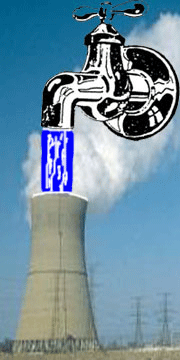 Unlike solar PV and wind power, thermal electric power stations are totally dependent on adequate water supplies, at cool water temperatures

The estimates in the study are based on an assumption that 80% of the world’s electricity is generated thermally – coal, gas, nuclear, biomass – with an additional 17% generated using hydropower. (Only 3% of global energy comes from PV and wind, according to the study*.)
(*The figures originated from a 2009 paper from the IEA – so it’s based on 2008 data. The IEA has been fairly notorious for undercounting renewables for some time, as the adoption rate has increased exponentially, so in the future, it is unlikely that 80% will still be thermal.)
As of now, however, of all water taken from rivers and lakes; the percentage used in thermal power generation amounts to about 50% in the UK and about 40% in the US.
With so much electricity generation so dependent on water, the study shows just how vulnerable is the world’s combustion-based energy supply in a hotter, drier world, when water will be warmer and droughts and heat waves longer and more frequent in many regions.
The paper is one of several that look at the impact of a hotter climate on thermal electricity generation, between coal, gas, biomass and nuclear. Two more quantify the effects on electricity costs.
How rising temperatures cause rising cost: droughts reduce cheap hydropower
As Californians have just experienced, hotter temperatures have already begun to result in the droughts long predicted for the entire Southwest US by climate scientists as the 21st century continues to warm.
What California has just seen is that when droughts deepen, mountain reservoirs and lakes and rivers dry up, and hydropower dries up with them………
How thermal power is reduced as water temperatures increase:
The changes that higher temperatures bring not only deplete water flow, impacting hydropower, but also act to warm the water that is needed to cool discharged water from thermal power plants. This warmer water, both in rivers and the ocean, also reduces electricity production.
Because of rules governing environmental degradation, thermal plants that essentially boil water must shut down if the water used for cooling gets too warm.
Discharged water temperature is monitored to ensure that coal and nuclear plants don’t discharge water that is too hot, endangering wildlife in surrounding waterways.
But already in 2007, during a heat wave that contributed to river water reaching an astounding 90 °F, the Tennessee Valley Authority had to shut down a nuclear plant due to hot river water in Kentucky.
During the heat wave in Europe in 2003 and 2006; 17 nuclear plants across Germany, France, Spain and Romania had to idle production or shut down entirely because the waterways normally used to cool down boiled water coming out of the electricity plants was too warm to discharge hot water into.
Shutting down or idling plants reduces generation and raises electricity prices because the lowered output of electricity results in higher prices per unit of generation
Paper assesses global costs of thermal generation in a hotter water future
In a third paper published at Norges Handelshøyskole, Electricity Prices, River Temperatures and Cooling Water Scarcity, a future of higher costs for thermal electricity is predicted as a direct result of the warmer water temperatures caused by climate change. In the longer term, these costs could become unsupportable.
The study co-author Øivind Anti Nilsen estimated that even as little as a one degree rise in average river temperatures will result in almost a 4% percent increase in electricity prices, over the course of a week.
“The analysis shows that higher temperatures lead to reduced production in power plants and hence higher electricity costs. Prices shoot up”, explained Nilsen, a co-author of the paper, and professor at the Department of Economics at Norges Handelshøyskole.
“The higher the temperature, the lower the power plant’s efficiency. Prices therefore rise in line with the temperature,” said Nilsen
“Many people who work on the effects of climate change have overlooked these price effects and their implications,” he said.
These increasing costs of climate change will be felt in the US as much as in Europe, because in the US, the thermal energy industry accounts for as much as 40% of all freshwater withdrawals, according to the US Department of Energy
This effect will only continue to increase in the future, as the world sees more frequent and hotter heat waves. Yet the world continues to build thermal plants that are dependent on a diminishing resource – cool water.
The Arabian Gulf region already has one of the highest ocean temperatures in the world, reaching above 95°F in the summer. Despite this inability to act as a cooling resource, the Arabian Gulf is to provide the cooling for two proposed nuclear plants, a 1 GW nuclear plant from a Russian manufacturer, and another much larger one, comprising four adjoined 1.4 GW units, that is made in Korea.
So, which regions will be most affected?
“In particular the US, southern South America, southern Africa, central and southern Europe, Southeast Asia and southern Australia are vulnerable regions,” said Dr Michelle van Vliet, a researcher at the International Institute for Applied Systems Analysis (IIASA) and lead author of Power-generation system vulnerability and adaptation to changes in climate and water resources.
“This is because declines in mean annual streamflow are projected combined with strong increases in water temperature under changing climate.”
One more reason to abandon thermal combustion for making electricity. http://earthtechling.com/2016/03/how-a-hotter-climate-destroys-thermal-electricity-generation/
USA and China – joint statement: both will sign Paris climate deal
 US and China to sign Paris climate deal http://www.heraldsun.com.au/news/breaking-news/us-and-china-to-sign-paris-climate-deal/news-story/94b6ac23151ca2d99645372ed0bf9269
The United States and China have confirmed that they will sign the Paris climate change agreement in New York on April 22, a move that officials hope will help the accord enter into force this year.
The world’s two biggest greenhouse gas emitters issued a joint presidential statement on Thursday in which they called on other countries to sign the accord next month “with a view to bringing the Paris Agreement into force as early as possible”.
Leaders from nearly 200 countries forged the landmark agreement to transform the world’s fossil fuel-driven economy on December 12 after four years of fraught negotiations.
But the Paris climate agreement needs at least 55 countries, representing at least 55 per cent of global emissions, to formally accede to it before it can enter into force.
Stern has stepped down from his role as the chief US climate negotiator, and will be replaced by his former deputy, Jonathan Pershing, on April 1.
United Nations Secretary-General Ban Ki-moon said earlier this month that he expected 120 or more countries would sign the accord at the April 22 ceremony at its New York headquarters.
“Clean coal” technology is not working
Technology to Make Clean Energy From Coal Is Stumbling in Practice, NYT, By IAN AUSTEN MARCH 29, 2016 OTTAWA — An electrical plant on the Saskatchewan prairie was the great hope for industries that burn coal.
In the first large-scale project of its kind, the plant was equipped with a technology that promised to pluck carbon out of the utility’s exhaust and bury it underground, transforming coal into a cleaner power source. In the months after opening, the utility and the provincial government declared the project an unqualified success.
 But the $1.1 billion project is now looking like a green dream.
Known as SaskPower’s Boundary Dam 3, the project has been plagued by multiple shutdowns, has fallen way short of its emissions targets, and faces an unresolved problem with its core technology. The costs, too, have soared, requiring tens of millions of dollars in new equipment and repairs.
“At the outset, its economics were dubious,” said Cathy Sproule, a member of Saskatchewan’s legislature who released confidential internal documents about the project. “Now they’re a disaster.”……….http://www.nytimes.com/2016/03/30/business/energy-environment/technology-to-make-clean-energy-from-coal-is-stumbling-in-practice.html?_r=0
1 This Month





PLEASE OPPOSE HR 8255 AND S.3639 – bills would accelerate satellite deployment, with no environmental review or safeguards – https://ncstd5li.quorum.us/campaign/169331/
To see nuclear-related stories in greater depth and intensity – go to https://nuclearinformation.wordpress.com
-
Archives
- October 2026 (19)
- September 2026 (339)
- August 2026 (330)
- July 2026 (355)
- June 2026 (287)
- May 2026 (306)
- April 2026 (356)
- March 2026 (251)
- February 2026 (267)
- January 2026 (308)
- December 2025 (358)
- November 2025 (359)
-
Categories
- 1
- 1 NUCLEAR ISSUES
- business and costs
- climate change
- culture and arts
- ENERGY
- environment
- health
- history
- indigenous issues
- Legal
- marketing of nuclear
- media
- opposition to nuclear
- PERSONAL STORIES
- politics
- politics international
- Religion and ethics
- safety
- secrets,lies and civil liberties
- spinbuster
- technology
- Uranium
- wastes
- weapons and war
- Women
- 2 WORLD
- ACTION
- AFRICA
- Atrocities
- AUSTRALIA
- Christina's notes
- Christina's themes
- culture and arts
- Events
- Fuk 2022
- Fuk 2023
- Fukushima 2017
- Fukushima 2018
- fukushima 2019
- Fukushima 2020
- Fukushima 2021
- general
- global warming
- Humour (God we need it)
- Nuclear
- RARE EARTHS
- Reference
- resources – print
- Resources -audiovicual
- Weekly Newsletter
- World
- World Nuclear
- YouTube
-
RSS
Entries RSS
Comments RSS

