James Hansen is so wrong about “new nuclear” as saviour of the world’s climate

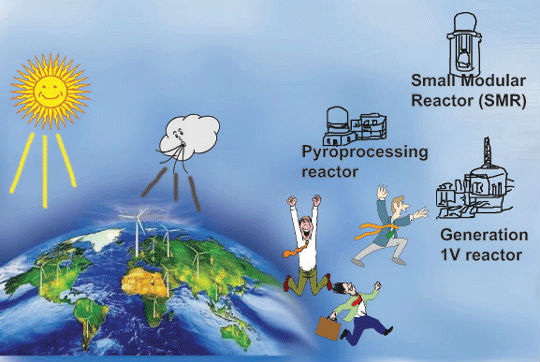 Stanford University engineering professor, Mark Z. Jacobson’s response to Hansen points out that it takes around 10-19 years from the start of planning for new reactors to the start of operation compared with 2-5 years for wind or solar. Nuclear is just too slow to help solve climate problems. (8) Bill Gates also made a lot of headlines with his “Breakthrough Energy Coalition” fund to come up with new energy solutions, including “advanced” nuclear reactors. It’s not that innovation isn’t welcome, but what the climate really needs right now is the large-scale deployment of existing technologies which, according to investment bank Goldman Sachs, are already cost-effective and climate-effective. The problem is, an Apollo-style push for what Gates has called “Energy Miracles” is not only a misguided strategy for mitigating climate change, it could also distract funders with the enticing idea that invention is going to rescue us from climate change. They really should be distributing funds to empower communities, and incentivize the massive deployment of energy efficiency and existing renewable technology now rather waiting for miracles which might never happen, or will happen too late to make a difference. (9) ……http://www.no2nuclearpower.org.uk/nuclearnews/NuClearNewsNo81.pdf
Nuclear Industry goes into Climate Overdrive
 No 2 NuclearPower No 81 January 2016 “…….. “We are now in the midst of a fight between the past and the future”. Former Australian Greens’ Senator Christine Milne The nuclear industry and its champions went into overdrive during the Paris Climate Conference. Was it a last-ditch effort to convince us all that nuclear power is an important part of the answer to the climate crisis? It all seemed a bit desperate with blatant attacks (1) on those who envisage a future based on renewables and no nuclear.
World needs a global carbon tax, says aluminium billionaire
Almost every Australian mining company believes that a carbon tax in some form or another is necessary to provide the certainty required for investment. But Mr Deripaska’s call for a $US15-a-tonne tax represents a bold call in comparison
Rusal’s Deripaska calls for worldwide carbon tax THE AUSTRALIAN JANUARY 13, 2016 Barry Fitzgerald Resources Editor Melbourne
Billionaire Russian aluminium king Oleg Deripaska has slammed the lack of action after the Paris climate summit, saying the world needs to act now on introducing a carbon tax to curb emissions and fund the rise of renewables.
Writing exclusively in The Australian, Mr Deripaska, president of the world’s biggest aluminium group Rusal, says the outcome of the Paris summit late last year was nothing more than an agreement for 196 countries to “kick the can down the road a few decades’’……..
He says that without immediate action on a carbon tax, the losers from the Paris Summit are “those of us who breathe the air, drink the water, and wish for the safe and healthy environment our children and grandchildren deserve”.
………….“It is now incumbent on global governments, corporations and citizens to bring action to the words of Paris,’’ Mr Deripaska adds. He has suggested a carbon tax starting off at $US15 a tonne, increasing over time.
- “Such a tax would constitute a clear pricing mechanism and signal to the global market, providing a powerful disincentive to carbon producers and consumers,’’ Mr Deripaska says.He suggests one-third of the revenue raised could be used to “unleash an unprecedented wave of R&D investment in energy-efficient and lower carbon emissions energy sources’’……….
- A carbon tax is no stranger to either Australian government or industry, with the first proposal coming from the Hawke-Keating government in 1991 in a secret cabinet proposal sponsored by treasurer Keating. Industry reacted savagely against the proposal when the news was leaked via the media and the idea was shut down.The Howard government picked up the ball with its Renewable Energy Target in November 1997. It was a forerunner of the emissions trading system proposed by the Rudd government, which ended in Kevin Rudd’s eventual ousting on the back of Tony Abbott’s relentless campaign against the introduction of any carbon tax or emissions trading.
Mr Rudd’s successor Julia Gillard introduced the carbon tax in July 2012 that ended in her defeat as prime minister, and the tax was repealed by the newly elected Abbott government in July 2014.
Almost every Australian mining company believes that a carbon tax in some form or another is necessary to provide the certainty required for investment. But Mr Deripaska’s call for a $US15-a-tonne tax represents a bold call in comparison……. http://www.theaustralian.com.au/business/mining-energy/rusals-deripaska-calls-for-worldwide-carbon-tax/news-story/651eabfd65e51841b6b9899fd895f444
Refuting James Hansen’s claims about nuclear power and climate change
The nuclear power industry has essentially priced itself out of the market for new power plants because of its 1) negative learning curve and 2) inability to avoid massive delays and cost overruns in market economies. This is doubly problematic because the competition — renewable power, electricity storage, and energy efficiency — have seen steady, stunning price drops for a long time.
the IEA and many others have concluded that new renewable energy will play a far bigger role in the transition.
 Why James Hansen Is Wrong About Nuclear Power, Climate Progress BY JOE ROMM JAN 7, 2016 CLIMATOLOGIST JAMES HANSEN ARGUED LAST MONTH, “NUCLEAR POWER PAVES THE ONLY VIABLE PATH FORWARD ON CLIMATE CHANGE.” HE IS WRONG.
As the Nuclear Energy Agency (NEA) and International Energy Agency (IEA) explained in a major report last year, in the best-case scenario, nuclear power can play a modest, but important, role in avoiding catastrophic global warming if it can solve its various nagging problems — particularly high construction cost — without sacrificing safety.
Hansen and a handful of other climate scientists I also greatly respect — Ken Caldeira, Tom Wigley, and Kerry Emanuel — present a mostly handwaving argument in which new nuclear power achieves and sustains an unprecedented growth rate for decades. The one quantitative “illustrative scenario” they propose — “a total requirement of 115 reactors per year to 2050 to entirely decarbonise the global electricity system” — is far beyond what the world ever sustained during the nuclear heyday of the 1970s, and far beyond what the overwhelming majority of energy experts, including those sympathetic to the industry, think is plausible.
They ignore the core issues: Continue reading
Cruel nuclear winter, deadly famine from one “small” nuclear war
One small atomic war could trigger cruel nuclear winters and global famine http://www.techinsider.io/nuclear-explosions-earth-atmosphere-temperature-2016-1 Kevin Loria 7 Jan 16
North Korea’s fourth test of a nuclear weapon — whether it was a hydrogen bomb or not — calls attention to a well-known but sobering fact: There are a terrifying number of nuclear weapons in the arsenals of major powers around the world.
But worse, unprecedented and widespread devastation doesn’t require the unlikely scenario of all those powers unleashing all the firepower at once, according to a recent study published in an American Geophysical Union journal.
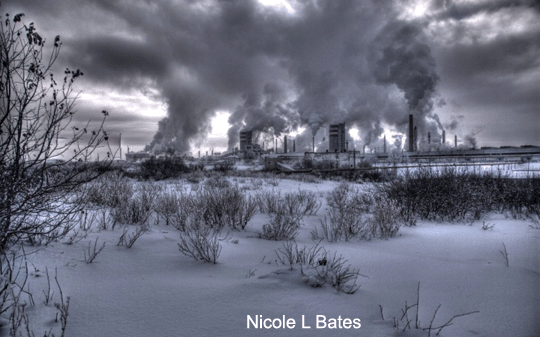
In fact, that study found that a “limited, regional nuclear war” using 100 “small nuclear weapons” — the size of the bomb dropped at Hiroshima — could cause a nuclear winter that would last decades. Continue reading
The nuclear lobby failed its goal for Paris climate agreement
Paris Fails to Revive the Nuclear Dream, Ecowatch Paul Brown,  Climate News Network | December 31, 2015 In Paris, in early December, the advocates of nuclear power made yet another appeal to world leaders to adopt their technology as central to saving the planet from dangerous climate change.
Yet analysis of the plans of 195 governments that signed up to the Paris agreement, each with their own individual schemes on how to reduce national carbon emissions, show that nearly all of them exclude nuclear power.
Only a few big players—China, Russia, India, South Korea and the United Kingdom—still want an extensive program of new–build reactors.
To try to understand why this is so the U.S.-based Bulletin of the Atomic Scientists asked eight experts in the field to look at the future of nuclear power in the context of climate change.
One believed that large-scale new-build nuclear power “could and should” be used to combat climate change and another thought nuclear could play a role, although a small one. The rest thought new nuclear stations were too expensive, too slow to construct and had too many inherent disadvantages to compete with renewables.
Industry in Distress
Amory Lovins, co-founder and chief scientist of the Rocky Mountain Institute, produced a devastating analysis saying that the slow-motion decline of the nuclear industry was simply down to the lack of a business case.
The average nuclear reactor, he wrote, was now 29 years old and the percentage of global electricity generated continued to fall from a peak of 17.6 percent in 1996 to 10.8 percent in 2014. “Financial distress stalks the industry,” wrote Lovins.
Lovins says nuclear power now costs several times more than wind or solar energy and is so far behind in cost and building time that it could never catch up.
The full details of what he and other experts said are on the Bulletin’s site, with some of their comments below……..
M.V. Ramana, of the Nuclear Futures Laboratory and the Program on Science and Global Security at Princeton University, was dismissive. “There are still some who hope that nuclear power will magically undergo a massive expansion within a relatively short period of time.”
”The evidence so far suggests that this is a false hope, one that is best abandoned if we are to deal with climate change with the seriousness the problem demands.”
Peter Bradford, adjunct professor at Vermont Law School and former Nuclear Regulatory Commission member, agreed: “Climate change, so urgent and so seemingly intractable, has become the last refuge of nuclear charlatans throughout the Western world.”
He said James Hansen, perhaps the most visible of the climate scientists who advocate heavy reliance on breeder or other innovative reactor designs, did so without paying any attention to their track record of long and costly failure…… http://ecowatch.com/2015/12/31/paris-fails-nuclear-dream/
Danger of moving plutonium from Dounreay to Sellafield after major flooding in Cumbria
 Concerns over moving of Dounreay material by rail after flooding 14 December 2015 by David Kerr A campaign group has raised new concerns about the movement of waste materials from Dounreay by rail after major flooding in Cumbria.
Spent “exotic fuels” are being moved from the Caithness site to Sellafield in the north of England by rail, as part of the decommissioning process.
The first of a series of loads of unirradiated plutonium fuel from Dounreay’s Prototype Fast Reactor arrived at Sellafield last Monday.
Around 13 tonnes is due to be moved between the north of Scotland and Sellafield over the next few years……
Core spokesman Martin Forwood said: “It beggars belief that the decision to risk the plutonium fuel transport was taken despite the widely-trailed storm evidence and rail warnings.
“We condemn the perverse decision as being dangerously irresponsible and as a blatant breach of the stringent safety and security rules required for such transports.
“Those responsible have shown a level of incompetence that verges on criminal and should be weeded out, so that public and rail safety is not similarly endangered again.
“If any public confidence at all in such transports is to be salvaged, answers on the decisionmaking process must be given and lessons learned.”
The unirradiated plutonium is the latest fuel to be removed from Dounreay as part of a decommisioning program which started in 2001 when the site was closed. ………..https://www.pressandjournal.co.uk/fp/news/highlands/778884/concerns-raised-by-campaigners-over-moving-dounreay-material-by-rail-after-flooding/
.
Russia to dump nuclear waste in melting permafrost in Arkhangelsk Region
 Approves radioactive waste disposal in melting permafrost December 22, 2015 http://thebarentsobserver.com/ecology/2015/12/approves-radioactive-waste-disposal-melting-permafrost
On Monday, the Government of Arkhangelsk Region sent an order to Russia’s national operator for radioactive waste management with the approval to locate a repository for low- and medium level radioactive waste on the south-western part of the southern island of the Novaya Zemlya archipelago.
Novaya Zemlya is geographically part of Arkhangelsk Oblast.
The repository will receive radioactive waste that already are in temporary storages in north-western Russia, including the large quantities stored at the naval yards in Severodvinsk on the coast of the White Sea, reports Nuclear.ru
The repository will be underground, but near the surface. Novaya Zemlya, like most other places in the High Arctic has permafrost in the ground. With climate changes, scientists fears the top layers of the permafrost could melt. That worries nuclear safety experts.
“It is important to consider the melting permafrost when studying risk-assessments for a radioactive waste repository on Novaya Zemlya,” says Nils Bøhmer, Nuclear Physicists with the Bellona Foundation in Norway.
He says the melting permafrost makes it highly uncertain for how long such waste can be protected.
Low- and medium level waste must be kept safe for hundreds of years according to Russian standards, reports Polit.ru that wrote about the Novaya Zemlya plans on Monday.
Bøhmer says it would be a much better alternative to establish a final repository for low- and medium level radioactive waste on the Kola Peninsula where the rocks are way more stable.
“In addition, it is safer to establish a repository where most of the waste already are located. Sea transport across the Barents Sea to Novaya Zemlya is a risky business in itself,” Bøhmer argues.
Novaya Zemlya was one of ten different sites in Northwest-Russia studied over the last couple of years to see if it is suited to be repository. Sites on the coast of the Kola Peninsula were also studied.
Indonesian govt taking action over over deadly forest fires
 Indonesia takes unprecedented move to punish firms over deadly forest fires, ABC News, 22 Dec 15
Indonesia has announced it is punishing more than 20 companies for starting deadly forest fires that killed 19 people.
Three companies have been shut down permanently after having their licences revoked over their role in the blazes that choked vast expanses of South-East Asia with acrid haze and cost Indonesia $16 billion.
It is the first time the Government has revoked company licences over forest fires, an annual occurrence caused by slash-and-burn land clearance.

The Environment Ministry also froze the operations of 14 companies and said they face closure if they do not meet the Government’s demands over fire prevention.
Several other companies have been given a strong warning and will be put under close supervision……..http://www.abc.net.au/news/2015-12-22/indonesia-punishes-firms-over-deadly-forest-fires/7049190
Paris climate agreement – countries see that their national interest is served by the common good
 In Paris, the United Nations showed its ability to deliver hope and healing to the world, The Age, December 20, 2015 Ban Ki-moon
Governments have ushered in a new era of global co-operation on climate change – one of the most complex issues ever to confront humanity. In doing so, they have significantly advanced efforts to uphold our charter mandate to “save succeeding generations”.
The Paris agreement is a triumph for people, the environment, and for multilateralism. It is a health insurance policy for the planet. For the first time, every country in the world has pledged to curb their emissions, strengthen resilience and act internationally and domestically to tackle climate change.
Together, countries have agreed that, in minimising risks of climate change, the national interest is best served by pursuing the common good. It is an example we could gainfully follow across the political agenda……
The Paris agreement delivered on all the key points I called for. Markets now have the clear signal they need to scale up investments that will generate low-emissions, climate-resilient development.
All countries have agreed to work to limit global temperature rise to well below 2 degrees and, given the grave risks, to strive for 1.5 degrees. This is especially important for the nations of Africa, small island developing states and least developed countries.
In Paris, countries agreed on a long-term goal to cap global greenhouse gas emissions as soon as possible in the second half of the century. One hundred and eighty-eight countries have now submitted their intended nationally determined contributions, which show what they are prepared to do to reduce emissions and build climate resilience.
These national targets have already significantly bent the emissions curve downwards. But, collectively, they still leave us with an unacceptably dangerous 3 degrees temperature rise. That is why countries in Paris pledged that they will review their national climate plans every five years, beginning in 2018. This will allow them to increase ambition in line with what science demands.
The Paris agreement also ensures sufficient, balanced adaptation and mitigation support for developing countries, especially the poorest and most vulnerable. And it will help to scale up global efforts to minimise loss and damage from climate change.
Governments have agreed to binding, robust, transparent rules of the road to ensure that all countries do what they have said they would do. Developed countries have agreed to lead in mobilising finance and to scale up technology support and capacity building. And developing countries have assumed increasing responsibility to address climate change in line with their capabilities……
Now, with the Paris agreement in place, our thoughts must immediately turn to implementation. By addressing climate change we are advancing the 2030 Agenda for Sustainable Development. The Paris agreement has positive implications for all the sustainable development goals. We are poised to enter a new era of opportunity.
As governments, business and civil society begin the mammoth project of tackling climate change and realising the sustainable development goals, the UN will assist member states and society at large at every stage. As a first step in implementing the Paris agreement, I will convene a high-level signing ceremony in New York, on April 22 next year.
I will invite world leaders to come to help keep and increase momentum. By working together, we can achieve our shared objective to end poverty, strengthen peace, and ensure a life of dignity and opportunity for all.
Ban Ki-moon is Secretary-General of the United Nations. http://www.theage.com.au/comment/united-nations-has-proven-its-ability-to-deliver-hope-and-healing-to-the-world-20151220-glrslx.html#ixzz3uvsOVMH3
The new climate denialism – that renewable energy “doesn’t work”
 There is a new form of climate denialism to look out for – so don’t celebrate yet, Guardian, Naomi Oreskes, 17 Dec 15 At the exact moment in which we need to reduce our reliance on fossil fuel, we’re being told that renewable sources can’t meet our energy needs.
fter the signing of a historic climate pact in Paris, we might now hope that the merchants of doubt – who for two decades have denied the science and dismissed the threat – are officially irrelevant.
But not so fast. There is also a new, strange form of denial that has appeared on the landscape of late, one that says that renewable sources can’t meet our energy needs.
Oddly, some of these voices include climate scientists, who insist that we must now turn to wholesale expansion of nuclear power. Just this past week, as negotiators were closing in on the Paris agreement, four climate scientists held an off-site session insisting that the only way we can solve the coupled climate/energy problem is with a massive and immediate expansion of nuclear power. More than that, they are blaming environmentalists, suggesting that the opposition to nuclear power stands between all of us and a two-degree world.
That would have troubling consequences for climate change if it were true, but it is not. Numerous high quality studies, including one recently published by Mark Jacobson of Stanford University, show that this isn’t so. We can transition to a decarbonized economy without expanded nuclear power, by focusing on wind, water and solar, coupled with grid integration, energy efficiency and demand management. In fact, our best studies show that we can do it faster, and more cheaply.
The reason is simple: experience shows that nuclear power is slow to build, expensive to run and carries the spectre of catastrophic risk. It requires technical expertise and organization that is lacking in many parts of the developing world (and in some part of the developed world as well). As one of my scientific colleagues once put it, nuclear power is an extraordinarily elaborate and expensive way to boil water.
The only country in the world that has ever produced the lion’s share of its electricity from nuclear is France, and they’ve done it in a fully nationalized industry – a model that is unlikely to be transferable to the US, particularly in our current political climate.
Even in the US, where nuclear power is generated in the private sector, it has been hugely subsidized by the federal government, which invested billions in its development in order to prove that the destructive power unleashed at Hiroshima and Nagasaki could be put to good use. The government also indemnified the industry from accidents, and took on the task of waste disposal – a task it has yet to complete.
We also have to pay attention to the problem of continued fossil fuel development. Climate activists have focused attention on divestment as a means to remind the world that continued investment in new fossil fuel infrastructure is inconsistent with the decarbonized economy that we need…….
we probably won’t get very far if the alternatives to fossil fuel – such as renewable energy – are disparaged by a new generation of myths. If we want to see real solutions implemented, we need to be on the lookout for this new form of denial……The key to decarbonizing our economy is to build a new energy system that does not rely on carbon-based fuels. Scientific studies show that that can be done, it can be done soon and it does not require nuclear power. http://www.theguardian.com/commentisfree/2015/dec/16/new-form-climate-denialism-dont-celebrate-yet-cop-21
SO FAR, nuclear lobbyists have not managed to hijack climate action funding
Is the nuclear industry having any success winning over environmentalists? Around the margins, perhaps, but the ranks of‘pro-nuclear environmentalists’ (PNEs – an acronym previous used to describe ‘peaceful nuclear explosions’) are very thin.Nuclear lobbyists’ epic COP21 fail. Our next job? Keep their hands off climate funds.
Nuclear lobbyists’ epic COP21 fail. Our next job? Keep their hands off climate funds, Ecologist Jim Green 16th December 2015
nuclear industry has had a disappointing COP21, writes Jim Green. Lobbyists were there en masse desperately trying to get pro-nuclear wording into the Paris Agreement, and they failed. The word does not occur even once in the entire document. But we must prepare for the next battle: keeping nuclear power out of the $100 billion a year Green Climate Fund.
The nuclear industry and its supporters were busily promoting nuclear power – and attacking environmentalists – before and during the COP21 UN climate conference in Paris.
All the usual suspects were promoting nuclear power as a climate-friendly energy source: the World Nuclear Association, the International Atomic Energy Agency, the International Energy Agency, the OECD’s Nuclear Energy Agency, the US Nuclear Energy Institute, and so on.
The Breakthrough Institute has been promoting its pro-nuclear “paradigm-shifting advocacy for an ecomodernist future” and arguing against the “reactionary apocalyptic pastoralism” of anyone who disagrees with them. Continue reading
Sea level rise threatens nuclear stations and nuclear waste dumps
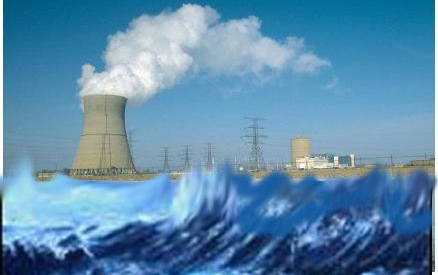 As Sea Levels Rise, Are Coastal Nuclear Plants Ready? National Geographic, By Christina Nunez, 16 Dec 15 [EXCELLENT MAPS] National Geographic Just east of the Homestead-Miami Speedway, off Florida’s Biscayne Bay, two nuclear reactors churn out enough electricity to power nearly a million homes. The Turkey Point plant is licensed to continue doing so until at least 2032.
At some point after that, if you believe the direst government projections, a good part of the low-lying site could be underwater. So could at least 13 other U.S. nuclear plants, as the world’s seas continue to rise. Their vulnerability, and that of many others, raises serious questions for the future……. safety concerns have stoked opposition to nuclear. Reactors can’t operate safely without uninterrupted power and vast amounts of cool water, which is why they’re often located near coastlines, rivers, and lakes. Even when a plant isn’t running, its fuel continues to generate heat that needs to be controlled to prevent explosions or radioactive leaks.
The disaster at Japan’s Fukushima Daiichi showed what can happen when a massive surge of water hits a nuclear plant……
Storms and Warming
The United States has 100 operational nuclear reactors, and another 17 that are being decommissioned. In the past, historical data about storms and flooding would inform the licensing requirements for a unit.
“We generally thought that backward look was sufficient,” says Dave Lochbaum, director of the Nuclear Safety Project at the nonprofit Union of Concerned Scientists. Fukushima and big storms like Hurricane Sandy in 2012 showed “that’s a tenuous assumption at best.”………
“The Nuclear Regulatory Commission has been slow to implement those Fukushima lessons learned,” says Matthew McKinzie, nuclear program director at the environmental group Natural Resources Defense Council. “Nuclear safety is a work in progress.”
Researchers at Stanford University echoed that concern in 2013, flagging four East Coast plants (the Salem and Hope Creek plants in New Jersey; Millstone in Connecticut; and Seabrook in New Hampshire) as especially vulnerable to storm surges and arguing for, among other measures, more and taller seawalls. A more recent analysis from the Union of Concerned Scientists found that at least four nuclear plants are vulnerable to storm surges by 2050.
The NRC is considering two new rules, one based on post-Fukushima safety orders issued in 2012, and another that would create new standards related to decommissioning.
The former rule, to be finalized at the end of next year, requires “an extra level of defense for a plant to deal with events that could interfere with ability to keep the core cool,” says Nuclear Regulatory Commission spokesperson Scott Burnell. That defense includes portable backup power generators, battery banks, and additional supplies if needed……..
 The more immediate concern from climate change, says Dominion spokesperson Ken Holt, is the water near Millstone getting too warm. One of its units had to shut down temporarily in 2012, because its intake from the Niantic Bay exceeded 75 degrees. It’s a problem that has affected other plants, too…….
Even if the plants aren’t running, though, the industry will need to address the radioactive waste left behind.
The question of what happens with spent fuel left at shuttered nuclear plants is, Lochbaum says, “the biggest wild card.”
He adds: “We do have a number of plants around the country where the spent fuel may remain there for decades, and nature may not give us that much time.”
The concern is that the shorter-term pools used to cool spent fuel rods require continuously circulated water. Loss of power at Fukushima, for example, led to urgent efforts to keep the water in the spent fuel pools from boiling away.
After a few years, fuel can be moved from pools to dry casks made of steel reinforced with concrete. Though the safety risk for casks is much lower—all of Fukushima’s emerged unscathed—some are concerned about how long those casks can remain safe at vulnerable sites, especially those buffeted by salty sea air. At the decommissioned San Onofre plant in California, for example, local activists tried but failed to stop plans to store nuclear waste 100 feet from the coast…….. http://news.nationalgeographic.com/energy/2015/12/151215-as-sea-levels-rise-are-coastal-nuclear-plants-ready/
The climate risks of nation-states’ coal industries, and of continuing exploration for oil and gas
There is a new form of climate denialism to look out for – so don’t celebrate yet, Guardian, Naomi Oreskes, 17 Dec 15 “………And here, there are some interesting facts that most people don’t know. In a recent study that I did with my colleague Richard Heede, we examined the potential impact of using the proven reserves of fossil fuels in the world. We discovered a surprising fact: if all the reserves in the hands of investor-owned companies were to be burned, we would not exceed the 2C (3.6F) target.
What puts the world at risk are the reserves in the hands of nation-states – which are mostly coal – and the continued exploration for more oil and gas by private companies like Exxon-Mobil, Chevron, BP and Shell. Most of the coal reserves are in developing nations such as China, which increasingly recognizes the very serious damage that coal use entails and is looking for alternatives modes of development. So this leaves us with the investor-owned companies seeking new reserves, and it means that we must find a way to convince – or prevent – these companies from continued exploration.
So far no one has proposed a plan to do that, and we probably won’t get very far if the alternatives to fossil fuel – such as renewable energy – are disparaged by a new generation of myths. If we want to see real solutions implemented, we need to be on the lookout for this new form of denial.
There have been important signs of late of cracks in the Republican rejection of climate science, as some party leaders have signaled their willingness to consider carbon pricing. Still, as new forms of denialism continue to emerge, it is hard to imagine federal implementation of a climate plan any time soon, much less the sort of ambitious plan that would help keep the world below the 1.5-2C (2.7-3.6F) level of warming, per the Paris agreement.
When President Obama rejected the Keystone XL pipeline, many critics of the decision (and even some supporters) said it was merely symbolic. Symbols matter – so even if it were, that would not necessarily be bad. But rejecting XL was a crucial step in the direction of rejecting new commitments to fossil fuel infrastructure. ……….http://www.theguardian.com/commentisfree/2015/dec/16/new-form-climate-denialism-dont-celebrate-yet-cop-21
Nuclear power an expensive distraction from REAL solutions to climate change – Gregory Jaczko
Given the lead-time of about ten to fifteen years for nuclear power plant design, approval and construction, a massive program of new construction would need to begin within the next few years to start to replace the soon-to-be-retiring units.
 The latest poster child for nuclear climate change salvation is a fleet of advanced reactors, which — on paper — do provide enticing improvements to the current generation of reactors. At best, however, this technology is several decades from becoming commercially viable, too far into the future to be relevant.
The reality with nuclear power is that it has proven time and again to take longer and cost more to develop than predicted. There is nothing in the new designs nor the performance of the industry today that suggests this trend will end.
 Nuclear Power and Climate Change http://www.huffingtonpost.com/gregory-jaczko/nuclear-power-and-climate_b_8806792.html?ir=Australia 15/12/2015 Gregory Jaczko Fmr. US Nuclear Regulatory Commission Chairman and Commissioner As world leaders convene in Paris in an attempt to prevent a rise in global temperatures, the nuclear industry has — not surprisingly — seized this moment to once again promise the perfect solution to the climate challenge. Having witnessed this industry up close for the last decade and a half, I am concerned that the uniquely perfect promise of safe, clean, predictable, and affordable nuclear power will divert our focus from solutions that will actually work to control greenhouse gas emissions. Continue reading
1 This Month





PLEASE OPPOSE HR 8255 AND S.3639 – bills would accelerate satellite deployment, with no environmental review or safeguards – https://ncstd5li.quorum.us/campaign/169331/
To see nuclear-related stories in greater depth and intensity – go to https://nuclearinformation.wordpress.com
-
Archives
- October 2026 (19)
- September 2026 (339)
- August 2026 (330)
- July 2026 (355)
- June 2026 (287)
- May 2026 (306)
- April 2026 (356)
- March 2026 (251)
- February 2026 (267)
- January 2026 (308)
- December 2025 (358)
- November 2025 (359)
-
Categories
- 1
- 1 NUCLEAR ISSUES
- business and costs
- climate change
- culture and arts
- ENERGY
- environment
- health
- history
- indigenous issues
- Legal
- marketing of nuclear
- media
- opposition to nuclear
- PERSONAL STORIES
- politics
- politics international
- Religion and ethics
- safety
- secrets,lies and civil liberties
- spinbuster
- technology
- Uranium
- wastes
- weapons and war
- Women
- 2 WORLD
- ACTION
- AFRICA
- Atrocities
- AUSTRALIA
- Christina's notes
- Christina's themes
- culture and arts
- Events
- Fuk 2022
- Fuk 2023
- Fukushima 2017
- Fukushima 2018
- fukushima 2019
- Fukushima 2020
- Fukushima 2021
- general
- global warming
- Humour (God we need it)
- Nuclear
- RARE EARTHS
- Reference
- resources – print
- Resources -audiovicual
- Weekly Newsletter
- World
- World Nuclear
- YouTube
-
RSS
Entries RSS
Comments RSS

