Fast warming of Arctic region will mean many climate refugees
 Obama administration warns of ‘climate refugees’ due to rapid Arctic warming
US Interior Secretary Sally Jewell has painted a stark picture of communities displaced by rising Arctic temperatures that are ‘washing away’ towns, Guardian, Oliver Milman @olliemilman Saturday 30 April 2016 The Obama administration has warned the US will need to deal with a wave of “climate refugees” as the Arctic continues to warm, joining with the Canadian government to express alarm over how climate change is affecting indigenous communities.
Sally Jewell, US secretary of the interior, painted a stark picture of communities relocating and lives disrupted in her first official visit to Canada. The Arctic, which is warming at twice the rate of the global average, has just recorded its lowest recorded peak ice extent after what’s been called a “warm, crazy winter”……..
Obama declares disaster as Marshall Islands suffers worst-ever drought….http://www.theguardian.com/environment/2016/apr/29/climate-change-refugees-arctic-obama-administration-warning
Austria losing to climate change its most precious environmental resource – glaciers
Austria’s Treasured National Resource, Its Glaciers, Are Melting Fast. inside climate news, Glaciers across the country retreated an average of 72 feet in 2015, more than twice the rate of the previous year, finds an annual survey.BY BOB BERWYN APR 28, 2016 VIENNA—NEARLY ALL OF AUSTRIA’S 900 GLACIERS RETREATED LAST YEAR AMID RECORD-SETTING HEAT, ACCORDING TO AUSTRIAN SCIENTISTS. THE RAPID MELTING MIRRORS A TREND ACROSS THE ALPS AND UNDERSCORES SCIENTISTS’ WARNINGS OF ACCELERATING, EXTREME CLIMATE IMPACTS CAUSED BY HUMAN-CAUSED GREENHOUSE GAS EMISSIONS.
Across the country, the glaciers retreated an average of 72 feet in 2015, more than twice the rate of the previous year, the Austrian Alpine Association said in its annual glacier survey. Three of the country’s glaciers retreated by more than 320 feet. The nonprofit association—which promotes mountain culture, research and conservation— has beenconducting detailed glacier measurements since 1927, creating a dramatic record of climate change effects in the alpine region.
“The summer of 2015 was more than 2 degrees Celsius warmer than the long-term average,” said survey team coordinator Andrea Fischer, a glaciologist with the Austrian Academy of Sciences. “Long periods of high pressure and the absence summer snowfall…are the reasons for the glacial meltdown.”
Austria’s largest glacier, the Pasterz, retreated by 177 feet in 2015, the survey found. Its volume has declined by half since it was first accurately measured in 1851. The annual survey measures a representative sample of 92 major glaciers; 96 percent were found to be receding.
Globally, 2015 was the hottest year since recordkeeping began in 1880, by a large margin, with the bulk of the temperature rise a result of manmade global warming, according to the World Meteorological Organization and U.S. government science agencies. Last summer was also the warmest on record in Austria, surpassing the previous record set in 2003, when heat waves were blamed for 30,000 deaths in Europe…….
If the Paris climate accord leads to the world limiting the global temperature rise to 2 degree Celsius, about 60 percent of the world’s glaciers will melt away in the next few centuries. At 1.5 degrees Celsius of warming, about 50 percent will vanish, Marzeion said.
Melting glaciers are among the most visible signs of climate change, and they are a crucial, disappearing water source. Changes in streamflows will affect hydroelectric power generation in the Himalaya, according to a 2013 study published in the journal Nature. The buildup of meltwater in the valleys beneath glaciers also increases the risk of catastrophic flooding……..http://insideclimatenews.org/news/27042016/austria-glaciers-melting-fast-climate-change-global-warming-alps-pasterze
March the world’s hottest month in recorded history
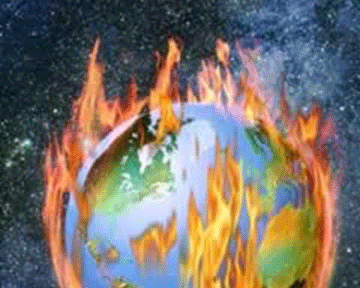 ‘Worse things in store’: Steaming hot world sets more temperature records, The Age, April 20, 2016 Peter Hannam Environment Editor, The Sydney Morning Herald
The Earth sizzled in March with the most unusually warm month in recorded history as average land surface temperatures easily exceeded levels deemed by scientists to constitute dangerous climate change.
The abnormal weather has continued into April as the most powerful tropical cyclone ever recorded in the Indian Ocean dumped rain at rates reaching 300 mm an hour, and Australian scientists declared the worst coral bleaching event ever on the Great Barrier Reef.
Combined global land and sea-surface temperatures in March were 1.22 degrees above the 20th-century average, beating the previous record for the month – set just a year earlier – by almost one-third of a degree, the US National Oceanic and Atmospheric Administration said. Each of the past 11 months have now broken global temperature records, the longest such streak in the agency’s 137 years of data collection.
Land surface temperatures for March, though, were 2.33 degrees above the 20th-century average, smashing the previous March record set in 2008 by 0.43 degrees. It was also the most unusually warm reading for any month, eclipsing February, NOAA said.
The record breaking conditions come as leaders of 150-plus nations are due to gather in New York this week to ratify the global climate pact agreed in Paris in late 2015 to limit global warming to 1.5-2 degrees, compared with pre-industrial times………
The most abnormally hot regions of the world last month included Australia, which set a record with minimum temperatures almost 2 degrees above the average for 1961-90, while the Arctic region was about 3.3 degrees above average, NOAA said.
The El Nino has played a role in boosting temperatures in the year. The stalling or reversal of equatorial trade winds in the Pacific that characterise such events created a huge pool of relatively warm water in the central and eastern Pacific that is now breaking up.
However, the first three months of 2016 were not only the warmest on record for surface temperatures by 0.28 degrees – set a year earlier – they also beat the same period in 1998 by 0.45 degrees during a similar strength El Nino, NOAA said.
For the first three months of this year, average land surface temperatures were 2.05 degrees above the 20th-century average and a full 0.95 degrees warmer than in 1998, the agency said.
Most powerful Indian Ocean storm
The list of extreme weather events this year continues to grow……….http://www.theage.com.au/environment/climate-change/worse-things-in-store-steaming-hot-world-sets-more-temperature-records-20160419-goaf58.html
Politicians oblivious to the very real threat of nuclear famine
Nuclear Famine, Independent Australia, 17 April 2016 Daryl Williams discusses a recent scientific report in which the devastating global impacts of a small nuclear conflict, including “nuclear famine”, are outlined.
THE COLD WAR is over, the Berlin Wall has fallen, nuclear warhead numbers have declined significantly — so the threat of nuclear catastrophe has passed, right?
Well, sadly no.
In fact, things may be more dangerous today than at the height of the Cold War.
Computer simulations of the indirect climate effects of even a “small” regional nuclear exchange indicate that the whole world would still be imperiled.
A recent 16-page scientific paper, ‘Multidecadal global cooling and unprecedented ozone loss following a ‘regional nuclear conflict‘, by Mills, Toon, Lee-Taylor and Robock, outlines the horrific unexpected consequences. Once you boil down the “science-speak” it paints a bleak picture – via an “Earth system model” which includes atmospheric chemistry, ocean dynamics and interactive sea ice and land components – which we should do everything we can to avoid.

It deserves far more attention than it has received and its findings should be informing our foreign, defence and emergency management policies. In summary, the scenario it simulates is as follows:
Firestorms in India and Pakistan from a “small” regional conflict and nuclear exchange would inject 5 Tg (or one million tonnes) of black carbon (smoke, soot, dust) into the stratosphere which spreads globally.
The black carbon heats the stratosphere (by up to an amazing 80 degrees C) and cools the lower atmosphere and surface (by 1.1 degrees C in the first four years, down to 1.6 degrees in the fifth year, slowly rising to 0.25 to 0.5 degrees 20 years later). The colder surface temperatures reduce precipitation by 6% globally for the first five years and still by 4.5% one decade on.
Oh, and hundreds of millions of Indians and Pakistanis would be incinerated to death … but let’s concentrate on the long-term climate repercussions……..
That spells big trouble for Earth in the form of
‘widespread damage to human health, agriculture, terrestrial and aquatic ecosystems.’
That is,
‘…combined cooling and enhanced UV would put significant pressures on global food supplies and could trigger global nuclear famine.’………
The report also states:
‘The combined effects of elevated UV levels alone on terrestrial agriculture and marine ecosystems could put significant pressures on global food security.’
And yet, I didn’t read anything about this in the 2016 Defence White Paper or in any plans byEmergency Management Australia. Why not?…….https://independentaustralia.net/environment/environment-display/nuclear-famine,8893
Future uninhabitable for Middle East, due to climate change?
 Climate Change (I) Will the Middle East Become ‘Uninhabitable’? IPS, By Baher Kamal This is the first of a two-part series of reports focusing on the impact of climate change on the Middle East & North of Africa region, ahead of the signing ceremony of the Paris climate agreement, on 22 April 2016 in New York. Part II will address the dramatic issue of water scarcity in the region.
CAIRO, Apr 18 2016 (IPS) – This is not about any alarming header—it is the dramatic conclusion of several scientific studies about the on-going climate change impact on the Middle East region, particularly in the Gulf area. The examples are stark.
“Within this century, parts of the Persian Gulf region could be hit with unprecedented events of deadly heat as a result of climate change, according to a study of high-resolution climate models,” a recent Massachusetts Institute of Technology (MIT) research warned.
The research–titled “Persian Gulf could experience deadly heat”, reveals details of a business-as-usual scenario for greenhouse gas emissions, but also shows that curbing emissions could forestall these “deadly temperature extremes.”
The study, which was published in detail ahead of the Paris climate summit in the journal Nature Climate Change, was conducted by Elfatih Eltahir, a professor of civil and environmental engineering at MIT, and Jeremy Pal PhD ’01 at Loyola Marymount University.
The authors conclude that conditions in the Persian Gulf region, including its shallow water and intense sun, make it “a specific regional hotspot where climate change, in absence of significant mitigation, is likely to severely impact human habitability in the future.”
Running high-resolution versions of standard climate models, Eltahir and Pal found that many major cities in the region could exceed a tipping point for human survival, even in shaded and well-ventilated spaces. Eltahir says this threshold “has, as far as we know … never been reported for any location on Earth.”……….
While global models predict sea levels rising from about 0.1 to 0.3 meters by the year 2050, and from about 0.1 to 0.9 meters by 2100, the World Bank says, for MENA, the social, economic, and ecological impacts are expected to be relatively higher compared to the rest of the world. Low-lying coastal areas in Tunisia, Qatar, Libya, United Arab Emirates, Kuwait, and specially Egypt are at particular risk.
Climate change also poses many challenges to the region’s cities, which represent hubs for economic, social, cultural and political activities. Rising sea level could affect 43 port cities—24 in the Middle East and 19 in North Africa, according to the World Bank study.
“In the case of Alexandria, Egypt, a 0.5 meter rise would leave more than 2 million people displaced, with 35 billion dollars in losses in land, property, and infrastructure, as well as incalculable losses of historic and cultural assets.”(TO BE CONTINUED) http://www.ipsnews.net/2016/04/will-the-middle-east-become-uninhabitable/
USA energy firms – history of climate change denial from 1968
US firms knew about global warming in 1968 – what about Australia?, The Conversation, Marc Hudson, April 18, 2016 Earlier this month the satirical newspaper The Onion “reported” on the discovery in a Californian university’s archives of a dusty, yellowing report saying the time to act on climate change is now.
This week life imitated art, as it was revealed that there is indeed a decades-old report to be found in a Californian archive warning of climate impacts. The real report, as opposed to the satirical one, was written in 1968 by scientists at the Stanford Research Institute, who sent it to the American Petroleum Institute to warn of the possible impacts of carbon dioxide emissions.
That wasn’t even the start. A decade earlier, in 1959, a scientist working for oil giant Shell wrote in New Scientist about the idea of humans altering the climate, although he poured scorn on the idea.
By the early 1970s, the idea of the greenhouse effect was already in the air, if you’ll pardon the pun. It merited several pages in the Club of Rome’s landmark 1972 report, The Limits to Growth, and even got a mention in the dystopian classic 1973 film Soylent Green……..
The sceptics
Only now is the issue really coming home to roost for fossil fuel firms, such as the world’s biggest private coal miner Peabody Energy, which this week filed for bankruptcy in the United States.
Peabody’s recently retired chief executive Greg Boyce has always been combative on the subject of climate change. He told the World Energy Congress in 2010 that:
“The greatest crisis society confronts is not a future environmental crisis predicted by computer models but a human crisis today that is fully within our power to solve – with coal.”
Its now-retired chief lobbyist Fred Palmer, in a 1997 documentary, happily and emphatically states:
“Every time you turn your car on and you burn fossil fuels and you put CO₂ in the air, you are doing the work of the Lord.”………
The fallout
The New York attorney-general’s office is now demanding answers from Exxon over its response to the climate warnings of half-a-century ago.
Meanwhile, the attorney-general of the US Virgin Islands has subpoenaed the US think tank the Competitive Enterprise Institute, a long-time ally of the fossil fuel industry, over its campaign to cast doubt on climate science.
While it is both interesting and frustrating to learn that the very companies that have worked hardest to obfuscate climate science actually knew about it before the wider public did, that knowledge doesn’t help us figure out how to deliver the sorts of deep emissions cuts that are needed now. We need to keep our eyes on the increasingly unlikely and battered prize of a habitable planet. https://theconversation.com/us-firms-knew-about-global-warming-in-1968-what-about-australia-57878
NASA will no longer mess with climate change denialists on Facebook
NASA on climate change: Official Facebook account smacks down dissenters, news.com.au APRIL 19, 2016 WHEN it comes to climate change, don’t mess with NASA.
The space agency has shut down climate changers in the best possible way in an ongoing Facebook discussion.
The agency, which has a NASA Climate Change Facebook page, is used to dealing with sceptics and deniers.
But one comment made last week saw the agency pounce and the comments have kept flowing since, coming faster than melting ice.
It all started after a post by the science guy Bill Nye who was talking about a climate change denier refusing his $20,000 bet that the planet will keep getting hotter.
But the thread was quickly hijacked by climate deniers.
Facebook user Fer Morales argued NASA confirmed fossil fuels were actually cooling the planet, but the agency jumped straight on it, firing back: “Do not misrepresent NASA. Fossil fuels are not cooling the planet.”……..http://www.news.com.au/technology/environment/climate-change/nasa-on-climate-change-official-facebook-account-smacks-down-dissenters/news-story/25219d16e4478ce851046d22b1620b63
A bleak picture of the climate effects of “just a small” nuclear war
Nuclear Famine, Independent Australia 17 April 2016, Daryl Williams discusses a recent scientific report in which the devastating global impacts of a small nuclear conflict, including “nuclear famine”, are outlined.
THE COLD WAR is over, the Berlin Wall has fallen, nuclear warhead numbers have declined significantly — so the threat of nuclear catastrophe has passed, right?
Well, sadly no.
In fact, things may be more dangerous today than at the height of the Cold War.
Computer simulations of the indirect climate effects of even a “small” regional nuclear exchange indicate that the whole world would still be imperiled.
A recent 16-page scientific paper, ‘Multidecadal global cooling and unprecedented ozone loss following a ‘regional nuclear conflict‘, by Mills, Toon, Lee-Taylor and Robock, outlines the horrific unexpected consequences. Once you boil down the “science-speak” it paints a bleak picture – via an “Earth system model” which includes atmospheric chemistry, ocean dynamics and interactive sea ice and land components – which we should do everything we can to avoid.
It deserves far more attention than it has received and its findings should be informing our foreign, defence and emergency management policies. In summary, the scenario it simulates is as follows:
Firestorms in India and Pakistan from a “small” regional conflict and nuclear exchange would inject 5 Tg (or one million tonnes) of black carbon (smoke, soot, dust) into the stratosphere which spreads globally.
The black carbon heats the stratosphere (by up to an amazing 80 degrees C) and cools the lower atmosphere and surface (by 1.1 degrees C in the first four years, down to 1.6 degrees in the fifth year, slowly rising to 0.25 to 0.5 degrees 20 years later). The colder surface temperatures reduce precipitation by 6% globally for the first five years and still by 4.5% one decade on.
Oh, and hundreds of millions of Indians and Pakistanis would be incinerated to death … but let’s concentrate on the long-term climate repercussions.
The heating of the stratosphere caused by the black carbon produces a dramatic loss of ozone (30% to 45% at mid-latitudes for the first five years, 50 to 60% at northern high latitudes) giving ‘a global ozone loss on a scale never observed‘.
It is the combination of dramatic extended drops in surface temperatures termed ‘the coldest average surface temperatures in the last 1000 years’ and precipitation with a dramatic increase in UV radiation.
That spells big trouble for Earth in the form of
‘widespread damage to human health, agriculture, terrestrial and aquatic ecosystems.’
That is,
‘…combined cooling and enhanced UV would put significant pressures on global food supplies and could trigger global nuclear famine.’
As well, ‘… the average growing season is reduced by up to 40 days throughout the world’s agricultural zones over these five years’. The increased UV-B radiation would reduce plant height, shoot mass and foliage area, damage DNA and significantly increase insect losses. A 16% loss of ozone could reduce phytoplankton levels in the ocean by 15%, resulting in a loss of seven million tons of fish per year……..
Regional extremes can be worse. Large areas of continental landmasses would experience significantly greater cooling than average:
Winters (JJA) in southern Africa and South America would be up to 2.5 degrees C cooler on average for 5 years … [and] … most of North America, Asia, Europe and the Middle East would experience winters (DJF) that are 2.5 to 6 degrees C cooler … and summers (JJA) 1 to 4 degrees C cooler.
Which is worse than any volcanic winter in the last 1000 years. There would be significant regional drying over the Asian Monsoon region, including the Middle East, the Indian subcontinent and Southeast Asia, as well as the Amazon, the American South-East and Western Australia — which would be 20% to 60% drier.
All from a “minor” nuclear exchange between India and Pakistan……..https://independentaustralia.net/environment/environment-display/nuclear-famine,8893
As coal mines go bankrupt, tax-payers will be left with the cleanup costs

 After Bankruptcies, Coal’s Dirty Legacy Lives On, NYT By TOM SANZILLO and DAVID SCHLISSEL APRIL 14, 2016 THE bankruptcy filing on Wednesday by Peabody Energy, the world’s largest private- sector producer of coal, is the latest in a series of major coal company collapses that threaten to leave behind a costly legacy that will haunt taxpayers and consumers for years.
The abandonment of hundreds of mines over the years led Congress in 1977 to pass a law that requires coal companies to clean up after mining. Left untreated, these sites are more than eyesores: They create long-lingering problems including polluted drinking water.
And the problem is likely to become more pronounced in the wake of these bankruptcies. Mining companies are supposed to buy insurance to cover the cost of cleanups. But Congress has allowed some of the more financially secure coal producers to “self-bond,” promising to pay for cleanups themselves.

Perhaps the most glaring instance of self-bonding gone bad is Peabody Energy. Leading up to its bankruptcy, Peabody had been frantically trying to preserve its $1.47 billion in self-bonding agreements in states where they had been called into question by regulators.Two other major coal companies, Alpha Natural Resources and Arch Coal, recently filed for bankruptcy, leaving hundreds of millions in reclamation guarantees in limbo. A deal between Arch Coal and regulators in Wyoming suggests taxpayers will get stuck with the bulk of the cleanup costs. The company agreed toearmark at most $75 million to cover self-bonded reclamation liabilities of more than $450 million………
Climate Change threatens the already leaking Marshall Islands radioactive dome
This dome in the Pacific houses tons of radioactive waste – and it’s leaking
The Runit Dome in the Marshall Islands is a hulking legacy of years of US nuclear testing. Now locals and scientists are warning that rising sea levels caused by climate change could cause 111,000 cubic yards of debris to spill into the ocean , Guardian Coleen Jose, Kim Wall and Jan Hendrik Hinzel on Runit Island 3 July 2015
“……..Officially, this vast structure is known as the Runit Dome. Locals call it The Tomb.

Below the 18-inch concrete cap rests the United States’ cold war legacy to this remote corner of the Pacific Ocean: 111,000 cubic yards of radioactive debris left behind after 12 years of nuclear tests.
Brackish water pools around the edge of the dome, where sections of concrete have started to crack away. Underground, radioactive waste has already started to leach out of the crater: according to a 2013 report by the US Department of Energy, soil around the dome is already more contaminated than its contents.
Now locals, scientists and environmental activists fear that a storm surge, typhoon or other cataclysmic event brought on by climate change could tear the concrete mantel wide open, releasing its contents into the Pacific Ocean.
“Runit Dome represents a tragic confluence of nuclear testing and climate change,” said Michael Gerrard, director of the Sabin Center for Climate Change Law at Columbia University, who visited the dome in 2010.
“It resulted from US nuclear testing and the leaving behind of large quantities of plutonium,” he said. “Now it has been gradually submerged as result of sea level rise from greenhouse gas emissions by industrial countries led by the United States.”
Enewetak Atoll, and the much better-known Bikini Atoll, were the main sites of the United States Pacific Proving Grounds, the setting for dozens of atomic explosions during the early years of the cold war……..http://www.theguardian.com/world/2015/jul/03/runit-dome-pacific-radioactive-waste
USA Democrats probing oil companies’ campaign against action on climate change
Dem AGs mounting Big Tobacco-style probe of oil companies, industry fights back By Jennifer G. Hickey April 12, 2016 FoxNews.com Democratic officials’ campaign against fossil fuel companies is entering a new phase as state attorneys general launch investigations that mirror the Justice Department’s landmark case against “Big Tobacco,” probing claims that oil companies misled the public about the risks of global warming — a charge industry representatives adamantly reject.
Massachusetts and the U.S. Virgin Islands are the latest to announce probes, specifically into whether ExxonMobil was up-front regarding what it knew about climate change.
“Fossil fuel companies that deceived investors and consumers about the dangers of climate change should be held accountable. That’s why we have joined in investigating ExxonMobil,” Massachusetts Attorney General Maura Healey said in announcing the inquiry.
The announcements follow a similar investigation by New York Attorney GeneralEric T. Schneiderman, who subpoenaed Exxon’s financial records and emails last November. Schneiderman has indicated ExxonMobil is not the only energy company in his office’s crosshairs, vowing to prosecute any that committed fraud to maximize profit at the public’s  expense “to the fullest extent of the law.”
Yet industry representatives and their allies say what’s really going on is a coordinated attempt to silence climate change skeptics while punishing the industry itself for society’s use of fossil fuels, all based on spurious claims of a cover-up. Exxon representatives say the accusations against the oil giant are “laughable” and “not credible,” blasting recent news reports that assert the industry tried to mislead the public about global warming dangers. …….. http://www.foxnews.com/politics/2016/04/12/dem-ags-mounting-big-tobacco-style-probe-oil-companies-industry-fights-back.html
With concerted effort, world could phase out fossil fuels within a decade
Fossil fuels could be phased out worldwide in a decade, says new study http://www.eurekalert.org/pub_releases/2016-04/uos-ffc041516.php UNIVERSITY OF SUSSEX The worldwide reliance on burning fossil fuels to create energy could be phased out in a decade, according to an article published by a major energy think tank in the UK.
Professor Benjamin Sovacool, Director of the Sussex Energy Group at the University of Sussex, believes that the next great energy revolution could take place in a fraction of the time of major changes in the past.
But it would take a collaborative, interdisciplinary, multi-scalar effort to get there, he warns. And that effort must learn from the trials and tribulations from previous energy systems and technology transitions.
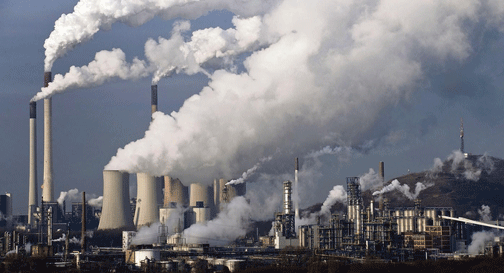
In a paper published in the peer-reviewed journal Energy Research & Social Science, Professor Sovacool analyses energy transitions throughout history and argues that only looking towards the past can often paint an overly bleak and unnecessary picture.
Moving from wood to coal in Europe, for example, took between 96 and 160 years, whereas electricity took 47 to 69 years to enter into mainstream use.
But this time the future could be different, he says – the scarcity of resources, the threat of climate change and vastly improved technological learning and innovation could greatly accelerate a global shift to a cleaner energy future.
The study highlights numerous examples of speedier transitions that are often overlooked by analysts. For example, Ontario completed a shift away from coal between 2003 and 2014; a major household energy programme in Indonesia took just three years to move two-thirds of the population from kerosene stoves to LPG stoves; and France’s nuclear power programme saw supply rocket from four per cent of the electricity supply market in 1970 to 40 per cent in 1982.
Each of these cases has in common strong government intervention coupled with shifts in consumer behaviour, often driven by incentives and pressure from stakeholders. Professor Sovacool says: “The mainstream view of energy transitions as long, protracted affairs, often taking decades or centuries to occur, is not always supported by the evidence.
“Moving to a new, cleaner energy system would require significant shifts in technology, political regulations, tariffs and pricing regimes, and the behaviour of users and adopters.
“Left to evolve by itself – as it has largely been in the past – this can indeed take many decades. A lot of stars have to align all at once.
“But we have learnt a sufficient amount from previous transitions that I believe future transformations can happen much more rapidly.”
In sum, although the study suggests that the historical record can be instructive in shaping our understanding of macro and micro energy transitions, it need not be predictive.
Australia’s Great Barrier Reef in grave danger from global warming
Now the scientists have found that the coping mechanism barrier reef corals use to prepare themselves to face warm summer water is also under threat from global warming, and from human activities such as agriculture, shipping, and fishing.
“As temperature warms, the evidence is that this protective mechanism will no longer function
 How the Great Barrier Reef is going from bad to worse Christian Science
 Monitor, 14 Apr 16 Though the corals of Australia’s Great Barrier Reef historically have managed to adjust to gradually warming seawater of the summer months, they will likely lose their defenses when the ocean warms overall in the near future, say scientists. (at left – coral bleaching )
This was the latest finding from a team of American and Australian coral reef experts from James Cook University, the University of Queensland, and the US National Oceanic and Atmospheric Administration (NOAA).
These same scientists recently reported that their aerial surveys of some of the 3,000 coral reefs that make up this iconic natural wonder off Australia’s northeastern coast have showed that coral bleaching this year is the worst that has ever been observed. This is largely due to a recurring weather event known as El Niño, a storm system that is expected to become more frequent and more severe in the future.
I agree that El Niño is a natural variability; it’s a part of nature, but that variation in patterns and temperatures is superimposed upon a trend of warming,” Scott Heron, a NOAA coral reef scientist based in Australia, tells The Christian Science Monitor in an interview. “There are ups and downs, but now there are just higher ups than ever before, and the downs are not as low,” he says.
Coral bleaching happens when ocean temperatures rise to a point that zooxanthellae – tiny algae that live on corals and provide them with nutrients and their radiant colors – leave their coral homes, thereby rendering coral white or “bleached.” When corals go without zooxanthellae for too long, they die. This affects about a quarter of marine species that depend on coral reefs for shelter, and the humans who depend on those species for their livelihoods.
This year’s is the third major bleaching event in recent history for the 2,300-kilometer-long Great Barrier Reef, which is home to one of the most diverse ecosystems in the world. But this one is much worse than the bleaching events that occurred in 1998 and 2002, say scientists who recently found bleaching in almost 1,100 kilometers of northern barrier reef, from the island of New Guinea to the Australian coastal city of Cairns. The researchers estimate that 30 to 50 percent of the corals there are already be dead.
Now the scientists have found that the coping mechanism barrier reef corals use to prepare themselves to face warm summer water is also under threat from global warming, and from human activities such as agriculture, shipping, and fishing.
“As temperature warms, the evidence is that this protective mechanism will no longer function,” C. Mark Eakin, a scientist with NOAA Coral Reef Watch, tells the Monitor in an interview…….
The most viable immediate remedy, say paper authors, is to reduce the carbon emissions that cause warming and restrict other human activities near the reefs that add more stress, including runoff from agriculture, unsustainable fishing practices, and physical damage to the reef from ship groundings.
“These are all human stressors on reef that have to be minimized or eliminated for reefs to be able to bounce back from these bleaching events, even in a decade or two,” Eakin says.http://www.csmonitor.com/Science/2016/0414/How-the-Great-Barrier-Reef-is-going-from-bad-to-worse
Rapid collapse of ice shelves in Antarctica
 Scientists Are Watching in Horror as Ice Collapses Everything we learn about ice shows that it is disturbingly fragile, even in Antarctica. National Geographic, By Douglas Fox APRIL 12, 2016 “……..The catastrophic collapse of Larsen A and several other ice shelves along the Antarctic Peninsula has yielded important lessons about the vulnerability of Antarctica’s ice sheets to a warming climate. A new analysis of ice sheet instability, published March 31 in Nature, took the public by surprise when it projected that global sea level might rise six feet by 2100, and as much as 40 to 50 feet by the year 2500. (Read “Why the New Sea Level Alarm Can’t Be Ignored.”) That study seemed to double, overnight, the amount of sea level rise that can be expected. But many glacial scientists weren’t surprised. The new estimate is based on insights that have emerged slowly, over 20 years, in the aftermath of these ice shelf collapses.
The Aftermath of an Ice Shelf Collapse
Explore the fjords along the northeastern Antarctic Peninsula today, and it’s easy to find landscapes that look scarred even to the casual observer. …..
The glacier, now absent, had retreated several miles into its fjord. The fjord used to hold 2,000 feet (600 meters) of ice. Now it held 2,000 feet of seawater instead.
The aftermath of an ice shelf collapse is obvious in Sjögren’s fjord. When the ice shelf in front of Sjögren disintegrated in 1995, it removed the buttress that stabilized the glacier. The glacier started sliding into the sea at twice its original speed. Sjögren erupted in crevasses and thinned by several hundred feet as it stretched. After a few years, the glacier had retreated miles into its fjord as icebergs splintered off the glacier’s front faster than the ice could flow forward…….
Every ice shelf that disintegrated along the Antarctic Peninsula has shown the same pattern: summer melting of its top layers, winter refreezing of those top layers into icy crusts able to hold large melt ponds, and the re-exposure of long-buried crevasses.
For all of these ice shelves, the moment of death occurred suddenly. Each collapse began when water from the melt ponds drained into the crevasses. The weight of the water drove the cracks deeper—like a wedge, says Ted Scambos, a glaciologist with the National Snow and Ice Data Center at the University of Colorado in Boulder, who discovered the process. These fluid wedges eventually broke through the bottom of the ice shelf, calving off one iceberg, then another and another—a process called hydrofracturing that can devour an ice shelf nearly the size of Rhode Island in a matter of hours or days……..
Ice loss may have begun at a narrow beachhead in Antarctica, at the north end of the Antarctic Peninsula, but it has expanded on multiple fronts, as new regions of ice come into play every several years. As warm summer temperatures push farther south, so will the problems of melt ponding, ice shelf disintegration, and ice cliff collapse, which drive the rapid retreat of ice. (Read more about how calving causes mini-tsunamis daily in Antarctica.)
Scattered melt ponds already appear on some of the ice shelves that surround the Antarctic mainland, much farther south than any that have collapsed so far. The amount of ice lost each year from all of Antarctica’s ice shelves has increased 12-fold between 1994 and 2012.
Aside from warm air, the fringes of Antarctica’s ice are under assault from another source—warming ocean currents that melt the undersides of ice shelves. (Read more about research on what climate change will mean for whales.)……..http://news.nationalgeographic.com/2016/04/160412-ice-sheet-collapse-antarctica-sea-level-rise/
Widespread support for Church of England’s stand against Exxon Mobil
Church of England takes on energy giant ExxonMobil http://www.christiantoday.com/article/church.of.england.takes.on.energy.giant.exxonmobil/83931.htm Mark Woods CHRISTIAN TODAY CONTRIBUTING EDITOR 13 April 2016 The Church Commissioners have won widespread support for a move to put pressure on energy giant ExxonMobil to disclose the impact of climate change policy on its business.
The Church Commissioners manage a fund of around £6.7 billion, whose revenues are used to support the Church of England. The Commissioners co-filed a shareholder motion with the New York State Comptroller Thomas DiNapoli. It asks Exxon to disclose the effect on its business if measures to restrict global warming to two degrees are successful.
More than 30 institutional investors have so far said they will vote for the motion.
Exxon’s competitors Shell and BP have already agreed to disclose how much they will be impacted by efforts to lower greenhouse gas emissions. They were targeted by similar shareholder proposals co-filed in 2015 by the Church Commissioners and other investors. Exxon had attempted to have the resolution struck down by the Securities and Exchange Commission but its request was denied last month.
Church Commissioners spokesman Edward Mason said: “We are delighted with the scale of support this resolution has received so far. The resolution is part of a much wider trend following the Paris Agreement for investors to ask companies to improve disclosure on how they are positioned for the risks and opportunities posed by climate change.”
Exxon has funded groups spreading information denying human-induced climate change and lobbying politicians against climate change legislation. While it pledged to cease doing so in 2007, a Guardian report last July claimed it was continuing the practice.
It has a long history of rejecting shareholder motions on climate change and of rejecting the scientific consensus.
When Exxon challenged the most recent shareholder motion, DiNapoli said: “ExxonMobil risks becoming an outlier among its peers who have publicly supported reining in climate change.
“As investors, we need to know how ExxonMobil’s bottom line will be impacted by the global effort to reduce emissions and what the company plans to do about it.”
Exxon is also under under pressure from a coalition of 17 US attorneys general, Attorneys General United for Clean Power (AGUCP), who have banded together to enforce climate change laws. New York attorney general Eric Schneiderman announced at a press conference on March 29 that the coalition was working to find “creative ways to enforce laws being flouted by the fossil fuel industry and their allies in their shortsighted efforts to put profits above the interests of the American people and the integrity of our financial markets”.
Schneiderman referred to a “relentless assault from well-funded, highly aggressive and morally vacant forces that are trying to block every step by the federal government to take meaningful action” to fight climate change.
The initiative by the attorneys general was criticised by some religious conservatives, however.
Jeffrey Riley, professor of ethics at New Orleans Baptist Theological Seminary, told Baptist Press: “Few deny that the climate is changing – it always has. The debate is on the cause. In spite of the public rhetoric that declares scientific consensus, the debate is still out. Public and political rhetoric on this issue is neither truth nor an argument for truth. Christians who hold that we are stewards of the earth ought to be interested in truth, and for that reason should not support any action that stifles legitimate scientific and economic debate.”
1 This Month





PLEASE OPPOSE HR 8255 AND S.3639 – bills would accelerate satellite deployment, with no environmental review or safeguards – https://ncstd5li.quorum.us/campaign/169331/
To see nuclear-related stories in greater depth and intensity – go to https://nuclearinformation.wordpress.com
-
Archives
- October 2026 (19)
- September 2026 (339)
- August 2026 (330)
- July 2026 (355)
- June 2026 (287)
- May 2026 (306)
- April 2026 (356)
- March 2026 (251)
- February 2026 (267)
- January 2026 (308)
- December 2025 (358)
- November 2025 (359)
-
Categories
- 1
- 1 NUCLEAR ISSUES
- business and costs
- climate change
- culture and arts
- ENERGY
- environment
- health
- history
- indigenous issues
- Legal
- marketing of nuclear
- media
- opposition to nuclear
- PERSONAL STORIES
- politics
- politics international
- Religion and ethics
- safety
- secrets,lies and civil liberties
- spinbuster
- technology
- Uranium
- wastes
- weapons and war
- Women
- 2 WORLD
- ACTION
- AFRICA
- Atrocities
- AUSTRALIA
- Christina's notes
- Christina's themes
- culture and arts
- Events
- Fuk 2022
- Fuk 2023
- Fukushima 2017
- Fukushima 2018
- fukushima 2019
- Fukushima 2020
- Fukushima 2021
- general
- global warming
- Humour (God we need it)
- Nuclear
- RARE EARTHS
- Reference
- resources – print
- Resources -audiovicual
- Weekly Newsletter
- World
- World Nuclear
- YouTube
-
RSS
Entries RSS
Comments RSS

