The damage for such a poor country sitting at the forefront of a growing climate-change-based destruction from the recent extreme rain event has been tremendous. At least 115 people have died. Nearly six million have been impacted. The government has run out of medicine, water purification tablets, and temporary shelters for the hundreds of thousands of people displaced. More than 400,000 hectares of crops have been destroyed. Fully half a million homes have been damaged or lost. And there is not enough food or water to go around.
Fears of water-borne illness such as cholera are running high and calls for international aid in the flood-stricken state have grown more and more urgent. But the worst is not yet over as floodwaters from Nepal and India continue to swell Bangladesh’s multiple waterways over banks and into communities through central and southern parts of the country. And more rain may be on the way as another powerful storm system gathers.
(This is what happens if you keep burning fossil fuels. According to recent scientific reports, the global number of record-breaking rainfall events has increased dramatically during recent years. This increase has coincided with global temperatures exceeding the 1 C warmer than 1880s temperature threshold. Higher global temperatures amp up the hydrological cycle by squeezing more moisture out of land and ocean surfaces. A warmer atmosphere that’s more heavily loaded with moisture adds move convective energy to thunderstorms which tends to spike rainfall potentials for the strongest storms to higher levels. Image source: Increased Record-Breaking Precipitation Events Under Global Warming.)
In the Indian States of Bahir and Assam more than 430 people have lost their lives as schools have been buried under 8 feet of water, crops have been destroyed, roads have been washed out and power has been disrupted. As with Bangladesh, concern over contaminated water supplies has brought with it fears of water-borne illness as a gargantuan disaster relief effort gets underway.
Nepal has likewise seen its share of the pain and heartbreak. There, more than 140 people have perished in the floods as 40,000 families have been severely impacted.
(This is what happens if you keep burning fossil fuels. According to recent scientific reports, the global number of record-breaking rainfall events has increased dramatically during recent years. This increase has coincided with global temperatures exceeding the 1 C warmer than 1880s temperature threshold. Higher global temperatures amp up the hydrological cycle by squeezing more moisture out of land and ocean surfaces. A warmer atmosphere that’s more heavily loaded with moisture adds move convective energy to thunderstorms which tends to spike rainfall potentials for the strongest storms to higher levels. Image source: Increased Record-Breaking Precipitation Events Under Global Warming.)
In the Indian States of Bahir and Assam more than 430 people have lost their lives as schools have been buried under 8 feet of water, crops have been destroyed, roads have been washed out and power has been disrupted. As with Bangladesh, concern over contaminated water supplies has brought with it fears of water-borne illness as a gargantuan disaster relief effort gets underway.
Nepal has likewise seen its share of the pain and heartbreak. There, more than 140 people have perished in the floods as 40,000 families have been severely impacted.
Independent 21st Aug 2017,The world has missed the chance to avoid dangerous global warming – unless
we start geo-engineering the atmosphere by removing greenhouse gases,
according to new research. Scientists used computer models to assess what
needs to be done to restrict global warming to between 1.5 and 2 degrees
Celsius, the limits adopted by the Paris Agreement on climate change.
They found that the world was likely to overshoot this temperature but could
bring it back down to 1.2C by the end of this century by using techniques
to remove carbon dioxide from the air. http://www.independent.co.uk/environment/world-global-warming-avoid-geo-engineering-planet-climate-change-man-made-a7904966.html
CLIMATE CHANGE MAY SHRINK THE WORLD’S FISH, National Geographic, BY CRAIG WELCH 21 AUGUST 2017, A new study suggests warming sea temperatures could result in smaller fish sizes. Warming temperatures and loss of oxygen in the sea will shrink hundreds of fish species—from tunas and groupers to salmon, thresher sharks, haddock and cod—even more than previously thought, a new study concludes.
Because warmer seas speed up their metabolisms, fish, squid and other water-breathing creatures will need to draw more oxygen from the ocean. At the same time, warming seas are already reducing the availability of oxygen in many parts of the sea.
A pair of University of British Columbia scientists argue that since the bodies of fish grow faster than their gills, these animals eventually will reach a point where they can’t get enough oxygen to sustain normal growth.
“What we found was that the body size of fish decreases by 20 to 30 percent for every 1 degree Celsius increase in water temperature,” says author William Cheung, director of science for the university’s Nippon Foundation—Nereus Program.
These changes, the scientists say, will have a profound impact on many marine food webs, upending predator-prey relationships in ways that are hard to predict.
Lab experiments have shown that it’s always the large species that will become stressed first,” says lead author Daniel Pauly, a professor at the university’s Institute for the Ocean and Fisheries, and principal investigator for the Sea Around Us. “Small species have an advantage, respiration-wise.”
Trump’s attack on science isn’t going very well, WP, By Robert B. RichardsonAugust 10 2017, Robert B. Richardson is an ecological economist and an associate professor in Michigan State University’s Department of Community Sustainability. He served on the Environmental Protection Agency’s Board of Scientific Counselors from 2014 to 2017.
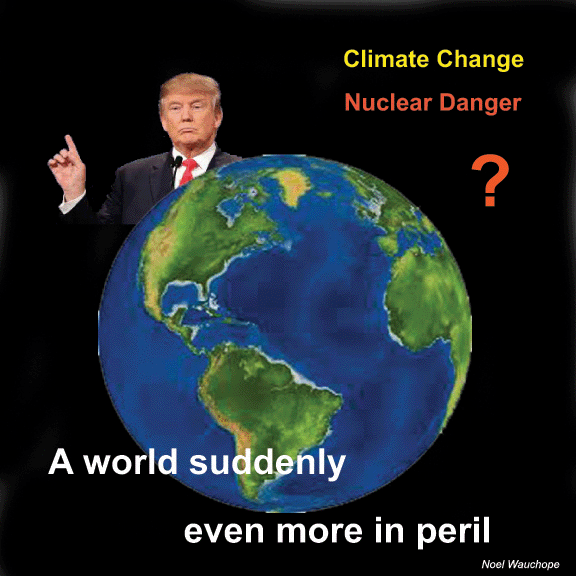
The first 200 days of the Trump administration have been marked by direct and consistent confrontations with the scientific community, and no area of science has been targeted more explicitly than climate science. The administration has proposed drastic cuts in the budget to federal climate change programs; removed climate-related information from government websites; and refused to renew the appointments of more than 30 members of the Environmental Protection Agency’s Board of Scientific Counselors — including me.
Scientists know that these actions are dangerous to public health, the economy and our national security. Thankfully, some government workers concerned about climate change are pushing back on the administration’s attempts to muzzle them, finally speaking out — or, in some cases, leaking out — against threats to academic freedom.
This week, The New York Times published a draft report written by scientists from 13 federal agencies. The draft, completed this year under congressional mandate as a special science section of the National Climate Assessment, states that “evidence for a changing climate abounds, from the top of the atmosphere to the depths of the oceans.” It goes on to say that “many lines of evidence demonstrate that human activities, especially emissions of greenhouse (heat-trapping) gases, are primarily responsible for recent observed climate change.”
The document was publicized before the Trump administration signed off on the release of the final draft. As the Times reported, scientists who worked on the draft feared that the Trump administration would not approve the document or might tamper with the report.
Fears of censorship are not unfounded. Staff members at the Agriculture Department’s Natural Resource Conservation Service must “avoid” using the phrase “climate change” in agency documents, according to a series of emails leaked to the Guardian this week. The phrase “weather extremes” is now the prefered language. Other phrases on the blacklist: “climate change adaptation,” “reduce greenhouse gases” and “sequester carbon.”
Such phrases are part of the language and lexicon of science, and instructing federal scientists to avoid using particular words is an affront to the pursuit of knowledge. This is censorship, and it is dangerous to both science and democracy…….
The United States previously served as a world leader in global environmental responsibility, but tragically that’s no longer the case. The administration’s decision to withdraw from the Paris climate accord and President Trump’s refusal to budge on the issue at the recent Group of 20 conference confirms that the United States is denying science and dangerously ignoring the threat of climate change.
The Trump administration just disbanded a federal advisory committee on climate change, WP, By Juliet EilperinAugust 20The Trump administration has decided to disband the federal advisory panel for the National Climate Assessment, a group aimed at helping policymakers and private-sector officials incorporate the government’s climate analysis into long-term planning.
The charter for the 15-person Advisory Committee for the Sustained National Climate Assessment — which includes academics as well as local officials and corporate representatives — expires Sunday. On Friday, the National Oceanic and Atmospheric Administration’s acting administrator, Ben Friedman, informed the committee’s chair that the agency would not renew the panel.
The National Climate Assessment is supposed to be issued every four years but has come out only three times since passage of the 1990 law calling for such analysis. The next one, due for release in 2018, already has become a contentious issue for the Trump administration.
Administration officials are currently reviewing a scientific report that is key to the final document. Known as the Climate Science Special Report, it was produced by scientists from 13 different federal agencies and estimates that human activities were responsible for an increase in global temperatures of 1.1 to 1.3 degrees Fahrenheit from 1951 to 2010.
The committee was established to help translate findings from the National Climate Assessment into concrete guidance for both public and private-sector officials. Its members have been writing a report to inform federal officials on the data sets and approaches that would best be included, and chair Richard Moss said in an interview Saturday that ending the group’s work was shortsighted……
While many state and local officials have pressed the federal government for more concrete guidance on how to factor climate change into future infrastructure, President Trump has moved in the opposite direction.
Last week, the president signed an executive order on infrastructure that included language overturning a federal requirement that projects built in coastal floodplains and receiving federal aid take projected sea-level rise into account. Some groups, such as the National Association of Home Builders, hailed the reversal of that standard from the Obama administration on the grounds that stricter flood requirements would raise the cost of development and “could make many projects infeasible.”
Seattle Mayor Ed Murray (D) said in an interview Saturday that the move to dissolve the climate advisory committee represents “an example of the president not leading, and the president stepping away from reality.” An official from Seattle Public Utilities has been serving on the panel; with its disbanding, Murray said it would now be “more difficult” for cities to participate in the climate assessment. On climate change, Trump “has left us all individually to figure it out.”…..
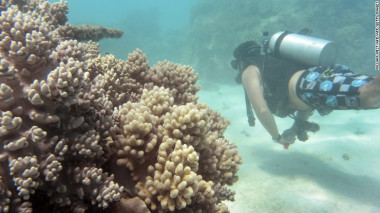
Coral bleaching: Researchers struggle to find anywhere in Pacific Ocean untouched, ABC News, By Nadia Daly,20 Aug 17 Scientists aboard a French research ship say they have been shocked to see the extent of coral bleaching across the Pacific Ocean, just halfway through their two-year voyage around the world.
The vessel Tara has been sailing around the globe for more than a decade to study the effects of climate change on the ocean.
Its current expedition will cross 11 time zones and span 100,000 kilometres from Europe to Asia and back again, and the group claims it is the biggest study of this scale across coral reefs.
The focus is how coral reefs in the Pacific are adapting to climate change, and on a stopover in Sydney, captain Nicolas De La Brosse said the extent of damage is already deeply troubling.
“What we’ve seen in really isolated spots like Samoa for example, even though it’s very far away from [developed] countries with pollution, we struggled to find any coral life,” he said.
Mr De La Brosse said nowhere was immune to the effects of global warming.
“It doesn’t matter where you are in the Pacific, coral is starting to bleach.”
He said data was still being collected and analysed and the final results would be released at the end of 2019……http://www.abc.net.au/news/2017-08-19/researchers-shocked-by-coral-bleaching-in-pacific/8822126
More GOP lawmakers bucking their party on climate change, But if the Republican Party is undergoing a shift on climate, it is at its earliest, most incremental stage. Politico, By DAVID SIDERS. 08/19/2017
LOS ANGELES — While President Donald Trump continues to dismantle Obama-era climate policies, an unlikely surge of Republican lawmakers has begun taking steps to distance themselves from the GOP’s hard line on climate change.
The House Climate Solutions Caucus, a bipartisan backwater when it formed early last year, has more than tripled in size since January, driven in part by Trump’s decision in June to withdraw the United States from the Paris climate accord.
And last month, 46 Republicans joined Democrats to defeat an amendment to the annual defense authorization bill that would have deleted a requirement that the Defense Department prepare for the effects of climate change.
The willingness of some Republicans to buck their party on climate change could help burnish their moderate credentials ahead of the 2018 elections. Of the 26 Republican caucus members, all but five represent districts targeted by the Democratic Congressional Campaign Committee next year.
Greenland is an important cog in the global climate system. The ice sheet which covers 80% of the island reflects so much of the sun’s energy back into space that it moderates temperatures through what is known as the “albedo effect”. And since it occupies a strategic position in the North Atlantic, its meltwater tempers ocean circulation patterns.
But Greenland is especially vulnerable to climate change, as Arctic air temperatures are currently rising at twice the global average rate. Environmental conditions are frequently setting new records: “the warmest”, “the wettest”, “the driest”.
Despite its size, the fire itself represents only a snapshot of Greenland’s fire history. It alone cannot tell us about wider Arctic climate change.
But when we superimpose these extraordinary events onto longer-term environmental records, we can see important trends emerging.
The ice sheet is melting
Between 2002 and 2016 the ice sheet lost mass at a rate of around 269 gigatonnes per year. One gigatonne is one billion tonnes. One tonne is about the weight of a walrus. During the same period, the ice sheet also showed some unusual short-term behaviour. The 2012 melt season was especially intense – 97% of the ice sheet experienced surface melt at some point during the year. Snow even melted at its summit, the highest point in the centre of the island where the ice is piled up more than 3km above sea level.
In April 2016 Greenland saw abnormally high temperatures and its earliest ever “melt event” (a day in which more than 10% of the ice sheet has at least 1mm of surface melt). Early melting doesn’t usher in a period of complete and catastrophic change – the ice won’t vanish overnight. But it does illustrate how profoundly and rapidly the ice sheet can respond to rising temperatures.
Permafrost is thawing
Despite its icy image, the margins of Greenland are actually quite boggy, complete with swarms of mosquitoes. This is the “active layer”, made up of peaty soil and sediment up to two metres thick, which temporarily thaws during the summer. The underlying permafrost, which can reach depths of 100m, remains permanently frozen.
In Greenland, like much of the Arctic, rising temperatures are thawing the permafrost. This means the active layer is growing by up to 1.5cm per year. This trend is expected to continue, seeing as under current IPCC predictions, Arctic air temperatures will rise by between 2.0°C and 7.5°Cthis century.
Arctic permafrost contains more than 1,500 billion tonnes of dead plants and animals (around 1,500 billion walrus equivalent) which we call “organic matter”. Right now, this stuff has been frozen for thousands of years. But when the permafrost thaws this organic matter will decay, releasing carbon and methane (another greenhouse gas) into the atmosphere.
With this in mind, it is clear to see why the recent wildfire, which was burning in dried-out peat in the active layer, was especially interesting to researchers. If Greenland’s permafrost becomes increasingly degraded and dry, there is the potential for even bigger wildfires which would release vast stores of greenhouse gases into the atmosphere.
Species are adapting to a changing ecosystem
Major changes in the physical environment are already affecting the species that call Greenland home. Just look at polar bears, the face of Arctic climate change. Unlike other bears, polar bears spend most of their time at sea, which explains their Latin name Ursus maritimus. In particular they rely on sea ice as it gives them a deep-water platform from which to hunt seals.
However, since 1979 the extent of sea ice has decreased by around 7.4% per decade due to climate warming, and bears have had to adjust their habitat use. With continued temperature rise and sea ice disappearance, it’s predicted that populations will decline by up to 30% in the next few decades, taking the total number of polar bears to under 9,000.
I have considered only a handful of the major environmental shifts in Greenland over the past few decades, but the effects of increasing temperatures are being felt in all parts of the earth system. Sometimes these are manifest as extreme events, at others as slow and insidious changes.
The different parts of the environmental jigsaw interact, so that changes in one part (sea ice decline, say) influence another (polar bear populations). We need to keep a close eye on the system as a whole if we are to make reliable interpretations – and meaningful plans for the future.
Kuwait’s inferno: how will the world’s hottest city survive climate change?
Malls and office complexes continue to spring up in Kuwait City, built by migrants often working illegally in soaring temperatures. But as oil and water reserves dwindle, the energy-guzzling citystate heads for an existential crisis, Guardian, Ruth Michaelson.18 Aug 2017,
It is 9am and the temperature in Kuwait City is 45C and rising, but already people working outside. A row of litter-pickers are already hard at work along a coastal highway, their entire bodies covered to protect them from the sun. Outside one of the city’s many malls, valets hover beside the air-conditioned entrance, while two men in white hats huddle wearily next to their ice cream stands.
Other city residents are luckier. They can avoid the outdoors altogether, escaping the inferno by sheltering in malls, cars and office buildings, where temperatures are kept polar-cold.
For years, Kuwait’s climate has been steadily heating up. In the summer months, the Gulf state now frequently touches 50C, and was last year awarded the grim prize of being the hottest place on earth, when temperatures reached a staggering high of 54C.
But while the capital is making plans to prepare for climate change and the rising heat, there are growing concerns for those residents who cannot afford to shelter inside, and mounting questions about how such an energy-intensive city can survive as resources such as water and oil dwindle.
Nearly 70% of Kuwait’s population is made up of migrant workers, many of whom power the near-constant construction of new office complexes and malls across the state. Though labour legislation now bans work outdoors between 12pm and 4pm, many are seen toiling through the hottest hours of the day regardless………
The conditions for those men and women forced to work outside are set to worsen: between 2010 and 2035, Kuwait’s annual average temperature will increase by 1.6% to 28.7C , according to the country’s Environmental Public Authority (EPA), making for increasingly sweltering summer temperatures and more of the dust storms that already plague Kuwait City and beyond.
“Yes, we’re under pressure,” says Shareef al-Khayat, head of the climate change division at the EPA. “Not just from rising temperatures, but sea level rises – the demand for electricity and water will also be harder in the future.”……..
Adapting to rising temperatures will require a radical shift in thinking in Kuwait, especially concerning the most vulnerable. “We can’t manage the way these companies work,” says the construction manager, referring to the contractors who incentivise labourers to work outside in punishing conditions. “Of course, when I see labourers working after midday in this heat, it’s horrible. But what can we do? It’s their rules.” https://www.theguardian.com/cities/2017/aug/18/kuwait-city-hottest-place-earth-climate-change-gulf-oil-temperatures
Curbing climate change: Why it’s so hard to act in time, The Conversation Timothy H. Dixon
Professor, Geology and Geophysics, Natural and human-caused hazards, sea level rise and climate change, University of South Florida, August 18, 2017This summer I worked on the Greenland ice sheet, part of a scientific experiment to study surface melting and its contribution to Greenland’s accelerating ice losses. By virtue of its size, elevation and currently frozen state, Greenland has the potential to cause large and rapid increases to sea level as it melts.
When I returned, a nonscientist friend asked me what the research showed about future sea level rise. He was disappointed that I couldn’t say anything definite, since it will take several years to analyze the data. This kind of time lag is common in science, but it can make communicating the issues difficult. That’s especially true for climate change, where decades of data collection may be required to see trends.
A recent draft report on climate change by federal scientists exploits data captured over many decades to assess recent changes, and warns of a dire future if we don’t change our ways. Yet few countries are aggressively reducing their emissions in a way scientists say are needed to avoid the dangers of climate change.
While this lack of progress dismays people, it’s actually understandable. Human beings have evolved to focus on immediate threats. We have a tough time dealing with risks that have time lags of decades or even centuries. As a geoscientist, I’m used to thinking on much longer time scales, but I recognize that most people are not. I see several kinds of time lags associated with climate change debates. It’s important to understand these time lags and how they interact if we hope to make progress.
Agreeing on the goal
Changing the basic energy underpinnings of our industrial economy will not be easy or cheap, and will require broad public support……
Designing cleaner technologies
It will also take time for technological developments to support our transition to a low-carbon energy future. Here, at least, there is reason for optimism. A few decades ago renewable energy sources such as wind and solar seemed unlikely to replace a significant fraction of carbon-based energy. Similarly, electric vehicles seemed unlikely to meet a significant share of our transportation needs. Today both are realistic alternatives……
Funding the transition
Once we finally decide to make a low-carbon transition and figure out how to do it, it will cost trillions of dollars. Capital markets can’t provide that sort of funding instantaneously……
The natural carbon cycle
Our ability to add carbon dioxide to the atmosphere greatly exceeds nature’s ability to remove it. There is a time lag between carbon emission and carbon removal. The process is complicated, with multiple pathways, some of which operate over centuries…….. most of the carbon dioxide that we put into the atmosphere today will continue to heat the world for hundreds to thousands of years.
Today the concentration of carbon dioxide in the atmosphere is just over 400 parts per million, rising by about 3 ppm yearly. Given the political, technological and economic time lags that we face, it’s likely that we will hit at least 450-500 ppm before we can seriously curtail our carbon emissions. The last time Earth’s atmosphere contained this much carbon dioxide was several million years ago, during the Pliocene era. Global temperatures were much higher than 2°C above today’s average, and global sea level was at least 6 meters (nearly 20 feet) higher.
We haven’t seen comparable temperature or sea level increases so far because of time lags in Earth’s climate response. It takes a while for our elevated carbon dioxide levels to trigger impacts on this scale. Given the various time lags that are in play, it is quite possible that we have already exceeded the 2°C rise over preindustrial temperatures – a threshold most scientists say we should avoid – but it hasn’t shown up on the thermometer yet.
We may not be able to predict exactly how much future temperatures or sea levels will rise, but we do know that unless we curb our carbon emissions, our planet will be a very uncomfortable place for our grandchildren and their grandchildren. Large-scale social changes take time: they are the sum of many individual changes, in both attitudes and behaviors. To minimize that time lag, we need to start acting now. https://theconversation.com/curbing-climate-change-why-its-so-hard-to-act-in-time-80117
Climate change will likely wreck their livelihoods – but they still don’t buy the science
The small Louisiana town of Cameron could be the first in the US to be fully submerged by rising sea levels – and yet locals, 90% of whom voted for Trump, still aren’t convinced about climate change, Guardian, Shannon Sims in Cameron Parish, Louisiana, 18 Aug 17, In 50 years, the region near where I grew up, Cameron Parish in south-west Louisiana, will likely be no more. Or rather, it will exist, but it may be underwater, according to the newly published calculations of the Louisianagovernment. Coastal land loss is on the upswing, and with each hurricane that sweeps over the region, the timeline is picking up speed.
As a result, Cameron, the principal town in this 6,800-person parish (as counties are called in Louisiana), could be the first town in the US to be fully submerged by rising sea levels and flooding. So it’s here one would expect to feel the greatest sense of alarm over climate change and its consequences.
Instead, Cameron has earned a different kind of fame: it’s the county that, percentage-wise, voted more in favor of Trump than any other county in the US in last year’s election. Nearly 90% of the population did.
Why would some of the people most vulnerable to climate change vote for a politician skeptical of climate change’s existence? Why would people in Cameron Parish support policies that could ruin them?……..
…..”Because of the rules and regulations, it costs so much to live here.”
Many locals in Cameron repeat this phrase – “rules and regulations”. They’re referring to the strict construction rules placed on residents who wanted to return to Cameron and rebuild after Rita and Ike hit the town. As a result, all structures needed to be raised in order to qualify for hurricane insurance. The result is a humble town whose homes appear strangely grandiose: single-story modest brick houses now rest on top of large, grassy man-made hills, a kind of south Louisianacastle…….
As for her politics, Smith thinks Cameron’s residents voted for Trump because “we think he could help the oil field out, and hopefully stop the imported seafood from coming into our country so our people can make a living,” she says.
Smith, like most of the residents of Cameron, has been highly dependent on state and federal assistance programs to recover after the storms. But what if, in Trump’s push to shrink the size of the government, recovery programs are cut?
“We’d be screwed,” she says frankly. “But that doesn’t change my opinion about Trump,” she quickly adds. “Outsiders think that everybody is just looking for a handout down here, but there is hard-working people that live here. There are just not many jobs right now, especially if all you know is commercial fishing. Even if Trump cuts those programs that helped us, we gonna make it one way or another here, with or without help. Down here we survive.”…….
Vail says he’s pleased with the drawdown on environmental restrictions that Trump has instituted since taking office.
“When he took office he stopped the EPA’s Waters of the US rule, where anything that would flow into a navigable tributary would have had jurisdiction under the EPA. Well, navigable tributaries go through half the land I farm. So you’re saying a ditch I put in my field to drain the water off, then that the land comes under your jurisdiction? You can tell me when I can go into it, and what I can use as fertilizer?”………
Mr Benny’s son lets me know that their alligator hunting business has brought in a high-end clientele. He brings out a photo of a grinning Donald Trump Jr taken during an alligator hunting trip. That personal connection has helped inform Mr Benny’s politics. “I’m Donald Trump all the way,” he says with a smile.
Even though Mr Benny’s family has been directly impacted by hurricanes, and even though the state mapping agency indicates that his home will be submerged within 50 years due to coastal land loss, Mr Benny isn’t buying it.
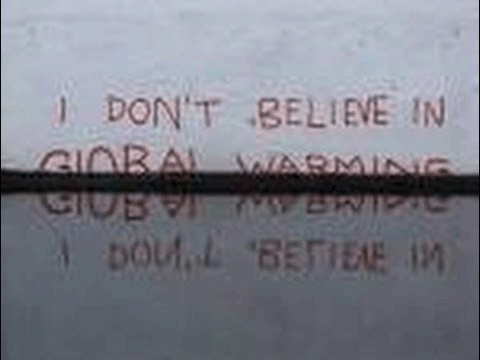
“I don’t believe it,” he says, shaking his head. “I don’t believe that the tide is gonna rise 10 feet and that the Ice Age is coming and stuff like that.” Like many of the residents here in Cameron, Mr Benny sees time on a longer horizon than others might. “I been here 75 years, you understand?,” he reminds me with gentle force. “And I’ve lived on the water and guess what? The tides still come up almost the same way, and there is no flooding. And today our front marshes aren’t underwater.”
“If you go by what the real scientists say, there’s no proof. In the last 10 years the average temperature of the world hasn’t even risen a half degree………
Theriot seems caught between her job as a science educator and her life as a longtime Cameron resident, tasked with teaching about the environment in a fiercely red town. “…….“But I think the data is incomplete. And I am still not sure about climate change. I am still researching it. I feel like I don’t have enough good sources to say yes or no on if climate change is a real thing.”
Now, from her elevated balcony overlooking the old slabs, she takes a clearer position. “I’m a big proponent of the oil industry, because that’s how my family and my community made a lot of its money. So that is my livelihood. So it is hard for me to point that finger.”….
….Dyson is not particularly concerned about the forecasts that show the coast disappearing over the coming decades. He thinks global warming is a gossipy scam……. Instead, Dyson says that what worries him most are the environmental regulations ostensibly intended to save the coast. “The laws are already there to protect the coast. And I understand Trump is not 100% environmentalist. But I think it’s a good thing to get the government out of our lives. I don’t want any more environmental regulations. I don’t want any more fishing laws. And I don’t want a lot of restrictions where people can’t make a living.”….. https://www.theguardian.com/us-news/2017/aug/18/louisiana-climate-change-skeptics-donald-trump-support
How the U.S. Navy is Responding to Climate Change, Harvard Business Review AUGUST 18, 2017 FOREST REINHARDT AND MICHAEL TOFFEL, Harvard Business School professors, talk about how a giant, global enterprise that operates and owns assets at sea level is fighting climate change—and adapting to it. They discuss what the private sector can learn from the U.S. Navy’s scientific and sober view of the world. Reinhardt and Toffel are the authors of “MANAGING CLIMATE CHANGE: LESSONS FROM THE U.S. NAVY” in the July–August 2017 issue of Harvard Business Review. “……The U.S. Navy is raising its bases, using early storm warning systems, and increasingly powering its missions with the sun, instead of fossil fuels……
FOREST REINHARDT: ………. the Navy is our primary waterborne military force. And as the planet warms, the amount of water is going to increase. That is, the area near the poles, which until quite recently has been closed to marine traffic for much if not all of the year, is going to be increasingly open as the ice melts. You think the last time the Western world really encountered a new ocean was in the early part of the 1500s, and the same kinds of opportunities and conflicts are going to exist in the Arctic.
A second reason is that climate change is potentially destabilizing to societies, especially societies which are not particularly rich and not particularly well governed. And as those societies become increasingly stressed by things like drought and storm severity, the kinds of behaviors that call the military into action are going to become more frequent, whether those are wars or internal conflicts or just need for humanitarian assistance.
MICHAEL TOFFEL: And this is why the military refers to climate change as a threat multiplier. Many have made the connection between the breakdown of societies in the Middle East, in particular in Syria, for example, to be attributed to changing rainwater and other precipitation patterns. So you see these problems right now behind the growth of ISIS. You see these problems also with the migration into Europe and Europe’s struggle with what to do with these migrants. These are examples of issues that climate scientists suggest are only going to get worse in the coming decades..…..
….The Navy also is investing in massive amounts of solar to power their bases. But it’s not motivated so much by those effects that I just mentioned the private sector is trying to claim. It’s really about, in their case, about mission readiness and the resilience of their bases. They want to be sure that as climate change occurs with more intensive storms that that’s not going to knock out the power grids that supply their bases. So they’re investing in some of these power sources because of their distributed nature—the fact that they can produce power on site and not have to rely on long distance ge
Environmentalists have long objected to calling a coal-fired carbon capture and sequestration project “clean coal,” arguing that the label is misleading because it focuses on carbon dioxide pollution while ignoring other problems like acid rain and airborne contaminants. And carbon capture projects rely on continuing fossil fuel production, because the CO2 that’s captured is sold to oil companies who pump it into aging wells to coax more oil from the ground.
Politicians nevertheless continue to use the term. “My administration is putting an end to the war on coal,” President Donald Trumpsaid this spring. “We’re going to have clean coal, really clean coal.”
New Fraud Allegations Emerge at Troubled ‘Clean Coal’ Project As Southern Co. Records Multi-Billion Loss, Desmog By Sharon Kelly • Tuesday, August 8, 2017 Southern Co. is accused of fraudulently misrepresenting the prospects for its troubled “clean coal” project in Kemper County, Mississippi in several legal filings this summer.
Southern announced in late July that it was shuttering the troubled “clean coal” part of Kemper after construction ran years behind schedule and the company spent $7.5 billion on the 582 megawatt power plant — over $5 billion more than it first projected.In a lawsuit filed today, Brett Wingo, a former Southern Company engineer, alleges he warned the company’s top executives that it would not be possible to meet key construction deadlines. Management responded by retaliating against him, the complaint asserts, and Southern continued to assure investors and the public that Kemper’s schedule and budget targets would be met, then blamed unpredictable factors like the weather when those goals were missed.
Wingo’s claim that Southern misled investors by concealing construction-related problems drew national attention in a front page New York Times investigation last year. In January, the U.S. Occupational Safety and Health Administration (OSHA) concluded that Wingo had suffered a “continuing pattern of retaliatory treatment” and ordered Southern to reinstate Wingo, but the company has refused, according to a statement accompanying the lawsuit. (The case is “Brett Wingo v. The Southern Company, et al.,” Case No. 2:17-cv-01328-MHH in the U.S. District Court for the Northern District of Alabama, Southern Division.)
A second less-noticed legal filing with Mississippi state regulators accuses Southern of misrepresenting Kemper’s prospects right from the outset, before construction even began. Those claims center on Southern’s projections for what it would cost to operate and maintain the plant once it was up and running, which the filing asserts were so low they were “indefensible”.
In an email to DeSmog, Wingo seconds those claims, saying that he believes management knew back in 2012 that its “operation and maintenance” (O&M) projections were off — but kept the accurate numbers under wraps for years.
“By hiding the true O& M costs for so long, apparently since 2012 and likely longer, Fanning basically ensured shareholders would be forced to absorb $6 billion in losses,” Wingo told DeSmog.
“In 2012, sunk costs on Kemper were only around $1 billion and the natural gas part of the plant substantially complete. It would have been a perfect time to stop a runaway train from running off the end of the tracks,” he added. “But history shows, that’s not what Fanning and Southern Company chose to do.”…….
Spending Money to Make Money
Why would a company want to build a power plant that’s too expensive to run? Part of the answer, critics say, is the way that utilities like power companies are regulated.
Because they are essentially regulated monopolies, the laws governing how utilities like power companies make money are different than most industries, as explained in a 2015 Wall Street Journal article titled “Utilities’ Profit Recipe: Spend More.”
“[U]tilities have another incentive for heavy spending; It actually boosts their bottom lines — the result of a regulatory system that turns corporate accounting on its head,” The Journal reported, explaining that as long as state-level regulators sign off on a project, regulated utilities get a fixed percentage of what they spend as a profit……..
Clean Coal?
Kemper was supposed to be an engineering feat, able to turn the world’s least efficient but most abundant form of coal, lignite coal, into a climate-friendly fuel. That’s “climate friendly” as compared to the kind of coal-burning power plants upon which the U.S. has historically relied for the bulk of its electricity……..
Environmentalists have long objected to calling a coal-fired carbon capture and sequestration project “clean coal,” arguing that the label is misleading because it focuses on carbon dioxide pollution while ignoring other problems like acid rain and airborne contaminants. And carbon capture projects rely on continuing fossil fuel production, because the CO2 that’s captured is sold to oil companies who pump it into aging wells to coax more oil from the ground.
Politicians nevertheless continue to use the term. “My administration is putting an end to the war on coal,” President Donald Trumpsaid this spring. “We’re going to have clean coal, really clean coal.”
Asked about the prospects for new “clean coal” projects in general after Kemper’s shuttering, a top Department of Energy official was dubious. EIA chief Howard Gruenspecht noted the role of natural gas prices, as well as the lower price of oil, which hurts the price of carbon sold to enhance oil recovery.
The National Oceanic and Atmospheric Administration officially confirmed last week that 2016 was the Earth’s hottest year on record, surpassing 2015, which surpassed 2014. The NOAA had reported this unofficially back in January. What made last week’s announcement noteworthy is that the NOAA is now part of the administration of President Donald Trump, who has famously called global warming a “hoax.”
Climate change denial is getting a little tricky for the president and his fellow Republicans. Politicoreported last week that some business groups, including those allied with Charles and David Koch’s powerful interests, are pushing back against the aggressive efforts of Environmental Protection Agency administrator Scott Pruitt to deny human-induced climate change.
These groups would rather not argue against the scientific consensus that man-made global warming is a growing threat. They want to roll back environmental regulations anyway without getting into debates that might hurt moderate Republicans. It’s an amazingly cynical strategy: Don’t argue the evidence or address the problem. Just ignore it.
The Trump administration has another chance this week to consider the choice between deny and ignore. Friday is the deadline for the heads of the 13 federal agencies that study various aspects of climate change to sign off on a draft of the Climate Science Special Report compiled by the scientists who work for their agencies. The report is part of the quadrennial National Climate Assessment mandated by Congress in 1990.
The draft was posted on the private nonprofit Internet Archive in January at a time when scientists feared that Trump might halt all climate research. It came to light last week when The New York Times reported that some government scientists were still concerned about potential Trump administration censorship.
The 673-page report largely reflects findings of hundreds, if not thousands, of previous studies of climate change, including those of the U.N.’s Intergovernmental Panel on Climate Change. This is not surprising: Good science must be replicable.
This report concludes that “it is extremely likely that human influence has been the dominant cause of the observed warming since the mid-20th century. For the warming over the last century, there is no convincing alternative explanation supported by the extent of the observational evidence.”
Scientists don’t throw terms like “extremely likely” around casually. It means a 95 percent to 100 percent probability. And yet Pruitt, Trump’s chief environmental official, scoffs at the concept that carbon dioxide released by human activity is a primary cause of global warming.
The draft report ventures into the quickly evolving field of “attribution science,” suggesting that there’s a “very high level of confidence” that global warming is responsible for extreme temperatures and “high confidence” that it’s responsible for extreme precipitation.
The scientific argument is over. It’s silly to deny it. It’s shameful to know it and ignore it.
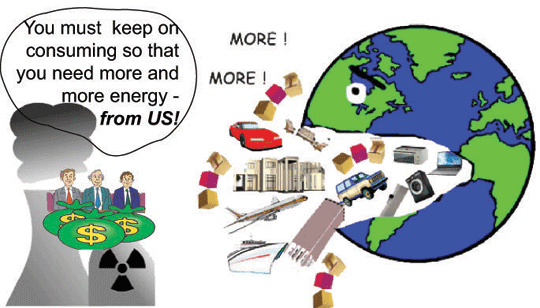
Why Climate Change Isn’t Our Biggest Environmental Problem, and Why Technology Won’t Save Us, Post Carbon, Richard Heinberg, August 17, 2017 Our core ecological problem is not climate change. It is overshoot, of which global warming is a symptom. Overshoot is a systemic issue. Over the past century-and-a-half, enormous amounts of cheap energy from fossil fuels enabled the rapid growth of resource extraction, manufacturing, and consumption; and these in turn led to population increase, pollution, and loss of natural habitat and hence biodiversity. The human system expanded dramatically, overshooting Earth’s long-term carrying capacity for humans while upsetting the ecological systems we depend on for our survival. Until we understand and address this systemic imbalance, symptomatic treatment (doing what we can to reverse pollution dilemmas like climate change, trying to save threatened species, and hoping to feed a burgeoning population with genetically modified crops) will constitute an endlessly frustrating round of stopgap measures that are ultimately destined to fail……..
The strategy of buying time with a techno-fix presumes either that we will be able to institute systemic change at some unspecified point in the future even though we can’t do it just now (a weak argument on its face), or that climate change and all of our other symptomatic crises will in fact be amenable to technological fixes. The latter thought-path is again a comfortable one for managers and investors. After all, everybody loves technology. It already does nearly everything for us.
Hello Humanity, it’s me, Technology. We need to talk
During the last century it solved a host of problems: it cured diseases, expanded food production, sped up transportation, and provided us with information and entertainment in quantities and varieties no one could previously have imagined. Why shouldn’t it be able to solve climate change and all the rest of our problems?
Of course, ignoring the systemic nature of our dilemma just means that as soon as we get one symptom corralled, another is likely to break loose. But, crucially, is climate change, taken as an isolated problem, fully treatable with technology? Color me doubtful.
I say this having spent many months poring over the relevant data with David Fridley of the energy analysis program at Lawrence Berkeley National Laboratory. Our resulting book, Our Renewable Future, concluded that nuclear power is too expensive and risky; meanwhile, solar and wind power both suffer from intermittency, which (once these sources begin to provide a large percentage of total electrical power) will require a combination of three strategies on a grand scale: energy storage, redundant production capacity, and demand adaptation. At the same time, we in industrial nations will have to adapt most of our current energy usage (which occurs in industrial processes, building heating, and transportation) to electricity. Altogether, the energy transition promises to be an enormous undertaking, unprecedented in its requirements for investment and substitution. When David and I stepped back to assess the enormity of the task, we could see no way to maintain current quantities of global energy production during the transition, much less to increase energy supplies so as to power ongoing economic growth. The biggest transitional hurdle is scale: the world uses an enormous amount of energy currently; only if that quantity can be reduced significantly, especially in industrial nations, could we imagine a credible pathway toward a post-carbon future.
Downsizing the world’s energy supplies would, effectively, also downsize industrial processes of resource extraction, manufacturing, transportation, and waste management. That’s a systemic intervention, of exactly the kind called for by the ecologists of the 1970s who coined the mantra, “Reduce, reuse, and recycle.” It gets to the heart of the overshoot dilemma—as does population stabilization and reduction, another necessary strategy. But it’s also a notion to which technocrats, industrialists, and investors are virulently allergic.
The ecological argument is, at its core, a moral one—as I explain in more detail in a just-released manifesto replete with sidebars and graphics (“There’s No App for That: Technology and Morality in the Age of Climate Change, Overpopulation, and Biodiversity Loss”). Any systems thinker who understands overshoot and prescribes powerdown as a treatment is effectively engaging in an intervention with an addictive behavior. Society is addicted to growth, and that’s having terrible consequences for the planet and, increasingly, for us as well. We have to change our collective and individual behavior and give up something we depend on—power over our environment. We must restrain ourselves, like an alcoholic foreswearing booze. That requires honesty and soul-searching.
In its early years the environmental movement made that moral argument, and it worked up to a point. Concern over rapid population growth led to family planning efforts around the world. Concern over biodiversity declines led to habitat protection. Concern over air and water pollution led to a slew of regulations. These efforts weren’t sufficient, but they showed that framing our systemic problem in moral terms could get at least some traction.
Why didn’t the environmental movement fully succeed? Some theorists now calling themselves “bright greens” or “eco-modernists” have abandoned the moral fight altogether. Their justification for doing so is that people want a vision of the future that’s cheery and that doesn’t require sacrifice. Now, they say, only a technological fix offers any hope. The essential point of this essay (and my manifesto) is simply that, even if the moral argument fails, a techno-fix won’t work either. A gargantuan investment in technology (whether next-generation nuclear power or solar radiation geo-engineering) is being billed as our last hope. But in reality it’s no hope at all.
The reason for the failure thus far of the environmental movement wasn’t that it appealed to humanity’s moral sentiments—that was in fact the movement’s great strength. The effort fell short because it wasn’t able to alter industrial society’s central organizing principle, which is also its fatal flaw: its dogged pursuit of growth at all cost. Now we’re at the point where we must finally either succeed in overcoming growthism or face the failure not just of the environmental movement, but of civilization itself……