THE DROWNING ISLES, THE SOLOMON ISLANDS ARE AN ARCHIPELAGO FILLED WITH IDYLLIC  BEACHES AND PERFECT WAVES, BUT AS TEMPERATURES AND SEA LEVELS RISE, MUCH OF THEIR PRISTINE COAST IS DISAPPEARING, Surfer ,AUGUST 17, 2017 BY ASHTYN DOUGLAS “…….A few months prior to our visit, I came in contact with Dr. Simon Albert, a marine scientist at the University of Queensland. He and his colleagues had recently discovered, using time series and satellite imagery, that five Solomon Islands had been swallowed by the sea over the last 70 years, and another six islands had severely eroded. The cause was determined to be accelerated sea-level rise.

“Over the last 20 years, rates of sea-level rise in the Solomon Islands have been three times higher than the global average,” said Albert. “That’s about an 8 or 9 millimeter rise each year.” Half of that number, he explained, is the result of El Niño cycles, which naturally siphon the world’s water into the South Pacific. The other culprit is climate change.
In some parts of the country, this rapid sea-level rise, combined with high wave intensity, has eroded beaches and destroyed people’s properties. Even over the short span of five years, many have watched the ocean come into their villages and carry homes away.
“The changes have been really swift,” said Albert. “People living on those islands are feeling very physically and psychologically insecure because they’re feeling like their entire foundation of life is washing away.”….
This island, [ Beneamina, a small, circular island near Santa Isabel] Albert explained, is now only half the size it was 10 years ago. “When I was there in December, an island nearby had one house on it,” he said. “By the time we returned in February, that house had been washed away.”……
Most people talk about sea-level rise and other consequences of climate change using the future tense — as something our coastal-dwelling grandchildren will have to deal with 100 years from now. But according to Albert, that dystopian future has already arrived in parts of the Solomon Islands. “The rates we’re seeing there are the rates we’re likely to see over the next 50 years around the world as things get worse,” says Albert. “In a way, the Solomon Islands provide a window into the future.” http://www.surfer.com/features/the-drowning-solomon-islands/
August 18, 2017
Posted by Christina Macpherson |
climate change, OCEANIA |
Leave a comment
 How Climate Change Could Already Be Affecting Your Health, HealthLine, by Gillian Mohney on August 17, 2017
Small changes to the climate can have wide-ranging effects on public health from asthma to heart problems to mosquito-borne diseases. While climate change discussions often focus on what will happen in the future, changes to the atmosphere have already been taking a toll on people today.“Health is the canary in the coal mine and we are the canaries,” Jeffrey Shaman, PhD, director of the climate and health program at the Columbia University Mailman School of Public Health, told Healthline.
Last week, the U.S. Global Change Research Program’s climate change report made public by the New York Times concluded that “it is extremely likely that human influence has been the dominant cause of the observed warming since the mid-20th century.”
The report also pointed to a host of factors likely to affect the United States, including changes to “water quality and availability, agricultural productivity, [and] human health.”
Shaman and other health experts have pointed to the ways in which extreme temperatures and other effects of climate change are impacting people today, from heat-related illnesses to cardiovascular events.
Effects of climate change now
Asthma
Spiking temperatures can affect air quality since it raises the levels of pollutants and ozone in the air……..
Heat-related illnesses
Dramatic heat waves and record-breaking temperatures have become more common in recent years. The authors of the climate change report found that 16 of the past 17 years were the hottest on record.
Higher temps mean more people at risk for potentially dangerous heat-related illnesses……
Allergies
One lesser-known consequence of climate change is seasonal allergies.
Increasing temperatures and rising levels of carbon dioxide in the air can have a significant effect on plants and pollen that cause common seasonal allergy symptoms.
Plants that cause hay fever in the spring, summer, and early fall will bloom and flourish for longer due to warming temperatures.
Shaman said in particular the ragweed plant, a mainstay of the fall allergy season, has been shown to produce more pollen when exposed to higher carbon dioxide levels……..
Cardiovascular disease
The warming climate can result in conditions that can put strain on the cardiovascular system. This puts people at risk for stroke, heart attack, or other major cardiac events.
Wildfires in particular can put people at risk. An increase in extreme hot and dry weather in recent decades can exacerbate natural cycles of forest fires.
“Wildfires have increased over parts of the western United States and Alaska in recent decades and are projected to continue to increases as a result of climate change,” the climate change report authors wrote.
These fires can increase rates of cardiac events for people, even if they are miles away.
Dr. Richard Josephson, a cardiologist at University Hospitals Cleveland Medical Center, told Healthline in an earlier interview that the cardiovascular system can come under increased strain from particulates in smoke or haze from a forest fire.
“There are a variety of toxic chemicals in the smoke and small particulate air pollution in the smoke that are bad for the cardiovascular system,” Josephson said.
These tiny particulates put strain on the cardiovascular system, putting people at risk for major cardiac events. “It can cause activation of the clotting system and constriction of blood vessels,” Josephson said.
Effects of climate change in the future
Insect-borne disease There are other public health factors that scientists are closely watching to see if they will impact public health.
The WHO states that insect- and other animal-borne diseases could be affected by climate change if the insects and animals move to new habitats in reaction to changing weather patterns……http://www.healthline.com/health-news/how-climate-change-could-be-affecting-your-health#1
August 18, 2017
Posted by Christina Macpherson |
2 WORLD, climate change, health |
Leave a comment
Global warming ‘is causing the Alps to CRUMBLE’: Huge rock fall in Austria is latest sign of climate change’s effects on the mountain range – with SKI RESORTS at risk, Daily Mail, Temperature is rising twice as fast in the Alps than the global average.
August 18, 2017
Posted by Christina Macpherson |
climate change, EUROPE |
Leave a comment
 Effort backed by the state’s flagship universities comes as US President Donald Trump shrugs off global warming, Scientific American By Jeff Tollefson, Nature magazine on August 17, 2017
California has a history of going it alone to protect the environment. Now, as US President Donald Trump pulls back on climate science and policy, scientists in the Golden State are sketching plans for a home-grown climate-research institute—to the tune of hundreds of millions of dollars per year.
The initiative, which is backed by California’s flagship universities, is in the early stages of development. If it succeeds, it will represent one of the largest US investments in climate research in years. The nascent ‘California Climate Science and Solutions Institute’ would fund basic- and applied-research projects designed to help the state to grapple with the hard realities of global warming. ……
California might ultimately have some company. At Columbia University in New York City, science dean Peter de Menocal—a palaeoclimatologist—hopes to build an alliance of major universities and philanthropists to support research into pressing questions about the impacts of climate change. Potential topics include local variations in sea-level rise and the changing availability of freshwater resources and food. …..https://www.scientificamerican.com/article/california-scientists-push-to-create-massive-climate-research-program/
August 18, 2017
Posted by Christina Macpherson |
climate change, USA |
Leave a comment
Another climate-change nightmare: 91 new volcanoes beneath Antarctica’s ice, WP , By Avi Selk August 15 “….now it turns out Antarctica has problems we didn’t even know about. Deep problems. Volcanoes-under-the-ice problems, which doesn’t sound healthy.
University of Edinburgh researchers on Monday announced the discovery of 91 previously unknown volcanoes under west Antarctica. They do not sound nearly as alarmed as, say, Quartz, which called the possibilities terrifying.
“By themselves the volcanoes wouldn’t be likely to cause the entire ice sheet to melt,” said lead researcher Max Van Wyk de Vries, whose team published the study in the Geological Society in late May. But if the glacier is already melting because of global warming, he said, “if we start reducing significant quantities of ice … you can more or less say that it triggers an eruption.”
In a worst-case scenario, the researchers say, we could see a feedback loop of melting ice that destabilizes volcanoes, which erupt and melt more ice, and so on until Antarctica’s troubles to date seem halcyon in comparison……
While some are quite worried, de Vries doubted that a little blast of molten rock would do much harm to a massive Antarctic ice sheet. Directly, at least.
But he laid out a worst-case scenario in which lava managed to melt through a glacier, and warm ocean water seeped into the hole, and the whole system began melting even faster, potentially unleashing vast magmatic forces beneath the ice. https://www.washingtonpost.com/news/speaking-of-science/wp/2017/08/15/another-climate-change-nightmare-dozens-of-volcanoes-beneath-antarcticas-thinning-ice/?utm_term=.fe9ede7c33c3
August 18, 2017
Posted by Christina Macpherson |
ANTARCTICA, climate change |
Leave a comment
Study validates East Antarctic ice sheet to remain stable even if western ice sheet melts https://www.eurekalert.org/pub_releases/2017-08/iu-sve081717.php INDIANA UNIVERSITY, INDIANAPOLIS — A new study from Indiana University-Purdue University Indianapolis validates that the central core of the East Antarctic ice sheet should remain stable even if the West Antarctic ice sheet melts.
The study’s findings are significant, given that some predict the West Antarctic ice sheet could melt quickly due to global warming.
If the East Antarctic ice sheet, which is 10 times larger than the western ice sheet, melted completely, it would cause sea levels worldwide to rise almost 200 feet, according to Kathy Licht, an associate professor in the Department of Earth Sciences in the School of Science at IUPUI.
Licht led a research team into the Transarctic Mountains in search of physical evidence that would verify whether a long-standing idea was still true: The East Antarctic ice sheet is stable.
The East Antarctic ice sheet has long been considered relatively stable because most of the ice sheet was thought to rest on bedrock above sea level, making it less susceptible to changes in climate. However, recent studies show widespread water beneath it and higher melt potential from impinging ocean water.
The West Antarctic ice sheet is a marine-based ice sheet that is mostly grounded below sea level, which makes it much more susceptible to changes in sea level and variations in ocean temperature.
“Some people have recently found that the East Antarctic ice sheet isn’t as stable as once thought, particularly near some parts of the coast,” Licht said. Recent studies have determined that the perimeter of the East Antarctic ice sheet is potentially more sensitive and that the ice may have retreated and advanced much more dynamically than was thought, Licht said.
“We believed this was a good time to look to the interior of the ice sheet. We didn’t really know what had happened there,” Licht said.
The research team found the evidence confirming the stability of the East Antarctic ice sheet at an altitude of 6,200 feet, about 400 miles from the South Pole at the edge of what’s called the polar plateau, a flat, high surface of the ice sheet covering much of East Antarctica.
To understand how an ice sheet changes through time, a continuous historical record of those changes is needed, according to Licht. The team found layers of sediment and rocks that built up over time, recording the flow of the ice sheet and reflecting climate change. Finding that record was a challenge because glaciers moving on land tend to wipe out and cover up previous movements of the glacier, Licht said.
The big question the team wanted to answer was how sensitive the East Antarctic sheet might be to climate change.
“There are models that predict that the interior of the East Antarctic ice sheet wouldn’t change very much, even if the West Antarctic ice sheet was taken away,” Licht said. According to these models, even if the ice sheet’s perimeter retreats, its core remains stable.
“It turns out that our data supports those models,” she said. “It’s nice to have that validation.”
The team’s research findings are presented in a paper, “East Antarctic ice sheet stability recorded in a high-elevation ice-cored moraine,” that was published today online in the journal Geology. The research presented is in collaboration with Mike Kaplan, Gisela Winckler, Joerg Schaefer and Roseanne Schwartz at Lamont-Doherty Earth Observatory in New York.
August 18, 2017
Posted by Christina Macpherson |
ANTARCTICA, climate change |
Leave a comment
France’s Climate Science Grants Want To Make The Planet Great Again–And Thousands Have Applied
France’s response to the U.S. withdrawal from the Paris climate accord was to offer safe harbor for scientists and entrepreneurs who might lose funding in the U.S. For worried Americans, it might be a good deal. Fast Company, BY ADELE PETERS , In the past, a young American climate researcher with a PhD might have applied to work at NASA or NOAA. Now, some are considering moving to Europe instead.
Since French president Emmanuel Macron announced the “Make Our Planet Great Again” initiative on June 1–inviting climate researchers, entrepreneurs, and nonprofits to come to France, hours after Trump announced his intention to withdraw from the Paris climate agreement–roughly 11,000 people have applied. The program offers $69 million in support to selected applicants; Germany recently announced that it will join France and offer another $17 million….
The grants are flexible, with no set limits on the amount of time someone can work in France or preference for particular research areas or businesses, as long as they address climate change and are judged to have strong potential…….
“In the U.S., the current administration seems poised to do real damage to U.S. climate science, both in terms of critical observations and the science that goes with it,” says Dennis Hartmann, a professor in the Department of Atmospheric Sciences at the University of Washington. “The effects would be long lasting, as young scientists, especially, would be forced out of the field, and critical observational information would be lost, and some long-term time series broken……
After France made its offer, others have followed: Germany plans to launch its own website as a partner to the initiative. The U.K. also
launched a new fund–though not specifically focused on climate–designed to attract international researchers. Canada is similarly investing in a
new program to attract international researchers.
France’s program, like the others, is open worldwide, but Americans make up many of the applicants, likely both because of the strength of American academia and business and the current political climate…..
France is hoping that the program can be part of helping the world meet–and even go beyond–the objectives of the Paris agreement to limit global warming. “If collectively, all over the world, we achieve to respect that agreement, it would be a great thing,” says the Elysée source. “Secondly, we want to improve research and an understanding of our world and climate phenomena. A third aspect is that we expect it to deliver hope . . . we do believe that cleantech can offer new jobs, new industries of the future.” https://www.fastcompany.com/40446915/frances-climate-science-grants-want-to-make-the-planet-great-again-and-thousands-have-applied
August 18, 2017
Posted by Christina Macpherson |
climate change, France |
Leave a comment
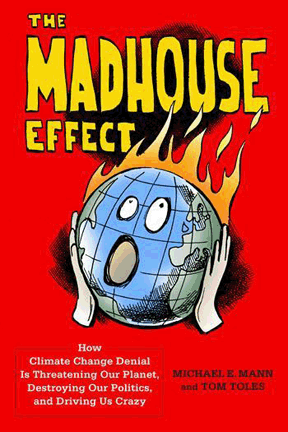
 The Madhouse Effect: this is how climate denial in Australia and the US compares, The Conversation August 14, 2017 Michael Mann is well known for his classic “hockey stick” work on global warming, for the attacks he has long endured from climate denialists, and for the good fight of communicating the environmental and political realities of climate change.
Mann’s work, including his recent book The Madhouse Effect, has helped me, as a dual US-Australian citizen, think about the similarities and differences between the US and Australia as we respond to what has been called the climate change denial machine.
In both countries, the denialists and distortionists have undermined public knowledge, public policy, new economic development opportunities, and the very value of the environment. Climate policy is being built upon alternative facts, fake news, outright lies, PR spin and industry-written talking points.
From the carbon industry capture of the two major parties, to the Abbott-Turnbull government parroting industry talking points, to coal industry lobbyists as government energy advisers, to the outright idiotic conspiracy pronouncements of senators funded and advised by the US- based denial machine, the Madhouse Effect is in full force in Australia.
How we can expose and counter this denialist machine? To partly lay out the task, I will discuss three points of contrast between the US and Australia.
Political culture
There is a key difference between the two countries’ political cultures. As much as the denialists have determined Australian energy and climate policy, they have not been as successful, yet, at undermining deep-seeded respect in Australian culture for the common good, for science, for expertise and knowledge…….
Last year, when the government fired climate scientists at CSIRO, there was another huge public backlash. The government had to step back a bit, both on the actual science to be done and the radical agenda change away from science for the public good.
And again, when the government wanted to support the dubious work of Bjorn Lomborg, that caused an outcry from both the university sector and the public. Even though the government wound up paying more than A$600,000 on what The Australian called his “vanity book project”, they couldn’t import him and plant him at any Australian university.
As Mann says, the main issue in implementing good, sound climate policy is no longer simply the science. The main issue is the cultural understanding of, and respect for the role of science in informing political decisions.
That’s not to say there are no attacks on science – clearly, these continue (such as the recent challenges to normal Bureau of Meteorology practices). But, overall, climate denialists and their enablers are outnumbered outliers in Australia, rather the norm.
The power of the carbon industry
My second point of comparison is not quite as positive.
The problem in Australia is less a culture turning against the Enlightenment, and more the direct political power and influence of the carbon industry. ……
even here I think there is some hope. We have seen, over the last few years, an incredible coalition grow – one focused on the end of carbon mining, on protecting communities, on creating real jobs, and on supporting renewables.
Once-unthinkable coalitions of farmers and Aboriginal communities are fighting new mines, new attacks on sacred and fertile land and water.
We have intensive household investment in rooftop solar – and as the feed-in tariffs are undermined, those folks will increasingly invest in battery storage. And we’re finally seeing states move in this direction, with increasing development of utility-scale renewable and storage projects. As hard as the federal government and its allies resist, renewables are growing and the public supports this – even conservative voters. https://theconversation.com/the-madhouse-effect-this-is-how-climate-denial-in-australia-and-the-us-compares-81822
August 16, 2017
Posted by Christina Macpherson |
AUSTRALIA, climate change, USA |
Leave a comment
 Trump to reverse Obama-era order aimed at planning for climate change, WP, By Darryl Fears and Steven Mufson August 15 President Trump signed an executive order Tuesday that he said would streamline the approval process for building infrastructure such as roads, bridges and offices by eliminating a planning step related to climate change and flood dangers……
The White House confirmed that the order issued Tuesday would revoke an earlier executive order by former President Barack Obama that required recipients of federal funds to strongly consider risk-management standards when building in flood zones, including measures such as elevating structures from the reach of rising water. Obama’s Federal Flood Risk Management Standard, established in 2015, sought to mitigate the risk of flood damage charged to taxpayers when property owners file costly claims.
August 16, 2017
Posted by Christina Macpherson |
climate change, USA |
Leave a comment
Climate change projected to significantly increase harmful algal blooms in US freshwaters, Phys Org,
August 15, 2017, Harmful algal blooms known to pose risks to human and environmental health in large freshwater reservoirs and lakes are projected to increase because of climate change, according to a team of researchers led by a Tufts University scientist. The team developed a modeling framework that predicts that the largest increase in cyanobacterial harmful algal blooms (CyanoHABs) would occur in the Northeast region of the United States, but the biggest economic harm would be felt by recreation areas in the Southeast.
The research, which is published in print today in the journal Environmental Science & Technology, is part of larger, ongoing efforts among scientists to quantify and monetize the degree to which climate change will impact and damage various U.S. sectors…….
It has been estimated that lakes and reservoirs serving as drinking water sources for 30 million to 48 million Americans may be contaminated periodically by algal toxins. Researchers cited an example in 2014, when nearly 500,000 residents of Toledo, Ohio, lost access to drinking water after water drawn from Lake Erie revealed the presence of cyanotoxins……..https://phys.org/news/2017-08-climate-significantly-algal-blooms-freshwaters.html
August 16, 2017
Posted by Christina Macpherson |
climate change, USA, water |
Leave a comment
Nigel Lawson admits claim that global temperatures have fallen was false http://www.independent.co.uk/environment/nigel-lawson-climate-change-sceptics-global-temperatures-fall-false-claim-warming-gwpf-bbc-radio-4-a7894686.html
Global Warming Policy Foundation concedes that the Tory peer’s supposedly official figures were wrong and produced by a right-wing think tank, Ian Johnston Environment Correspondent @montaukian 15 aug 17, A claim by Britain’s leading climate science sceptic, Nigel Lawson, that the world’s average temperature has fallen in the past 10 years was based on an “erroneous” temperature chart, his think tank, the Global Warming Policy Foundation, has admitted.
The former Tory Chancellor was interviewed on BBC Radio 4’s Today programme about the release of former US Vice-President Al Gore’s new film, The Inconvenient Sequel: Truth to Power, which describes how climate change is already having significant effects on the planet but also that the plunging cost of renewable energy means there is a solution.
The film points out the world’s average temperature had hit the highest on record for three years in a row – 2014, 2015 and 2016 – and an increase in extreme weather events.
August 16, 2017
Posted by Christina Macpherson |
climate change, UK |
Leave a comment
Nuclear war with North Korea ‘would be suicidal’, climate experts warn, Mashable BY ANDREW FREEDMAN, 10 Aug 17, It’s winter, 2018, in Iowa, five months after the last of the nuclear bombs detonated across megacities in northeast Asia, from Seoul to Tokyo to Shanghai. Radioactive fallout was the initial concern, but now something else is going awry: the weather.
American farmers accustomed to snow and cold during the winter would be forgiven for mistaking their corn and wheat fields for the Arctic tundra, as temperatures dip well below zero at night, and barely recover above 10 degrees Fahrenheit during the day, under a milky, leaden sky.
Forecasters say the corn and wheat harvest may be significantly shortened this year, and for the next several years. In fact, fears of a famine on an international scale are settling in.
This is what our world could look like just a few months to years after a regional nuclear war breaks out on the Korean Peninsula and spreads to include China and possibly Russia.

Whether from a deliberate strategy or a terrifying miscalculation, such a war could trigger a global climate catastrophe, experts warn, that is not being factored into leaders’ planning.
Such a war could cause the planet to cool by up to 10 degrees Celsius, or 18 degrees Fahrenheit, with larger regional swings and extremes, according to Owen Brian Toon, a scientist at the University of Colorado at Boulder. The amount of cooling could be far lower, depending on whether the conflict were more limited in scope.
Apocalyptic visions of a so-called global “nuclear winter” were popular during the Cold War when envisioning a U.S. conflict with the then-Soviet Union, but the odds of a regional nuclear war in recent times have jumped higher after President Donald Trump’s bellicose rhetoric toward North Korea on Tuesday. …….
It’s not just national security experts who are horrified by Trump’s words. Trump’s rhetoric, and history of openly considering using nuclear weapons, is also concerning to climate scientists.
Two researchers, in particular, are taking note of the North Korean threat: Alan Robock, of Rutgers University, and Toon. Robock and Toon are modern day Cassandras, having warned for decades about the potentially ruinous climate change consequences of a nuclear war, most recently focusing on regional conflicts.
Robock has conducted much of the research into the idea of a nuclear winter, whereby a global thermonuclear war vaults so much smoke into the upper atmosphere to block out the sun for years afterwards, causing temperatures to plunge and killing off vital crops and plant and animal species…….
Robock says most people, including high-ranking defense officials, are unaware that a nuclear war occurring halfway around the world from the U.S. could seriously harm the homeland, by altering the climate.
Simulations in the 1980s, he said, found that temperatures would plunge so far after a U.S.-Soviet nuclear war that high temperatures in the summer temperatures would stay below freezing worldwide. ……..
The modern-day nuclear scenario that Robock, Toon and others have studied closely involves an exchange of nuclear weapons between India and Pakistan, with about 50 bombs of 15 kilotons each, which is less than half of those nations’ nuclear arsenals.
Such a war would induce massive firestorms in urban areas that could send up to 5 million tons of smoke high into the upper atmosphere, where tiny particles known as aerosols would scatter sunlight, preventing it from reaching the Earth’s surface.
This would turn the planet’s climate sharply colder, despite the effects of human-caused global warming, and impact areas far from the actual fighting. The global cooling from such a regional war could be near 1.25 degrees Celsius, or 2.25 degrees Fahrenheit, studies have shown.
Once in the stratosphere, the particles contributed by the smoke would stick around for a long time, Toon and Robock’s simulations show. Observations after volcanic eruptions and wildfires support the model simulations.
“It circles the globe and stays there for many years,” Toon said. ……..http://mashable.com/2017/08/09/north-korea-nuclear-war-climate-change-winter/#WoP6BE3O6iq4
August 14, 2017
Posted by Christina Macpherson |
2 WORLD, climate change, weapons and war |
Leave a comment
Stoddard believes flood insurance rates — which have been subsidized for years by governments — will be the so-called tipping point for homeowners in the U.S.
When rates are allowed to rise to a level that matches the actuarial risk of flooding, homeowners will find they cannot afford their flood insurance and will pressure elected officials to take action, he argued.
“Homeowners will find themselves underwater literally and figuratively,” Stoddard
 Refugees of a different kind are being displaced by rising seas — and governments aren’t ready
- Sea levels are on the rise, displacing entire populations and stirring fears for ‘climate refugees’ that must relocate.
- A ‘tipping point’ is nearing as costs mount, and governments appear unprepared.
- The impact is being felt as far away as Panama, and as close as Louisiana.
Increasingly, the phenomenon of rising sea levels has amplified fears over climate refugees — individuals forced to leave their homes due to changing environmental conditions in their respective homelands. Climate watchers estimate that at least 26 million people around the world have already been displaced, and that figure could balloon to 150 million by 2050, according to the Worldwatch Institute.
Relocating those populations costs vast sums of money, raising the question of who will cover those costs as sea levels continue their uptrend. The rise in global sea levels has accelerated since the 1990s amid rising temperatures, with a thaw of Greenland’s ice sheet pouring ever more water into the oceans, a team of international scientists reported last month.
In the U.S., the cost of climate change is expected to be steep. A
Science study estimates that every one degree Celsius increase in global mean temperature will cost the U.S. 1.2 percent of its economic growth. Separately, a recent assessment by Lloyds estimated that flooding
ranked high among the top five risks to global economic growth, and could cost upwards of $430 billion.
Mark Witte, a professor of public finance at Northwestern University, said climate relocation demonstrates a classic economic problem when it comes to addressing slow moving, long-term challenges. “We’re waiting for the tipping point,” Witte told CNBC recently. “We’re going to wait too long, and it’ll be a more expensive fix in the long term than if we just did something now.”……..
for people like 27-year-old Panama native Diwigdi Valiente, climate change is “not a fairy tale anymore.” In addition to washing away homes and schools on the inhabited islands, rising seas are set to engulf hundreds of Kuna-owned tourist beaches off the Caribbean coast, which locals use as their main source of revenue.
Valiente, part of an indigenous population called the Kuna, is one of tens of thousands of autonomous islanders who may need to relocate to the mainland within the next 20 years, as rising seas threaten to swallow their homes. Some Kuna are facing moves to the mainland even sooner than that as puddles of water form on the islands………
Panama’s government has pledged to help fund the Kuna’s relocation. However, according to Valiente, the effort is not moving quickly enough, and may not cover the full costs………
For millions of individuals living in low coastal areas across the world, and for the policymakers debating what to do and how to pay for it, climate change is no longer an abstract, far-off concept.
“We all thought this is something that was going to happen in 100 years or something,” said Valiente. “But it’s happening right now.”………
Louisiana, however, is just one recipient of federal aid. Other states haven’t been as fortunate, at least not yet.
Philip Stoddard, the mayor of South Miami, said he does not expect to see financial assistance from the federal government anytime soon — even though one in eight homes in Florida could be underwater by 2100, Zillow data states.………. Stoddard believes flood insurance rates — which have been subsidized for years by governments — will be the so-called tipping point for homeowners in the U.S.
When rates are allowed to rise to a level that matches the actuarial risk of flooding, homeowners will find they cannot afford their flood insurance and will pressure elected officials to take action, he argued.
“Homeowners will find themselves underwater literally and figuratively,” Stoddard said.https://www.cnbc.com/2017/08/11/climate-change-refugees-grapple-with-effects-of-rising-seas.html
August 14, 2017
Posted by Christina Macpherson |
climate change, USA |
Leave a comment
The basic findings from the State of the Climate report, which diagnosed 2016, are summarized at NOAA’s website:
- Greenhouse gases were the highest on record.
- Global surface temperature was the highest on record.
- Average sea surface temperature was the highest on record.
- Global upper-ocean heat content neared record high.
- Global sea level was the highest on record.
- Arctic sea ice coverage was at or near record low.
- Tropical cyclones (globally) were above-average overall.
These finding continue with a story that has emerged in report after report (at least those done carefully and credibly). There are opinion or grey literature (not peer-reviewed) efforts out there that say odd things and advance certain agendas. However, the message is pretty clear if you consume peer-reviewed science reported by National Academies, NASA, NOAA, National Climate Assessment, American Association for the Advancement of Science, IPCC, and the majority of published journal studies……
New data does suggest that public is paying attention. The recent report, Climate Change in the American Mind (May 2017) says
More than half of Americans (58%) believe climate change is mostly human caused. That’s the highest level measured since our surveys began in 2008. By contrast, only 30% say it is due mostly to natural changes in the environment, matching the lowest level measured in our November 2016 survey……. https://www.forbes.com/sites/marshallshepherd/2017/08/11/more-climate-change-stories-less-graphs-and-maps/#763882ea1cac
August 12, 2017
Posted by Christina Macpherson |
2 WORLD, climate change |
Leave a comment
The crazy climate records from 2016 you haven’t heard much about http://reneweconomy.com.au/crazy-climate-records-2016-havent-heard-much-12340/ [good graphics] By Andrea Thompson on 11 August 2017 Climate Central
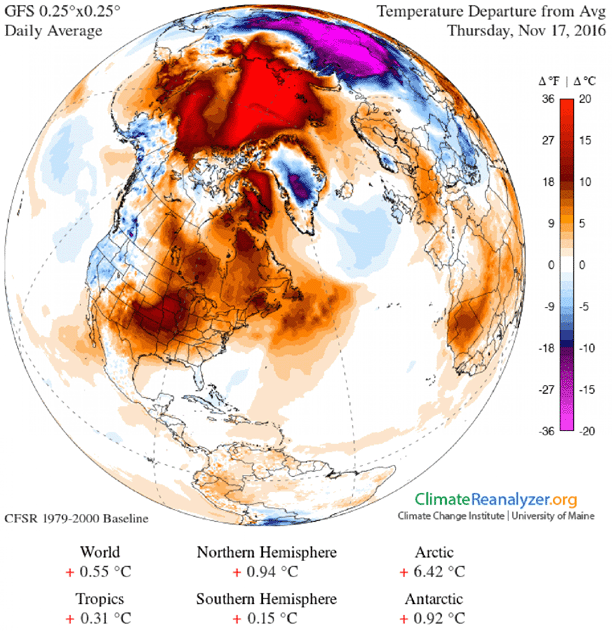
By now, we’ve all heard that 2016 was the hottest year on record, and that heat-trapping greenhouse gases hit their highest concentration ever, surpassing 400 parts per million for the first time in nearly 1 million years. But there are other climate change-related records that have flown more under the radar. Several of those records were highlighted Thursday in the annual State of the Climate report, released in the Bulletin of the American Meteorological Society:
For example, during August, ice-free areas of the Barents Sea (north of Norway and Russia) were up to 20°F (11°C) above average, a figure that stunned climate scientists.
The Chukchi Sea off Alaska and the waters to the west of Greenland were 13°F to 14°F above average. Those warm waters were linked to the
smallest annual winter peak in sea ice levels and the second lowest annual minimum.
The average land surface temperature for the Arctic was 3.6°F (2.0°C) above the 1981-2010 average — a 6.3°F (3.5°C) rise in temperatures since 1900. Record-high temperatures were measured below the surface of the permafrost, or permanently frozen ground, across the North Slope of Alaska.
“2016 was a year in the Arctic like we’ve never seen before,” Jeremy Mathis, director of the National Oceanic and Atmospheric Administration’s Arctic research program and an author of the report, said.
The rate of warming in the Arctic, which is happening at twice the rate of the rest of the globe, has major impacts on local ecosystems, but also further drives the warming of the planet, as the sea ice that would reflect the sun’s rays back to space is lost.
And for the 37th consecutive year, alpine glaciers retreated across the globe. These glaciers are a major source of water for local communities, and their loss has led to concerns about water security, particularly in places like Southeast Asia.
August 12, 2017
Posted by Christina Macpherson |
ARCTIC, climate change |
Leave a comment