For the first time, tanker crosses Arctic without icebreaker
 http://money.cnn.com/2017/08/25/news/arctic-ice-tanker-ship/index.html?sr=twCNN082517arctic-ice-tanker-ship0141PMStory, August 25, 2017:
Climate change is helping create new opportunities for shipping companies by melting the ice around the North Pole.
A Russian tanker carrying natural gas has become the first merchant ship to sail across the Arctic without the help of an icebreaker, finishing the journey in record time.
The ship, the Christophe de Margerie, traveled from Norway to South Korea in 19 days, about 30% quicker than the regular route through the Suez Canal, its Russian owner, Sovcomflot, said this week.
Thinner, younger sea ice — less than a year old — has become the majority across the Arctic. Young ice struggles to reach a thickness of 2 meters (6½ feet) during winter months and then is more likely to melt during the summer.
Related: Watch as old sea ice vanishes
It’s a huge concern. According to NASA, many global climate models predict that the Arctic will be ice-free for at least part of the year before the end of the 21st century. Some models predict an ice-free Arctic by midcentury. That would have a direct impact on weather patterns around the world.
The thinning ice also opens new paths for global trade, saving companies hundreds of thousands of dollars they would spend on longer journeys via more southerly routes.
“This is the paradox of climate change,” said Ben Ayliffe, a campaigner for Greenpeace. “The fossil fuels we’re burning are allowing access into areas that were previously protected by ice.” He expressed concern that increasing sea traffic in the inhospitable environment will bring new risks, such as a fuel spill that would be virtually impossible to clean up.
Shipping tankers making their way across the top of the world typically need to be accompaniedby massive, nuclear-powered Russian icebreakers to plow through patches of six-foot-thick ice.
But the Christophe de Margerie, named for a former CEO of French oil giant Total, is specially designed to sail independently through ice as thick as 2.1 meters (nearly 7 feet), its owner said.
That means it should be able to operate in the harsh Arctic waters year round rather than just the summer months.
Its recent journey ferrying liquified natural gas more than 2,000 nautical miles through ice as thick as 1.2 meters (4 feet) “demonstrates the economic potential of using the Northern Sea Route for large-capacity vessel transits,” Sovcomflot said.
Hurricane Harvey: what is the role of climate change in this?
 Did climate change make Hurricane Harvey worse? https://qz.com/1062574/hurricane-harvey-and-climate-change-did-rising-temperatures-and-sea-levels-make-harvey-worse/ 25 Aug 17, As climatologist Katharine Hayhoe points out, seasonal hurricanes are a natural part of the weather system in the Gulf coast, and attributing the cause of a single storm entirely to climate change is currently an impossible task. “Once you get down to a small regional level, hurricanes are so rare and random that you would not be able to detect a robust trend even if there was one,” says John Nielsen-Gammon, Texas’ state climatologist.
But did climate change-driven factors make Hurricane Harvey more destructive?
The waters of the Gulf of Mexico have been warmer than average this year, with bathtub-like temperatures breaking heat records all last winter.
Researchers can point to a direct relationship between warmer water temperatures and an increase in tropical cyclone formations, but the link between warm water and hurricanes is less clear, in part because hurricanes require several other ingredients, like specific wind patterns, to form.
Climate change is definitely setting up conditions that are known to make storms more destructive, including heating up the oceans. “The warmer the Gulf water is, the greater the amount of moisture will be available” to fuel rainfall, Nielsen-Gammon says.
Officials at the National Hurricane Center predict Hurricane Harvey will bring torrential rainfall of 15 to 25 inches to Texas—with “isolated maximum amounts of 35 inches over the middle and upper Texas coast,” the Center wrote in its latest warning.
Climate change is also heating South Texas faster than most other regions in the US, and the area has been setting heat records all summer. Warmer air temperatures mean the air has a far greater carrying capacity for moisture—which translates to even more rainfall, and more floods.
“We’ve seen an increase of 30% in very heavy rainfall and intensity across Texas,” Nielsen-Gammon says. The US Environmental Protection Agency’s website notes that rainstorms in Texas are “becoming more intense, and floods are becoming more severe…In the coming decades, storms are likely to become more severe.”
And then there’s sea level rise; global warming is raising sea levels along Texas’ coast by almost two inches per decade, according to the EPA. Sea level rise makes storm surges “that much higher,” Nielsen-Gammon says.
Officials currently warn the storm surge for Harvey is expected to bring “life-threatening” flooding at heights of six to 12 feet above ground level along the coast.
Workers at 39 offshore petroleum production platforms and an oil rig in the Gulf of Mexico were evacuated on Thursday in anticipation of Hurricane Harvey, CNN reports. Over the past century, offshore platform heights have risen with sea level and storm intensity, the Atlantic reports; in the 1940s, they were 20 to 40 ft above sea level. In the 1990s, they rose to 70 ft. Now, after Hurricanes Katrina and Rita, platforms in the Gulf sit 91 ft above the sea surface.
Later, after the storm is over, scientists who work on “event attribution” may try to assess whether Hurricane Harvey would have been less intense in the absence of human-driven climate change, much like researchers did with Hurricane Katrina; for example, one team found that under the climate conditions of 1900, Katrina’s storm surge would have been anywhere between 15% and 60% lower.
But for now, researchers, including experts at NASA, point out that the already-clear effects of a changing climate—warmer air, warmer water, and sea level rise—could make any storm that develops more intense.
Investment fund company Vanguard calls for climate change risk disclosures
Call for climate change risk disclosures, news.com.au AUGUST 25, 2017 Vanguard Group has urged companies to disclose how climate change could affect their business and asset valuations, reflecting how the environment has become a priority for the investment industry.
Under pressure from investors, Vanguard and other fund companies have pushed to pass several high-profile shareholder resolutions on climate risk at big energy firms like Exxon Mobil Corp and Occidental Petroleum Corp during the northern Spring proxy season.
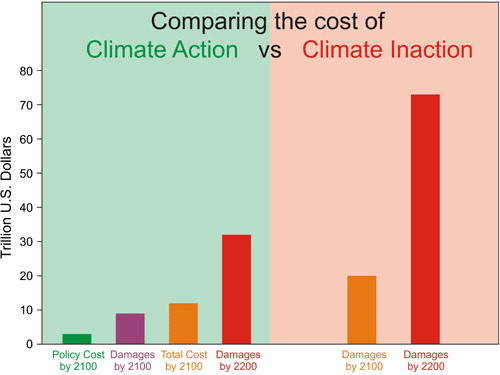
Vanguard manages about $US4 trillion ($A5.1 trillion) and is often the top shareholder in big US corporations through its massive index funds – giving it a major voice in setting corporate agendas.
Vanguard, the biggest US mutual fund firm by assets, had not supported climate activists on similar measures. But Glenn Booraem, Vanguard’s investment stewardship officer, said in a telephone interview on Monday the issue as well as shareholder proposals have evolved.
“Our support for these proposals is not a matter of ideology, it’s a matter of economics,” he said.
“To the extent there are significant risks to a company’s long-term value proposition, we want to make sure there is long-term disclosure of those risks to the market.”
Vanguard earlier this year changed its proxy voting policies to give more leeway to support resolutions tied to climate risk, but until now it has given few details about its thinking unlike rivals State Street Corp or BlackRock Inc……http://www.news.com.au/finance/business/breaking-news/call-for-climate-change-risk-disclosures/news-story/2577352981a4bd0ecab44c222cef7d37
Katharine Hayhoe: I was an Exxon-funded climate scientist
I was an Exxon-funded climate scientist, The Conversation, August 25, 2017 ExxonMobil’s deliberate attempts to sow doubt on the reality and urgency of climate change and their donations to front groups to disseminate false information about climate change have been public knowledge for a long time, now.Investigative reports in 2015 revealed that Exxon had its own scientists doing its own climate modeling as far back as the 1970s: science and modeling that was not only accurate, but that was being used to plan for the company’s future.
Now, a peer-reviewed study published August 23 has confirmed that what Exxon was saying internally about climate change was quantitatively very different from their public statements. Specifically, researchers Geoffrey Supran and Naomi Oreskes found that at least 80 percent of the internal documents and peer-reviewed publications they studied from between 1977 and 2014 were consistent with the state of the science – acknowledging that climate change is real and caused by humans, and identifying “reasonable uncertainties” that any climate scientist would agree with at the time. Yet over 80 percent of Exxon’s editorial-style paid advertisements over the same period specifically focused on uncertainty and doubt, the study found.
The stark contrast between internally discussing cutting-edge climate research while externally conducting a climate disinformation campaign is enough to blow many minds. What was going on at Exxon?
I have a unique perspective – because I was there.
From 1995 to 1997, Exxon provided partial financial support for my master’s thesis, which focused on methane chemistry and emissions. I spent several weeks in 1996 as an intern at their Annandale research lab in New Jersey and years working on the collaborative research that resulted in three of the published studies referenced in Supran and Oreskes’ new analysis.
Climate research at Exxon
A scientist is a scientist no matter where we work, and my Exxon colleagues were no exception. Thoughtful, cautious and in full agreement with the scientific consensus on climate – these are characteristics any scientist would be proud to own.
Did Exxon have an agenda for our research? Of course – it’s not a charity. Their research and development was targeted, and in my case, it was targeted at something that would raise no red flags in climate policy circles: quantifying the benefits of methane reduction…….
Did I know what else they were up to at the time? I couldn’t even imagine it.
Fresh out of Canada, I was unaware that there were people who didn’t accept climate science – so unaware, in fact, that it was nearly half a year before I realized I’d married one – let alone that Exxon was funding a disinformation campaign at the very same time it was supporting my research on the most expedient ways to reduce the impact of humans on climate.
Yet Exxon’s choices have contributed directly to the situation we are in today, a situation that in many ways seems unreal: one where many elected representatives oppose climate action, while China leads the U.S. in wind energy, solar power, economic investment in clean energy and even the existence of a national cap and trade policy similar to the ill-fated Waxman-Markey bill of 2009.
Personal decisions
This latest study underscores why many are calling on Exxon to be held responsible for knowingly misleading the public on such a critical issue. For scientists and academics, though, it may fuel another, different, yet similarly moral debate.
Are we willing to accept financial support that is offered as a sop to the public conscience?
The concept of tendering literal payment for sin is nothing new. From the indulgences of the Middle Ages to the criticisms some have leveled at carbon offsets today, we humans have always sought to stave off the consequences of our actions and ease our conscience with good deeds, particularly of the financial kind. Today, many industry groups follow this familiar path: supporting science denial with the left hand, while giving to cutting-edge research and science with the right.
The Global Climate and Energy Project at Stanford University conducts fundamental research on efficient and clean energy technologies – with Exxon as a founding sponsor. Philanthropist and political donor David Koch gave an unprecedented US$35 million to the Smithsonian National Museum of Natural History in 2015, after which three dozen scientists called on the museum to cut ties with him for funding lobbying groups that “misrepresent” climate science. Shell underwrote the London Science Museum’s “Atmosphere” program and then used its leverage to muddy the waters on what scientists know about climate…….
After two decades in the trenches of climate science, I’m no longer the ingenue I was. I’m all too aware, now, of those who dismiss climate science as a “liberal hoax.” Every day, they attack me on Facebook, vilify me on Twitter and even send the occasional hand-typed letter – which begs appreciation of the artistry, if not the contents. So now, if Exxon came calling, what would I do?……
Despite the fact that there’s no easy answer, it’s a question that’s being posed to more and more of us every day, and we cannot straddle the fence any longer. As academics and scientists, we have some tough choices to make; and only by recognizing the broader implications of these choices are we able to make these decisions with our eyes wide open, rather than half shut. https://theconversation.com/i-was-an-exxon-funded-climate-scientist-49855
No free speech in Trump’s America when it comes to climate research
The Trump Administration Censors Climate Change Research as Hurricane Harvey Barrels Down on Texas http://www.esquire.com/news-politics/news/a57202/climate-change-censor-scientist/ This is nothing new, but it’s still a disgrace. BY JACK HOLMES, AUG 25, 2017
Free speech for me but not for thee” seems to be a core principle of the Trump administration.
The importance of that 2 degrees Celsius of warming limit
 Why is climate change’s 2 degrees Celsius of warming limit so important? The Conversation, Professor of Practice in Meteorology, Professor of International Affairs & Director Center for Solutions to Weather and Climate Risk, Pennsylvania State University, August 23, 2017
If you read or listen to almost any article about climate change, it’s likely the story refers in some way to the “2 degrees Celsius limit.” The story often mentions greatly increased risks if the climate exceeds 2°C and even “catastrophic” impacts to our world if we warm more than the target.
Recently a series of scientific papers have come out and stated that we have a 5 percent chance of limiting warming to 2°C, and only one chance in a hundred of keeping man-made global warming to 1.5°C, the aspirational goal of the 2015 Paris United Nations Framework Convention on Climate Change conference. Additionally, recent research shows that we may have already locked in 1.5°C of warming even if we magically reduced our carbon footprint to zero today………
This short history makes it clear that the goal evolved from the qualitative but reasonable desire to keep changes to the climate within certain bounds: namely, within what the world had experienced in the relatively recent geological past to avoid catastrophically disrupting both human civilization and natural ecosystems.
Climate scientists subsequently began supporting the idea of a limit of 1°C or 2°C starting over three decades ago. They showed the likely risks increase with temperatures over 1°C, and those risks grow substantially with additional warming.
And if we miss the target?
Perhaps the most powerful aspect about the 2°C threshold is not its scientific veracity, but its simplicity as an organizing principle.
The climate system is vast and has more dynamics, parameters and variations in space and time than is possible to quickly and simply convey. What the 2°C threshold lacks in nuance and depth, it more than makes up as a goal that is understandable, measurable and may still be achievable, although our actions will need to change quickly. Goals and goal-setting are very powerful instruments in effecting change.
While the 2°C threshold is a blunt instrument that has many faults, similar to attempting to judge a quarterback’s value to his team solely by his rating, its ability to rally 195 countries to sign an agreement should not be discounted
Ultimately, what should we do if we cannot make the 1.5°C or 2°C limit? The most current IPCC report shows the risks, parsed by continent, of a 2°C world, and how they are part of a continuum of risk extending from today’s climate to a 4°C.
Most of these risks are assessed by the IPCC to increase in steady fashion. That is, for most aspects of climate impacts we do not “fall off a cliff” at 2°C, although considerable damage to coral reefs and even agriculture may increase significantly around this threshold.
Like any goal, the 2°C limit should be ambitious but achievable. However, if it is not met, we should do everything we can to meet a 2¼°C or 2.5°C goal.
These goals can be compared to the speed limits for trucks we see on a mountain descent. The speed limit (say 30 mph) will allow trucks of any type to descend with a safety margin to spare. We know that coming down the hill at 70 mph likely results in a crash at the bottom.
In between those two numbers? The risk increases – and that’s where we are with climate change. If we can’t come down the hill at 30 mph, let’s try for 35 or 40 mph. Because we know that at 70 mph – or business as usual – we will have a very bad outcome, and nobody wants that. https://theconversation.com/why-is-climate-changes-2-degrees-celsius-of-warming-limit-so-important-82058
The key to reversing climate change – the education of women
Educated women are the key to reversing climate change https://thenextweb.com/science/2017/08/24/educated-women-are-the-key-to-reversing-climate-change/#.tnw_mQzgoobNby RACHEL KASER — One author and activist thinks he’s found the answer to reversing climate change: the education and empowerment of women.
The Trump Southeastern States will cop the hardest costs of climate change
New study finds that climate change costs will hit Trump country hardest
In the USA, the southeastern states are most vulnerable to the costly impacts from human-caused climate change, Guardian, John Abraham 24 Aug 17, “….. The costs are not uniformly distributed. Some regions will suffer more and other regions will suffer less. In fact, some regions will actually benefit in a warming climate. We understand that the world is interconnected and costs will inevitably be shared to some extent. But it is clear we won’t all suffer the same.
It is also clear that the natural biosystems won’t suffer the same. Some areas are more susceptible to climate change, others less so. Coastal areas and tropical areas are great examples. We know that sea level rise and ocean acidification will impact coastal regions much more than where I live (Minnesota, USA). But tropical zones that experience a very small climate variation throughout the year (there is no winter, for instance, in the tropics) have biosystems that have evolved to survive in very tight climate ranges. The plants and animals just are not used to systematic changes to the climate.
In my opinion, the most interesting research deals with answering just these questions.
Fortunately, a really important paper just came out in Science titled Estimating Economic Damage from Climate Change in the United States. Granted, this paper focused on the United States, but the analysis method and lessons can be applied elsewhere.
So what did they find? First, even in a single country like the United States, the losses will be very uneven. In general, the more southern states will suffer most. In the figure below, counties are colored by economic consequences from climate change under a business as usual scenario. The time period associated with the image is 2080–2099. Yellow, orange and red colors correspond to climate costs. Green colors are areas where climate change benefits will be seen…..

Exxon Mobil misrepresented climate change to deliberately mislead the public
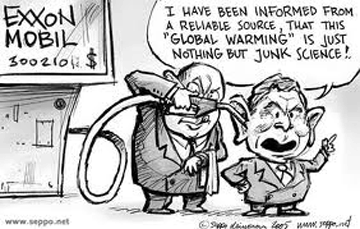 Exxon accused by Harvard researchers of misleading public on climate change, ABC News 24 Aug 17 Two Harvard University researchers say they have collected data proving Exxon Mobil Corp made “explicit factual misrepresentations” in newspaper ads it purchased to convey its views on the oil industry and climate science.
In an article in the journal Environmental Research Letters, researchers Geoffrey Supran and Naomi Oreskes said they examined 187 documents, including internal memos, peer-reviewed papers by Exxon scientists and “advertorials” that ran in The New York Times — paid advertisements in the style of opinion pieces.
The researchers said they used a social science analysis method to turn statements in the documents into data points that could be counted and compared to each other.
Exxon ‘consistently asserted doubt’ on climate change
Mr Supran and Ms Oreskes said as early as 1979, Exxon scientists acknowledged burning fossil fuels was adding more carbon dioxide to the atmosphere and causing global temperatures to rise, but they said the company’s position in newspaper ads remained significantly different by consistently asserting doubt about climate science.
The study was funded by the Rockefeller family philanthropies, which previously supported a campaign to prove Exxon knew more than it publicly admitted about climate change.
That campaign used the slogan #ExxonKnew…..
Ms Oreskes said the Rockefeller family funding did not affect the study’s outcome.
She said the impetus for the study came from Exxon’s responses to reports in InsideClimate News and The Los Angeles Times in September 2015 and October 2015, respectively, that Exxon’s scientists had long known of the dangers fossil fuels posed to the earth’s climate…..http://www.abc.net.au/news/2017-08-24/exxon-climate-change-misled-public-harvard-researchers-say/8837894
Climate change will boost some infectious diseases
the pathogen with the highest sensitivity to climate factors was Vibrio cholera, the microbe that causes the serious, and often deadly, diarrheal disease, cholera. Cholera had nine climate drivers, indicating high volatility in the face of climate change.
These Infections Are Likely to Get Worse as the Climate Changes, Invisiverse, BY CYNTHIA WALLENTINE, 08/23/2017
When the climate changes, so do all the things that rely on the climate, including people, plants, and pathogens. A European study recently took a broad look at what kind of microorganisms are most likely to be affected as climate change heats, cools, dries, and wets the world around us.
In a study published in the journal Scientific Reports, a research team from the University of Liverpool performed a broad assessment of how factors of climate change impact pathogens that make humans and animals sick. By understanding which microorganisms are more sensitive to environmental change, we have a better idea of how infection rates might change as the environment grows progressively less stable.
What Are Climate Drivers?
In the study, the authors note there is evidence that climate shifts are already causing changes in the incidence of disease — allowing some to appear at higher or lower altitudes and latitudes. The authors note modeling is frequently used to predict which pathogens could advance, but this study uses climate variables, along with data on selected pathogens, to get an idea of which pathogens we should worry about the most.
Climate variables that affect these pathogens are an important part of this study. The research team refers to these variables as “climate drivers” that include:
Primary drivers: Extreme weather events, climate change, climate oscillations, moisture, rainfall, temperature, and wind fluctuations.
Secondary drivers: Altitude, salinity, particulate matter, and vegetation.
The team chose to analyze 101 pathogens considered “high impact” to humans and animals in Europe and categorized them by how sensitive they are to these factors. These pathogens included bacteria, fungi, helminths, protozoa, and viruses. Overall, there are 157 pathogens categorized because some pathogens are affected by both primary and secondary variables.
Which Pathogens Are Set to Be Destabilized by Climate Change?
Humans, animals, plants, and microorganisms rely on climate variables that are always in some local flux. When climate drivers swing far enough beyond the expected spectrum, larger change is bound to happen.
When comparing pathogens to climate drivers, the study team found that 99, or 63% of the pathogens were likely to respond to at least one climate driver. Fifty-eight, or 37%, of the pathogens, like HIV, did not show sensitivity to climate variables. That narrows the field of pathogens likely to go askew because of environmental change.
More than 90% of that initial group of 99 pathogens were sensitive to between one and five climate drivers. Other statistical findings on the numbers of pathogens likely to be affected by climate change include:
- 81 of 99 pathogens were affected by primary climate drivers
- 56 of the 99 pathogens also had secondary climate drivers
- 18 of the 99 agents had sensitivity to secondary, but not primary climate drivers
Overall, pathogens were found to be most sensitive to climate drivers (primary and secondary) that include rainfall, temperature, moisture, and particulate matter.
- The pathogen with the highest sensitivity to climate factors was Vibrio cholera, the microbe that causes the serious, and often deadly, diarrheal disease, cholera. Cholera had nine climate drivers, indicating high volatility in the face of climate change.
- First runner up was the helminth, a parasite known as the “liver fluke” found throughout the world where sheep and cattle are present. A “helminth,” is the term for any parasitic nematode, worm, or fluke.
- Next up is anthrax, Bacillus anthracis, a naturally occurring bacteria that can prove fatal depending on infection type, and available treatment.
- Rounding out the top four is Borrelia burgdorferi, the tick-borne bacteria that causes Lyme disease. (We’re already seeing increased incidence of Lyme-bearing ticks in the Northeast US.)
Oh My God! Climate Change is messing up our wine supply!
 Climate change is real. Maybe once it comes for our vino, more people will get on board with trying to slow it.
Climate change is about to mess with your wine supply, so yes, things are very serious http://hellogiggles.com/climate-change-is-about-to-mess-with-your-wine-supply/Karen Fratti August 24, 2017 Most of us know that climate change is an ongoing problem, but it can be hard to see the direct effects of it in our daily lives. Unless you study the populations of animals that are suffering due to it or are a farmer, the change is definitely incremental enough to ignore. But climate change is already affecting wine production, so maybe more people will notice what is going on a little sooner than expected. Because whether you can experience the effects of climate change or not, it’s happening.
Donald Trump spouted nonsense about “clean coal” , at rally in Phoenix
Trump thinks clean coal is when workers mine coal and actually ‘clean it’ http://reneweconomy.com.au/trump-thinks-clean-coal-workers-mine-coal-actually-clean-36755/ By Joe Romm on 24 August 2017 ThinkProgress
How off the rails was President Donald Trump’s rally speech in Phoenix Tuesday night? He spouted utter nonsense on clean coal, and it didn’t even make CNN’s story, “Donald Trump’s 57 most outrageous quotes from his Arizona speech.”
Trump appears to believe that clean coal — which, it must always be pointed out, doesn’t actually exist — is when workers mine coal and then physically “clean it.” That does not happen, but facts have never stopped Trump.
“We’ve ended the war on beautiful, clean coal, and it’s just been announced that a second, brand-new coal mine,” said Trump, “where they’re going to take out clean coal — meaning, they’re taking out coal. They’re going to clean it — is opening in the state of Pennsylvania, the second one.” nia, the second one.”
The phrase “clean coal” refers to expensive and mostly non-commercial technologies that reduce pollution and capture carbon dioxide when coal is burned.
Even Robert Murray, CEO of the country’s largest privately held coal-mining company, doesn’t believe in that. “Carbon capture and sequestration does not work,” he said last month. “It is neither practical nor economic.”
Second, there never was a “war on coal.” Indeed, as we reported last month, a leaked draft of the Department of Energy’s electric grid study concluded that factors like environmental regulations and renewable energy subsidies “played minor roles” in the shutdown of big coal plants.
Instead, coal has simply become uneconomic. “[Coal] plants that have retired are old and inefficient units that were not recovering their operations and fuel costs, much less capital cost recovery,” the draft report says.
Finally, Trump’s “second, brand-new coal mine” in Pennsylvania is actually a renovation and reopening project for a metallurgical coal mine.
The increase in the metallurgical coal market is largely being driven by China’s steel industry, not by any policies from Trump, as the Washington Post fact checker explained in June. The mine project will create, at most, dozens of jobs.
The Post gave Trump three Pinocchio’s for lying about the first coal plant back in June. These new statements deserves a lot more.
America’s National Institute of Environmental Health Sciences has deleted references to climate change from its site.
 Another Government Agency Has Purged References to Climate Change From Its Site http://gizmodo.com/another-government-agency-has-purged-references-to-clim-1798397016?IR=T Sidney Fussell 24 Aug 17, Data-tracking watchdog group, Environmental Data & Governance Initiative (EDGI), has reported dozens of instances where the National Institute of Environmental Health Sciences has deleted references to climate change from its site.
Vast majority of UK accept climate change is real, finds new poll
Old men in the East Midlands are less likely to accept scientists’ evidence than young women in the South-east, The Independent, Ian Johnston Environment Correspondent @montaukian , 24 Aug 17, About 13 per cent of people in Britain do not accept the science of climate change, according to a new poll.
The survey of 1,200 adults in the UK by Censuswide found men (17 per cent) were significantly more likely than women (11 per cent) to deny the widespread evidence of global warming – from melting sea ice and glaciers and rising sea levels to animals and plants heading for the poles.
However, a substantial majority of 70 per cent said they did agree the temperature is rising and that greenhouse gas emissions are to blame – as accepted by every major scientific organisation in the world. …… http://www.independent.co.uk/environment/uk-climate-change-real-accept-majority-global-warming-poll-finds-a7909841.html
Growth in climate migration – one billion by 2050?
Climate Migrants Might Reach One Billion by 2050 http://www.ipsnews.net/2017/08/climate-migrants-might-reach-one-billion-by-2050/,
Although not yet based on definite scientific projections, the proven speed with which the process of climate change has been taking place, might lead to such a scenario by 2050. If so, 1 in 9 human beings would be on the move by then.
Migrants in Countries in Crisis: Guidelines
Currently, forecasts vary from 25 million to 1 billion environmental migrants by 2050, moving either within their countries or across borders, on a permanent or temporary basis, with 200 million being the most widely cited estimate, according to a 2015 study carried out by the Institute for Environment and Human Security of the United Nations University.
“This figure equals the current estimate of international migrants worldwide.”
Other specialised sources estimate that “every second, one person is displaced by disaster.” On this, the Oslo-based Norwegian Refugee Council (NRC) reports that in 2015 only, more than 19.2 million people fled disasters in 113 countries. “Disasters displace three to ten times more people than conflict and war worldwide
One Person Displaced Every Second
As climate change continues, adds NRC, it will likely lead to more frequent and severe natural hazards; the impact will be heavy, warns this independent humanitarian organisation providing aid and assistance to people forced to flee.
“On average, 26 million people are displaced by disasters such as floods and storms every year. That’s one person forced to flee every second.” See: Climate Victims – Every Second, One Person Is Displaced by Disaster
For its part, the UN International Organization for Migration (IOM) also forecasts 200 million environmental migrants by 2050, moving either within their countries or across borders, on a permanent or temporary basis. Many of them would be coastal population.
In an interview to IPS, the IOM Director General William Lacy Swing explained that political crises and natural disasters are the other major drivers of migration today.
“We have never had so many complex and protracted humanitarian emergencies now happening simultaneously from West Africa all the way to Asia, with very few spots in between which do not have some issue.”
The UN specialised body’s chief added “We have today 40 million forcibly displaced people and 20 million refugees, the greatest number of uprooted people since the Second World War.” See: Q&A: Crisis and Climate Change Driving Unprecedented Migration
Droughts, Desertification
Another warning comes from the United Nations Convention to Combat Desertification (UNCCD), which estimates that some 135 million people may be displaced by 2045 as a result of desertification.
Up to 12 million hectares of productive land become barren every year due to desertification and drought alone, which is a lost opportunity to produce 20 million tons of grain, adds the Bonn-based Convention secretariat.
Meantime, the increase in droughts and flash floods that are stronger, more frequent and widespread is destroying the land – the Earth’s main fresh water store, according to UNCCD.
“Droughts kill more people than any other single weather-related catastrophe and conflicts among communities over water scarcity are gathering pace. Over 1 billion people today have no access to water, and demand will increase by 30 per cent by 2030.”
On the other hand, getting sustainable energy to all represents one of the biggest development challenges of the 21st century, it continues.
“Research suggests that 1.4 billion people — over 20 per cent of the global population — lack access to electricity, and that at least 2.7 billion people — some 40 cent of the global population — rely on the traditional use of biomass for cooking.”
In short, land, water and energy as resources are all pillars of our survival and of sustainable development.
“They stand or fall together. To be sustainable and in particular to reach poor rural populations, we need to enhance supply, access and security across all three pillars, at the same time, while supporting global climate ambitions.”
National Security, Migration
On this, based on the UN Environment Programme’s 2009 study “From Conflict to Peace-building. The Role of Natural Resources and the Environment,” UNCCD reminds that 40 per cent of all intrastate conflicts in the past 60 years are linked to the control and allocation of natural resources.
“The exposure of more and more poor people to water scarcity and hunger opens the door to the failure of fragile states and regional conflicts. Non-state actor groups are increasingly taking advantage of large cross-border migration flows and abandoned lands.”
Where natural assets including land are poorly managed, warns the Convention, violence might become the dominant means of resource control, forcing natural resource assets out of the hands of legitimate government.
Meanwhile, the number of international migrants worldwide has been on the rise. According to the International migration report (2015), their number has continued to grow rapidly over the past fifteen years reaching 244 million in 2015, up from 222 million in 2010 and 173 million in 2000.
Losing productive land is driving people to make risky life choices, says UNCCD, adding that in rural areas where people depend on scarce productive land resources, land degradation is a driver of forced migration.
Africa is particularly susceptible since more than 90 per cent of economy depends on a climate-sensitive natural resource base like rain-fed, subsistence agriculture.
“Unless we change the way we manage our land, in the next 30 years we may leave a billion or more vulnerable poor people with little choice but to fight or flee.”
Currently, forecasts vary from 25 million to 1 billion environmental migrants by 2050, moving either within their countries or across borders, on a permanent or temporary basis, with 200 million being the most widely cited estimate, according to a 2015 study carried out by the Institute for Environment and Human Security of the United Nations University.
“This figure equals the current estimate of international migrants worldwide.”
Other specialised sources estimate that “every second, one person is displaced by disaster.” On this, the Oslo-based Norwegian Refugee Council (NRC) reports that in 2015 only, more than 19.2 million people fled disasters in 113 countries. “Disasters displace three to ten times more people than conflict and war worldwide
One Person Displaced Every Second
As climate change continues, adds NRC, it will likely lead to more frequent and severe natural hazards; the impact will be heavy, warns this independent humanitarian organisation providing aid and assistance to people forced to flee.
“On average, 26 million people are displaced by disasters such as floods and storms every year. That’s one person forced to flee every second.” See: Climate Victims – Every Second, One Person Is Displaced by Disaster
For its part, the UN International Organization for Migration (IOM) also forecasts 200 million environmental migrants by 2050, moving either within their countries or across borders, on a permanent or temporary basis. Many of them would be coastal population.
In an interview to IPS, the IOM Director General William Lacy Swing explained that political crises and natural disasters are the other major drivers of migration today.
“We have never had so many complex and protracted humanitarian emergencies now happening simultaneously from West Africa all the way to Asia, with very few spots in between which do not have some issue.”
The UN specialised body’s chief added “We have today 40 million forcibly displaced people and 20 million refugees, the greatest number of uprooted people since the Second World War.” See: Q&A: Crisis and Climate Change Driving Unprecedented Migration
Droughts, Desertification
Another warning comes from the United Nations Convention to Combat Desertification (UNCCD), which estimates that some 135 million people may be displaced by 2045 as a result of desertification.
Up to 12 million hectares of productive land become barren every year due to desertification and drought alone, which is a lost opportunity to produce 20 million tons of grain, adds the Bonn-based Convention secretariat.
Meantime, the increase in droughts and flash floods that are stronger, more frequent and widespread is destroying the land – the Earth’s main fresh water store, according to UNCCD.
“Droughts kill more people than any other single weather-related catastrophe and conflicts among communities over water scarcity are gathering pace. Over 1 billion people today have no access to water, and demand will increase by 30 per cent by 2030.”
On the other hand, getting sustainable energy to all represents one of the biggest development challenges of the 21st century, it continues.
“Research suggests that 1.4 billion people — over 20 per cent of the global population — lack access to electricity, and that at least 2.7 billion people — some 40 cent of the global population — rely on the traditional use of biomass for cooking.”
In short, land, water and energy as resources are all pillars of our survival and of sustainable development.
“They stand or fall together. To be sustainable and in particular to reach poor rural populations, we need to enhance supply, access and security across all three pillars, at the same time, while supporting global climate ambitions.”
National Security, Migration
On this, based on the UN Environment Programme’s 2009 study “From Conflict to Peace-building. The Role of Natural Resources and the Environment,” UNCCD reminds that 40 per cent of all intrastate conflicts in the past 60 years are linked to the control and allocation of natural resources.
“The exposure of more and more poor people to water scarcity and hunger opens the door to the failure of fragile states and regional conflicts. Non-state actor groups are increasingly taking advantage of large cross-border migration flows and abandoned lands.”
Where natural assets including land are poorly managed, warns the Convention, violence might become the dominant means of resource control, forcing natural resource assets out of the hands of legitimate government.
Meanwhile, the number of international migrants worldwide has been on the rise. According to the International migration report (2015), their number has continued to grow rapidly over the past fifteen years reaching 244 million in 2015, up from 222 million in 2010 and 173 million in 2000.
Losing productive land is driving people to make risky life choices, says UNCCD, adding that in rural areas where people depend on scarce productive land resources, land degradation is a driver of forced migration.
Africa is particularly susceptible since more than 90 per cent of economy depends on a climate-sensitive natural resource base like rain-fed, subsistence agriculture.
“Unless we change the way we manage our land, in the next 30 years we may leave a billion or more vulnerable poor people with little choice but to fight or flee.”
1 This Month




PLEASE OPPOSE HR 8255 AND S.3639 – bills would accelerate satellite deployment, with no environmental review or safeguards – https://ncstd5li.quorum.us/campaign/169331/
To see nuclear-related stories in greater depth and intensity – go to https://nuclearinformation.wordpress.com
-
Archives
- September 2026 (330)
- August 2026 (330)
- July 2026 (355)
- June 2026 (287)
- May 2026 (306)
- April 2026 (356)
- March 2026 (251)
- February 2026 (267)
- January 2026 (308)
- December 2025 (358)
- November 2025 (359)
- October 2025 (375)
-
Categories
- 1
- 1 NUCLEAR ISSUES
- business and costs
- climate change
- culture and arts
- ENERGY
- environment
- health
- history
- indigenous issues
- Legal
- marketing of nuclear
- media
- opposition to nuclear
- PERSONAL STORIES
- politics
- politics international
- Religion and ethics
- safety
- secrets,lies and civil liberties
- spinbuster
- technology
- Uranium
- wastes
- weapons and war
- Women
- 2 WORLD
- ACTION
- AFRICA
- Atrocities
- AUSTRALIA
- Christina's notes
- Christina's themes
- culture and arts
- Events
- Fuk 2022
- Fuk 2023
- Fukushima 2017
- Fukushima 2018
- fukushima 2019
- Fukushima 2020
- Fukushima 2021
- general
- global warming
- Humour (God we need it)
- Nuclear
- RARE EARTHS
- Reference
- resources – print
- Resources -audiovicual
- Weekly Newsletter
- World
- World Nuclear
- YouTube
-
RSS
Entries RSS
Comments RSS

