Regulated Asset Base model may save Hitachi’s Wylfa Newydd nuclear project.

RAB model may have saved Wylfa Newydd nuclear project. Access to the
regulated asset base (RAB) financing model may have helped to save
Hitachi’s plans to build a new nuclear plant in north Wales, an executive
who worked on the project has told MPs. Last year, the Hitachi-backed
Horizon consortium announced it had withdrawn from the Wylfa Newydd project
after ploughing more than £2 billion into its development.
Utility Week 18th Nov 2021
France’s Court of Audit wants a debate on nuclear power decisions – in view of delays and costs in this sector.
Electricity production choices: anticipate and control technological,
technical and financial risks. COURT OF AUDIT,19 Nov 21,
The Court publishes notes that are part of a body of work carried out on several major public policies, which identify both the main challenges that public decision-makers will face in the coming years, and the levers likely to overcome them. As an extension of the report "A public finance strategy for exiting the crisis", submitted last June to the President of the Republic and the Prime Minister, this series of publications allows the Court to express itself on structural issues. With these educational notes, the Court is placing itself at the heart of its mission to inform citizens, at a key democratic moment.

Nearly 70% of French electricity production is provided by nuclear reactors, two-thirds of which will have ceased to produce before 2050. To renew this large part of our electricity production capacity, new means of production - “Carbon-free”, in accordance with France's climate commitments - will require not only a considerable financial investment, but also significant construction delays. This situation calls for urgent decisions now, aimed at securing the needs of an increasing energy supply.

 In this perspective, the Court of Auditors considers it necessary to hold a debate on the choice of electricity production, which constitutes a technological, technical and industrial challenge, and the consequences of which in terms of employment and development of the territory will reverberate over several decades. Cour des Comptes 18th Nov 2021

 https://www.ccomptes.fr/fr/publications/les-choix-de-production-electrique-anticiper-et-maitriser-les-risques-technologiques
UK’s small nuclear reactor consortium indicates that it will be relying on tax-payer funding if it is to go ahead
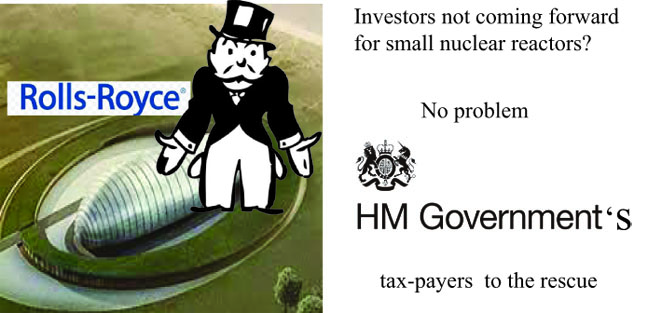
State support a fallback option for UK’s mini-nuclear plants rollout.
The head of the consortium, which is developing a £ 30 billion fleet of
mini-nuclear power stations, has indicated that it will have to rely on UK
taxpayers to help fund the construction of the first of the new designs if
there is not enough investor interest.
FT 10th Nov 2021
https://www.ft.com/content/869279aa-f771-4025-8719-c3b8bdf1f375
U.S. govt brings early Christmas to Bill Gates and the nuclear industry – tax-payer funding!

The U.S. Government and Bill Gates Get Behind Nuclear Power, Barrons, By Avi Salzman, Nov. 17, 2021 Nuclear power got a boost from the infrastructure bill signed into law this week by President Biden that could at the very least forestall the industry’s decline. With government support and the endorsement of major investors like Bill Gates, nuclear power looks as if it has a place in a carbon-free future. [ed. only nuclear is not carbon-free]
The legislation sets aside $6 billion to help fund nuclear plants in danger of closing. Several plants have needed help from the states where they are located in recent years because running nuclear plants has not always been profitable as other sources of electricity have become cheaper. A 2018 report from the Union of Concerned Scientists found that “more than one-third of U.S. nuclear plants are unprofitable or scheduled to close.” Having a federal financing program would ease the pressure on states and make it more likely plants could stay open……..
The new law has other goodies for the industry too, including funding for the Energy Department’s Advanced Reactor Demonstration Program.
One project that will receive funding from the bill is a new advanced reactor in Wyoming being built by TerraPower, which was founded by Bill Gates. The TerraPower reactor is expected to be smaller than most traditional nuclear plants, but to have more highly enriched uranium. Theoretically, these kinds of projects could bring power to more remote areas. The TerraPower plant is expected to open by 2028 and replace a coal plant.
Several utility companies could benefit from support for nuclear plants, including Exelon (ticker: EXC) and NextEra Energy (NEE).
Nuclear power could get an even bigger boost from the Build Back Better bill now being debated, including from special tax credits.
Those credits could be worth as much as $15 billion to the industry. Additional credits for low-carbon hydrogen production could also benefit the nuclear industry. https://www.barrons.com/articles/the-u-s-government-and-bill-gates-get-behind-nuclear-power-51637177613
The consumerism that destroys life is also the cause of the environmental emergency — Hawkins Bay Dispatch — Barbara Crane Navarro

The consumerism that destroys life is also the cause of the environmental emergency, https://hawkinsbay.wordpress.com/2021/11/13/the-consumerism-that-destroys-life-is-also-the-cause-of-the-environmental-emergency/
Decades ago, corporations and governments invented the traits we now call ‘human nature.’ COP26 has shown ‘consumers’ that buying something ‘different’ is not working. 13 November 2021 | Graham Peebles | Euroasia Review The natural environment has been poisoned, vandalized and trashed in accordance with the demands and values of the all-pervasive socio-economic system, and as long as it persists it is impossible to imagine the steps required to save the natural world being taken.
The consumerism that destroys life is also the cause of the environmental emergency — Hawkins Bay Dispatch — Barbara Crane Navarro
greed, ownership of things (homes, cars, clothes etc.), and the general accumulation of stuff is insisted upon, for the simple reason that it is consumerism that feeds the monster. This very same consumerism, which is perpetuating unhappiness and fuelling ill health, is also the underlying cause of the environmental emergency.
As COP26 draws to an unimpressive close, governments haggle over emission targets, funding of fossil fuels and money for the global south, and a new poll reports that most people (in the 10 countries polled, including UK, US, Germany, France) say they are unwilling to alter their way of life to save our planet. We must once again ask, what will it take for humanity to wake up and change?
Economic considerations and short term self-interest will continue to be applied and the devastation will continue.
Continue readingUK’s planned Sizewell nuclear reactor at risk – same design as Taishan reactor which has been shut down since July for safety reasons
Chinese nuclear reactor shutdown hangs over future of Sizewell C. Developers behind Taishan plant, where radiation was found in cooling waters, are also building UK’s Hinkley Point C and planning Sizewell C.
Reports of cracked fuel rods from a Chinese nuclear power station will be examined for any implications for new plants in Britain. Mark Foy, chief nuclear inspector at the Office for Nuclear Regulation, told civil society groups he was in touch with Chinese and other regulators over the plant in Taishan, southeastern China, where a reactor has been shut since July after radiation was found in its cooling waters. The plant is owned by Chinese state nuclear developer CGN along with its French equivalent EDF.
The two companies are also building the Hinkley Point C plant in Somerset and areplanning a second plant, Sizewell C in Suffolk, using the same reactor design as at Taishan. he problems at Taishan emerged in June after CNN reported that Framatome, the part-EDF owned company which helps run the plant, had written to US officials on June 8 asking for permission to share American technical assistance. Experts have said cracked fuel rods are “not uncommon”, albeit undesirable. An Office for Nuclear Regulation spokesman said: “We held one of our regular meetings with the NGO community last week where we reiterated that we remain in contact with the Chinese, French and Finnish regulators on this matter and are likely to be in dialogue again with them before the end of this year. “We will take the opportunity to gain any knowledge from this issue in China to help inform our regulation of nuclear plants in the UK, like Hinkley Point C, where the EPR reactor will be installed.”
Telegraph 14th Nov 2021
Targeting Trident: how divestment is impacting the nuclear weapons industry

investors are adhering to the international norm against nuclear weapons that was established by the Treaty on the Prohibition of Nuclear Weapons, despite that the fact that the UK is not party to the treaty.
More than 100 financial institutions have divested from the nuclear weapon industry since the treaty entered into force in January this year.
Targeting Trident: how divestment is impacting the nuclear weapons industry, https://bellacaledonia.org.uk/2021/11/15/targeting-trident-how-divestment-is-impacting-the-nuclear-weapons-industry/ Every year, the Don’t Bank on the Bomb report profiles the world’s largest nuclear weapons producers and reveals the financial institutions that invest in them. The latest report, published on Thursday, shows that investors around the world made a total of £510 billion available to nuclear weapons companies between January 2019 and July 2021.
UK-headquartered financial institutions account for £23 billion of this total. Scotland’s largest bank, NatWest Group (RBS), provided financing worth £2.2 billion to eight major nuclear arms manufacturers during the period, including BAE Systems, General Dynamics and Raytheon.
The DBOTB report is published by PAX, a Netherlands-based organisation that works to persuade financial institutions to divest from the nuclear weapons industry. Here, the campaign is led by Don’t Bank on the Bomb Scotland. The group focus on Scottish local authority pension funds and universities, as well as financial institutions.
Every year, the Don’t Bank on the Bomb report profiles the world’s largest nuclear weapons producers and reveals the financial institutions that invest in them. The latest report, published on Thursday, shows that investors around the world made a total of £510 billion available to nuclear weapons companies between January 2019 and July 2021.
UK-headquartered financial institutions account for £23 billion of this total. Scotland’s largest bank, NatWest Group (RBS), provided financing worth £2.2 billion to eight major nuclear arms manufacturers during the period, including BAE Systems, General Dynamics and Raytheon.
The DBOTB report is published by PAX, a Netherlands-based organisation that works to persuade financial institutions to divest from the nuclear weapons industry. Here, the campaign is led by Don’t Bank on the Bomb Scotland. The group focus on Scottish local authority pension funds and universities, as well as financial institutions.
Fund managers warned Serco that “working with nuclear weapons might force them to dump Serco shares as a result of non-compliance with Environmental, Social and Governance (ESG) Standards”, the Telegraph says. The fund managers are not named, but Serco has increasingly appeared on investor blacklists in recent years due to its role in the consortium.
Impact of the nuclear ban treaty
The article reports that fund managers rejected Serco’s argument that investing in a Trident contractor is “ethically no different to owning UK sovereign debt, as both are functions of a democratically elected government”. This detail is significant, as it suggests that investors are adhering to the international norm against nuclear weapons that was established by the Treaty on the Prohibition of Nuclear Weapons, despite that the fact that the UK is not party to the treaty.
The ban treaty has made investors increasingly wary of nuclear weapons producers, as the new Don’t Bank on the Bomb Report explains: “[nuclear weapons] are now comprehensively outlawed, as is any assistance with producing, manufacturing or developing them. Financial institutions that continue investing in companies building nuclear weapons face regulatory risks as more countries join the treaty. They also face an increased reputational risk as clients learn of their support for weapons of mass destruction and terminate their relationships.”
More than 100 financial institutions have divested from the nuclear weapon industry since the treaty entered into force in January this year. This includes Bank of Ireland and AIB (Ireland), and South African firm, Investec. The total amount of financing made available to nuclear weapons producing companies has dropped by £47 billion since 2019.
More trouble for Trident
It appears that the prospect of losing investors was enough to persuade Serco – which previously held long-term nuclear weapons contracts as part of AWE Management Ltd – to pull out of the competition for future nuclear-weapons related work. This provides a clear example of how divestment, or the threat of divestment, can change company behaviour.
Furthermore, the story shows how investor action has the potential to undermine the viability of Britain’s nuclear weapons programme. The Telegraph notes that Serco’s decision “leaves defences chiefs with fewer options as they seek to restructure the management of Britain’s nuclear stockpile”. This could hinder the MoD’s ability to complete the Trident renewal project, which is already in serious trouble.
Join the movement
As the Serco story illustrates, divestment is a powerful tool that we can use to advance the goal of a nuclear-weapons-free world. Don’t Bank on the Bomb Scotland is encouraging individuals to contact NatWest Group about its investment policy, as well as their own bank and pension fund. The group has also created a model resolution targeting local authority pension funds that can be sent to local councillors.
The more financial institutions that divest, the more companies will be forced to withdraw from nuclear weapons work like Serco. This will make it harder for nuclear-armed nations to maintain their nuclear arsenals in the long-run.
N. Korea replaces, punishes 14 cadres and technicians working on nuclear-powered submarine programThe Central Committee criticized the technicians for failing to follow party policy to “localize” production
N. Korea replaces, punishes 14 cadres and technicians working on nuclear-powered submarine program
The Central Committee criticized the technicians for failing to follow party policy to “localize” production https://www.dailynk.com/english/north-korea-replaces-punishes-14-cadres-and-technicians-working-on-nuclear-powered-submarine-program/ By Jeong Tae Joo – 2021.11.15
North Korea recently replaced or punished 14 cadres and technicians tasked with designing small nuclear reactors for nuclear-powered submarines, apparently for failing to meet party criterion. The authorities will likely now face difficulties in their plan to acquire the capability of stealthily striking enemies.
According to multiple Daily NK sources in North Korea on Thursday, the Central Committee’s Military Industries Department began screening designs for nuclear-powered submarines on Nov. 5.
Work on the designs has been ongoing since October of last year.
North Korean leader Kim Jong Un said during the Eighth Party Congress in January that “new planning research for a nuclear-powered submarine has been completed and is to enter the final examination process.”
Nuclear-powered submarines are highly stealthy as they need not surface for long periods of time, making them the most likely weapon to survive an enemy’s preemptive strike.
Focusing on advancing the country’s arsenal of asymmetrical strategic weapons, North Korea has assigned its top researchers to the project.
In particular, the authorities reportedly put experts on the task of producing small nuclear reactors, the key to building the submarines, imploring them to “exercise their top abilities, given their rich experience built up over six nuclear tests.”
However, the Central Committee apparently criticized the screening report, which included analysis of design flaws.
Firstly, the Central Committee reportedly said it would “take 10 more years” to build nuclear-powered submarines according to current designs, even though the goal is to complete them by 2025.
The Central Committee also criticized the designs for failing to meet three criteria put forth by the party to achieve its goals.
Though party leadership had stressed 1) improving the capabilities of conventionally powered mini-submarines that are currently deployed, 2) building a new class of submarines capable of carrying North Korea’s existing SLBMs and 3) building nuclear-powered submarines capable of carrying several nuclear launch systems, the Central Committee reportedly judged that these criteria had not been met on the ground.
The Central Committee also criticized technicians for failing to follow party policy to “localize” production. That is to say, the committee took serious issue with designers handing over for final screening a complete comprehensive blueprint that called for large-scale imports of foreign technology and parts during the entire shipbuilding process.
Several basic errors were discovered as well, including a failure by designers to make the technical descriptions in the partial plans and assembly plans match when they drew the blueprints for the small nuclear reactors.
The Central Committee responded by excluding from the research team 14 cadres, researchers and technicians who took part in drawing up the plan. Six of them were kicked out of the party or disciplined.
One of the sources said the six who took responsibility for the failure were exiled with their families to remote areas. He added that the authorities now face snags in their plans, including the need to completely revise the designs for nuclear-powered submarines.
Industrial action from Tuesday could ‘cripple’ Clyde nuclear base.
Industrial action from Tuesday could ‘cripple’ Clyde nuclear base, The Herald, By Martin Williams @Martin1Williams, Senior News Reporter, 15 Nov 21, SPECIALIST staff are to down tools on Tuesday in an industrial dispute a union says is expected to “cripple” the effective running of UK’s nuclear submarine base on the Clyde.
The Unite Scotland union has confirmed that around 70 of its members who provide specialist services for the UK’s nuclear deterrent submarines will start an overtime at the Royal Naval Armaments Depot (RNAD) Coulport.
The union has severely criticised the “delay tactics” employed by the ABL Alliance after the workers voted to take industrial action in September in what was then described as a “final warning shot” to ABL Alliance, a joint venture which won a 15-year contract from the Ministry of Defence in 2013 to maintain the weapons systems at Coulport.
Unite Scotland said the specialist staff who provide care and maintenance services for the weapons systems on the Royal Navy nuclear armed submarine fleet took the “historic” decision in a dispute over pay that it says will leave the base severely debilitated.
Since then, the union say the ABL Alliance refused to meet over what it called an RPI inflation annual pay claim of 3.8%.
Some 90.5% of Unite members at RNAD Coulport voted in support of strike action, and 95.3% supporting action short of a strike.
The ABL Alliance, made up of AWE plc, Babcock Marine (Clyde) Ltd, and Lockheed Martin UK Strategic Systems Ltd, previously state it was “disappointed” at the industrial action vote………………….
The union is concerned that all the companies could afford the pay rise as they were profitable. AWE Plc had an after tax profit of £17.7m in the year to December, 2020, Babcock Marine (Clyde) Ltd turned a £7.3m profit in 2019/20, while Lockheed Martin UK Strategic Systems Ltd was £41m in the black in 2019.
Babcock have been approached for comment. https://www.heraldscotland.com/news/homenews/19716968.industrial-action-tuesday-cripple-clyde-nuclear-base/
UK’s Regulated Asset Base (RAB) “a very bad deal for consumers” – like the USA’s disastrous system in South Carolina
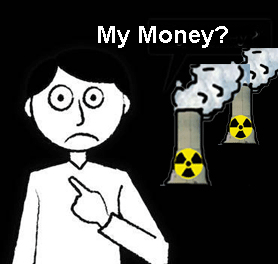
Reaction to the Bill from stakeholders has been mixed. Some environmental bodies have questioned whether the RAB model set out in the Bill offers value for money for consumers and whether it transfers the risk of cost overruns to consumers. Tom Burke, the co-founder of E3G, a climate think-tank, told the Financial Times that the model risked being “a very bad deal for consumers” on the grounds that electricity generated from nuclear power would be more expensive than that from ‘homegrown’ renewables and would simultaneously “inhibit the market in wind, [an] area where we have the opportunity to create a global competitive industry in the UK”.145 The same article included comment from Steve Thomas, Professor of Energy Policy at the University of Greenwich, who questioned whether people would want their pension funds exposed to construction risk cost and whether that meant the consumer would take on all the risk. In an article in the i on the day the legislation was published, Doug Parr, Chief Scientist at Greenpeace, noted that the RAB model had already been used to finance nuclear power in the United States, adding that the “results were disastrous”: “It transfers huge financial risk from the builders to bill payers. In South Carolina, 18 per cent of residents’ energy bills went to pay for a half-built reactor which has been abandoned and will never produce electricity.” House of Commons Library 1st Nov 2021 https://researchbriefings.files.parliament.uk/documents/CBP-9356/CBP-9356.pdf |
“Perilous Profiteering: The companies building nuclear arsenals and their financial backers”

Table on original lists the top 10 investors in nuclear weapons –Vanguard, State street, Capital Group, Blaxk Rock, Bank of America, Citigroup, J P Morgan Chase, Wells Fargo, Morgan Stanley
$63 billion drop in investments: New report shows impact of nuclear weapons ban treaty on nuclear weapons business, ICAN,
Anew report released by ICAN and PAX today, has found that the number of banks, pension funds, asset managers and insurance companies investing in the production of nuclear weapons has gone down in 2021, and shows significant drops in the shareholder values of investments in the 25 companies involved in nuclear weapon production around the world. There is also an early but visible impact of the entry into force of the UN Treaty on the Prohibition of Nuclear Weapons (TPNW), with many institutions citing the treaty’s entry into force and the risk of a negative public perception as reasons for the change in their investment policies.
The 2021 report “Perilous Profiteering: The companies building nuclear arsenals and their financial backers” exposes the banks, pension funds, asset managers and insurance companies investing in the production of nuclear weapons and examines the companies involved in producing, manufacturing, or developing nuclear weapons for six of the nine nuclear armed countries for which data was available between January 2019 and July 2021.
Download the Executive Summary
Key findings from the report:
- While $685,184 million was made available to the 25 nuclear weapons producing companies during this period, this actually marks a $63 billion drop from the 2019 “Shorting our security”report, a trend that is affecting the producing companies’ stock holdings. There is also a marked shift in how the nuclear industry is raising funds to off-set debt, from significant loans to issuances, and underwriting of bond issuances rose by $80 billion.
- Northrop Grumman is the biggest nuclear weapons profiteer, with at least $24 billion in outstanding contracts, not including the consortium and joint venture revenues. Raytheon Technologies and Lockheed Martin also hold multi-billion-dollar contracts to produce new nuclear weapon systems.
Table on original lists the top 10 investors in nuclear weapons –Vanguard, State street, Capital Group, Blaxk Rock, Bank of America, Citigroup, J P Morgan Chase, Wells Fargo, Morgan Stanley
The Good news:
- In 2021,127 financial institutions stopped investing in companies producing nuclear weapons, valued at $31 billion. .
- Several of these institutions are from states that joined the TPNW, including the Bank of Ireland and AIB (Ireland), and Investec (South Africa), but they are not the only ones. Exclusions by financial institutions based in nuclear-armed states or allied countries are worth billions, such as Longview Asset Management (U.S.) which divested $5.7 billion from General Dynamics or Nomura (Japan) which divested $273 million from Larsen & Toubro.
- The nuclear weapons industry itself is getting smaller, with companies acquiring or merging together, which in turn makes it easier for financial institutions and other investors to exclude them from investments. Instead of tracking down hundreds, or even thousands of contributors to catastrophic threats, it’s simply a matter of exiting a few relationships
ICAN and PAX show how despite $billions still going to nuclear weapons, – $63 billion has moved away from this funding

Perilous Profiteering: The companies building nuclear arsenals and their financial backers
The 2021 report “Perilous Profiteering: The companies building nuclear arsenals and their financial backers” is a joint publication of ICAN and it’s partner PAX. The report details how 338 financial institutions made $685 billion available to 25 nuclear weapon producing companies from China, France, India, the Russian Federation, the United Kingdom and the United States.
This report looks at those with vested interests to keep a nuclear arms race going. The companies that want to get contracts to build weapons of mass destruction, and the private sector financiers and investors that want to generate a profit without apparent concern for the devastating potential consequences of any use of the products they support. It is only by knowing those who seek to maintain the status quo that we can engage and shift their behaviour……….https://www.icanw.org/perilous_profiteering_companies_building_nuclear_weapons_and_financial_backers?utm_campaign=perilous_profiteers_launch&utm_medium=email&utm_source=ican
ICAN – If you only take one thing away from this, it is that we moved $63 billion in funds away from the companies producing nuclear weapons in the last 2 years.
Today, PAX and ICAN are releasing the latest Don’t Bank on the Bomb report “Perilous Profiteering: The companies building nuclear arsenals and their financial backers”, which names the 338 investors backing 25 nuclear weapon producing companies and the size of their investments. This report is also the first time we were able to find information on Russian and Chinese investments.
But that’s not the most interesting part. The report also found three clear signs that financial institutions are starting to see nuclear weapons as risky business, and are leaving them behind:
• From 2019 to 2021, the total amount made available for nuclear weapons producing companies dropped by an impressive $63 billion, and the total number of financial institutions willing to invest in nuclear weapons producing companies went down too.
• Nuclear weapons producing companies, despite billion dollar contracts, have debt. But investors are moving away. So instead, they’re borrowing from wherever they can to raise cash. In other words: producing weapons of mass destruction has become extremely unattractive.
• 127 financial institutions stopped investing in companies producing nuclear weapons this year!
Of course, we still have a lot of work to do to hold these profiteers accountable. Banks, insurers, asset managers and pension funds still made $685 billion available for the companies producing nuclear weapons (like Northrop Grumman, which has $24 billion in outstanding contracts).
Our banks, insurers, and pension funds have no business investing in companies that choose to be involved in illegal weapons of mass destruction, and we need to tell them. Can you start today by reading and sharing the key findings of the report?
Speaker of UK Parliament refuses debate on motions against Nuclear Energy (Financing) Bill.

Of course, consumers who have signed up to buy 100% renewable electricity could quite rightly feel aggrieved at having to pay the “nuclear tax” as well.
nuClear News, November. 21. Nuclear Energy Finance Bill On Wednesday 3rd November, MPs debated the second reading of the Nuclear Energy (Financing) Bill. The Liberal Democrats and the SNP, bot put forward an amendment, but neither was accepted for debate by the Speaker.
LibDem Motion: That this House declines to give a Second Reading to the Nuclear Energy (Financing) Bill because there is no economic or environmental case for the construction of any further nuclear stations in the UK; because the Bill does nothing to address concerns about costs around nuclear waste disposal and decommissioning; because the Bill fails to bring forward meaningful reforms to accelerate the deployment of renewable power or the removal of restrictions on solar, wind and the building of more interconnectors to guarantee security of supply; and because it fails to remove barriers to investment in renewables or to support investment and innovation in cutting-edge energy technologies, including tidal and wave power, energy storage, demand response, smart grids and hydrogen.
SNP Motion: This House declines to give a Second Reading to the Nuclear Energy (Financing) Bill because it believes there is no longer a justification for a large nuclear power station to provide base load energy, because large scale nuclear is not compatible as a counter to the intermittency of renewable wind as nuclear stations are too inflexible, because pumped storage hydro should be utilised to provide renewable energy that can be dispatched when required and pumped storage hydro should be supported with a minimum electricity price providing better value to bill payers than funding new nuclear, because wave and tidal technologies should be utilised to provide stable and predictable electricity generation and these technologies should be supported to scale up via the provision of a ring fenced pot of funding within the forthcoming contracts for difference auction, because the net zero pathway will be better advanced by supporting the Scottish Cluster as a fast track Carbon Capture, Utilisation and Storage project given that it includes hydrogen production, direct air capture and carbon storage facilities that will serve the wider UK, and because greater support and investment should be directed towards green hydrogen production and emerging storage technologies; and, as the cost of energy increases, this House calls on the Government to spend more money on energy efficiency measures and targeted support for those who suffer from or are at risk of fuel povertyac1
Continue readingBitcoin could be nuclear power’s last hope of salvation?

Bitcoin miners look toward nuclear power for sustainable energy, COINTELEGRAPH, 12 Nov 21,
Several major players say that nuclear energy might be the best choice for Bitcoin miners. Major players in the Bitcoin (BTC) mining industry have their sights set on nuclear energy as pressure mounts to go green. [nuclear green? Wha aa t ?]
Nuclear energy could present a “tremendous opportunity” to introduce “enormous amounts of clean [nuclear clean? wha aa at?], carbon-free” energy to the baseload, Harry Sudock, vice president of Griid, said at the “Bitcoin & Beyond Virtual Summit” on Wednesday. Griid is an American company that procures low-cost, renewable energy to build vertically integrated Bitcoin mining facilities.
According to Sudock, past subsidy programs and discourse about renewable energy have largely focused on solar and wind power and neglected to consider the potential benefits of nuclear energy.
“The growth rate is largely focused around solar and wind right now, and that’s just the reality of the programs that have been rolled out over the last eight to 10 years. But what we’d love to see is an expansion of nuclear,” he said………..
Blockstream chief strategy officer Samson Mow is also a proponent of nuclear energy for Bitcoin mining. “The problem is, we’ve regressed as a society where we have kind of rejected nuclear power and have gone for other things like wind and solar, which are more costly more difficult to generate and don’t always function,” he said…………….
Bitcoin miners will go to the cheapest form of electricity that they can find,” [nuclear cheap? wha aa at?]
said Amanda Fabiano at the summit. Fabiano is the head of mining at digital asset invest management firm Galaxy Digital and a founding member of BMC. https://cointelegraph.com/news/bitcoin-miners-look-toward-nuclear-power-for-sustainable-energy
Vogtle nuclear project: is nuclear energy really right for Georgia?

GREEN GEORGIA: Is nuclear energy right for Georgia?, The Red and Black Carson BarrettNov 12, 2021
As a native Augustan, I have always been much more fond of the nearby hydroelectric Clarks Hill Dam than the equally nearby nuclear power plant, Plant Vogtle. The tragedies of similar plants such as those in Fukushima and Chernobyl scar my mind, resulting in an almost automatic repugnant disfavor of this clean-ish energy.
While these disasters are extremely rare and safety procedures have evolved to protect against them, nearly half of Americans hold an unfavorable view of nuclear energy, according to Morning Consult. Should we simply cast off these doubts as visceral, knee-jerk responses to deadly accidents? Or should we take a deeper look into the fears about nuclear energy and reconsider our path on its dependence?
First, it is worth looking at the status of current nuclear energy projects. On Oct. 22, Georgia Power announced even more delays on Plant Vogtle’s expansion of two new reactors. These reactors, which were due to be in operation by 2016 and 2017, have faced four delays in just the past six months. These delays have racked up the total project cost to $11.1 billion, significantly higher than the projected cost of $6.1 billion.
This may just seem like a financial issue for the state’s largest energy firm, but customers might have to cover some of the burdens. The Georgia Public Service Commission agreed to an addition of $2.1 billion into Georgia Power’s rate base, possibly affecting typical customers with an increase of $3.78 a month in bills after the first reactor is finished.
Plant Vogtle is expected to produce 17 million megawatt-hours of energy, which is enough to power 1.6 million average households. This seems to make the case that the plant is worth the investment. But even with these tremendous increases in the power grid, the cost of nuclear power often outweighs the production amount. Across the country, 34 of the total 61 power plants are losing money, totaling $2.9 billion in losses a year.
However, this is not stunting the expansion of Plant Vogtle. In fact, Georgia Power has profited off of the delayed construction of the plant. Customers have already footed a $2.3 billion bill for the new units, half of which has been straight profit for the company. By being late and over budget, Georgia Power stands to make $5 billion in extra profit.
Furthermore, nuclear energy presents waste management issues. While nuclear energy does not emit a handful of common pollutants, including carbon dioxide, extraction of raw uranium gives rise to an abundance of other problems. Required for nuclear power plants, uranium needs energy-intensive mining and milling. Twenty-eight tons of uranium — which will keep an average reactor going for about a year — requires the extraction of half a million tons of waste rock and over 100,000 tons of toxic mill tailings.
Additionally, the plant generates 159 tons of solid radioactive waste and 47,000 cubic feet of liquid waste. Around 30 tons of such waste generated is known as high-level waste and has no way of being safely disposed of. Instead, the waste is stored near the plant facility, emitting dangerous radiation and awaiting the development of a permanent disposal method.
Nuclear energy is not the future for a sustainable Georgia. The source is too costly, too time-consuming and not nearly as green as proponents wish you would think. While nuclear energy would reduce carbon emissions significantly, these other factors turn the tides against the energy source………….. https://www.redandblack.com/opinion/green-georgia-is-nuclear-energy-right-for-georgia/article_205e6716-436e-11ec-b25f-cbf1776c5f60.html
1 This Month



26 September – International Day for the Total Elimination of Nuclear Weapons


PLEASE OPPOSE HR 8255 AND S.3639 – bills would accelerate satellite deployment, with no environmental review or safeguards – https://ncstd5li.quorum.us/campaign/169331/
To see nuclear-related stories in greater depth and intensity – go to https://nuclearinformation.wordpress.com
-
Archives
- September 2026 (245)
- August 2026 (330)
- July 2026 (355)
- June 2026 (287)
- May 2026 (306)
- April 2026 (356)
- March 2026 (251)
- February 2026 (267)
- January 2026 (308)
- December 2025 (358)
- November 2025 (359)
- October 2025 (375)
-
Categories
- 1
- 1 NUCLEAR ISSUES
- business and costs
- climate change
- culture and arts
- ENERGY
- environment
- health
- history
- indigenous issues
- Legal
- marketing of nuclear
- media
- opposition to nuclear
- PERSONAL STORIES
- politics
- politics international
- Religion and ethics
- safety
- secrets,lies and civil liberties
- spinbuster
- technology
- Uranium
- wastes
- weapons and war
- Women
- 2 WORLD
- ACTION
- AFRICA
- Atrocities
- AUSTRALIA
- Christina's notes
- Christina's themes
- culture and arts
- Events
- Fuk 2022
- Fuk 2023
- Fukushima 2017
- Fukushima 2018
- fukushima 2019
- Fukushima 2020
- Fukushima 2021
- general
- global warming
- Humour (God we need it)
- Nuclear
- RARE EARTHS
- Reference
- resources – print
- Resources -audiovicual
- Weekly Newsletter
- World
- World Nuclear
- YouTube
-
RSS
Entries RSS
Comments RSS
 nuclear-news