Question hangs over Bradwell nuclear project – Bradwell B (BRB) a partnership 66.5% China’s CGN and 35% France’s EDF.

SafeEnergy E Journal No.92. December 21 Bradwell Bradwell B (BRB), which is a partnership between the Chinese Company, CGN – with a 66.5% share and EDF Energy with a 33.5% share is hoping to build a Chinese reactor – the UKHPR100 at Bradwell in Essex. BRB appealed to the Planning Inspectorate against the refusal by Maldon District Council of Planning Permission for further land investigations at Bradwell. The Appeal was successful.
But this does not give a green light to a future nuclear power station at Bradwell, and given the current hostility to Chinese involvement in UK Infrastructure seems unlikely to progress much further. The Blackwater Against New Nuclear Group (BANNG) objected to land investigations on the grounds that they were unnecessary since the site is wholly unsuitable, unsustainable and unacceptable for the development of a mega nuclear power station and spent fuel stores.
The Planning Inspector chose to uphold the Appeal on the narrow grounds that the works would be temporary and would create little disruption and disturbance to the environment and human welfare. The Inspector declined to take into account the question of need for new nuclear, relying on the 2011 National Policy Statement on Nuclear (EN6) which deemed Bradwell a ‘potentially suitable’ site. In its latest policy statements the Government is silent on Bradwell and the project seems likely to be dropped altogether on geopolitical grounds.
On 25th November The Times reported that China would be cut out of future involvement in developing new nuclear power stations. Boris Johnson said that a potential adversary could have no role in Britain’s “critical national infrastructure”. The Prime Minister, asked by Labour spokesperson, Matthew Pennycook if he could “confirm unequivocally today that plans for China General Nuclear to own and operate its own plant at Bradwell in Essex have been abandoned”, said:
“Clearly, one of the consequences of our approach on critical national infrastructure in the National Security and Investment Bill is that we do not want to see undue influence by potentially adversarial countries in our critical national infrastructure. That is why we have taken the decisions that we have. On Bradwell, there will be more information forthcoming. What I do not want to do is pitchfork away wantonly all Chinese investment in this country, or minimise the importance to this country of having a trading relationship with China.” (3) https://www.no2nuclearpower.org.uk/wp/wp-content/uploads/2021/11/SafeEnergy_No92.pdf
Despite the USA’s V.C. Summer nuclear fiasco, a consortium plans to build the same type of reactor, with same funding model, at Wylfa, UK
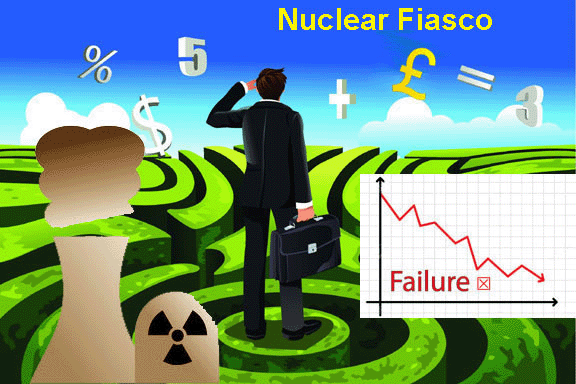
SafeEnergy E Journal No.92. December 21, Wylfa. In October it was reported that two groups had been speaking to the Department for Business, Energy and Industrial Strategy about the possibility of building at Wylfa on the island of Anglesey. A consortium involving US engineering firm Bechtel has proposed building a large Westinghouse AP1000 reactor. Talks have also taken place with UK-based Shearwater Energy, which has hybrid plans for small nuclear reactors and a wind farm. (1)
The AP1000 is the very reactor that was being built at V.C.Summer in South Carolina and which bankrupted Toshiba Westinghouse in 2017. After huge overspending the project was abandoned 40% of the way into construction.
Under legislation passed by the South Carolina Public Services Commissioners in 2008—but strongly opposed by civil society groups—construction costs for the V.C. Summer reactors were to be paid by state ratepayers. On 31 July 2017, Santee Cooper and SCANA Corporation (the parent company of South Carolina Electric & Gas or SCG&E) decided to terminate construction of the V.C. Summer reactor project. At the time of cancellation, the total costs for completion of the two AP-1000 reactors at V.C. Summer was projected to exceed US$25 billion—a 75 percent increase over initial estimates. Dominion, which took over SCANA in January 2019, will be charging South Carolina ratepayers an additional US$2.3billion over the next two decades, having already paid $4billion, for the collapsed V.C. Summer project. (2)
On 16th November, Steve Thomas, Emeritus Professor of Energy Policy at Greenwich University, told the House of Commons Nuclear Energy Finance Bill Committee that the V.C. Summer experience shows the folly of the RAB model. The plant has added 18% to bills in South Carolina.
Since October there has been more of a focus on the fact that Rolls Royce is considering Wylfa and Trawsfynydd as possible locations to build small nuclear power stations. (3) https://www.no2nuclearpower.org.uk/wp/wp-content/uploads/2021/11/SafeEnergy_No92.pdf
Risk of lack of electricity: is EDF’s nuclear fleet properly managed?
Risk of lack of electricity: is EDF’s nuclear fleet properly managed? The
manager of the transmission of electricity RTE alerted Monday on the state
of “particular vigilance” of the electricity network this winter. The low
availability of nuclear power is questioned.
L’Express 24th Nov 2021
Are small nuclear reactors actually small, safe, economic ?
Can Small Nuclear Reactors Really Help The Climate? QuickTake, Jonathan Tirone 27 Nov 2021 (Bloomberg) — Much of the world has been turning away from nuclear power, with its aging plants, legacy of meltdowns and radioactive waste. But some governments, big companies and billionaires including Bill Gates and Warren Buffett are convinced the technology can help save the planet.
1. How small is small? Of the more than 70 such reactors that the International Atomic Energy Agency lists as in some stage of design or development, the smallest are less than 5 meters (16 feet) in diameter and 10 meters in height. (The plant that would be built to operate the reactor would be bigger, of course.) SMRs typically have less than 300 megawatts of generating capacity, about a third of that of existing reactors.
…………. Do SMRs already exist? The only ones currently in commercial operation are two 35-megawatt units on a floating power plant deployed by Russia in the Arctic in 2020. China expects to begin trials in 2026 on an SMR being built near an existing power plant on Hainan island. The first commercial SMR project in the U.S., planned for the site of the Idaho National Laboratory, will consist of six reactors capable of producing a combined 462 megawatts. It’s supposed to be operational by the end of this decade.
…………….. smaller reactors would ideally be located closer to population centers, increasing the possible danger from an accident. And like their larger brethren, SMRs produce radioactive waste that must be stored safely for centuries.
………….. What are the economic challenges? Cost competitiveness is an uphill climb. U.S. manufacturer NuScale Power LLC, to cite one example, is aiming for an SMR that can sell power for $55 per megawatt-hour. Yet wind power in much of the world is now about $44 a megawatt-hour, solar is $50, and in some regions, renewable energy will be below $20 a megawatt-hour by the end of the decade, according to BloombergNEF. A 2020 study by professors at the University of British Columbia found that on a lifetime basis, the cost of electricity produced by SMRs could be 10 times greater than the cost of electricity produced by diesel fuel.
Who’s investing in SMRs? Electricite de France, China National Nuclear, Japan’s Toshiba and Russia’s Rosatom are pushing SMR designs, as is NuScale. Gates and Buffett have teamed up to build and test a reactor at an abandoned coal plant in Wyoming. Rolls-Royce Holdings Plc raised 455 million pounds ($608 million) to fund the development of SMRs, with almost half of the financing coming from the U.K government.
Read more at: https://www.bloombergquint.com/quicktakes/can-small-nuclear-reactors-really-help-the-climate-quicktake
Nuclear power for MINDLESS, ENDLESS, ENERGY use – Data ”Farms” and Bitcoin – theme for November 21.

When you think about the stupidity of eternal wastage of energy , it’s hard to beat the system of the supposed ”CLOUD”. Every pointless little email, little emoji, tweet, and all the other bits of digital junk produced goes not up into the disappearing ether, but down into a dirty great computer server, just one of the accumulating number of dirty great computer servers. Far from being ”farms”, these collections of steel enclosed machines actually produce nothing, but they do CONSUME massive amounts of electricity.
No wonder that the nuclear industry loves them!
The nuclear industry also loves crypto-currency, Bitcoin being the current top favourite of energy-guzzling systems.
A pernicious trio – data farms, cryptocurrency, and nuclear power – leading the world into eternal energy consumption and environmental degradation.

UK government tries to save its nuclear skin by turning to dubious Regulated Asset Base funding

At a time of rising energy bills in the UK, it certainly seems risky of the government to commit to increasing them further and opening themselves up to a downside risk that could prove very costly.
The National Infrastructure Commission, a body designed to give impartial advice to the government, said in March 2020 that a “renewable-based system looks like a safer bet” and a “substantially cheaper” option than the construction of multiple new nuclear power plants.
The UK’s nuclear plan is a financial, environmental and political risk, Investment Monitor, Jon Whiteaker , 16 Nov 21,” …………..The problem with financing nuclear power
…… Hinkley Point C has been a bit of a nightmare for the UK government. It is already seven years behind schedule, has controversial Chinese investors that the government is understood to be trying to get rid of, and is widely agreed to be far too expensive.
It was financed under the contracts for difference (CfD) model used for offshore wind. This guarantees a ‘strike price’ for the power plant owner, allowing them to raise capital for construction by having certainty of revenues.
Using the same funding model as offshore wind has, however, allowed for simple comparisons of the costs of the two power types. While the latest round of offshore wind projects saw strike prices of about £40 per megawatt-hour (MWh) over a 15-year contract, the owners of Hinkley are guaranteed at least £89.5/MWh over 35 years.
The reasons the Hinkley strike price is so much higher is because the capital costs are much higher, but also because the risks involved in developing them are much greater.
At least Hinkley Point C is being built. A number of planned projects, including the Moorside power station in West Cumbria and Wylfa Newydd plant on Anglesey, have been cancelled or shelved in recent years.
With the need to develop the UK’s next generation of nuclear plants increasingly urgent, the government has turned to the RAB model to save its skin.
UK government turns to the RAB model
The RAB model is known mostly for its successful use on the Thames Tideway Tunnel (TTT), the new super sewer in London that is helping to clean up the Thames River. The government says that like that project, nuclear power plants are complex, have high capital costs and long operating lives.
The RAB model allows developers of infrastructure to earn immediate revenues by adding charges to consumers’ utility bills during the construction. Bill payers will have to buy before they try their lovely new nuclear power.
This in theory widens the pool of potential investors, making the government less beholden to a small group of companies who typically invest in and build nuclear plants, lowering the cost of financing, and ultimately saving money for bill payers.
The government predicts that using the RAB model to build a new nuclear plant will save energy bill payers £10 per year compared with the CfD model.
Legislation allowing the introduction of the RAB model for new nuclear was introduced in October 2021 and is moving through the House of Commons. The government has pledged to reach a final investment decision on at least one new nuclear plant by the end of this parliament in 2024.
It is hoped by government that the previously stalled 3.2GW Sizewell C, owned by EDF Energy, will be the first nuclear project to use the RAB model.https://www.investmentmonitor.ai/business-activities/energy/uk-nuclear-rab-energy-renewable
The problems with RAB for nuclear
While this all sounds like a perfect panacea for the government’s problems, there are several downsides to using the RAB model.
The depth of investor interest in new nuclear power stations is yet unknown. As the UK government should be painfully aware, having just hosted COP26, the conversation about what does and does not meet different investors ESG standards is a live one. Whether nuclear power is seen as a sustainable investment is debatable.
Trying to get any of the investors in TTT to make clear their stance on nuclear power is not easy, and I have tried. For the government to achieve its goals, institutional investors, like those that supported TTT, should want to invest in new nuclear too.
Asset manager Aviva Investors, a major investor in UK infrastructure, has called on the government to present a robust ESG case for new nuclear, which it says is lacking at present.
Many investors will be concerned over whether nuclear meets the criteria of an environmentally sustainable activity. Institutional investors are incredibly cautious by nature and the shadow cast by the Fukushima disaster in Japan in 2011 is still long.
All energy suppliers will have to contribute to the costs of RAB nuclear plants, whether they want to or not, before passing those costs on to bill payers. That seems a retrograde step for an energy market that has been diversifying to provide customers with ‘green only’ options in recent years. Whether you have ethical objections to nuclear power or not, you will have to use a supplier that helps fund that technology.
Hinkley Point C is seven years behind schedule. You would be brave to bet against any delays to the first RAB model nuclear plant too.
The government says that there would be a cap on how much extra investors could charge consumers but that this cap could be increased by the government if deemed necessary. If the costs became excessive, the government would have the option of covering the costs itself, although this is ultimately taxpayer money too.
At a time of rising energy bills in the UK, it certainly seems risky of the government to commit to increasing them further and opening themselves up to a downside risk that could prove very costly. Perhaps the government thinks these are all costs worth shouldering to ensure its net-zero plans stay on track.
The National Infrastructure Commission, a body designed to give impartial advice to the government, said in March 2020 that a “renewable-based system looks like a safer bet” and a “substantially cheaper” option than the construction of multiple new nuclear power plants.
That sounds like advice worth considering again. https://www.investmentmonitor.ai/business-activities/energy/uk-nuclear-rab-energy-renewable
The UK’s nuclear plan is a financial, environmental and political risk
The UK’s nuclear plan is a financial, environmental and political risk, Investment Monitor, Jon Whiteaker , 16 Nov 21, If the UK government thinks the RAB model will solve all its nuclear power problems, it may have a nasty surprise coming its way.
As the dust settles on COP26, the UK government will turn its attention away from global discussions and towards what it is doing domestically to help mitigate the climate crisis.
The government’s Net Zero Strategy sets aside £120m towards developing new nuclear power plants, which it says “could support our path to decarbonising the UK’s electricity system” by 2035.
Could’ is doing a lot of work in that sentence, because although nuclear power plays a prominent role in the government’s decarbonising strategy, bringing additional nuclear capacity online is far from straightforward.
The government says nuclear is a continuous, reliable and low-carbon form of energy that has been part of the UK electricity system for 65 years. Nuclear is also controversial, hugely expensive in comparison to other fossil fuel alternatives, and often proves challenging to develop.
According to the latest World Nuclear Industry Status Report, between 1951 and 2021, of the 783 nuclear reactor projects launched, 12% have been cancelled. Delays and cost overruns are also very common when constructing nuclear plants.
The UK government is hoping to kickstart development of new nuclear in the UK through the introduction of the regulated asset base (RAB) funding model. This model is intended to widen the investor pool for nuclear power, reduce financing costs, and ultimately save bill payers money.
While the RAB model has proved successful for other large UK infrastructure projects, it comes with risks for the government. It is unclear which investors will be happy to support new nuclear projects, and there are potential political costs if UK citizens are made to pick up at least part of the tab if things go wrong.
The government expects electricity usage to increase by 40–60% by 2035. It has mapped out several scenarios for how this demand can be met solely by renewables, all of them dependant on building new nuclear power capacity.
Yet in 2020, while generation from all other renewable energy sources increased, generation from nuclear power actually declined in the UK due to a decision not to restart operations at the Dungeness B plant in Kent, which had been suffering a prolonged outage since 2018.
The UK nuclear fleet is old, suffering performance issues and largely due to be decommissioned. By 2035, the UK will lose almost 8GW of nuclear power plants to decommissioning.
The only new nuclear plant under construction is the 3.26GW Hinkley Point C plant, which is now due to be completed in 2026.
All this means the government needs to quickly develop new nuclear capacity. It seems very taken by new small modular reactors, particularly if they are developed by UK companies such as Rolls-Royce.Yet this and another new technology, advanced modular reactors, are not due to reach the demonstration phase until the early 2030s.
So, the government has been seeking a way to deliver several new Hinkley Point Cs…………………
The National Infrastructure Commission, a body designed to give impartial advice to the government, said in March 2020 that a “renewable-based system looks like a safer bet” and a “substantially cheaper” option than the construction of multiple new nuclear power plants.
That sounds like advice worth considering again. https://www.investmentmonitor.ai/business-activities/energy/uk-nuclear-rab-energy-renewable
Christmas bonanza from USA tax-payers to the nuclear industry
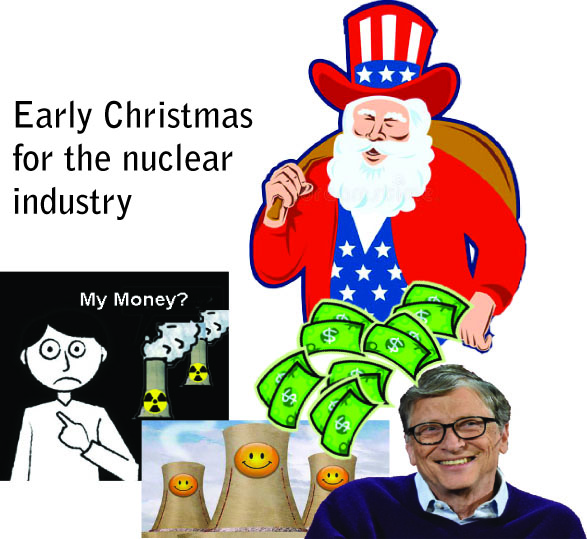
Passage of the Infrastructure Investment and Jobs Act last Monday had some nice things for nuclear energy. The overall Bill is a $1.2 trillion for everything from bridges and roads to the nation’s broadband, water and energy systems.
Nuclear got about $25 billion, distributed as:
– $3.2 billion (to FY2027) Advanced Reactor Demonstration Program (ARDP);
$21.5 billion (to 2025) for an Office of Clean Energy Deonstrations in DOE including: $6 billion civil nuclear credit program to preserve the existing nuclear fleet and prevent premature shutdowns of nuclear power plants like Diablo Canyon pictured above;
$8 billion for clean hydrogen hubs,
……… $1 billion for demonstration projects in rural areas and $0.5 billion for demonstration projects in economically hard-hit communities
$0.5 billion for new clean energy demonstration on mine lands assistance for siting micro-reactors, small modular reactors, and advanced nuclear reactors in isolated communities
provides federal government authority to transfer real property for advanced reactor demonstrations and
authorizes longer term protections for intellectual property related to nuclear technology used in demonstrations changes to the DOE Loan Programmaking it more usable by reducing the credit subsidy costs that borrowers must pay.
Forbes 23rd Nov 2021
Europe to pay half for raising Russia’s dangerous sunken submarines, – while Russia builds new ones!

“The sunken submarines K-27 and K-159 are the potential source of contamination of the Arctic, the riskiest ones,”
As Moscow this spring took the Chair of the Arctic Council, the need to lift dangerous nuclear materials from the seabed was highlighted as a priority.
No other places in the world’s oceans have more radioactive and nuclear waste than the Kara Sea.
Europe to pay half … it is a dilemma that international partners are providing financial support to lift old Cold War submarines from the ocean, while Russia gives priority to building new nuclear-powered submarines threatening the security landscape in northern Europe.
EU willing to co-fund lifting of sunken nuclear subs from Arctic seabed https://thebarentsobserver.com/en/nuclear-safety/2021/11/europe-offers-pay-russia-raise-sunken-nuclear-subs The Northern Dimension Environmental Partnership (NDEP) has decided to start a technical review aimed to find a safe way to lift two Cold War submarines from the Barents- and Kara Seas. By Thomas Nilsen
“We are proceeding now,” says a smiling Jari Vilén, Finland’s Ambassador for Barents and Northern Dimension.
Projects aimed to improve nuclear safety are some of the few successful arenas for cooperation still going strong between the European Union and Russia.
“In roughly two years time we will have the understanding on what and how it can be done, what kind of technology has to be used,” Vilén elaborates with reference to the two old Soviet submarines K-159 and K-27, both rusting on the Arctic seabed with highly radioactive spent nuclear fuel elements in their reactors.
Continue readingFinancial hypocrisy in Canada – the pretence that nuclear power is green and cheap

A Global First: BMO Supports Bruce Power with World’s First Nuclear Green Financing Framework, Yahoo Finance TORONTO, Nov. 22, 2021 /PRNewswire/ – Bruce Power, Ontario’s leading private sector power provider, has taken another industry-leading step in its environmental [?], social and governance strategy by launching the world’s first green [?] finance framework with nuclear use of proceeds.
Acting as Co-Lead Green Structuring Agent, BMO Financial Group (TSX:BMO) (NYSE:BMO), today announced the successful issuance of CAD $500 Million in green [?] bonds under the framework, which is designed to guide future issues of green bonds with a focus on Bruce Power’s Life-Extension Program and investments related to increasing the output of nuclear units and extending the plant’s life beyond 2060.
The framework sets out the guidelines in accordance with the Green Bond Principles issued by the International Capital Markets Association (ICMA) and the Green Loan Principles issued by the Loan Market Association (LMA) and Loan Syndications and Trading Association (LSTA) – ensuring the proceeds are exclusively allocated to green projects and activities that promote environmental sustainability and deliver clear environmental benefits.
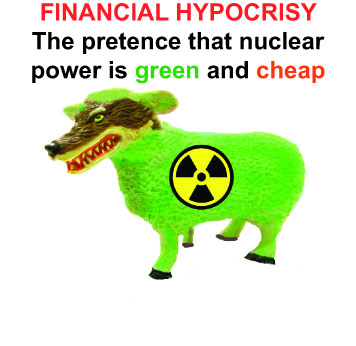
CICERO Shades of Green, an internationally-recognized leading provider of independent review and second-party opinions on green financing frameworks, [REALLY?} has given Bruce Power’s Green Finance Framework the highest possible governance score of Excellent, and an overall designation of CICERO Medium Green, acknowledging the role of nuclear power in mitigating climate change and recognizing Bruce Power’s strong risk management processes.
Clean nuclear power is crucial to fighting climate change, and today’s announcement marks another industry-leading step in the company’s environmental, social and governance strategy,” said Mike Rencheck, Bruce Power’s President and CEO…..
“We’re proud to partner with Bruce Power to build a green framework that facilitates the alignment of the company’s business and financing activities to support nuclear power’s critical role in mitigating climate change,” said Jonathan Hackett, Head, Sustainable Finance, BMO Capital Markets. ………. https://finance.yahoo.com/news/global-first-bmo-supports-bruce-143800875.html
Exelon Generation Co changing its name to the more appropriate (Nuclear) Spin Co

Exelon moving nuclear plants, including Limerick, to spin-off company, https://www.readingeagle.com/2021/11/22/exelon-moving-nuclear-plants-to-spin-off-company/
The Nuclear Regulatory Commission OK’d the move on Nov. 17, By EVAN BRANDT | ebrandt@pottsmerc.com | Reading Eagle
November 22, 2021 LIMERICK — The federal Nuclear Regulatory Commission has signed off on a plan by Exelon Corp. to divest itself of its fleet of 23 nuclear power reactors, including the two at the Limerick Generating Station.
Exelon Corp. will transfer the NRC licenses to a new company, currently called HoldCo, as part of a corporate restructuring, the NRC announced on Nov. 17.
There is no money changing hands.
Exelon is not “selling” the plants, and spent fuel rod storage facilities, but rather “the transaction is taking place between corporate entities owned by Exelon,” NRC spokesman Neil Sheehan explained in response to a query from MediaNews Group.
‘It intends to separate its utilities, such as PECO, and competitive energy businesses, including its nuclear power plants, into two separate companies,’ Sheehan wrote.
“HoldCo will wholly own Exelon Generation Co. (renamed as SpinCo) and its subsidiaries. SpinCo will continue to own and operate the plants to the same extent as before the transfers. The final names for HoldCo and SpinCo will be determined prior to the completion of the transfer,” according to the Nov. 17 NRC announcement.
The new power-generation company will be named Constellation, according to a Nov. 17 press release from Exelon.
“Each of these companies will emerge as industry leaders with the financial and strategic independence to focus on best serving their respective customers and communities,” Chris Crane, president and CEO of Exelon, said in the company’s press release.
German banks sceptical about nuclear and gas inclusion in green taxonomy.
German banks sceptical about nuclear and gas inclusion in green taxonomy.
Eight German banks have said there is “limited room” for nuclear and
gas power in the EU’s list of sustainable economic investments, warning
that the ‘green taxonomy’ should only include genuinely
climate-friendly activities.
ENDS Europe 19th Nov 2021
While the French government promises a nuclear revival, its supreme auditing body warns of serious obstacles to this.

The Court of Auditors (Cour des comptes) is the supreme body for auditing the use of public funds in France. It is independent from the Government and Parliament. It has financial jurisdiction and is in charge of auditing, issuing rulings and certifying the State and Social Security accounts, as well as contributing to the evaluation of public policies.
Nuclear revival: the Court of Auditors highlights many obstacles https://reporterre.net/Relance-du-nucleaire-la-Cour-des-comptes-pointe-de-nombreux-obstacles 19 Nov 21,
In a report published this Thursday, November 18, the Court of Auditors questions our “ability to build a new fleet of [nuclear] reactors on time and at reasonable costs”. This, while “maintaining a 50% nuclear share in electricity production (…) beyond 2050 would require ultimately not having seven EPR or EPR2, but 25 to 30 in the assumption that the current reactors would almost all be shut down by this time, ”the text specifies. And that the composition of the new mix must be decided between 2022 and 2027, believes the institution, given the delays in the construction of new plants.
The report from the Court of Auditors
In this document entitled “The choices of electricity production: anticipating and controlling technological, technical and financial risks”, the wise men of the rue Cambon recall the slippages of cost – 19 billion euros instead of the 3 billion planned – and of deadlines – at least eleven years late – of the Flamanville EPR site. “The gaps are similar for the Olkiluoto RPE in Finland,” they said. In July 2020, the Court of Auditors detailed these troubles at length in a report dedicated to the EPR sector.
Several points of real concern are mentioned.
One is the locations of these new reactors, “as climate change can make the installation of sites along rivers more complicated”.
Management of spent fuel and waste: the construction of new reactors planned to operate until 2100 would in fact involve “either renewing the fuel reprocessing plant at La Hague (…) and creating new sites for ‘warehousing and then disposal of nuclear waste, or to propose another mode of management of spent nuclear fuel and waste which would be, in such a hypothesis, much more voluminous ”, we read in the note.
Another imperative element for the implementation of this half-nuclear mix emphasized by the Court is “the start of the Cigeo radioactive waste disposal project” – a project that is also marred by many uncertainties.
The cost, finally. “EDF will not be able to finance the construction of new nuclear reactors on its own when it has to bear the cost of extending the current fleet and of the“ post Fukushima ”safety investments, face the future costs of dismantling and the uncertain evolution regulated access to historic nuclear power since its inception in 2011, and that it is already indebted to the tune of 42 billion euros, ”warns the Court of Auditors. The project to build six new EPRs had been estimated at 46 billion euros by EDF and could be half-financed by the state, as reported by Reporterre. The cost of the investment has since been reassessed from 52-56 billion euros to 64 billion euros, according to a working document released at the end of October by the media Context.
The implementation of a 100% renewable energy mix also represents many challenges, nevertheless warns the Court of Auditors. It would thus be necessary to define modalities for storing energy (batteries, etc.) at an affordable cost and to overcome implementation difficulties linked to geography, regulations and even social acceptability.
In any case, “the holding of an informed democratic debate would encourage choices made with full knowledge of the facts and then followed up with lasting effects”, recommends the institution. This debate could take place in 2023 during the preparation of the next multiannual energy program, the roadmap for France’s energy policy.

The publication of this report comes at a time when debates rage on the definition of the electricity mix of the future. On October 25, the electricity transmission manager unveiled its six electricity scenarios for 2050: three give pride of place to the atom. Less than three weeks later, Emmanuel Macron promised the construction of new nuclear reactors in France during a televised address.
Finland’s nuclear power project collapsing – unprofitable and unnecessary
Doubts about nuclear power plant construction in Finland. The planned Hanhikivi nuclear power plant could be on the verge of collapse.
It is unclear whether there will be any need for the plant’s electricity at all.
The costs are running away, the schedule for the start of construction and commissioning has been revised and postponed several times. The planning documents are so inadequate that the project is not yet ready for approval even after a six-year approval process.
And most of the independent analyzes assume that the project can neither become profitable nor that
there is even a need for what is to be produced here. It recently revealed that there is also a huge funding gap, and now the military is raising concerns about national security.
Taz 18th Nov 2021
France has multiple nuclear problems – costs, wastes, safety and more …..

Cost, waste management and safety: eight questions raised by the announced
return of nuclear power in France. Emmanuel Macron said he wanted new
reactors, in the name of France’s energy independence and climate
preservation. But where is the sector and what does this choice imply?
Le Monde 18th Nov 2021
Electricity production choices: anticipate and control technological,
technical and financial risks.
Cour des Comptes 18th Nov 2021
Nuclear revival: the Court of Auditors highlights many obstacles.
Reporterre 18th Nov 2021
https://reporterre.net/Relance-du-nucleaire-la-Cour-des-comptes-pointe-de-nombreux-obstacles
1 This Month



26 September – International Day for the Total Elimination of Nuclear Weapons


PLEASE OPPOSE HR 8255 AND S.3639 – bills would accelerate satellite deployment, with no environmental review or safeguards – https://ncstd5li.quorum.us/campaign/169331/
To see nuclear-related stories in greater depth and intensity – go to https://nuclearinformation.wordpress.com
-
Archives
- September 2026 (245)
- August 2026 (330)
- July 2026 (355)
- June 2026 (287)
- May 2026 (306)
- April 2026 (356)
- March 2026 (251)
- February 2026 (267)
- January 2026 (308)
- December 2025 (358)
- November 2025 (359)
- October 2025 (375)
-
Categories
- 1
- 1 NUCLEAR ISSUES
- business and costs
- climate change
- culture and arts
- ENERGY
- environment
- health
- history
- indigenous issues
- Legal
- marketing of nuclear
- media
- opposition to nuclear
- PERSONAL STORIES
- politics
- politics international
- Religion and ethics
- safety
- secrets,lies and civil liberties
- spinbuster
- technology
- Uranium
- wastes
- weapons and war
- Women
- 2 WORLD
- ACTION
- AFRICA
- Atrocities
- AUSTRALIA
- Christina's notes
- Christina's themes
- culture and arts
- Events
- Fuk 2022
- Fuk 2023
- Fukushima 2017
- Fukushima 2018
- fukushima 2019
- Fukushima 2020
- Fukushima 2021
- general
- global warming
- Humour (God we need it)
- Nuclear
- RARE EARTHS
- Reference
- resources – print
- Resources -audiovicual
- Weekly Newsletter
- World
- World Nuclear
- YouTube
-
RSS
Entries RSS
Comments RSS
 nuclear-news