Australian-UK-US nuclear submarine deal makes the connection clear between civilian and military nuclear activities.

In failing fully to investigate this link between military nuclear and civil energy policy, the UK media have also missed more intimate connections. The senior Energy Ministry figure who negotiated the extraordinarily costly electricity contracts with France from the sole UK nuclear power plant currently under development went on to become the leading official in the Defence Ministry.
This same individual confirmed under questioning by Parliament that the nuclear submarine program is connected to civil nuclear policy. And it is this same person who is reported to have played a lead role in brokering the AUKUS deal.
In the United Kingdom, France, the United States, and Australia, policies in non-military, non-nuclear areas are often shaped by military nuclear interests. The AUKUS alliance is driven, in part, by a longstanding crisis in the nuclear submarine industry’s efforts to realize economies of scale.
In these countries, energy policy is steered towards risky, costly, delay-prone nuclear options rather than alternatives. In the process, policymakers impede progress on vital climate targets. Throughout, the public remains unaware. So, the gravest damage inflicted by hidden nuclear military interests is not their warping effects on non-military policy but on the health of democracy.
Australian-UK-US nuclear submarine deal exposes civilian-military links, https://thebulletin.org/2021/11/australian-uk-us-nuclear-submarine-deal-exposes-civilian-military-links/ Bulletin, By, Phil Johnstone | November 9, 2021 Andy Stirling Andy Stirling is Professor of Science and Technology Policy in the Science Policy Research Unit at Sussex University where he co-directs the ESRC. Phil Johnstone is a Senior Research Fellow at the Science Policy Research Unit at Sussex University. Phil has researched and published widely .
Under the AUKUS agreement, the United States and the United Kingdom plan to transfer nuclear submarine technologies to Australia. One international security scholar characterized the deal as “a terrible decision for the nonproliferation regime,” noting grave concerns for peace and security worldwide. Others have expressed concerns about “loopholes” surrounding nuclear submarine fissile materials, increased nuclear risks in the Pacific, and a potential acceleration of an arms race in the region. Still others doubt the purported efficacy of nuclear-propelled submarine designs.
Within national borders, nuclear activities often depend on expensive access to specific skills, supply chains, regulatory and design capabilities, educational and research institutions, and waste management and security infrastructures. These dependencies are especially strong in national struggles to build, maintain, and operate nuclear-propelled submarines. The AUKUS announcement overturned normally sacrosanct nuclear secrecy on these matters. It also raised bigger questions about energy policy, climate strategies, and democracy itself.
In democratic nuclear weapons states such as the United States, the United Kingdom, and France, shared civil-military nuclear industrial bases are largely—albeit indirectly—funded by electricity consumers. Colossal investments in new nuclear power are underwritten by anticipated revenues from future electricity sales. These investments flow through nuclear construction supply chains and outward to support military nuclear activities. In this way, crucial support is given to military infrastructures, outside of defense budgets and off the public books. But as civil nuclear power declines, this massive hidden funding flow may diminish, which presents problems for nuclear submarines whose costs are not only often prohibitive but escalating.
The AUKUS deal makes more sense when viewed in light of this crisis in the US, UK, and French national nuclear submarine industries. Spiralling civil nuclear construction delays, technological failures, bankruptcies, and fraud exercise little effect on government commitments to civil nuclear power, given pressure to underpin military capability. This is why these governments are failing to recognize the radical technology and market changes that render baseload power, according to industry, “outdated.” This is why policymakers so often neglect renewables and storage options that are outcompeting nuclear power. This is why some argue that nuclear power must persist as a “necessary part of the mix” in nuclear weapons states, despite diverse alternatives offering sufficient volumes of zero carbon power more quickly and cheaply than can nuclear.
Although well documented in the defense policy documents of existing and aspiring nuclear weapons states, these military drivers have been seriously neglected in discussions of energy and climate strategies. Recently however, some countries have begun to acknowledge the strong connections between civil and military nuclear capabilities.
In the United States, for instance, a report led by former energy secretary Ernest Moniz said in 2017 that “a strong domestic supply chain is needed to provide for nuclear Navy requirements. This supply chain has an inherent and very strong overlap with … commercial nuclear energy.” Since then, multiple high level reports have acknowledged that US military nuclear programs depend on a vibrant civil nuclear sector. “The connectivity of the civilian and military nuclear value chain—including shared equipment, services, and human capital—has created a mutually reinforcing feedback loop, wherein a robust civilian nuclear industry supports the nuclear elements of the national security establishment,” according to one study. Civil nuclear activities transfer an effective value of $26.1 billion dollars to the US military nuclear enterprise, according to this study.
In recent years, French press reports have hinted that dwindling civil nuclear power threatens national military nuclear capabilities. President Macron confirmed this when he said that “without civil nuclear power, there can be no military nuclear power.” Military drivers of civil nuclear activities are also acknowledged in more authoritarian nuclear states like Russia and China.
Australia possesses some of the most abundant and competitive renewable energy resources in the world. Yet the Australian nuclear lobby argues that acquiring military nuclear technology will benefit the claimed imperative to establish a civil nuclear industry. Prime Minister Scott Morrison asserted that he is not pushing for a civil nuclear power program, but other prominent voices disagree. Referring to submarine-derived small modular reactors, Australian politician and UK trade advisor Tony Abbott said that “if nuclear power is ok at sea, pretty soon it will be ok on land, too.” The Minerals Council for Australia claims that acquiring military nuclear technology is an “incredible opportunity” because it “connect[s] [Australia]… to the growing global nuclear power industry and its supply chains.”
Australian civil nuclear proponents welcome the aspirations of military nuclear proponents—and the reverse is also true. Australia’s military is concerned that a lack of a civil nuclear industry may pose difficulties for sustaining nuclear submarine competencies. Australian Navy Admiral Chris Barry pointed out that the absence of a civil nuclear industry left a “big gap” in the country’s ability to manage nuclear submarines. Some argue that a civil nuclear sector in Australia could provide the skills and expertise to enable military nuclear capability. Others are concerned that Australia will be the only country with nuclear submarines but no civilian nuclear industry. Military nuclear ambitions drive otherwise-inexplicable civil nuclear attachments.
In the United Kingdom, some worry about a post-imperial loss of a coveted “seat at the top table” of world affairs. Here again, nuclear submarine capabilities take center stage. Former prime minister Tony Blair worried that relinquishing nuclear capabilities would be “too big a downgrading of our status as a nation.” Meanwhile, detailed official energy policy analyses urged the government to set nuclear plans aside, given trends in renewables and related options. But shortly after a Defence Ministry report on submarine capabilities, Tony Blair swapped the open energy policy consultation for a quicker, covert process, after which the government proclaimed a “nuclear renaissance.”
The Royal Courts of Justice found reasoning for this policy insufficient, but Blair doubled down. “Nuclear power is back with a vengeance,” he said, invoking the name of the recently launched ballistic missile submarine, HMS Vengeance. He did not mention the military rationale. Since then, UK government white papers have failed to justify the country’s civil nuclear commitments—for instance by comparing nuclear costs with those of renewable alternatives. The commitment is taken for granted.
In the United Kingdom, the submarine industry’s openness about military pressures for civil nuclear power contrasts with energy policymakers’ silence. Now-declassified defense reports express grave worries that faltering civil nuclear programs undermine provision for essential military skills. Submarine-builder BAE Systems admits that funding for civil programs “masks” military costs. Naval reactor manufacturer Rolls Royce states that their expensive, government-funded efforts on ostensibly civilian small modular reactors can “relieve the burden” on Defence Ministry efforts to retain skills and capabilities for military programs. Numerous other government documents highlight synergies between civil and military nuclear skills. Yet when challenged, the UK Government denies that civil nuclear commitments influence military activities.
Boris Johnson emphasized that the AUKUS deal offers the United Kingdom “a new opportunity to strengthen Britain’s position as a science and technology superpower, and … could reduce the cost of the next generation of nuclear submarines for the Royal Navy.” Indeed, as discussed in this publication, the deal is “…likely to have particular significance for the UK’s nuclear program” because “the UK is struggling through a number of issues related to the revamping of its nuclear enterprise.” Despite government denials, Johnson’s statement confirms that the AUKUS deal is influenced by the same cost pressures and economies of scale associated with dogged maintenance of a shared civil-military industrial base.
In failing fully to investigate this link between military nuclear and civil energy policy, the UK media have also missed more intimate connections. The senior Energy Ministry figure who negotiated the extraordinarily costly electricity contracts with France from the sole UK nuclear power plant currently under development went on to become the leading official in the Defence Ministry. This same individual confirmed under questioning by Parliament that the nuclear submarine program is connected to civil nuclear policy. And it is this same person who is reported to have played a lead role in brokering the AUKUS deal.
In the United Kingdom, France, the United States, and Australia, policies in non-military, non-nuclear areas are often shaped by military nuclear interests. The AUKUS alliance is driven, in part, by a longstanding crisis in the nuclear submarine industry’s efforts to realize economies of scale. In these countries, energy policy is steered towards risky, costly, delay-prone nuclear options rather than alternatives. In the process, policymakers impede progress on vital climate targets. Throughout, the public remains unaware. So, the gravest damage inflicted by hidden nuclear military interests is not their warping effects on non-military policy but on the health of democracy.
Investor backlash predicted, if European Union were to include Nuclear and Gas as ”Green” in its EU Taxonomy

Net-Zero Alliance Plans to Reject Gas, Nuclear as Green Assets, https://www.bloomberg.com/news/articles/2021-11-08/net-zero-alliance-plans-to-reject-gas-nuclear-as-green-assetsBy John Ainger and Alastair Marsh9 November 2021
- UN-convened asset owners weigh in on taxonomy debate
- The group favors separate legislation for energy transition
The European Union will likely face investor backlash if it includes natural gas and nuclear energy in its green rulebook, known as the EU taxonomy.
The United Nations-convened Net-Zero Asset Owner Alliance, which is part of the wider finance industry’s $130 trillion climate agreement announced last week, wrote in a document that hasn’t been finalized that it would oppose such a decision. Instead, fossil fuels should go into an extension or separate piece of legislation for transition technologies, the group said.
“The Alliance supports a taxonomy that is credible, usable, as well as science- and evidence-based,” according to the document seen by Bloomberg News. The inclusion of gas “would be inconsistent with the high ambition level of the EU taxonomy framework overall.” For nuclear, “it will be of utmost importance to apply strict criteria when assessing” the principle of do-no-significant-harm, “with respect to the other environmental objectives to identify a potential taxonomy alignment,” it said.
The development marks a blow to those EU members who’d hoped the bloc would take a softer stance on gas and nuclear. It also sets the tone for other investors keen to put their net-zero pledges to work, less than a week after international financial institutions representing 40% of total global assets pledged to work toward carbon neutrality by the middle of the century.
The European Commission is under pressure from member states such as France, which want to include nuclear and gas as key planks of their green transition strategies. The debate has intensified in recent months as energy prices soar amid a lack of supply. A decision on the so-called complementary delegated act is expected in the coming weeks.
Environmental groups have criticized the potential inclusion of gas, arguing it would undermine the EU’s ambition of setting the “gold standard” for green investing. It also would result in the bloc failing to meet its goal of cutting emissions by 55% by 2030 from 1990 levels and becoming carbon neutral by mid-century, they said. For nuclear, meanwhile, there are concerns over the environmental impacts of radioactive waste.
The Net-Zero alliance, whose members include Allianz SE and the California Public Employees’ Retirement System, urged the EU Commission, member states and their expert bodies to make sure any decision arrived at is “science and evidence-based,” according to the document.
:
Ethical Investors press Serco to drop bid for contract with the Atomic Weapons Establishment
Best known for its involvement with NHS test and trace during the
coronavirus pandemic Serco is believed to have had plans to compete for
contracts with the Atomic Weapons Establishment, which makes and maintains
warheads. Serco abandoned its bid after investors warned that if the
FTSE250 company began working on nuclear weapons they may have to dump
shares to meet Environmental, Social and Governance (ESG) standards, the
Telegraph first reported. A spokesperson for Serco declined to comment on
the news.
City AM 7th Nov 2021
Serco pulls out of bidding for work on UK’s nuclear arsenal, because of ethical investing concerns

The rise of ethical investing has forced the outsourcer Serco to
pull out of bidding to help manage Britain’s nuclear weapons arsenal,
leaving the Ministry of Defence reliant on fewer potential partners for the
critical work. The FTSE 250 company has abandoned plans to compete for
contracts with the Atomic Weapons Establishment, which designs, makes and
maintains warheads, City sources revealed. The decision follows warnings
from fund managers that working with nuclear weapons might force them to
dump Serco shares due to non-compliance with Environmental, Social and
Governance (ESG) standards.
Telegraph 6th Nov 2021
Other owners of Georgia Power’s Vogtle nuclear power project are balking at the billowing costs.

Nuclear plant price doubles to $28.5B as other owners balk. https://www.news4jax.com/business/2021/11/05/nuclear-plant-price-doubles-to-285b-as-other-owners-balk/ Jeff Amy, Associated Press.
ATLANTA – The cost of two nuclear reactors being built in Georgia is now $28.5 billion, more than twice the original price tag, and the other owners of Plant Vogtle argue Georgia Power Co. has triggered an agreement requiring Georgia Power to shoulder a larger share of the financial burden.
Atlanta-based Southern Co. announced in its quarterly earnings statement Thursday that Georgia Power’s share of the third and fourth nuclear reactors at Plant Vogtle has risen to a total of $12.7 billion, an increase of $264 million. Along with what cooperatives and municipal utilities project, the total cost of Vogtle has now more than doubled the original projection of $14 billion.
Opponents have long warned that overruns would be sky-high. Liz Coyle, executive director of consumer advocacy group Georgia Watch, said the price tag is “outrageous” but predictable.
“We said you can’t build it for what you’re saying you can,” she said of Georgia Watch’s opposition to the project when the Georgia Public Service Commission originally authorized the new reactors.
Total costs are actually higher than $28.5 billion, because that doesn’t count the $3.68 billion that contractor Westinghouse paid back to owners after going bankrupt. When approved in 2012, the first electricity was supposed to be generated in 2016…..
Southern Co. also disclosed Thursday that the other owners of Vogtle are saying Georgia Power has tripped an agreement to pay a larger share of the ongoing overruns, a cost the company estimates at up to $350 million. Southern Co. said it disagrees that Georgia Power has crossed the cost threshold but has signed an agreement to extend talks with the other owners on the issue.
Georgia Power owns 45.7% of the new reactors, while cooperative-owned Oglethorpe Power Corp. owns 30%. The Municipal Electric Authority of Georgia owns 22.7% and the city of Dalton’s municipal utility owns 1.6%. Florida’s Jacksonville Electric Authority is obligated to cover some of MEAG’s costs. Some cooperatives and municipal utilities in Alabama and northwest Florida have agreed to buy power as well.
The higher costs stem from more construction delays. Georgia Power announced last month that it doesn’t expect Unit 3 to start generating electricity until the third quarter of 2022. It was the third delay announced since May. Unit 4 is now projected to enter service sometime between April and June of 2023.
The company says it is redoing substandard construction work and contractors aren’t meeting deadlines. Experts hired by the Georgia Public Service Commission to monitor construction have long said Southern Co. has set an unrealistic schedule. In August, the U.S. Nuclear Regulatory Commission found two sets of electrical cables meant to provide redundancy in Unit 3 weren’t properly separated. Earlier, Georgia Power had to repair a leak in Unit 3′s spent fuel pool.
Georgia Power shareholders have been paying the cost of recent overruns, but the company could ask regulators to require customers to pay some or all of those bills.
UK govt would do better to spend consumers’ money on making homes sustainable, and supporting smart grids, rather than on a nuclear tax
NFLA comments on Plans to Impose a Nuclear Tax on Consumers’ Bills. The
Minister justifies this on the basis that consumers will save more than
£30 billion compared with the system used to pay for Hinkley Point C.
NFLA UK & Ireland Steering Committee Chair Councillor David Blackburn said:
“The Minister is comparing one expensive environmentally unsustainable
project with another expensive environmentally unsustainable project.
If he really wanted to save consumers’ money he would introduce a National
Homes Retrofit Scheme as quickly as possible having learned the lessons
from its failed Green Homes Scheme, and introduce a scheme to support
flexibility, demand management and smart grids so that we can use more of
our cheap, sustainable renewable electricity.”
The Minister went on to argue that despite the fact that the Scottish Government has a different
position with regard to new nuclear projects, Scottish Consumers should
also pay his “nuclear tax” because they “will benefit from a cheaper,
more resilient and lower-carbon electricity system.”
Scottish NFLA Chair, Cllr. Feargal Dalton said: “Renewables met 97% of Scotland’s
electricity demand in 2020. The Scottish electorate has consistently voted
for Governments opposed to building new nuclear power stations. With wind
and solar now the cheapest forms of electricity Scottish consumers
shouldn’t have to pay for the Tories’ failed energy policies.”
NFLA 4th Nov 2021
Fukushima farmers fear nuclear-tainted water’s impact on business
A decade on, Fukushima farmers fear nuclear-tainted water’s impact on business, Channel Newa Asia, 5 Nov 21, WAKI, Japan: Fukushima farmers fear the Japanese government’s planned release of water from the crippled power plant could revive concerns about contamination and again hit the price of their produce, undoing a decade of slow recovery from nuclear disaster.
Japan plans to release more than one million tonnes of contaminated water from the plant in the country’s northeast into the sea after treating it, as the site reaches storage limits for the water. Although international authorities support the plan, it has sparked concern from neighbours China and South Korea and worried local fisherman and farmers.
“We’re just about seeing our prices go back to normal after a big drop following the disaster, but now we will have to deal with the potential reputational damage all over again because of the release of the water,” said Hiroaki Kusano, a pear farmer and vice-leader of the local agricultural co-operative.
The water is to be processed to remove radioactive contamination other than from tritium, which cannot be removed. Water with the radioactive isotope diluted to one-seventh of the World Health Organization’s guidelines for drinking water will be released into the Pacific a kilometre out from the plant around spring 2023, under a government plan.
Nuclear plants worldwide routinely release water containing tritium, considered the least-toxic byproduct of atomic power…………….
DECOMMISSIONING
The Daiichi plant is being decomissioned as part of a clean-up by operator Tokyo Electric Power Company Holdings (Tepco) expected to take decades,
Some 1,000 tanks, each 12m tall, crowd the site and hold enough radioactive water to fill around 500 Olympic-sized swimming polls. The release of water that once passed through contaminated areas of the plant marks a milestone in decommissioning and will free up space for the clean-up.
……………… Tepco will compensate for damages related to the water release, said Junichi Matsumoto, a company official overseeing decommissioning work. Tepco says it has so far paid out some ¥10.1 trillion (US$89 billion) in damages from the crisis…
There are additional concerns because the Fukushima water has been sitting around for years, said Toru Watanabe, a radioactivity researcher at the Fukushima Fisheries and Marine Science Research Center.
“The water has been in those tanks for a long time. The quality of that water needs to be thoroughly understood before it’s released,” he said.
Farmers say there is not much they can do once the water is released. They worry about their tough customers – Japanese shoppers are famously picky about produce and pay close attention to freshness and place of origin… https://www.channelnewsasia.com/asia/decade-fukushima-farmers-fear-nuclear-tainted-waters-impact-business-2293361
Nuclear workers’ unions want nuclear energy included as clean and sustsainable
—European unions press leaders to include nuclear in clean energy mix, Ft.com Jim Pickard in Glasgow, 5 Nov 21, A dozen union chiefs from across Europe have pressed world leaders to factor in nuclear power as they discuss how to accelerate the path to net zero emissions at the global climate summit in Glasgow……….. ….. The use of nuclear to tackle climate change is fiercely contested, with some countries such as Belgium phasing out their existing power stations. Countries such as Germany, Austria and Luxembourg have opposed a Finnish proposal for the EU “taxonomy” to include nuclear in its definition of sustainable activity…….. Today’s letter was signed by figures including Gary Smith, general secretary of Britain’s GMB union, Helene Lopez, secretary-general of CFE-CGC Energies in France, and Bob Walker, national director of the Canadian Nuclear Workers’ Council – as well as counterparts in Belgium, Czech Republic, Hungary, Slovakia and Romania………. https://www.ft.com/content/f01342c5-d1af-4c36-8362-582b48767a05 |
China’s grandiose plans for nuclear build and export of reactors.

Along with the potential for geopolitical fallout, potential partners have other concerns. China hasn’t signed on to any of several international treaties that set standards for sharing liability in the event of accidents. It also hasn’t offered to take back spent fuel, an added disadvantage when competing with Russia, which does……………
China’s Climate Goals Hinge on a $440 Billion Nuclear Buildout. China is planning at least 150 new reactors in the next 15 years, more than the rest of the world has built in the past 35. Bloomberg, By Dan Murtaugh and Krystal Chia, 3 November 2021, Nuclear power once seemed like the world’s best hope for a carbon-neutral future. After decades of cost-overruns, public protests and disasters elsewhere, China has emerged as the world’s last great believer, with plans to generate an eye-popping amount of nuclear energy, quickly and at relatively low cost. ……………..
China also expects its domestic projects to persuade potential overseas buyers. In 2019, the former chairman of China National Nuclear Corp. said China could build 30 overseas reactors that could earn Chinese firms $145 billion by 2030 through its Belt and Road Initiative.
Its most eager customer has been Pakistan which, like China, shares a sometimes violently contested border with India. China’s built five nuclear reactors there since 1993, including one that came online this year and another expected to be completed next year.
Other countries have been more hesitant. Romania last year canceled a deal for two reactors with CGN and opted to work with the U.S. instead. A 2015 agreement with Argentina has been stalled by economic upheaval and changes in the country’s leadership. Memorandums of understanding to build reactors with countries including Kenya and Egypt have yet to develop into anything concrete.
Along with the potential for geopolitical fallout, potential partners have other concerns. China hasn’t signed on to any of several international treaties that set standards for sharing liability in the event of accidents. It also hasn’t offered to take back spent fuel, an added disadvantage when competing with Russia, which does……………
Prior to the meltdown at Fukushima, China’s nuclear goals were even bigger. Within a week of the tsunami that triggered a meltdown at the Japanese atomic plant, the Chinese government put a moratorium on new projects and began a deep safety review of its entire program. By 2014, it decided against building any more reactors that required active safety measures, like the one at Fukushima did. It paused approvals again for several years until it was satisfied with its new technology.
Fukushima, Chernobyl, Three-Mile Island: Each new disaster underscores the most obvious risk in nuclear energy. Plants house incredibly dangerous radioactive material — even after 10 years of cooling, spent fuel can release twenty times the fatal dose of radiation in one hour. And in the event of a leak or an explosion, the potential for immediate and long-term damage is enormous. In Chernobyl, 350,000 people had to be evacuated after an explosion shot radioactive material into the atmosphere, and dozens of workers died of radiation poisoning within weeks. More than 30 years later, there are still reports of dangerously high levels of radiation in locally produced milk and grain. ……….
public support for nuclear power has waned to the point that new investment is politically untenable in most democracies. At COP26, applications by the International Atomic Energy Agency and industry advocates to set up shop at a more public and visible area were rejected. Japan’s efforts to restart its fleet are mired in court actions and public opposition, Germany will take the last of its reactors offline next year, and France has pledged to cut its reliance on nuclear energy from 70% to 50% by 2035.
Beijing’s own record was largely spotless until June, when reports emerged of an issue at the French-designed plant in Taishan. Any report of a problem at a nuclear plant is alarming, let alone one at a facility within 100 miles of both Hong Kong and Shenzhen.
The incident underscored the potential problem with big nuclear projects, and how they can be made worse by Chinese firms’ typical lack of transparency or public accountability. While media reports and rumors swirled about a possible problem at the plant, CGN insisted everything was fine. Its partner, the French utility EDF, wasn’t so sure, and eventually took its case to the public as a way to push for more information, at one point alerting the U.S. government.
It took weeks before Chinese officials clarified that the problem involved a few damaged fuel rods, which is common and in this case, experts agreed, unthreatening. The plant was eventually shut for maintenance, which EDF said would have happened as a matter of course in France.
While the incident ended up being largely uneventful, it widened the already gaping trust gap between China and the global marketplace for nuclear technology. China’s business practices are often opaque and sometimes downright hostile to the world’s other big emitters. The U.S., India and others are unlikely to build critical infrastructure around Chinese technology, even if it does prove safe and cost-effective.
………. In 2016, China’s CGN invested in three U.K. reactor developments, part of an effort to upgrade an aging nuclear fleet. Now, even as the country confronts a potentially crippling energy crisis this winter, government officials are trying to minimize CGN’s involvement in one of the projects and buy out its stake in the other two.
Crisis or no, it’s hard to see the country move actively toward more nuclear now, given the country’s fraught relationship with China, said Michal Meidan, director of the China Energy Research Programme at the Oxford Institute for Energy Studies. “The lack of transparency and concerns about working relationships have become deeper,” she said. https://www.bloomberg.com/news/features/2021-11-02/china-climate-goals-hinge-on-440-billion-nuclear-power-plan-to-rival-u-s
Pandora Papers: is the world’s biggest leak the world’s biggest cover-up?
Pandora Papers: is the world’s biggest leak the world’s biggest cover-up? https://www.michaelwest.com.au/pandora-papers-is-the-worlds-biggest-leak-the-worlds-biggest-cover-up/ , By Michael West|, October 8, 2021
Where are the US billionaires, the Wall Streeters, the Big Four tax firms Deloitte, EY, KPMG, PwC? Michael West explores the mystery of the Pandora Papers in this first of a two-part series.
In the wake of the stunning Pandora Papers data leak this week, the ABC enthused, “Even by the ICIJ’s standards, this is big. If the documents were printed out and stacked up they would be four times taller than Sydney’s Centrepoint Tower”.
Probably not. If we assume Pandora is like its predecessors Panama Papers and Paradise Papers – where less than 1% of the data was made public – that would represent a stack of documents 12.2 metres high, not 1220 metres, which would get you up to Yogurt World on Level 5 of the Centrepoint food court.
Another “biggest data leak in history”, another trove mega-leaks where billionaires, celebrities, Italian mobsters, Russian oligarchs and foreign heads of state have been outed for their links to tax havens.
But where are the US politicians? Where are the Wall Streeters? Where are the Big Four, the masterminds of global tax avoidance PwC, EY, KPMG and Deloitte?
Conspicuously absent, that’s where. Again.
Beating the B Team
Make no mistake this is fabulous, explosive stuff. The Pandora Papers, like Panama Papers and Paradise papers, are a spectacular data leak but, like the leaks before them, they have blown the lid on the world’s Tax Avoidance B Team.
And, like the others, the data has not actually been made public; not much of it anyway, maybe 1%. The rest is sitting with the International Consortium of Investigative Journalists (ICIJ) in Washington. It has been leaked to the ICIJ alone which in turn leaks bits of it, presumably a very small part of it, to its “global media partners”.
n Australia, these are Nine Entertainment’s AFR, Guardian and ABC who are themselves keeping most of it a secret. This from Guardian Australia:
“Australians who appear in the data include senior figures from the finance and property industries. The Guardian has chosen not to identify them.
“About 400 Australian names are contained in the papers, a cache of 11.9m files from companies hired by wealthy clients to create offshore structures and trusts in tax havens such as Panama, Dubai, Monaco, Switzerland, the Cayman Islands and Samoa.”
Meanwhile Julian Assange
Meanwhile Julian Assange continues to rot in London’s Belmarsh Prison, facing extradition to the US, abandoned by successive Australian governments amid reports of a CIA plot to assassinate him. His crime? Wikileaks made public US war crimes; a real leak, documents actually made public.
In contrast, the Washington-based ICIJ has consistently refused to release its data to the public, preferring instead to conduct a choreographed media circus. Its director, Australian journalist Gerard Ryle, declined to respond to questions for this story, doubly ironic given we used to work together on the newsroom floors at Fairfax and the ICIJ is a self-styled beacon of journalistic integrity dedicated to “expose the truth and hold the powerful accountable, while also adhering to the highest standards of fairness and accuracy”.
One question we put to Ryle was whether ICIJ had received a subpoena from US authorities for this incredible trove of corporate information, say the Department of Justice. If not, why not?
The questions are many, not only because of the sheer magnitude of this set of leaks but also because the effect of the Pandora Papers is to, deservedly, trash a suite of non-US tax havens such as the notorious British Virgin Islands and the upshot will be to drive global wealth towards secrecy jurisdictions in the US such as Rupert Murdoch’s preferred haven of Delaware.
So, what is going on here?
The way ICIJ works is they use a panel of 150 “media partners”, mostly large corporate media organisations around the world, to disseminate the information, or at least the bits of it they deem suitable.
In the case of Panama Papers, an anonymous source dubbed John Doe hacked Panamanian law firm Mossack Fonseca and leaked the data to German journalists who got it to ICIJ for dissemination to its band of media partners.
14 Mossack Fonsecas
This time around, there are 14 Mossack Fonsecas; that is, 14 “offshore service providers” have been hacked. This is hacking on an industrial, possibly sovereign, scale. It is possible these “offshore service providers”, from Hong Kong to the Caribbean, divulged the information voluntarily, but unlikely.
Who benefits? The US and the Big Four. Just as the Panama Papers helped to demolish Panama as a tax haven, compelling clients of Mossack Fonseca to flee to other secrecy jurisdictions to hide their money, the upshot of the Pandora Papers is that, right at this moment, the super rich who secrete their money in the British Virgin Islands, the Seychelles or Cyprus will be thinking long and hard about restructuring to hide their riches via Delaware or another onshore tax haven in the US.
They will also think long and hard about getting the Big Four global tax firms – PwC, Deloitte, EY and KPMG – to manage their affairs. The A Team.
This is of course a speculative conclusion but also, as one regulatory finance source confided to Michael West Media this week, just a matter of putting two and two together. The Washington-based ICIJ never seems to be harassed by US authorities, the Big Four are rarely named, US billionaires are rarely named, blue chip tax avoiders are rarely named, the identity of the vast bulk of wealthy Australians in the data are never named.
Foreign PEPs, mobsters and oligarchs
This is not to disparage the work of Gerard Ryle and his team. The latest mega-leak of almost 12 million documents from offshore finance firms has identified the usual high profile types: crooner Julio Iglesias, cricket star Sachin Tendulkar, pop music diva Shakira, supermodel Claudia Schiffer and “an Italian mobster known as “Lell the Fat One”.
Great headlines, and every one a worthy story, although many will have bona fide reasons for being in tax havens. Rich people avoid tax, full stop. We will discuss the mechanics of secrecy jurisdictions, how it all works and who actually benefits in the sequel to this story.
Besides the crooners, mobsters and Russian oligarchs however, the Pandora Papers have outed an array of ”politically exposed persons” (PEP); former politicians and present heads of state. From King Abdullah of Jordan, Azerbaijan’s ruling Aliyev family, the prime minister of the Czech republic, Andrej Babiš and Ukraine’s president, Volodymyr Zelenskiy, to former British prime minister Tony Blair and three current Latin American heads of state, those identified publicly in Pandora Papers have sent shockwaves around the world.
The Aussie connection
A slew of tax authorities have vowed to take action, including the Australian Tax Office which, on Wednesday, froze more than $80 million in assets and companies linked to Gold Coast property developer Jim Raptis.
Westpac director Steve Harker was also identified as a client of one of the offshore service providers Singapore’s Asiaciti. As the identities of most of the Australians remain a secret, Harker is probably feeling unfairly targeted. What of the other 400 Australians?
No doubt the draconian defamation laws in this country, laws which protect the wealthy, played a part in the decision of local media to keep the names secret. Yet this also goes to the fundamental issue with ICIJ’s arbitrary arrangements and its media partners cherry-picking the data.
If ICIJ were truly fair dinkum about transparency and public interest, it would make the data from all its leaks public so that boffins from around the world, anybody for that matter, could hop in and dig around.
Who is calling the shots? One man apparently, Gerard Ryle. In the wake of the Panama Papers, when we asked Ryle on a number of occasions for an ICIJ log-in to analyse the data, we were denied.
“My path, my call,” said Ryle. We already have our media partners, he said.
Meanwhile, the 2016 Panama Papers remain under lock and key, unavailable to the public, secreted by ICIJ. The data is getting stale now. It is six years old. It is wasted, an insult to the people who risked their lives to put it in the public domain.
In Part II: who guards the guards? The second story in our investigation of the ICIJ and its Offshore Leaks examines what is really going on with international tax avoidance.
Michael West
Michael West established michaelwest.com.au to focus on journalism of high public interest, particularly the rising power of corporations over democracy. Formerly a journalist and editor at Fairfax newspapers and a columnist at News Corp, West was appointed Adjunct Associate Professor at the University of Sydney’s School of Social and Political Sciences. You can follow Michael on Twitter @MichaelWestBiz.
ESG – Environmental Social and Governance investing excludes nuclear power
Green finance clarifies nuclear issue, https://www.taipeitimes.com/News/editorials/archives/2021/11/02/2003767157, By Honda Chen 陳鴻達 Translated by Perry Svensson

MSCI, the world’s most reputable compiler of investment indices, generates ESG lists by first excluding firms in the nuclear power, arms, gambling and pornography industries.
The EU Taxonomy excludes nuclear power generation, and nuclear power cannot be used to account for carbon reduction efficiency.
ESG funds exclude companies that generate revenue from nuclear power.
Nuclear power cannot be regarded as green energy, so carbon reduction still requires renewable energy, energy efficiency, or carbon capture and storage technology, Environmental Protection Administration (EPA) Minister Chang Tzi-chin (張子敬) told a question-and-answer session at the Legislative Yuan in Taipei on Thursday.
This is the mainstream view worldwide, and green finance, or ESG — environmental, social and governance — investments, which have surged over the past few years, prohibit investing in nuclear power plant projects.
For example, MSCI, the world’s most reputable compiler of investment indices, generates ESG lists by first excluding firms in the nuclear power, arms, gambling and pornography industries. Only then does it look at whether a firm’s performance indicators meet sustainability requirements. Many funds based on MSCI’s ESG indices do not buy the stocks or bonds of companies in those industries.
Although most power plants in other countries are privately owned, many are publicly traded, but ESG funds exclude companies that generate revenue from nuclear power.
Over the past few years, the EU has been promoting its Green Deal, a transformation of the bloc’s energy sector, and has adopted the EU Taxonomy, a transparency tool that lists economic activities that meet sustainability standards.
Businesses that meet the standards can issue green bonds, which enjoy lower borrowing costs and fewer administrative procedures. Funds that claim to be ESG must disclose how sustainable the companies in their portfolios truly are.
The EU Taxonomy excludes nuclear power generation, and nuclear power cannot be used to account for carbon reduction efficiency.
The EU’s logic is that carbon reduction cannot be achieved to the detriment of other environmental objectives, such as eliminating radioactive waste or safeguarding biodiversity. Sustainable carbon reduction must “do no significant harm” to the environment.
By this logic, nuclear power is a major hazard in Taiwan, a densely populated country situated in an earthquake zone.
The proposed third liquefied natural gas terminal off the coast of Datan Borough (大潭) in Taoyuan’s Guanyin District (觀音) is another example of this.
Infrastructure for the project has been moved farther out to sea, far from the coastline, and the shipping lane is not to be dredged, minimizing damage to an algal reef.
In other words, if the terminal is part of the fight against air pollution, it must comply with the principle of not causing significant harm to other aspects of the environment.
The referendums that are to be held next month have either become highly politicized or distort the issue of nuclear power.
Perhaps the logic behind today’s ESG trend in global finance could help the public to better understand the issue and make more informed decisions.
Honda Chen is an associate research fellow at the Taiwan Academy of Banking and Finance.
U.S Suspends Nuclear Trade With Chinese Group
U.S 1. Suspends Nuclear Trade With Chinese Group, November 2021
The U.S. Nuclear Regulatory Commission (NRC) has suspended shipments of radioactive materials to China’s state-owned and -operated nuclear company, the China General Nuclear Power Group (CGN). The action includes restrictions on deuterium, a hydrogen isotope used in nuclear reactors and boosted nuclear weapons.
Concerned about China’s growing nuclear weapons program, the NRC decided Sept. 27 that a suspension was “necessary to further the national security interests of the United States and to enhance the United States common defense and security consistent with the Atomic Energy Act of 1954.” ……………..
The United Kingdom is also planning to remove CGN from the nuclear power plant under construction in Suffolk by selling China’s 20 percent stake in the project. https://www.armscontrol.org/act/2021-11/news-briefs/us-suspends-nuclear-trade-chinese-group
Megaprojects like Hinkley Point C nuclear are now blamed for shortages of materials for up to 2500 construction firms
HS2 and Hinkley Point blamed for concrete shortages. Megaprojects have
been accused of gobbling up concrete supplies, while steelmakers face a
magnesium drought caused by China. Ian Anfield, managing director of Hudson
Contract, which provides services to more than 2,500 construction firms,
said small builders cannot compete for materials with mega-projects such
as HS2 and Hinkley nuclear power plant.
The British Merchants Federation
(BMF) and the Construction Products Association (CPA) have set up a task
force with the Government and major schemes including HS2 and the Hinkley
nuclear plant to monitor the situation.
Telegraph 30th Oct 2021
https://www.telegraph.co.uk/business/2021/10/30/hs2-hinkley-point-blamed-concrete-shortages/
France’s failing EDF nuclear company hopes to save itself by marketing small nuclear reactors
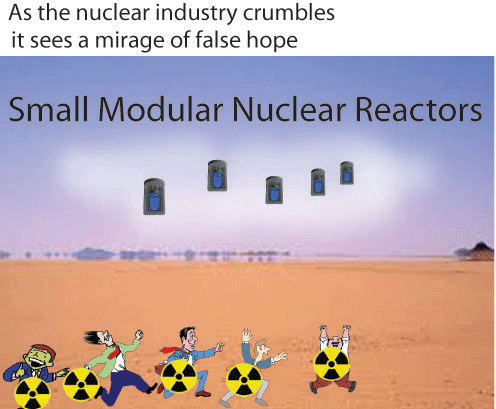
France will act as the shop window for exports of the new SMR technology — billed to be less powerful but easier to produce and run than conventional reactors — with EDF expected to begin building its first “Nuward” reactor in nine years
France’s nuclear drive offers chance of redemption for EDF
New commitments boost state-controlled utility but path ahead remains uncertain , Anna Gross and Sarah White in Paris Ft.com, 31 Oct 21, As the French government signals a future where nuclear power will play an integral rolein achieving carbon neutrality for the country by 2050 [ed. that is a spurious claim] , its state-controlled energy giant EDF remains encumbered by its past. Positioned at the heart of the nuclear debate in France and Europe, EDF struggles under a debt-laden balance sheet and a reputation for being unable to make novel nuclear technologies on time and on budget. But now President Emmanuel Macron has extended an olive branch and seemingly cleared a path for it to expand internationally and attract much-needed investment.
………..Created in 1946 by General Charles de Gaulle, EDF holds emotional power in France, Europe’s last bastion of nuclear power, and is linked with the nation’s industrial past and future. For years it was unclear if Macron, under pressure to move away from nuclear power towards renewables, would give the green light to new reactors long called for by EDF. Shortly after coming to power, Macron committed to reducing nuclear’s share of France’s electricity production from 75 to 50 per cent by 2035.
However, ambitious European climate goals, which hinge on pivoting to forms of energy that emit less carbon than fossil fuels, have put the spotlight on nuclear again and handed France an opportunity to assert its dominance in the field.
For EDF, thawing state tensions and confirmation of France’s desire for a nuclear future bring increased visibility to ensure it can keep training and hiring the people it will need and attract investment. That will be no small task for a company saddled with €41bn of debt and a colossal maintenance and investment programme to fund. UBS estimates a total investment requirement of more than €100bn for it to secure a 20-year life extension for 80 per cent of its nuclear fleet.
If approved, any government subsidies to fund six new reactors — estimated in leaked documents in 2019 to cost around €47bn — and the final price of the nuclear power produced by them, will ultimately be given the green light by Brussels. The cost of this funding could also be influenced by whether or not the EU includes nuclear energy in its taxonomy on “green finance”, making it a more attractive investment prospect. That decision has been delayed indefinitely because of infighting in the EU.
“Whether we can get financing at a low rate or super high rates completely changes the final cost. That’s the real subject, behind the gross number,” said Ursat. EDF faces other hurdles too, including the failure to reach a compromise with Brussels over the restructuring of the utility that would have allowed it to raise the regulated price at which it sells nuclear energy and ringfence some of its activities. It also needs to show it can deliver on its next-generation European Pressurised Reactor (EPR) technology, which it is planning to sell to India, Poland and the Czech Republic.
EPR reactors under construction in Europe — including Flamanville in France and Hinkley Point in the UK — are billions over budget and years behind schedule. The company’s previous chief financial officer quit over concerns about strains Hinkley Point was putting on EDF’s balance sheet.
These setbacks have led some investors and analysts to question EDF’s strategy and growth in the risky and costly field of nuclear power, were it not more than 80 per cent owned by the French government.
“The new reactor at Flamanville is not up and running yet, and some will want to see that project completed before France commits to more reactors with the same design,” said Sam Arie, an analyst at UBS. “From an investor point of view, is there interest in new nuclear projects? Not really.” However, recent soaring energy prices coupled with stringent climate goals seemed to have turned the tide in EDF’s favour. ……….
France will act as the shop window for exports of the new SMR technology — billed to be less powerful but easier to produce and run than conventional reactors — with EDF expected to begin building its first “Nuward” reactor in nine years. …….. https://www.ft.com/content/a1c95212-c122-4a29-8952-14a346381b91
UK’s new nuclear financing plan is a nightmare

Tax-and-spend budgets can be dispiriting. But at least Kwasi Kwarteng
squirrelled out a “£30 billion” consumer windfall this week.
Apparently, we’re going to be that much better off on “each new
large-scale” nuclear power plant he’s planning for Blighty.
And all
thanks to “a new funding model” — the regulated asset base, or RAB.
Where the business secretary has plucked his figure from is not exactly
clear. But it’s all part of his conversion to a new nuclear nirvana —
one all the more crucial, too, “in light of rising global gas prices”.
Yes, it’s debatable whether gas prices will still be on the up in, say,
2035 when a new Kwasi nuke might actually be built. But who cares about
that? Buried in the budget was the news ministers have set aside “£1.7
billion to enable a final investment decision” this parliament on a new
reactor (who else spends that sort of sum making a decision?) and is in
talks with EDF over Sizewell C in Suffolk.
On top, Kwarteng has dusted off
Wylfa on Anglesey, the project Hitachi spent four years trying to fire up
before jacking it in and writing off £2.1 billion. Apart from the
decade-long delays in getting built, construction cost overruns are
nuclear’s forte: France’s Flamanville, up from the initial €3.3
billion to €19.1 billion; Finland’s Olkiluoto, up from €3 billion to
€11 billion; and our very own Hinkley Point C, up from £18 billion to
£23 billion.
Kwarteng knows all that. But he’s calculated that the RAB
model, where consumers “contribute to the cost of new nuclear power
projects during the construction phase”, can not only attract private
investors but also allow lower electricity prices in the long run: his
so-called “£30 billion” saving.
For him, it beats the
“contracts-for-difference” template of Hinkley Point C. Both models are
deeply flawed. But the RAB is worse. First, because developers, and their
backers, have no incentive to keep costs down. Sure, there’d be an
independent regulator to rule on cost overruns.
But with investors making
their return on the size of the RAB, the more cost they can get past the
regulator, the better. And, second, because if the project keels over,
consumers are still left with the bill. “Nukegate” in America is proof
of that: two reactors in South Carolina built by Westinghouse that blew up
the company after costs ballooned from $9.8 billion to $25 billion. The
plants were never completed: a scandal leading to criminal lawsuits. But
consumers are still paying for the nukes: billions of dollars of costs,
making up 18 per cent of their electricity bills.
Guess what, too? Fresh
from Chapter 11 bankruptcy, it’s Westinghouse that Kwarteng fancies for
another go at Wylfa.
Times 30th Oct 2021
https://www.thetimes.co.uk/article/new-nuclear-plan-is-a-nightmare-63schq6ks
| R |
1 This Month



26 September – International Day for the Total Elimination of Nuclear Weapons


PLEASE OPPOSE HR 8255 AND S.3639 – bills would accelerate satellite deployment, with no environmental review or safeguards – https://ncstd5li.quorum.us/campaign/169331/
To see nuclear-related stories in greater depth and intensity – go to https://nuclearinformation.wordpress.com
-
Archives
- September 2026 (245)
- August 2026 (330)
- July 2026 (355)
- June 2026 (287)
- May 2026 (306)
- April 2026 (356)
- March 2026 (251)
- February 2026 (267)
- January 2026 (308)
- December 2025 (358)
- November 2025 (359)
- October 2025 (375)
-
Categories
- 1
- 1 NUCLEAR ISSUES
- business and costs
- climate change
- culture and arts
- ENERGY
- environment
- health
- history
- indigenous issues
- Legal
- marketing of nuclear
- media
- opposition to nuclear
- PERSONAL STORIES
- politics
- politics international
- Religion and ethics
- safety
- secrets,lies and civil liberties
- spinbuster
- technology
- Uranium
- wastes
- weapons and war
- Women
- 2 WORLD
- ACTION
- AFRICA
- Atrocities
- AUSTRALIA
- Christina's notes
- Christina's themes
- culture and arts
- Events
- Fuk 2022
- Fuk 2023
- Fukushima 2017
- Fukushima 2018
- fukushima 2019
- Fukushima 2020
- Fukushima 2021
- general
- global warming
- Humour (God we need it)
- Nuclear
- RARE EARTHS
- Reference
- resources – print
- Resources -audiovicual
- Weekly Newsletter
- World
- World Nuclear
- YouTube
-
RSS
Entries RSS
Comments RSS
 nuclear-news