Disputes over safety, cost swirl a year after California OK’d plan to keep last nuke plant running

Disputes over safety, cost swirl a year after California OK’d plan to keep
last nuke plant running. More than a year after California endorsed a
proposal to extend the lifespan of its last nuclear power plant, disputes
continue to swirl about the safety of its decades-old reactors, whether
more than $1 billion in public financing for the extension could be in
jeopardy and even if the electricity is needed in the dawning age of
renewables.
Daily Mail 10th Nov 2023
https://www.dailymail.co.uk/wires/ap/article-12733339/Disputes-safety-cost-swirl-year-California-OKd-plan-nuke-plant-running.html #nuclear #antinuclear #nuclearfree #NoNukes
No American money left for Ukraine – USAID
USAID’s help has enabled Ukraine to spend all of its own government revenue on its defense, including soldier salaries.
https://www.rt.com/news/586853-us-ukraine-humanitarian-funding-runs-out/ 10 Nov 23
Kiev faces economic collapse if new funding isn’t approved, an official has warned US lawmakers
The US government agency overseeing Washington’s humanitarian relief program for Ukraine has warned lawmakers that funding has run out, putting Kiev at risk of economic ruin if more money isn’t allocated amid the former Soviet republic’s conflict with Russia.
“We have no more direct budget support,” Erin McKee, an assistant administrator for the US Agency for International Development (USAID), testified on Wednesday to the Senate Foreign Relations Committee in Washington. “The last tranche was disbursed at the end of the fiscal year. This jeopardizes, particularly over the coming months, Ukraine’s ability to maintain its economic stability while it continues to fight the war. It’s urgent.”
The US government’s latest fiscal year ended on September 30. Ukraine has relied on Washington not only as its biggest provider of weaponry, but also for money to meet its non-military expenses. President Joe Biden has proposed a $106 billion emergency spending bill that combines aid to help Ukraine fight Russia and Israel fight Hamas. It also includes $9.2 billion in humanitarian aid tied to both conflicts.
McKee said USAID’s help has enabled Ukraine to spend all of its own government revenue on its defense, including soldier salaries. “That means they don’t have any resources to take care of their own people and govern,” she added.
Such outlays as paying teachers, police and health care workers would be suspended without new US funding being approved, McKee said. A prolonged funding disruption would cripple the Ukrainian economy, she claimed, giving Russian President Vladimir Putin the upper hand in the ongoing conflict. “If their economy collapses, Putin will have won.”
Congressional opposition to Biden’s Ukraine policy has grown in recent months. The Republican-controlled House of Representatives passed a $14 billion aid bill for Israel alone last week, leaving new funding for Ukraine to be decided separately. The Democrat-controlled Senate blocked the House bill on Tuesday, demanding that Biden’s bundled aid package be approved instead.
Congress previously approved $113 billion in Ukraine aid in four rounds of legislation. McKee warned that without the approval of a new tranche of funding, Ukraine’s government “would need to use emergency measures, such as printing money or not paying critical salaries, which could lead to hyperinflation and severely damage the war effort.”
Chess, cards and catnaps in the heart of America’s nuclear weapons complex

At Los Alamos National Laboratory, workers collect full salaries for doing nothing
Across those decades, the notion of keeping secrets from adversaries has simultaneously morphed into keeping secrets from the American public — and regulators.
| by Alicia Inez Guzmán. Searchlight New Mexico, 8 Nov 23 |
| A few days after beginning a new post at Los Alamos National Laboratory, Jason Archuleta committed a subversive act: He began to keep a journal. Writing in a tiny spiral notebook, he described how he and his fellow electricians were consigned to a dimly lit break room in the heart of the weapons complex. “Did nothing all day today over 10 hrs in here,” a July 31 entry read. “This is no good for one’s mental wellbeing or physical being.” |
“I do hope to play another good game of chess,” noted another entry, the following day.
A journeyman electrician and proud member of the International Brotherhood of Electrical Workers Local 611, Archuleta had been assigned to Technical Area 55 back in July. He had resisted the assignment, knowing that it was the location of “the plant,” a sealed fortress where plutonium is hewn into pits — cores no bigger than a grapefruit that set off the cascade of reactions inside a nuclear bomb. The design harks back to the world’s first atomic weapons: “Gadget,” detonated at the Trinity Test Site in New Mexico in 1945, and “Fat Man,” dropped on Nagasaki shortly afterward.
It has been almost that long since LANL produced plutonium pits at the scale currently underway as part of the federal government’s mission to modernize its aging stockpile. The lab, now amidst tremendous growth and abuzz with activity, is pursuing that mission with single-minded intensity. Construction is visible in nearly every corner of the campus, while traffic is bumper to bumper, morning and evening, as commuters shuttle up and down a treacherous road that cuts across the vast Rio Grande Valley into the remote Pajarito Plateau on the way to the famous site of the Manhattan Project.
But from the inside, Archuleta tells a different story: that of a jobsite in which productivity has come to a standstill. With few exceptions, he says, electricians are idle. They nap, study the electrical code book, play chess, dominoes and cards. On rare occasions, they work, but as four other journeymen (who all requested anonymity for fear of retaliation) confirmed, the scenario they describe is consistent. At any given time, up to two dozen electricians are cooling their heels in at least three different break rooms. LANL officials even have an expression for it: “seat time.”
The lab recognizes that the expansion at TA-55, and especially the plant, presents challenges faced by no other industrial setting in the nation. The risk of radiation exposure is constant, security clearances are needed, one-of-a-kind parts must be ordered, and construction takes place as the plant strives to meet its quota. That can mean many workers sit for days, weeks, or even, according to several sources, months at a time.
“I haven’t seen months,” said Kelly Beierschmitt, LANL’s deputy director of operations, “It might feel like months,” he added, citing the complications that certain projects pose. “If there’s not a [radiation control technician] available, I’m not gonna tell the craft to go do the job without the support, right?”
Such revelations come as red flags to independent government watchdogs, who note that the project is already billions of dollars over budget and at least four years behind schedule. They say that a workplace filled with idle workers is not merely a sign that taxpayer money is being wasted; more troublingly, it indicates that the expansion is being poorly managed.
“If you have a whistleblower claiming that a dozen electricians have been sitting around playing cards for six months on a big weapons program, that would seem to me to be a ‘where there is smoke, there is fire’ moment,” said Geoff Wilson, an expert on federal defense spending at the independent watchdog Project on Government Oversight.
Given the secrecy that surrounds LANL, it is virtually impossible to quantify anything having to do with the lab. That obsession is the subject of Alex Wellerstein’s 2021 book, “Restricted Data: The History of Nuclear Secrecy in the United States.” Wellerstein, a historian of science at Stevens Institute of Technology, traces that culture of secrecy from the earliest years of the Manhattan Project into the present. Across those decades, the notion of keeping secrets from adversaries has simultaneously morphed into keeping secrets from the American public — and regulators.
“What secrecy does is it creates context for a lack of oversight,” said Wellerstein in a recent interview. “It shrinks the number of people who might even be aware of an issue and it makes it harder — even if things do come out — to audit.”
The code of secrecy at LANL is almost palpable. The lab sits astride a forbidding mesa in northern New Mexico some 7,500 feet above sea level, protected on the city’s western flank by security checkpoints. Its cardinal site, TA-55, is ringed by layers of razor wire and a squadron of armed guards, themselves bolstered by armored vehicles with mounted turrets that patrol the perimeter day and night. No one without a federal security clearance is allowed to enter or move about without an escort — even to go to the bathroom. Getting that clearance, which requires an intensive background investigation, can take up to a year.
Sources for this story, veterans and newcomers alike, said they fear losing their livelihoods if they speak publicly about anything to do with their work. Few jobs in the region, much less the state (one of the most impoverished in the nation), can compete with the salaries offered by LANL. Here, journeyman electricians can earn as much as $150,000 a year; Archuleta makes $53 per hour, almost 70 percent more than electricians working at other union sites.
Nevertheless, in late September, Archuleta lodged a complaint with the Inspector General’s office alleging time theft. He and two other workers told Searchlight New Mexico that their timesheets – typically filled out by supervisors – have shown multiple codes for jobs they didn’t recognize or perform. To his mind, the situation is “not just bordering on fraud, waste and abuse, it’s crossing the threshold.”
………………………………………………………………………………………………………………………………………“By all the normal measures our society uses to evaluate cost, benefit, risk, reliability, and longevity, this latest attempt has now already failed as well,” said Greg Mello of the Los Alamos Study Group (LASG), a respected nonprofit that has been monitoring LANL for 34 years. “Federal decision makers will have to ask ‘Will the LANL product still be worth the investment,’” Mello said, referring to the plant, which will have exceeded its planned lifetime of 50 years by 2028.
The cogs of this arms race have been turning for years. In May 2018, a few months after President Donald Trump tweeted that he had a much “bigger & more powerful” nuclear button than North Korea’s Kim Jong Un, the Nuclear Weapons Council certified a recommendation to produce plutonium pits at two sites.
That recommendation was enacted into law by Congress, which in 2020 called for an annual quota of plutonium pits — 30 at LANL and 50 at the Savannah River plutonium processing facility in South Carolina — by 2030. According to the LASG, the cost per pit at LANL is greater than Savannah River. The organization estimates that each one will run to approximately $100 million.
Whether such production goals are achievable is another question: Just getting those sites capable of meeting the quota will cost close to $50 billion—and take up to two decades from the project’s start. After that, another half a century may pass before the nation’s approximately 4,000 plutonium pits are all upgraded, according to the calculations of Peter Fanta, former deputy assistant secretary of defense for nuclear matters.
…………………………………………………………………………………………………………………………………………………………Plutonium is one of the most volatile and enigmatic of all the elements on the periodic table. It ages on the outside like other metals, while on the inside, “it’s constantly bombarding itself through alpha radiation,” as Siegfried Hecker, a former LANL director and plutonium metallurgist put it. The damage is akin, in his words, to “rolling a bowling ball through [the plutonium’s] crystal structure.” Most of it can be healed, but about 10 percent can’t. “And that’s where the aging comes in.”
The renewed urgency dodges the most resounding “unanswered question at the heart of the U.S.’s nuclear arsenal,” Stephen Young, the Washington representative for the Global Security program at the Union of Concerned Scientists, wrote in “Scientific American.” “What is the lifetime of a pit?” And why hasn’t the NNSA — the federal agency tasked with overseeing the health of the nuclear weapons stockpile — dedicated the resources to finding out?
“It seems entirely possible that this was not an oversight on the part of NNSA but reflects that the agency does not want to know the answer,” Young went on. With novel warhead designs on the horizon, it was entirely plausible, he posited, that the NNSA wasn’t merely seeking to replace old pits but instead wanted to populate entirely new weapons — a desire driven less by science than by politics.
Booms and blind spots
This uncertainty has worked in LANL’s favor, propelling the mission forward and all but securing the lab’s transformation. As Beierschmitt, the deputy director of operations, publicly described the lab’s goals this summer: “Keep spending and hiring.”
Meanwhile, the Government Accountability Office, which investigates federal spending and provides its findings to Congress, has pointed to a gaping blind spot in the mission. A January report detailed how the NNSA lacked a comprehensive budget and master schedule for the entire U.S. nuclear weapons complex — essential for achieving the goal of producing 80 pits per year. The agency, in other words, has thus far failed to outline what it needs to do to reach its target — or what the overall cost will be, the GAO concluded.
“How much they’ve spent is pretty poorly understood because it shows up in so many different buckets across the budget,” said Allison Bawden, the GAO’s director of natural resources and environment. “We tried to identify these buckets of money ultimately tied to supporting the pit mission. But it’s never presented that way by NNSA, so it’s very difficult to look across the entire pit enterprise and say, ‘this is how much has been spent, and this is how much is needed going forward.’” The GAO includes the DOE on its biennial list of federal agencies most vulnerable to fraud, waste and abuse — and has done so since 1990. A major reason is the Möbius strip of contractors and subcontractors working on DOE-related projects at any given time.
The DOE, for instance, oversees the NNSA, which oversees Triad National Security — a company owned by Battelle Memorial Institute, the Texas A&M University and the University of California. Triad oversees its own army of subcontractors on lab-related projects, including construction, demolition and historic preservation. And many of those subcontractors outsource their work to yet other subcontractors, creating money trails so byzantine they defy tracking.
But one thing is known: Subcontractors will rake in billions of dollars. “We expect to be executing at least $5.5 billion in construction over the next five years and $2.5 billion in subcontracting labor and materials,” Beierschmitt said at a 2019 forum.
“Most people think that for something so giant and so supposedly important to the nation, there would be some kind of well-thought through plan,” said Mello of LASG. “There is no well-thought through plan. There never has been.”
Secrets on the plateau
……………………………………………….. Over time, systems at LANL and across the U.S. weapons complex have ossified into “their own little universes,” said Wellerstein, the science historian. “And when you combine that with the kind of contractor system they use for nuclear facilities, you create the circumstances where there’s very little serious oversight and ample opportunities and incentives for everybody to pat themselves on the back for a job well done…………………………………………………….. https://searchlightnm.org/chess-cards-and-catnaps-in-the-heart-of-americas-nuclear-weapons-complex/?utm_source=Searchlight+New+Mexico&utm_campaign=77629f0906-11%2F08%2F2023+-+Chess%2C+cards+and+catnaps&utm_medium=email&utm_term=0_8e05fb0467-77629f0906-395610620&mc_cid=77629f0906&mc_eid=a70296a261 #nuclear #antinuclear #nuclearfree #NoNukes #radioactive
NuScale Power, UAMPS agree to terminate nuclear project

Reuters, November 9, 2023
– NuScale Power (SMR.N) said on Wednesday it has mutually agreed with Utah Associated Municipal Power Systems (UAMPS) to terminate the company’s small modular reactors project, sending shares sliding 20% in extended trading.
The six-reactor, 462 megawatt Carbon Free Power Project was expected to be the first small modular reactor (SMR) design certified by the Nuclear Regulatory Commission in January. But NuScale said it appeared unlikely the project will have enough subscription to continue toward deployment.
NuScale said in January the target price for power from the plant is $89 per megawatt hour, up 53% from the previous estimate of $58 per MWh, a jump that raised concerns about whether customers would be willing to pay.
SMRs are meant to fit new applications such as replacing shut coal plants and being located in more remote communities.
So far, the design for only NuScale Power Corp’s SMR had been approved by U.S. regulators.
NuScale had previously said the project will be fully running in 2030.
Reporting by Manas Mishra in Bengaluru; Editing by Shounak Dasgupta and Krishna Chandra Eluri #nuclear #antinuclear #nuclearfree #NoNukes
Flagship US nuclear reactor project collapses owing taxpayers $600m

Ben Potter, Australian Financial Review, 9 Nov 23
A flagship US small modular nuclear reactor project has collapsed, taking with it $US600 million ($930 million) of American taxpayers’ money.
Develop NuScale said the Portland, Oregon-based company and Utah Associated Municipal Power Systems (UAMPS) had agreed to terminate their Carbon Free Power Project after cost blowouts scared off potential customers.
“It appears unlikely that the project will have enough subscription to continue toward deployment,” NuScale said in a statement.
Its shares fell 30 per cent in after-market trade, on top of a 70 per cent decline for the year to date.
The Utah project to build a 462-megawatt small modular reactor was one of a handful aimed at demonstrating the commercial viability of SMRs.
The nuclear industry is pinning its hopes on the ambitious technology as a zero-carbon option for firming variable renewable energy after massive cost blowouts in conventional large-scale nuclear reactors in the US and UK.
It has been enthusiastically promoted by Opposition Leader Peter Dutton and his energy spokesman Ted O’Brien. However, Energy and Climate Change Minister Chris Bowen and local experts such as The Grattan Institute’s Tony Wood have dismissed the technology as too costly and too far away in terms of implementation to be of use to Australia’s faltering grid decarbonisation.
A small modular reactor project being pursued by Ontario Power Generation remains on foot.
……………………………………………………..Reuters reported the US Department of Energy had agreed to provide $US1.35 billion to the collapsed project over 10 years, of which about $US600 million had been disbursed since 2014.
Municipal participants in the project were unnerved when the indicative wholesale cost of power from the Utah project jumped to $US89 per megawatt hour ($A137/MWh) from $US58/ MWh last January.
Mr Bowen said: “The opposition’s only energy policy is small modular reactors. Today, the most advanced prototype in the US has been cancelled. The LNP’s plan for energy security is just more hot air from Peter Dutton.” ……………………………………. https://www.afr.com/policy/energy-and-climate/flagship-us-nuclear-reactor-project-collapses-owing-taxpayers-930m-20231109-p5eit0 #nuclear #antinuclear #nuclearfree #NoNukes
Business complications for SMR companies X-energy and NuScale – 6 November last day of trading in public shares

NEI Magazine, 3 November 2023
US-based X-Energy Reactor Company and publicly-traded special purpose acquisition company Ares Acquisition Corporation (AAC), have mutually agreed to terminate their previously announced business combination agreement with immediate effect. ……. X-energy and AAC agreed not to proceed with the transaction citing “challenging market conditions, peer-company trading performance and a balancing of the benefits and drawbacks”.
……………………………………….Neither party is required to pay the other a termination fee as a result of the mutual decision to terminate the agreement. AAC determined that it will not be able to consummate an initial business combination within the time period required by its amended and restated memorandum and articles of association and intends to dissolve and liquidate. AAC anticipates that the last day of trading in the public shares will be 6 November…………………….
NuScale is also facing difficulties after a lengthy report by Iceberg Research entitled “Nuscale Power ($SMR): A fake customer and a major contract in peril cast doubt on NuScale’s viability”. Iceberg alleged that NuScale had sold 24 reactors to a “fake customer”. This referenced a deal NuScale announced in October to supply Standard Power with 1,848 MWe of power provided by 24 SMRs to power two US data centre sites. Iceberg predicts Standard Power will be unable to support the contract.
……………………………….. The Standard Power deal is bigger than NuScale’s other contract, with the government-backed Carbon Free Power Project (CFPP) to provide Utah Associated Municipal Power Systems (UAMPS) with 462 MWe. Iceberg said NuScale has “around 15 months before its cash runs out” and that the UAMPS contract is reaching a crucial stage. Overall shares in NuScale have fallen around 75% since their peak in late 2022, from around $14 to around $3.5……………………………………………………………………………… https://www.neimagazine.com/news/newsbusiness-complications-for-smr-companies-x-energy-and-nuscale-11268599. #nuclear #antinuclear #nuclearfree #NoNukes #smr
Small modular nuclear reactor merger plan falls through

X-energy, Ares drop merger plan, 31 October 2023
Small modular reactor (SMR) and advanced fuel technology developer X-Energy Reactor Company – known as X-energy – and Ares Acquisition Corporation (AAC) have “mutually agreed to terminate their previously announced business combination agreement, effective immediately”.
In December last year, X-energy and AAC – a publicly traded special purpose acquisition company affiliated with global alternative investment manager Ares Management Corporation – entered into a definitive business combination agreement. The combination was set to establish X-energy as a publicly traded company, a move that was expected to accelerate the company’s growth strategy.
………………………………….., given challenging market conditions, peer-company trading performance and a balancing of the benefits and drawbacks of becoming a publicly traded company under current circumstances, X-energy and AAC jointly determined that it was the best course of action at this time not to proceed with their previously announced transaction.”
……………………….”In view of the termination of the Business Combination Agreement, AAC determined that it will not be able to consummate an initial business combination within the time period required by its amended and restated memorandum and articles of association,” the statement said. “As such, AAC intends to dissolve and liquidate in accordance with the provisions of the articles.”
X-energy is the developer of the Xe-100 pebble bed high-temperature gas reactor…………………… https://www.world-nuclear-news.org/Articles/X-energy,-Ares-drop-merger-plan #nuclear #antinuclear #nuclearfree #NoNukes
Macron pursues nuclear deals in Russia’s back yard
French president hopes to secure uranium supply in Kazakhstan and Uzbekistan.
Politico, BY GIORGIO LEALI, OCTOBER 31, 2023
PARIS — French President Emmanuel Macron travels on Wednesday to Kazakhstan and Uzbekistan, where he hopes to secure uranium for his country’s nuclear plants.
The trip comes as geopolitical tensions grow with the EU’s current major suppliers, Niger and Russia.
Macron’s visit to the two countries aims to expand French influence in an area which has strong ties with Russia and is now also growing closer to China, an Elysée official said………………….
Last summer a military junta took over Niger, which supplies 15 percent of France’s uranium needs, sparking questions as to whether the African country can continue to be a reliable source. Uncertainty has also surrounded imports of Russian uranium since Moscow’s invasion of Ukraine.
“Niger raises questions, Russia could raise questions in the long term [if] the EU imposes sanctions on the nuclear sector.
An Elysée official said that new contracts and business partnerships will be announced during the trip, including in the energy sector. ………………………………………………………………………..
EDF has also positioned itself to become a supplier of nuclear reactors for Kazakhstan’s first nuclear plant.
The visit comes as Brussels competes with China for influence in the region via investment programs focused on infrastructure.
Both Kazakhstan and Uzbekistan are benefitting from Chinese investment under Beijing’s Belt and Road Initiative, with their presidents attending a high-level meeting on the subject in Beijing in October. The EU is trying to gain influence in the two countries by involving them in cooperation and investment projects under its “Global Gateway” initiative, the bloc’s response to Belt and Road. https://www.politico.eu/article/emmanuel-macron-nuclear-deal-russia-back-yard-kazakhstan-uzbekistan/ #nuclear #antinuclear #nuclearfree #NoNukes
Reports Expose US Billionaires and Corporate Profiteers Enabling Israel’s War on Gaza
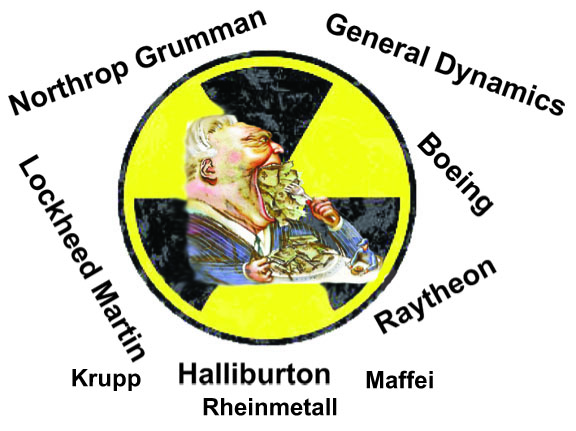
“As the Biden administration attempts to deny the death toll of Israel’s campaign of mass murder in Gaza and sell genocide as a stimulus for the U.S. economy, these are the death merchants profiting from the war machine.”
By Jessica Corbett / Common Dreams, October 29, 2023
With more than 7,300 Palestinians killed so far in Israel’s three-week bombardment of Gaza, a series of reports this week have exposed how U.S. weapon-makers and billionaire donors are enabling what legal scholars say could amount to genocide.
After Israel declared war in response to Hamas killing over 1,400 Israelis and taking around 200 hostages, the stocks of major American and European war profiteers soared. A Thursday report from Eyes on the Ties—the news site of LittleSis and Public Accountability Initiative—targets five U.S. firms with a record of providing weaponry to Israel.
The outlet stressed that while announcing a supplemental funding request that includes $14.3 billion for Israel, U.S. President Joe Biden last week “invoked ‘patriotic American workers’ who are ‘building the arsenal of democracy and serving the cause of freedom,’ but it’s the defense company CEOs who rake in tens of millions a year, and Wall Street shareholders, who are the real beneficiaries of warmongering.”
The five targeted industry giants collectively recorded $196.5 billion in military-related revenue last year, Eyes on the Tiesreported. They are Boeing ($30.8 billion), General Dynamics ($30.4 billion), Lockheed Martin ($63.3 billion), Northrop Grumman ($32.4 billion), and RTX, formerlyRaytheon ($39.6 billion).
“The top shareholders in these five defense companies largely consist of big asset managers, or big banks with asset management wings, that include BlackRock, Vanguard, State Street, Fidelity, Capital Group, Wellington, JPMorgan Chase, Morgan Stanley, Newport Trust Company, Longview Asset Management, Massachusetts Financial Services Company, Geode Capital, and Bank of America,” the news outlet noted.
Eyes on the Ties also highlighted how chief executives are handsomely compensated—and the CEOs’ ties to Big Pharma, the fossil fuel industry, Wall Street, and foreign policy think tanks such as the Council on Foreign Relations and Center for Strategic and International Studies.
According to the report:
- Boeing CEO David Calhoun took in over $64 million in total compensation from 2020-22 and as of February held 193,247 shares;
- General Dynamics CEO Phebe N. Novakovic took in over $64 millionin total compensation from 202-22 and as of March held 1,616,279shares;
- Lockheed Martin CEO Jim Taiclet took in over $66 million in total compensation from 2020-22 and as of February held 56,054 shares;
- Northrop Grumman CEO Kathy J. Warden took in over $61 million in total compensation from 2020-22 and as of March held 161,231shares; and
- RTX CEO Gregory J. Hayes took in over $63 million in total compensation from 2020-22 and as of February held 801,339 shares.
Other reporting this week has taken aim at those CEOs for their suggestions that Israel’s assault on Gaza is good for business.
During Lockheed Martin’s latest earnings call, Taiclet correctly predicted Biden’s request last week, saying that “there continues to be the option… for supplemental requests related to support Ukraine, Israel, and potentially Taiwan.”
In addition to the request for Israel—which already gets nearly $4 billion in annual U.S. military aid—Biden asked for $4 billion to counter Chinese influence in the Indo-Pacific region and $61.4 billion more for Ukraine, which is battling a Russian invasion. …………………………………………………
It’s not just defense executives enabling Israel’s mass slaughter of civilians in Gaza. As Eyes on the Ties reported, “Lobbying groups including the American Israel Public Affairs Committee (AIPAC) and Democratic Majority for Israel have been active in Washington, calling on lawmakers to send money and weapons to Israel.”
The report names some billionaire donors to the lobbying groups, including New England Patriots and the Kraft Group CEO Robert Kraft, private equity investor Marc Rowan, venture capitalist Gary Lauder, hedge fund managers Daniel Loeb and Paul Singer, and Home Depot co-founder Bernard Marcus, who is also the founding president of the Israel Democracy Institute.
U.S. Rep. Summer Lee (D-Pa.) said Wednesday that Americans “know that funneling billions more dollars into arms dealers’ pockets won’t keep our children safe from weapons of war at home or across the world. It won’t keep our loved ones safe from toxins in our air and drinking water. They know that lining the pockets of weapons manufacturers won’t help families struggling to afford housing, medicine, or grocery costs. They know defense contractors won’t safeguard Medicare and Social Security or shield our communities against the climate crisis.”
Unlike the CEOs of firms like Lockheed Martin and RTX, “moms who can’t afford childcare, young folks who can’t pay off their debt, veterans who can’t keep up with housing costs, and children who go to school hungry don’t have million-dollar lobbying budgets,” added Lee, one of the few members of Congress pushing for a cease-fire in Gaza. “So it’s up to us to stand up for their needs.” https://scheerpost.com/2023/10/29/reports-expose-us-billionaires-and-corporate-profiteers-enabling-israels-war-on-gaza/ #Israel #Palestine
Nuclear Waste Management market is projected to grow at a CAGR of 1.4% by 2034: Visiongain
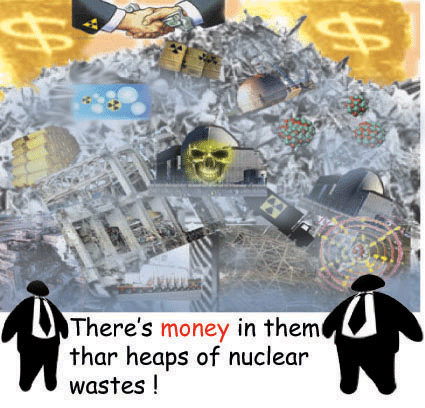
Yahoo! Finance, Visiongain Reports Ltd, Mon, October 30, 2023
Visiongain has published a new report entitled Nuclear Waste Management Market Report 2024-2034: Forecasts by Solutions (Waste Sorting, Waste Treatment and Conditioning, Waste Storage and Disposal), by Type (Very-Low-Level Waste (VLLW), Low-Level Waste (LLW), Intermediate-Level Waste (ILW), High Level Waste (HLW)), by Disposal Method (Transmutation, Seabed Disposal, Space Disposal, Encapsulation and Burial, Synthetic Rock Formations), by Source (Decommissioning/Remediation, Reactor Operations, Military and Defence Programs, Nuclear Applications, Fuel Reprocessing, Fuel Fabrication/Enrichment) AND Regional and Leading National Market Analysis PLUS Analysis of Leading Companies AND COVID-19 Impact and Recovery Pattern Analysis.
The global nuclear waste management market was valued at US$4,864.0 million in 2023 and is projected to grow at a CAGR of 1.4% during the forecast period 2024-2034.
Economic Viability: Balancing Costs and Long-term Commitments
Economic viability is a crucial factor in nuclear waste management endeavours. Companies must strategically balance initial investments in advanced technologies with long-term costs associated with waste containment and disposal. Effective financial planning ensures the availability of funds for continuous research, facility maintenance, and adherence to evolving regulatory requirements. Finding cost-effective solutions without compromising safety and environmental integrity is essential for the industry’s sustained growth and for ensuring that nuclear waste management remains both efficient and financially feasible………………………………………………………… more https://finance.yahoo.com/news/nuclear-waste-management-market-projected-090000621.html #nuclear #antinuclear #nuclearfree #NoNukes
Hinkley Point C nuclear station-£16.7bn overbudget: Estimated to be 5 years late
From
From HS2 to Wembley, why can’t Britain build on budget? Our
infrastructure projects are invariably late and over-budget compared with
European neighbours. Our planning system, political wrangling and a lack of
civil service expertise is to blame. Hinkley Point C: Final Cost £32.7bn:
£16.7bn overbudget: Estimated to be 5 years late. #nuclear #antinuclear #NoNukes
Times 29th Oct 2023 https://www.thetimes.co.uk/article/from-hs2-to-wembley-why-cant-britain-build-on-budget-9k6xgs8c6
Amid rising cost worries, UK government promises “practical nuclear roadmap”
Government promises ‘practical’ UK nuclear roadmap this year amid rising cost concerns.
Stuart Stone, 26 October 2023
Government agrees to map out route to 24GW nuclear target by 2050 and
allow Parliament to consider major investment value for money amid fears of
‘another HS2’.
The government has promised set out a “practical roadmap”
before the end of the year towards its goal of securing 24GW of nuclear
power capacity 2050, but MPs have raised concerns as to whether new nuclear
generation will offer value for money in light of the controversial
decision to cancel the northern leg of the HS2 high speed rail project.
In a letter to MPs on the Science, Innovation and Technology Committee (SITC)
yesterday, the government confirmed that a new Nuclear Strategic Plan is on
its way, and that it would spell out how the current reactor fleet will
contribute to UK targets and allow Parliament to weigh up value for money
of major new nuclear projects.
It follows a report from the SITC in July
which had called for greater detail on how the government plans to meet its
ambitious nuclear targets, as it cited the UK’s “intermittent history” with
regards to ramping up nuclear power capacity, with no new reactors having
been built in several decades. The report warned that UK nuclear capacity –
which currently contributes 15 per cent of the electricity needs – is set
to fall substantially by 2028 when all plants bar Sizewell B are scheduled
to reach the end of their operational lives.
Business Green 26th Oct 2023
https://www.businessgreen.com/news/4138819/government-promises-practical-uk-nuclear-roadmap-amid-rising-cost-concerns #nuclear #antinuclear #NoNukes
Why consumers are very likely to pay a lot more for power from Sizewell C than from Hinkley C
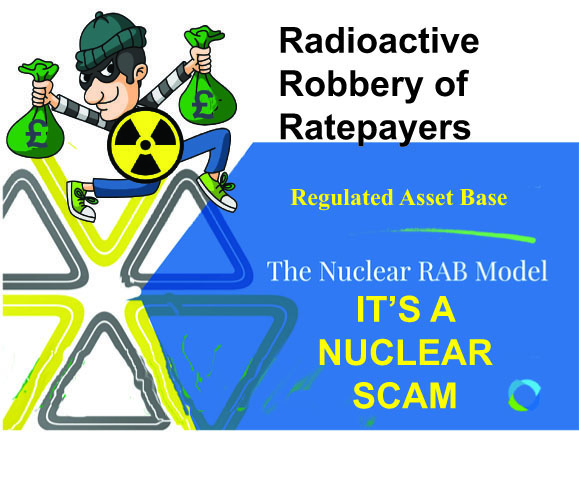
under the RAB mechanism, it seems that EDF will be paid for what they actually spend. This time it will be British, not French taxpayers and consumers, that will be paying for the cost overruns.
The Government are deceiving us about the cost effectivemess of their new funding mechanism for nuclear power
Dave Toke’s Green Energy Blog, DAVID TOKE, OCT 25, 2023
Consumers face a double whammy of bills to pay for the planned nuclear power plant, Sizewell C, due to be given a go-ahead soon. According to a ‘worst case scenario,’ consumers are likely to (collectively) pay around £34 billion in today’s prices before any electricity is generated from Sizewell C at all. But, in addition, according to my calculations, under this (quite likely) worst-case scenario consumers will then also pay around £160 per MWh in today’s prices for electricity produced by Sizewell C. This works out as £117 per MWh in 2012 prices (ie the base year for setting the cost of Hinkley C). The Government appears to be doing little or nothing to prevent this scenario from occurring.
Hence consumers could not only be paying much more per MWh than the controversially high Hinkley C deal (£92.5 per MWh in 2012 prices) but will also be paying large sums upfront before a kWh is even generated. In fact, despite being labeled as a ‘worst case scenario’, the estimate for Sizewell C costs that have been calculated is essentially based on the type of cost overrun experienced by attempts to build nuclear power plants in the West since 1990. That is nuclear construction costs end up being around double the amount initially budgeted.
I have taken the size of the upfront costs payable by consumers from an analysis done by Professor Stephen Thomas of Greenwich University. See also here. I have then taken his worst-case scenario figure for these upfront costs and converted them into a figure for costs per MWh by applying conventional economic tools. This involves using discounted cash flow analysis using a (real) 6 percent discount rate and assuming Sizewell C will be generating at an average of 90 percent of full capacity. This assumes using a contract type paying premium prices for energy generated similar to that used for Hinkley C (ie lasting for 35 years). I have based cost estimates of operating nuclear power plants on US experience, although operating costs form only a small element of the costs. The large bulk of the costs are concerned with repaying money loaned and invested in the power station.
My analysis runs contrary to the narrative spread by the Government. They claim that the so-called Regulated Asset Base (RAB) mechanism for funding new nuclear power plants will make nuclear power cheaper for the consumer. On the contrary, it is likely to allow more to be paid to EDF for Sizewell C compared to Hinkley C. This is because consumers will be responsible for paying cost overruns for Sizewell C whilst in the case of Hinkley C it is EDF that takes responsibility for cost overruns. The total amounts that consumers will have to pay will remain unknown until it is far too late to do anything to stop consumers from having their electricity bills dramatically increased………………..
The RAB mechanism has been lauded as a cost-saver because it allows EDF to pay lower interest rates on money borrowed to finance construction compared to the borrowing costs applicable to building Hinkley C. Money needed to finance interest payments and investors during the construction period is charged to consumers whilst the plant is being built.
There’s one giant flaw in this argument. The Government seems to be heading towards giving the go-ahead to EDF to start construction without agreeing a price to be paid for electricity. This means that consumers will pay for whatever it costs to build the plant. The costs of nuclear power stations seem always to be a lot more than what was estimated at the time of the ‘final investment decision’ (FID).
This is different from what happened with Hinkley C. In the case of Hinkley C EDF was committed to paying for any cost overruns themselves without being paid any extra money. ………… EDF bears responsibility for these cost overruns – in effect the French taxpayers will pay since EDF is owned by the French Government.
Yet under the RAB mechanism, it seems that EDF will be paid for what they actually spend. This time it will be British, not French taxpayers and consumers, that will be paying for the cost overruns. OFGEM is being given responsibility for organising payments to EDF.
Ultimately, it seems, OFGEM will be the ‘fall guy’ when, many years down the line, there is public controversy over the costs of the power from Sizewell C. In an obscure piece of wording in an obscure document entitled ‘Revenue Stream for the nuclear RAB model’, the government says (page 12) ‘The amount a relevant licensee nuclear company is allowed to receive (‘allowed revenue’) in respect of its activities relating to the design, construction, commissioning, and operation of the relevant nuclear project would be determined by Ofgem’.
In other words, EDF will have virtually a blank cheque to pay all their costs. The only control OFGEM will have is to check that the costs have actually been spent or will be spent on the power plant.
People were surprised at the cost of the Hinkley C contract, but the surprise was based on the public being kept in ignorance of nuclear construction costs in the past. Now the Government has learned its lesson, and we shall see a return to the past practice of the public being kept in the dark about the costs of building nuclear power plants…………………………………………… https://davidtoke.substack.com/p/why-consumers-are-very-likely-to
Faulty coolant pump delays commissioning of Vogtle 4 nuclear reactor: project cost now over $30Billion

US Georgia Power has reported the discovery of a malfunctioning coolant
pump at unit 4 of its Vogtle NPP, resulting in a delay in commissioning of
the unit. The problem in one of the reactor’s four pumps was found during
pre-operational testing and startup of the unit, which had been expected
begin operation later this year. Instead, the reactor now is forecast to
begin operations in the first quarter of 2024.
Fuel loading at Vogtle 4 began in August. Unit 3 began commercial operation at the end of
July. Vogtle 3&4 are both 1,117 MWe Westinghouse AP1000 pressurised water
reactors (PWRs). The two units were originally expected to cost about $14bn
and to enter service in 2016 and 2017 but suffered a series of delays,
including Westinghouse’s bankruptcy in 2017.
The total cost of the project
to build Vogtle 3&4 is now put at more than $30bn. Georgia Power owns 45.7%
of the project; Oglethorpe Power Corp owns 30%; the Municipal Electric
Authority of Georgia (MEAG) owns 22.7%; and the city of Dalton owns 1.6%.
The units will be operated by Southern Nuclear.
Nuclear Engineering International 11th Oct 2023
https://www.neimagazine.com/news/newsfaulty-coolant-pump-delays-commissioning-of-vogtle-4-11210696 #nuclear #antinuclear #NoNukes #NuclearCosts
The future of Luc Rémont at the head of EDF called into question by tensions over the regulation of electricity prices.
The differences between
the government and EDF, which are currently discussing the future
regulatory framework for electricity prices, make several officials of the
public company fear a possible resignation of Luc Rémont, the group’s CEO.
L’Usine Nouvelle 25th Oct 2023
1 This Month

of the week – Shut Down Drone Warfare!


Tell the Ukrainian Government to Drop Prosecution of Peace Activist Yurii Sheliazhenko

Petition to revoke the licensing of the Near Surface Nuclear Disposal Facility (NSDF) at Chalk River. https://www.ourcommons.ca/petitions/en/Petition/Details?Petition=e-7247
To see nuclear-related stories in greater depth and intensity – go to https://nuclearinformation.wordpress.com
-
Archives
- April 2026 (114)
- March 2026 (251)
- February 2026 (268)
- January 2026 (308)
- December 2025 (358)
- November 2025 (359)
- October 2025 (376)
- September 2025 (257)
- August 2025 (319)
- July 2025 (230)
- June 2025 (348)
- May 2025 (261)
-
Categories
- 1
- 1 NUCLEAR ISSUES
- business and costs
- climate change
- culture and arts
- ENERGY
- environment
- health
- history
- indigenous issues
- Legal
- marketing of nuclear
- media
- opposition to nuclear
- PERSONAL STORIES
- politics
- politics international
- Religion and ethics
- safety
- secrets,lies and civil liberties
- spinbuster
- technology
- Uranium
- wastes
- weapons and war
- Women
- 2 WORLD
- ACTION
- AFRICA
- Atrocities
- AUSTRALIA
- Christina's notes
- Christina's themes
- culture and arts
- Events
- Fuk 2022
- Fuk 2023
- Fukushima 2017
- Fukushima 2018
- fukushima 2019
- Fukushima 2020
- Fukushima 2021
- general
- global warming
- Humour (God we need it)
- Nuclear
- RARE EARTHS
- Reference
- resources – print
- Resources -audiovicual
- Weekly Newsletter
- World
- World Nuclear
- YouTube
-
RSS
Entries RSS
Comments RSS
 nuclear-news