Rolls Royce misses out on government funding for their small nuclear reactors
Rolls-Royce Holdings PLC shares faced a blow as X-energy and Cavendish
Nuclear were awarded £3.34 million from the government to build
mini-nuclear reactors in Hartlepool. These funds will aid X-energy and
Babcock International PLC owned Cavendish’s plans to build 12 mini nuclear
generators, known as small modular reactors, in the County Durham town by
the early 2030s.
Proactive Investor 5th April 2024
America’s crazed proxy war on Russia is destroying Ukraine’s economy

Walt Zlotow, West Suburban Peace Coalition, Glen Ellyn IL 7 Apr 24
I’m no economist. But you don’t need to be one to figure out the economic catastrophe the US has imposed on its Trojan Horse Ukraine in its lust to weaken Russia.
Most opponents of this endless US debacle focus on the hundreds of thousands dead Ukrainian soldiers without a single US death to weaken, isolate Russia.
But we should not ignore the economic basket case Uncle Sam has created, essentially degrading life for every Ukrainian not yet killed.
Since goading Russia into invading 26 months ago, Ukraine has ceased to exist as an economically independent nation. Its exports have largely vanished, its imports have exploded. Ukraine has gone from a surplus exporter to a massive importer. That dries up foreign currency making the paying for further imports, even the national debt, increasingly problematic.
Exports plummeted by 17% and 30% respectively in ’22 and ’23. Imports? More than doubled since America’s disastrous, losing proxy war crossed the Red Line to invasion.
Ukraine now spends half its GDP on defense that’s accomplishing nothing but more soldier cemeteries and spiraling economic collapse. Its borrowed over $40 billion in last 2 years, a 200% increase compared to the previous 10 years. Its external debt is now 90% of GDP and heading north to 140% by 2026 according to EU estimates.
All this could have been avoided had the US realized 33 years ago that the Soviet Union’s demise meant the true end to the Cold War. Now, having turned the Cold War into a Hot War destroying Ukraine, America’s crazed leaders, including most Democrats and Republicans, lust for another $61 billion in weapons that will prolong the flow of red blood and red ink.
And the Big Fool in the White House just says ‘Push on.’
Dounreay workers vote to strike
Workers at the Dounreay nuclear power complex in Caithness have voted to
strike after long-running pay talks stalled. The GMB union said members at
the plant had overwhelmingly backed industrial action including strikes,
working to rule and an overtime ban. It comes after a pay offer was
rejected. GMB said its vote delivered a “crushing majority” on a
turnout of 85%. Other unions, Unite and Prospect, are also balloting
members.
Press and Journal 4th April 2024
The cost of Europe’s new nuclear power plants.
By Paul Messad | Euractiv France, 5 Apr 24
An alliance of 15 pro-nuclear EU member states said the EU needs an additional 50 GW of nuclear power by 2050 to meet energy transition targets, requiring the construction of more than 30 new reactors.
The additional 50 GW of nuclear capacity is estimated to cost between €5 and €11 billion per GW, a range that “shows a great deal of uncertainty and a big difference in the assumptions”, energy economist Professor Jaques Percebois told Euractiv.
Basic assumptions
When costs are expressed in terms of electricity production (measured in kWh, GWh), they take into account the total cost of generating unit of power: investment in construction, operation (day-to-day running, maintenance, etc.) and fuel (loading, life cycle, etc.). This is the Levelised Cost of Energy (LCOE).
However, estimates often focus on the investment costs required to construct the plant (measured in kW, GW)
“Because it represents around 70% of the cost of a new reactor while operating costs represent only around 15% and fuel costs around 15% of the total amount,” explained Percebois.
Different estimates may include or exclude costs associated with decommissioning plants and treating the waste. Cost figures can also be strongly impacted by assumptions about external factors like future inflation rates………………………………..
Any country wishing to subsidise nuclear plant construction needs to navigate EU State aid rules. A number of member states are also calling for the possibility of dipping into European funds to finance nuclear power, or even to set up new dedicated funds.
Support for financing from publicly-backed banks, such as the European Investment Bank (EIB), can also prove decisive………………………………………………………………………………………………..
More clarity needed
This mix of factors explains the wide variations in cost estimates for new nuclear. However, at some point it will be necessary “to have figures” warns Percebois, if only to estimate funding requirements…………. https://www.euractiv.com/section/energy-environment/news/nucleaire-comment-definir-le-cout-des-futurs-reacteurs-en-europe/
Inside Sellafield behind the razor wire gun- toting guards and blast barriers at the toxic nuclear site

The 700-acre Sellafield complex means different things to different
people. To UK authorities it is a decommissioning hub being used to
spearhead the clean-up of Britain’s early nuclear industry mistakes, made
before the issue of long-term waste disposal was a priority.
In Ireland,
about 180km away, Sellafield is mostly seen as a potential hazard, a byword
for danger. A former reprocessing site for lethal spent nuclear fuel rods,
it was also known for a now-defunct power plant that was tacked on, Calder
Hall, but this was only ever a minor part of it. Reprocessing was the main
activity.
These days, Sellafield is seen as more of a nuclear dump for the
most radioactive material from all over the UK, with work ongoing in a
100-year, £134 billion (€156 billion) decommissioning project.
Yet another view of Sellafield: in the eyes of one nuclear industry source, the
site is a “gravy train” for well-paid staff and big contractors. Sellafield Ltd, the site’s UK state-owned operator whose mission is to make it safe, spends more than £2.5 billion each year on the clean-up strategy. It is also a bustling 24-hour workplace for 11,000 people paid an
average of €91,000 each annually.
The site’s critics, including the UK academic and radioactivity adviser to the Irish State, Dr Paul Dorfman, warn that the nuclear industry tries to dazzle outsiders with glossy public
relations. Sellafield, meanwhile, says it is only trying to be honest and
open about what it does.
The company, which answers to the UK government
through the Nuclear Decommissioning Authority (NDA), confirms that The
Irish Times is the first media outlet from the Republic to be granted
recent access to the site and its inner sanctum, where the most dangerous
nuclear material is handled. Thirty years after U2′s Bono landed on a
nearby beach in a Greenpeace protest, and almost 20 years after the
Republic last tried to sue the UK over its safety risks, its existential
relevance to Ireland remains.
Sellafield hasn’t gone away, you know. The battle to keep it safe goes on.
Irish Times 30th March 2024
Russia’s state-owned energy company Rosatom is drumming up new nuclear business in Africa
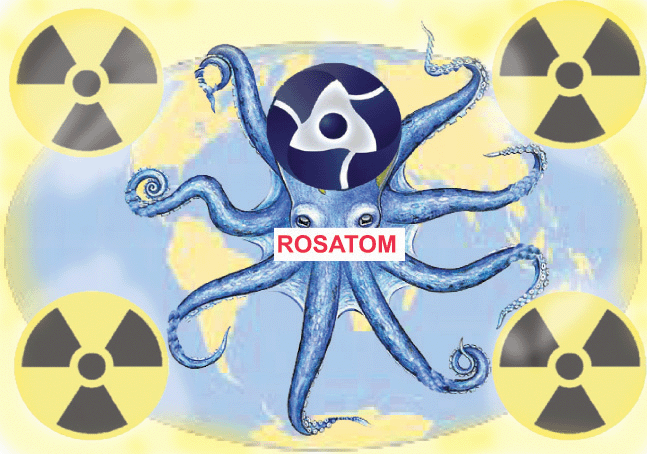
As the sabre-rattling over possible sanctions against Russia’s nuclear
industry intensifies, the country’s state-owned energy company Rosatom is
busily drumming up new business in Africa.
Last month, speaking at the
African Energy Indaba in Cape Town, Rosatom’s chief executive for central
and southern Africa, Ryan Collyer, urged the continent’s most
industrialised country, South Africa, to press go on its nuclear programme
to ensure “stable, affordable and environmentally friendly” power. It
was a message that resonated with South Africa’s energy minister Gwede
Mantashe, who said the country, which has been battling electricity
blackouts for the past 16 years, expects nuclear energy to be part of the
fix.
“The proposal to develop 2,500MW of nuclear power is not a dream —
there’s already an agreement, and the procurement capacity is being
worked on. We’re going to be investing in that capacity,” he told the
conference. While nuclear power provides about 10 per cent of electricity
generated globally, according to the Paris-based International Energy
Agency, the Koeberg plant in Cape Town is the only nuclear power station on
the African continent. Yet a number of African countries have announced
plans to build nuclear power plants in the past year — including Uganda,
Rwanda and Kenya.
FT 2nd April 2024
https://www.ft.com/content/4f1d0d1d-3a98-4b03-8771-54d88ed0a023
United Arab Emirates in talks to invest in European nuclear power infrastructure
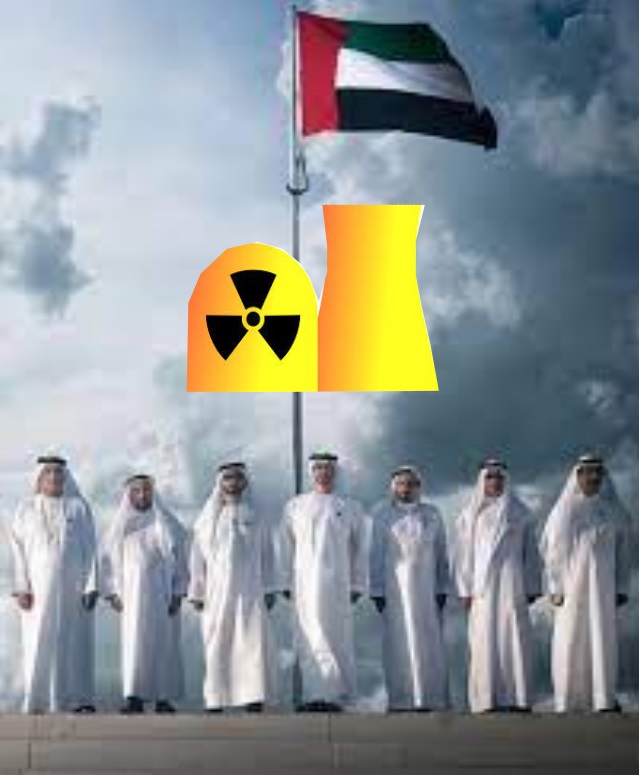
The United Arab Emirates (UAE) is exploring opportunities to invest in
nuclear power infrastructure across Europe, including in Britain, Reuters
has reported.
The state-owned Emirates Nuclear Energy Company (ENEC) is
considering becoming a minority investor in several nuclear power assets.
ENEC, which is owned by Abu Dhabi’s investment fund, the Abu Dhabi
Developmental Holding Company, has ambitions to expand its international
footprint by acquiring minority stakes in nuclear projects.
The company has
been in discussions to invest in the UK, specifically in the Sizewell C
nuclear project, which is currently seeking additional private investment
following the exit of a Chinese investor. Alongside Saudi Arabia, the UAE
is looking to diversify its economy beyond oil, while Britain is actively
seeking private investment to support its nuclear energy ambitions.
Power Technology 2nd April 2024
https://www.power-technology.com/news/uae-invest-european-nuclear-infrastructure
United Arab Emirates signals interest in European nuclear energy investments, sources say
ENEC has ambitions of becoming an international nuclear energy company holding minority stakes in nuclear power infrastructure of other nations, without managing or operating them.
A lack of investment, cost overruns and delays have also plagued recent projects.
It could also face political opposition to an investment in such a sensitive area.
29/03/2024 , By Alexander Cornwell and Maha El Dahan, https://uk.investing.com/news/commodities-news/uae-signals-interest-in-european-nuclear-energy-investments-sources-say-3408307
DUBAI (Reuters) – The United Arab Emirates has approached European nations including Britain to gauge their interest in the Middle Eastern state investing in their nuclear power infrastructure, according to three sources familiar with the talks.
As part of its outreach, the UAE has discussed the idea of state-owned Emirates Nuclear Energy Company (ENEC) becoming a minority investor in European nuclear power assets, the sources said. They requested anonymity because the discussions are private.
ENEC has ambitions of becoming an international nuclear energy company holding minority stakes in nuclear power infrastructure of other nations, without managing or operating them, the sources told Reuters.
ENEC, owned by Abu Dhabi’s ADQ, has been holding talks to invest in the United Kingdom, the sources who have been briefed on the discussions added, without elaborating. Cash-rich oil producers United Arab Emirates and Saudi Arabia are seeking to diversify their economies away from fossil fuels. Meanwhile, Britain is looking for additional private investment in the Sizewell C large-scale nuclear project being built by French energy giant EDF (EPA:EDF) in southeast England after buying out a China backer.
The UAE and Britain in December signed a so-called memorandum of understanding on civil nuclear cooperation at the U.N. climate summit in Dubai, where more than 20 countries agreed a pledge to treble nuclear capacity by 2050.
“Sizewell C is a crucial part of the UK’s agenda for new nuclear power, which is central to our plans for achieving a low cost, clean and secure electricity system,” a spokesperson for Britain’s Department for Energy Security and Net Zero told Reuters.
“The commercial structure of the project is subject to ongoing development and commercially sensitive discussions,” the spokesperson said, adding they could not comment further.
As part of “international growth and investment plans, ENEC is working with a multitude of partners to explore collaboration opportunities in both new civil nuclear projects and civil nuclear technologies and related clean energy technologies such as clean hydrogen,” ENEC said in a statement to Reuters.
EDF declined to comment.
The UK and EDF are ‘on track’ to raise 20 billion pounds ($25.2 billion) for Sizewell C by end of year, a UK energy security minister told the Financial Times in January, without naming the investors. UK ministers have been lining up Abu Dhabi investors for Sizewell C, the Times of London reported last year.
The sources told Reuters that, among the proposals, ENEC could also be a partner in the development of new nuclear energy infrastructure in European countries given its relatively recent experience in building a facility.
ENEC oversaw the construction of the UAE’s sole nuclear power plant, which was constructed in Abu Dhabi by Korea Electric Power Corp (KEPCO), and started commercial operations in 2021.
Several European countries are pushing to expand nuclear – a low-carbon energy source – in an effort to meet ambitious climate goals and develop alternatives to Russian energy supplies.
But European Union states are divided over nuclear energy use, which fell out of favour over safety concerns following Japan’s Fukushima nuclear accident in 2011.
A lack of investment, cost overruns and delays have also plagued recent projects.
ENEC’s backing by a wealthy Gulf state could potentially help overcome investment challenges. However, it could also face political opposition to an investment in such a sensitive area.
Emirati state investments have recently raised concerns in Britain, which has blocked a state-linked acquisition of prominent conservative newspaper the Telegraph.
Britain’s government also determined that a recent investment by UAE state-linked telecommunications company E& posed national security concerns, although approved the deal.
($1 = 0.7925 pounds)
UK’s ever more expensive nuclear submarines will torpedo spending plans for years to come.

Jasper Jolly and Alex Lawson, https://www.theguardian.com/business/2024/mar/31/uks-ever-more-expensive-nuclear-submarines-will-torpedo-spending-plans-for-years-to-come
Whoever wins the next election, a reckoning is overdue on the costs of Britain’s nuclear deterrent.
When Rishi Sunak visited Barrow-in-Furness on Monday he said the Cumbrian town was “mission critical for our country” because of its role building four new nuclear submarines to carry the UK’s nuclear weapons. If you believe Sunak’s erstwhile ally, Dominic Cummings, then that mission faces serious problems.
Cummings, once Boris Johnson’s most powerful adviser, said this month – in characteristically aggressive terms – that spiralling costs were making a mockery of the government’s budget plans. He wrote on X: “the nuclear enterprise is so fkd [sic] it’s further cannibalising the broken budgets and will for decades because it’s been highly classified to avoid MPs thinking about it.”
But the scale of the issue makes it hard to ignore. The government reiterated last week that the four new Dreadnought class submarines would cost £31bn plus a £10bn “contingency”. But the Nuclear Information Service (NIS), a monitoring group, said in 2019 that the full cost of the nuclear weapons programme between 2019 and 2070 could be £172bn, when including new warheads and running costs.
Costs are also increasing rapidly, as the government has prioritised replacing the existing Vanguard submarines on time rather than on budget. (The Vanguard boats launch Trident nuclear missiles – like the one that crashed into the sea during a test last month.)
The Ministry of Defence puts the cost of the programme to replace the UK’s nuclear weapons at £118bn over the next decade. That is already £8bn more than the Treasury has forecast, suggesting something may have to give elsewhere.
The National Audit Office, a government watchdog, found in December that forecasts of costs of the MoD’s Defence Nuclear Organisation had risen by £38.2bn in the past year.
However it is counted, hugely costly delays and overruns, plus inflation, mean a reckoning is overdue on the costs of Britain’s nuclear submarines.
“They don’t have very many good options,” said David Cullen, director of the NIS. He said the problems appeared so intractable that it could affect the UK’s continuous at-sea deterrence – the longstanding policy of always having a nuclear-armed submarine gliding silently under the waves in case of attack.
“It would be much better for them to make a conscious decision to stop having constant patrols, rather than having it forced on them,” he said.
Nuclear submarines are among the most complicated machines ever built. They sustain 132 humans deep beneath the oceans, needing to surface only when its crew runs out of food – or runs out of patience during months without daylight.
The Labour party, eyeing power in an imminent election, has a decision over whether to confront the problem head-on – and add billions to already constrained budgets – or to continue with the sticking-plaster approach.
One thing Labour has said it will not do – to the chagrin of campaigners particularly aligned with the left of the party – is accept the UK’s diminished role in world affairs by scrapping the nuclear deterrent. David Lammy and John Healey, shadow foreign secretary and defence secretary respectively, wrote in September that “with Keir Starmer, our commitment to Nato and the UK’s nuclear deterrent – maintained on behalf of Nato allies – is unshakeable”.
Some in the defence industry believe Labour could, if elected, choose to launch an inquiry into the entire nuclear defence enterprise – which might allow it to blame the current government and help ease the blow from a big hit to its budget. However, a Labour source said the lack of visibility into classified plans meant it was not yet able to work out a detailed strategy.
One way to help government finances might be to share costs. Under the new – and increasingly controversial – Aukus alliance, Australia will receive nuclear weapons technology from the UK (with the blessing of the US, which originally bestowed the city-destroying abilities on Britain).
The Aukus programme is split into two “pillars”. Pillar one is centred on helping Australia acquire conventionally armed, nuclear-powered submarines. The second part is more techy, focusing on speeding up cooperation of specific technologies – including artificial intelligence, cyber work, quantum computing and hypersonic weapons.)
In 2022, the second pillar of the pact was extended to allow the trilateral partners to develop hypersonic weapons in response to Russia’s use of the deadly high-speed missiles in airstrikes in Ukraine.
The French defence giant Thales, a supplier of sonar and light-sensing masts, is expected to pick up work as the “eyes and ears” of the submarines. Its UK boss, Alex Cresswell, told the Observer: “Pillar one of Aukus is a once-in-a-generation event that is extremely significant for the industry as a whole. I recruit graduates on the basis of it.”
Cresswell adds: “The rate of the submarine part is being driven by the design work on the submarine after Dreadnought … that early design work is being placed now and we’re involved in it.”
Yet it is unlikely that Aukus will help to fill the Dreadnought black hole. Immediate manufacturing problems appear to be the problem there, which will not be helped by the promise of future work for submarines built after Dreadnought, according to NIS’s Cullen.
Meg Hillier, a Labour MP who heads the public accounts committee, said that budgets have been blown because of the government’s “stop/start approach to defence procurement” and “a lot of optimism bias” in plans. She said the nuclear submarine budget is one of the “big nasties” lying in wait for a future government. It is an ominous threat lurking under the surface for the next prime minister.
TODAY. The nuclear lobby’s new “prime wheeze” – Community Interest Companies

The UK, famous for comedy, had a great character, Bertie Wooster, who kept thinking up wonderful (useless and silly) new ideas, that he called “Prime Wheezes”. In true Bertie Wooster tradition, the nuclear lobby does the same.
They usually go for “registered charities” – and there’s any number of these, that the industry creates, really nuclear front groups, that pose as genuinely working for the public good.
So why is the nuclear lobby now going for the non-profit Community Interest Companies (CICs)?
Some of the reasons:
- The nuclear industry can get approval and respectability, “piggy-back” on a lot of genuinely positive and popular businesses in an existing CIC.
- The CIC business model can incorporate a wider range of social aims than are allowed for charities. This is because the definition of community interest within the test applied to a CIC is broader than the Public Benefit Test for charities.
- easier to set up than is a charity..
- murkiness of funding – relatively easy from private donors, grants or community development finance
- can more easily buy and sell commercially.
- It is a lightweight structure, it is unencumbered by bureaucracy. It can be set up in a couple of days
- it is like a standard profit-making company then, but with social objectives supposedly built in.
- it avoids the accountability mechanisms that charities have, e.g a CIC can have just one director. It does have a (poorly funded) government regulator, Office of the Regulator of Community Interest Companies, but there appears to be no pro-active monitoring of whether CICs are operating for community benefit.
- Directors and functioning can change overtime, not encumbered by rules that ensure its social aims. The directors of a CIC can pay themselves whatever they can argue could reasonably be seen as necessary.
- any money in the organisation can very easily be siphoned out to profit-making enterprises.
- No legal requirement to have a democratic structure
In Somerset UK, where there is community anxiety about the development of Hinkley Point C nuclear station, and its effect on the environment – what better prime wheeze for the nuclear lobby, than to join an existing reputable Community Interest Company?
Hinkley Point C, has teamed up with the CIC Passion for Somerset. as a principal partner.
Security concerns as UAE Eyeing Investments in Europe’s Nuclear Energy Sector
By Julianne Geiger – Mar 29, 2024 https://oilprice.com/Latest-Energy-News/World-News/UAE-Eyeing-Investments-in-Europes-Nuclear-Energy-Sector.html
The United Arab Emirates is considering investments in Europe’s nuclear power segment, approaching several European nations to gauge their receptivity to a collaboration, sources familiar with the talks told Reuters this week.
The UAE has discussed the possibility of its state-owned Emirates Nuclear Energy Company (ENEC) investing in European power assets, including Britain’s, to become a minority owner.
According to Reuters’ sources, ENEC has aspirations of expanding its area of operations, becoming an international nuclear energy company that holds minority stakes in other countries. Its aspirations stop short of wanting to manage or operate those stakes, ending with minority ownership only.
ENEC has been in discussions about such an investment in the United Kingdom, the sources said.For Britain, an investment could mean relief for its massive Sizewell C nuclear project, which it says it has successfully drummed up $25 billion in investments so far, in an effort to complete.
As part of “international growth and investment plans, ENEC is working with a multitude of partners to explore collaboration opportunities in both new civil nuclear projects and civil nuclear technologies and related clean energy technologies such as clean hydrogen,” ENEC told Reuters.
While several European nations are looking to expand their nuclear power footprint to help them reach their ambitious net-zero goals, others are divided on whether nuclear power should be classified as green energy at all.
While Britain appears to need investors for Sizewell C, UAE investors have found themselves out of favor, with Britain’s government blocking a UAE investment for the acquisition of The Telegraph and showing concern over a UAE telecom company investment, saying that it raised national security concerns.
EDF Names New Head of Nuclear Plant Projects Amid Cost Overruns
Francois de Beaupuy, Bloomberg News, 29 Mar 24, https://www.bnnbloomberg.ca/edf-names-new-head-of-nuclear-plant-projects-amid-cost-overruns-1.2053220
Bloomberg) — Electricite de France SA appointed a new head of nuclear plant projects as the utility struggles with the construction of new reactors in the UK and prepares plans to build at least six new atomic units in France.
Thierry Le Mouroux, a member of EDF’s executive committee, will become senior executive vice president with responsibility for the group’s Projects and Construction Directorate from April 1, the company said in a statement on Friday.
Xavier Ursat, the executive in charge of new nuclear projects and engineering, will become senior executive vice president with responsibility for the Strategy, Technologies, Innovation and Development Directorate. This will “act as project owner for nuclear construction projects” and drive nuclear development abroad, EDF said.
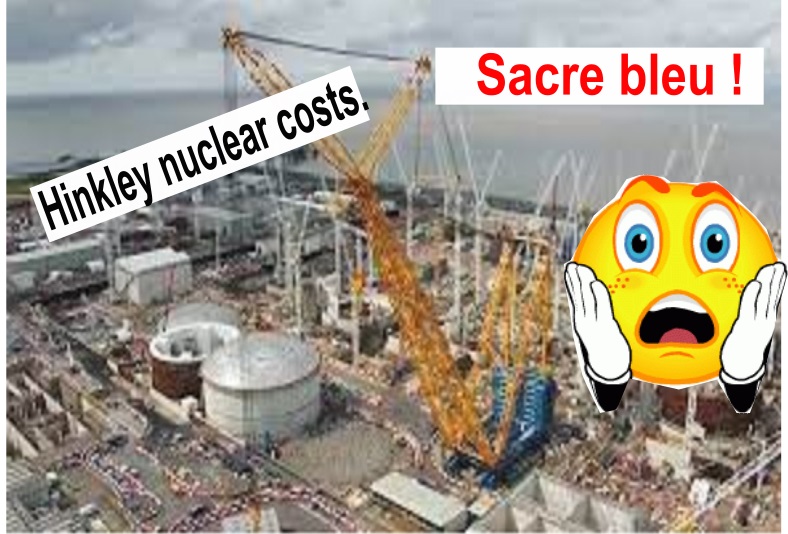
The appointments, part of a broader reshuffle at the executive committee, come as Chief Executive Officer Luc Remont is under pressure to boost the debt-laden company’s performance to cope with the ballooning cost of its Hinkley Point C nuclear project in the UK and the prospect of soaring capital expenditure to build new atomic plants in France.
“We are currently seeing an unprecedented recovery in nuclear power, which brings considerable challenges for EDF,” Remont said in the statement. “Our organization and the way we work is evolving to deliver further improvements in performance and ensure that our nuclear projects are successful.”
Earlier this year, EDF raised the budget of the two reactors it’s building at Hinkley Point in the UK to as much as £47.9 billion ($60.4 billion), citing labor shortages, supply chain issues, and longer-than-expected cable and pipe-fitting works.
It’s also working to complete the basic design of six new reactors to be built in France, which could cost about €67.4 billion ($72 billion), and is seeking to develop a so-called small modular reactor by the start of the next decade.
Famous UK seaside town ‘decimated’ by £46bn nuclear power station and huge Pontins change.
Famous UK seaside town ‘decimated’ by £46bn nuclear power station and
huge Pontins change. This once-thriving seaside resort has seen its economy
dwindle following the arrival of 900 nuclear workers taking holiday
accommodation.
What was once a thriving seaside town is now a shell of its
former self. Brean Sands in Somerset used to be by-word for family fun but
following the take-over of the town’s Pontins resort by 900 nuclear
workers, the local economy has suffered significantly. EDF commandeered 900
rooms at the Pontins site for construction staff building Hinkley Point C.
The project will cost around £46billion, vastly more than the county’s
economic output. However, with the resort poised to re-open for the Easter
weekend, the BBC has spoken to local tradespeople who claim that far from
support the economy, the EDF project has savaged it.
Express 29th March 2024
https://www.express.co.uk/news/uk/1882931/famous-uk-seaside-town-pontins-brean-sands-hinkley-point-c
Nuclear energy everywhere costs an arm and a leg
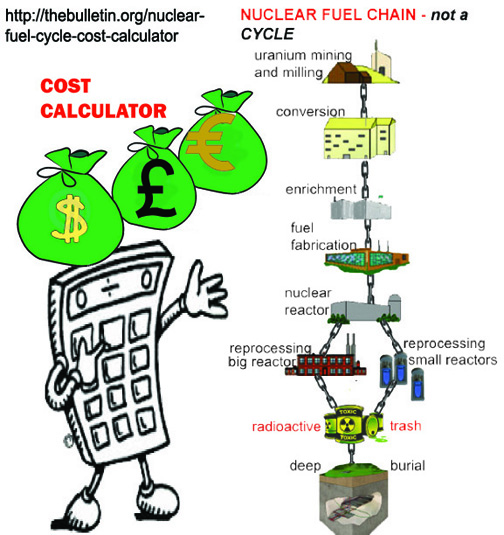
By Jean-François Julliard, Mar 30, 2024, https://johnmenadue.com/nuclear-energy-everywhere-costs-an-arm-and-a-leg/
The contribution of nuclear power to electricity generation is the lowest for thirty years and its price twice that of renewables.
It crackles like a Geiger counter in a uranium mine: in 2023, Emmanuel Macron announced plans for six additional EPR [European Pressurised Reactor] nuclear power plants. Hang on, no, perhaps fourteen in the long term.
In reviving nuclear in the name of the struggle against global warming, the European Union has followed suit. Japan is promising new developments on the nuclear front. The US is experimenting with miniature reactors. China is building with gusto … All these ‘ionising’ projects seem to indicate that fission-based nuclear power is in full swing.
In fact, it is to the contrary. A report of experts published in December 2023, the World Nuclear Industry Status Report 2023 [549pp!], using data supplied by the International Atomic Energy Agency and national states, provides the evidence. The part of electricity generation due to nuclear power is the lowest in 30 years (9.2 percent), compared to near double that figure in the 1990s.
Over twenty years, the cost of a nuclear kilowatt hour has increased slightly, whereas the cost of solar and wind has plummeted (‘melted’), these days coming in at roughly half that of nuclear. In 2022, the report highlights, €35 billion has been invested in nuclear globally, compared to … €455 billion in renewables.
France is still trying to recover from an annus horribilis in 2022. In addition to higher costs associated with the war in Ukraine, reactor shutdowns have multiplied. In August 2023, 60 % of France’s 56 reactors were dysfunctional. During 2023, production has augmented, but it has stayed at the level of … 1995.
Showcases of French savoir-faire, the EPR reactors are not ‘making sparks’, accumulating shutdowns, delays (twelve years for Flamanville, on the English Channel, and thirteen years for Olkiluoto, in Finland) as well as cost blowouts (the bill multiplied by 1.7 [for now] at Hinkley Point, in Great Britain, by 3 at Olkiluoto and by 6 at Flamanville!).
During this time, plutonium (for which every gram is of fearsome toxicity), an essential fuel for these ‘toys’, piles up. The accumulated stock for France has reached an unprecedented level of 92 tonnes.
Small problem: how can EDF [Électricité de France], which has acquired a debt of €65 billion, finance the announced projects? This question doesn’t stop Brussels from supporting them – in spite of the industrial disaster on course. No matter that, for several years, within the EU, renewable energy (hydraulic, wind and solar) has generated the most electricity, ahead of nuclear, followed by gas and coal.
South Korea was formerly one of the principal international competitors of EDF for conquering foreign markets. These days South Korea shows itself more reluctant, especially after a calamitous 2022. Kepco, the national electrician, has lost more than €22 billion, adding to a debt of €131 billion – a record. Nuclear contributes 29.6 % to production, currently less than coal. But the promises – within ten years coal’s contribution is supposed to be cut in half and that of renewables tripled. As for nuclear, it will grow by … 5 %.
Japan only starts to pick up with the atom after the closure of several reactors following Fukushima. To the subsequent shortage of electricity add the financial dimension of the catastrophe: in 2021, the government estimated it at more than €200 billion. Thirteen years after the event, the Prime Minister, Fumio Kishida, wants to rekindle nuclear (‘accelerate the particles’) but furnishes no details on new reactors.
Last year, production in Japan was at its lowest level (equivalent to that of the 1970s), and only 6 % of electricity was of nuclear origin. In spite of announcements, distrust persists, especially since the discovery of misrepresentations (modification of results of chemical analyses, falsification of measures of resistance of materials) of Japan Steel Works, manufacturer of components for reactors, selling them worldwide and notably to France.
China is the country the most committed to the atom. On 58 reactors currently under construction globally, 23 (40 %) are in the Middle Kingdom. However, if nuclear trots, renewables gallop, flat out. Nuclear represents 5 % of electricity, whereas wind and solar furnish 15 %, progressing more quickly than coal, which remains far and away the main ‘source of the juice’. Other vexation: Beijing exports little of its savoir-faire. This because the US, among others, which have blacklisted Chinese enterprises, accused of having siphoned American technology for its military ambitions. Slanderous!
The United States remains the champion of nuclear energy but its brainpower has not kept pace (‘their neutrons are not very quick’). In 2022, the contribution of nuclear to electricity generation has fallen to 18.2 % – the lowest rate since 1987 – less than coal and renewables, the latter passed for the first time to pole position. American reactors are on average the oldest in the world (42 years), and only two reactors have been brought into service in the last twenty-five years.
And what a debut! The AP1000 (variation of the EPR) of Vogtle (Georgia) began operation in March 2023, eight years later than planned and, above all, at an estimated cost of €28.5 billion, more than double the initial estimate. Les Echos [French business newspaper] (25/1/22) has kindly described the feat as a local ‘Flamanville’. This financial debacle has much contributed to the failure of Westinghouse, giant of nuclear reactor manufacture. The event has also provoked the shutdown of the construction site (nine years work) of two other AP1000s in South Carolina. Living fossils!
As a consequence, the US is paying more attention to mini reactors, or SMR [small modular reactors]. Save that NuScale, the champion of the type, last November, cancelled a vast construction program of six of these miniatures, for which the budget had almost tripled …
Russia is the veritable world champion of the ‘civil atom’. That said, however, it produces only 20 % of the country’s electricity. Rosatom, the Russian EDF, foreshadows a small increase to 25 %, but in … 2045. It is overseas where business is booming. Russia, a nation at war, is building reactors in countries as peaceful as Iran, Egypt, India or Turkey. Without forgetting China, one of Russia’s best customers.
Russia’s commercial secret? Its discounted prices, its turnkey packages and, above all, its control of the indispensable enriched uranium. Russia furnishes much of the latter to Europe but also to the US, 31 % of its supplies coming from Russia. All this while imposing sanctions on Putin’s country, which toys with the nuclear threat, going so far as to bomb the vicinity of Ukraine’s nuclear reactor at Zaporizhzhia – the largest such in Europe.
Sellafield’s head of information security to step down

Richard Meal is second senior leader to depart following Guardian investigation into failings at UK nuclear waste site
Guardian Alex Lawson and Anna Isaac, 28 Mar 24
A former Royal Air Force officer who has led Sellafield’s information security for more than a decade is to leave the vast nuclear waste site in north-west England, it can be revealed.
Richard Meal, who is chief information security officer at the Cumbrian site, is to leave later this year.
Meal will be the second senior leader to depart the organisation this year, after the top director responsible for safety and security – Mark Neate – announced in January that he planned to leave.
His imminent departure follows several safety and cybersecurity failings, as well as claims of a “toxic” working culture, that were revealed in Nuclear Leaks, a year-long Guardian investigation into Sellafield, late last year. Sellafield said no staff departures were linked to the revelations.
ellafield, which has more than 11,000 staff, was placed into a form of “special measures” in 2022 for consistent failings on cybersecurity, according to sources at the Office for Nuclear Regulation (ONR) and the security services.
Sellafield said it did not have evidence of a successful cyber-attack after the Guardian revealed that groups linked to Russia and China had penetrated its networks.
……………………………….. In response to the Guardian’s investigation, the energy secretary, Claire Coutinho, said the reports were “deeply concerning” and wrote to the Nuclear Decommissioning Authority (NDA), the state-owned body that ultimately runs Sellafield, demanding a “full explanation”.
In his response, the NDA’s chief executive, David Peattie, said there had been “necessary changes to the leadership, governance, and risk management of cyber” and responsibility for its cyber function had been moved. A new head of cybersecurity took up the role in January. Sellafield declined to name the new appointee.
On announcing his departure, Neate said that he had decided last year “that 2024 was the right time for me to move on”. He will be replaced this week by the current head of the site’s “spent fuel management value stream”, James Millington, on an interim basis.
Separately, Nic Westcott, the former Openreach and Severn Trent executive, was seconded from Nuclear Waste Services in January as interim chief people officer.
In its latest annual report, the ONR stated that “improvements are required” from Sellafield and other sites in order to address cybersecurity risks. It also confirmed that the site was in “significantly enhanced attention” for this activity……………………………
Britain’s public spending watchdog, the National Audit Office, last month launched an investigation into risks and costs at Sellafield.
The Nuclear Leaks series detailed concerns over cracks in the concrete and asphalt skin of a toxic point known as the First Generation Magnox storage pond or informally as “Dirty 30”. This week, Sellafield said that the building had been “prioritised for cleanup” by the NDA and that the first “zeolite skip” – containers used to absorb radiation in the 1970s and 1980s – had been removed and placed in a shielded box.
Separately, Sellafield released its gender pay report for the year to 5 April 2023, which showed the median gender pay gap had risen to 13.7% from 11.3% a year earlier. The proportion of women in the upper quartile of its pay scale was static, at 18%………………… https://www.theguardian.com/business/2024/mar/27/sellafields-head-of-information-security-to-step-down
1 This Month

26 September – International Day for the Total Elimination of Nuclear Weapons


PLEASE OPPOSE HR 8255 AND S.3639 – bills would accelerate satellite deployment, with no environmental review or safeguards – https://ncstd5li.quorum.us/campaign/169331/
To see nuclear-related stories in greater depth and intensity – go to https://nuclearinformation.wordpress.com
-
Archives
- September 2026 (206)
- August 2026 (330)
- July 2026 (355)
- June 2026 (287)
- May 2026 (306)
- April 2026 (356)
- March 2026 (251)
- February 2026 (267)
- January 2026 (308)
- December 2025 (358)
- November 2025 (359)
- October 2025 (375)
-
Categories
- 1
- 1 NUCLEAR ISSUES
- business and costs
- climate change
- culture and arts
- ENERGY
- environment
- health
- history
- indigenous issues
- Legal
- marketing of nuclear
- media
- opposition to nuclear
- PERSONAL STORIES
- politics
- politics international
- Religion and ethics
- safety
- secrets,lies and civil liberties
- spinbuster
- technology
- Uranium
- wastes
- weapons and war
- Women
- 2 WORLD
- ACTION
- AFRICA
- Atrocities
- AUSTRALIA
- Christina's notes
- Christina's themes
- culture and arts
- Events
- Fuk 2022
- Fuk 2023
- Fukushima 2017
- Fukushima 2018
- fukushima 2019
- Fukushima 2020
- Fukushima 2021
- general
- global warming
- Humour (God we need it)
- Nuclear
- RARE EARTHS
- Reference
- resources – print
- Resources -audiovicual
- Weekly Newsletter
- World
- World Nuclear
- YouTube
-
RSS
Entries RSS
Comments RSS
 nuclear-news