Point Lepreau nuclear station down till at least September, costing utility extra $71M.
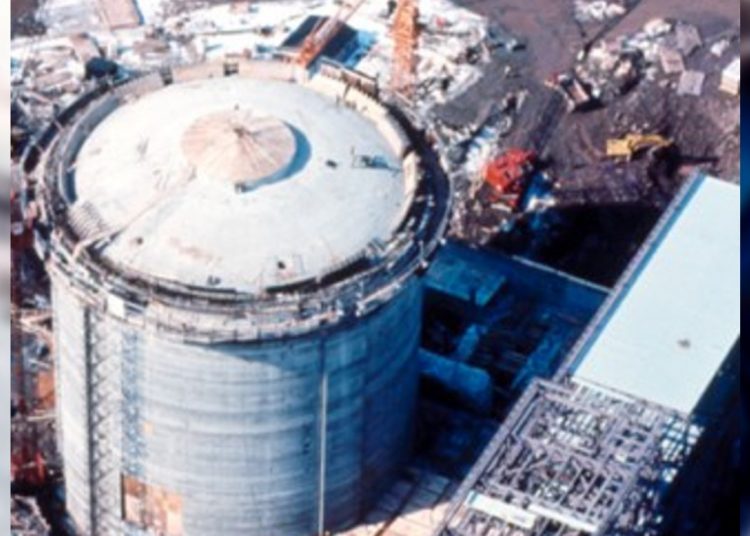
All of this has been costly for the utility, which now carries more than $5 billion in debt, and to ratepayers, who are being asked to swallow the biggest increases to their bills in their lifetimes.
New target is a ‘best-case scenario,’ said expert of 27 years, who added it ‘wouldn’t be appropriate’ to give a worst-case scenario.
Telegraph Journal, John Chilibeck, Jul 22, 2024
The prolonged shutdown at the Point Lepreau nuclear plant is raising alarm, including over how it could affect power bills for residents and businesses.
At a rate hearing in Fredericton on Monday, NB Power officials said the longer-than-expected shutdown would likely last until at least September and cost an extra $71 million. That includes $51 million for buying replacement power and about $20 million for added repair and equipment costs.
Craig Church, a chief modeler for the public utility, said it would cost on average an extra $900,000 for each day Lepreau is shuttered given it is one of the cheapest in NB Power’s fleet of generators to run.
It normally provides one-third of the province’s electricity.
“The loss will have to be made up by future ratepayers?” asked public intervenor Allain Chiasson at the hearing.
After a pregnant pause, Church replied yes.
NB Power is already seeking the biggest hike in electrical bills in a lifetime. If the New Brunswick Energy and Utilities Board, an independent regulator, grants its request, households will have to pay 9.8 per cent more this year and 9.8 per cent more next year.
According to NB Power’s evidence, the average electrically heated residential customer is billed about $3,087 annually. Adding 9.8 per cent to that bill would be another $303, or a total of $3,390.
Big industry is facing a similar percentage hike, whereas small and medium-sized businesses would face slightly smaller increases.
But the evidence before the board does not take into account the prolonged shutdown of Lepreau, meaning those extra costs will only come into play in future years.
NB Power undertook a 100-day outage of Lepreau, west of Saint John along the Fundy coast, from mid-April to mid-July to overhaul parts of the non-nuclear side of the plant at a cost of $124 million.
It was part of a planned shutdown to renew the plant and make sure it was robust enough for the winter, when it supplies baseload power for the province. According to the plan, the upgrades were supposed to be completed last week.
But on Monday, an expert on the NB Power panel, Jason Nouwens, the director of regulatory and external affairs at Lepreau, said on June 29, the team discovered a problem with the main generator on the non-nuclear side of the plant.
Specifically, one of 144 stator bars in a giant rotor had failed, but NB Power isn’t sure why. To get to the failed equipment, workers must painstakingly take apart the generator piece by piece, a job that will take at least two weeks.
Then, Nouwens said, the troubleshooting team that includes outside experts from the Canadian nuclear industry will try to figure out why the stator bar broke and possible remedies to prevent such a failure from happening again.
The expert, who has been working at Lepreau 27 years, said the plant coming back online in September was a best-case scenario. When asked by one of the interveners, Nouwens said it “wouldn’t be appropriate” to give a worst-case scenario.
Besides the extra costs caused by the delayed re-start, questions have been raised about possible spillover.
On Friday at the same hearings at the Fredericton Convention Centre, a lawyer working on behalf of J.D. Irving, Limited asked NB Power officials repeatedly how the longer-than-expected outage at the nuclear generator would affect other important power plants in the electrical system.
The lawyer Glenn Zacher had before him Phil Landry, NB Power’s executive director of project management offices, who answered questions about other power plants in the system.
The other plants are also supposed to undergo regular outages for maintenance and repairs to ensure they are safe and reliable.
But some of the maintenance work has already been delayed because those plants need to be running when Lepreau is down, otherwise people’s lights and air conditioners wouldn’t work.
“When is it too late to do undertake maintenance elsewhere?” asked Zacher. “It seems to be an important question to be answered.”
Landry, however, didn’t have any firm answers and struggled to give any specific timelines, given the uncertainty at Lepreau
Landry explained to the board that NB Power has been running the Belledune Generating Station – which belches out emissions from high-polluting coal – and Coleson Cove, which burns similarly polluting heavy oil, to replace the energy lost at Lepreau.
Belledune was supposed to undergo maintenance and repairs right now, at a cost of $17.1 million, but its 46-day outage has been indefinitely delayed………………………………….
Pushing out the maintenance to later in the year, closer to the winter months, is not an ideal scenario, Landry said, because they need to be running smoothly when people heat their homes and electrical demand is greatest.
NB Power refurbished the nuclear side of the plant in 2012, at a cost of $2.5 billion, a project that was over-budget by $1 billion and took 37 months longer to complete than expected. But NB Power didn’t do similar work to other important parts of the plant, leading to frequent breakdowns.
All of this has been costly for the utility, which now carries more than $5 billion in debt, and to ratepayers, who are being asked to swallow the biggest increases to their bills in their lifetimes.
NB Power CEO Lori Clark has promised Lepreau will no longer be neglected in the hopes of improving its performance. The utility has partnered with Ontario Power Generation, which has more expertise with nuclear plants, to ensure the next phase of the overhaul is done right.
A benchmarking study showed Lepreau is one of the worst performers out of 38 similar nuclear power plants in the world, consistently in the bottom quarter.
On Monday, Nouwens said NB Power was committed to improving the plant’s performance but cautioned it would take years of extra spending and repair work to get to the average performance of most nuclear plants. He pointed out that Lepreau has 115,000 different components, many of which have to be replaced or repaired with age.
Even by 2030, NB Power still thinks the plant will be mired in the basement, performance wise.
“In the past, the work hasn’t been comprehensive and intrusive enough to reach the performance we need,” the executive said. “We’ve under-invested, causing unreliability.” https://tj.news/new-brunswick/long-shutdown-of-nuclear-plant-would-have-knock-on-effect-warns-lawyer
NATO/US Complicity in Israel’s Relentless Genocide of Gaza
Only 4 of 32 NATO Members do NOT Sell Weapons to Israel or Buy Weapons from Israel
Israel has been the largest cumulative recipient of U.S. foreign aid since its founding in 1948, having received about $310 BILLION dollars in economic and military assistance. Since October 7, 2023, the U.S. has passed legislation that has provided at least $12.5 billion in military aid to Israel, which included $3.8 billion from legislation in March 2024 and $8.7 billion from a supplemental appropriation in April 2024.
Biden says U.S. should not have “Killing Fields,” while he is complicit in the Israeli “Killing Fields” in Gaza.
ANN WRIGHT, JUL 17, 2024, LA Progressive
As Israel continued its relentless genocide on steroids of Palestinians in Gaza with over 140 killed in the past weekend, imprisonment without charges of thousands of Palestinians in the West Bank and destruction of the hospitals, universities, schools (8 UNRWA schools bombed in the past 10 days), cultural centers and indiscriminate bombing of markets, soccer fields and “safe area” residents of Gaza have been forced into, an assassination attempt was made on former President Trump and NATO finished its gala 75th Anniversary celebrations in Washington, DC.
Biden Says “U.S. Politics Should Never Be A Killing Field,” While He is complicit in the Israeli “Killing Fields” in Gaza
As the genocide continued and a few days after the end of the NATO celebrations, an assassination attempt on former President Trump caused President Biden to address the nation and orate that “political violence has no place in America and U.S. politics should never be a killing field.”
The statement of no political violence and no killing fields in America rings totally hollow as the Biden administration and NATO countries fuel the Israeli killing fields in Gaza with over 90 Palestinians killed and 300 wounded by multiple Israeli rocket attacks in Khan Yunis on Saturday, July 12, and 80 Palestinians killed in the past 24 hours of July 13 in several refugee camps.
NATO members fuel the Genocide of Gaza by Selling/Sending Weapons to Israel
Heads of 32 NATO member states and 10 NATO “global partners”, Australia, New Zealand, Japan, South Korea, Colombia, Mongolia, Iraq, Afghanistan and Pakistan, met in Washington, DC at the 75th Anniversary events of NATO.
Some of the NATO members and partners are the same countries that are aiding and abetting the Israeli genocide of Gaza.
An Office for the State of Israel Located in the NATO Headquarters
NATO has a long, close and relatively unknown relationship with Israel that, eight years ago, resulted in establishment of an Israeli office in NATO headquarters in Brussels in 2016. Underscoring the importance to Israeli association with NATO, Prime Minister Netanyahu said upon the opening of the office, “This is an important step that helps Israel’s security. It is further proof to the status of Israel and the willingness of many organizations to cooperate with us in the field of security.”
The invitation from NATO for Israel to have an office in NATO headquarters was a result of pressure by other NATO members on Turkey to drop its veto of the invitation. The invitation arose through a new NATO partnership policy beginning in 2014 but Turkey vetoed the invitation until 2016.
Behind the scenes negotiations between Turkey and Israel in 2015 warmed the chilly relationship that had been essentially severed between the countries in 2010 over Israeli commandos killing 10 Turkish activists and wounding over 50 participants on the Mavi Marmara, a Turkish ship bound for Gaza as a part of the 7-ship Gaza Freedom Flotilla.
According to NATO documents, NATO and Israel have worked together for almost 30 years, cooperating in science and technology, counter terrorism, civil preparedness, countering weapons of mass destruction and women, peace and security. To strengthen NATO naval interoperability NATO brought on Israel as a partner for NATO’s Operation Sea Guardian. Israel’s military medical academy now serves as a “unique asset” for NATO’s Partnership Training and Education Centers community.
Israel is not officially integrated in NATO but is part of the Mediterranean Dialogue, a program sponsored by NATO in cooperation with seven countries of the Mediterranean.
Only 4 of 32 NATO Members do NOT Sell Weapons to Israel or Buy Weapons from Israel
NATO’s long-standing working relationship with Israel has translated into NATO countries selling weapons to Israel and other countries buying weapons from Israel’s big weapons industry.
With the exception of Canada, the Netherlands, Spain and Belgium, the remainder of the 32 NATO members continue to sell/send weapons to Israel as Israel conducts genocide operations on Palestinians in Gaza. Due to a court case, Denmark may suspend export of F-35 fighter jet parts to the U.S., because the U.S. sells the jets to Israel.
Even Latvia sold weapons to Israel, while Lithuania bought weapons from Israel. Greece, Albania, Slovakia, and many other NATO countries have purchased military equipment from Israel.
The Action on Armed Violence has a comprehensive worldwide listing of weapons sales and transfers to Israel.
The US is the mammoth supplier to Israel, providing an estimated 68% of Israel’s foreign-sourced weapons.
Israel has been the largest cumulative recipient of U.S. foreign aid since its founding in 1948, having received about $310 BILLION dollars in economic and military assistance. Since October 7, 2023, the U.S. has passed legislation that has provided at least $12.5 billion in military aid to Israel, which included $3.8 billion from legislation in March 2024 and $8.7 billion from a supplemental appropriation in April 2024.
Since October 7, only two of the more than one hundred military aid transfers to Israel have reportedly met the congressional review threshold of $250 million to be made public, and since the records for the other weapons transfers have not been made public, we can’t be sure . Additionally, the Israeli military received expedited deliveries of weapons from a strategic stockpile of weapons that is normally used to replenishment weapons for U.S. units in the Middle East. The U.S. has maintained massive warehouses for the stockpile of huge variety and amount of weapons since the 1980s…………………. https://www.laprogressive.com/foreign-policy/relentless-genocide—
France’s EDF faces fresh setback after losing Czech nuclear bid
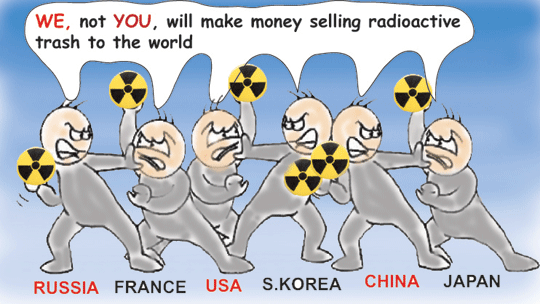
French state power giant EDF lost a bid to build at least two new nuclear
reactors in the Czech Republic on Wednesday, a major blow to Europe’s only
nuclear power plant builder at a critical time for the company. The
project, won instead by Korea’s KHNP, would have been the first contract
for EDF since Hinkley Point in Great Britain in 2016, and a vote of
confidence after being dogged by delays and soaring costs on projects at
home and abroad.
Reuters 17th July 2024
EDF pulls out of competition to build mini-nuclear reactors in Britain

Sat, 13th July 2024, https://www.lse.co.uk/news/edf-pulls-out-of-competition-to-build-mini-nuclear-reactors-in-britain-yipcxoiuz1s67eu.html
Alliance News) – Paris-based energy firm EDF has withdrawn from a competition to construct mini-nuclear reactors in Britain, the company said on Tuesday.
EDF was one of six firms shortlisted in October last year for government support to deliver a new wave of nuclear reactors to provide cheaper and cleaner energy.
Two designs for small modular reactors (SMRs) from those submitted by GE-Hitachi, Holtec Britain, NuScale Power Corp, Rolls-Royce Holdings PLC and Westinghouse Electric Corp will be chosen by the end of the year.
The Conservative government which lost last week’s general election set up the competition as part of its aim to derive up to a quarter of all UK electricity from nuclear power by mid-century…………..
Labour, which won the election, has promised to extend the lifetime of existing nuclear plants, including the much-delayed and over-budget Hinkley Point C in southwest England.
EDF said in January that project could be delayed by four years, and cost as much as GBP8 billion more than planned.
It had been due to become operational in June 2027 but that has now been pushed back to between 2029 and 2031, it added.
Labour also made developing SMRs part of its election pitch to the country, saying nuclear would help Britain achieve energy security and its aims of decarbonising the power grid by 2030.
source: AFP
Analyst Says Nuclear Industry Is ‘Totally Irrelevant’ in the Market for New Power Capacity
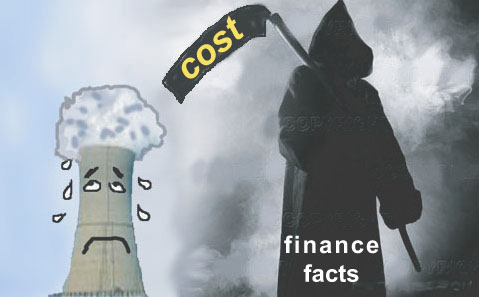
Power, Jul 8, 2024, by Aaron Larson
“…………………………………………….. Mycle Schneider, an independent international analyst on energy and nuclear policy, and coordinator, editor, and publisher of the annual WNISR, said, “in [new] capacity terms, the nuclear industry, from what is going on, on the ground, is totally irrelevant.”
Schneider was speaking as a guest on The POWER Podcast and prefaced his statement by comparing nuclear power additions to solar power additions in recent years. “Let’s look at China, because China is the only country that has been massively building nuclear power plants over the past 20 years,” he said.
“China connected one reactor to the grid in 2023—one gigawatt. In the same year, they connected, and the numbers vary, but over 200 gigawatts of solar alone. Solar power generates more electricity in China than nuclear power since 2022. And, of course, wind power generates more than nuclear power in China for a decade already,” Schneider said. Furthermore, he noted, the disparity has gone “completely unnoticed by the general public or even within the energy professionals that are in Europe or often also in North America.”
Schneider said the media often gives the impression that the nuclear industry is booming, but the facts suggest otherwise. “Over the past 20 years—2004 to 2023—104 reactors were closed down and 102 started up,” Schneider said. “But here is important that almost half, 49 of those new reactors started, were in China [where none closed], so the balance outside China is minus 51.”
Some nuclear advocates might suggest that things are changing. They might argue that small modular reactors (SMRs) or other advanced designs are poised to reinvigorate the industry. But Schneider disagrees. He noted that since the construction start of the second unit at Hinkley Point C in the UK in 2019—almost five years ago—there have been 35 nuclear project construction starts in the world. Twenty-two of those were in China and the other 13 were all implemented by the Russian nuclear industry in a few different countries. “Nothing else. Not an SMR here or an SMR there, or a large reactor here or a large reactor there by any other player,” reported Schneider.
Meanwhile, history has shown that the nuclear industry struggles to meet timeline targets. As examples, Schneider noted that on Jan. 1, 2022, 16 reactors were scheduled to come online during the following year. Only seven actually did. In 2023, nine were planned to come online, but only five made it to the grid. This demonstrates how bad the industry is at scheduling—it can’t even predict project completion at a high rate of accuracy during the final year of construction. “How precise could it possibly be if there are predictions for 2030, 2035, 2040, for reactors that don’t even have a [design] license yet?” asked Schneider.
Notably, timelines haven’t always improved on later units. Schneider said the EPR units have demonstrated a “negative learning curve.” Specifically, the first EPR units to enter commercial operation were at the Taishan site in China, which came online in 2018 and 2019. They had a shorter construction time than Olkiluoto 3 in Finland, which started construction about four years prior to Taishan but didn’t enter commercial operation until 2023. Flamanville 3 in France began construction in 2007 and hasn’t yet entered commercial operation. It could end up having a construction period even longer than Olkiluoto 3. To cap it all off, Schneider said the Hinkley Point C EPR units could be even longer than Flamanville 3.
“By the way, you can also show that through the building history of nuclear reactors in France—it’s actually a negative learning curve,” said Schneider. Furthermore, with so few reactors being constructed, learnings are limited.
Schneider noted that the vast majority of new capacity being added to the grid is from solar and wind energy. “These guys are building tens of thousands of wind turbines, and literally hundreds of millions of solar cells, so the learning effect is just absolutely stunning,” he said. “On the nuclear side, we’re talking about a handful. That’s very difficult. Very, very difficult—very challenging—to have a learning effect with so few units.”
Schneider said the nuclear discussion in general needs a “really thorough reality check.” He suggested the possibilities and feasibilities must be investigated. “Then, choices can be made on a solid basis,” he said.
To hear the full interview with Schneider, which contains more about the WNISR, what’s behind construction delays, how delays affect budgets, SMRs and why modular construction methods may not solve problems, and much more, listen to The POWER Podcast. Click on the SoundCloud player below to listen in your browser now or use the following links [listed on original] to reach the show page on your favorite podcast platform – https://www.powermag.com/analyst-says-nuclear-industry-is-totally-irrelevant-in-the-market-for-new-power-capacity/
New Brunswick’s nuclear-powered rate hikes

Commentary, by Janice Harvey, July 8, 2024, https://nbmediacoop.org/2024/07/08/new-brunswicks-nuclear-powered-rate-hikes/
The abject failure of this and previous governments’ energy policies is on full display these days. In the 1970s, New Brunswick was one of only three provinces that bought into the federal government’s agenda to build out a civilian nuclear power industry. Quebec has since shut its nuclear generators down, leaving only Ontario and New Brunswick as the nuclear flag-bearers. How has that worked out for us?
NB Power has come to the Energy and Utilities Board (EUB) with a request for the biggest rate hikes in the utility’s history. While the details are buried in thousands of pages of documents filed with the EUB, evidence from previous EUB hearings makes it crystal clear that the utility’s single greatest financial liability driving up power rates is the much-vaunted Point Lepreau Nuclear Generating Station.
Point Lepreau has been a financial white elephant since its construction ended up costing three times the original price tag. Its planned 30-year lifespan (over which all this extra cost was to be amortized) was cut short by premature aging of critical reactor components, prompting a decision to undergo an expensive refurbishment, which was to extend the life of the plant by a fantastical 40 years. At the time, the then-PUB determined based on the evidence that refurbishment was too big a financial risk for New Brunswickers to handle and recommended against it. The Lord government went ahead anyway.
Like the original construction, the refurbishment went way over the timeline and budget. The result has been very poor performance, a miserable 60 per cent in 2022 compared to the wildly optimistic 90 per cent capacity assumption that the EUB rejected. The costs of replacement power alone during these shutdowns have repeatedly sabotaged annual financial performance projections. Now, Point Lepreau is facing even more expensive upgrades to fix problems that were not dealt with during the refurbishment.
In short, Point Lepreau is the most unreliable and most expensive power generator on the grid, responsible for the lion’s share of NB Power’s debt. It is not going to get any better. Keeping it afloat until 2040, its new end-of-life target, is going to mean more of the same – throwing scarce money down a deep, black hole paid for by ever-rising power rates.

Despite the overwhelming evidence that New Brunswickers cannot afford nuclear power, the Higgs government has doubled down on nuclear, floating an equally fantastical proposition that the next generation of nukes – so-called small modular reactors – will quarterback New Brunswick’s climate change strategy, while an SMR export industry is expected to drive economic growth. To that end, New Brunswick taxpayers have already fronted a total of $35 million to two private nuclear upstarts, neither of which has designed or built a reactor. This is despite lots of reasons to put their rosy promises of “clean” nuclear-fueled prosperity in the same wishful thinking category as JOI Scientific’s power-from-water scheme that so beguiled NB Power executives.
Just as the EUB rate hearings got underway, an entirely predictable hitch in the Higgs’ nuclear dream occurred. It seems like the SMR upstart ARC Clean Energy is on its way down and out, taking $25 million provincial dollars and $7 million federal with it. If we’re lucky, Moltex Energy, propped up by $10 million in provincial and $50.5 million in federal tax dollars, will be close behind, and we can breathe a sigh of financial relief. The longer this nonsense persists, the more of our tax dollars will go into the nuclear black hole, and the greater the delay in meeting our climate change pollution targets.
Even if Moltex hangs on, or some other SMR promoter replaces them, any electricity that might eventually flow from an SMR will be, like Point Lepreau, the most expensive power on the grid – entirely unaffordable and unnecessary. The Higgs government knows this, passing legislation this spring requiring NB Power to buy electricity from the planned privately-owned SMRs regardless of price, a silent admission that electricity from SMRs, should they ever see the light of day, will be more expensive than any alternative. In other words, SMRs will drive up your power bill.
Meanwhile, the June 22nd issue of The Economist features the exponential growth of solar energy worldwide, the cost of which – even with storage – is falling exponentially. Other than home retrofits, this is the cheapest new power on offer.
The nuclear cost numbers are there for all to see. For elected representatives to support this industry, knowing people cannot tolerate higher power rates, is grossly irresponsible and a betrayal of trust. Renewables naysayers are depriving New Brunswickers of the benefits of this global energy transition. This – and our nuclear-powered rate hikes – need to be on the ballot on October 21.
Janice Harvey is the chair of the Environment and Society program at St. Thomas Universit
New nuclear is ‘too expensive’ for UK zero-carbon energy target.
Chairman of the Energy Transitions Commission says hydrogen or gas power
with carbon capture and storage could help to keep the lights on. New
nuclear power stations may not be needed for Britain to hit targets for net
zero because there are cheaper, low-carbon alternatives that could back up
intermittent renewable power, the head of a leading think tank has claimed.
Lord Turner of Ecchinswell, chairman of the Energy Transitions Commission,
said that while it was important to keep existing nuclear power stations
running for as long as possible, hydrogen fuel or gas power stations that
had been fitted with carbon capture and storage technology could fill the
gap when wind or solar generation was not enough to keep the lights on.
“I don’t think it is the case that you need new nuclear to balance the
system. The systems of the future don’t absolutely need a base load,”
he said. Turner, the former head of the Financial Services Authority and a
former director-general of the CBI, said future power sources “can work
on a combination of intermittent variable renewables, wind and solar plus
some hydro.
“I think the challenge for new nuclear is that it is just
expensive. Bluntly, new nuclear can play very little role in a 2030
target,” Turner said, referring to the new government’s target to
decarbonise the energy system by the end of the decade.
Times 8th July 2024
With global race to decarbonize electricity sector, demand for skilled nuclear workers heats up.

COMMENT. Most (or all?) of the funds available to these companies to hire “skilled workers” is coming directly from the public (taxpayers) through direct subsidies, contracts or tax refunds. For example, the story mentions that AtkinsRéalis is one of the top hiring firms. A few weeks back was another story stating that the AtkinsRéalis nuclear division got a $750M contract for work on a CANDU reactor in Romania. A few months before that was another story that Canada had signed a $3 BILLION “export development deal” with Romania (i.e. a gift) to build its CANDU reactor, and that most of the funds would be spent on Canadian jobs. This all comes back to the nuclear industry’s current core problem: its products (new nuclear reactors) are hulking dinosaurs that suck up funds at an alarming rate and no private investor doing due diligence wants to be part of this costly scheme.
Globe and Mail, MATTHEW MCCLEARN, 8 July 24
Last month, U.S.-based nuclear reactor vendor Westinghouse opened a 13,000-square-foot engineering office in Kitchener, Ont. The company wants to sell its products, including its flagship AP1000 reactor, in Canada while also serving international customers.
Having hired most of its 250 Canadian staff in the last three years, it now seeks to hire 100 more engineers. It’s recruiting at a moment when, after a decades-long lull, skilled nuclear workers find themselves in high demand.
China and Russia have long dominated construction activity, while Western countries stagnated; Canada’s newest power reactor was completed in the early 1990s. But efforts to decarbonize the electricity sector have coalesced into support for designing and building new reactors, even as aging facilities are overhauled – leading to a proliferation of announced nuclear projects.
Whether there’s enough engineering talent to execute them all, however, is a question vigorously debated within the nuclear industry, here and abroad.
According to a survey the Canadian Nuclear Association conducted five years ago, the industry directly employs 33,000 people – up from 30,000 in 2012. Large employers include Ontario Power Generation and Bruce Power, which operate large nuclear plants, as well as uranium mining giant Cameco Corp. and Canadian Nuclear Laboratories, which operates the Chalk River research facility.
That survey is now being updated, and while results have not been finalized, employment appears to have grown another 10 to 15 per cent during the past five years. But the sheer volume of announced projects implies more rapid growth.
OPG recently began early work to refurbish four reactors at its Pickering station. The eight-reactor Bruce station, already one of the world’s largest, is in the early stages of a planned expansion that could add four new large reactors.
AtkinsRéalis, steward of Canada’s homegrown Candu technology, is racing to develop a modernized 1,000-megawatt reactor it calls the Monark. It’s among the most active hirers on Nuclear Jobs Canada, an industry job board.
Canadian Nuclear Laboratories is hiring at its Chalk River facilities, a Second World War-era facility that has been extensively modernized in recent years. It’s looking to populate its new laboratories and replace retiring workers.
“Nuclear was a little bit quiet for a while, and now it’s coming back,” said Janet Tosh, CNL’s vice-president of human resources.
“So we are having to build up that talent pipeline. But it’s not just science and technology people we’re looking for. We’re looking for technicians, machinists, certified trade workers.”
And then there’s relative newcomers to Canada, such as Westinghouse. Another U.S.-based reactor vendor, GE-Hitachi Nuclear Energy, has partnered with OPG to build up to four small modular reactors at Darlington station.
The picture is similar in other Western countries, including the U.S. and Britain, both of which have seen limited reactor construction for decades. Reports abound that nuclear employers, desperate for talent, have lured long-retired professionals back into the work force.
Last year, the U.S. National Academy of Engineering published a 250-page report examining the potential barriers to a major build-out of new “advanced” reactors. It identifies labour availability as a key constraint.
“Utilities have generally not retained the talent on their staff to execute these large projects given the limited deployment of nuclear technology in the past 30 years in the United States,” the report says.
“This shortfall in talent could become equally limiting across the supply chain, operations, and regulatory organizations that must support any large-scale growth in nuclear deployment.”
Akira Tokuhiro, a professor at Ontario Tech University, which has one of the largest nuclear engineering programs in North America, has noticed major nuclear employers pledging to hire hundreds of workers apiece on LinkedIn.
“And I thought, how can that be?” he recalled during an interview. “Because we’re producing 50 graduates a year.”
Prof. Tokuhiro added up the output from other programs across the continent, and determined that fewer than 1,000 people graduate with a degree in radiation science or nuclear engineering in North America. (He figures that for every such graduate, nuclear employers hire 10 times as many mechanical, chemical and other engineers who’ve not studied nuclear directly.)
He compares that against likely retirement rates for workers at major nuclear employers, as well as the many announced nuclear projects.
“We don’t have enough new graduates,” Prof. Tokuhiro concluded. “There’s a disconnect between what the industry needs, and what the universities are producing.”
Luca Oriani, Westinghouse’s global chief engineering services officer, disagrees. The reactor vendor almost exclusively hires graduates with little or no industry experience, he said, and then trains and retains them as long as possible, typically decades. The company has found the supply of engineering talent abundant, in Canada and elsewhere.
That’s not to say competition isn’t fierce. Westinghouse used to visit campuses a week ahead of job fairs for coming graduates to recruit before they met with competitors; now it’s offering them jobs as early as a year before graduation.
“I have over 2,000 engineers working for me,” Mr. Oriani said. “I still spend at least a week month just going to different universities and discussing with students, and trying to see how do we get them to come to us before they go somewhere else.”
In an interview earlier this year, OPG chief executive officer Ken Hartwick divided the industry’s labour into two groups: engineering and project management on one side; and trades, such as boilermakers and electricians, on the other. Availability of the first group, he said, has not been a problem, an aging work force notwithstanding.
“I’m less worried about the older person losing some of the experience, because the younger people coming through our universities are brilliant,” Mr. Hartwick said.
Tradespeople were another matter. OPG competes for them not just with other nuclear utilities such as Bruce Power, but with many other construction projects, including hospitals and roads.
“Can we ramp up our trades programs fast enough? That’s the biggest challenge.”
Some in Canada’s nuclear industry say talent isn’t as scarce here as it is in the U.S. and Britain, thanks to major multi-reactor reactor refurbishments at Ontario’s Darlington and Bruce stations over the past decade. They’re major capital projects in their own right, requiring significant manpower to execute.
That’s kept a lot of building trades very engaged, and it’s kept the regular work force [of utilities] engaged,” said Bob Walker, national director of the Canadian Nuclear Workers’ Council, an umbrella organization of nuclear sector unions.
He confirmed that retirees are re-entering the work force, but added that most nuclear employers offer generous pension plans, allowing workers to retire relatively early.
“That’s been a running joke for as long as I can remember: No one ever retires, they just change positions,” Mr. Walker said. “The industry plans on people coming back, and people plan on retiring and coming back.”……………….. https://www.theglobeandmail.com/business/article-after-decades-of-dormancy-competition-for-nuclear-engineering-talent/
Labour must act fast to fire up Rolls-Royce nuclear reactor deals

Rolls-Royce risks losing billions in overseas contracts if Labour delays
vital strategic decisions on nuclear reactors, in what is emerging as the
first crucial test of its business policies.
Other projects may also be in
jeopardy, imperilling thousands of jobs, if new ministers are slow to take
action to tackle the overflowing in-trays confronting them. The engineering
giant is considered to be a front-runner of the six groups in the race to
build Britain’s first mini nuclear plants, known as small modular reactors
(SMRs).
State funding has been key to the development of its designs. One
of the company’s goals is to create a major export market for its SMRs. It
is eyeing contracts worth billions of pounds. [Really !!] The Mail on Sunday
understands that central European countries including the Czech Republic
are among those in talks with Rolls. But these negotiations will stall –
and possibly end – if Labour does not give the UK’s formal backing to the
project by the end of the year.
This is Money 6th July 2024
Constellation Energy plans restart of Three Mile Island nuclear plant
Constellation Energy is in discussions with the US state of Pennsylvania
governor’s office and state legislators regarding funding for a potential
restart of a unit at the Three Mile Island power facility, Reuters has
reported. The ongoing talks have been described as “beyond preliminary”
by two sources.
The move indicates that Constellation is moving forward
with plans to bring back part of the nuclear generation site in southern
Pennsylvania, which was operational from 1974 until its closure in 2019.
The unit at Three Mile Island that may be restarted is distinct from the
facility’s unit 2, which suffered a partial meltdown in 1979 – the most
notorious nuclear accident in US history.
Power Technology 3rd July 2024 https://www.power-technology.com/news/constellation-three-mile-island-pennsylvania/
Talent Shortage Threatens Europe’s Nuclear Renaissance
As many countries in Europe look to boost their nuclear power capacities
and build more reactors, companies face a workforce challenge as many of
the skilled force are retiring while younger generations choose energy jobs
in solar and wind. European countries and companies planning major
expansion in nuclear fleets are struggling to fill in thousands of skilled
engineering jobs that would support the construction of nuclear reactors,
which take years to complete. Companies in France are hiring back retirees
and are collaborating with colleges and universities to promote jobs in the
nuclear power sector.
Oil Price 3rd July 2024
Small Modular Nuclear Reactors cost concerns challenge industry optimism

Reuters, Paul Day, Jun 27, 2024
Concerns over the potential cost of small modular reactors (SMRs) and the electricity they produce continue to cast a shadow over growing optimism for new nuclear.
Proponents say that the recent faltering history of large nuclear projects missing schedules and running over budget are just teething problems for a new industry in the midst of a difficult economic climate.
However, critics claim it as proof that nuclear is not economically viable at all, and it will take too long faced with pressing climate issues.
There is little doubt that new nuclear will, at least initially, be more expensive to develop, build, and run than many are hoping.
New Generation IV reactors, such as SMRs, are likely to produce hidden costs inherent in the development of first-of-a-kind technology, while high commodity and building material prices, stubbornly high inflation, and interest rates at levels not seen for decades are adding to mounting expenses for the new developers.
NuScale’s cancelled deal to supply its SMRs to a consortium of electricity cooperatives due to rising power price estimates prompted The Breakthrough Institute’s Director for Nuclear Energy Innovation Adam Stein to write that advanced nuclear energy was in trouble.

Speaking during an event at the American Nuclear Society (ANS) 2024 Annual Conference in June, Stein said nothing had changed to fix the fundamental challenges nuclear faces since he wrote that in November, but there was a greater sense of urgency.
“Commodity prices have come down slightly, though interest rates are largely still the same and those are risks, or uncertainties, that are outside of the developer’s control,” Stein said during an event at the American Nuclear Society (ANS) 2024 Annual Conference.
“Until those can be considered a project risk, instead of unknown uncertainties, they are not going to be controlled at all and can drastically swing the price of any single project.”
Enthusiastic hype
These criticisms clash with growing enthusiasm (critics say ‘hype’) surrounding the new technology.
Twenty two countries and 120 companies at the COP28 conference in November vowed to triple global nuclear capacity by 2050, and developers are making sweeping promises about the capabilities and affordability of their latest creations, many of which will not be commercially available in North America or Europe until the early 2030s.
SMRs, defined as reactors that generate 300 MW or less, cost too much, and deployment is too far out for them to be a useful tool to transition from fossil fuels in the coming 10-15 years, according to a recent study by the Institute for Energy Economics and Financial Analysis (IEEFA).
“SMRs are not going to be helpful in the transition. They’re not going to be here quick enough. They’re not going to be economic enough. And we really don’t have time to wait,” says co-author of the study Dennis Wamsted.
Existing SMRs in China (Shidao Bay), Russia (floating SMR such as the Akademik Lomonosov), and in Argentina (the still under-construction CAREM) have all cost significantly more than originally planned, the IEEFA says in the study ‘Small Modular Reactors: Still too expensive, too slow, and too risky.’
Construction work on the cutting-edge CAREM project has been stalled since May due to cost-cutting measures by Argentina’s President Javier Milei, the head of National Atomic Energy Commission (CNEA) told Reuters.
The billions of dollars the U.S. and Canadian governments are pouring into nuclear power through subsidies, tax credits, and federally funded research, would be better spent on extra renewables, Wamsted says.
Some 260,000 MW of renewable energy generation, mostly solar, is expected to be added to the U.S. grid just through to 2028, the study says citing the American Clean Power Association, way before any new nuclear is expected to be plugged in.
“Federal funds to nuclear is, in our opinion, a waste of time and money,” says Wamsted.
High uncertainty…………………………………………….
https://www.reutersevents.com/nuclear/smr-cost-concerns-challenge-industry-optimism
CEO, staff suddenly depart New Brunswick reactor developer ARC Clean Technology

“reactor developers would not normally terminate staff after hitting a regulatory milestone.
“If they were going to move forward, basically, they would be hiring people,”
MATTHEW MCCLEARN 26 June 24, https://www.theglobeandmail.com/business/article-ceo-staff-depart-new-brunswick-reactor-developer-arc-clean-technology/
ARC Clean Technology Canada, a developer of small modular reactors in New Brunswick, has revealed the sudden departure of its Canadian chief executive, raising questions about its future.
Alongside Tuesday’s announcement of CEO William Labbe’s exit, other ARC employees also received layoff notices, according to a report from the Telegraph Journal, a Saint John, N.B., newspaper. The company did not respond to questions from The Globe about those reported departures, or how many staffers remain with the company.
In a statement, ARC spokesperson Sandra Donnelly said the company had nearly completed a phase of a pre-licensing process with the Canadian Nuclear Safety Commission, and was “realigning personnel and resources to strengthen our strategic partnerships and rationalize operations to best prepare for the next phase of our deployment.”
Ms. Donnelly said ARC Canada will be led by Bob Braun, chief operating officer of its Washington-based parent ARC Clean Technology Inc., and two vice presidents, Lance Clarke and Jill Doucet.
The company’s staff changes follow the resignation of New Brunswick energy minister Mike Holland, announced June 20. Mr. Holland had been an advocate for the province’s SMR program, but had previously announced he would not stand for re-election.
ARC set up offices in Saint John several years ago, as part of an initiative to build SMRs at the province’s only nuclear power plant, Point Lepreau Nuclear Generating Station. The plant’s owner, NB Power, has promoted plans for demonstration units of two different reactors built there by 2030. The second reactor would be designed by another startup, Moltex Energy, which would include a nuclear fuel reprocessing plant.
ARC is one of several vendors jockeying to sell SMRs to Canadian utilities. All existing commercial power reactors in Canada – including the existing one at Point Lepreau – are of the homegrown Candu design. (The newest, at Ontario’s Darlington Nuclear Generating Station, was completed in the early 1990s.)
The company is in the early stages of designing a reactor known as the ARC-100, a next-generation reactor that would use sodium as coolant – a striking departure from Candus and nearly all other commercial power reactors used today, which are water-cooled. The ARC-100 is also marketed as having the ability to consume reprocessed spent fuel, something that has not been done historically in Canada.
As ARC rationalizes its work force, some of its better-established competitors are staffing up. U.S.-based GE-Hitachi and Ontario Power Generation are preparing a site at Darlington for potential construction of a BWRX-300 small modular reactor. Westinghouse, which is marketing several reactors including its AP-1000 large reactor and eVinci microreactor, announced a new 13,000-square-foot office in Kitchener, Ont., this month along with plans to hire 100 engineers to staff it by next year.
Last year, Mr. Labbe said developing the ARC-100 would cost around $500-million. But so far, the company has raised only a small fraction of that. In 2022, it announced it had raised $30-million from the provincial government and the private sector. In October, the federal government awarded it another $7-million. Its partner, NB Power, has not contributed any funding.
ARC submitted an application to the Canadian Nuclear Safety Commission in 2023 for a license to prepare a site at Point Lepreau for its demonstration unit. At an industry conference in April, Mr. Labbe said ARC was also preparing to apply for a license to construct the reactor, which it planned to issue within the next year.
“We’ve been at this for about seven years,” he told the audience. “And we really have another six, seven years until we get that commercial deployment.”
Mr. Labbe became ARC Canada’s CEO in May, 2021. His predecessor, Norm Sawyer, is now president of ION Nuclear Consulting Ltd., an adviser to investors, energy companies and First Nations. Mr. Sawyer said that, while he had no inside information on the company, reactor developers would not normally terminate staff after hitting a regulatory milestone.
“If they were going to move forward, basically, they would be hiring people,” he said.
“If you’re on hold and you’re thinking that you’re going to move forward in a short time period, you maintain your staffing levels.”
Susan O’Donnell, a researcher at St. Thomas University who studies energy technologies, said that, while ARC has managed to attract some private funding, it has remained almost wholly dependent on government money. She added that the federal government is unlikely to provide the billions of dollars required to build new reactors at Point Lepreau.
“I just don’t see how this is going to work, where the money’s going to come from,” she said. “And I think this is why we’re seeing this with ARC today.
“They can’t afford to have that number of staff.”
As recently as November, NB Power chief executive officer Lori Clark had said SMRs were “a key part” of the utility’s plans to phase out coal by 2030. On Tuesday, NB Power said it will continue to provide technical expertise to ARC and Moltex, and that it regards SMRs as a “potential option” to achieve net zero emissions electricity production by 2035.
“We continue to work toward the goal of having an SMR on the grid by the early 2030s,” spokesperson Dominique Couture wrote in an e-mail.
With a report from Emma Graney
The insane amount it could cost to turn Australia nuclear – as new detail in Peter Dutton’s bold plan is revealed
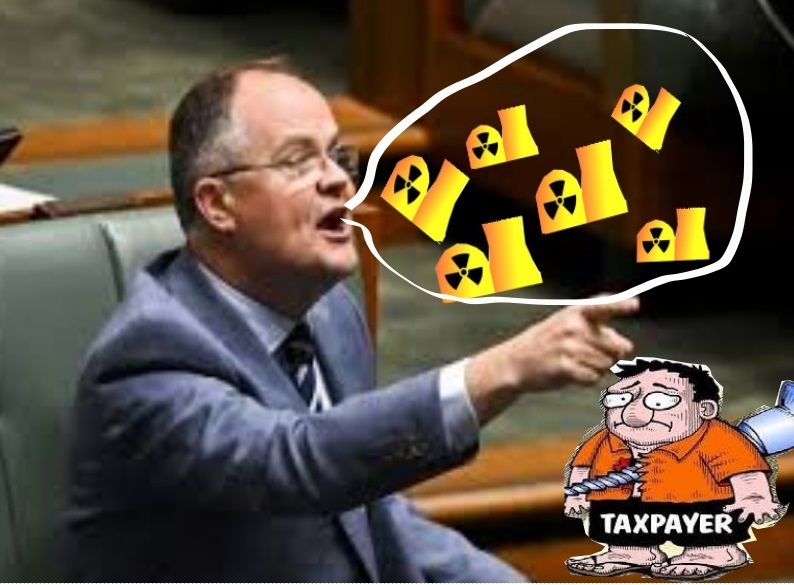
The large-scale and small modular generators would be Commonwealth-owned, similar to arrangements governing the Snowy Hydro 2.0 scheme, requiring a multibillion-dollar funding commitment from taxpayers.
- Peter Dutton nuclear plan slammed
- Proposal could cost $600billion
By JACK QUAIL FOR NCA NEWSWIRE and AUSTRALIAN ASSOCIATED PRESS 23 June 2024, more https://www.dailymail.co.uk/news/article-13559019/The-insane-cost-turn-Australia-nuclear-Peter-Dutton-slammed-completely-irrational-plan.html
Labor frontbencher Tanya Plibersek has added her voice to the tirade of criticism against the Opposition’s nuclear energy push, labelling the proposal as ‘completely irrational’ and ‘designed to be a distraction’.
Speaking on Sunday, the environment and water minister criticised the Coalition for its refusal to detail the estimated cost to add nuclear generation to the national electricity market in the biggest overhaul of energy policy in decades.
‘He’s saying to Australians: ‘I don’t trust you. I don’t trust you with the costing we’ve done,’ if he’s got costings,’ Ms Plibersek told Sky News.
According to analysis released by the Smart Energy Council using data from the latest GenCost report, Labor’s non-nuclear energy plan is estimated to cost $117bn through to 2050, while the Coalition’s pledge would cost upwards of $600bn.
Opposition energy spokesman Ted O’Brien has flagged an evolution in the Coalition’s nuclear power policy, revealing that each of the seven sites could host multiple reactors.
But in a major concession, Mr O’Brien said on Sunday the Coalition would not go to the election announcing the estimated generation capacity of its nuclear power plan, leaving this decision to an independent body until after the election.
‘One of the lessons we learned from overseas, in order to get prices down, you need multi-unit sites,’ Mr O’Brien told the ABC’s Insiders program.
‘Let’s say the small modular reactors … When you talk about a nuclear plant, these are modularised compartments. You can add another 300, add another 300.
‘You’re talking about multi-unit plants.’
An independent nuclear energy coordinating authority would make recommendations on the number and type of reactors per site, Mr O’Brien said, which would then determine the final generation capacity.
‘The independent body would look at each plant, and come up with a recommendation as to what sort of technology should be used,’ he said.
‘From there, it would be exactly what capacity based on that technology.
‘Only from there can you come down to a specific number of gigawatts’.
Last week Coalition unveiled plans to build seven nuclear power plants by 2050 with the first reactor slated to be operational in just over a decade in a move designed to deliver cheaper, zero-emissions and reliable power supply.
The large-scale and small modular generators would be Commonwealth-owned, similar to arrangements governing the Snowy Hydro 2.0 scheme, requiring a multibillion-dollar funding commitment from taxpayers.
The Coalition has proposed to locate the reactors in Queensland, NSW, Victoria, South Australia and Western Australia on the sites of former coal fired power stations, adding no more than 10GW to the power grid, meaning renewables will remain the vast majority of the energy mix.
Smart Energy Council chief executive John Grimes said Mr Dutton’s nuclear proposal would deliver ‘at best’ 3.7 per cent of the energy required at the same cost as the government’s current strategy.
‘In reality, current cost overruns happening right now in the UK could mean a $600 billion bill to Australian taxpayers, whilst delivering a small proportion of the energy that is actually required,’ he said.
Nuclear had no place in a country with cheap, reliable energy powered by the sun and wind and backed up by renewable energy storage, Mr Grimes said.
‘The most optimistic assessment of Peter Dutton’s nuclear proposal indicates it is a pale shadow of the reliable renewables plan outlined and costed by the Australian Energy Market Operator,’ he said.
The council has called on the opposition to release its analysis of the costings and generation capacity from the seven proposed nuclear reactor sites.
‘They need to explain how their forecasts contradict the experts at the CSIRO and AEMO,’ Mr Grimes said.
‘It is extraordinary that the details are being hidden from the Australian public.’
Separate analysis released by CSIRO put the cost of building a large-scale nuclear reactor at $8.6bn, bringing the total cost to approximately $60bn, however nuclear projects are often subject to hefty delays and soaring cost overruns.
Asked why Australia had eschewed nuclear power when many other advanced economies had adopted the technology, Ms Plibersek pointed to Australia’s comparative advantage in renewable power generation.
‘We’ve got the room, we’ve got the resources, we’ve got the critical minerals we need, battery manufacturing, we’re investing in green hydrogen,’ Ms Plibersek said.
‘We can be a renewable energy superpower and instead Peter Dutton wants to slam the brakes on, instead of leading the world with renewable energy investment.
‘He wants to fast track nuclear, and put us on the slow lane when it comes to renewables. It’s just mad.’
Australian Opposition Leader Peter Dutton’s nuclear plan could cost as much as $600bn and supply just 3.7% of Australia’s energy by 2050, experts say

Coalition proposal would cost a minimum of $116bn – the same as Labor’s plan for almost 100% renewables by 2050, the Smart Energy Council says
Jordyn Beazley, Sun 23 Jun 2024 https://www.theguardian.com/australia-news/article/2024/jun/23/peter-duttons-nuclear-plan-could-cost-as-much-as-600bn-and-supply-just-37-of-australias-energy-by-2050-experts-say
The Coalition’s pledge to build seven nuclear reactors as part of its controversial energy plan could cost taxpayers as much as $600bn while supplying just 3.7% of Australia’s energy mix by 2050, according to the Smart Energy Council.
The analysis found the plan would cost a minimum of $116bn – the same cost as delivering the Albanese government’s plan for 82% renewables by 2030, and an almost 100% renewable energy mix by 2050.
The Coalition has drawn widespread criticism for not releasing the costings of the nuclear power proposal it unveiled on Wednesday as part of its plan for Australia’s energy future if elected. On Friday, the opposition leader, Peter Dutton, said the costings would come “very soon”, but did not confirm whether it would be days, weeks or months.
The Smart Energy Council came to the $116bn figure using data from the CSIRO and the Australian Energy Market Operator’s latest GenCost report. It factored in the Coalition’s proposed timeframe and the capital costs of replacing the 11 gigawatts of coal capacity produced on the seven sites with nuclear reactors.
But factoring in the experience of cost and timeframe blowouts in the UK, the refurbishment of coal-fired power stations, and Dutton’s plan to compensate the states, the Smart Energy Council found the cost could reach as much as $600bn.
The council found the large nuclear reactors – of which there will be five alongside two smaller reactors – would probably cost $60bn each and were unlikely to be built by 2040. Dutton has said that they plan for the reactors to be built and operational by the second half of the 2030s.
“At best, Peter Dutton’s nuclear proposal would deliver 3.7% of the energy required at the same cost as the government’s comprehensive strategy,” John Grimes, the chief executive of the Smart Energy Council, said.
“In reality, current cost overruns happening right now in the UK could mean a $600bn bill to Australian taxpayers, whilst delivering a small proportion of the energy that is actually required.
“The most optimistic assessment of Peter Dutton’s nuclear proposal indicates it is a pale shadow of the reliable renewables plan outlined and costed by the Australian Energy Market Operator (Aemo).”
The Smart Energy Council called on the opposition to immediately release its costings and the generation capacity of the proposed seven nuclear reactors.
“They need to explain how their forecasts contradict the experts at the CSIRO and Aemo. It is extraordinary that the details are being hidden from the Australian public,” said Grimes.
The CSIRO and Aemo have assessed the cost of different electricity sources and found nuclear generation would be the most expensive technology available for consumers.
It found that solar and wind backed by storage energy, new transmission lines and other “firming” – in other words, what the country is building now – were the cheapest option.
The Coalition’s promise has met widespread scepticism from Australia’s energy sector and industry groups, which have warned about the risks of cost blowouts and destroying private sector investment.
During an address to party officials in Sydney on Saturday, Dutton said his nuclear energy plan would cost a fraction of Labor’s renewable energy rollout, and would assist in achieving the party’s goal for “cheaper, cleaner and consistent power.
1 This Month

26 September – International Day for the Total Elimination of Nuclear Weapons


PLEASE OPPOSE HR 8255 AND S.3639 – bills would accelerate satellite deployment, with no environmental review or safeguards – https://ncstd5li.quorum.us/campaign/169331/
To see nuclear-related stories in greater depth and intensity – go to https://nuclearinformation.wordpress.com
-
Archives
- September 2026 (206)
- August 2026 (330)
- July 2026 (355)
- June 2026 (287)
- May 2026 (306)
- April 2026 (356)
- March 2026 (251)
- February 2026 (267)
- January 2026 (308)
- December 2025 (358)
- November 2025 (359)
- October 2025 (375)
-
Categories
- 1
- 1 NUCLEAR ISSUES
- business and costs
- climate change
- culture and arts
- ENERGY
- environment
- health
- history
- indigenous issues
- Legal
- marketing of nuclear
- media
- opposition to nuclear
- PERSONAL STORIES
- politics
- politics international
- Religion and ethics
- safety
- secrets,lies and civil liberties
- spinbuster
- technology
- Uranium
- wastes
- weapons and war
- Women
- 2 WORLD
- ACTION
- AFRICA
- Atrocities
- AUSTRALIA
- Christina's notes
- Christina's themes
- culture and arts
- Events
- Fuk 2022
- Fuk 2023
- Fukushima 2017
- Fukushima 2018
- fukushima 2019
- Fukushima 2020
- Fukushima 2021
- general
- global warming
- Humour (God we need it)
- Nuclear
- RARE EARTHS
- Reference
- resources – print
- Resources -audiovicual
- Weekly Newsletter
- World
- World Nuclear
- YouTube
-
RSS
Entries RSS
Comments RSS
 nuclear-news