In UK’s liberalised competitive market, nuclear power has no chance
Now the landscape is infinitely harsher. Britain has a liberalised, highly competitive energy market, and ministers are swearing blue that no nuclear subsidies will be provided. No nuclear power station has yet successfully been built, anywhere in the world, in such circumstances.
Will Chris Huhne succeed where Mrs Thatcher failed? I wouldn’t bet on it – Telegraph UK, By Geoffrey Lean October 19th, 2010 “…….the new announcement by the formerly anti-nuclear Chris Huhne takes me back some thirty years to the time when Mrs Thatcher’s government unveiled its atomic ambitions, the last serious British attempt to expand the country’s use of the technology. Continue reading

Nuclear renaissance bubble losing its puff
the simple reality is that a nuclear renaissance in the U.S. will be impossible if new reactors remain too expensive to build and natural gas remains “dirt cheap” while renewable energy costs continue to decline and consumer demand remains on a downward spiral……
underestimated costs, ignored risks, political ballyhoo
and prodigious but inadequate subsidies — now make clear that we are dealing not with a renaissance but with a bubble. The main remaining question is just how much taxpayer money will go into keeping it inflated.”

Reactor under microscope South Maryland News, Constellation, officials working to keep CC3 project going, Oct. 20, 2010, By MEGHAN RUSSELL“.………..even if EDF agreed to take the project under its wing, many skeptics, like the Nuclear Information and Resource Service, doubt the conditions are right for a “nuclear renaissance” and believe Calvert Cliffs 3 was doomed from the start. Continue reading
American families unwilling to cop the financial risk exposure of nuclear power
The struggle for a nuclear renaissance has been and remains a struggle over allocation of economic risk. U.S. power markets allocate that risk to investors and lenders, who will not put up the money for new nuclear…… southeastern states decided to allocate that risk to their customers, some of whom have begun to rebel. Congress is being asked to allocate it to taxpayers. However, with each new reactor requiring the allocation of close to $100 in risk exposure to every family in America, this is proving a tough sell.
Honey, I Shrunk the Renaissance: Nuclear Revival, Climate Change and Reality, CleanEnergy Footprints, by Peter Bradford, 15 Oct 10, “……Did the nuclear renaissance jump, or was it pushed? In truth, the nuclear renaissance has always consisted of the number of plants that government was willing to build. This is true not only in the United States but also in every other country now building new nuclear units. Continue reading
Yet more delays in reviving Point Lepreau nuclear reactor
Point Lepreau delayed until fall 2012. CBC News – New Brunswick , 14 Oct 10, The $1.4-billion Point Lepreau refurbishment project is now delayed until the fall of 2012, NB Power said Thursday.The refurbishment of Atlantic Canada’s only nuclear reactor is now three years behind schedule……..The project was supposed to be completed in September 2009……. CBC News – New Brunswick – Point Lepreau delayed until fall 2012
Old nuclear plants have low market value, new ones not viable
..Constellation’s finances have stabilized but demand for electric power has fallen, reducing not only the market value of old power plants but the viability of building new ones.

Constellation’s fallout with French firm unfortunately the new business as usual, The Washington Post, By Steven Pearlstein, October 14, 2010 If you were looking for an example of the erosion in standards of business behavior, you couldn’t do better than the story of Constellation Energy and its recent falling-out with the French nuclear energy company EDF….. Continue reading
Nuclear “renaissance” looking riskier than ever, with cancellation of Maryland plant
There’s no gainsaying that nuclear construction projects are looking riskier all the time, especially in the United States, where many factors have conspired to spoil dreams of a big nuclear renaissance: declining energy demand since the onset of the global economic crisis (down 4 percent since 2007 in the States); plummeting natural gas prices (down almost half from what they were a few years ago); collapsing prospects for enactment of a U.S. climate bill (which would have raised the costs of fossil-fuel-generated electricity); and soaring reactor construction costs (with EDF’s current reactor 40 or 50 percent more expensive than originally billed).
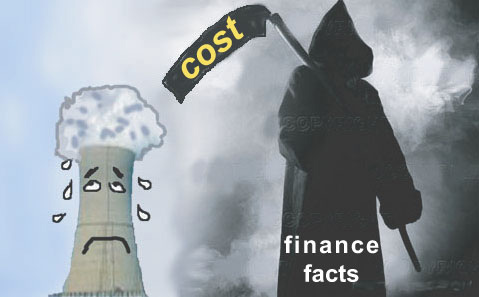
Cancellation of Maryland Plant Delivers Double Whammy IEEE Spectrum: Bill Sweet , October 13, 2010 Continue reading
France’s EDF takes share loss, with cancellation of USA project
EDF shares fall on nuclear news The Daily Record, , October 11, 2010By Associated Press PARIS — Shares in Electricite de France SA slid Monday after the French state-owned utility’s U.S. partner, Constellation Energy Group, pulled out of a project to build the first of a new generation of nuclear power plants in Maryland.
The announcement dealt a serious setback to EDF’s ambitions to lead a nuclear renaissance in the United States. The company is the world’s largest electric power producer.EDF shares slipped as much as 1.5 percent in early trading and midafternoon were down 1.1 percent at $43.43 on the Paris stock exchange — and were the biggest loser on the benchmark CAC-40 index.
An EDF spokeswoman said the future of the multibillion-dollar Calvert Cliffs 3 plant project is unclear after Baltimore-based Constellation said it would drop out over risks linked to the high cost of a $7.5 billion loan guarantee… » EDF shares fall on nuclear news
Ratepayers, not shareholders, cop the cost of Georgia’s planned nuclear reactors
[Georgia’s nuclear] project is receiving other assistance that was not available to the Calvert Cliffs project: Construction Work in Progress financing, or CWIP. This is a scheme that allows Southern Company/Georgia Power to begin charging ratepayers for the reactors even before they’re built. Maryland law does not allow CWIP.


Nuclear project cancellation leaves Georgia standing alone, FACING SOUTH, 11 Oct 10, Apparently even billions of dollars in loan guarantees from the federal government are not enough to help the nuclear industry overcome the financial risks of building new reactors……. Continue reading
Nuclear power’s high costs make nuclear socialism essential
the all-in cost of a 2-gigawatt nuclear plant including financing running around $20 billion to $25 billion — in other words, $10 or more per watt. Financing costs are important to include because plants take years to erect: even a one percent loan on a $8 billion project adds up. As a result, the high price results in nuclear socialism, … because plants will always need state support.
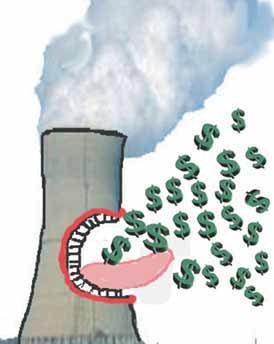
How Much Does Nuclear Cost? $6,000 a Kilowatt or More, Greentech Media, 11 Oct 10, Constellation’s bid to get government backing sheds some light on the high cost of nuclear.
How much is that nuclear reactor in the window? Continue reading
Constellation Energy about to kill nuclear reactor project
Constellation Energy says loan backstop too costly, MontereyHerald.com :By DANIEL WAGNER 10/10/2010 WASHINGTON—Constellation Energy Group Inc. says it won’t tap a government program necessary to build a new nuclear plant in Maryland, in a move likely to kill the project, according to a published report on Sunday.The U.S. Department of Energy’s loan guarantee came with “unworkable” terms and an “unreasonably burdensome” cost, Constellation said Saturday, according to a report by The Wall Street Journal……..The government guarantee was necessary for Constellation to finance the planned Calvert Cliffs 3 plant in Calvert County, Md. Lenders require developers of nuclear sites to obtain the guarantee. The projects are too costly and high-risk to qualify for regular loans…….. Constellation Energy says loan backstop too costly – MontereyHerald.com :
Growing focus on renewable energy investment in Asia
“There is a realization that renewable energy is no longer a trendy fad,” It is actually something that has proven to work, proven to be financially viable and it is a sector that is maturing rapidly.
Betting big on renewables The Asset July / August 2010 by Chito Santiago As several countries across Asia are plugging their infrastructure gaps, particularly in the power sector, much attention is focussed on renewable sources of energy. Sponsors, both domestic and foreign, as well as investors and financiers, are pouring into the region looking for various opportunities in wind, solar, waste, water and hydropower projects. Continue reading
Insurance for losses related to nuclear reactors – no way!
it is very clear that general insurance will not cover coastal property owners from losses related to nuclear plants.

NO INSURANCE FOR COASTAL – or any – PROPERTY NEAR NUCLEAR REACTORS | Coalition Against Nuclear Energy 4 oct 10, Energy Minister Dupuo Peters said that by the time a nuclear plant was constructed in SA, this country would not be able to afford enriched uranium.She also raised the valid point that coastal homes would be affected, since nuclear power plants would be built on the coast. Continue reading

South Africa says no to South Korea nuclear power deal
S.Africa will not sign S.Korea nuclear power deal: official, Google hosted news, (AFP) 4 Oct 10, JOHANNESBURG — South Africa said Sunday it would not sign an agreement with South Korea to design and build nuclear power plants in the African country, dismissing an earlier report, the foreign ministry said.South Africa’s Deputy President Kgalema Motlanthe is due in Seoul on Friday “to discuss our bilateral relations in general”, spokesman Saul Molobi for the foreign ministry said.”Motlanthe is not going to sign any deal… We are not going to discuss any possibility for South Africa to buy a nuclear plant,” he added.
AFP: S.Africa will not sign S.Korea nuclear power deal: official
Nuclear finance squabble as France’s debt-laden EDF in dispute with USA’s Constellation
From Put Options to Development Aid The French EDF ex-monopoly electricity supplier with the biggest number of nuclear reactors of any traded power company in the world, also the most debt-laden traded company in France, and with a share price down about 25% through Jan-Aug 2010, is using financial engineering to keep a foothold in the US nuclear power market. Continue reading
Financing the Nuclear Resuscitation will bring about Global Debt
Sovereign Debt to Global Debt The UN’s Nuclear Suppliers Group has an impressive 45-nation list of supposed nuclear equipment and service suppliers, but these include countries like Iceland, Malta, Croatia, Cyprus and Romania, everyone short of the Vatican. Continue reading
1 This Month



19 November – Webinar – The Reality of Reprocessing
Time: 11:00 AM Pacific Time (US & Canada) / 2:00 PM Eastern / 7:00 PM UK / 8:00 PM CET
Register for the Zoom Event Here



Shut down the radiation-damaged Heysham nuclear reactors now
To see nuclear-related stories in greater depth and intensity – go to https://nuclearinformation.wordpress.com

Say No to NASA’s Reckless Nuclear Reactor on the Moon
Say No to NASA’s Reckless Nuclear Reactor on the Moon
-
Archives
- November 2026 (84)
- October 2026 (302)
- September 2026 (339)
- August 2026 (330)
- July 2026 (355)
- June 2026 (287)
- May 2026 (306)
- April 2026 (356)
- March 2026 (251)
- February 2026 (267)
- January 2026 (308)
- December 2025 (358)
-
Categories
- 1
- 1 NUCLEAR ISSUES
- business and costs
- climate change
- culture and arts
- ENERGY
- environment
- health
- history
- indigenous issues
- Legal
- marketing of nuclear
- media
- opposition to nuclear
- PERSONAL STORIES
- politics
- politics international
- Religion and ethics
- safety
- secrets,lies and civil liberties
- spinbuster
- technology
- Uranium
- wastes
- weapons and war
- Women
- 2 WORLD
- ACTION
- AFRICA
- Atrocities
- AUSTRALIA
- Christina's notes
- Christina's themes
- culture and arts
- Events
- Fuk 2022
- Fuk 2023
- Fukushima 2017
- Fukushima 2018
- fukushima 2019
- Fukushima 2020
- Fukushima 2021
- general
- global warming
- Humour (God we need it)
- Nuclear
- RARE EARTHS
- Reference
- resources – print
- Resources -audiovicual
- Weekly Newsletter
- World
- World Nuclear
- YouTube
-
RSS
Entries RSS
Comments RSS

