Down, down, continues the price of uranium
Spot Uranium Drifts Downward. by Melissa West, Uranium Researcher, 13 March 12 Uranium Investing News, Platts reported spot uranium prices are continuing to drop at a slightly faster rate than earlier this year. As quoted in the market news:
TradeTech on Friday lowered its weekly spot price to $51 a pound U3O8, a drop of 80 cents/lb from TradeTech’s price March 2. TradeTech said the drop was due largely to a lack of buying interest and “aggressively priced material offered by one motivated seller.” http://uraniuminvestingnews.com/10910/spot-uranium-drifts-downward.html
Tanzania’s battle over uranium tax
The fierce battle for $205m uranium tax, BY FLORIAN KAIJAGE 11th March 2012 As the Russian firm seeks court order Tanzania Revenue Authority (TRA) and Russian company JSC Atomredmetzoloto (AMRZ) are in fierce legal battle over the $205.8 million (Sh330billion) that TRA demands from the company as an income tax and stamp duty emanating from thelatter’s purchase of Mkuju River Uranium mining site from Mantra
Resources of Australia in 2011.
The legal battle is before the Tax Revenue Appeals Board that begun hearing of the matter on Monday March 5, 2011 in Dar es Salaam under the chairmanship of Pentarin Kente…. The amount of money involved is staggering; this is a record amount in Africa just on income tax. It
is $196 million that equivalent to Sh320 billion, 2 percent of the country’s GDP (Gross Domestic Product); it is not a small amount by local or international standards…. http://www.ippmedia.com/frontend/index.php?l=39338
Iowa residents might have to take the financial risks of planned nuclear power plant
opens the door for MidAmerican to charge customers rather than fund a significant portion of a project with their own capital.
“It shifts the risk from the shareholder to the ratepayer,”
Lawmakers question if nuclear bill helps customers, The Gazette, 11 March 12, DES MOINES, Iowa (AP) — Iowa lawmakers could take action this week on a bill allowing MidAmerican Energy to seek permission from regulators to move forward with a nuclear power plant, but some are still questioning if the measure would hurt customers.
The measure would allow MidAmerican to ask the Iowa Utilities Board for a rate increase from the company’s customers to fund the cost of permitting, licensing, and building a plant. Costs for such a project have been estimated at $2 billion. Continue reading
Patrick Moore praises nuclear power, but the world does not believe him!
Dramatic fall in new nuclear power stations after Fukushima, Fiona Harvey in Brussels, John Vidal and Damian Carrington. guardian.co.uk, 8 March 2012 The drop in construction work on new reactors may reflect waning interest in nuclear after the shutdown of the Japan reactor a year ago
The number of new nuclear power stations entering the construction phase fell dramatically last year compared with previous years, in the aftermath of the incident at the Fukushima nuclear plant in Japan last March.
From 2008 to 2010, construction work began on 38 reactors around the world, but in 2011-12, there were only two construction starts, according to Steve Thomas, professor of energy studies at the University of Greenwich. Continue reading
Plenty of future work for Japan’s nuclear professionals – in shutting down the world’s nuclear reactors
concerns over where Japan’s nuclear professionals will end up. We believe, however, that this concern needs to be reframed. There are more than 430 nuclear reactors in the world, and one by one they will all reach the end of their service lives. Regardless of the future paths of nuclear policies around the world, there will be plenty of reactors that need to be shut down.
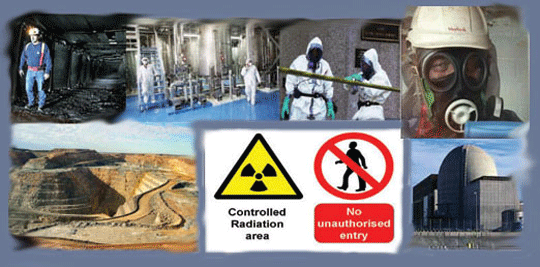
Editorial: Time to say goodbye to nuclear power, Mainichi Daily News, 7 March 12, The illusion of nuclear power safety has been torn out by the root. The Fukushima nuclear disaster that followed the great waves of March 11 last year made sure of that.. Continue reading
World’s biggest man made hole – BHP ‘s uranium mine, might not go ahead
 Reuters report on mining conference in Canada Mar 6, 2012 By Euan Rocha TORONTO, March 6 – The Anglo-Australia mining giant, which already operates an underground mine at the site, has yet to sign off on the budget for
the open pit…. but BHP may opt to delay taking on the heavy financial burden that could easily be in the $10 billion to $20 billion range…..
…. PDAC, the mining industry’s largest annual gathering. The convention, organized by the Prospectors and Developers Association of Canada, opened in Toronto on Sunday.
Even though Olympic Dam, located 550 km (345 miles) north of Adelaide, is one of BHP’s biggest growth prospects, the cost of
digging the massive pit may prove prohibitive.
Last month the company reported a profit decline, and it struck a cautious tone on its expectations for growth in China, one of its
biggest markets. That has led some to speculate that the miner may delay spending on capital-intensive projects such as Olympic Dam and the Jansen potash project in the Canadian province of Saskatchewan.
In late 2011, BHP finalized state approvals to begin construction work on the open-pit phase of the Olympic Dam project, but the agreement would lapse around December if BHP delays its decision on proceeding.
“We want to see a board decision before the end of the year about substantial works beginning. If not, the approvals run out and BHP know this,” said Tom Koutsantonis, minister for mineral resources and energy for the state of South Australia.” I’m not in the business, and no government should be in the business, of allowing anyone to have massive tenements that they don’t develop …”-
A spokesman for BHP declined to comment on the remarks.
MASSIVE SCALE The sheer scale of the open-pit project is formidable. BHP will have to shovel rock for five to seven years before it reaches the Olympic Dam ore body, discovered in the mid-1970s….. http://www.reuters.com/article/2012/03/06/canada-mining-pdac-olympicdam-idUSL2E8E60E220120306
Plan for Mid American to finance its nuclear plans and must then construct them
Lawmaker says deal struck on nuclear power bill CBS News, 6 Mar 12, DES MOINES, Iowa — A legislator said Tuesday that he had struck a deal on a plan that would give MidAmerican Energy new incentives to build a nuclear power plant in Iowa.
Sen. Matt McCoy, chairman of the Senate Commerce Committee, said his panel will approve the compromise Thursday. The compromise would require that MidAmerican, Iowa’s largest utility, have financing in place before beginning construction of a nuclear power plant. Once
state regulators approve a new plant, the utility would have to carry out construction.
Some legislators had worried earlier versions of the measure would allow the utility to raise rates to pay for the plant, without being committed to actually building the facility. They said consumers could end up with higher rates, and no new power plant to show for it.
Lawmakers reached the agreement even as opponents held a Statehouse news conference, where they argued that nuclear plants are inherently dangerous….. Francis Thicke, a farmer and environmental activist from Fairfield, said the compromise backed by McCoy only dealt with the potential financial risks of the proposed nuclear plant. “My concern is the whole environmental issue and they are not addressing the environment,” Thicke said. ….
http://www.cbsnews.com/8301-505245_162-57391792/lawmaker-says-deal-struck-on-nuclear-power-bill/
‘Outing’ the financial firms that fund nuclear weapons
The institutions most heavily involved in financing nuclear arms makers include Bank of America, BlackRock and JP Morgan Chase in the US, BNP Paribas in France, Allianz and Deutsche Bank in Germany, Mistubishi UFJ Financial in Japan, Credit Suisse and UBS in Switzerland, and Barclays, HSBC, Lloyds and Royal Bank of Scotland in Britain.
 Over 300 financial institutions funding nuclear firms: NGO ,Economic Times, 5 March 12, http://economictimes.indiatimes.com/news/politics/nation/over-300-financial-institutions-funding-nuclear-firms-ngo/articleshow/12151557.cms NEW DELHI: A foreign NGO today claimed that more than 300 financial institutions, including some Indian firms, have exposure to 20 major nuclear weapons companies across the world and urged them to stop these investments.
The NGO, International Campaign to Abolish Nuclear Weapons (ICAN), has also named Indian conglomerate Larsen and Toubro (L&T), which has done some work for Indian Navy and the missile system, in a report released today.
“L&T is involved in the design and construction of five nuclear-armed submarines for the Indian navy, each of which will be equipped with 12 missiles. The company has also tested a launch system for India’s nuclear missiles,” it said. Continue reading
Scotland’s renewable energy will mean cheaper electricity by 2020
 Renewable energy cheaper, Scotland says, Outcome, March 5, 2012, EDINBURGH, Scotland, March 5 (UPI) — Energy bills for consumers in Scotland could be as much 7 percent higher if the government didn’t pursue its renewable energy strategy, a minister said.
Scotland has some of the most ambitious renewable energy targets in Europe. The government aims to meet 100 percent of the electricity demand through renewable energy resources by 2020.
A report from the Scottish government concludes that consumers would pay around $2,035 per year for energy bills by 2020 under the low-carbon policies. If the government pursues a “business as usual” model, bills would be around $2,182 per year.
Scottish Energy Minister Fergus Ewing said there are some doubts as to whether the government can meet its renewable energy targets but they are achievable. “We know there is doubt and skepticism about our 100 percent renewables target and the financial and engineering challenges required to meet it,” he said in a statement.
“But we will meet these challenges. I want to debate, engage and cooperate with every knowledgeable, interested and concerned party to ensure we achieve our goals.” Ewing added renewable energy targets would be met without the need for new nuclear power stations. http://outcomemag.com/science/2012/03/05/renewable-energy-cheaper-scotland-says/
Nuclear power industry in meltdown
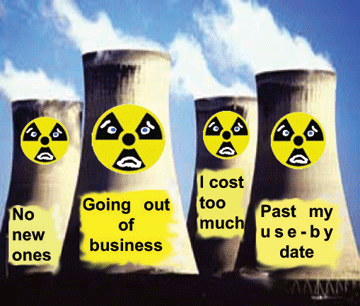 Why nuclear is in meltdown, Telegraph UK, Britain’s atomic plants will be cut from 10 to just one in little more than a decade. By Geoffrey Lean 02 Mar 2012 This week the world’s longest-running nuclear power station ran out of steam. At 11am on Wednesday, the appropriately named Oldbury in Gloucestershire – once a location for a Doctor Who storyline – was switched off after 44 years, as part of a wider shutdown that will cut Britain’s 10 atomic plants to just one in little more than a decade.
That same morning, just down the Severn Estuary, protesters were evicted from a deserted farmhouse on the site of the first of the new reactors designed to replace them. But the original start-up date for the plant – to be built by the French firm EDF at Somerset’s Hinkley Point – has already slipped by two years, from 2017 to 2019, and this week it emerged that the Office for Nuclear Regulation is delaying its safety approval.
It’s an ominous picture as next weekend’s anniversary of the Japanese tsunami and the disaster at Fukushima approaches – yet Britain is supposed to be one of the world’s few nuclear bright spots……
Elsewhere, the “nuclear renaissance” before Fukushima – which saw more than 400 reactors in construction or in the pipeline – has gone into reverse. Continue reading
Current status of Fukushima’s nuclear reactors
Fukushima Nuclear Crisis Update for February 28th – March 1st, 2012, Greenpeace by Christine McCann – March 2, 2012“”…..Reactor Status The Fukushima Daiichi plant chief, Takeshi Takahashi, admitted this week that the plant is fragile, and its reactors remain highly vulnerable to ongoing earthquakes and the risk of a tsunami. “I have to admit that it’s still rather fragile. Even though the plant has achieved what we call cold-shutdown conditions, it still causes problems that must be improved,” Takahashi said.
TEPCO is continuing to struggle with how to handle large amounts of radioactive water, the byproduct of keeping nuclear fuel in the crippled Fukushima Daiichi reactors cool. The utility is pumping several hundred thousand gallons of water into the reactors each day; the water then becomes contaminated. Experts estimate that 10,000 tons of radioactive water leak from the reactors each month; in January and February alone, 28 new leaks were discovered. TEPCO says it will take at least six years to repair the leaks, and approximately 25 years to remove the fuel. Storage of the radioactive water is becoming an increasingly urgent issue. TEPCO currently has space to store 165,000 tons; 125,000 tons are already being stored. The utility has destroyed nearby forests to create room for more storage containers.
TEPCO announced that Quince II, a Japanese-made robot, has discovered radiation levels measuring 220 millisieverts per hour in reactor #2 at the Fukushima Daiichi plant. The robot, which was designed by researchers at the Chiba Institute of Technology, was created to explore the interior of the Fukushima Daiichi nuclear reactors, where radiation levels remain too high for humans to enter. http://www.greenpeace.org/international/en/news/Blogs/nuclear-reaction/fukushima-nuclear-crisis-update-for-february-/blog/39340/
One stop nuclear shop AREVA suffering, as nuclear industry declines
 Areva, which has been designed as a one-stop nuclear shop, has been affected by massive impairments on its uranium assets and a slowdown of the nuclear industry following Japan’s Fukushima disaster
Areva Accelerates Disposals By GERALDINE AMIEL, WSJ, March 2, 2012, PARIS—French state-controlled nuclear energy company Areva SA announced two asset disposals as part of a plan to boost competitiveness and better position it to face a slowing civil atomic industry, one year after Japan’s Fukushima nuclear catastrophe. Continue reading
Debts force First Uranium to sell off assets
First Uranium to sell two South African assets for $405 mln, Mar 2, 2012 (Reuters) – First Uranium Corp said it would sell two assets in South Africa for $405 million, as the gold and uranium miner scrambles to liquidate itself to pay off its debts.
The company will sell Mine Waste Solutions, a tailings recovery project, to South Africa-based AngloGold Ashanti Ltd for $335 million in cash.
First Uranium also said it would sell its stake in First Uranium Ltd, which owns the Ezulwini Mining Co, to Australian miner Gold One International Ltd for $70 million. Gold One will also provide a $10 million loan facility to First Uranium.
The company said it is moving ahead with plans to liquidate the company and will use the proceeds to pay its securityholders and shareholders…. http://af.reuters.com/article/investingNews/idAFJOE8210CP20120302?feedType=RSS&feedName=investingNews
Kazakhstan says Japan will continue to buy its uranium
Japan to Purchase Contracted Kazakh Uranium, Kazatomprom Says Bloomberg, By Nariman Gizitdinov and Yuriy Humber – Feb 23, 2012 Kazatomprom (KZAP), the state nuclear company in the world’s biggest uranium-producing nation, said its Japanese customers will take delivery of the fuel they agreed to buy even as the country idles its atomic stations.
The supply contracts with Japan haven’t changed, Chief Executive Officer Vladimir Shkolnik told reporters in Almaty, Kazakhstan, today without identifying the buyers…..
http://www.bloomberg.com/news/2012-02-24/japan-to-purchase-contracted-kazakh-uranium-kazatomprom-says.html
Ratepayers to take all financial risks, nuclear company to take profits!
 “It exposes ratepayers to all the risk.” The nuclear industry’s answer to its post-Fukushima challenges, he said, “is to simply rip out the heart of consumer protection and turn the logic of capital markets on their head.”
His message to policymakers is simple, Cooper said. “This is an investment you would not make with your own money. Therefore, you should not make it with the ratepayers’ money.”
The Nuclear Industry’s Answer to Its Marketplace Woes, Greentech media Construction Work in Progress (CWIP) financing shifts the risks of nuclear energy to utility ratepayers. HERMAN K. TRABISH: FEBRUARY 22, 2012 A sign of the nuclear industry’s difficult situation in the aftermath of Fukushima is a proposal before the Iowa legislature that would allow utility MidAmerican Energy Holdings, a subsidiary of Warren Buffett’s Berkshire Hathaway, to build a new nuclear facility in the state using Construction Work in Progress (CWIP) financing (also called advanced cost recovery).
“Investment in nuclear power is the antithesis of the kind of investments you would want to make under the current uncertain conditions,” explained nuclear industry authority Mark Cooper, a senior fellow for economic analysis at Vermont Law School’s Institute for Energy and the Environment. “They cannot raise the capital to build these plants in normal markets under the normal regulatory structures.”
CWIP would allow the utility to raise the money necessary to build a nuclear power plant by billing ratepayers in advance of and during construction.
“Construction Work in Progress was intended to circumvent the core consumer protection of the regulatory decision-making process,” Cooper explained. “It exposes ratepayers to all the risk.” The nuclear industry’s answer to its post-Fukushima challenges, he said, “is to simply rip out the heart of consumer protection and turn the logic of capital markets on their head.”
The Staff of the Iowa Utilities Board concurred with Cooper. Its recommendations to the legislature followed his arguments in “Nuclear Socialism Comes to the Heartland of America,” his most recent paper on nuclear economics. In it, Cooper found that CWIP could increase average utility bills as much as $70 per month “before any power is generated by the reactors.”
His message to policymakers is simple, Cooper said. “This is an investment you would not make with your own money. Therefore, you should not make it with the ratepayers’ money.”
CWIP exposes ratepayers to all the risks inherent in nuclear energy, Cooper explained. Continue reading
1 This Month





PLEASE OPPOSE HR 8255 AND S.3639 – bills would accelerate satellite deployment, with no environmental review or safeguards – https://ncstd5li.quorum.us/campaign/169331/
To see nuclear-related stories in greater depth and intensity – go to https://nuclearinformation.wordpress.com
-
Archives
- October 2026 (29)
- September 2026 (339)
- August 2026 (330)
- July 2026 (355)
- June 2026 (287)
- May 2026 (306)
- April 2026 (356)
- March 2026 (251)
- February 2026 (267)
- January 2026 (308)
- December 2025 (358)
- November 2025 (359)
-
Categories
- 1
- 1 NUCLEAR ISSUES
- business and costs
- climate change
- culture and arts
- ENERGY
- environment
- health
- history
- indigenous issues
- Legal
- marketing of nuclear
- media
- opposition to nuclear
- PERSONAL STORIES
- politics
- politics international
- Religion and ethics
- safety
- secrets,lies and civil liberties
- spinbuster
- technology
- Uranium
- wastes
- weapons and war
- Women
- 2 WORLD
- ACTION
- AFRICA
- Atrocities
- AUSTRALIA
- Christina's notes
- Christina's themes
- culture and arts
- Events
- Fuk 2022
- Fuk 2023
- Fukushima 2017
- Fukushima 2018
- fukushima 2019
- Fukushima 2020
- Fukushima 2021
- general
- global warming
- Humour (God we need it)
- Nuclear
- RARE EARTHS
- Reference
- resources – print
- Resources -audiovicual
- Weekly Newsletter
- World
- World Nuclear
- YouTube
-
RSS
Entries RSS
Comments RSS

