First Uranium company teeters on the brink of collapse

 What will happen to First Uranium? First Uranium is looking at a distress sale of assets to settle upcoming debts, a move that would have a number of implications for shareholders Christy Filen , 22 Feb 2012 JOHANNESBURG (MINEWEB) –
It is no secret that First Uranium is in a pickle. Releasing a forecast that shows its cash will run out by the end of March will be cold comfort to shareholders and creditors alike…. First Uranium has turned to what is conceivably its only option and that is a distress sale of its assets in an effort to settle upcoming debts….. As if this wasn’t enough First Uranium’s Ezulwini operation is not making the gradeand its Mine Waste Solutions (MWS) is fighting licensing issues with environmentalists and the Department of Mineral Resources. In terms of the results of an impairment exercise of the Ezulwini Mine’s assets, an impairment adjustment of $180m was recognised in the company’s financial statements…. “The Company’s ability to continue as a going concern is dependent upon its ability to bring these proposed transactions to fruition” said First Uranium….. http://www.mineweb.com/mineweb/view/mineweb/en/page34?oid=145826&sn=Detail&pid=102055
How the nuclear lobby’s devious marketing distorts “incentives”
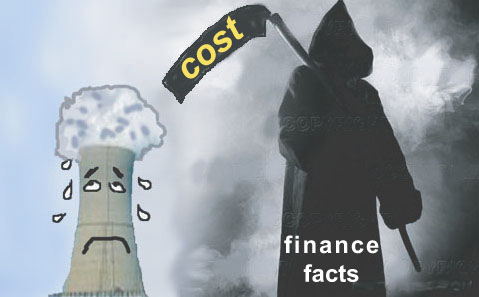 the NRC’s decision on Vogtle was “a non-event” because, he said, “The morning after the license was issued, nobody on Wall Street woke up and said, ‘Hey! Now I’m going to buy in!'” The licensing decision had, he said, “no effect on the economics.”
The Nuclear Industry’s Answer to Its Marketplace Woes, Greentech media Construction Work in Progress (CWIP) financing shifts the risks of nuclear energy to utility ratepayers. HERMAN K. TRABISH: FEBRUARY 22, 2012 “……..An example of incentive distortion is “the sunk-costs argument” now being used by Southern Company for the Vogtle reactors under development in Georgia with CWIP financing. Construction there is reportedly both behind schedule and over budget. Southern Company, Cooper said, is arguing that, with as much as $4 billion in sunk costs, “It’s cheaper to finish this project than to start something else.”
Some nuclear developers, he added, will simply tell regulators that have authorized the spending of billions in ratepayer funds, “If you don’t give me the next $50 million, I’m going to abandon this project.” Continue reading
Thorium reactors won’t save the nuclear industry

 Nuclear power entrepreneurs push thorium as a fuel, Washington Post, 20 Feb 12, “….. a small group of scientists, entrepreneurs and advocates see the post-Fukushima era as the perfect opportunity to get the United States to consider a proposal they have made with no success for years. What about trying a new fuel, they say, and maybe a new kind of reactor?….. They’re pushing the idea of adapting plants to use thorium as a fuel or replacing them with a completely new kind of reactor called a liquid-fluoride thorium reactor, or LFTR (pronounced “lifter”). The LFTR would use a mixture of molten chemical salts to cool the reactor and to transfer energy from the fission reaction to a turbine..
….‘Small boatloads of fanatics’ Although the idea of thorium power has been around for decades — and some countries are planning to build thorium-powered plants — it has not caught on with the companies that design and build nuclear plants in the United States or with the national research labs charged with investigating future energy sources.
“There are small boatloads of fanatics on thorium that don’t see the downsides,” said Dan Ingersoll, senior project manager for nuclear technology at the Oak Ridge National Laboratory in Tennessee. For one thing, he said, it would be too expensive to replace or convert the nuclear power plants already running in this country: “A thorium-based fuel cycle has some advantages, but it’s not compelling for infrastructure and investments.”
He also pointed out that thorium would still have some radioactive byproducts — just not as much as uranium and not as long-lived — and that there is no ready stockpile of thorium in the United States. It would have to be mined.
Overall, he says the benefits don’t outweigh the huge costs of switching technologies. “I’m looking for something compelling enough to trash billions of dollars of infrastructure that we have already and I don’t see that.”…… most U.S. nuclear energy industry executives are wary of both approaches to thorium, saying that neither utilities nor investors are eager to gamble on an unfamiliar technology….
Japan’s nuclear crisis resulting in its record trade deficit
Japan’s trade deficit ballons to record high as nuclear crisis pushes up fuel imports Washington Times, By Associated Press, February 19 TOKYO — Japan posted a record high trade deficit in January after its nuclear crisis shut down nearly all the nation’s reactors for tougher checks, sending fuel imports surging. Exports were hurt by a strong yen and weak demand.
The 1.48 trillion yen ($18.7 billion) deficit reported Monday highlights Japan’s increased dependence on imported fuel after the March 11 earthquake and tsunami sent the Fukushima Dai-ichi nuclear plant into multiple meltdowns…. http://www.washingtonpost.com/business/worldbusiness/japans-trade-deficit-ballons-to-record-high-as-nuclear-crisis-pushes-up-fuel-imports/2012/02/19/gIQABX1HOR_story.html
Nuclear education for North Dakota
Senate hopeful Sand spearheading nuclear energy education effort Fargo, ND (WDAY TV) 16 Feb 12, – A Candidate for U.S Senate is spear-heading an effort to educate North Dakotans on nuclear power. Republican Duane Sand is organizing a nuclear power symposium, to educate people about its benefits.
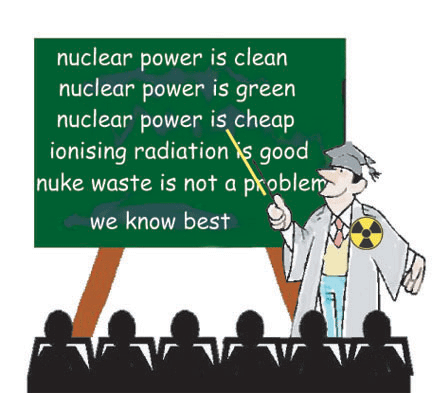
Sand hopes the public, local government officials, and nuclear power companies will attend. He eventually wants to bring a nuclear power plant to the state,… http://www.wday.com/event/article/id/59214/
Rating agency casts gloom on nuclear industry’s future in America
 “In our opinion, the current market conditions combined with nuclear projects’ long planning and construction timelines will prevent the construction of additional new units until at least the end of this decade,” the report said.
US nuclear revival unlikely absent more regulatory support: S&P, Washington (Platts)–15Feb2012 The likelihood of a US “nuclear renaissance” this decade is faint and changes in state regulatory treatment of nuclear projects is needed before utilities outside Georgia and South Carolina build new reactors, credit rating agency Standard & Poor’s said Wednesday.
A sluggish economy has depressed demand and low natural gas prices have allowed utilities to postpone or cancel plans for new nuclear units in favor of new gas-fired generation, S&P analyst Dimitri Nikas wrote in a report. Continue reading
Nuclear power quite likely to be abandoned for Iowa
Nuclear Power – ‘Off the Table’, Blog for Iowa, February 15, 2012 , Paul Deaton MidAmerican Energy made it clear today that if HF 561, or some form of it, does not become law, nuclear power will be “off the table” in Iowa and the electric utility will deal with it by increasing their use of natural gas to generate electricity as demand increases and coal burning power plants are taken off line.
There was no equivocation on this point by Dean Crist, vice president of regulation for the electric utility.
Crist was on WHO Newsradio with Mark Cooper, senior research fellow for economic analysis at the Institute for Energy and the Environment at Vermont Law School, Silver Spring, MD. Each had different ideas about HF 561 and what it would or would not do for Iowa rate payers.
It boiled down to answering this question, “does the legislation change the dynamic, or construct for approval of a potential new nuclear reactor in Iowa?” The simple answer is yes, it does..
USA’s Energy Secretary Chu’s trip to promote nuclear power to Georgia
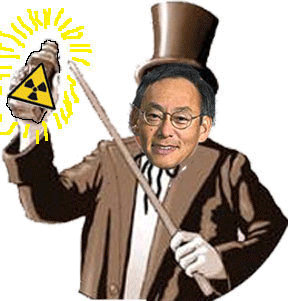 OVERNIGHT ENERGY: Chu to tout nuclear in Georgia The Hill, By Andrew Restuccia and Ben Geman – 02/14/12 State of play: Energy Secretary Steven Chu will tout the Obama administration’s support for nuclear energy Wednesday at a Georgia power plant whose owner recently won approval to build the first new U.S. reactors in more than 30 years.
Rep. Edward Markey (D-Mass.)has called on President Obama to hold off on finalizing the loan guarantee until the Energy Department makes improvements to its loan program, recommended in a White House-mandated report released last week…… http://thehill.com/blogs/e2-wire/e2-wire/210651-overnight-energy
Upfront costs for nuclear reactors, even if they’re never built
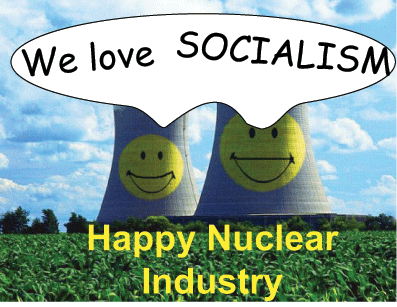 Critic: Proposed MidAmerican nuclear plant is “socialism” Des Moines Register 14 Feb 12, A steady critic of MidAmerican Energy’s proposed nuclear plant in Iowa said legislation backing the project amounts to “socialism” and would cost average ratepayer more than $800 a year.
That bill stalled last year in the Iowa Senate, where it now is before the Commerce Committee and has substantial support.
Mark Cooper, senior fellow at Vermont Law School’s Institute for Energy and the Environment, said the legislation amounts to “nuclear socialism.” “Building new nuclear reactors is entirely uneconomic,” Cooper said. “Nuclear reactors cannot compete with a range of alternatives on price. Construction is so risky, the capital market has said they won’t fund them at normal rates.”
“Under normal market conditions, this power wouldn’t be supplied. The utilities recognize that,so they are pushing for special treatment,” Cooper said. “They want suspension o fmarket forces and suspension of consumer protection.”…. http://www.desmoinesregister.com/article/20120214/NEWS/120214020/1007/NEWS05
Global problems of the nuclear industry
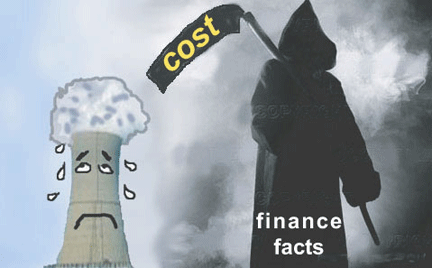 Nuclear Problems, Environmental Research Web, 12 Feb 12, The European Pressurised-water Reactor (EPR) being built at Olkiluoto in Finland is now unlikely to be completed until 2014- five years late- and $3bn or more over-budget. Similar problems face the EPR being built at Flammanville in France.
And similar problems have emerged at the two 1.7GW EPRs being built at Taishan in China, 140km west of Hong Kong: variable concrete quality, unqualified or inexperienced subcontractors, poor documentation, language issues.
Unit 1 is meant to be ready in 2013, Unit 2 in 2014, followed by two more. China has also had some problems with rapidly deploying its re-engineered version of the Westinghouse AP1000, Continue reading
Huge expense to extend life of France’s nuclear reactors, but cheaper than new ones
France to extend life of nuclear reactors beyond 40 years, M & C, Feb 12, 2012, Paris – French President Nicolas Sarkozy has decided to extend the life of the country’s 58 nuclear reactors beyond 40 years, Industry Minister Eric Besson said Sunday. France’s nuclear reactors were built with a 40-year life span in mind, but the nuclear safety authority can decide, on a case-by-case basis, to extend the life of a reactor.
‘The decision has been taken,’ Besson said, while acknowledging that the ASN had the final say….
.. EDF says to extend the life of a reactor would cost between 680 million euros (896 million dollars) and 860 million euros, a fraction of the cost of building a new reactor.
France gets three-quarters of its electricity from nuclear plants. A number of European countries, including Germany, pulled the plug on nuclear power in the wake of last year’s nuclear disaster in Japan but Sarkozy remains a staunch champion of atomic energy..
…. The role of nuclear power in the energy mix is a subject of debate in this year’s
presidential campaign. Sarkozy’s main challenger, Socialist candidate Francois Hollande, has
pledged to reduce the share of nuclear in the energy mix to 50 per cent by 2025….
http://news.monstersandcritics.com/business/news/article_1690615.php/France-to-extend-life-of-nuclear-reactors-beyond-40-years
Despite approval of 2 new US nuclear reactors, the nuclear industry has ground to a halt
These US reactors are only happening in Georgia, where the electricity price is regulated. Elsewhere, the nuclear renaissance has ground to a halt.
building a nuclear power plant is risky and that risk falls on the banks and the banks are not happy with that.
There were only ever two firm orders for nuclear power plants in the West using these new designs; one is in Finland and one is in France and both of those are going badly wrong. All the other projects are no more than projections of what might happen in the future……. And the industry needs China more than it needs nuclear.

 http://www.abc.net.au/pm/content/2012/s3428147.htm No nuke comeback despite US approval of two reactors, Matt Peacock reported this story , February 10, 201 ABC Radio P.M.Listen to MP3 of this story
MARK COLVIN: In the United States, the Nuclear Regulatory Commission has approved construction of two new nuclear power plants in Georgia. They’ll be the first nuclear reactors in the US since the Three Mile
Island accident more than 30 years ago.
While the nuclear industry is hailing this decision as a breakthrough, Matt Peacock reports; a so-called nuclear renaissance seems further away than ever. Continue reading
Ratings agency sees little future for new nuclear reactors
 Fitch says new nuclear plant may spur few more, Reuters, Caryn Trokie, New York Ratings Unit, Feb 10 -, Fitch Ratings believes that the Nuclear Regulatory Commission’s (NRC) vote on February 9 approving the combined construction and operating license (COL) for Plant Vogtle Units 3 and 4 is a significant milestone in the development of new nuclear capacity in the US but has limited impact on credit.
The new reactors are being developed by Southern Company subsidiary, Georgia Power Company (GPC) along with its partners the Municipal Electric Authority of Georgia (MEAG), Oglethorpe Power Corporation (OPC), and the city of Dalton, GA..
.. The two public power utilities have already prefunded, through debt issuance, a substantial portion of their share of the construction
costs. GPC will rely on a combination of Department of Energy loan guarantees and traditional utility funding sources. The utility
benefits from constructive rate treatment of project costs including recovery of construction work in progress on financing costs…..
We believe that new COL applications beyond those in process are unlikely in the near term. Despite significant enthusiasm for nuclear
power in recent years as an alternative to fossil generation, diminished load growth in the slow economy and historically low
natural gas and wholesale electric prices have dampened interest. Combined with lower prospects for carbon emission regulations and
evolving safety standards following the events at Fukushima, the industry’s focus has shifted to maintenance of the nation’s existing
nuclear fleet.
Details of the approval are not yet available. Fitch will review them as soon as they are made available to us to evaluate the conditions included in the COL and any impact they may have on the cost or timing of completion. http://www.reuters.com/article/2012/02/10/idUSWNA998020120210
$14 billion to build Vogtle nuclear plant. If it makes losses, $8.3 billion loan guarantee from govt?
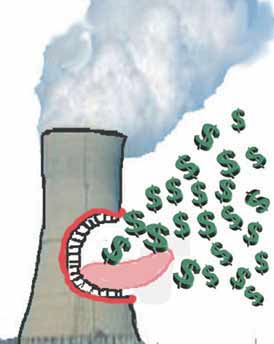 The Vogtle plant will cost $14 billion at least to build……..If things go as planned, the reactors will be making electricity four to five years from now. If not, the company is seeking an $8.3 billion loan guarantee from the federal government to cover losses.
Nuclear Safety, Cost Issues Loom As U.S. OKs Reactor, NPR, by CHRISTOPHER JOYCE February 10, 2012 The nuclear industry is celebrating the federal Nuclear Regulatory Commission’s decision to give the go-ahead for a utility company to build two new nuclear reactors in Georgia, the first license to be granted for a new reactor in the U.S. since 1978. But last year’s accident at reactors in Fukushima, Japan, still clouds the future of nuclear power, as does the cost of new power plants.
Southern Co. will build the reactors at its Vogtle site in Georgia, where two older reactors already operate. Scott Peterson, vice president of the industry’s Nuclear Energy Institute, says it’s not a “nuclear renaissance,” but instead a “first wave” for new reactors….
Costs But demand for electricity is flat, and the price of natural gas, also used to make electricity, is low. Continue reading
The lower price of gas is causing the stillbirth of the nuclear ‘renaissance’
Nuclear Power vs. Natural Gas, February 10, 2012, NYT, By MATTHEW L. WALD When critics say nuclear power is risky, they often mean the risk of an accident. But people in the nuclear industry say that the bigger threat is natural gas.
To look like a smart move, the $14 billion nuclear project undertaken by the Southern Company and its partners must meet several challenges, including actually completing the job for that figure, always a question in nuclear construction.
But for the 104 nuclear reactors now running in this country, and for many of the ones that have retired, the big issue has always been the price of electricity from competing sources. And generally, that comes down to a prediction about the future cost of natural gas, which usually sets the price of electricity on the grid in much of the United States.
The nuclear industry must also reckon with the prospect that in the 2020’s or 2030’s, that the United States will get more serious about limiting carbon dioxide emissions, which would be a plus for nuclear operators. Substituting gas for coal does reduce emissions, but there is still far too much carbon in natural gas to allow its widespread use if the electric system is to reduce its emissions by 80 percent by 2050. That was the national goal endorsed by President Obama when he ran for president in 2008.
In fact, some electricity experts say that if the economy as a whole has to cut emissions by 80 percent, the electric sector will have shoulder even deeper reductions, given that other areas, like transportation, can probably manage less….
John W. Rowe, the chairman of Exelon, the nation’s biggest nuclear utility, had said that he would not build a new reactor at today’s natural gas prices. Referring to the geologic formations from which natural gas is extracted, he said in a recent speech, “Shale is good for the country, bad for new nuclear development.”
“There must be a shortage of natural gas and stable high prices to make the economics right, ‘’ he said of nuclear power in a speech to a nuclear group. And the Union of Concerned Scientists, a group that is generally critical of nuclear energy, argues that new reactors will be more expensive than other “readily available alternatives, including energy efficiency, renewable energy and natural gas.” http://green.blogs.nytimes.com/2012/02/10/natural-gas-vs-nuclear-power/
1 This Month





PLEASE OPPOSE HR 8255 AND S.3639 – bills would accelerate satellite deployment, with no environmental review or safeguards – https://ncstd5li.quorum.us/campaign/169331/
To see nuclear-related stories in greater depth and intensity – go to https://nuclearinformation.wordpress.com
-
Archives
- October 2026 (29)
- September 2026 (339)
- August 2026 (330)
- July 2026 (355)
- June 2026 (287)
- May 2026 (306)
- April 2026 (356)
- March 2026 (251)
- February 2026 (267)
- January 2026 (308)
- December 2025 (358)
- November 2025 (359)
-
Categories
- 1
- 1 NUCLEAR ISSUES
- business and costs
- climate change
- culture and arts
- ENERGY
- environment
- health
- history
- indigenous issues
- Legal
- marketing of nuclear
- media
- opposition to nuclear
- PERSONAL STORIES
- politics
- politics international
- Religion and ethics
- safety
- secrets,lies and civil liberties
- spinbuster
- technology
- Uranium
- wastes
- weapons and war
- Women
- 2 WORLD
- ACTION
- AFRICA
- Atrocities
- AUSTRALIA
- Christina's notes
- Christina's themes
- culture and arts
- Events
- Fuk 2022
- Fuk 2023
- Fukushima 2017
- Fukushima 2018
- fukushima 2019
- Fukushima 2020
- Fukushima 2021
- general
- global warming
- Humour (God we need it)
- Nuclear
- RARE EARTHS
- Reference
- resources – print
- Resources -audiovicual
- Weekly Newsletter
- World
- World Nuclear
- YouTube
-
RSS
Entries RSS
Comments RSS

