$billions needed from Japanese government to save Tepco from bankruptcy
TEPCO seeks new billions from Japan CNN March 29, 2012 –
*Tokyo Electric Power Co. is asking the Japanese government for about $22 billion
*The company is reeling from the Fukushima Daiichi nuclear disaster
* Analysts say it the accident may cost up to 10 trillion yen ($120 billion)
Tokyo – Japan’s largest utility asked the government for 1 trillion yen ($12 billion) in fresh capital Thursday to stay solvent as it faces enormous compensation costs for the Fukushima Daiichi nuclear disaster.
The Tokyo Electric Power Co. is also seeking another 800 billion yen ($10 billion) from a government fund to help it compensate people affected by the Fukushima Daiichi accident, including the estimated 100,000-plus people displaced. It has already requested more than 1.7 trillion yen from that fund…. http://edition.cnn.com/2012/03/29/world/asia/japan-tepco/
Loan guarantees to nuclear power not scrutinised like solar loans
 why do we continue to nurture nuclear power so much more generously than safer and less costly sources of electricity?
The Nurture of Nuclear Power, NYT, By NANCY FOLBRE , 27 March 12, Free enterprise? States’ rights? Public opinion? These concepts seem to bounce off the nuclear power industry like a pebble tossed at a reactor containment vessel.
Remember the brouhaha about $563 million in Obama administration loan guarantees to Solyndra , the solar panel manufacturer that went belly up last fall? Neither President Obama nor Republicans in Congress have voiced opposition to an expected $8.3 billion Energy Department guarantee to help the Southern Company, a utility giant, build nuclear reactors in Georgia. Continue reading
South Korea keen to sell nuclear reactors to India
S Korea offers nuke reactors to India TNN | Mar 26, 2012,“…..South Korea has offered to build nuclear reactors in India and sought land for the project. …. A joint statement said, “The two leaders proposed that the concerned agencies of both countries study the possible cooperation in future space activities, including launching a nano-satellite developed by Korean students on an Indian launch vehicle.”…. http://timesofindia.indiatimes.com/india/South-Korea-offers-India-nuke-reactors/articleshow/12408369.cms
Appeal of electric car damaged by connection with nuclear power

 Is nuclear power damaging electric car image? The Green Car Website, 23 Mar 12, As Japan’s government prepares to restart dozens of nuclear power plants, idled since the Fukushima disaster last year, there is concern that electric cars could become tainted by their association with nuclear generation. Continue reading
Malaysia rare earths plant, construction problems as well as political
the opposition had decided not to take part in the committee because the government was using the panel to try to quell public worries……. the government would allow the plant to go ahead regardless of the committee’s findings…..
Political and Construction Hurdles for Malaysia Rare Earths Plant NYT, By LIZ GOOCH and KEITH BRADSHER March 21, 2012 KUALA LUMPUR, Malaysia — A controversial rare earth metal refinery in Malaysia encountered further obstacles this week, with the country’s political opposition refusing to participate in a parliamentary committee set up to investigate the safety of the plant and with hints that the refinery could face further construction delays. Continue reading
Non nuclear energy strategy would save Ontario $billions
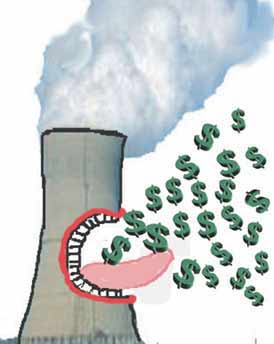
 Nuclear power too costly, Ontario Clean Air Alliance argues The Star, John Spears Business Reporter, 20 March 12, Abandoning nuclear power in favour of imported electricity from Quebec and new, high-efficiency natural gas plants, would save Ontario billions, says the Ontario Clean Air Alliance. Continue reading
Enormous costs of the global fraud that is nuclear power
The world has since lost over $1,000 billion in subsidies, cash losses, abandoned projects and other damage from nuclear power. Decontaminating Fukushima alone is estimated to cost $623 billion, not counting treatment costs for thousands of likely cancers.
The end of the nuclear illusion, The Daily Star, Praful Bidwai, 20 March 12A year after the Fukushima nuclear catastrophe began in Japan, the world has a historic chance to end one of the biggest-ever frauds played on the public to promote a patently unsafe, accident-prone, expensive and centralised form of energy generation based upon
splitting the atom to boil water and spin a turbine. Candidly, that’s what nuclear power generation is all about. Continue reading
In UK, 102 business leaders urge government to back renewable energy

 Sir Branson and fellow entrepreneurs ask Cameron to back renewables http://www.eaem.co.uk/news/sir-branson-and-fellow-entrepreneurs-ask-cameron-back-renewables Energy and Envronment Magazine 16 March 2012
Sir Richard Branson is one of 102 top business signatories of an open letter to David Cameron urging him to back wind and other renewable forms of power generation.
“March’s budget provides one of the biggest opportunities to tackle climate change in the UK,” the Virgin tycoon says. “We must ensure it encourages investment rather than creates uncertainty and delays further serious investment in the renewable sector. As a country we need to be better prepared to deal with rising energy prices.”
The so-called ‘102 letter’ is conceived partly as a response to the actions of 101 backbenchers who last month wrote to the Prime Minister attacking wind power, and a call to the Treasury to re-establish a stable investment platform for renewable energy as a driver of the recovery out of the recession.
It is published on the website of the Entrepreneurs’ Organisation (EO), the global network of more than 7,500 business owners in 38 countries.
“Cutting support for green energy is a false economy,” comments Dale Vince, Founder and CEO of Ecotricity, one of Britain’s most successful new energy companies trying to muscle in on the territory controlled by the Big Six.
His angle is energy security. “Britain needs to become energy independent once more, and with the North Sea all but depleted of fossil fuels we need to look to other forms of indigenous energy. We have them in abundance, in the wind the sun and the sea, enough to power our country many times over.
“While Britain remains dependent on global energy markets, our bills can only go one way: upwards.”
His analysis is that the level of current support for green energy sources is relatively small in comparison to that for oil and gas.
In the last 12 months roughly £30 of our household energy bills has been spent on green energy support. Of this, the Renewables Obligation (RO) added just £15.15 to the annual energy bill of the United Kingdom’s 26.3 million households, with onshore wind power adding only £4.68, according to Ofgem’s recently published RO annual report for 2010/11and Ecotricity’s analysis.
The RO is the main support mechanism for encouraging the growth of renewable energy in the UK.
Meanwhile, the rising cost of imported gas added around £120 to energy bills last year, according to Ofgem’s Electricity and Gas Supply Market Report.
“We need to reverse those proportions; it’s an incredible false economy to throw money at energy market speculators while penny pinching over the one thing we can do to solve the problem long term: make our own energy,” concludes Mr Vince.
The letter says that “as entrepreneurs, investors, economists, scientists, engineers, energy providers, community builders and Members of Parliaments, we are increasingly concerned about the lack of clarity around the future of government support for land-based renewables, such as solar, wind and biogas.”

Britain’s nuclear power industry has always failed, and will continue to fail
The nuclear industry’s history is one of broken promises. Mrs Thatcher pledged 10 new nuclear plants in 1979 – one reactor eventually sent electricity to the grid in 1995.
Britain’s existing fleet of Advanced Gas-cooled Reactors was described by the then Chairman of the Central Electricity Generating Board as the worst civil engineering disaster in our history.
The proto-type fast reactor at Dounreay is now being expensively dismantled, having never worked properly. Nor has the THORP reprocessing plant at Sellafield
 Nuclear power will fail to achieve what George Monbiot wants, Guardian UK 16 Mar 12, Nuclear industry’s broken promises show atomic energy will not help climate efforts, say former directors of Friends of the Earth Deciding on how best to meet the country’s energy needs is difficult. There are no absolutely right answers. But one issue guaranteed to excite personal passions rather than brain cells is nuclear power.
Some solutions are more convincing than others. The best make the most economic, environmental and social sense, based on facts rather than fervent beliefs.
As four former Directors of Friends of the Earth, we wrote to the Prime Minster this week setting out eight major economic and political problems facing a new build nuclear programme in the UK. We have engaged in the nuclear debate for forty years. On the basis of our experience and the evidence, we concluded that the government’s policy will fail…. Continue reading
Nuclear power revival being killed off by cheaper, safer, gas

 Cheap Natural Gas Unplugs U.S. Nuclear-Power Revival, WSJ, BY REBECCA SMITH, 16 March 12, The U.S. nuclear industry seemed to be staging a comeback several years ago, with 15 power companies proposing as many as 29 new reactors. Today, only two projects are moving off the drawing board.
What killed the revival wasn’t last year’s nuclear accident in Japan, nor was it a soft economy that dented demand for electricity. Rather, a shale-gas boom flooded the U.S. market with cheap natural gas, offering utilities a cheaper, less risky alternative to nuclear
technology.
“It’s killed off new coal and now it’s killing off new nuclear,” says David Crane, chief executive of NRG Energy Inc http://online.wsj.com/article/SB10001424052702304459804577281490129153610.html
Bulgaria considers abandoning expensive nuclear project
Bulgaria delays Belene nuclear project, Daily Times, 17 March 12
* PM says Belene project cannot go ahead without Western investors
* Final decision on 2,000MW project likely to be delayed
SOFIA: Bulgaria will abandon plans to build a 2,000 megawatt nuclear power plant on the Danube River if it cannot attract sufficient Western funding for the 8 billion euros ($10.5 billion) project, Prime Minister Boiko Borisov said on Friday. Continue reading
Czech Republic’s nuclear power plans unraveling, unaffordable
Stalemate Hits $10 Billion Czech Nuclear Plan on Funding, By Ladka Bauerova on March 15, 2012 The Czech Republic’s $10 billion plan to build two atomic reactors near the German border that could supply electricity to the Bavarian industrial heartland is unraveling over financial and pricing disputes.
CEZ AS (CEZ), Europe’s only utility with an atomic project out to bid, is beset by falling power prices and predictions that its financial muscle is too weak to safeguard investors. Continue reading
No end of problems for San Onofre nuclear power plant
San Onofre’s Unit 3 reactor shut indefinitely while US regulators probe tube problems Washington Post, By Associated Press, March 15 LOS ANGELES — A nuclear reactor on the California coast will remain shut down indefinitely while a team of federal inspectors determines why several relatively new tubes became so frail that tests found they could rupture and release radioactive water, a federal official said Thursday….
The Unit 3 reactor at the San Onofre Nuclear Generating Station, located about 45 miles north of San Diego, was shut down as a precaution on Jan. 31 after a water leak from another tube in a massive steam generator. Traces of radiation escaped, but officials say there was no danger to workers or neighbors.
Since then, investigators have been looking into excessive wear found on steam generator tubes in the seaside plant and its twin, Unit 2, which has been off line for maintenance and refueling. The two huge steam generators at Unit 2, each containing 9,700 tubes, were replaced in fall 2009, and a year later in Unit 3 as part of a $670 million overhaul.
The NRC dispatched a special, five-member team to Unit 3 on Thursday after pressure tests showed three of the metal-alloy tubes had become so degraded that they could rupture under some circumstances. Such ruptures can require a plant to shut down, if spewing water reaches 150 gallons a day……
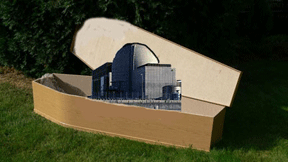 San Onofre’s Unit 1 reactor operated from 1968 to 1992, when it was shut down and dismantled. The utility’s plan to ship the 600-ton reactor vessel on a 15,500-mile voyage around South America to a disposal site in South Carolina was thwarted and it remains at San Onofre, encased in concrete and steel….
http://www.washingtonpost.com/national/federal-regulators-to-investigate-tube-failures-at-califs-san-onofre-nuclear-power-plant/2012/03/15/gIQAn3lIES_story.html
Utility losing interest in investing in nuclear power
E.ON says its commitment to nuclear is fading LONDON, March 14 (Reuters) – German utility E.ON , which together with rival RWE plans to build new nuclear plants in Britain, said on Wednesday its appetite for investing in nuclear power had slowed down.
“Our appetite to boost nuclear with great energy has become smaller,” said board member Klaus-Dieter Maubach during the company’s 2011 results conference…. time and cost overruns at new nuclear plants in Finland and France….. E.ON posted a net loss of 2.22 billion euros in 2011 as it was hit by Germany’s decision to shut down its oldest nuclear plants in the wake of Japan’s Fukushima accident and losses in its gas business.
French company EDF gives up on new nuclear power station in Lancashire
 Third nuclear power station at Heysham plans on ice, BBC News, Lancashire, 14 March 12, Plans for a third nuclear power station at Heysham in Lancashire have been put on ice.
French company EDF Energy has cancelled an agreement with the National Grid to set up any new connection to the grid from Heysham. The site was one of eight earmarked two years ago for a new generation of nuclear power stations.
EDF Energy said all its plans for new stations will be focused on their sites at Sizewell and Hinkley Point…. http://www.bbc.co.uk/news/uk-england-lancashire-17374496
1 This Month





PLEASE OPPOSE HR 8255 AND S.3639 – bills would accelerate satellite deployment, with no environmental review or safeguards – https://ncstd5li.quorum.us/campaign/169331/
To see nuclear-related stories in greater depth and intensity – go to https://nuclearinformation.wordpress.com
-
Archives
- October 2026 (29)
- September 2026 (339)
- August 2026 (330)
- July 2026 (355)
- June 2026 (287)
- May 2026 (306)
- April 2026 (356)
- March 2026 (251)
- February 2026 (267)
- January 2026 (308)
- December 2025 (358)
- November 2025 (359)
-
Categories
- 1
- 1 NUCLEAR ISSUES
- business and costs
- climate change
- culture and arts
- ENERGY
- environment
- health
- history
- indigenous issues
- Legal
- marketing of nuclear
- media
- opposition to nuclear
- PERSONAL STORIES
- politics
- politics international
- Religion and ethics
- safety
- secrets,lies and civil liberties
- spinbuster
- technology
- Uranium
- wastes
- weapons and war
- Women
- 2 WORLD
- ACTION
- AFRICA
- Atrocities
- AUSTRALIA
- Christina's notes
- Christina's themes
- culture and arts
- Events
- Fuk 2022
- Fuk 2023
- Fukushima 2017
- Fukushima 2018
- fukushima 2019
- Fukushima 2020
- Fukushima 2021
- general
- global warming
- Humour (God we need it)
- Nuclear
- RARE EARTHS
- Reference
- resources – print
- Resources -audiovicual
- Weekly Newsletter
- World
- World Nuclear
- YouTube
-
RSS
Entries RSS
Comments RSS

