Nuclear supplier nations not happy with India’s Liability Law
The nuclear ‘breakthrough’ is mostly hype: http://economictimes.indiatimes.com/news/politics-and-nation/the-nuclear-breakthrough-is-mostly-hype-swaminathan-sa-aiyar/articleshow/46162264.cms Swaminathan SA Aiyar 8 Feb, 2015 ndian officials say the Obama visit broke a seven-year logjam in nuclear cooperation, opening the way for US firms to set up nuclear power plants in India.
The Modi-Obama meeting whipped up a lot of fizz and optimism. Problem: the key issue is not political at all but commercial. The entities that must be convinced are not US presidents but heads of nuclear corporations like GE and Toshiba-Westinghouse. And no corporation so far is convinced that India’s nuclear liability law has ceased to be a hurdle.

An Indo-US agreement was indeed reached on a completely separate issue — tracking the movement of US nuclear materials to ensure India did not divert these to military use. This was an additional roadblock in case of the US. But overcoming this does not settle the much bigger roadblock — unlimited liability — that all four supplier nations are complaining about.
For investors – the ‘nuclear renaissance’ is all but dead
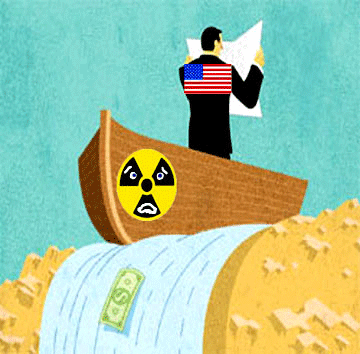 Nuclear Energy Renaissance Takes Another Blow and May Never Recover, The Motley Fool By Travis Hoium February 7, 2015 The nuclear renaissance some people hoped for took another big step backward this week when the Vogtle Nuclear Power Plant said it would be delayed another 18 months and cost at least $720 more than the $14.5 billion previously expected.
Nearly every nuclear plant that’s been proposed in the U.S. in the last decade has run into major cost overruns and delays, and without government support, the nuclear renaissance may already be dead. But the latest delay casts a shadow over an energy source that’s becoming increasing uncompetitive in today’s energy landscape.
What happened at Vogtle
The latest news from Southern Co.‘s (NYSE: SO ) subsidiary Georgia Power is that the Vogtle Plant will now be delayed until mid-2019 for the first reactor, and mid-2020 for the second. Costs could pile up to $720 million and could be as much as $1 billion.
Contractors Westinghouse Electric Co. and Chicago Bridge & Iron Co. alerted Southern Co. of the delays, adding to a long list of delays for Westinghouse plants that were supposed to help revitalize nuclear power in the U.S. Worse yet, it’s ratepayers, not Southern Co.’s shareholders, who will be footing most of the bill for this project, even if it’s never completed.
The kick in the gut to ratepayers
If you live in Georgia, the delay and additional cost will affect you more than you think. Under a plan called construction work in progress, or CWIP, Georgia Power gets to charge customers for the Vogtle plant before it’s even finished. Yes, today customers are paying an average of $6.60 per month for a plant that isn’t likely to produce any power until at least 2019. It’s a sweet deal for utilities, but one that’s becoming increasingly problematic for consumers.
What CWIP does is transfer the risk from the company building the nuclear plant to ratepayers. If the project is delayed or costs more than expected, Georgia Power still makes its money unless regulators intervene. In fact, without CWIP, we may not even be talking about nuclear plants being built in the U.S. If utilities had to take on the risk of nuclear themselves, they wouldn’t do it, something we’re already seeing across the country.
Nuclear energy’s problem in the U.S.
This isn’t the only nuclear plant running into these kind of issues. NRG Energy (NYSE: NRG ) abandoned a potential expansion of South Texas Nuclear Generating Station because of rising costs for nuclear plants and low cost natural gas. The project is still moving forward with regulatory approval, which partner Toshiba is funding, but it’s doubtful the plant will ever be built.
Duke Energy (NYSE: DUK ) canceled the Levy Nuclear Plant because of rising costs, but under CWIP, it still gets to keep a profit of about $150 million. Even Entergy closed the Vermont Yankee nuclear plant late last year because it wasn’t cost effective. Whether it’s new plants or upgrades to old plants, it’s costs that are sinking nuclear in the U.S. today.
In an analysis of the unsubsidized levelized cost of energy for various energy sources, investment bank Lazard found that nuclear energy would cost between 9.2 cents and 13.2 cents per kW-hr. Compare that to 6.1-8.7 cents/kW-hr for natural gas, 7.2-8.6 cents/kW-hr for utility scale solar, and 3.7-8.1 cents/kW-hr for wind energy.
Nuclear energy is also losing based on recent trends. The cost of solar and wind energy are falling rapidly, which is why over half of all energy generation installed in each of the last two years was solar or wind energy.
The nuclear renaissance is all but dead
Setbacks like the Vogtle Nuclear Plant faced this week have become all too predictable in the nuclear industry, and they’re the reason a nuclear renaissance is unlikely in the U.S. Costs have simply gotten too high, and low costs from competing energy sources like natural gas, solar, and wind will keep the industry from ever taking off.
For investors, the lesson comes down to where the energy industry and its costs are trending. Nuclear energy may seem like a great idea on the surface, but if costs are continually rising, it’s an energy source that’s doomed in this country. Solar energy, on the other hand, is cutting costs by double-digit percentage points per year and is now less costly than nuclear on a per kW-hr basis. Maybe it’s time to look at alternative energy more seriously, something utilities are already doing……….http://www.fool.com/investing/general/2015/02/07/nuclear-energy-renaissance-takes-another-blow-and.aspx
France wants to beat USA in selling nuclear reactors to India
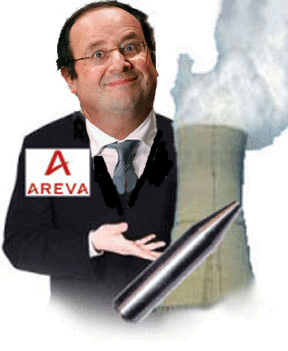 US nuclear ‘breakthrough’ cloud on France deal, Telegraph New Delhi, Feb. 5:France has indicated it may want to use elements of the nuclear liability “breakthrough” India and the US have claimed, in setting up its own reactors in this country, signalling potential for competitive bargaining over the terms New Delhi offers to different nations.
India last year offered France and Russia – the two nations other than the US that have committed to selling nuclear reactors – an insurance pool created by Indian public sector firms to fund any compensation following an accident from their reactors.
The US had so far appeared unconvinced by the insurance pool plan. Its apparent turnaround during President Barack Obama’s India visit last week has sparked speculation in the capital’s diplomatic enclave that New Delhi may have offered Washington a particularly sweet deal……….
France is pandering to Modi’s pet initiative of “Make in India” by promising to build “large parts of the Areva reactors” in India. And unlike the US, France had also never sought any change in the nuclear liability law despite its concerns that the law was draconian and out of line with global standards, the senior French official said…….
The Indian foreign office also pointed to France’s acceptance of India’s liability law.”Every country has a different approach to this matter,” Akbaruddin said, citing the example of uranium India already sources from France. “With France, the template of our engagement is already set.” http://www.telegraphindia.com/1150206/jsp/nation/story_1764.jsp#.VNUrReaUcnk
Nuclear industry fears shift to decentralized electricity system – fights renewables, not gas
“One thing to understand about the nuclear industry is that nuclear is also the coal and natural gas industry”
These days natural gas-fired power is cheap, but wind is even cheaper.
 Even if renewables make up only a small amount of generation, they represent a shift to a more decentralized energy system, less reliant on big baseload coal or nuclear power plants
Why the nuclear industry targets renewables instead of gas, Midwest Energy news, on 02/06/2015 by Kari Lydersen
Why attack renewables?……..“The fact of the matter is natural gas and wind power both compete with Exelon’s nuclear generation,” said Environmental Law & Policy Center director Howard Learner. “Exelon can’t do anything about the market price for natural gas, so Exelon is training its fire on trying to stop and hold off wind power and solar energy development.”
Some companies that own nuclear generation are also heavily invested in natural gas. Continue reading
China organising itself to market nuclear reactors to other countries
 China nuclear power firms to merge in bid to boost global clout By Pete Sweeney and Charlie Zhu Feb 4 (Reuters) – China Power Investment Corp is merging with the State Nuclear Power Technology
 Corp, as Beijing drives consolidation in its rapidly expanding nuclear power sector with the aim of eventually exporting reactors.
The Chinese power producer currently controls about a tenth of China’s nuclear power market, while the State Nuclear Power Technology Corp was formed in 2007 to handle nuclear technology transferred from U.S.-based Westinghouse Electric Co.
A merger between the two would create a firm with total assets of more than 600 billionyuan ($96 billion), industry experts estimate.
“The merger will help them expand in China, and the overseas market in the long run,” said Francois Morin, Beijing-based China director of World Nuclear Association……..
China, which now primarily provides financing and construction services to nuclear power projects overseas, is expected by some experts to start exporting reactors after 2020 and become a major exporter by 2030 when it has fully digested foreign technology and developed its domestic industry.
The global nuclear market is currently dominated by firms such as France’s Areva, Russia’s Rosatom State Nuclear Energy Corp and Japan’s Toshiba Corp, which controls Westinghouse………Westinghouse Electric Co has already handed over most of the intellectual property for its AP1000 reactor design to the State Nuclear Power Technology Corp……..http://www.reuters.com/article/2015/02/04/china-nuclear-ma-idUSL4N0VE05Q20150204
Nuclear power , highly subsidised, but still not cost-effective or compatible with a clean energy future.
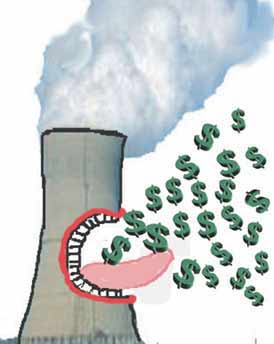 Let’s not forget, either, that nuclear power has some of the largest per kilowatt-hour subsidies of any electricity source.
Big, Expensive Power Plants Undermine a Clean Energy Future http://cleantechnica.com/2015/02/04/big-expensive-power-plants-undermine-clean-energy-future/ February 4th, 2015 by John Farrell – (excellent charts and diagrams) Originally published on ilsr.org.
With the rich history of cost overruns in the nuclear industry, Xcel Energy and Minnesota regulators shouldn’t have been surprised when the retrofit cost for the Monticello nuclear power plant ballooned to more than twice the original estimate. Regulators asked tough questions last year about whether the cost overruns were the responsibility of poor management and the definitive answer came back this week: yes.
This example only reinforces why nuclear power (and other large-scale power generation) isn’t cost-effective or compatible with a clean energy future. Continue reading
Exelon Nuclear wants tax-payer to bail out its unprofitable Clinton Power Station, among others
 Illinois nuclear shutdown threatened Herald Review CLINTON 1 Feb 15, – Stopping a threatened economic meltdown of the Illinois nuclear power industry is now in the hands of state lawmakers.
Chicago-based Exelon Nuclear has said it will be forced to close its Clinton Power Station, along with shuttering similar plants in Ogle County and Rock Island, if the state doesn’t come up with policy changes to make the stations more profitable……..
Bill Stoermer, a senior site communications manager based at Exelon’s Quad Cities Generating Station, said the nuclear clock is ticking……
Sums add up for solar power in India, but NOT for nuclear power
I’m afraid the sums simply don’t add up for nuclear power, purely from an economic point of view. The fully loaded cost (including decommissioning and waste management) of a unit of power would be probably 100 times that of a unit of conventional power today.
On the other hand, it appears as though the time has come for solar power. Plummeting costs of photovoltaic panels, improvements in storage and transmission, and other technological factors now mean that solar lifecycle cost is approaching conventional costs in the West. Given India’s inherent availability of sunlight, I am of the opinion that we would be better off spending the billions needed for nuclear power on a crash program of research into solar power, and maybe even on subsidizing it heavily to kick-start it.
Indo-US nuclear deal: Why is Modi pursuing what looks like a total loss in N-energy? First Post by Rajeev Srinivasan Jan 26, 2015 On 25 January, the airwaves were filled with self-congratulatory and self-satisfied messages about how “we” had “won” the “nuke deal”. Nobody was clear about what exactly we had won, and how, and why the Americans (superb negotiators) had apparently caved in to Indian demands. As I write this on Republic Day, there is still no concrete data. ……. Continue reading
USA States consider helping nuclear industry, but it seems to be nuclear’s last dance
Analysis: Last tango for nuclear? Environmental health News, 30 Jan 15, “……..Those new nukes are falling behind schedule and soaring over budget, making an already-jittery Wall Street even more skeptical. On Thursday, the builders of two new reactors at Georgia’s Plant Vogtle disclosed additional delays and overruns, potentially making the project over a billion dollars in the hole and three years late. The demise of Yucca Mountain means there’s nowhere for the industry to permanently store its waste. And just when you thought it was safe to atomically boil the water, Fukushima provided the first nuclear mega- disaster since Chernobyl a quarter-century earlier, fairly or unfairly reviving public unease about nuclear energy’s safety in the U.S.
And it didn’t help when the longtime CEO of America’s biggest nuclear player stuck the financial fork in shortly after his retirement.
John Rowe, a longtime nuclear booster and former CEO of Exelon, the Chicago-based offspring of mergers between Commonwealth Edison of Illinois, Philadelphia’s PG&E, and Baltimore-based Constellation, oversaw 23 reactors. “I’m the nuclear guy,” Rowe told a gathering at the University of Chicago two weeks after his 2012 retirement. “And you won’t get better results with nuclear. It just isn’t economic, and it’s not economic within a foreseeable time frame.”
Rowe was commenting on plans for newly built reactors. But old ones, including up to six of Exelon’s fleet, may be on the block………. Continue reading
Financial problems escalate with delays in Nuclear Plant Vogtle

 Cost pressure intensifies for Georgia nuclear plant http://www.sltrib.com/home/2121839-155/cost-pressure-intensifies-for-georgia-nuclear By RAY HENRY The Associated Press Atlanta 31 Jan 15, • The delays and cost overruns are piling up for a new plant in Georgia that was supposed to prove nuclear energy can be built affordably.
Southern Co. announced this week the builders of Plant Vogtle expect construction will be delayed 18 months. That would bring the total project delays to roughly three years.
The firms designing and building the plant, Westinghouse Electric Co. and Chicago Bridge and Iron Co., want Southern Co. and its co-owners to pay roughly $1 billion for previous delays and snags.
Regulatory filings show the latest delay could cost Southern Co. an additional $720 million. The other co-owners have not yet disclosed their potential costs. Similar delays and costs have surfaced at an identical project in South Carolina.
Enthusiasm by investors for Indian renewable energy project
“We have received commitment for investments for nearly 1.3 lakh MW of renewable energy from both the domestic and international players,” Goyal today said, speaking here on sidelines of an event organised by VASVIK………..
http://economictimes.indiatimes.com/articleshow/46069893.cms?utm_source=contentofinterest&utm_medium=text&utm_campaign=cpps
More costs, another long delay for new nuclear facility in Georgia, USA
Builder Projects 18-Month Delay for Nuclear Plant in Georgia, abc news, ATLANTA — Jan 30, 2015,
The latest delay at Plant Vogtle is another setback for a project that was supposed to prove nuclear reactors could be built on time and without the cost overruns that financially strained utilities decades ago. Power companies are already shuttering existing nuclear plants because natural gas is so cheap by comparison…….http://abcnews.go.com/Business/wireStory/builder-projects-18-month-delay-nuclear-plant-georgia-28594816
USA nuclear reactor corporations know that exports to India are nowhere near really happening
 A year’s wait likely before commercial N-deals inked mydigitalFc.com By Subhash Narayan Jan 27 2015 The breakthrough in civil nuclear deal between India and US may be heads up for American equipment makers that plan to export eight unbuilt nuclear power reactors to India, but the companies will have to wait for up to a year before any commercial deal is inked with their Indian counterparts.
 department of atomic energy on the other would take a year to conclude before projects can commence on ground in Andhra Pradesh and Gujarat, a government official said……….
Toshiba’s Westinghouse Electric Company did not issue a statement but its chief executive officer Danny Roderick told Bloomberg that the company would look at commercial agreements with Indian only after studying the Indian government’s offer to create an insurance pool
“Let us understand that Indo-US civil nuclear deal is government-to-government agreement while the final deals have to reached between companies. There is sense that a lot still needs to be resolved,” said Debasish Mishra, partner at Deloitte Touche Tohmatsu……..
Under the umbrella agreement since the technology transfer will happen over a phased manner, nuclear reactor services companies are also likely to set up their shop in India through joint ventures with Indian entities.
The deal could also see increased exposure of Exim banks from US, Canada, Germany, France. Insurance companies from these countries are also likely to generate business.
Indo-US agreement provides for an insurance cover on liabilities to cover any disaster related liabilities.
Westinghouse has already been allotted a site in Modi’s home state of Gujarat to build a nuclear power station with total capacity of 2,500 MW and possibility of expansion in future. Similarly, two sites have also been identified for GE plants in Andhra Pradesh with an initial capacity of 3,200 MW………http://www.mydigitalfc.com/news/year%E2%80%99s-wait-likely-commercial-n-deals-inked-082
Many a slip twixt the much touted USA-India deal and commercial reality
Hurdles Remain in Nuclear Deal, Indian Express By B B Singh 30th January 2015 For almost two weeks prior to president Barack Obama’s visit to India, the negotiators from both the countries had been burning the midnight oil to operationalise Indo-US nuclear cooperation but hurdles seem to be emerging one after another. The first and the most talked about hurdle arose from Section 17 (b) of the Civil Liability for Nuclear Damage Act 2010, giving the right of recourse to the operator of the nuclear installation if nuclear incident resulted as a consequence of an act of the supplier or his employee which includes supply of equipment or material with patent or latent defects or sub-standard services.
This provision was introduced to ensure that the suppliers took utmost care since they would be liable even for “latent” defects that may exhibit their appearance in their equipment later on after extended exposure to nuclear related stresses. This problem seems to have been solved by India’s proposal for an insurance cover of `1500 crore out of which 50 per cent would be government contribution and the remaining from a pool of insurance companies which are public sector units.
Oddly, it would mean victims compensating victims.
The next conflict has arisen in respect of Section 46 of the Act which provides that its provisions shall be in addition to and not in derogation of any other law for the time being in force. It further provides that nothing contained in this Act shall exempt the operator from any proceeding which might, apart from this Act, be instituted against such operator or the suppliers directly or through the operator. The victims of nuclear incidents are thus entitled to file tort suits for unlimited damages and even criminal proceedings against the operator as well as suppliers. ………….
The story does not end here. There is still some more to come. Under the Hyde Act, the US president is further required to submit to an appropriate Congressional committee any significant changes in the nuclear activities of India including construction of nuclear facilities, production of nuclear weapons or changes in nature and amount of fissile material produced and the purpose and operational status of any unsafeguarded new nuclear facility.
Still further under the Hyde Act, the US president shall have to inform the Congress an estimate of the amount of uranium mined and milled in India and amount of such uranium that has likely been used or allocated for weapons; the rate of production of nuclear devices and the material used therein. Some procedure will have to be worked out in the administrative arrangements to achieve this objective and procure such information on India’s non-civilian nuclear activities for information to the US Congress. In view of these requirements, the Indian negotiators are likely to face still tougher uphill tasks ahead.http://www.newindianexpress.com/columns/Hurdles-Remain-in-Nuclear-Deal/2015/01/30/article2643619.ece
Renewable energy is getting a boost from the nuclear industry’s focus on climate change
“The nuclear industry giving credence to climate change from fossil fuels has simply led to a stronger renewables industry. …….now renewables, often thought of as useful complements to nuclear, begin to threaten it in power markets when there is abundant power from renewables when the wind blows and the sun shines.”
U-turn to nowhere: Nuclear’s dire outlook U-turn to nowhere: Nuclear’s dire outlook Business Spectator, 27 January 2015Jim Green “……. a long-standing pattern of stagnation continues. Global nuclear capacity grew by 10.6% in the two decades from 1995-2014, and just 2.6% in the decade from 2005-2014.
The pattern of stagnation is likely to persist. Steve Kidd, a nuclear consultant who worked for the World Nuclear Association for 17 years, wrote in a May 2014 article:
“Upper scenarios showing rapid nuclear growth in many countries including plants starting up in new countries now look very unlikely……….”Despite 20 years of stagnation, the World Nuclear Association remains upbeat. Its latest report, The World Nuclear Supply Chain: Outlook 2030, envisages the start-up of 266 new reactors by 2030. The figure is implausible.
Nuclear Energy Insider was more sober and reflective in an end-of-year review published in December: “As we embark on a new year, there are distinct challenges and opportunities on the horizon for the nuclear power industry. Many industry experts believe that technology like Small Nuclear Reactors (SMR) represent a strong future for nuclear. Yet, rapidly growing renewable energy sources, a bountiful and inexpensive supply of natural gas and oil, and the aging population of existing nuclear power plants represent challenges that the industry must address moving forward.”
Kidd’s comments on renewables are also worth quoting: “The nuclear industry giving credence to climate change from fossil fuels has simply led to a stronger renewables industry. Nuclear seems to be ’too difficult’ and gets sidelined − as it has within the entire process since the original Kyoto accords. And now renewables, often thought of as useful complements to nuclear, begin to threaten it in power markets when there is abundant power from renewables when the wind blows and the sun shines.”….. “nuclear power faces major challenges in competitive markets where there are significant market and regulatory risks, and public acceptance remains a critical issue worldwide.”…….
1 This Month




PLEASE OPPOSE HR 8255 AND S.3639 – bills would accelerate satellite deployment, with no environmental review or safeguards – https://ncstd5li.quorum.us/campaign/169331/
To see nuclear-related stories in greater depth and intensity – go to https://nuclearinformation.wordpress.com
-
Archives
- September 2026 (339)
- August 2026 (330)
- July 2026 (355)
- June 2026 (287)
- May 2026 (306)
- April 2026 (356)
- March 2026 (251)
- February 2026 (267)
- January 2026 (308)
- December 2025 (358)
- November 2025 (359)
- October 2025 (375)
-
Categories
- 1
- 1 NUCLEAR ISSUES
- business and costs
- climate change
- culture and arts
- ENERGY
- environment
- health
- history
- indigenous issues
- Legal
- marketing of nuclear
- media
- opposition to nuclear
- PERSONAL STORIES
- politics
- politics international
- Religion and ethics
- safety
- secrets,lies and civil liberties
- spinbuster
- technology
- Uranium
- wastes
- weapons and war
- Women
- 2 WORLD
- ACTION
- AFRICA
- Atrocities
- AUSTRALIA
- Christina's notes
- Christina's themes
- culture and arts
- Events
- Fuk 2022
- Fuk 2023
- Fukushima 2017
- Fukushima 2018
- fukushima 2019
- Fukushima 2020
- Fukushima 2021
- general
- global warming
- Humour (God we need it)
- Nuclear
- RARE EARTHS
- Reference
- resources – print
- Resources -audiovicual
- Weekly Newsletter
- World
- World Nuclear
- YouTube
-
RSS
Entries RSS
Comments RSS

