Politicians and public not keen for new nuclear reactors, as problems of the old ones multiply
The nuclear industry has a simple solution to the problem of old reactors: new reactors. But the battles over ageing and decommissioned reactors − and the raiding of taxpayers’ pockets to cover shortfalls − will make it that much more difficult to convince politicians and the public to support new reactors.
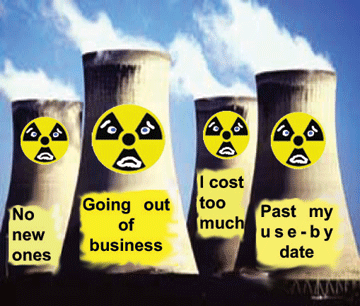 U-turn to nowhere: Nuclear’s dire outlook U-turn to nowhere: Nuclear’s dire outlook Business Spectator, 27 January 2015 Jim Green “……..The elephant in the room − ageing reactors The problem of ageing reactors came into focus in 2014 − and will remain in focus for decades to come with the average age of the world’s power reactors now 29 years and steadily increasing.
Problems with ageing reactors include:
– an increased risk of accidents (and associated problems such as generally inadequate accident liability arrangements);
– an increased rate of unplanned reactors outages (at one point last year, less than half of the UK’s nuclear capacity was available due to multiple outages);
– costly refurbishments;
– debates over appropriate safety standards for reactors designed decades ago; and
– the uncertainties and costs associated with reactor decommissioning and long-term nuclear waste management.
Greenpeace highlighted the problems associated with ageing reactors with the release of a detailed report last year,and emphasised the point by breaking into six ageing European nuclear plants on March 5, 2014.The International Energy Agency (IEA) said in its World Energy Outlook 2014 report: “A wave of retirements of ageing nuclear reactors is approaching: almost 200 of the 434 reactors operating at the end of 2013 are retired in the period to 2040, with the vast majority in the European Union, the United States, Russia and Japan.”
IEA chief economist Fatih Birol said: “Worldwide, we do not have much experience and I am afraid we are not well-prepared in terms of policies and funds which are devoted to decommissioning. A major concern for all of us is how we are going to deal with this massive surge in retirements in nuclear power plants.”The World Energy Outlook 2014 report estimates the cost of decommissioning reactors to be more than $US100 billion up to 2040, adding that “considerable uncertainties remain about these costs, reflecting the relatively limited experience to date in dismantling and decontaminating reactors and restoring sites for other uses.”
The IEA’s head of power generation analysis, Marco Baroni, said that even excluding waste disposal costs, the final cost could be as much as twice as high as the $100 billion estimate, and that decommissioning costs per reactor can vary by a factor of four.
Baroni said the issue was not the decommissioning cost per reactor but “whether enough funds have been set aside to provide for it.” Evidence of inadequate decommissioning funds is mounting. To give just one example, Entergy estimates a cost of $US1.24 billion to decommission Vermont Yankee, but the company’s decommissioning trust fund for the plant − $US670 million − is barely half that amount.
Michael Mariotte, president of the US Nuclear Information and Resource Service, noted in a recent article: “Entergy, for example, has only about half the needed money in its decommissioning fund (and even so still found it cheaper to close the reactor than keep it running); repeat that across the country with multiple and larger reactors and the shortfalls could be stunning. Expect heated battles in the coming years as nuclear utilities try to push the costs of the decommissioning fund shortfalls onto ratepayers.”
The nuclear industry has a simple solution to the problem of old reactors: new reactors. But the battles over ageing and decommissioned reactors − and the raiding of taxpayers’ pockets to cover shortfalls − will make it that much more difficult to convince politicians and the public to support new reactors.
Jim Green is the national nuclear campaigner with Friends of the Earth, Australia.https://www.businessspectator.com.au/article/2015/1/28/energy-markets/u-turn-nowhere-nuclears-dire-outlook
USA’s nuclear utilities want ratepayers to cough up for uneconomic nuclear power plants
 America’s nuclear power utilities seek big ratepayer bailouts, Daily Kos.com by nirsnet JAN 23, 2015
America’s nuclear power utilities are increasingly saddled with aging, uneconomic reactors. Their operating and maintenance costs are rising, and in many locations they’re no longer able to compete with low-cost natural gas and the growing use of wind and solar power.
For a year now, Exelon, the nation’s largest nuclear utility, has been complaining–loudly–that at least five of its 11 Illinois reactors are uneconomic. And the nuclear giant has threatened to close some or all of these reactors if it can’t get some form of bailout (a word Exelon despises, but is nonetheless accurate). Of course, there are many who would feel much better if those threats were actually promises….
But Exelon hasn’t said what it wants Illinois to do about these threats. The utility has said it wants Illinois to institute a vague “market-based solution” to Exelon’s economic problems. Last year, Exelon floated the idea that it needs some $580 million/year in additional revenue to make up for its nuclear fleet’s losses. The utility did get the legislature last year to order state agencies to produce a report that Exelon hoped would provide backing for its position. But that report didn’t exactly do what Exelon wanted. Instead, it found that Illinois could easily handle the threatened reactor shutdowns; that if they occurred, it might bolster clean energy development in the state; and that bailing out Exelon would be expensive.
Why Exelon hasn’t articulated what it wants is obvious: it knows that when it puts down real numbers for the subsidies it seeks, then people will be able to figure out what a bailout may cost. Even the “market-based solution” Exelon wants, which is utility-speak for a means of hiding the costs, will have to have numbers attached to be meaningful………..
Exelon doesn’t appear to be gaining any new friends. Even the Chicago Sun-Times editorialized on the issue, beginning its piece: “The people of Illinois got a bit of good news Wednesday when a report by several state agencies essentially said nobody should rush in with baskets of cash to rescue Exelon’s fleet of nuclear power plants.” The paper said the legislature should “be in no hurry to play along” with Exelon.
NRG Energy, one of Exelon’s major competitors in the state, was even less charitable, saying in a statement to Midwest Energy News,
These reports demonstrate that the economic situation for multiple nuclear facilities is more manageable than originally thought. The report finds that the retirements of the Illinois nuclear fleet won’t cause reliability problems with the state’s electric supply, except under extreme scenarios never before seen in US energy markets. In addition, short-term job losses could be replaced with increased investment in energy efficiency and renewable energy.
In any event, any subsidy to these plants, already paid for many times over, is unnecessary and could easily cost more than the rate increase costs of nuclear plant retirements. Allowing the market to work, which means no “subsidy legislation,” will save ratepayers more than $120 million per year and create almost 10,000 new Illinois jobs between now and 2020.
……….In New York, meanwhile, Exelon is looking for another ratepayer bailout: this one for its antiquated Ginna reactor, which it says has lost $100 million over the past three years. Exelon wants the NY Public Service Commission to approve a new above-market power purchase contract with Rochester Gas & Electric that would cost ratepayers more than $200/year each. RG&E at first appeared willing to do so, but is now looking at other possible alternatives that would lead to Ginna’s shutdown…..
For its part, the second-largest nuclear utility, Entergy, already closed its uneconomic Vermont Yankee reactor. Its Pilgrim reactor in Massachusetts is also teetering on the edge of viability; Entergy’s solution so far is similar to one of Exelon’s ideas: get Pilgrim included in the state’s new Clean Energy Standard. As in Illinois, this wouldn’t lead to any new carbon reductions, but would serve to prevent investment in new, genuinely clean energy technologies. So far, Massachusetts has held firm in its view that no existing power plants, including Pilgrim, should be included in the new standard, but with a new Republican governor that stance could change. The state will hold public hearings on its standard in March.
Ohio’s FirstEnergy can be added to the list of bailout seekers. It is seeking subsidies that the Ohio Consumers Counsel puts at $3 Billion to keep its Davis-Besse reactor and some old, decrepit coal plants operating.
The portion for Davis-Besse alone is at least $171 million/year and NIRS estimates that the actual price tag may be $225 million/year above the market rate for electricity.
Ohioans are not happy with the prospect of such rate increases. As the Cleveland Plain-Dealer reported Wednesday, some 200 people crammed into a Public Utilities Commission of Ohio (PUCO) hearing in Cleveland “to vent rage about the company’s latest rate proposal, and at times, its actions over the last decade.”
As is the case elsewhere, some of FirstEnergy’s power plants, especially the Davis-Besse reactor and the Sammis coal plant, can’t compete with lower cost natural gas and wind power. Since FirstEnergy doesn’t own those gas and wind plants, it wants ratepayers to pay the much higher costs of keeping Davis-Besse and Sammis open……..
Lowest production in 16 years – uranium in Australia
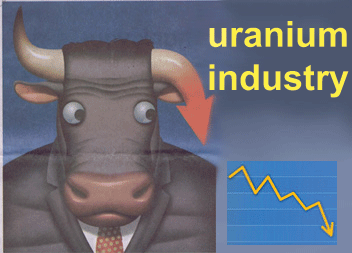 Lowest Australian uranium production for 16 years, World Nuclear Association 23 Jan 15 Due to the shutdown of ERA’s Ranger plant to June, and despite the rich Four-Mile deposit coming on line, Australia’s uranium production in 2014 at 5897 tonnes U3O8 (5000 tU) was the lowest since 1998. Two thirds of it was from Olympic Dam, where uranium is a by-product of copper. Production from Four Mile is recovered at the Beverley plant, replacing output from that mine at about double the level. http://us1.campaign-archive1.com/?u=140c559a3b34d23ff7c6b48b9&id=e08ac096b6&e=ae5ca458a0
Nations make (optimistic) guesses at the cost of getting rid of old nuclear reactors
Getting Rid Of Old Nuclear Reactors Worldwide Is Going To Cost Way More Than People Think Business Insider, NINA CHESTNEY, GEERT DE CLERCQ LONDON/PARIS (Reuters) 20 Jan 15 –”…….The U.S.  Nuclear Regulatory Commission estimates that the cost of decommissioning in the United States – which has some 100 reactors – ranges from $US300 million to $US400 million per reactor, but some reactors might cost much more.
 France’s top public auditor and the nuclear safety authority estimate the country’s decommissioning costs at between 28 billion and 32 billion euros ($US32-37 billion).
 German utilities – such as E.ON, which last month said it would split in two, spinning off power plants to focus on renewable energy and power grids – have put aside 36 billion euros..
 Britain’s bill for decommissioning and waste disposal is now estimated at 110 billion pounds ($US167 billion) over the next 100 years, double the 50 billion pound estimate made 10 years ago.
 Japanese government estimates put the decommissioning cost of the country’s 48 reactors at around $US30 billion, but this is seen as conservative. Russia has 33 reactors and costs are seen ranging from $US500 million to $US1 billion per reactor……… http://www.businessinsider.com.au/r-global-nuclear-decommissioning-cost-seen-underestimated-may-spiral-2015-1
Uranium selling at price way below its costs of production, by Australian miner Paladin Energy
 Paladin Energy Ltd revenues soar 79% but shares sink Motley Fool By Mike King – January 19, 2015 Uranium miner Paladin Energy Ltd (ASX: PDN) has announced sales of US$69.9 million in the December quarter, a rise of 79% over the previous quarter.
But despite the news, shares are down 2.8% at 35 cents at lunchtime.
So why are investors selling out of a stock reporting such strong growth?
The problem is that Paladin sold 1.9 million pounds of uranium in the quarter, at an average price of US$36.58 per pound. That last figure is the issue – that price is well below what it costs Paladin to produce the uranium, and there are no signs that the price is…[members only] http://www.fool.com.au/2015/01/19/paladin-energy-ltd-revenues-soar-79-but-shares-sink/
Small rally in uranium price didn’t last long
Uranium Rally Running Low on Juice After shooting higher, prices have come back down amid questions about how much more of the radioactive metal China needs to buy. BARRON’S Uranium bulls have long pointed to China’s nuclear-industry expansion as a catalyst for a recovery in the market. In mainland China, there are 22 nuclear reactors currently operating, 26 being built and more about to start construction, according to the World Nuclear Association.
However, Australian investment bank Macquarie thinks there are now “serious question marks” about how much uranium the world’s No. 2 economy will need. “China is clearly the most positive story globally when it comes to nuclear-power-capacity expansion,” according to Macquarie analysts. “The concern, however, is that China has already procured a substantial amount of uranium well in excess of what it has consumed and that this advance purchasing might limit its need to enter the market to source material over the next few years,” they add in a note.
Uranium prices have mostly languished since the 2011 Fukushima disaster………with uranium prices rising 37% from August through November as Japan moved closer to restarting its idled reactors. Consultants Ernst & Young said they thought the market had bottomed. Analysts at Australian brokerage Bell Potter agreed.
BUT THAT RECOVERY HAS STALLED…….While the revival of Japan’s nuclear sector is positive for prices, China’s potential demand is more important……..But Macquarie’s analysts say China’s growing store of uranium may be bigger than anyone previously thought. Their latest analysis suggests China increased its stockpiles by 17% last year and now has enough uranium to meet domestic demand for about seven years at forecast 2020 consumption rates. China doesn’t provide data on its uranium inventories…. JPMorgan expects uranium prices to average $30.70 a pound this year, down from last year’s $31.70…….http://online.barrons.com/articles/uranium-rally-running-low-on-juice-1421462807
China’s role in the nuclear marketing frenzy
 Chinese nuclear firms urged to boost presence overseas South China Morning Post 16 Jan 15 China will push its big nuclear firms to improve their competitiveness and boost their presence overseas as it bids to become one of the world’s dominant nuclear energy powers, Premier Li Keqiang said.
“To continue the struggle to become a strong nuclear energy power, China must comprehensively raise the industry’s competitive advantages, promote nuclear power equipment overseas…..
the country’s two biggest state nuclear companies, China National Nuclear Corp (CNNC) and China General Nuclear Corp (CGN), have agreed to invest in Britain’s Hinkley Point nuclear project.
Wang Zhongtang, the chief engineer at State Nuclear Power Technology Corp, said China was also well on its way to securing projects in Turkey and South Africa.
China has been making steady progress on its own third-generation reactors, including the Hualong I, jointly developed by CNNC and CGN for the purpose of winning overseas projects.
Zheng Hua, a deputy chief engineer with CGN’s reactor design unit, said last month that China hoped to develop Hualong I reactors in Britain, building on the agreement to invest in Hinkley Point.
China was also considering a plan to merge CNNC and CGN in order to pool their resources and improve their competitiveness overseas, sources said late last year. http://www.scmp.com/business/economy/article/1680957/chinese-nuclear-firms-urged-boost-presence-overseas
China well up in the throng to market nuclear technology to other countries
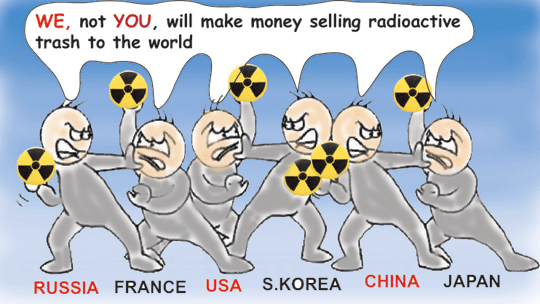
 China ready to sell nuclear fuel for NPPs in Ukraine and Eastern Europe — CNNC source http://itar-tass.com/en/world/771570 January 16, 15 Ukrainian energy sector workers are facing technical problems with American nuclear fuel loading into the Soviet-type reactors BEIJING, January 16. /TASS/. China is ready to sell fuel for nuclear power plants in Ukraine and Eastern Europe, a China National Nuclear Corporation (CNNC) source told TASS on Friday on the sidelines of the World Nuclear Spotlight forum.
According to the source, Chinese companies intend to sell the fuel to the countries that operate various types of Soviet-and Russian-made NPPs. Aside from Ukraine, China is viewing the possibility of exporting nuclear fuel to Hungary and Romania.
The source said Ukrainian energy sector workers are facing technical problems with American nuclear fuel loading into the Soviet-type reactors.
At the moment China is actively buying uranium mines with a view to exporting uranium to other countries in the foreseeable future. Asked about Russia’s possible claims to the Chinese manufacturers of nuclear fuel, he said that “there are no special restrictions.” “Despite the related agreements, the Russian side is unlikely to stop the supplies,” said the CNNC representative.
Russia and China have been actively developing co-operation in the nuclear sphere for many years. For example, State Atomic Energy Corporation Rosatom and CNNC signed a protocol to launch the discussion of possible formats of co-operation in the sphere of construction of nuclear power plants in third countries.
22 Fukushima-style reactors still operating in USA
Japan closing 5 reactors but U.S. still running its Fukushimas, Beyond Nuclear 17 Jan 15 The Japanese nuclear industry has announced it will permanently close five more of its remaining 48 “operable” nuclear reactors by March 2015, leaving the country with 43 reactors “operable” but still not actually “operating.” Two of the plants to be decommissioned are the same GE Mark I boiling water reactors identical to Fukushima. Despite the political landscape in Japan still promoting nuclear power, the anti-nuclear movement there continues to campaign to keep all of Japan’s reactors closed indeifinitely.
China’s nuclear power delay – problems with its new Westinghouse Advanced Reactor

 China’s First Advanced Nuclear Reactor Faces More Delays Start-Up Now Unlikely Until 2016 at the Earliest WSJ By CHUIN-WEI YAP And BRIAN SPEGELE Jan. 15, 2015 BEIJING—China’s ambitions to be a leader in nuclear technology have been dealt a fresh blow, as construction of its most advanced reactor is facing a new delay.
The project—which China is developing with Westinghouse Electric Co. of the U.S.—faces new development problems and now isn’t expected to start up until 2016 at the earliest, the chief engineer at China’s state-owned reactor technology company said Thursday.
“We discovered some new problems during tests so we need to delay it more until next year,” Wang Zhongtang, chief engineer of China’s State Nuclear Power Technology Corp., said on the sidelines of an industry conference. Mr. Wang didn’t specify the nature of the latest problems found at ongoing trials for the reactor, nor did he provide a more precise time frame for its launch.
The delay is the second for the project, which had been slated to start by the end of 2013. It marks another setback for China’s clean-energy ambitions, as technical hurdles loom over Beijing’s aim to triple its nuclear power capacity by 2020…
….the delays have illustrated shortcomings in China’s nuclear sector, particularly when dealing with immature and first-of-a-kind technologies such as those found in the AP1000 reactor, said Li Ning, a nuclear-industry expert at China’s Xiamen University.
Chinese officials “are certainly very frustrated,” said Mr. Li. “I think they feel Westinghouse oversold the system, oversold the technology, promised more than they could really deliver.”………
China’s ambitions and vast market remain vital for the global nuclear industry. French nuclear engineering firm Areva S.A. , which lost out a key bid in 2007 to Westinghouse to build four reactors for China, is still seeking business there…….http://www.wsj.com/articles/chinas-first-advanced-nuclear-reactor-faces-more-delays-1421297393
India should not buy Russia’s unsafe nuclear reactors

 Reactors from Russia are unsafe and unreliable, India shouldn’t buy them: Russian environmentalist Vladimir SlivyakDiaNuke.org, 9 Jan 15 DiaNuke.org interviewed the eminent environmentalist Vladimir Slivyak whose group EcoDefense has been facing repression in Russia for exposing the lack of nuclear safety and environmental impacts. His report on the status of nuclear industry in Russia, prepared on the request of an environmental group in Africa which is also an important market that the Russian nuclear giant Atomsroyexport is eyeing, has been published recently.
The Russian President in his recent visit to New Delhi, offered 21 more reactors to India. Why is the Russian nuclear industry is in such hurry when there is a global shift away from nuclear after Fukushima?
Unfortunately, Russia hasen’t learnt any lessons from Fukushima. Development of nuclear power industry remains the priority for Russian government……..
It is also about making other countries dependent on Russian services and supplies, including nuclear fuel and also so called treatment of high-level radioactive waste, such as spent nuclear fuel, which is usually taken back to Russia. Making someone dependent in such a sensitive field as nuclear power, where not many producers existing, has global political importance for Russian authorities……….
Rosatom promises are far bigger than its technical capability to build reactors. The only explanation I can think of is that they don’t believe that all these reactors will be actually ordered. And Rosatom’ $100billion portfolio is not about real orders actually. It looks great on paper and allows Rosatom managers to report about big success to the government and continue to benefit from big governmental subsidies. But let’s see how their promises are interacting with reality. Couple of years ago there was contract signed with Vietnam and it was said publicly construction will start soon. And last year it appeared that this plan is postponed until 2020. Contract with Turkey was signed before Vietnam and reported to be another big breakthrough, but no construction started until now. And the most of so-called “orders” of Rosatom in other countries are, in fact, not real contracts, but just talks and wishful thinking. Rosatom often gives away totally unreliable information on new reactors, and it was many times proven to be false.
It doesn’t mean Rosatom is not capable of building reactors in India at all. Rather it means that if they do, they would have to postpone many other plans for long, they will try to do it as fast as possible which will likely affect safety of new reactors.
We often hear from the Russian Ambassador and the industry leaders from Russia visiting India that the Russian reactors are safest in the world. What is your take?
Rosatom is promoting its new reactor design, the VVER-TOI, to international customers even though this design has never been tested in practical operation in Russia. No assessments of this design have been done by independent experts, either. It remains unclear if safety has been improved in the new design, as Rosatom claims. But even industry experts put Rosatom’s claims of increased safety in doubt and argue over the effectiveness of new safety systems.
Existing Russian reactors, likewise, do not demonstrate a high level of safety………http://www.dianuke.org/russian-reactors-are-unsafe-and-unreliable-india-shouldnt-buy-them-russian-environmentalist-vladimir-slivyak/
2015 – A Critical Year for New Nuclear Power in UK
 nuClear News Jan 15 “………Last month we reported that it was still unclear exactly who would invest in EDF Energy’s
Women on the move – into employment in renewable energy
An increasing female presence in Renewable energy By Sarah Brooks Linked In 12 Jan 15 The energy sector has always been regarded as male dominated. As of 2013, females contributed to just 21% of the workforce for traditional energy sources such as oil, gas and petroleum. However in the renewables sector females appear to be getting ahead. In Scotland alone 28% of the employees of the renewable energy industry were female.As the renewable industry is considered to be a relatively new source of energy and is still continuously undergoing development and investment, it opens up opportunities for females who would not normally be given a chance to work in the energy sector. Scotland are leading in the renewable sector in the UK, in 2012 almost 30% of electricity generated came from renewable sources compared to just 8% in England and Wales.

If the rest of the UK continue to develop similar to Scotland the number of careers for women within the sector will only increase. Although females are beginning to enter the energy workforce, it is questioned whether these are still mainly in sales and business based roles rather than technical. As of 2010, only 6% of the engineering workforce in the UK were female. Granting this, in 2013 16% of the graduates in engineering degrees were female, which was a small improvement from years prior.
This slight growth over the recent years can be shown through the fact in 2013 50% of the females employed by engineering industries were aged 25-30 years old. This is indication there will be a gradual influx of a younger generation of females into technical roles within the renewable sector as engineers begin to graduate and build their careers within the industry. Initiatives are in place to help encourage and support females to pursue engineering and technical roles. A survey carried out by Atkins in 2013 on females in engineering careers found over 50% of the sample felt they were put off at school for pursuing engineering as it being portrayed as ‘too difficult’ and ‘male dominated’………
Despite the renewable energy industry still being largely dominated by males, there is still huge opportunity for females to get on board not only in business support roles but technical too. With females being gradually encouraged to pursue an engineering career we can expect to see a gradual influx of women in the renewable workforce over the next few years…….https://www.linkedin.com/pulse/increasing-female-presence-renewable-energy-sarah-brooks
USA’s nuclear industry’s future in doubt – as shown in the costs of Exelon’s New York reactor
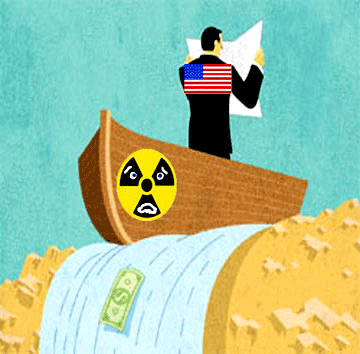 Troubled New York reactor’s costs test the future of nuclear power Tulsa World 6 Jan 15 NEW YORK — Exelon Corp., the biggest U.S. owner of nuclear reactors, needs to almost double power prices to keep a New York plant running in a move that promises to show just how far regulators will go to keep uneconomic plants operating.
After recording losses that exceeded $100 million from 2011 to 2013, Exelon will need to charge about 83 percent more than wholesale prices to earn a profit at its Ginna plant, based on company cost estimates. State regulators have set a Jan. 15 deadline for a new power contract that’s rich enough to keep the Rochester-area plant running.
Last month, Entergy Corp. shut Vermont’s only operating reactor citing low power prices. Ginna is one of 10 other nuclear plants that can’t compete in current markets, Moody’s Investors Service said in November. Retiring the reactors, which account for 10 percent of the nation’s nuclear output, would undercut a push to produce power without greenhouse gases as renewables such as wind and solar are just emerging……..
Exelon isn’t alone in its struggle with at-risk plants. Four U.S. nuclear reactors were shut in 2013 because they weren’t profitable or needed repairs that owners decided were too costly. Entergy’s Vermont Yankee was closed after it failed to find a buyer. ……
A single-unit reactor like Ginna needs as much as $71 a megawatt-hour to earn an 11 percent return and $56 to $64 to break even, based on 2016 forecasts, Exelon said. http://www.tulsaworld.com/washingtonpost/business/troubled-new-york-reactor-s-costs-test-the-future-of/article_dc3a470f-42d8-5bfb-9a27-14706b30cadb.html
Ginna nuclear plant would have to double its charges to consumes, to be profitable
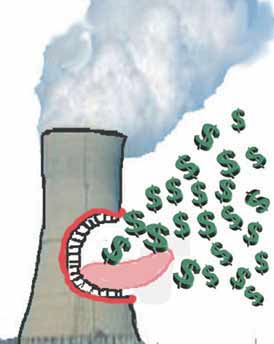 US Nuclear Plant Would Have To Charge Double To Stay Profitable, Simply Info January 6th, 2015 Bloomberg has an interesting article about the major problem for US nuclear reactors. The economics are killing them. They blame subsidies other power generation gets (conveniently avoiding mention of the considerable subsidies nuclear power receives) and other (cheaper) power sources.
What was so startling in this Bloomberg article is that Ginna nuclear plant would have to charge consumers double the current retail power rates in order to turn a profit. This was vs. all other power sources (gas, coal, renewables)……….http://www.fukuleaks.org/web/?p=14282
1 This Month





PLEASE OPPOSE HR 8255 AND S.3639 – bills would accelerate satellite deployment, with no environmental review or safeguards – https://ncstd5li.quorum.us/campaign/169331/
To see nuclear-related stories in greater depth and intensity – go to https://nuclearinformation.wordpress.com
-
Archives
- September 2026 (339)
- August 2026 (330)
- July 2026 (355)
- June 2026 (287)
- May 2026 (306)
- April 2026 (356)
- March 2026 (251)
- February 2026 (267)
- January 2026 (308)
- December 2025 (358)
- November 2025 (359)
- October 2025 (375)
-
Categories
- 1
- 1 NUCLEAR ISSUES
- business and costs
- climate change
- culture and arts
- ENERGY
- environment
- health
- history
- indigenous issues
- Legal
- marketing of nuclear
- media
- opposition to nuclear
- PERSONAL STORIES
- politics
- politics international
- Religion and ethics
- safety
- secrets,lies and civil liberties
- spinbuster
- technology
- Uranium
- wastes
- weapons and war
- Women
- 2 WORLD
- ACTION
- AFRICA
- Atrocities
- AUSTRALIA
- Christina's notes
- Christina's themes
- culture and arts
- Events
- Fuk 2022
- Fuk 2023
- Fukushima 2017
- Fukushima 2018
- fukushima 2019
- Fukushima 2020
- Fukushima 2021
- general
- global warming
- Humour (God we need it)
- Nuclear
- RARE EARTHS
- Reference
- resources – print
- Resources -audiovicual
- Weekly Newsletter
- World
- World Nuclear
- YouTube
-
RSS
Entries RSS
Comments RSS

