Worker deaths at Fukushima nuclear plant
Professor: Fukushima workers told us about “all of the deaths” happening at nuclear plant — We stayed at their dormitory and “learned a lot about what’s going on there, it really is not pretty” — Instructor who was with him on trip weeps while topic is discussed (VIDEO) http://enenews.com/professor-fukushima-workers-revealed-all-deaths-happened-nuclear-plant-stayed-dormitory-learned-lot-about-whats-going-really-pretty-instructor-during-trip-weeps-during-conversation-video?utm_source=feedburner&utm_medium=email&utm_campaign=Feed%3A+ENENews+%28Energy+News%29
Wesleyan University, Feb. 3, 2015 (at 12:45 in):
- William Johnston, Professor of History and East Asian Studies at Wesleyan University, Feb 3, 2015: [Eiko Otake, Visiting Artist at Wesleyan’s College of East Asian Studies, and I] hopped on the train in Tokyo… then rented a car… and we went to the town of Hirono, which is fairly close to the Daiichi reactors… Eiko found a place for us to stay there which was basically a dormitory for these workers. That opened up a whole other world to us. We sat down and had dinner, and we talked…. It was fascinating… we learned a heck of a lot about what was going on there.
- Eiko Otake: (sobbing) Oh God…
- Johnston: It really is not pretty. All of the deaths which have happened with subcontractors, which allows Tepco — which basically owns the place, manages it, but they work through subcontractors – and then when somebody dies, Tepco can say, “None of our men have died, of course not.”… In summer time we also learned of other things that were going on, but we couldn’t get the same lodging.
Asahi Shimbun, Feb 17, 2015: [TEPCO] submitted its plan to provide wide-ranging training programs for workers [after] a string of accidents, some of them fatal… Nine serious accidents occurred between March 2014 and January 2015, resulting in two deaths and eight serious injuries. The labor ministry ordered TEPCO to develop measures to prevent similar incidents following the death of a 55-year-old worker in January… [TEPCO] submitted the plans on Feb. 16 to the labor ministry… outlining countermeasures against occupational injuries and deaths. The report attributed the accidents to tight schedules and a lack of experience… a TEPCO official vowed that the utility would proceed with decommissioning the reactors with the highest priority on safety, saying, “We will ascertain (the pressure on the workers imposed by tight deadlines) by enhancing communication.”… “We have to prevent a situation in which workers feel it is no longer safe to work at the Fukushima plant,” a TEPCO official said. The plant operator also intends to accelerate decommissioning and improve efficiency… so employees will be able to work longer at the plant site before reaching the annual radiation exposure limit of 50 millisieverts.
AFP, Feb 17. 2015: In its preliminary report issued yesterday the IAEA also said it “strongly encourages Tepco… to reinforce safety leadership and safety culture” at the plant, where some 7,000 workers are engaged. One man died there in January after falling into a water tank. “There is still some room to enhance this interaction between radiation safety and labour safety through more integrated plans,” [an IAEA official] said.
Watch the discussion with Prof. Johnston and Eiko Otake here
California’s solar industry boosting jobs
Report: California adds nearly 7,500 solar jobs to its nation-leading total http://www.sacbee.com/news/business/article10468988.html BY MARK GLOVER MGLOVER@SACBEE.COM 02/16/2015
California’s solar industry added nearly 7,500 jobs in 2014, boosting its nation-leading total to 54,690, according to a new report by the Washington, D.C.-based Solar Foundation.
That represented a 15.8 percent gain over 47,223 reported in 2013. Nearly 60 percent of the current jobs are in the solar installation sector, according to the report.
Massachusetts was a distant second in the 2014 job rankings, with 9,400 solar industry jobs.
“California’s solar industry has once again proven to be a powerful engine of economic growth and job creation,” Andrea Luecke, foundation president and executive director, said in a statement accompanying the figures.
The report also noted that California is projected to add nearly 10,000 more solar industry jobs in 2015.
The foundation said there were 2,094 solar companies in California as of November 2014, also No. 1 nationally. The Golden State also topped the nation in the number homes powered by solar energy, at more than 2.38 million.
Nationally, the foundation said 173,807 held jobs in the solar industry near the end of 2014, up 21.8 percent from the previous year.
How the nuclear lobby changes its sales pitch over the years
 The sixty-year pitch.From a dancing housewife to Homer Simpson and beyond, here are some memorable moments in the long grind to sell nuclear power to a wary public. Environmental Health News Third of three parts. Part 1: Last Tango for nuclear?; Part 2: Atomic Balm. February 13, 2015 By Peter Dykstra The nuclear power industry has often been its own worst enemy through its marketing.
At the height of the Cold War in 1953, President Eisenhower rolled out the “Atoms for Peace” campaign, envisioning everything from electrical generation to harnessing atomic bombs to dredging harbors and damming rivers. The following year, Atomic Energy Commission Chair Lewis Strauss upped the ante, envisioning a day when “our children will enjoy in their homes electrical energy too cheap to meter.”
The Atom and Eve
Strauss was placing his bets on nuclear fusion, which, sixty years later, is still on the drawing board. And the meters are still ticking away.
Eager to invest in nukes, utilities took their cue from the AEC Chairman. The Atomic Industrial Forum, the first nuclear power trade association, led the way in messages equating nuclear power with easy living and patriotism. Utilities ran ad campaigns that promised cheap nuclear energy.
From hot times to deep freeze
Nuclear power plant construction hit its Golden Era in the 1960’s. A late Sixties video touting proposed New England nukes, “The Atom and Eve,” is a memorable example from the era: Eve is a dancing housewife, reveling in the virtues of an all-electric kitchen powered by clean, safe nuclear energy. The video’s cigarette-smoking safety engineer looks like he was plucked out of the fission edition of Mad Men, but it’s Eve’s show. She pirouettes around household appliances, caressing the refrigerator, fondling an electric range, and (viewer advisory!) at about the 8:45 mark, she pretty much makes it to third base with an electric washer-dryer combo.
By the end of the decade, rising protests at nuclear plant construction sites and the near-calamity of Three Mile Island changed the game. Public mistrust grew, particularly after Nuclear Regulatory Commission staffers accused Pennsylvania officials and Three Mile Island’s operators of downplaying risks……
Nervous Nineties and beyond
In 1998, industry advertising was whacked by the Better Business Bureau, which ruled in favor of environmental groups and a windmill power producer that nuclear ads could not boast of producing “environmentally clean” power. When those claims continued, the groups won a similar ruling from the Federal Trade Commission a year later.
As the 21st Century rolled in, the industry increasingly marketed itself as a remedy to climate change concerns, with a parade of prominent citizens, some of them paid spokespeople, plugging nuclear.
Then, in 2011, came Fukushima, and the industry’s umpteenth redemption pitch was in doubt. And Japan, by reputation one of the best-prepared and most safety-conscious nation on Earth, went into damage control mode, including at least one world-class PR overreach: Tokyo Electric Power’s legal team argued in court that radiation released by the Fukushima meltdowns was no longer the company’s responsibility.
It was now “owned” by the people it fell on.
The court was not amused.
Today, the domestic nuclear industry is relying heavily on selling nuke plants as a climate change solution. ……http://www.environmentalhealthnews.org/ehs/news/2015/feb/essay-the-sixty-year-pitc
h
Another $8 billion added to the $14 billion cost of Nuclear Plant Vogtle

 Monitors: Southern Co. might spend $8B on nuclear plant http://www.pennenergy.com/articles/pennenergy/2015/02/monitors-southern-co-might-spend-8b-on-nuclear-plant.html February 16, 2015 By Ray Henry, Associated Press ATLANTA (AP) — Southern Co. might spend more than $8 billion to finish building a nuclear power plant in Georgia, or roughly 30 percent more than it originally budgeted, according to a recent analysis prepared for state utility regulators.
Power company officials disclosed in January that builders expect it will take three years longer than first expected to construct two new reactors at Plant Vogtle. Construction delays can significantly run up the cost of building and financing a nuclear plant.
Southern Co. subsidiary Georgia Power would spend about $8 billion if construction is delayed just short of three years, according to an analysis that the head of the Public Service Commission’s utilities division sent Jan. 8 to an elected regulator. That estimate is consistent with the potential delays Southern Co. and other Vogtle owners announced later in January, after the analysis was written.
Ongoing lawsuits could raise costs. Georgia Power’s cost would rise to $8.3 billion if the power company paid half the money the plant’s designer, Westinghouse Electric Co., and builder, Chicago Bridge & Iron Co., are seeking in a lawsuit.
Georgia Power spokesman Brian Green said the company could not immediately comment on the state agency’s analysis. Utility officials last projected Georgia Power would spend $6.7 billion on its share of the plant. Company officials will file an updated budget Feb. 27 that is expected to show roughly $720 million in additional charges due to delays.
A project using the same plant design in South Carolina previously announced similar delays priced at more than $1 billion.
Overall we continue to maintain that building these units correctly, and safely, is more important than building them quickly,” Green said.
Georgia Power’s customers will pay for the cost of the new plant unless state regulators intervene. The documents show staffers at the Public Service Commission are compiling a record of testimony showing how Southern Co. executives promised the plant’s original cost estimate was reasonable and rejected suggestions they budget more for the possibility of delays or other difficulties.
Georgia Power owns a 46 percent stake in the new reactors at Plant Vogtle. The other owners include Oglethorpe Power Corp., the Municipal Electric Authority of Georgia and the city of Dalton.
The owners estimated the plant would cost a total of $14 billion. Estimating the precise cost now is difficult because each utility faces different borrowing costs and other charges. If the other companies faced costs similar to Georgia Power, the plant’s total price tag would stand at more than $17 billion.
Now India too wants to sell nuclear reactors overseas!
 India to supply nuclear reactors to Sri Lanka By Dipanjan Roy Chaudhury, ET Bureau | 17 Feb, 2015 NEW DELHI: With an eye on checking China’s growing ambitions in South Asia, India has signed a landmark civil nuclear pact with Sri Lanka – the first such agreement to supply nuclear power reactors to a foreign nation – and decided to expand defence and security cooperation to address Colombo’s requirements.
China’s delay in building reactors is watched in concern by US nuclear industry
 Power plant projects closely watched International Falls Journal, ATLANTA (AP) 17 Feb 15, — U.S. power companies struggling with the escalating costs of building nuclear plants are closely watching similar efforts in China, where officials are expecting delays.
Two plants under construction in Sanmen and Haiyang, China, are the first-ever built using Westinghouse Electric Co.’s AP1000 reactor design. Utility companies in Georgia and South Carolina are building two similar plants in the United States using a very similar design. Since the project in China is further along, U.S. executives and safety regulators watch it closely…….
Meeting deadlines is critical for projects in both countries. When nuclear plant construction slows down, building and financing costs can soar. That problem hobbled the nuclear industry during earlier rounds of building. Proponents had hoped the new projects in China and the United States would demonstrate nuclear plants can be constructed without blowing budgets.
If nuclear plants go massively over budget, the nuclear industry will find it nearly impossible in the short run to compete against much-cheaper gas-fired plants…….
The projects in the United States are already under cost pressure. Westinghouse Electric Co. and Chicago Bridge & Iron Co. expect construction of two new AP1000 reactors at Plant Vogtle in eastern Georgia will go three years beyond the approved schedule, according to financial filings……..
Regulators in Georgia estimate the latest delays could push Southern Co.’s share of spending on the plant from $6.1 billion to more than $8 billion.
A sister plant owned by SCANA Corp. and Santee Cooper in South Carolina has run into similar delays and cost overruns. http://www.ifallsjournal.com/news/business/power-plant-projects-closely-watched/article_1b0cfa36-f047-5337-81c6-632b926ec139.html
Russia promoting its nuclear technology to Egypt
 Russia to help Egypt build ‘a whole new nuclear power industry’ – Putin, Rt.com February 10, 2015 Russia will contribute to building “a whole new nuclear power industry” in Egypt, President Vladimir Putin has announced as the two countries have signed a number of agreements after a meeting in Cairo.
Google’s big investment in renewable energy, $US1.5 billion and more
 Google joins Apple in turning to renewable energy, SMH February 12, 2015 Matt O’Brien Google has spent $US1.5 billion ($1.95 billion) around the world on clean energy projects cutting the pollution from millions of users clicking on search links, watching YouTube videos and sending emails, but now it’s found a powerful electricity source close to home. The company will announce Wednesday that it is buying power from the Altamont Pass, one of the nation’s oldest, largest and most iconic wind farms that is about to get a Google-funded makeover.
The tech giant has no plans to brand the blades with its multicolored logo, but its 20-year power purchase agreement with Florida-based NextEra Energy will dramatically transform the rolling, treeless landscape that connects the Bay Area with the Central Valley here. About 770 old turbines from the 1980s will be replaced this year by 48 new machines producing twice as much energy, enough to power Google’s corporate campus in Mountain View with 100 percent renewable power.
It’ll be majestic,” said Sam Arons, an energy strategist at Google. “Today there are many small turbines of all different sizes, all different vintages. It’s kind of a hodgepodge out there. Once this project is done, you’ll see a lot of tall, sleek, majestic turbines that will really de-clutter the landscape.”
Google’s involvement is the latest green power play from a company that has spent a decade dropping money on wind, solar and geothermal projects from West Texas to South Africa and the Netherlands, and is an investor in Ivanpah, the massive solar thermal power plant built by BrightSource Energy in the Mojave Desert. Google says it operates with 35 percent renewable power worldwide.
Last year, it spent $US3.2 billion to acquire Nest Labs, maker of the slick “learning thermostat.” It also quietly named John Woolard, the former CEO of Brightsource, as a vice president for energy. It has several previous deals with NextEra – for wind farms in Iowa, North Dakota and Oklahoma – and recently invested in Utah’s largest solar plant.
But unlike most of those projects, Google’s Altamont venture is more than a capital investment. Just 50 miles from Mountain View, it will do more to reduce the Googleplex’s carbon footprint than any of the quirky projects on the corporate campus, from the 1.9-megawatt solar array to the plant fueled by landfill gas.
Google is the second Silicon Valley tech giant this week to announce a major local green energy project. On Tuesday, Apple announced an $US850 million agreement to buy power and help build a 280-megawatt solar farm in Monterey County……..
The price of wind has declined very, very substantially over the past couple of years and the technology has improved,” said Ryan Wiser, a staff scientist who studies electricity markets at the Lawrence Berkeley National Laboratory. “The cost of wind energy is so low that it’s not as if these companies are taking an enormous financial risk in locking into these agreements. The price is stable.” http://www.smh.com.au/environment/climate-change/google-joins-apple-in-turning-to-renewable-energy-20150211-13cdge.html
EDF’s financial problems delay decision on proposed new nuclear plant at Hinkley Point
 EDF Energy delays Hinkley Point nuclear decision French power firm’s plans to build first British atomic reactors in almost 30 years suffers further setback Guardian, Terry Macalister, 13 feb 15 The timetable surrounding the construction of Britain’s first new atomic reactors in almost 30 years has once again been blown off course, its developer, EDF Energy, has admitted. The setback came as the French-owned generator and supply company reported a 25% slump in operating profits for 2014 to £863m, which it blamed on challenging market conditions.
EDF had originally promised to tie up a new deal with financial backers and then take a final investment decision on the proposed new plant at Hinkley Point in Somerset by the middle of last year. This date was later revised to March 2015.
But in a new statement, the largely state-owned energy group said a final investment decision might only be possible in a matter of months, and it had still not finalised talks with Chinese financial backers……….
Meanwhile, there is growing speculation that Chinese investors are hardening the terms under which they would be willing to help underwrite some of the cost of the new plant. China National Nuclear Corporation and China General Nuclear Power Corporation are expected to be minority shareholders in the project, but are also pushing for commitments to build and operate their own plant at Bradwell in Essex.
EDF has declined to confirm that it too is trying to limit the financial damage through compensation from the UK government should there be a successful legal challenge in the European courts by Austria to the UK subsidy arrangement.
Critics of the £24.5bn nuclear programme in Somerset have highlighted the industry’s poor track record for constructing facilities on time and on budget. They have questioned whether Hinkley Point C reactors would able to meet their timetable of opening for operations in 2023.
EDF has already run into problems with a new project at Flamanville in Normandy, while another project in Finland, the European pressurised reactor, which uses the same design as Hinkley, is also massively behind its original timetable.
Financial problems at its French design partner, Areva, have not helped the sense of uncertainty surrounding EDF’s nuclear ambitions,……http://www.theguardian.com/business/2015/feb/12/edf-energy-delays-hinkley-point-nuclear-decision
Obama – Modi discussions resulted in no deal for USA nuclear salesmen
The same stumbling block over parallel safeguards in perpetuity has held up India’s conclusion of nuclear deals with Japan and Australia
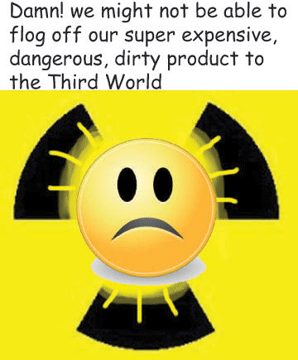 India’s bitter experience over the 1984 gas leak from an American-owned Bhopal city plant that killed about as many people as the Fukushima disaster. Indeed, Japan’s dual liability laws, which indemnify suppliers and make plant operators exclusively liable, should serve as a sobering lesson for India: GE built or designed all the three Fukushima reactors that suffered core meltdowns in 2011, yet the U.S. firm went scot-free, despite a fundamental design deficiency in the reactors.
With complex legal, pricing and other issues still pending, the deal’s commercialization is anything but imminent. In fact, the two sides are yet to sign the administrative arrangements, which they announced had been “finalized.”
It is an open question whether the deal will ever yield substantive energy benefits for India, given the exorbitant price of foreign-origin reactors, the concomitant need for India to heavily subsidize the electricity from such plants, and grassroots safety concerns over the Fukushima-type multi-plant nuclear parks earmarked by India for Westinghouse, GE-Hitachi and Areva, each of which is to sell prototype LWR models presently not in operation anywhere in the world.
The U.S.-India nuclear breakthrough that wasn’t, Japan Times 12 Feb 15 BY BRAHMA CHELLANEY During U.S. President Barack Obama’s recent India visit, a stalled, decade-old civil nuclear deal took center-stage, with the two sides announcing a breakthrough on the contentious issues blocking its implementation — a development that promised to potentially open the path for a Japan-India nuclear deal. It now appears that the breakthrough was more hype than reality and that there is little prospect of the U.S.-India deal’s early commercialization……..
it has now become apparent that the U.S. and India are still locked in negotiations to tie up loose ends and that the much-trumpeted breakthrough was little more than an effort to project a substantive advance during a presidential visit rich in pageantry and symbolism. Obama was the chief guest at India’s Jan. 26 Republic Day parade, a year after Prime Minister Shinzo Abe had that honor.
While claiming a breakthrough, neither side released any details, including on how another sticking point had been resolved: a U.S. demand that New Delhi accept nuclear-material tracking and accounting arrangements Continue reading
India’s Nuclear Liability Law is a major deterrent to USA Nuclear companies
for the U.S., the “right to recourse” clause remains a major deterrent.The law has stalled the implementation of deals for new reactors that India signed with the U.S., Russia, and France in 2008, when the Nuclear Suppliers Group (NSG) allowed India to import nuclear fuel technology without being a member of the multinational body concerned with reducing nuclear proliferation. India said the breakthrough deal with Russia reached this April after four years of negotiations takes into account the liability law when pricing four more Russian reactors meant for India’s Kundankulam plant in Tamil Nadu (each of which is valued at $2.5 billion) as well as four or six other VVER-1200 units planned for Haripur, West Bengal. The deal essentially calls for India’s public sector General Insurance Co. to evaluate each component of the Russian reactors and prescribe a 20-year insurance premium it will charge to cover Russia’s liability for an accident.
Russia’s state-owned nuclear firm Rosatom reportedly has indemnity from any liability arising from an accident at the VVER-1000s at Kundankulam Unit 1 (Figure 2), which attained criticality in July 2013 and is expected to come online later this year, and Unit 2, expected to be operational in October 2014. Observers note that contracts for those plants were signed in 1998, before India’s domestic liability legislation had even been contemplated.
Before Indian legislation on civil nuclear liability—The Civil Liability for Nuclear Damage Bill—finally passed both houses of parliament in August 2010, exempting suppliers from all liability had been India’s typical practice, starting in 1962, when India signed its first nuclear cooperation agreement with the U.S. to allow General Electric to supply two 200-MW reactors to India’s Tarapur site. The practice of liability exemption was modeled on America’s own 1957-passed nuclear liability law, the Price Anderson Act, and went on to extend indemnity protection to Atomic Energy of Canada Ltd. for two reactors in Rajasthan in 1965, and later to Russia. Continue reading
Renewable Energy + Storage a better option for Ontario than Nuclear Power
Is nuclear refurbishment Ontario’s best option?, Corporate Knights, BY TYLER HAMILTON FEBRUARY 11, 2015 A renewables and energy storage combo could do the job and shouldn’t be ignored, a Navius Research analysis argues. ances are slim that shiny new nuclear plants will be built in Ontario. High upfront costs and a history of delays and cost overruns are among the reasons “new builds” will likely never happen in the province.
But there remains widespread debate over plans to refurbish existing reactors at the Darlington Nuclear Generating Station in Clarington, about an hour east of Toronto.
Ontario Power Generation, the province-owned electricity generator, is determined to rebuild the cores of four reactors at the Darlington site. Together, the four reactors represent about 3,500 megawatts of generating capacity and refurbishing them will extend their lives by about 30 years.
The utility estimates the project will carry a final price tag of $12.9 billion once completed a little over a decade from now. Is that a deal for Ontario ratepayers, or is there a better, less risky, and just as climate-friendly alternative?
Let’s put aside the standard anti-nuclear talking points about the risk of a Fukushima-style accident or the challenges and unknown costs involved with storing highly toxic nuclear waste far into the future. A new case study done by Vancouver-based Navius Research calls into question the wisdom of Ontario’s refurbishment plan in a world where solar power and energy storage costs are falling dramatically.
The Navius report, using a detailed model of Ontario’s electricity system that accounts for the current mix and performance of energy generation, simulated the grid for a full year under a variety of different conditions to see how it would respond.
It found that renewables in combination with the right amount of energy storage – in this case, compressed air energy storage (CAES) – and a small amount of natural gas generation would result in “equivalent GHGs and quite similar electricity system costs” compared to nuclear refurbishment……..
the findings are compelling enough that it should give Ontario pause before taking the plunge with Darlington, …….http://www.corporateknights.com/channels/utilities-energy/nuclear-refurbishment-ontarios-best-option/
Westinghouse cagey about paying more for delays in new nuclear power
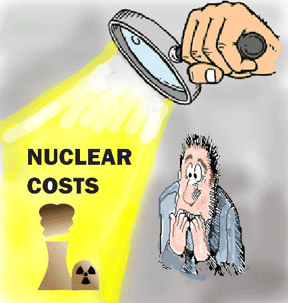 Will Westinghouse pay for another nuclear delay? Power Source, February 10, 2015 A strange argument went down on Dec. 16 among electric utility Georgia Power and its regulator, the Georgia Public Service Commission, and entangled local nuclear firm Westinghouse Electric Co.
Cranberry-based Westinghouse and its partners in the construction of the first two AP1000 reactors in the United States had, up to that point, resisted telling Georgia Power when the project would be completed. The company provided a list of activities planned through December 2015, but would not forecast further, Georgia Power told the commission.
The utility tried time and again to obtain an integrated project schedule, it told regulators. Already, the project originally set to be completed by April 2016 was 21 months behind.
The regulators, in turn, wondered who’s running the show — the utility that hired the consortium of nuclear builders for an estimated $14 billion project or its contractors.
When Westinghouse and its main construction partner, Chicago Bridge & Iron, finally submitted the long sought-after document in January, they revealed another 18-month delay, projecting the first plant would be ready for service in mid-2019 and the second in 2020.
Georgia Power has placed the estimated cost of the delay at $720 million, or $40 million a month. That’s on top of more than $1 billion in delay- and design-related costs that the two sides have been suing each other over since 2012.
The utility hasn’t agreed to the new dates, its parent company, Atlanta-based Southern Co. said in a public filing Jan. 29. Nor does it believe that Westinghouse and its partners have done everything possible to mitigate the delay. And, as has been the pattern with cost overruns in the project, Southern Co. told investors it expects the latest expenses to become part of the lawsuit.
The company’s CEO Tom Fanning said on Bloomberg Television last week, “Southern Co. won’t absorb those costs. The contractors will.”
Chicago Bridge & Iron has denied that claim. Westinghouse declined to address the comment………..
The likelihood of delays is so ingrained in nuclear construction that the Public Service Commission requires its analysts to continuously update the cost of potential delays spanning as many as four years.
Deviating from original construction schedules and budgets has been the norm for all past nuclear construction projects in this country, one of the main criticisms of undertaking such efforts.
As a result, a lot is seen as riding on the Vogtle construction. With cheap natural gas flooding U.S. markets, nuclear has to prove there’s an economic advantage to investing in such capital-heavy construction instead of throwing up a couple of natural gas power plants in a few years’ time at a fraction of the cost……..http://powersource.post-gazette.com/powersource/companies-powersource/2015/02/10/Will-Westinghouse-pay-for-another-nuclear-delay/stories/201502100014
Nuclear power agreement between Russia and Egypt
Cairo and Kremlin agree on building a nuclear power plant, DW, 10 Feb 15
Officials from Egypt and Russia have signed agreements to boost economic and industrial ties during Putin’s visit to Cairo. The two countries plan to build a nuclear power station, Egypt’s President El-Sissi says. Russia’s president, Vladimir Putin, wrapped up his two-day visit with Egyptian counterpart Abdel-Fattah el-Sissi in Cairo on Tuesday, after both countries signed a memorandum of understanding to build Egypt’s first nuclear power plant together. The power plant is expected to be made with the latest technology and have four separate blocks providing 1200 megawatts of energy each, according to Sergey Kirienko, the director general of the Russian atomic energy corporation Rosatom.
President Putin stressed that “if definite decisions are made, it would not be simply about building a nuclear power plant, but about creating a whole new nuclear industry in Egypt.”
He also stressed that Moscow had only signed a memorandum of understanding on the construction, meaning that the deal had not yet been finalized…….http://www.dw.de/cairo-and-kremlin-agree-on-building-a-nuclear-power-plant/a-18248404
Uranium company Cameco continues to get miserable results
 Uranium Producer Cameco Looks Depleted Full-Year Results Lowest Since 2006, WSJ, By SPENCER JAKAB Feb. 8, 2015 Customers shutting down in droves? Environmentalists creating headaches? Low cost competitors flooding the market? Nuke ‘em. ……
he nearly two-thirds decline in Cameco’s U.S.-listed share price since February 2011 is about more than a delayed earnings bonanza. Furthermore, fluctuations in uranium’s thinly traded spot market should be viewed cautiously.
Not only do utilities in Japan and elsewhere have substantial inventory on hand but other sources of uranium supply hang over the market. These include low-cost mines in Kazakhstan that now supply around 40% of the market as well as nuclear fuel derived from nonmine sources such as the waste “tailings” of previously processed uranium.
Assuming analysts’ 2018 scenario plays out in terms of output and prices, Cameco now fetches just under 10 times that year’s consensus forecast earnings according to FactSet—hardly a bargain in today’s depressed mining landscape. The cloud hanging over Cameco may not dissipate soon.http://www.wsj.com/articles/uranium-producer-cameco-looks-depleted-ahead-of-the-tape-1423421905
1 This Month




PLEASE OPPOSE HR 8255 AND S.3639 – bills would accelerate satellite deployment, with no environmental review or safeguards – https://ncstd5li.quorum.us/campaign/169331/
To see nuclear-related stories in greater depth and intensity – go to https://nuclearinformation.wordpress.com
-
Archives
- September 2026 (339)
- August 2026 (330)
- July 2026 (355)
- June 2026 (287)
- May 2026 (306)
- April 2026 (356)
- March 2026 (251)
- February 2026 (267)
- January 2026 (308)
- December 2025 (358)
- November 2025 (359)
- October 2025 (375)
-
Categories
- 1
- 1 NUCLEAR ISSUES
- business and costs
- climate change
- culture and arts
- ENERGY
- environment
- health
- history
- indigenous issues
- Legal
- marketing of nuclear
- media
- opposition to nuclear
- PERSONAL STORIES
- politics
- politics international
- Religion and ethics
- safety
- secrets,lies and civil liberties
- spinbuster
- technology
- Uranium
- wastes
- weapons and war
- Women
- 2 WORLD
- ACTION
- AFRICA
- Atrocities
- AUSTRALIA
- Christina's notes
- Christina's themes
- culture and arts
- Events
- Fuk 2022
- Fuk 2023
- Fukushima 2017
- Fukushima 2018
- fukushima 2019
- Fukushima 2020
- Fukushima 2021
- general
- global warming
- Humour (God we need it)
- Nuclear
- RARE EARTHS
- Reference
- resources – print
- Resources -audiovicual
- Weekly Newsletter
- World
- World Nuclear
- YouTube
-
RSS
Entries RSS
Comments RSS

