Russia to supply credit to sell untested nuclear reactors to Bangladesh
 Rosatom eager to sign three more accords with BAEC http://www.observerbd.com/2015/07/22/100629.php#sthash.jdS4D1ks.USjrUblf.dpuf Shahnaj Begum, 22 July, 2015, The Russian state-owned nuclear power agency, Rosatom, is eager to sign three separate deals with Bangladesh Atomic Energy Commission (BAEC) before signing the general contract to install the country’s first nuclear power plant at Rooppur on the north-west part of the country.
According to the official one deal will be signed to arrange the fuel to run the plant and another one for the “back end” for taking away the waste of the plant, and another one is for the operational purpose (maintenance), he added.
Bangladesh formed three separate teams to discuss the issue.
“We are yet to know about the technology, but we want to procure a reactor which will have SSE (safe shut acceleration) and capacity to handle minimum peak ground acceleration value of 0.38g (which means it would be all right against earthquake of 9 on the Richter scale),” a BAEC official said.
This is a follow-up to another visit by a high-powered technical committee to Russia last month.
This visit is necessary for selecting the right thing for Bangladesh and ensure a block allocation from the Russian Federation to implement the dream project, first of its kind in the country,” Yeafesh Osman said.
Moscow financed the technical study of the RNPP. Under the deal Bangladesh would borrow an amount of $569 million with an interest rate of not less than 5 per cent from Russia.
The government is going to build two nuclear plants with the capacity of 1,000 MW each at Rooppur with the latest ‘third generation’ technology from Russia where five-layer security measures would be installed, according to officials.
France’s nuclear corporation AREVA going down the financial gurgler
As Areva Goes Belly Up, Modi’s French Nuclear Plans May Start Unravelling, DiaNuke.org, 24 July 15 “………..The signs of Areva’s irreparable decline if not imminent death have been on the horizon these past years. With its single product catalogue, Areva has struggled to complete two identical EPR reactors, the first at Olkiluoto for TVO in Finland (still not operational despite a nine-year delay and a trebling of costs) and the second in Flamanville, France, plagued by equally serious construction and security flaws, delays and outrageous cost over-runs. …….

Reactor woes continue
The estimated price of the reactor continues to go up and up – it has nearly trebled from 3.3 billion euros eight years ago to around 9 billion euros at current estimates and could go higher if the EPR’s technical problems persist. The company has run up a deficit estimated at 4.8 billion euros for a turnover of 8.3 billion. Its recapitalisation requirements stand at 7 billion euros. The French government has stepped in to impose draconian solutions on the company that will see its design, construction and operations arm hacked off and handed over to its arch enemy, EDF. When the negotiations with EDF are completed – the haggling over price is currently underway – Areva, a company that has built and operated some 64 nuclear reactors will be reduced to a dwarf.
The French nuclear security watchdog, ASN, has issued a number of severe warnings to Areva on major security issues and manufacturing and construction flaws in the reactor being built in Flamanville, France, one of four EPRs under construction in the world. One of the latest warnings concerns the weakness of the reinforced steel core at the heart of the reactor where nuclear fission takes place. French papers have described fissures in the reactor’s innermost core as measuring as much as 42 centimetres. If the ASN’s suspicions about the poor quality of the forging done by Areva are proved right (the final test results will be available in October), the reactor dome will have to be removed. This can only mean one thing: the total abandonment of the EPR in France. A decision is not expected until 2016.
Several reports published in France on the woes of the EPR describe it as a product of “French technological hubris”. It is a gigantic reactor that looks good on paper. But as the adage goes, the proof of the pudding lies in the eating and India did not wait long enough to see the reactor’s performance before rushing in to buy an untried product.
“The EPR reactor whose problems are at the heart of the current crisis is an expensive failure,” writes energy analyst Nick Butler. “It has to be written off and replaced by a new generation of smaller, less complex reactors that can be built on time and on budget. The EPR was designed at a time when it was believed that energy costs would rise inexorably. That is no longer the case.”…………There is also the question of Areva’s massive debt.
Uncertain future
The Finnish nuclear operator TVO is suing Areva for billions of dollars for the delays, cost over-runs (estimated at 7 billion euros instead of the 3.3 billion originally projected) and technical flaws related to the EPR in Olkiluoto. The failure of the Finnish EPR has contributed vastly to Areva’s troubles.
Once hailed as the harbinger of a nuclear renaissance, the EPR is fast becoming one of the world’s most criticised and by far the most expensive nuclear white elephants. In France work began in 2007 and the reactor was to have gone on stream in 2012. This date has now been pushed forward to 2017 at three times the initial cost.
Leaving aside the problems linked to cost, safety and technological know-how, it is at this stage totally unclear if EDF would like to pursue the EPR programme at all. Last year the European Commission gave the go ahead for building another EPR reactor at Hinkley Point in Britain. But British authorities, which were to have signed in March 2015, now appear reluctant to go ahead. The Financial Times reported that the project might be completely abandoned. In the US, plans to build the EPR have currently been suspended. as World Nuclear News reported in March, Areva “has asked the US Nuclear Regulatory Commission (NRC) to suspend work on the design certification of the US EPR until further notice, prompting Unistar Nuclear Energy to request the suspension of the review of its construction and operation licence (COL) application for Calvert Cliffs 3.” http://www.dianuke.org/why-is-india-bent-on-joining-the-sinking-french-nuclear-ship/
Control of electricity at the local level, with batteries for renewable energy
In the end, the solution might lie on a smaller scale: giving everyone the power to store their own power. Tesla is one company of several in this game: it recently announced a device called the Powerwall, designed for homes and businesses. It uses the same batteries as electric cars to store energy, either from renewables or cheap night-time electricity, ready to be used during the day.
If such systems become commonplace, we might all become a little more aware of where our energy is coming from, and how our own behaviour affects its use and production

The battery revolution that will let us all be power brokers, New Scientist 22 July 15
Companies are racing to find better ways to store electricity – and so provide us with cheaper energy when and where we want it “……... Although they are still dwarfed in most respects by the bulky lead-acid batteries found in almost every car on the road today, in 2015, lithium-ion batteries will account for around a third of the money spent on rechargeable batteries globally (see “Turn it on”), and just under a sixth of the total energy stored, according to French research firm Avicenne.
US Military Industrial companies benefit greatly from aggravating US-Russian tensions
 Nuclear Buildup in EU: Who Benefits From Aggravating US-Russian Tensions? Sputnik News, 23 July 15 While beefing up NATO’s military presence in Europe Washington should refrain from deploying more US nuclear weapons in EU countries, senior fellow of the Brookings Institution Steven Pifer said.
what forces are playing the first fiddle in Washington, urging the White House to drag the country into new overseas conflicts and increase its military spending? US investigative journalist Robert Parry is pointing the finger at US neocons, who “still dominate Official Washington’s inside-outside game.” The journalist underscored that wars have long become a profitable business for transnational corporations and their influential lobbyists in the White House.
“So, to understand the enduring influence of the neocons… you have to appreciate the money connections between the business of war and the business of selling war,” Parry remarked.
These wars cost trillions and trillions of dollars and multinational corporations including the US military-industrial complex benefit a lot from them. ……..: http://sputniknews.com/politics/20150723/1024969193.html#ixzz3gkc7anUQ
Nuclear power won’t kill renewables – quite the reverse
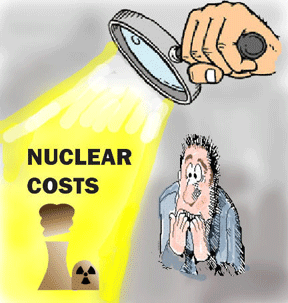 Roger Sowell , Sowell’s Law Blog 22 July 15 “……I would not anticipate the nuclear power industry being able to kill renewable energy, in fact, quite the opposite is very likely to occur. Most forms of renewable energy have a decreasing unit cost over time, most especially wind turbines over the past decade. Meanwhile, nuclear-based power has an increasing unit cost. The only examples I can find where nuclear power plants can be built for approximately $4,000 per kW are those countries where labor rates are still very cheap, such as China.
But, labor costs increase over time so that small advantage will disappear. Finally, the grid-storage problem has been solved technically, with under-sea storage and hydroelectric power as described by MIT. As offshore wind-turbines decline in installed cost, and the under-sea storage costs also decline with experience, truly sustainable and inexhaustible clean power on demand will finally exist. The electricity may not be too cheap to meter (the big lie of nuclear power), but it will be relatively cheap and not subject to price increases due to fuel availability. http://sowellslawblog.blogspot.com.au/
Japan’s agricultural industries affected by radiation levels
Green tea plantations were first highlighted as suffering from potential radiation contamination last month following the results of sample tests in Kanagawa prefecture. The authorities discovered around 570 becquerels of caesium per kilogram in leaves grown in the city of Minamiashigara – compared to the legal limit of 500 – and started a recall of tea products.
Tea leaves are the latest agricultural products in Japan to be affected by problems surrounding the still-damaged Fukushima Daiichi nuclear power plant.
From milk to spinach, a raft of items have fallen under the spotlight due to radiation fears although Japanese authorities have assured the public and its export nations that it is strictly regulating products.
While it seems that areas around the nuclear crisis will never recover, tens of thousands of farmers have lost their livelihood due to soil contamination and food safety fears.
Just another serious blow on the global food supply that seems to be diminishing. Source: natural society http://planetsave.com/2012/06/12/japan-green-tea-exports-banned-due-to-high-radiation-levels/
Migrit rejected for nuclear investment in Finland – “a front for Russian capital”.
 Finnish officials reject nuclear plant investor Ft.com By David Crouch in Gothenburg, July 16, 2015 Finland’s plan to build a nuclear power station with help from Russia has been thrown into doubt after officials in Helsinki rejected a mysterious investor that it is alleged has links with Moscow.
The move raises a fresh obstacle to the project, which has been dogged by accusations that Finland is placing Russian interests before EU foreign policy objectives.
Finland’s economics ministry said on Thursday that the ownership of Migrit Solarna Energija, a Croatian group listed as owning almost 9 per cent of the Fennovoima project, could not be “adequately verified”.
The ministry said it could not establish with certainty that the company was “factually controlled” from inside western Europe.
Finland’s government has insisted that 60 per cent of the €6bn–€7bn cost of the nuclear plant should be borne by companies residing or domiciled in the EU or the wider European Free Trade Association, which includes Norway, Iceland and Switzerland.
However, without Migrit, this requirement will not be met — which means either a new investor or additional investment from existing shareholders.
“We cannot speculate on who Migrit is controlled by,” said Herkko Plit, a senior civil servant in the economics ministry. “It has many relations to foreign countries, not just Russia. But . . . those people who founded it originally were Russians. The current owners are also Russian citizens to the best of our knowledge.”
Fennovoima plans to begin construction of a 1,200-megawatt reactor at Pyhaejoki in northern Finland in 2018, with operation due to begin in 2024.
But the company has struggled to find backers after the main original shareholder, the German utility Eon which had a 34 per cent stake, withdrew in 2012 after energy prices fell. Rosatom, the Russian state-owned nuclear company that will build the plant, now owns a 34 per cent stake.
Olli Rehn, a former European commissioner who in April became economics minister in Finland’s rightwing coalition government, said a decision on the future of the Fennovoima project would be referred to a meeting of the government on August 6.
“It seems that behind the Croatian company are Russian financiers,” Mr Rehn told YLE, the Finnish broadcaster, although he declined to say whether he believed that Migrit was linked to Rosatom………..
anti-nuclear campaigners said the new doubts about the project should be enough to kill it off. “It should be a sign to the government — if they cannot find investors the plant is not viable,” said Sini Harkki, Greenpeace programme manager for Finland.
She said it appeared that Migrit was “a front for Russian capital”.
“Fennovoima has had several years to find investors, and all it has found was this small Croatian company,” she added. http://www.ft.com/intl/cms/s/0/601da0a4-2bda-11e5-acfb-cbd2e1c81cca.html#axzz3g6DMCh5d
More deaths from leaukemia as workers exposed to more low level ionising radiation
As cumulative dose of radiation exposure increased, so did the risk of dying from certain kinds of leukemia, the researchers found.
In the new study, the researchers calculate that for each gray (1,000 mGy) of total radiation exposure, a worker’s risk of leukemia rose three-fold.

Long-Term Low-Dose Radiation Exposure May Increase Leukemia Risk, Scientific American, Leukemia was already known to be caused by exposure to high doses of radiation, like that released by the atomic bombs dropped on Japan in 1945 By Kathryn Doyle July 10, 2015 (Reuters Health) – In a long-term study of more than 300,000 workers in France, the U.S. and the U.K., those with many years of exposure to low doses of radiation had an increased risk of dying from leukemia.
Medical workers and even patients are also exposed to much more radiation than was common decades ago, the study authors point out, but it’s unclear what amount of low-level exposure raises cancer risk, they say.
“A lot of epidemiological or radiobiological studies have brought evidence that exposure to ionizing radiation can cause cancer and leukemia,” said lead author Dr. Klervi Leraud of the Radiobiology and Epidemiology Department at Fontenay-aux-Roses in Cedex, France.
Workers exposed to ionizing radiation who are later diagnosed with leukemia can already ask for financial compensation in the U.S., the U.K. or France, Leraud told Reuters Health by email.
Leukemia is known to be caused by exposure to high doses of radiation, like that released by the atomic bombs dropped on Japan in 1945. In the years following those bombings, leukemia cases increased among the survivors, the authors note in The Lancet Haematology, online June 21. But such high doses are rare today.
For the new study, researchers considered 308,297 nuclear energy workers whose radiation exposures were monitored. All had worked for at least a year for the French Atomic Energy Commission or similar employers or for the Departments of Energy and Defense in the U.S., or were members of the National Registry for Radiation Workers in the U.K.
The workers were followed for an average of 27 years, with data on exposure and health status through the early- to mid-2000s, depending on their country. Researchers looked for deaths from leukemia or lymphoma. Continue reading
Russia is front-runner in scramble to sell nuclear reactors to South Africa, but who will pay?
South Africa has concluded similar pacts with China, France, the US, Japan and South Korea.
“There are serious questions that need to be answered as to whether South Africa is able to finance this programme and how any investment would have to be repaid,
 Will Putin pay for SA’s $100bn nuclear plan?, Mail & Guardian, 06 JUL 2015 11:03 MIKE COHEN The awarding of contracts to build SA’s nuclear plants is nearing. Who will pay for the big project? Russia is seen as the frontrunner to win the right to build South African nuclear power plants that may be worth as much as $100-billion. With a six-month deadline to award contracts, who’s going to pay for the country’s biggest project yet remains a mystery.
Price-tag estimates for as many as eight reactors generating 9 600 megawatts, which the government wants to begin operating from 2023 and complete by 2029, range from $37-billion to $100-billion. Bids are due to start this quarter, with Russia’s Rosatom seen as a leader. Areva, EDF, Toshiba’s Westinghouse Electric, China Guangdong Nuclear Power Holding and Korea Electric Power have also shown interest.
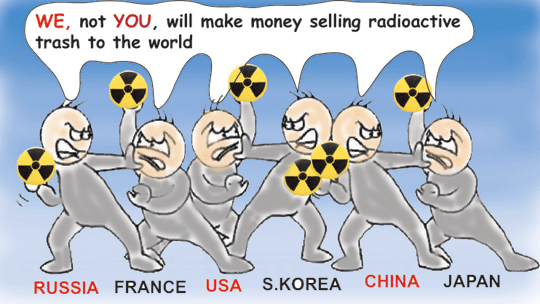
The planned investment comes as the government battles to fend off a junk-grade credit rating and the Treasury seeks to rein in the budget deficit. Proceeding with the nuclear plants could result in a large increase in public debt, the International Monetary Fund warned in a report on June 24.
“There appears to be a simple-minded assumption that countries like China or Russia will provide cheap plants and offer finance,” Steve Thomas, professor of energy policy at the University of Greenwich in the UK, who has monitored South Africa’s nuclear plans since 1997, said in a phone interview on June 24. “That’s an illusion.” Continue reading
Australian uranium mining company Paladin accused of ribbing off impoverished Malawi

 Australian miner accused of dodging tax in world’s poorest country, The Age, July 11, 2015 –Heath Aston Political reporter Tax avoidance tactics of multinational companies have angered Australians, but an Australian mining firm used such methods in Malawi. Tax avoidance tactics of multinational companies have angered the public and placed pressure on the Abbott government to prevent profits being exported offshore.
But an Australian uranium miner is defending the use of identical methods to reduce its tax bill in the world’s poorest country, Malawi.
Between 2009 and 2014, Paladin Energy moved $US183 million out of Malawi to a holding company in the Netherlands and then on to Australia.
A 15-page report by London-based ActionAid has found the Dutch transfers and a special royalties deal – in which Malawi’s mining minister agreed to drop the initial tax rate applied to the uranium mine from 5 per cent to 1.5 per cent – have cost the Malawi public $US43 million.
In Africa’s poorest nation, where per capita GDP is just $US226 a year and life expectancy 55, that money could provide the equivalent of 39,000 new teachers or 17,000 nurses, according to the aid group……..
Paladin’s tax-free transfers to the Netherlands were a combination of management fees and interest payments on loans initiated in Australia. The company loaded its African subsidiary up with huge debts, leaving the Kayelekera uranium mine in northern Malawi with an 80:20 debt to equity ratio – a financing structure known as “thin capitalisation”.
The Dutch structure allowed Paladin to avoid paying a 15 per cent withholding tax to the Malawi government due to a tax treaty between Malawi and the Netherlands which expired in 2014, saving the company $US7.3 million. Paladin closed the mine in February 2014, citing a “sustained low uranium price”.
ActionAid has accused the company of “treaty shopping” and shortchanging the Malawi people. The country’s nursing ranks have the equivalent of four nurses to every 100 in Australia, despite 10 per cent of Malawi’s population being infected with HIV/AIDS……..http://www.theage.com.au/federal-politics/political-news/australian-miner-accused-of-dodging-tax-in-worlds-poorest-country-20150710-gi6uzv.html
Fuel loaded into Japan’s Sendai #nuclear reactors, amid community doubts on its safety
Reactor in Japan being loaded with nuke fuel before restart ,Stars and Stripes, By By MARI YAMAGUCHI The Associated Press July 7, 2015 TOKYO — A Japanese utility on Tuesday began loading fuel into a nuclear reactor where operations are scheduled to resume next month in the country’s first restart under safety requirements set following the Fukushima disaster.
Kyushu Electric Power Co. said the first four fuel bundles were loaded into the Sendai plant’s No. 1 reactor as of late Tuesday. A crane slowly lifts each bundle out of a cooling fuel storage pool and places it into the reactor, in a round- the-clock operation. The utility plans to finish loading all 157 fuel bundles Friday ahead of final inspections before restarting the reactor around Aug. 10.
All of Japan’s more than 40 reactors are offline for repairs or safety checks. Sendai No. 1 is one of 25 reactors seeking restarts and under safety inspection, as Prime Minister Shinzo Abe’s government wants to operate as many of them as possible …..
The second reactor in Sendai is scheduled to be restarted in October.

While the trade ministry and local municipalities have approved the restart of the two reactors in southern Japan, many residents oppose the plan, citing potential danger from active volcanos in the region. Opponents of the restarts and nuclear experts are also concerned the evacuation plans in case of a disaster may not work effectively.
Mounting risk and costs of new Vogtle nuclear reactors shown at hearing
 Hearing on New Vogtle Nuclear Reactors Provides New Information on Mounting Risks and Costs July 7th, 2015 ›
Members of the public voice concerns about the Vogtle expansion at the GA PSC hearing
http://blog.cleanenergy.org/2015/07/07/hearing-on-new-vogtle-nuclear-reactors-provides-new-information-on-mounting-risks-and-costs/Below is a Georgia Utility Update first published on July 1, 2015 by Robert “Bobby” B. Baker, Jr. with Freeman, Mathis & Gary, LLP who serves as SACE’s legal counsel in the ongoing semi-annual Vogtle Construction Monitoring (VCM) review before the Georgia Public Service Commission (PSC). Mr. Baker served three terms as a Georgia PSC Commissioner and he provides an invaluable perspective. SACE has consistently intervened and is extremely concerned about the project’s negative impacts on customers given the significant cost increases and schedule delays that have now eroded any supposed benefits, according to experts who testified at the July 23, 2015 PSC hearing. The audiocast of the hearing is available in two parts: part 1 has the Jacobs/Roetger panel and part 2 continues with Jacobs/Roetger until witness Philip Hayet begins at ~37:33. U.S. taxpayers are also at risk should the project default as $8.3 billion in federal loan guarantees for the project were just recently finalized, more than five years after they were originally offered. Additionally, the proposed expansion poses significant risks to the already imperiled Savannah River. We have added links within Mr. Baker’s article to provide our readers with more information. The Georgia PSC Commissioners will vote on the $169 million in expenditures for docket #29849 on August 18, 2015. To contact the Commission, click here. –Sara Barczak, SACE’s High Risk Program Director
Hearing in Vogtle Review Provides New Information on Project’s Cost by Bobby Baker
At the June 23rd hearing on the 12th Vogtle Construction Monitoring Review the Public Service Commission (“PSC”) Staff expert witnesses provided new information regarding the actual financial impact of the current 39 month delay in the construction schedule for Vogtle Units 3 and 4. While it is hardly newsworthy to report that the Project has fallen further behind schedule and the overall costs have increased, the PSC’s witnesses explained how the cost increases impact each residential ratepayer, quantified the total revenue requirement for the Project and refuted the Company’s claims regarding the alleged benefits of the Project.
Staff Witness Philip Hayet testified that the current 39 month delay would add $319.00 or $6.26 per month to the average residential ratepayer’s bill beginning in April 2016 and continuing to June 2020 in the form of higher fuel costs and Nuclear Construction Cost Recovery (“NCCR”) tariff payments.
Of the additional $319.00 in costs, 59% of the increase or $187.00 would be through higher NCCR monthly charges. The cost increase is especially significant to businesses because the $319.00 increase was for the average residential customer who uses 1,000 kilowatt hours per month. Obviously, electric customers with higher monthly electric usage would be paying significantly more in fuel and NCCR costs.
During cross examination concerning the current cost projection of $7.5 billion for Georgia Power Company’s share of the Project it was disclosed for the first time that the total revenue requirement just for Georgia Power’s share of the Project would be $30 billion. Knowing that the total revenue requirement for the project is four times the construction costs gives consumers an ability to evaluate the total Project costs. The current total revenue requirement for the Project is approximately $65 billion.
In the past few Vogtle reviews it was revealed that the cost for every day of delay is $2 million. This calculation was further clarified when it was explained that it did not contain payment of any taxes. The gross up on the $2 million daily cost with taxes would be approximately $2.92 million.
Finally, the PSC Staff witness refuted the Company’s claims regarding the alleged ratepayer benefits of the Project by testifying that the remaining $2.7 billion in alleged benefits claimed by the Company had shrunk down to no more than $208 million. This figure would be further reduced to negative $300 million if 50% of the production tax credits were removed from the calculation. Based on the Project’s current schedule it is highly unlikely that Unit 4 will be on line by December 31, 2020 to be eligible to receive $522 million in production tax credits.
While the testimony at the June 23 hearing was not reassuring to ratepayers, it did provide a clearer financial picture regarding the true costs of Vogtle Units 3 and 4, and reaffirmed the fact that the Project would see more construction delays.:… http://blog.cleanenergy.org/2015/07/07/hearing-on-new-vogtle-nuclear-reactors-provides-new-information-on-mounting-risks-and-costs/#sthash.NN53E6sH.dpuf
Revelations on the dirty work given to Windscale nuclear cleanup workers – and at Hanford
BBC: People taken from movie theater by police, forced to go in reactor and deal with burning fuel rods — TV: Military picked men off street to battle meltdown — Women, minorities, homeless, and prisoners used by nuclear industry for most dangerous work (VIDEO) http://enenews.com/bbc-police-grabbed-people-movie-theatre-made-reactor-deal-burning-fuel-rods-tv-men-picked-streets-forced-battle-nuclear-meltdown-video?utm_source=feedburner&utm_medium=email&utm_campaign=Feed%3A+ENENews+%28Energy+News%29
BBC, ‘Windscale – Britain’s Biggest Nuclear Disaster’ (emphasis added) — Tom Tuohy, deputy manager at Windscale plutonium production plant (at 8:00 in): “We were trying to push the burning fuel into the back of the reactor.” — But the heat had melted the cartridges, so they were stuck in the core… Radiation was so intense they could only work a few hours. They were running out of firefighters. — Neville Ramsden, Windscale health physicist: “The police from the [plutonium] factory had turned up looking for volunteers and they brought a bus. They decided the best way to get the volunteers was to go up to the cinema, and ‘volunteer’ the back 2 rows at the show to go… push the fuel rods out of the reactor.”
Yorkshire Television, ‘Children of Chernobyl’(at 4:00 in): “When the robots broke down because of the extreme radioactivity, men were sent in to cleanup the site. They werenot volunteers. They were picked up off the streets and press ganged [i.e. taken by force] onto the roof… In 90 seconds, they received their permissible lifetime dose of radiation. The men were sent home and forgotten… They do not figure in any official casualty lists.”
Prof. Kate Brown, C-SPAN (at 35:00 in): “When there was an accident [at Hanford],when there was some dangerous groundthat needed to be worked… they sent in these temporary workers, prisoners from the camps nearby… minority laborers… basically ‘jumpers’ to work in dangerous ground,unmonitored… and they’d leave with the many possible radioactive isotopes they had ingested… without any epidemiological trace… The plutonium cities presented a picture of healthy pink populations, this was a mirage.”
Prof. Brown (at 42:30 in): “That job [of refining plutonium] was often given to women… it’sone of the dirtiest jobs. At Dupont… they’d write the Army Corps, ‘Maybe since we’re going to make this super-poisonous product, we shouldn’t hire women who were younger than the menopausal age. What about fertility problems? What about mutants and monsters in offspring?’ They were real nervous about it… they knew a great deal, and they were worried.”
DC Bureau: When the enormous problem of high-level nuclear waste became apparent… White workers ordered African Americans to deal with this deadly mess, and disposal involveddumping plutonium straight into the soil…. [Mr. Lindsay] was recruited from his job as a segregated school principal to commute several hours from Greenwood, South Carolina… like thousands of other African American workers, was given the most dangerous jobs andordered to throw his dosimeter… in a bucket before going into high risk areas.
Reuters: Police say Japanese gangsters rounded up homeless men to clean up Fukushima radiation… “Many homeless people are just put into dormitories [and] left with no pay at all.”
Anand Grover, United Nations Special Rapporteur (at 15:30 in): “These [Fukushima] workers told me, ‘Do you know we’re actually living in a shanty town?’… Literally on the pavement…in Tokyo… They told me that people come take them.”
Channel 4, ‘Nuclear Ginza’ (1995) — Prof. Kenji Higuchi (at 2:00 in): “The scenes I saw, the stories I heard, I found them difficult to believe at first… Workers go near the reactor and get exposed… Many of them become ill… sometimes die… [They’re] picked off the street in the slums… I found so many… who didn’t know what had happened to them, or if they did,too frightened to speak… all their stories were the same… People simply don’t believe this could happen in a country like Japan… It’s as if they’re the living dead.”
Grim future for France’s nuclear companies AREVA and EDF
Burdened by losses, EDF’s foreign activities are currently unable to finance the increasing requirements at home, where the production costs of nuclear plants are rising by around 5% each year and investment needs are increasing.
The international trend is not for a nuclear renaissance but for a boom in renewable energy, and France will not be able to export significantly more reactors, or to develop new reprocessing contracts abroad under profitable conditions.
To understand just how far the French nuclear industry has fallen in recent years, look no further than the value of EDF and Areva. Since 2007, EDF’s stock price has fallen more than 70%; Areva’s by more than 85%. If Areva weren’t 83% government-owned, it almost certainly would have declared bankruptcy by now.
 nuClear News July 15 http://www.no2nuclearpower.org.uk/nuclearnews/NuClearNewsNo75.pdf The deep crisis which the French nuclear industry is experiencing is not new, although it seems to have shocked some commentators. It actually represents the outcome of a strategy launched at the end of the 1990s which was always flawed. The project involved an aggressive export policy which it was hoped would disguise predictable difficulties at home, according to a report by WISE Paris for Greenpeace. (1)
Game Over for UK’s Hinkley Point Nuclear power project?
The UK Government is now said to be deeply concerned about the future of the Hinkley project following revelations about problems at the similar reactor being built at Flamanville
Nuclear needs a blank cheque Now that it is plain that nuclear power has failed miserably to compete with renewable energy even on the somewhat skewed playing field represented by the (proposed) Hinkley C deal, nuclear supporters are trying to engineer a ‘blank cheque’ to be given to nuclear developers
nuClear News, July 15 http://www.no2nuclearpower.org.uk/nuclearnews/NuClearNewsNo75.pdf There is a growing chorus of critics calling for Hinkley Point C to be scrapped altogether, according to the Sunday Times.
It would be one of the most expensive man-made objects ever built in the world. At a cost of £24.5bn it would tie British households into paying for astonishingly expensive electricity subsidies until 2060. The world has changed since 2010 when Hinkley was first named as a site for new reactors. The price of renewables has plummeted.

1 This Month




PLEASE OPPOSE HR 8255 AND S.3639 – bills would accelerate satellite deployment, with no environmental review or safeguards – https://ncstd5li.quorum.us/campaign/169331/
To see nuclear-related stories in greater depth and intensity – go to https://nuclearinformation.wordpress.com
-
Archives
- September 2026 (339)
- August 2026 (330)
- July 2026 (355)
- June 2026 (287)
- May 2026 (306)
- April 2026 (356)
- March 2026 (251)
- February 2026 (267)
- January 2026 (308)
- December 2025 (358)
- November 2025 (359)
- October 2025 (375)
-
Categories
- 1
- 1 NUCLEAR ISSUES
- business and costs
- climate change
- culture and arts
- ENERGY
- environment
- health
- history
- indigenous issues
- Legal
- marketing of nuclear
- media
- opposition to nuclear
- PERSONAL STORIES
- politics
- politics international
- Religion and ethics
- safety
- secrets,lies and civil liberties
- spinbuster
- technology
- Uranium
- wastes
- weapons and war
- Women
- 2 WORLD
- ACTION
- AFRICA
- Atrocities
- AUSTRALIA
- Christina's notes
- Christina's themes
- culture and arts
- Events
- Fuk 2022
- Fuk 2023
- Fukushima 2017
- Fukushima 2018
- fukushima 2019
- Fukushima 2020
- Fukushima 2021
- general
- global warming
- Humour (God we need it)
- Nuclear
- RARE EARTHS
- Reference
- resources – print
- Resources -audiovicual
- Weekly Newsletter
- World
- World Nuclear
- YouTube
-
RSS
Entries RSS
Comments RSS

