Japan exposing hundreds of young men to radiation – in the cause of promoting the nuclear industry
the level of radiation is so high that my biggest humanitarian concern is that – if the Japanese push to get these plants dismantled quickly – they will burn out hundreds and hundreds of young men. It’s usually young men because that’s how the construction trade is, needlessly. My point is, walk away for a hundred years, then come back in a hundred. By waiting a hundred years you’re reducing the radiation exposure to a significant, young virile gene pool that in my opinion doesn’t deserve to be exposed right now.
There’s a very real human cost to thousands of construction workers who are being exposed and will be exposed. But they have to show the Japanese that they’re dismantling that site because if the Japanese don’t believe it can be cleaned up they won’t let the other plants start back up.
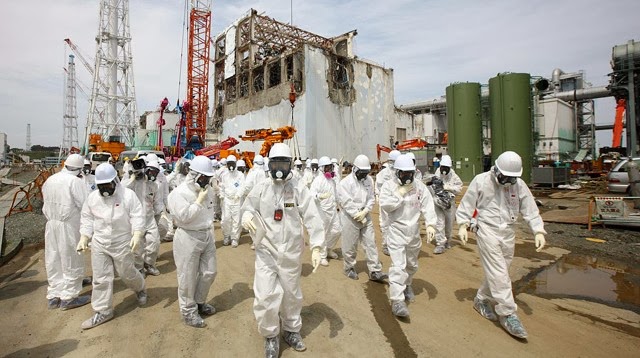
It’s a show. This is all about showing the Japanese that it’s not too bad, and we can run our other forty or so plants fine, trust us. It’s definitely symbolic for the Japanese, but the real reason is the banks want their money back.
This Expert Claims the Japanese Government’s Fukushima Clean Up Is Just “a Show” http://linkis.com/www.vice.com/en_uk/r/5UnqS August 12, 2015 by Thomas Marsh The past couple of weeks have seen two stories draw our attention back to the Fukushima Daiichi nuclear disaster of March 2011, in which three nuclear reactors melted down after the plant was hit by a tsunami. Radioactive material was released in what was the biggest and most disastrous nuclear incident since Chernobyl in 1986.
One story concerned some pictures of deformed daisies near the Fukushima Daiichi site, which trended online for a while and got everyone all hot under the collar about radiation, until it was established that they occur all the time in nature. So no need to worry about that.
The other was a video released by Arnie Gundersen, a former nuclear industry executive and engineer who’s declared Fukushima “the biggest industrial catastrophe in the history of mankind”. In it, he claimed that 23,000-tankers of water contaminated with radioactive isotopes have leaked into the Pacific from the Fukushima Daiichi site since 2011 and will continue to do so for decades – at a rate of three hundred tonnes a day. So maybe start worrying again.
Sure enough, a recent report by the Tokyo Electric Power Company (TEPCO) claimed that concentrations of radioactive isotope Strontium-90 have reached record highs in certain areas of the Pacific Ocean around Fukushima, with levels spiking by about 1,000 percent in three months. Continue reading
Total lifetime costs of Vogtle nuclear station estimated at $65 billion and rising
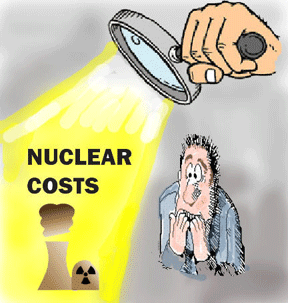 Vogtle: at $65 billion and counting, it’s a case study of nuclear power’s staggeringly awful economics, Green World, Michael Mariotte August 2, 2015 Georgia is one state that you would think would be wary of nuclear power economics. The first two reactors at Georgia Power’s Vogtle site, which came online in the late 1980s, were a record 800% over budget.
That is a number that is almost impossible to grasp. Nothing goes 800% over budget–in the real world, projects get cancelled well before reaching that point……
Sane people do not let projects get 800% over budget. Unless, perhaps, if someone else is putting up the money. And that’s exactly what happened with the first two Vogtle reactors–the overruns were pushed on to ratepayers; Georgia Power had to eat some small portion of them, but basically ratepayers were forced to pick up the tab.
And in a case of history repeating itself as predicted–as farce–that’s exactly what is happening with the two Vogtle reactors under construction now.
When the project was announced, and when the utilities building the project first applied for taxpayer loans to help finance the project, Southern Company (Georgia Power’s parent) said the two reactors would cost about $14 billion and would be online in 2016 and 2017.
That was back around 2008. Vogtle got its taxpayer loan promise in February 2010 and its construction permit in February 2012. Three and a half years later, Vogtle is more than three years behind schedule–39 months behind, in fact.
And the cost of building Vogtle has, not surprisingly, gone up. Way up. Right now, it’s somewhere around $16 billion and rising fast–the over-budget portion caused by the delays alone is $2 million per day. And as you can see from the photo at the top of the page, taken last Thursday, construction still has quite a long way to go.
Georgia Power already has run through half of its federal loan money, paid for by all U.S. taxpayers, not just Georgia ratepayers. Some of the rest of the taxpayer loan (the loans totaled more than $8 billion) was received later by the other partners, so perhaps they haven’t run through their share yet.
In any case, the supposed point of getting the loan, and of charging ratepayers for construction costs as they are incurred (a concept called Construction Work in Progress, barred in most states), and of building the reactors in the first place, was to save ratepayers money. That’s what Southern Company says anyway.
And they run off numbers and argue that building Vogtle, even with the overruns and delays, will save ratepayers $3 billion compared to building a gas-powered plant, which probably would already be operational, by the way, except that neither it nor Vogtle actually are needed.
But those numbers, despite the utility’s protestations, no longer add up……..
If one–or both–of the reactors gets cancelled before operation, then the negative benefits grow even more. Unless the cancellation occurs before too much more money is spent–then cancellation would turn into a net benefit for the ratepayers by avoiding the costs that have not yet been incurred. Sure, Georgia Power might take a hit and a lot of money that already has been spent would be wasted. But at least ratepayers could breathe easier……..
The economics of nuclear construction are just too staggeringly awful. But it gets worse. Because, as former PSC Commissioner Baker said, the total lifetime cost of Vogtle, including construction, is now estimated at $65 billion–a number too high for “staggering” to apply anymore……
the $65 billion number doesn’t include decommissioning and radioactive waste disposal costs, both of which will be added to ratepayers’ bills–and probably the rest of us taxpayers as well when the amount collected proves to be too small, as is the case with every other reactor in the country.
Meanwhile, utilities across the country, including Georgia Power, are buying solar power for 5 cents kilowatt/hour and less. And, unlike Vogtle, where the costs keep rising, solar’s price keeps falling…..http://safeenergy.org/2015/08/03/vogtle-at-65-billion-and-counting/
UK energy analysts unhappy with super costly Hinkley nuclear project
 Planned Hinkley Point nuclear power station under fire from energy industry, Guardian, Nils Pratley and Sean Farrell, 10 Aug 15 Energy analyst says that for same price as Hinkley Point C, providing 3,200MW of capacity, almost 50,000MW of gas-fired power capacity could be built. Hinkley Point, the planned £24.5bn nuclear power station in Somerset, is under intensifying criticism from the energy industry and the City, even as the government prepares to give the final go-ahead for the heavily subsidised project.
The plant, due to open in 2023, will cost as much as the combined bill for Crossrail, the London 2012 Olympics and the revamped Terminal 2 at Heathrow, calculated Peter Atherton, energy analyst at investment bank Jefferies. He said that, for the same price as Hinkley Point C, which will provide 3,200MW of capacity, almost 50,000MW of gas-fired power capacity could be built.
“This level of new gas build would effectively replace the entire thermal generation fleet in the UK – much of which is old and inefficient – with brand new, highly efficient, low carbon, gas generation,” said Atherton.
Doubts about Hinkley Point have deepened after a detailed report by HSBC’s energy analysts described eight key challenges to the project, which will be built by the state-backed French firm EDF and be part-financed by investment from China.
These challenges include: declining demand for power in the UK, currently falling at 1% a year as energy-saving measures take effect; a three-fold jump in the UK’s interconnection capacity with continental Europe by 2022, massively increasing the country’s ability to import cheaper supplies; and “a litany of setbacks” in Finland, France and China for EdF’s European Pressurised Reactor (EPR) model, the same type as planned for Hinkley Point.
HSBC’s analysts described the EPR model as too big, too costly and still unproven, saying its future was bleak. They also pointed out that wholesale power prices have fallen by 16% since November 2011 when the government agreed a “strike price” for Hinkley Point’s output – effectively a guaranteed price of £92.50 per megawatt hour, inflation-linked for 35 years and funded through household bills. “With the problems encountered by France’s EPR model and a strike price likely to be double the UK wholesale price at the scheduled 2023 time of opening of the proposed Hinkley C EPR, we see ample reason for the UK government to delay or cancel the project,” they said…….. http://www.theguardian.com/environment/2015/aug/09/planned-hinkley-point-nuclear-power-station-energy-industry
Smart economics: Germany’s decision to phase out nuclear power
Why Germany’s decision to phase out nuclear power is smart economics , REneweconomy, By Erik Gawel & Sebastian Strunz on 4 August 2015 London School of Economics
Germany has made a formal commitment to phase out the use of nuclear power by 2022. Erik Gawel and Sebastian Strunz write on the implications of the strategy for Germany’s future energy mix and whether the approach adopted in the country could function as a model for other European states. They argue that while the target is undeniably challenging, long-term it is economically sensible and feasible to phase out both fossil fuels and nuclear energy in favour of renewables.
Political responses to climate change and other negative consequences of conventional energies within Europe (e.g. oil spills, radioactive waste, open pit coal mining) are highly diverse. While the UK is promoting nuclear as a carbon-free energy source, for instance, Germany has embarked on a completely different path with its plan to phase out nuclear energy altogether. What is the background of Germany’s phase-out decision and how sensible is it from an economic point of view?
In order to fully answer this question, several aspects need to be acknowledged. First, the phase-out is no impulsive reaction to the Fukushima incident, which came out of the blue. Germany’s powerful anti-nuclear movement dates back to the 1970s; it bred the Green Party which entered the Parliament in 1983 and ascended to the government in 1998 by forming a coalition with the Social Democrats. In 2000 this centre-left coalition put a nuclear phase-out into law for the first time. The early 2020s were identified as the target date for a nuclear free energy system. While subsequent revisions of the law have changed the specifics, the currently stipulated year for the last plant to be shut down, 2022, is well in line with this original perspective. Thus, the phase-out project has always been crafted as a long-term and step-wise process.
Second, the Fukushima disaster effectively killed the narrative that nuclear power was necessary as a ‘bridging technology’ toward a renewables-based energy system. While conservatives had previously argued in line with this logic (and the government led by Chancellor Merkel in 2010 diluted the first phase-out law from 2000 by extending the running times of nuclear plants), they reversed their position after Fukushima. The most immediate consequence of Merkel’s shift on nuclear was the prompt shutdown of seven nuclear power plants in spring 2011. Due to overcapacities, this drop has neither proven to be problematic for the security of supply (contrary to the conservatives’ claims before 2011) nor has it led to an enduring increase of wholesale prices or a requirement to import foreign nuclear power. In fact, Germany is still a net exporter of electricity.
Third, Germany is not alone in phasing out nuclear power. As can be seen from Table 1, [in original] there are several countries in Europe that do not rely on nuclear power or have also declared their intention to stop nuclear energy production. While some of the countries without nuclear are smaller EU member states, it is noteworthy that Italy, another highly industrialised economy and member of the G7, has never used nuclear power. The highly diverse picture of nuclear energy in Europe becomes complete when the huge differences in nuclear-shares among countries are considered, as well as the fact that countries such as Poland intend to enter this form of energy………..
Is nuclear power a necessary part of a future energy mix?
All things considered, is nuclear power necessary for decarbonising the energy supply while also ensuring security of supply? The German experience shows that renewable energies may contribute major shares of the electricity supply – without jeopardising energy security in a highly industrialised economy and even under challenging natural frame conditions in Germany for renewables, provided that there is a long-term transition perspective and a stable political consensus.
Moreover, it may be questioned whether the long-term risks associated with nuclear power really fit the requirements of any sustainable energy system which demands being more than simply carbon-free. But even apart from such sustainability issues, the apparent need for heavy subsidies to render new nuclear plants economically viable undercuts the claim that nuclear is cheaper than renewable energy sources, even in terms of financial costs only. On the contrary, a recent Prognos study estimates that “new wind and solar can provide carbon-free power at up to 50 per cent lower generation costs than new nuclear”. Accounting for backup requirements in times without wind or sun, a combined system of wind, solar and gas is still 20 per cent cheaper than a system of nuclear and gas.
Sure enough, Germany has to cope with the side-effects of the transition (e.g. current rises in retail electricity prices) and interactions with other developments (e.g. increasing electricity production from lignitemainly due to high gas prices and the record low emission allowance prices). Yet, nuclear energy is rarely an inevitable part of decarbonising energy provision. Until now, Germany’s political consensus is very solid in this respect – and while the transition effort is indeed challenging, this does not diminish its merits from an economic point of view: in the long run, it seems both sensible and feasible to phase out fossil and nuclear energies in favour of renewables, thus treading a long but well-considered path towards comprehensive sustainability of energy provision, including long-term cost-effectiveness.
Source: This article was first published at the LSE’s Europblog http://reneweconomy.com.au/2015/why-germanys-decision-to-phase-out-nuclear-power-is-smart-economics-49500
Top bank advises UK government to delay or cancel Hinkley nuclear project
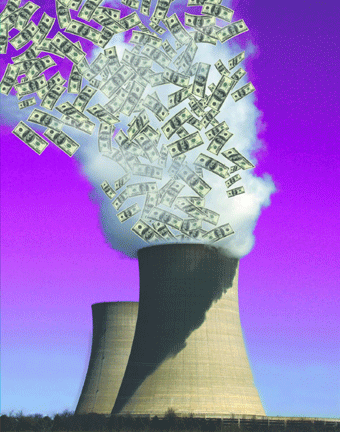 Too expensive…Not needed…top bank report hits out at plans for £25bn Hinkley C nuclear plant, This is Money, By NEIL CRAVEN FOR THE MAIL ON SUNDAY, 2 August 2015 Plans for Britain’s first nuclear reactor in almost 30 years have come under sustained attack from politicians and City bankers.
A report from a top bank this weekend warned that the cost of the £25billion Hinkley Point C plant was ‘becoming harder to justify’. HSBC concluded: ‘We see ample reason for the UK Government to delay or cancel the project.’
And former Tory Energy Secretary Lord Howell of Guildford – the self-described ‘pro-nuclear’ architect of a drive into nuclear power under Margaret Thatcher – has told the House of Lords that the reactor plan in Somerset was ‘one of the worst deals ever for British households and British industry’.
He added that he would ‘shed no tears if it was abandoned’.
Plans for Hinkley Point C have been controversial from the start with the Government guaranteeing what many saw as a sky high price electricity generated at the site.
The Department of Energy and Climate Change shrugged off HSBC’s report and the criticism seems unlikely to stop the nuclear plan. The Secretary of State for Energy, Amber Rudd, said on Friday that Britain could sign a deal as early as October during a visit by China’s President Xi Jinping.
EDF announced on the same day that it had chosen preferred suppliers for £1.3billion worth of work linked to the new plant.
But with the chorus of disapproval growing louder the Government and nuclear industry are set to be under huge pressure throughout the project to prove it is value for money for British energy users.
Key to the criticisms levelled by HSBC’s analysts is that the electricity produced by the reactor is likely to be too expensive, as European wholesale prices are expected to fall along with demand for energy from UK users. It warned of ‘huge difference between UK forward prices and the Hinkley price’.
Among HSBC’s eight key concerns is that the reactor will be economically unviable due in part to a rising number of electricity grid links with the Continent providing a ready source of cheaper supply.
At the same time it said projections by National Grid to 2025 all point to flat or declining demand. HSBC said its demand estimates are for a fall of one per cent a year.
HSBC also highlighted the ‘bleak’ future of large nuclear reactors which have a history of escalating costs and sliding deadlines. ……..
The Austrian and Luxembourg governments launched a legal complaint last month, followed by a challenge from ten German and Austrian green energy firms.
The complainants say the UK Government’s subsidies may reach £76 billion and are in breach of European rules relating to state aid. Some observers say the dispute could lead to delays of six years.: http://www.thisismoney.co.uk/money/news/article-3182406/Too-expensive-Not-needed-bank-report-hits-plans-25bn-Hinkley-C-nuclear-plant.html#ixzz3hhFWKFaE
Scottish firms warned that their reputation at stake, if involved in Hinkley nuclear build
French energy giant EDF yesterday announced its preferred bidders for the UK’s first such facility in more than 20 years. The list includes three Scottish firms – the Weir Group, Doosan Babcock and Clyde Union Pumps – which will find out in the coming months if they have been successful.
But Dr Richard Dixon, director of Friends of the Earth Scotland, told The National: “With one false start already, active legal action in Europe and a spectacular history of cost overruns and missed deadlines, getting involved with the nuclear industry is a huge reputational risk.”
He added: “Scottish engineering firms should be helping us exploit our huge potential in renewable energy rather than chasing the nuclear dream.”……..The EU approved the project last year after the Government agreed a subsidy contract with EDF, but the development is far from certain, with a challenge by Austria to the subsidy and green groups pondering a legal challenge.
Negotiations between the French company and potential investment partners have yet to result in a final decision.
Scottish Green MSP Patrick Harvie said: “This announcement is a reminder that the UK Conservative Government is in denial about the disastrous economics of new nuclear. Scottish consumers face paying to line the pockets of multinationals like EDF who have been promised double the current market price of power for the next 35 years. And that doesn’t take into account the … toxic waste legacy that this deal will simply add to.” http://www.thenational.scot/news/nuclear-contract-will-be-toxic-for-your-reputation-scots-firms-warned.5852
South Africa facing a R1-trillion nuclear financial disaster
 R1-trillion nuclear plans are simply “disastrous” for SA http://businesstech.co.za/news/energy/94677/r1-trillion-nuclear-plans-are-simply-disastrous-for-sa/ 31 July 15 Government’s R1-trillion nuclear build plans are going to turn South Africa’s energy crisis into a jobs crisis, according to the Democratic Alliance.
Earlier in July, the Department of Energy signed two memoranda of understanding with Russian state nuclear energy corporation Rosatom to implement several joint projects for education in the nuclear power industry.
Energy Minister Tina Joemat-Pettersson said that South Africa will start a nuclear build programme in 2015, in a bid to generate an additional 9,600MW of electricity.
The country will have as many as nine new nuclear power plants by 2030, with government pegging the total cost to build these at R500 million – though energy experts have stated R1 trillion was more realistic, and would likely increase.
In a statement issued on 31 July, DA leader Mmusi Maimane said the nuclear deal will drag the country’s economy back, and will cost thousands of South Africans their jobs.
According to the party, the details behind government’s nuclear plans show that the undertaking is unaffordable.
“Whichever funding model is chosen, you can rest assured that it will be paid for by the South African taxpayer, and that we can expect substantial tariff increases over many years.”
These higher prices would price the poor out of electricity usage, and would result in energy-heavy industries – like mining and manufacturing – shedding more jobs, said the DA.
“For a government that claims to be pro-poor – and for a country where 5.2 million people cannot find work and a further 2.4 million have given up looking – this is unfathomable.”
Maimane pointed to a number of flaws in the scheme:
- Even if government’s estimate of R500 million was correct, South Africa cannot afford to build the nuclear reactors. This would result in private-public partnerships being formed, which would be reflected in current and future electricity prices increasing, as citizens would have to pay.
- South Africa lacks the capacity and skills to operate eight nuclear power stations. We lack the capacity and skills to run the one we already have, said Maimane.
- The project goes against the government’s own National Development Plan, which urges caution on nuclear, pointing rather towards gas, wind, and solar energy as a primary source of power.
To date, government has not provided solid details on the nuclear build plans.
“Until the government tells us how much the nuclear deal will cost, how we plan to pay for it, and how they intend to choose the preferred bidder, we cannot begin to entertain the notion of going down this path.”
The DA leader said that, while the party does not oppose nuclear power, the current plan is “not right” for the country, and it will do anything in its power to block the deal.
The end of the line for AREVA’s model of “birth to grave” nuclear processes
 As losses mounted, so did Areva’s debt, which reached six billion euros at the end of the first half of 2015.
The sale of the nuclear reactor unit to EDF marks the end of Areva’s formerly profitable full-service model, which offered clients all aspects of development ranging from conception and construction to fuel procurement and waste treatment.
France sells major nuclear stake http://www.iol.co.za/business/international/france-sells-major-nuclear-stake-1.1893029#.VbqVMvOqpHw July 30 2015 Paris – Atomic energy giant Areva on Thursday agreed to sell a majority stake of its nuclear reactor unit to electricity group EDF as part of a shake-up of the French sector. Continue reading
€7bn needed to keep loss-making nuclear company AREVA alive
Lossmaking Areva needs €7bn capital injection, Ft.com Michael Stothard in Paris, 30 July 15 Struggling French nuclear group Areva on Thursday disclosed it needed a bigger than expected capital injection worth €7bn as the company also unveiled a far-reaching agreement with EDF on asset disposals and other projects.
The two companies — both state-controlled — agreed in principle that EDF will pay €2bn for a 75 per cent stake in Areva’s reactor unit, called Areva NP, in a radical reshaping of the French nuclear industry that has come after months of tense negotiations……..
Following the deal, Areva, which reported a €4.8bn net loss last year, will be reduced to a nuclear fuel company that mines, enriches and then disposes of uranium. The heart of the company — designing, building and servicing nuclear reactors — is being sold off.
Areva said that overall it would need €7bn in capital over the next two years, however, meaning that as much as €5bn will be required from sources other than EDF, the French utility group. Much of these additional funds are likely to come from a government-backed capital raising.
The French government may have to contribute between €4bn and €5bn, far more than the €2bn to €3bn that ministers had hoped for just a few months ago, according to people familiar with the situation, although the exact level of the capital raising was not announced on Thursday.
Areva said it could secure €0.4bn from selling some other assets including Canberra, its nuclear measurements subsidiary, and as much as €1.2bn from other sources of equity financing. This suggested a government-backed capital raising that might be closer to €4bn.
On Thursday the two companies also said they would set up a dedicated company to be 80 per cent owned by EDF and 20 per cent by Areva NP, aimed at improving the design and management of brand new reactors projects.
One of the problems that has weighed on Areva in recent years has been cost overruns at key projects, particularly the Olkiluoto 3 reactor in Finland, which is 10 years behind schedule and prompted the company to take €3.9bn in impairment charges………..http://www.ft.com/cms/s/0/110c0476-368c-11e5-b05b-b01debd57852.html#axzz3hPaCUU5g
September – expected decision on closing Quad Cities nuclear plant
Decision of possibly closing Cordova Exelon plant expected in September, WQAD, JULY 30, 2015, BY KATRINA LAMANSKY The decision of whether to close the Quad Cities nuclear plant, Exelon, is expected in September of 2015.
This possibility came out during a conference call with analysts on Wednesday, July 29, 2015, according to a report by Crain’s Chicago Business. The company’s CEO Chris Crane said he didn’t see a way to keep the Cordova, Illinois plant open given the lack revenue from customers.
Click here to read the full conference call transcript.
According to the report, it would take a state law that charges utility customers more to keep the company afloat. Crane said the company’s six plants are losing money partly due to the low cost of natural gas.
According to Bill Stoermer, Communications Manager for the Cordova Exelon plant, no decisions regarding any of the Illinois nuclear plants have been made……….http://wqad.com/2015/07/30/decision-of-possibly-closing-cordova-exelon-plant-expected-in-september/
$10 billion bonanza to save Exelon nuclear plants in Illinois?
New power rules may preserve Exelon nuclear plants in Illinois, St Louis Post Dispatch, By Scott DiSavino Reuters , 30 July 15, New rules for U.S. electricity providers could save two money-losing nuclear power plants in Illinois from shutting down and may amount to a $10 billion bonanza to U.S. power producers.
A system of rewards and penalties is part of a requirement approved last month by federal energy regulators that applies to a power auction next month.
It may benefit some costly nuclear reactors in the PJM power region, which stretches from New Jersey to Illinois, that have had a tough time competing against the growing use of wind turbines and power plants fired with cheap natural gas.
That is particularly true for two plants operated by Exelon Corp., the biggest U.S. nuclear power plant operator. It has warned it might be forced to shut its Quad Cities and Byron nuclear plants in northern Illinois, unless the reactors’ revenues increase.
Thanks to the growth of alternative power sources and abundant gas from shale formations, PJM power prices have fallen an average of 20 percent over the past five years to around $50 per megawatt hour compared with the prior five years…….
The rule creates a niche for nuclear plants, which run consistently, unlike breeze-dependent wind turbines, and do not need potential upgrades to withstand harsh winter temperatures like gas plants.
Under so-called capacity performance requirements, generators will receive higher fees to keep plants available but face stiff penalties if their units don’t deliver power when needed during system emergencies. Fines for an average 100-megawatt plant would be around $350,000 an hour………
If analysts’ estimates are correct and all ten of Exelon’s reactors in northern Illinois are selected to provide capacity in the auction, the company could receive around $600 million for those reactors during the 2018-2019 delivery year………
Exelon has lost close to $1 billion over the past five years on its nuclear operations — about $350 million at Quad Cities alone. It expects those losses to continue, based on forward power prices, Dominguez said.
Even if Byron and Quad Cities clear the auction, Dominguez said they still face the risk of shutdown unless federal, state and regional policy makers find ways to compensate generators for the environmental and reliability benefits that non-carbon emitting nuclear plants provide.
In the meantime, extra revenues from the capacity auction could keep the money losing reactors operating for a few more years until possible new carbon standards are available. http://www.stltoday.com/business/local/new-power-rules-may-preserve-exelon-nuclear-plants-in-illinois/article_e4007591-df54-5795-9b5f-de5a1e6ab3f8.html
Exelon should shut down those uneconomic nuclear reactors – says former CEO
Former Exelon CEO says Exelon should shut those reactors Green World, Michael Mariotte
July 28, 2015 “………..Last Friday, we linked to one interview he gave recently where he said he would have been quicker to close Exelon’s uneconomic reactors than the current Exelon regime–which still hasn’t closed them and is still floundering around trying to get someone, anyone, to order ratepayers to bail them out. So far, unsuccessfully.
Yesterday, E&E Publishing ran another interview with Rowe, which expands on his thoughts and surely caused unpleasant abdominal pains and teeth-gnashing in Exelon’s executive suite and boardroom. You see, Rowe is one of those retired execs whose stature has only grown since he left the company and his thoughts carry weight, especially in Illinois. And he’s still got some clout, perhaps more than Exelon itself these days: for example, he’s actually friends with Chicago Mayor and former White House Chief of Staff Rahm Emanuel, unlike the current Exelon suits.
So here’s what Rowe said about Exelon’s uneconomic reactors:
I’m living in a fairy world because I don’t have the numbers and I’m not responsible for them anymore. But in my opinion, you shut those three plants down. You say they have become uneconomic just like some old coal plants are uneconomic. And in a world that’s driven by unfriendly market prices and unfriendly public policy, you shut them down………
As for the idea that EPA’s Clean Power Plan should encourage nuclear power:
…I don’t think it’s EPA’s job to encourage a new nuclear world. I think that would be one of the most expensive solutions it could pursue……
Rowe, unlike the current short-sighted and economically-challenged management at Exelon, understands electricity markets and finances and, also unlike Exelon’s current management, is not afflicted with the kind of greed mentality that insists they should get whatever they want just because they want it. Rowe understands that is not how the world works. Rather than trying to force the world to adapt to Exelon, as the current regime is attempting, Rowe’s history was one of trying to steer Exelon through the real world that was presented. http://safeenergy.org/2015/07/28/former-exelon-ceo-says-exelon/
Insurance repercussions in Japan, as Fukushima nuclera nightmare continues
Japan Quake Insurance on the Rise as Fukushima Shakes Confidence, Bloomneerg Business, 30 July 15
The increase could come into effect in January 2017, according to the Ministry of Finance group studying the issue. It may be introduced in phases and would follow a 15.5 percent rise approved in July last year, the first increase in quake premiums in 18 years.
Japan’s earthquake insurance rates vary by region and are based on so-called hazard maps published each year by the Headquarters for Earthquake Research Promotion. Since the March 2011 disaster, the hazard maps have been expanded to other areas, said Professor Hiroyuki Fujiwara at the National Research Institute for Earth Science and Disaster Prevention.
Seismologists that draw up Japan’s hazard maps warn of a large earthquake that could do more direct damage to metropolitan Tokyo, the world’s biggest city with a population of about 30 million and the heart of Japan’s government, business world and financial markets.
The city sits adjacent to three major fault lines on the boundary of two tectonic plates, the Philippine and the Eurasian. Between 2000 and 2009, Japan experienced 20.5 percent of the world’s earthquakes that were magnitude 6 or above, according to the Japan Meteorological Agency and U.S. Geological Survey data.
Fujiwara said there is a 70 percent chance of a magnitude 7 quake hitting Tokyo within the next 30 years……..http://www.bloomberg.com/news/articles/2015-07-30/japan-quake-insurance-on-the-rise-as-fukushima-shakes-confidence
Problem for Modular Nuclear Reactors – they’re just as costly as the old ones
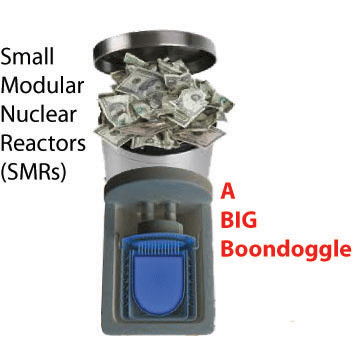 Prefab Nuclear Plants Prove Just as Expensive Modular method has run into costly delays and concerns about who will bear the brunt of the expense., WSJ, By REBECCA SMITHJuly 27, 2015
Building nuclear reactors out of factory-produced modules was supposed to make their construction swifter and cheaper, leading to a new boom in nuclear energy.
But two U.S. sites where nuclear reactors are under construction have been hit with costly delays that have shaken faith in the new construction method and created problems concerning who will bear the added expense.
“Modular construction has not worked out to be the solution that the utilities promised,” said Robert B. Baker, an energy lawyer at Freeman Mathis & Gary LLP in Atlanta and former member of the Georgia Public Service Commission, the state utility authority.
The new building technique calls for fabricating big sections of plants in factories and then hauling them by rail to power-plant sites for final assembly. The method was supposed to prevent a repeat of the notorious delays and cost overruns that marred the last nuclear construction cycle in the 1980s.
It hasn’t worked. Georgia Power Co., a unit of Southern Co. that is building one of the nuclear power plants, reports that construction is three years behind schedule, although it is making steady progress.
“The promise of modular construction has yet to be seen,” said Joseph “Buzz” Miller, executive vice president of nuclear development for Georgia Power. The Georgia plant’s delay will increase the project’s financing costs, potentially adding $319 annually to each residential bill, according to the public interest advocacy staff of the state utility commission. The utility is seeking to recover $778 million in total added financing costs from vendors. It hopes customer bills won’t rise more than 8% to pay for the plant.
Georgia Power expects to spend $7.5 billion for its 46% share in the Vogtle power plant, which is adding two nuclear reactors adjacent to an existing plant near Waynesboro, Ga. That tab is $1.4 billion higher than the spending limit state regulators approved in 2009.
The cost of the V.C. Summer plant that South Carolina Electric & Gas Co. is building near Jenkinsville, S.C., now stands at $6.8 billion for the company’s 55% stake, up $1.1 billion from a 2012 estimate. The company recently agreed to trim its profit margin on the project if regulators approve a revised construction schedule and cost estimate. The commission heard testimony last week but has yet to rule………
U.S. utilities proposed building more than two dozen reactors five years ago before the shale-gas revolution drove down the price of natural gas and made plants that burn gas a more attractive option for the power industry. Last month, the Nuclear Regulatory Commission said it was folding a division to manage construction of new reactors back into the division from which it was pulled a few years ago, acknowledging a nuclear renaissance hasn’t materialized. Write to Rebecca Smith at rebecca.smith@wsj.com http://www.wsj.com/articles/pre-fab-nuclear-plants-prove-just-as-expensive-1438040802
Independent assessment of the state of the nuclear industry
 What is spectacular is the extent to which the nuclear industry and many decision-makers are appearing to ignore the financial and technical realities of 2015, and the generalized move toward decentralized electricity generation and storage. The industry’s track record of delays and cost overruns, coupled with the urgency of replacing fossil fuels with efficiency improvements and low-carbon sources of energy, do not bode well for the long-term future of the industry.
 Deconstructing the nuclear industry, Bulletin of the Atomic Scientists, 27 July 15 Mycle Schneider Antony Froggatt Released on July 15, the World Nuclear Industry Status Report 2015 (WNISR 2015) is the latest independent assessment of nuclear energy trends in a series first published in 1992. This year’s report comes at a time when most energy and environmental experts shy away from the words “nuclear renaissance” but some view nuclear power as an indispensable substitute for fossil fuels in global efforts to combat climate change. Current trends, however, suggest that a rapid ramp-up of nuclear power is unlikely, and that renewable energy is surging past nuclear power in many countries. Here are a few of the report’s key findings: Continue reading
1 This Month




PLEASE OPPOSE HR 8255 AND S.3639 – bills would accelerate satellite deployment, with no environmental review or safeguards – https://ncstd5li.quorum.us/campaign/169331/
To see nuclear-related stories in greater depth and intensity – go to https://nuclearinformation.wordpress.com
-
Archives
- September 2026 (339)
- August 2026 (330)
- July 2026 (355)
- June 2026 (287)
- May 2026 (306)
- April 2026 (356)
- March 2026 (251)
- February 2026 (267)
- January 2026 (308)
- December 2025 (358)
- November 2025 (359)
- October 2025 (375)
-
Categories
- 1
- 1 NUCLEAR ISSUES
- business and costs
- climate change
- culture and arts
- ENERGY
- environment
- health
- history
- indigenous issues
- Legal
- marketing of nuclear
- media
- opposition to nuclear
- PERSONAL STORIES
- politics
- politics international
- Religion and ethics
- safety
- secrets,lies and civil liberties
- spinbuster
- technology
- Uranium
- wastes
- weapons and war
- Women
- 2 WORLD
- ACTION
- AFRICA
- Atrocities
- AUSTRALIA
- Christina's notes
- Christina's themes
- culture and arts
- Events
- Fuk 2022
- Fuk 2023
- Fukushima 2017
- Fukushima 2018
- fukushima 2019
- Fukushima 2020
- Fukushima 2021
- general
- global warming
- Humour (God we need it)
- Nuclear
- RARE EARTHS
- Reference
- resources – print
- Resources -audiovicual
- Weekly Newsletter
- World
- World Nuclear
- YouTube
-
RSS
Entries RSS
Comments RSS

