New renewable energy app from IRENA will help investors
 Irena off to a clean start with new renewable energy app, The National Business LeAnne Graves June 30, 2015 The renewable energy sector has been growing fast, and more and more people – particularly potential investors – are seeking information on little known areas to venture into.
Although some forms of renewable energy have been around for decades, there has been almost no mapping of the industry. Sure, companies have looked into their particular areas of interests, but until the International Renewable Energy Agency (Irena), an intergovernmental organisation that supports countries in their transition to a sustainable energy future, launched in 2009, there was little aggregated information available.
The organisation has now created an app to feed hungry minds on the subject – allowing users to search for renewable energy resources anywhere in the world, from sources such as wind, solar or marine, hydro, geothermal and bioenergy. And all this from their smartphone.
Launched last month, the Global Atlas pocket is a free app available for download on all platforms including BlackBerry 10, iOS, Android and Windows Phone.
At present it claims to be the only global tool of its kind, combining 1,000 maps from 67 governments and 50 data centres.
The idea is that users can overlay information listed in the catalogue to help identify areas of interest for potential projects or business ventures…….
What are the pros of this app?
It’s important to remember that this is the first of its kind. So to begin with, Irena needed to grab whatever information is currently available on different markets and regions. It’s not an easy task. But you can select any place in the world to find out how much solar irradiation is present, ask if renewable energy could power 100 per cent of a particular island or even whether wind energy is a suitable prospect for the UAE…….. http://www.thenational.ae/business/the-life/irena-off-to-a-clean-start-with-new-renewable-energy-app
Nuclear industry keen to save US government’s Export-Import Bank
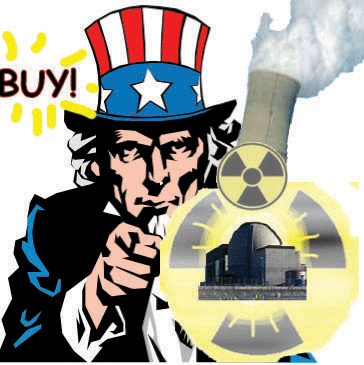 Why the US nuclear industry is eager to save this obscure, government-run bank The US nuclear industry has looked abroad for business as demand in the US has fallen. But without the Export-Import Bank’s backing, some say it would be harder for US companies to seal nuclear deals abroad.
Christian Science Monitor, By Jared Gilmour, Staff writer JULY 2, 2015 WASHINGTON — Tucked away in an unassuming building two blocks from the White House is a government-run bank. It helps US companies sell products abroad,……..
Until recently, the bank was relatively low-profile……the Export-Import Bank’s loans and loan guarantees are critical for another domestic industry that has fallen on hard times: US nuclear power. If the bank’s charter isn’t reauthorized, the industry and a host of other business interests say the effects could be devastating for US companies’ overseas prospects……..
Nuclear looks abroad For years, the US nuclear industry has struggled domestically. Cheap natural gas and coal have largely crowded the low-carbon power source out of the market. The recession also put a damper on demand for new US power generation. Safety concerns have made matters worse for US nuclear, and those worries flared up anew after Japan’s Fukushima disaster in 2011. http://www.csmonitor.com/Environment/Energy/2015/0702/Why-the-US-nuclear-industry-is-eager-to-save-this-obscure-government-run-bank
Organization of Canadian Nuclear Industries (OCI) to work with Romania to market nuclear reactors
 MOU promotes stronger ties among Canadian and Romanian nuclear suppliers Market Watch, BUCHAREST, Romania, Jul 2, 2015 (Canada NewsWire via COMTEX) — The Organization of Canadian Nuclear Industries (OCI) is proud to announce the signing today of a Memorandum of Understanding (MOU) with the Romanian Atomic Forum Association (ROMATOM)……..
The Partnering Workshop included an update on the planned Cernavoda 3/4 CANDU project as well as presentations by Canadian and Romanian nuclear suppliers on their nuclear capabilities and experience along with discussions on their mutual interest in collaborating on the Cernavoda 3/4 CANDU Project.
This MOU outlines several ways that OCI and ROMATOM will work together including identifying opportunities at nuclear projects in Romania, Canada, and other countries on which OCI and ROMATOM companies can cooperate. The OCI-ROMATOM MOU will also encourage and facilitate cooperation among Canadian and Romanian nuclear research institutes and universities on nuclear research, development, and nuclear education……..
The Canada-Romania Cernavoda 3/4 Supply Chain Partnering Workshop was the focal point of a three day 12 company OCI-led Trade Mission to Romania that kicked off with a July 1 Canada Day Celebration hosted by the Canadian Embassy …… The Trade Mission to Romania was supported by co-funding from Global Opportunities for Associations (GOA) program through which the Foreign Affairs, Trade and Development Canada (DFATD) encourages and supports trade associations in taking member companies into promising export markets.
Organization of Canadian Nuclear Industries (OCI) is an association of 180 leading Canadian suppliers to the nuclear industry in Canada and foreign markets. OCI…provides……engineering services and support to CANDU nuclear power plants in Canada as well as to CANDU and Light Water Reactor (LWR) plants in offshore markets. OCI promotes the continued and expanded use of nuclear energy in Canada and supports member companies in both domestic and international nuclear markets………http://www.marketwatch.com/story/mou-promotes-stronger-ties-among-canadian-and-romanian-nuclear-suppliers-2015-07-02
AREVA to sell its U.S. nuclear radiation measurement business
Areva puts U.S. nuclear radiation business Canberra up for sale PARIS, JUNE 29 French state-owned nuclear group Areva has begun the sale process for the planned disposal of its U.S. nuclear radiation measurement business Canberra, it said in a statement on Monday.
The sale of Canberra is part of a revamp of loss-making Areva, with utility EDF poised to buy its nuclear reactor business. (Reporting by Michel Rose; Editing by David Goodman) http://www.reuters.com/article/2015/06/29/areva-canberra-idUSL5N0ZF0H220150629
Russia aiming to take over the world’s market for nuclear reactors
Russia to tighten grip on global nuclear market with standardised reactors, Global Construction Review, 17 June 2015 | By David Rogers Russia’s state nuclear corporation claims it will start mass-producing nuclear reactors to meet growing demand for nuclear power around the world.
“Something we have and nobody else does is that we have learned to replicate nuclear power plants,” said Valery Limarenko, head of Rosatom’s Atomstroyexport subsidiary, speaking during the Rosatom’s annual conference.
He said: “The serial production of nuclear power plants around the world is a difficult thing to do, but we have managed it because we are building a series of standard designs with options covering seismicity, climate and the other parameters. Our competitive ability is very high because a company that can build a series of projects, has a very strong position on the market.”………http://www.globalconstructionreview.com/news/russia-tighten-grip-glob8al-n4uclea0r6-4m2ar0k8et/
France keen to save AREVA, by selling nuclear reactors to Saudi Arabia
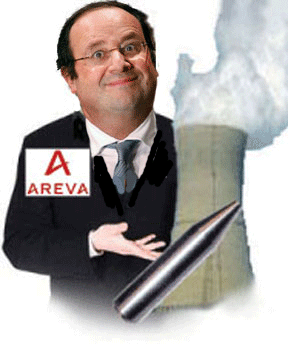 France plans new Saudi nuclear reactors, Sky News 25 June 2015 France has confirmed it is looking into building two nuclear reactors in Saudi Arabia, as part of 12 billion euro ($A17.31 billion) worth of deals struck between the nations.
Under one of the agreements Airbus will sell 23 H-145 multipurpose helicopters to Saudi Arabia for 500 million euros as well as launch a feasibility study into building the reactors, French Foreign Minister Laurent Fabius said on Wednesday……..
The study for two European Pressurised Reactors (EPR) – which France considers the safest and most advanced in the world – takes on added significance given the current efforts by Saudi Arabia’s rival, Iran, to develop its own nuclear capabilities.
In addition to the study, France will sign an agreement to train the Saudis on nuclear safety and the treatment of nuclear waste……
France has been reinforcing links with the conservative kingdom despite persistent criticism of its human rights record,…… http://www.skynews.com.au/news/world/mideast/2015/06/25/france-plans-new-saudi-nuclear-reactors.html#sthash.tI5czLBA.dpuf
Nuclear power a very poor deal for Saudi Arabia
Saudi Arabia must not focus on nuclear power THERE IS LITTLE DOUBT THAT NUCLEAR POWER WILL NOT BE ABLE TO COMPETE ECONOMICALLY WITH SOLAR PHOTOVOLTAIC AND WIND ENERGY BY ALI AHMAD AND M. V. RAMANA, SPECIAL TO GULF NEWS JUNE 25, 2015
Although Saudi Arabia has officially expressed interest in acquiring nuclear power since 2006, it is clear that this effort has gained momentum in the last few months, since the progress of negotiations between P5+1 (United States, Britain, France, Russia, China plus Germany) and Iran over the latter’s nuclear programme. Though some may find it understandable on strategic grounds, it is important to realise that nuclear power fares poorly if compared economically with fast-growing renewable technologies, especially solar photovoltaic energy.
Currently fossil fuel, oil and natural gas-based electricity generation constitutes essentially all of Saudi Arabia’s power production capacity. But it is desirable to develop alternative sources of electricity and both nuclear power and renewables have been held out as possibilities……
Nuclear reactors not only take long periods to construct, but are also prone to major construction delays and huge cost overruns. This is true in many countries, including industrialised economies with substantial nuclear capacity such as the US and France. Even without delays, establishing a nuclear power programme from scratch can take a minimum of 10 years. The UAE, for instance, started its programme in 2008 and expects to connect its first reactor to the grid in 2018. In comparison, solar projects typically have a one to two-year construction period.
If Saudi Arabia, for example, decides to build a nuclear reactor today, it will likely take a minimum of 10 years for it to start generating electricity. Therefore, any cost comparison must be based on what solar power may cost in 2025 rather than today’s costs. This time period is significant and if the dramatic decline in the cost of solar photovoltaic panels over the past decade (more than 75 per cent since 2009) continues till the end of this decade, the cost of generating nuclear power will exceed that of photovoltaic energy. There are good reasons to expect solar power costs to decline further in a similar fashion, including the relative lack of maturity of underlying technologies.
Even without such declines, there is evidence that renewable energy is already more economical than nuclear power. ……
Saudi Arabia is a natural location for investing in solar energy. It has one of the highest Direct Normal Irradiation resources in the world.
Likewise, wind energy too has significant potential in Saudi Arabia. Moreover, there is much greater scope with renewable energy for Saudi Arabia to ensure a higher degree of localisation and create a base of highly skilled workforce. Such localisation is certainly more difficult, if not impossible, to achieve with nuclear power.
Therefore, there is little doubt that nuclear power will not be able to compete economically with solar photovoltaic and wind energy. ….http://gulfnews.com/opinion/thinkers/saudi-arabia-must-not-focus-on-nuclear-power-1.1540888
Tax-payer backed loan guarantees for Vogtle nuclear reactors – still not enough to cover budget
 Feds Finalize $8.3 Billion in Taxpayer-Backed Loan Guarantees for Over Budget, Significantly Delayed Vogtle Nuclear Reactors as Alleged “Benefits” to Georgia Power’s Customers Have Eroded, Experts Say http://www.cleanenergy.org/2015/06/24/feds-finalize-8-3-billion-in-taxpayer-backed-loan-guarantees-for-over-budget-significantly-delayed-vogtle-nuclear-reactors-as-alleged-benefits-to-georgia-powers-customers/
Contact: Jennifer Rennicks, SACE, 865.235.1448, Jennifer@cleanenergy.org
Georgia Public Service Commissioners hear concerns from public on troubled project as Department of Energy issues remaining $1.8 billion to MEAG
Atlanta, Ga. (June 24, 2015) ///PRESS RELEASE/// On the heels of Tuesday’s all-day public hearing on the 12th semi-annual Vogtle Construction Monitoring (VCM) report (Docket 29849) at the Georgia Public Service Commission (PSC), which underscored more schedule delays and at least $1.4 billion in cost increases just for Georgia Power’s share of the two Toshiba-Westinghouse AP1000 nuclear reactors under construction at Plant Vogtle near Waynesboro along the Savannah River, the Department of Energy (DOE) issued the remaining $1.8 billion in federal loan guarantees to MEAG, a utility partner in the project. Despite testimony from the PSC Public Interest Advocacy (PIA) staff expert witnesses that identified at least an additional 3-month delay, constituting a 3 1/2 year overall project delay, and stressed that significant obstacles remain that could further derail the schedule, the DOE finalized the remaining portion of the $8.3 billion loan guarantee.
Since the controversial loan guarantee offers were made over five years ago, the Southern Alliance for Clean Energy (SACE) has questioned the risks posed to U.S. taxpayers if the more-than $15 billion nuclear project should default — a reality that plays a large role in the nuclear industry’s history. The loan guarantee terms, including the credit subsidy fees that represent the “price tag” a utility must pay to the federal government for the loan guarantee, were never made readily available to the public. The shocking information that the credit subsidy fee for utility giant Southern Company (subsidiary Georgia Power) and its utility partner, Oglethorpe Power, was nothing, $0, was only disclosed two months after the Department of Energy (DOE) finalized terms of $6.5 billion worth of loan guarantees despite the fact that taxpayers are on the hook should the project default. Now DOE has issued the third partner in the project, MEAG, the remaining $1.8 billion loan guarantee, without making the credit subsidy fee and loan documents public.
“The loan guarantee process has been shrouded in secrecy from Day One and the Vogtle project is a total mess,” said Sara Barczak, high risk energy choices program director with SACE. “We’re immensely frustrated that with all of this information on the problems plaguing this nuclear expansion project that the Department of Energy is still throwing taxpayer money after it.”
Not only are U.S. taxpayers shouldering risks from this project, but over $1.1 billion has already been collected from Georgia Power customers due to state legislation passed in 2009, the Georgia Nuclear Energy Financing Act or Georgia’s “nuclear tax,” which allows Georgia Power to charge customers in advance for financing costs associated with the Vogtle project. This is itemized on customers’ bills under the Nuclear Construction Cost Recovery rider. Expert testimony determined that the average household using 1000 kilowatt hours per month would pay an additional $319 during the delay period of April 2016 through June 2020 or $6.26 per month for additional financing costs and replacement fuel costs.
“During the hearing a shocking $30 billion price tag was revealed for Georgia Power customers over the course of the projected 60-year operating period for the two new Vogtle reactors. We learned that the $5 billion in benefits touted when the reactors were first approved during the certification process have completely evaporated. And the cost of $2 million per day of delay is actually closer to $3 million,” said Barczak. “What more information do the Georgia Public Service Commissioners and state lawmakers need to identify and implement measures to protect consumers from further hardship? The anti-consumer state legislation that allows Georgia Power to charge customers in advance for the project’s massive financing costs, which represent the largest share of the current cost overruns, was a bad experiment that must be corrected and prevented in the future.”
Originally Vogtle reactor Unit 3 was scheduled to come online April 1, 2016 and Unit 4 one year later but expert witnesses for the PSC have identified additional delays, now 42-months, as serious construction challenges remain. The current certified cost for Georgia Power’s share of the project is approximately $6.113 billion. The Company recently increased their cost estimate by 23%, to approximately $7.518 billion. At yesterday’s hearing experts provided even higher estimates: the current projected total cost for Georgia Power’s share, including litigation outcomes, has increased significantly since certification. Expert testimony provided a range from $7.884 billion to $8.578 billion.
“The Construction Monitor stated that original schedule projections had fuel loaded by now. But the reality is that less than 25% of the Vogtle project’s construction has been completed. The project is so delayed that financial benefits, especially the Production Tax Credits, may not even be realized,” said attorney Bobby Baker representing SACE, which has intervened in every VCM. “Only customers in the 2076 to 2080 time period will receive the fuel savings, which represents an enormous intergenerational subsidy benefitting customers 50 or 60 years down the road. Expert testimony confirmed that if a decision were made today, building new nuclear generation is uneconomic.”
SACE remains extremely concerned that decisions by the DOE and other federal agencies were made to put taxpayer money at risk in spite of all of this relevant information showing serious, ever-mounting problems facing the Vogtle project.
Additional information:
For additional background on the $8.3 billion in Vogtle loan guarantees, please view a report analyzing some of the loan guarantee documents SACE received from previous FOIA litigation here and the supplemental memo. Unlike DOE and OMB, the Southern Alliance for Clean Energy has made thousands of pages of documents received publicly available through an online library.
Georgia Power is 45.7% owner in the project (remaining utility partners are Oglethorpe Power (30%), MEAG (22.7%), and the City of Dalton (1.6%)). This means the original approximately $14.1 billion Vogtle project is now estimated to cost at least $16.5 billion, which does not include over $1.1 billion in possible litigation costs. Costs have increased by over $800 million just since the last review.
A Commission decision on whether to approve the $169 million in expenditures during the reporting period will be made by August 18, 2015. The public can submit comments by referencing “Docket 29849” either online via http://www.psc.state.ga.us/content.aspx?c=/commissioners/, by phone at (800) 282-5813 or by regular mail to: Georgia Public Service Commission, 244 Washington Street, SW, Atlanta, GA 30334-9052.
Cost of Georgia’s new nuclear plant erodes recent savings
Analyst: New savings erode as cost of nuclear plant grows WT, RAY HENRY – Associated Press – Tuesday, June 23, 2015 ATLANTA (AP) – The rising cost of building a new nuclear plant in Georgia will swallow most of the $2.7 billion in newfound savings that Southern Co. has publicly touted, a state analyst said Tuesday.
Southern Co. and its partners are building two more nuclear reactors at Plant Vogtle, a project running more than three years behind schedule. Time is money. The longer it takes to build, the more Southern Co. subsidiary Georgia Power must pay in construction and finance charges.
Since state regulators approved the plant in 2009, power company executives said they secured $2.7 billion in newfound savings, making the project more financially attractive. For example, the utility benefited from cheaper-than-expected borrowing and inflation costs, received government loans and expects to get tax credits.
But the actual savings could be as small as $208 million after subtracting new costs related to the delays, according to financial analyst Philip Hayet, who monitors project finances for the state Public Service Commission. By comparison, Georgia Power now expects to spend $7.5 billion on its share of construction expenses.
“It’s now virtually negligible,” Hayet said, describing the value of the savings identified by the utility. The first of the reactors is supposed to be complete in 2019, with the second following a year later. State monitors have cautioned that construction schedules could see more delays, further decreasing savings. Ultimately, Georgia Power customers will pay for the company’s share of building costs unless the elected members of the PSC intervene.
Read more: http://www.washingtontimes.com/news/2015/jun/23/analyst-slim-savings-as-cost-of-georgia-nuclear-pl/#ixzz3e6jsP41y
Clearly, South Africa can’t afford nuclear power
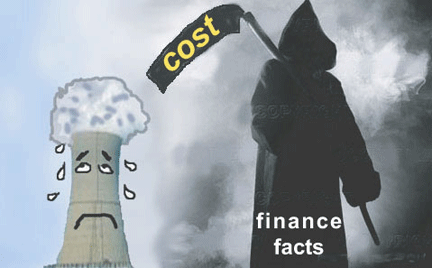 The South African government has said it will not go ahead with nuclear power if the expected construction cost is more than $6500/kW, equivalent to about R130bn per reactor. However, the latest cost estimates are about 25% higher than this. This means that if the South African government sticks to its promise, the tender will fail.
Why South Africa should steer clear of nuclear, By Steve Thomas, Professor of Energy Policy at University of Greenwich Business Tech By The Conversation June
21, 2015 It would be sensible to acknowledge that a nuclear programme is not viable for resolving South Africa’s energy crisis. Rather, the country should be focusing its attention on how to end electricity blackouts and speed up energy efficiency and renewable energy programmes.
Building new nuclear energy capability will cost the country billions of US dollars. It is doubtful that South Africa can afford this.
In addition, nuclear power entails a different but also serious set of risks to climate change. These include the risk of reactor accidents, the danger of weapons proliferation and the hazards of radioactive waste……
Price of nuclear
It’s wearing thin: the pretense that the uranium market is healthy
Uranium Energy Corporation: The Bad News Buried In The Recent Sale [excellent graphs and chart] CNA Finance 19 Jun e15 Uranium mining company Uranium Energy Corp (UEC) is digging all the love it’s getting from the market right now. But after we mined into company documents, we couldn’t resist humming the cowboy song, “You Done Tore Out My Heart and Stomped That Sucker Flat.”
Uranium Energy looks ready to do just that to investors.
The company has not responded to TheStreetSweeper’s request for comment but investors may find other viewpoints here. Meanwhile, we’ve leaned on some ol’ country songs to help us croon out the risks.
*”If The Jukebox Took Teardrops,” Or Market’s Feeling The Pain
While UEC stock is up, the company’s peers are all down. The reason the sector’s performance remains so terrible is because uranium spot prices of about $36 are at a five-year low,
So these factors indicate that UEC’s recent price performance is unsustainable because the fundamentals of the company (more on that below) and the sector have not improved. We expect the stock will collapse as it follows the path set by peers.
*UEC is “Busted”
UEC reports zero sales in the past seven quarters from its sole producer, the Palangana Mine. UEC and other uranium companies were hurt after the Fukushima nuclear disaster hit in March 2011. Public pressure mounted and the negative effects have lingered and lower oil and gas prices have made the situation worse as of late for uranium companies. During its spotty history, UEC generated “no revenues from the sale of U3O8 generated during Fiscal 2014 or prior to Fiscal 2012.”
No surprise, then, that UEC shareholders have endured a long history of horrid earnings:………http://cnafinance.com/uranium-energy-corporation-the-bad-news-buried-in-the-recent-sale/4088
Hedge funds, Goldman Sachs and the money behind the push for nuclear power
 Follow the Money http://majiasblog.blogspot.jp/2015/05/follow-money.html I’ve been following the money for the uranium supply chain:
I turned over a rock and found Goldman Sachs is one of the world’s biggest, if not the biggest, uranium trader through its control of Nufcor.
2008 June 26, Nufcor was bought by the Constellation Energy Group, a U.S. firm that operated several nuclear power plants, for about $103 million. (Exelon has owned Constellation Energy since 2011)
2009 Goldman acquires Nufcor from Constellation Energy as part of a purchase of 900,000 pounds of uranium. Nufcor is the biggest private trader of uranium.
Details about Goldman’s uranium venture are included in the 2014 US Senate report chaired by Carl Levin and including Senator John McCain title: “Wall Street Bank’s Involvement with Physical Commodities”: From Senate Report: page 113 Constellation Acquisition. After its conversion to a bank holding company, Goldman continued to expand its physical commodity activities. In 2009, according to a Goldman presentation to the Federal Reserve, Goldman purchased over 3,000 trading assets involving U.K., French, and German power and U.K. natural gas; as well as about 60 coal contracts, 20 time and voyage freight agreements, and 900,000 pounds of uranium ore from Constellation Energy, a U.S. utility and trading business.Included in that acquisition was Nufcor International, a uranium trading company which stored and traded uranium ore in various stages of enrichment, as further described below…
…Page 124: In 2009, Goldman purchased Nufcor, and expanded its business over the
next five years, resulting in Goldman’s buying millions of pounds of uranium, controlling inventories of physical uranium at storage facilities in the United States and Europe, and becoming a long term supplier of physical uranium to nine utilities with nuclear power plants. Because no employees who conducted Nufcor’s business joined Goldman after the sale, Goldman employees ran the business. In 2014, for a variety of reasons, Goldman decided it would sell Nufcor or wind it down…
I find no evidence that Goldman has successfully sold Nufcor. Since 2011 Constellation Energy, which no longer owns Nufcor, has been owned by Exelon.http://www.constellation.com/about-constellation/pages/about-us.aspx
In 2006 and 2007 hedge funds piled into Uranium. Goldman is noteworthy because of the scope of its involvement the leverage that involvement affords it over uranium pricing and, no doubt, demand.
If you want to know why nuclear is pursued despite its obvious costs and risks, there is no better place to begin understanding than addressing who benefits from the global uranium trade.
India’s new nuclear insurance pool will not cover its research reactors
 India’s research reactors not under nuclear insurance pool— By IANS | Jun 18, 2015 http://www.freepressjournal.in/indias-research-reactors-not-under-nuclear-insurance-pool/ Chennai: India’s research reactors will not be covered under the newly set-up nuclear insurance pool as they are owned by the union government, a top official of the Bhabha Atomic Research Centre (BARC) has said.
“The Rs.1,500 crore ($234 million) India Nuclear Insurance Pool is mainly for power plants operated by Nuclear Power Corporation of India Ltd (NPCIL). The reactors operated by research institutions do not come under the insurance pool,” BARC director Sekhar Basu told IANS. Basu is also a member of the Atomic Energy Commission and a director in NPCIL.
“The research reactors are very small. Further the research institutions are owned by the central government. And governments do not generally take out an insurance policy on its properties,” Basu added.
BARC’s two operational test reactors are the 100 MW and a very low-power Advanced Heavy Water Reactor (AHWR).
Basu said what is applicable to BARC applies equally to the research reactors operated by the Indira Gandhi Centre for Atomic Research (IGCAR) at Kalpakkam, around 80 km from here.
The IGCAR operates two small research reactors – fast breeder test reactor (FBTR) and Kamini.
According to Basu, the upcoming 500 MW prototype fast breeder reactor (PFBR) expected to go on stream this year would come under the insurance cover once it starts the nuclear fission process.
The government-owned Bharatiya Nabhikiya Vidyut Nigam Ltd (BHAVINI) is setting up the country’s first indigenously designed 500 MW PFBR at Kalpakkam.
A breeder reactor is one that breeds more material for a nuclear fission reaction than it consumes. The PFBR will be fuelled by a blend of plutonium and uranium oxide, called MOX fuel.
The central government recently announced the setting up of the Rs.1,500-crore India Nuclear Insurance Pool to be managed by national reinsurer GIC Re.
The GIC Re, four government-owned general insurers and also some private general insurers have provided the capacity to insure the risks to the tune of around Rs.1,000 crore and the balance Rs.500 crore capacity has been obtained from the British Nuclear Insurance Pool.
The losses or profits in the pool would be shared by the insurers in the ratio of their agreed risk capacity.
Foreign nuclear plant suppliers were reluctant to sell their plants to India citing the provisions of Civil Liability for Nuclear Damage Act (CLND) 2010 that provides the right of recourse to NPCIL against the vendors under certain circumstances for compensation in case of an accident.
The insurance pool was formed as a risk transfer mode for the suppliers and also NPCIL.
All the 21 operating nuclear power plants in India owned and operated by NPCIL are expected to come under public liability insurance cover from next month onwards, a senior official of New India Assurance Company Ltd told IANS, preferring anonymity.
The insurance cover would also extend to the 1,000 MW nuclear power plant at Kudankulam in Tamil Nadu built with Russian equipment.
“We are planning to issue a single policy covering all the 21 nuclear power units of NPCIL including the one in Kudankulam. The premium will be paid by NPCIL and the policy will be issued in its name,” he said.
According to him, the final premium has not been arrived at but it will be between Rs.100 crore and Rs.150 crore.
He said the proposed policy would cover the liability towards public as a consequence of any nuclear accident in the plants covered under the policy and also the right of recourse of NPCIL against the equipment suppliers.
Nuclear power industry cannot be saved by EPA Clean Power Plan
Report says EPA Clean Power Plan cannot save nuclear http://www.fierceenergy.com/story/report-says-epa-clean-power-plan-cannot-save-nuclear/2015-06-18 By Barbara Vergetis Lundin
The 20th Century model of large baseload electricity generation, including nuclear reactors, is in an irreversible decline in the face of the emerging 21st Century decentralized power model relying on renewables, energy efficiency, and technology-based demand management, says Mark Cooper, senior fellow for economic analysis, Institute for Energy and the Environment, Vermont Law School, in a new report.
For policymakers and ratepayers, Cooper’s stark conclusion means that “last-ditch efforts to prop-up nuclear power with amendments to the EPA Clean Power Plan (CPP), state-level subsidies (e.g., Exelon’s “nuclear blackmail” threat of Illinois lawmakers over five reactors in that state and FirstEnergy’s bailout scheme involving the Davis-Besse reactor in Ohio), attacks in Indiana, Ohio, Nevada, North Carolina and other states on renewable energy standards, and preferential rate-setting arrangements (e.g., Exelon’s Ginna reactor at Rochester, New York) are costly detours on the road to a much more consumer friendly, reliable and sustainable low carbon electricity sector.”
Cooper said: “Nuclear reactors old and new are far from a necessary part of a low-carbon solution. Nuclear power, with its war against the transformation of the electricity system, is part of the problem, not the solution. Following a path toward a 21st century electricity system poses no serious threat to reliability up to a 30-40 percent level. Beyond that, we already know the specific actions that can carry the system to much higher levels of reliance on renewables. Combining these measures which allow the system to operate at high levels of penetration with the implementation of aggressive efficiency measures meets 80 percent of ‘business as usual’ or base case demand. It is no longer a question of if this will happen, only when it will happen.”
 The report concludes that, even with tinkering, the EPA Clean Power Plan will not save nuclear power.
“After decades of claiming to be a low-cost source of power because of low operating costs, aging reactors are no longer cost competitive even in that narrow view of operating cost,” the report says. “Not even the full implementation of the EPA Clean Power Rule would save aging reactors from early retirement, so the owners of those reactors have launched a major campaign to increase revenues with direct subsidies from state and federal policymakers and secure jerry-rigged market pricing rules that undermine alternatives.”
The report further contends that the “Exelon reactor bailout schemes” in New York State and Illinois will not work.
The report says, “Ginna is a New York reactor and Quad Cities is a two-reactor site in Illinois for which Exelon has stated specific revenue increases are needed, although these estimates are shrouded in uncertainty. The operating costs are quite high and total costs are higher still, well above recent market clearing prices…Operating costs alone are almost twice the current market clearing price of electricity and…things are likely to get worse rather than better over time…The frantic push for states to bail out these reactors when a response at the regional level is more appropriate (if a reaction is needed at all) will saddle state ratepayers with much larger burdens.”
The report does contend that more renewables are feasible without creating reliability issues.
“In the mid-term, expansion of renewables to the 30-40 percent range can be easily accommodated with the existing physical assets and management tools with no negative impact on reliability. The electricity system only needs to be operated with policies that allow the renewables to enter. In the long-term, a wide range of measures to support the penetration of alternatives to much higher levels (80 percent or more) has been identified,” the report says. “Building an electricity system on principles of dynamic flexibility requires an institutional transformation and the deployment of supporting physical infrastructure. Given the need to respond to climate change and the cost of the alternatives, the 21st century model for the electricity system is the least-cost approach by a wide margin”.
For more:
– see this report
UK Treasury not happy with the Hinkley Nuclear power deal – especially after warnings on EPR safety
 French reactor problems cast doubt on UK nuclear power plant, Ft.com Jim Pickard, Chief Political Correspondent, 14 June 15 Problems with a reactor in northern France have triggered deep concern in the British government about the future of the UK’s first new nuclear power station for 20 years at Hinkley Point in Somerset.
EDF Energy, the French state-owned company behind Hinkley, has suffered a five-year delay and escalating costs at its flagship Flamanville project in Normandy.
The £7bn French scheme — designed to showcase new atomic technology — is based on an “EPR” European pressurised reactor, the same model that will be used in Hinkley. Further concerns mounted last week when a leaked report from France’s nuclear safety watchdog highlighted faults in Flamanville’s cooling system. That followed a warning in April by the French Nuclear Safety Regulator that there was an excessive amount of carbon in the steel of the reactor vessel.
EDF’s struggles in France have prompted worries at a senior level of the Treasury about the £24bn Hinkley scheme.“I think there are serious questions about the technology,” said one Treasury figure.
The Treasury has struck an agreement promising to pay a guaranteed price for energy generated by Hinkley for 35 years.It has also promised to guarantee £16bn of debt towards the project — but it has inserted conditions to ensure that taxpayers are not left on the hook if the technology fails.
Instead the agreement stipulates that it will be shareholders and not the government that retains the “principal exposure to the viability of the EPR technology” — until EDF can prove the success of its other projects such as Flamanville………
there are growing suspicions in Westminster and within the industry that the Treasury has been dragging its heels over supporting the project. One source close to EDF said he believed there had been “briefings from people at the Treasury” against the deal.
Some civil servants believe the government struck an overgenerous “strike price” to buy energy from Hinkley’s two reactors for 35 years. “I think Treasury officials would not be disappointed if Hinkley never happened,” said one Whitehall source. “They have been foot-dragging for at least a year.”
One Tory figure said: “I think the Treasury don’t really want that deal to work.”……….http://www.ft.com/intl/cms/s/0/b8741dd0-1048-11e5-bd70-00144feabdc0.html#axzz3d4bv74Km
1 This Month




PLEASE OPPOSE HR 8255 AND S.3639 – bills would accelerate satellite deployment, with no environmental review or safeguards – https://ncstd5li.quorum.us/campaign/169331/
To see nuclear-related stories in greater depth and intensity – go to https://nuclearinformation.wordpress.com
-
Archives
- September 2026 (339)
- August 2026 (330)
- July 2026 (355)
- June 2026 (287)
- May 2026 (306)
- April 2026 (356)
- March 2026 (251)
- February 2026 (267)
- January 2026 (308)
- December 2025 (358)
- November 2025 (359)
- October 2025 (375)
-
Categories
- 1
- 1 NUCLEAR ISSUES
- business and costs
- climate change
- culture and arts
- ENERGY
- environment
- health
- history
- indigenous issues
- Legal
- marketing of nuclear
- media
- opposition to nuclear
- PERSONAL STORIES
- politics
- politics international
- Religion and ethics
- safety
- secrets,lies and civil liberties
- spinbuster
- technology
- Uranium
- wastes
- weapons and war
- Women
- 2 WORLD
- ACTION
- AFRICA
- Atrocities
- AUSTRALIA
- Christina's notes
- Christina's themes
- culture and arts
- Events
- Fuk 2022
- Fuk 2023
- Fukushima 2017
- Fukushima 2018
- fukushima 2019
- Fukushima 2020
- Fukushima 2021
- general
- global warming
- Humour (God we need it)
- Nuclear
- RARE EARTHS
- Reference
- resources – print
- Resources -audiovicual
- Weekly Newsletter
- World
- World Nuclear
- YouTube
-
RSS
Entries RSS
Comments RSS

