Hinkley nuclear fiasco puts the wind up Hitachi, concerning investment in UK
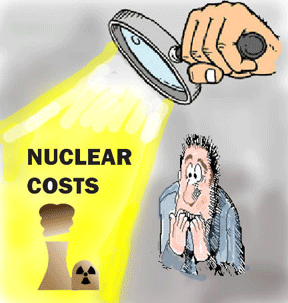
 Hinkley Point nuclear fiasco spooks Hitachi boss, Telegraph, 31 Jan 16
Hitachi boss raises concerns about funding of its own Wylfa Newydd project with foreign secretary during visit to Japan The head of Hitachi has warned that the debacle surrounding the construction of Hinkley Point nuclear plant throws up “very serious concerns” about its own investment in the UK.
Hiroaki Nakanishi, chairman and chief executive of the Japanese industrial giant, said the setbacks experienced by Hinkley’s developer EDF raised questions about how future plants including its Wylfa Newydd project are funded.
Hitachi’s subsidiary Horizon is planning to build a nuclear plant on Anglesey that is expected to start generating power by the mid-2020s.
In an interview with The Telegraph, Mr Nakanishi revealed that he had expressed concerns about the expected costs of the project with Philip Hammond during the Foreign Secretary’s visit to Japan this month.
Horizon is in talks with the Government to ensure the Wylfa deal presents value for money for both sides.
Mr Nakanishi said Hitachi had set out “very fair conditions for the making of our investment”, but could only commit to a deal it believed was viable.
“Hinkley Point [raises questions] about what are the real solutions for setting up financial support,” he said.
“Nuclear power construction requires huge money … we need to arrange a financial plan for which the kind of money needed can be introduced.
“Some part is government endorsement, some is more preferable investment conditions from the part of the finance industry.” Mr Nakanishi said the challenges faced by Hinkley Point could also affect Horizon. “The DECC worries about the stability of the scheduled construction of the [Hinkley Point] nuclear power plant, so some of the conditions – the credit requirements – those kind of things may affect us.
“In order to set up the financial conditions [to build Hinkley], Chinese capital was introduced, but what the real result will be – we have a very serious concern about that.”
Asked if the firm might step back if it believed a viable deal was not on the table, Mr Nakanishi replied: “Yes”.
Horizon is in negotiations with the Department of Energy and Climate Change (DECC) on issues such as the strike price, or the amount the Government will guarantee per unit of electricity produced, which will be key to attracting additional finance…….. http://www.telegraph.co.uk/finance/newsbysector/energy/12128405/Hinkley-Point-nuclear-fiasco-spooks-Hitachi-boss.html
Global nuclear industry – stagnation and decline
 Nuclear renaissance? Failing industry is running flat out to stand still Jim Green, 30 Jan 2016, The Ecologist,
Despite the endless rhetoric about a ‘nuclear renaissance’, there are fewer power reactors today than there were a decade ago, writes Jim Green. The one country with a really big nuclear build program is China, but no one expects it to meet its targets. And with over 200 reactor shut-downs due by 2040, the industry will have to run very hard indeed just to stay put. Over the next 10-20 years, global nuclear capacity may increase marginally, with strong growth in China more than masking patterns of stagnation and decline elsewhere. Beyond that, the aging of the global fleet of power reactors will be sharply felt.
Ten new power reactors began supplying electricity last year (eight of them in China), and eight reactors were permanently shut down.
Nuclear power’s 20-year pattern of stagnation continues. In 1995 there were 434 ‘operable’ reactors – operating plus temporarily shut down reactors. In 2005 there were 441, and now there are 439. Thus there are fewer reactors today than there were a decade ago. Moreover the 439 figure includes 41 reactors in Japan that have been shut down for several years, and not all of them will be restarted.
The nuclear power industry’s malaise was all too evident at the COP21 UN climate change conference in Paris in December. Former World Nuclear Association executive Steve Kidd noted:
“It was entirely predictable that the nuclear industry achieved precisely nothing at the recent Paris COP21 talks and in the subsequent international agreement. … Analysis of the submissions of the 196 governments that signed up to the Paris agreement, demonstrating their own individual schemes on how to reduce national carbon emissions, show that nearly all of them exclude nuclear power. The future is likely to repeat the experience of 2015 when 10 new reactors came into operation worldwide but 8 shut down. So as things stand, the industry is essentially running to stand still.”
According to the International Atomic Energy Agency, only seven out of 196 countries mentioned nuclear power in their climate change mitigation plans prepared for the COP21 conference: China, India, Japan, Argentina, Turkey, Jordan and Niger.
A striking feature of the debates around the COP21 conference was the vitriol directed at the anti-nuclear and environmental movements. Tim Judson from the Nuclear Information and Resource Service noted:
“The industry’s rhetoric is getting increasingly desperate and personal. The industry rolled out a new front group called ‘Nuclear for Climate’, which handed out thousands of copies of a book attacking anti-nuclear activists and blaming us for the climate crisis. Needless to say, their efforts to intimidate activists are backfiring. In fact, they have given us a clear sign of how close we are to winning. Greenpeace International’s Kumi Naidoo reminded activists in a speech in December – in which he broadened the call for divestment to include nuclear, as well as fossil fuels – of the famous adage attributed to Gandhi about the path to victory: ‘First they ignore you. Then they laugh at you. Then they fight you. And then you win.'”
Perhaps the five stages of grief are relevant as nuclear lobbyists confront the reality that the nuclear renaissance didn’t eventuate and isn’t likely to. Denial and anger are very much in evidence, along with some bargaining (‘we need all low carbon power sources’), depression and, in time, acceptance.
China’s great leap forward
With 30 operable reactors, 24 under construction, and many more in the pipeline, China remains the only country with significant nuclear expansion plans. China is unlikely to meet any of its targets – 58 GW by 2020, 110 GW by 2030 and up to 250 GW by 2050 – but growth will be significant nonetheless.
Growth could however be derailed by a serious accident, which is all the more likely because of China’s inadequate nuclear safety standards, inadequate regulation, lack of transparency, repression of whistleblowers, world’s worst insurance and liability arrangements, security risks, and widespread corruption.
There are fears, for example, that China may press ahead with its twin-EPR project at Taishan despite fears over the metallurgy of its reactor vessels and heads. Similar components supplied to the EPR at Flamanville in France have been found to have areas of excessive carbon leading to brittleness and possible failure in use. The French project is now on hold and may never be completed.
Over the next 10-20 years, global nuclear capacity may increase marginally, with strong growth in China more than masking patterns of stagnation and decline elsewhere. Beyond that, the aging of the global fleet of power reactors will be sharply felt: the International Energy Agency anticipates almost 200 permanent shut-downs by 2040.
Steve Kidd notes that the industry is running to stand still, and it will have to run faster to stand still as the annual number of shut-downs increases.
Growth elsewhere?
India is the only other country where there is a possibility of significant nuclear growth in the nearish-future. But nuclear growth in India has been modest – six reactor start-ups over the past decade – and may remain so.
In early 2015, India claimed to have resolved one of the major obstacles to foreign investment by announcing measures to circumvent a liability law which does not completely absolve suppliers of responsibility for accidents. But those claims were met with scepticism and a capital strike by most foreign suppliers is still in effect. Strong public opposition – and the Indian state’sbrutal response to that opposition – will also continue to slow nuclear expansion.
India has just signed an ‘preliminary agreement’ with EDF to build a massive six-reactor EPR project at Jaitapur, 360km south of Mumbai. But given the still-unresolved liability issues and the EPR’s disastrous construction record to date, it’s hard imagine any but the most cautious of progress taking place.
Meanwhile renewables are surging ahead. One part of the Jaitapur deal that is likely to move ahead fast is 142 MW of wind power in Gujarat that EDF is to develop with its Indian partner, SITAC.
And in mid-January 2016, the latest auction of solar energy capacity in India achieved a new record low price of 4.34 rupees / kWh (US$0.064; €0.059). Energy minister Piyush Goyal said: “Through transparent auctions with a ready provision of land, transmission and the like, solar tariffs have come down below thermal power cost.”
Russia has 35 operating reactors and eight under construction (including two very low power floating reactors). Only six reactors have started up over the past 20 years, and only four over the past decade. The pattern of slow growth will continue.
As for Russia’s ambitious nuclear export program, Steve Kidd noted in October 2014 that it “is reasonable to suggest that it is highly unlikely that Russia will succeed in carrying out even half of the projects in which it claims to be closely involved”.
South Korea has 25 operable reactors and three under construction. Six reactors have started up over the past decade. Along with China, India and Russia, South Korea is supposedly one of the four countries driving the ‘nuclear renaissance’. But the best the industry can hope for in South Korea is slow growth.
South Africa plans 9.6 GW of new nuclear capacity to add to the two Koeberg reactors. But the nuclear program is more theatre than reality. Pro-nuclear commentator Dan Yurman states:
“South Africa’s plans to build 9.6 GW of nuclear power will continue to be embroiled in political controversy and be hobbled by a lack of realistic financial plans to pay for the reactors. Claims by both Rosatom and Chinese state nuclear firms that they have won the business are not credible. Even if written down on paper, these claims of contracts cannot be guaranteed in the long term due to the political twists and turns by South African President Jacob Zuma. Most recently, he burned through three finance ministers over differences about whether the country could afford the cost of the reactors said to be at as much as US$100 billion including upgrades to the electrical grid. Additionally, Zuma is distracted by political and personal scandals.”
Brazil’s nuclear industry provided some theatre in 2015 with the arrest of Othon Luiz Pinheiro da Silva, the former CEO of Brazil’s nuclear power utility Eletronuclear, for allegedly accepting bribes to fix the bidding process for the Angra 3 reactor under construction 100 km from Rio de Janeiro. Fourteen other people were also charged as a result of the federal police’s ‘Operation Radioactivity’.
“The arrest is a tragedy for the industry,” said former Eletrobras’ chief executive Luiz Pinguelli Rosa. “The industry was already in crisis, but now the corruption concerns are bound to delay Angra 3 further and cause costs to rise even more.”
Newcomer countries: The World Nuclear Association claims that “over 45 countries are actively considering embarking upon nuclear power programmes.” Balderdash. Only two ‘newcomer’ countries are actually building reactors – Belarus and the United Arab Emirates. Other countries might join the nuclear club but newcomers will be few and far between.
Moreover, some countries are phasing out nuclear power. Countries with nuclear phase-out policies include Germany, Belgium, Taiwan, and Switzerland. Other countries – e.g. Sweden – may phase out nuclear power partly as a result of deliberate government policy and partly because of natural attrition: aging reactors are being shut down without replacement.
Stagnation and decline
Patterns of stagnation or slow decline in North America and western Europe can safely be predicted. In 2014, the European Commission forecast that EU nuclear generating capacity of 131 GW in 2010 will decline to 97 GW in 2025.
The European Commission forecasts that nuclear’s share of EU electricity generation will decline from 27% in 2010 to 21% in 2050, while the share from renewables will increase from 21% to 51.6%, and fossil fuels’ share will decline from 52% to 27%.
The most important nuclear power story of 2015 was legislation enacted in the French Parliament in July that will reduce nuclear’s share of electricity generation from 75% to 50% by ‘around’ 2025, and caps nuclear capacity at the current level of 63.2 GW.
The legislation also establishes a target of 32% of electricity generation from renewables by 2030, a 40% reduction in greenhouse gas emissions and a 20% reduction in overall energy consumption by 2030.
In April 2015, a report by ADEME, a French government agency under the Ministries of Ecology and Research, shows that 100% renewable electricity supply by 2050 in France is feasible and affordable.
French EPR reactor projects in France and Finland are three times over budget and many years behind schedule. As already noted, in April 2015 it was revealed that EDF’s Flamanville EPR under construction in France has a weak pressure vessel and head, and that the same problem may afflict China’s twin-EPR project with EDF at Taishan.
A January 2016 update to the World Nuclear Industry Status Report discusses the miserable state of the French nuclear industry:
“The French state-controlled AREVA, having announced an outlook of a further ‘heavy loss’ in 2015, was downgraded by credit-rating agency Standard & Poor’s to B+ (“highly speculative”). On 29 December 2015, the company plunged to a new historic low on the stock market (€5.30 compared to €72.50 eight years ago). On 7 December 2015, Euronext ejected the French heavy weight Électricité de France (EDF), largest nuclear utility in the world and “pillar of the Paris Stock Exchange”, from France’s key stock market index, known as CAC40. One day later, EDF shares lost another four percent of their value, which led to a new low, a drop of over 85 percent from its 2007 level. … The French nuclear industry’s international competitors are not doing much better. AREVA’s Russian counterpart Atomenergoprom as well as the Japanese controlled Toshiba-Westinghouse were both downgraded to ‘junk’ (‘speculative’) by credit-rating agencies during the year.”
Next door in Belgium, ageing reactors at Doel and Tihange – shut down a year ago because of serious safety concerns over numerous leaks and, at Tihange, 16,000 reactor vessel cracks – are scheduled to start up shortly, triggering serious concern across Europe. An Avaaz petition to be delivered to Belgium by German Environment Minister Barbara Hendricks on Monday has already attracted almost 500,000 signatures.
In the United States, utilities announced two more reactor shut-downs in 2015: the FitzPatrick reactor in New York will be shut down in 2016, and the Pilgrim reactor in Massachusetts will be closed between 2017 and 2019.
Five reactors are under construction but a greater number have been shut down recently or will be shut down in the next few years. The last reactor start-up was in 1996. In August 2015 the Environmental Protection Agency released its final Clean Power Plan, which failed to give the nuclear industry the subsidies and handouts it was seeking.
A decade ago, the US Nuclear Regulatory Commission was flooded with applications for US$127 billion (€117b) worth of reactor projects. Now, obituaries for the US nuclear power renaissance are increasingly common.
The situation is broadly similar in the United Kingdom – the nuclear power industry there is scrambling just to stand still. It should be clear by the end of this year whether the extraordinarily expensive Hinkley C EPR project will go ahead. But the signs are not good for the project’s backers: EDF was due to make its ‘final investment decision’ this week, but flunked out owing to its inability to raise the necessary £18 billion.
According to the World Nuclear Association, most of the UK’s reactors are to be retired by 2023. If other projects prove to be as expensive and difficult as Hinkley C, it’s unlikely that new nuclear capacity will match retirements.
In Japan, only two of the country’s 43 operable reactors are actually operating. Perhaps half to two-thirds of the reactors willeventually restart. Five reactors were permanently shut down in 2015, and the six reactors at Fukushima Daiichi have been written off.
Before the Fukushima disaster, Tokyo planned to add another 15-20 reactors to the fleet of 55, giving a total of 70-75 reactors. Thus, Japan’s nuclear power industry will be at most half the size it might have been if not for the Fukushima disaster……. www.theecologist.org/News/news_analysis/2987010/nuclear_renaissance_failing_industry_is_running_flat_out_to_stand_still.html
Anglesey nuclear plant project under threat over funding fears
Hitachi has warned it could walk away from Wylfa Newydd scheme unless it receives viable subsidy from UK Government 31 JAN 2016 BY OWEN HUGHES The Japanese firm behind Wylfa Newydd warned they could walk away from the £14bn nuclear project unless a viable funding deal could be found……..http://www.dailypost.co.uk/business/business-news/anglesey-nuclear-plant-project-under-10813851
UK nuclear power project a bonanza for Japanese companies, Hitachi-GE and others
Hitachi sees over 1tn yen in business for Japan companies http://asia.nikkei.com/Business/Deals/Hitachi-sees-over-1tn-yen-in-business-for-Japan-companies
 TOKYO — A nuclear power project in the U.K. will generate more than 1 trillion yen ($8.42 billion) in orders for Japanese businesses, it was learned Sunday, giving a shot in the arm to exports by an industry suffering from a lack of orders at home since the Fukushima accident of 2011.
More than 3 trillion yen is budgeted for the project if joint venture Hitachi-GE Nuclear Energy constructs four advanced boiling water reactors — and an even higher sum if six reactors get the nod. Hitachi has invited 40 or so Japanese companies to a meeting at the British Embassy here to explain details.
Also expected are water supply pump manufacturer Ebara as well as Kurita Water Industries and Kubota. Shimizu and Kajima, which have experience building housing structures for nuclear plants in Japan, will also likely go.
While Hitachi-GE will handle the reactor core, Japanese companies are expected to undertake key technologies for operating the nuclear plant, giving Japan about 40% of the project total.
(Nikkei)
Toshiba might sell off its unprofitable nuclear business in Japan
 Struggling Toshiba may spin off ailing Japan nuclear power business, Japan Times, 28 Jan 16, KYODO Scandal-hit Toshiba Corp. will consider splitting off its flagging nuclear power business in Japan and rebuilding it as a separate company as part of a sweeping restructure following an accounting scandal, sources said.
The 2011 Fukushima No. 1 nuclear plant disaster has made it difficult to build reactors in Japan amid safety concerns.
Toshiba’s subsidiary, Westinghouse Electric Co., which is in charge of its overseas nuclear power business, will seek to secure orders in emerging markets, the sources said Tuesday.
The move could trigger a realignment of the country’s nuclear power industry at a time when the government is aware of the need to bolster the competitiveness of domestic players, observers said…….
Toshiba said in November that Westinghouse had written down its assets by $1.3 billion in fiscal 2012 and 2013, revealing the difficulties facing the subsidiary in achieving profitability at the level anticipated by Toshiba.
Hit by the accounting scandal, Toshiba is proceeding with restructuring its unprofitable businesses….. http://www.japantimes.co.jp/news/2016/01/27/business/corporate-business/struggling-toshiba-may-spin-off-ailing-japan-nuclear-power-business/#.Vqkyc5p97Gh
French unions unhappy with arrangements for UK’s Hinkley nuclear build
 New nuclear power: It’s consumer protection vs corporate profit, http://www.carolinelucas.com/latest/new-nuclear-power-its-consumer-protection-vs-corporate-profit January 27, 2016 The Government’s policy of burdening bill payers with eye watering subsidies for new nuclear power has received another blow. Just before a crucial board meeting at EDF (the French state owned energy giant relied on by the Government to invest in and operate Hinkley Point) French trade unions spoke out about their concerns.
When even staff working for EDF are raising serious doubts about numerous aspects of the proposal, UK Ministers’ cavalier attitude to Hinkley Point C needs to change, more urgently than ever.
In advance of an EDF board meeting due to take place today, where the company was rumoured to be making a final investment decision, French unions threw a welcome spanner in the works.
They’ve raise no fewer than 15 questions about the project, suggesting it would be difficult to complete on time and that financing it could threaten EDF’s survival. The good news, for now, is that EDF has, again, delayed the decision.
But the concerns of French unions are worth a closer look. They include pending legal cases, the lack of evidence Hinkley can be built on time, and the partnership with the Chinese nuclear energy company when no other investors appear to be interested.
Most telling of all is the following question: “what happens if the UK government decides to look after consumer interest?”
This shows that the Conservative Government’s pro-nuclear policy flies in the face of everything they say about looking after the interests of consumers and billpayers. Indeed, studies show that solar power coupled with energy storage and smart grid technology could generate the equivalent to Hinkley Point C at half the cost – to the Govt and to you and I. Wind power, even with backup, ischeaper than nuclear power too.
The Government’s obsession with outdated, inflexible, expensive nuclear power stations is looking more economically and environmentally reckless by the day. So I’ve tabled some more urgent parliamentary questions on Hinkley.
The first question relates to the problems with a similar model of nuclear power station being built at Flamenville in France. It’s already 6 years behind schedule, €7.5 billion over budget, and subject to safety tests following some serious flaws in the reactor vessel and bottom. The ruling on these safety concerns has itself been delayed. I’m pressing the Government on whether the agreement to proceed with Hinkley is conditional on the Flamanville plant demonstrating it’s capable of operating.
My second question is about the huge cost of new nuclear to consumers. It picks up on Ministers’ mindboggling double standards when it comes to subsidies for nuclear power verses solar power, onshore wind and other renewable technologies.
In the Commons earlier this month, the Energy Secretary again attempted to justify her huge cuts to solar subsidies on grounds that “subsidies for low carbon power should be temporary, not part of a permanent business model”. So my question asks exactly when she expects nuclear power stations to meet the same standards and operate on a subsidy free basis. Some renewable technologies are nearly there already, with the costs of others on a clear downward cost trajectory. Energy storage, interconnection and smart grids make Ministers appear stuck in the last century as they desperately argue about baseload.
The cost and climate change arguments against new nuclear power grow stronger every day. This week, workers have made their voices heard. It’s surely time the UK Government started to work for us rather than big energy companies and consign new nuclear to the dustbin of history. Ministers need to start listening to the many voices cautioning against Hinkely and instead back 21st century clean technologies.
In other major nuclear news this week, tomorrow sees a Special Parliamentary seminar co-organised by Nuclear Free Local Authorities and Nuclear Consulting Group: “UK Energy Policy: Late Lessons from Chernobyl, Early Warnings from Fukushima” The keynote speaker will be Naoto Kan, Former Prime Minister of Japan at the time of Fukushima.
South Afric a’s nuclear corporation in a mess
Step one: Sort out the mess at the nuclear corporation, Times Live The Times Editorial | 28 January, 2016
Power struggles, factionalism and claims of impropriety at state institutions have become so commonplace they are losing their shock value. “…….The latest public entity to be affected is the Nuclear Energy Corporation of SA, which is involved in two court actions over allegations of corporate governance breaches.
Phumzile Tshelane, the corporation’s chief executive and a supporter of the Zuma administration’s nuclear ambitions, is centrally involved in both cases.
The Nuclear Energy Corporation, meanwhile, is reportedly in disarray.
According to Business Day, it has yet to finalise its financial statements for the 2014-2015 financial year and is without a full board.
Several independent directors resigned, or left after their terms ended last year, after reportedly clashing with Energy Minister Tina Joemat-Pettersson. It would be tempting to dismiss the ructions at the corporation as just another public entity gone awry.
But the fact is that this is the institution that will play a key role in the government’s controversial plan to procure eight nuclear power reactors at a cost, experts warn, that could exceed R1-trillion.
Moreover, the government has decided to go ahead with the procurement and proceed to the next step, which is to invite tenders, even though the nuclear building programme has not been properly costed.
Surely the mess at the nuclear corporation needs to be sorted out before we take a single step further down the nuclear road.http://www.timeslive.co.za/thetimes/2016/01/28/Step-one-Sort-out-the-mess-at-the-nuclear-corporation
EDF in a’panic’ over decision to be made on UK’s Hinkley nuclear power station
Hinkley Point: EDF set for decision on nuclear plant amid claims of board ‘panic’, The Independent, Sources in France say decision on whether to give the green light to controversial project would be made on Wednesday Geoffrey lean , 24 Jan 16
- The final decision on whether to build Britiain’s first nuclear power station in decades is set to be made by energy giant EDF this week, amid claims of “panic” among the French firm’s board over the viability of the £18bn project.
- Sources in France said the decision on whether to give the green light to its controversial plant at Hinkley Point, Somerset – on which ministers are depending to “kick-start a major new generation of nuclear power stations” – would be made on Wednesday. But the largely state-owned company refused to comment, or even to confirm or deny that the meeting is taking place.
This secrecy reflects the extreme sensitivity about the decision with practicalities and politics pulling in opposite directions. The project suffered a serious blow last week when French regulators delayed a decision on what to do about safety flaws in a similar reactor. But cancelling it would be a huge humiliation for British ministers, and could cause a cross-Channel diplomatic row.
- The “final investment decision” by EDF’s board – repeatedly delayed over the past two years – is the project’s only remaining hurdle.
Last October the government persuaded China to invest heavily in the plant, filling a funding shortfall, and the Energy Secretary Amber Rudd is awaiting the decision before signing a deal to allow the company to charge double the present price for the electricity generated from Hinkley’s twin reactors. Three similar European Pressurised Reactor (EPR) projects are planned for Britain if it succeeds…….
- there are signs of last minute jitters. Union leaders are reportedly warning the company of “financial, industrial and legal risks” in the project, while the French financial journal Boursier.com has suggested that there is “panic on board”.
Last week the French nuclear regulator delayed until the end of the year a decision on what to do about “very serious” weaknesses detected in the pressure vessel of a similar EPR being built at Flamanville, Normandy. The same fault – which could lead to a nuclear accident – was detected in the vessels for the Hinkley reactors, which had been built and will now have to be replaced.
- The Flamanville plant is five years behind schedule and its cost has trebled, while the only other EPR being built in Europe, in Finland, is almost a decade late, and the cost has more than doubled. Two other EPRs being built in China are also thought to be over-running while the cost of Hinkley has already soared.
EDF’s share price has plunged to record lows, and the company is considering selling billions of pounds of assets to fund building Hinkley. On top of all that, Austria is taking Britain to the European Court, alleging it is subsidising the plant illegally.Some British experts believe that, faced with all these difficulties, EDF will defer a final decision again. http://www.independent.co.uk/news/uk/home-news/hinkley-point-edf-set-for-decision-on-nuclear-plant-amid-claims-of-board-panic-a6830456.html
France’s President Hollande visits India, hoping to market nuclear reactors
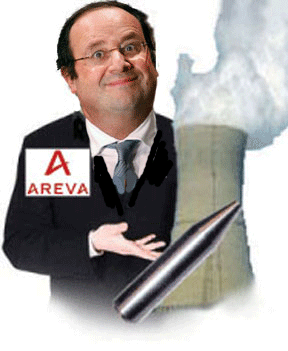 France Signals Rafale, Nuclear Progress as Hollande Visits India, Bloomberg, HeleneFouquet January 24, 2016 France signaled a state-to-state accord with India could be signed on Monday over a deal for 36 Dassault Aviation SA Rafale fighter jets, and that a six-year-old plan to build nuclear reactors in the South Asian nation would see some progress…………
The reactors are planned for Jaitapur, a coastal town in India’s western province of Maharashtra. Areva was seeking further clarity from India on its nuclear liability law before moving ahead with what would be India’s biggest nuclear plant.
The agreement India and the U.S signed recently over insurance-related issues for nuclear plants will help in overcoming certain hurdles, Royal said.
USA changes law to make it harder for nuclear radiation victims to get compensation
the directive signals an initial step toward trying to dismantle or rein in a $12 billion compensation program that has made payments to more than 53,000 sickened workers or their survivors since 2001.
 Nuclear workers fear new policy will make it harder to win compensation
Department of Labor says nuclear facilities are much safer since 1995
Workers and advocates worry it will be more difficult to prove cases
A fight is underway to get policy repealed in order to protect sick employees
BY LINDSAY WISE, ROB HOTAKAINEN AND FRANK MATT McClatchy Washington Bureau, 22 Jan 16 WASHINGTON
Abelardo Garza was working near tanks full of toxic sludge at Hanford nuclear reservation in Washington state last Aug. 14 when one of his co-workers noticed a strange smell.
Within minutes, Garza’s nose started bleeding. The next morning, he awoke gasping for breath.
It was the fourth time in five years that Garza would end up in the hospital after suspected exposure to chemical vapors at Hanford, a 586-square-mile site where workers once made plutonium for the bomb dropped on Nagasaki, Japan.
Now Garza, 65, worries that a new federal directive the government says was intended to speed up compensation claims by sick and dying nuclear workers could harm his chances of qualifying for benefits if his health worsens in the future.
The directive, which became effective in December 2014, orders claims examiners to conclude that workers at Department of Energy nuclear facilities have not have any significant exposure to toxins since 1995 “in the absence of compelling data to the contrary.”
To Garza, the wording of the government’s directive feels like a dismissal. Continue reading
How the tax payer funds the nuclear industry – to keep it alive
The many ways of counting subsidies
Among the goodies routinely given away, according to the Concerned Scientists, are:
- Subsidies at inception, reducing capital costs and operating costs.
- Accounting rules allowing companies to write down capital costs after cost overruns, cancellations and plant abandonments, reducing capital-recovery requirements,
- Recovery of ‘stranded costs’ (costs to a utility’s assets because of new regulations or a deregulated market) passed on to rate payers.
 Yes, you read that last item correctly. Even when the energy industry receives its wish to be rid of regulation, it is entitled to extra money because of the resulting rigors of market pressures.
The ongoing environmental disaster at Fukushima is a grim enough reminder of the dangers of nuclear power. But nuclear does not make sense economically, either. Continue reading
EDF Directors might delay UK Hinkley nuclear decision yet again
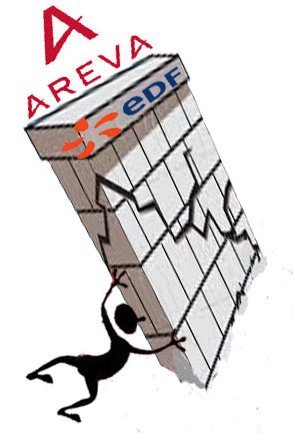 Hinkley Point – Edf to decide whether to build nuclear power station next week By Central Somerset Gazette January 19, 2016 A DECISION on whether a nuclear power station is built at Hinkley Point could be announced next week.
Reports in the French press indicate that the board of directors of the French state electricity generator EDF will meet on January 27 to make a final investment decision on the construction of two nuclear reactors at Hinkley Point near Bridgwater.
The final investment decision on the project has been delayed due to the lengthy negotiations with Chinese partners.
However even now there are concerns that the board might defer the decision for the ninth time……….
EDF is also locked in negotiations surrounding a complex deal to buy a French nuclear reactor builder, Areva, and in the disposal of it’s stake in eight current British nuclear power stations, five in the US, one in Finland and a number of Polish coal fired plants
Preparation of the site stopped last year when negotiations over the financing of the power station stalled.
Campaigners opposed to the building of Hinkley Point C are sceptical that the project will ever see the light of day.
Stop Hinkley spokesperson Roy Pumfrey said: “I’ll believe it when I see it. This is the ninth time EDF has said a final investment decision is imminent. Just last October the chairman of EDF, Jean-Bernard Levy, said work would be starting before the end of 2015. It would be completely reckless of the Board to give the go-ahead to this £25 billion project when the company is in such a parlous state.” http://www.centralsomersetgazette.co.uk/8203-Hinkley-Point-Edf-decide-build-nuclear-power/story-28559932-detail/story.html
Nuclear industry survived only because of ‘liability cap’
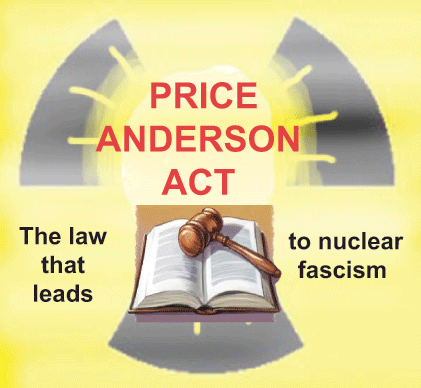
After 60 years of nuclear power, the industry survives only on stupendous subsidies, Ecologist, Pete Dolack 4th January 2016 Without ‘liability caps’ the industry would have been dead long ago
The British government, for instance, currently foots more than three-quarters of the bill for radioactive waste management and decommissioning, and for nuclear legacy sites. A report prepared for Parliament estimates that total public liability to date just for this program is around £50 billion, with tens of billions more to come.
Liability caps for accidents are also routine. In the US the Price-Anderson Act, in force since 1957, caps the total liability of nuclear operators in the event of a serious accident or attack to $10.5 billion. If the total is higher, as it surely would be, taxpayers would be on the hook for the rest.
As a further sweetener, the Bush II / Cheney administration, in 2005, signed into law new nuclear subsidies and tax breaks worth $13 billion. The Obama administration, attempting its own nuclear push, has offered an additional $36 billion in federal loan guarantees to underwrite new reactor construction, again putting the risk on taxpayers, not investors.
The Vermont Law School paper aptly sums up this picture with this conclusion: [page 69]
“If the owners and operators of nuclear reactors had to face the full liability of a nuclear accident and meet the alternatives in competition that is unfettered by subsidies, no one would have built a nuclear reactor in the past, no one would build a reactor today, and anyone who owned one would exit the nuclear business as quickly as they could.”
If we had a rational economic system, they surely would.http://www.theecologist.org/News/news_analysis/2986749/after_60_years_of_nuclear_power_the_industry_survives_only_on_stupendous_subsidies.html
Kansai Electric plans to restart another nuclear reactor
Japan to restart another nuclear reactor Jan. 29, 1st on MOX fuel, Kyodo News, TOKYO, Jan. 21, Kyodo A nuclear plant in Fukui Prefecture is expected to restart operations on Jan. 29, the first that will run on uranium-plutonium mixed oxide fuel under new safety regulations, sources close to the matter said Thursday.
Final arrangements are under way to restart the No. 3 reactor of Kansai Electric Power Co.’s Takahama plant, the third such case after Japan returned to nuclear power generation last summer following the loss of nuclear energy amid safety concerns in the wake of the 2011 Fukushima disaster.
Last April, a district court banned Kansai Electric from restarting the Nos. 3 and 4 reactors of the Takahama plant citing safety concerns. But since the court lifted the injunction last month, the utility is now making preparations to reactivate the two reactors on the Sea of Japan coast, with the restart of the No. 4 unit planned for late February…..http://english.kyodonews.jp/news/2016/01/393890.html
Nuclear power: high costs, massive subsidies – some details
After 60 years of nuclear power, the industry survives only on stupendous subsidies, Ecologist, Pete Dolack 4th January 2016 It’s a global phenomenon
“………….Numerous research papers paint a fuller picture. A Congressional Research Service report found that nuclear power had received $74 billion for research and developmentby the US government for the period 1948 to 1998, more than all such money given for fossil fuels, renewables and energy efficiency combined.
A report by the venture-capital firm DBL Investors, Ask Saint Onofrio, reports that nuclear energy cumulatively has received four times more subsidies than solar energy in California, and that nuclear subsidies were higher than solar in 2011 and all previous years. Nuclear has received $8.2 billion in subsidies in California, while providing the state with 3% of its power in 2012.
The uneconomical state of nuclear power is a global phenomenon, not limited to any one place. A comprehensive study prepared for the Green Party of Germany’s Heinrich Böll Stiftung, The Economics of Nuclear Power: An Update, reports:
“Up to now, nuclear power plants have been funded by massive public subsidies. For Germany the calculations roughly add up to over €100 billion and this preferential treatment is still going on today. As a result the billions set aside for the disposal of nuclear waste and the dismantling of nuclear power plants represent a tax-free manoeuvre for the companies.
“In addition the liability of the operators is limited to €2.5 billion – a tiny proportion of the costs that would result from a medium-sized nuclear accident.”
The paper later says: “Successive studies by the British government in 1989, 1995, and 2002 came to the conclusion that in a liberalised electricity market, electric utilities would not build nuclear power plants without government subsidies and government guarantees that cap costs. In most countries where the monopoly status of the generating companies has been removed, similar considerations would apply.”
Yet new plants are being built, with new subsidies
Significant cost overruns are the norm in building nuclear power plants, and it isn’t investors who are on the hook for them. Three nuclear projects are under construction in the United States and two in Western Europe, a group that features an assortment of cost overruns and generous guarantees:
- The two new Vogtle reactors in Georgia are already $3 billion over budget although their completion date is three and a half years away. The largest owner, Southern Company, has received $8.3 billion in federal loan guarantees. Overruns at this plant are not unprecedented; the two existing reactors cost $8.7 billion instead of the promised $600 million, resulting in higher electricity rates.
- The Watts Bar 2 nuclear reactor in Tennessee, which received its license to operate in October, has seen its cost rise to $6.1 billion from $2.5 billion. (This is technically a restart of a unit on which construction was suspended in 1985.) The existing reactor at this site has a history of safety problems.
- The Summer 2 and 3 reactors being built in South Carolina have already caused rate payers there to endure a series of rate increases. Cost overruns just since 2012 havetotaled almost $2 billion.
- In October 2013, British authorities approved a new nuclear reactor at Hinkley Point, England, that features subsidies designed to give the owner, Électricité de France, aguaranteed 10% rate of return on the project. Power from the plant will be sold at a fixed price, indexed to the consumer inflation rate.
In other words, The Independent reports, “should the market price fall below that [agreed-upon] level the Government would make up the difference.” The agreed-upon fixed price set by the Cameron government at the time was double the wholesale pricefor electricity. Since then the gap has only widened. - Olkiluoto-3 in Finland was supposed to have cost €3 billion, but is 10 years behind schedule and €5 billion over budget.
High costs despite high subsidies
There would at least be a small silver lining in this dark picture if the electricity produced were cheap. But that’s not the case. From the mid-1970s to the mid-1990s, the cost of producing electricity from nuclear power in France tripled and in the United States the cost increased fivefold, according to the Vermont Law School paper [page 46].
Then there are the costs of nuclear that are not imposed by any other energy source: What to do with all the radioactive waste? Regardless of who ultimately shoulders these costs, the environmental dangers will last for tens of thousands of years.
In the United States, there is the fiasco of the Yucca Mountain nuclear waste dump in Nevada. The US government has collected $35 billion from energy companies to finance the dump, which is the subject of fierce local opposition and appears to have no chance of being built.
Presumably, the energy companies have passed on these costs to their consumers but nonetheless are demanding the government take the radioactive waste they are storing at their plants or compensate them. As part of this deal, the US government made itself legally responsible for finding a permanent nuclear waste storage facility.
And, eventually, plants come to the end of their lives and must be decommissioned, another big expense that energy companies would like to be borne by someone else.
As the Heinrich Böll Stiftung study says, [page 17], “there is a significant mismatch between the interests of commercial concerns and society in general. Huge costs that will only be incurred far in the future have little weight in commercial decisions because such costs are ‘discounted’. This means that waste disposal costs and decommissioning costs, which are at present no more than ill-supported guesses, are of little interest to commercial companies.
“From a moral point of view, the current generation should be extremely wary of leaving such an uncertain, expensive, and potentially dangerous legacy to a future generation to deal with when there are no ways of reliably ensuring that the current generation can bequeath the funds to deal with them, much less bear the physical risk. Similarly, the accident risk also plays no part in decision-making because the companies are absolved of this risk by international treaties that shift the risk to taxpayers.” http://www.theecologist.org/News/news_analysis/2986749/after_60_years_of_nuclear_power_the_industry_survives_only_on_stupendous_subsidies.html
1 This Month

of the week– Nuclear Reactor Information Task Force

14 May – online event From Bombs to Data Centres: the Face of Nuclear Colonialism
To see nuclear-related stories in greater depth and intensity – go to https://nuclearinformation.wordpress.com
-
Archives
- May 2026 (91)
- April 2026 (356)
- March 2026 (251)
- February 2026 (268)
- January 2026 (308)
- December 2025 (358)
- November 2025 (359)
- October 2025 (376)
- September 2025 (257)
- August 2025 (319)
- July 2025 (230)
- June 2025 (348)
-
Categories
- 1
- 1 NUCLEAR ISSUES
- business and costs
- climate change
- culture and arts
- ENERGY
- environment
- health
- history
- indigenous issues
- Legal
- marketing of nuclear
- media
- opposition to nuclear
- PERSONAL STORIES
- politics
- politics international
- Religion and ethics
- safety
- secrets,lies and civil liberties
- spinbuster
- technology
- Uranium
- wastes
- weapons and war
- Women
- 2 WORLD
- ACTION
- AFRICA
- Atrocities
- AUSTRALIA
- Christina's notes
- Christina's themes
- culture and arts
- Events
- Fuk 2022
- Fuk 2023
- Fukushima 2017
- Fukushima 2018
- fukushima 2019
- Fukushima 2020
- Fukushima 2021
- general
- global warming
- Humour (God we need it)
- Nuclear
- RARE EARTHS
- Reference
- resources – print
- Resources -audiovicual
- Weekly Newsletter
- World
- World Nuclear
- YouTube
-
RSS
Entries RSS
Comments RSS
 nuclear-news