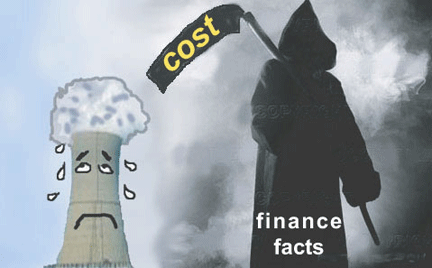
Central bankers, financial facts, bringing an end to the nuclear power era?
Central Bankers Stimulate Nuclear End That Evaded Activists http://www.bloomberg.com/news/articles/2016-04-25/central-bankers-stimulate-end-for-nuclear-that-evaded-activists Jonathan Tirone April 26, 2016 —
-
Interest rates near record lows cut funds for decommissioning
-
Industry faces $1 trillion of liabilities from retiring plants
-
Central banks may accomplish what a generation of anti-nuclear activists have failed to do: Force operators to finally decommission almost 150 reactors now sitting in limbo across the globe.

The plants have been shut down, either because they’re too expensive to run or because of concerns about their safety or age. They can’t send electricity to the grid, and they’ll need the special funds saved over decades for formal decommissioning and clean-up of radioactive waste.
In the past, many operators delayed decommissioning to allow growth in the clean-up funds. As the global economy weakened, however, and central banks kept interest rates low, the principal in some of those funds shrank. Last year in the U.S., seven of the 10 biggest funds lost money, falling to $43.7 billion, a drop of 1.1 percent. Now, with projected costs rising, industry advocates say owners are more likely to opt for full decommissioning before the funds decline further.
- “One can’t rely as much on fund growth as in the past,” said Patrick Joseph O’Sullivan, a decommissioning specialist with the International Atomic Energy Agency. “It’s actually pushing utilities to think about bringing forward all this work because they’re not able to rely anymore on assuming high returns on investments.”
- The change in emphasis comes 30 years after the April 26, 1986 explosion at the Chernobyl reactor spread radioactive fallout across Europe. That event, followed 25 years later by meltdown at the Fukushima plant in Japan, undercut nuclear as a power generator as low-cost options like natural gas and renewable energies became increasingly available.A 2005 report by the IAEA forecast costs to shut a 1,000 megawatt reactor would range from 150 million euros ($169 million) to 750 million euros. In the U.S., the country with the most decommissioning experience, actual costs have ranged from $307 million to $819 million, according to the Nuclear Energy Agency.
Twenty-four U.S. decommissioning projects with site-specific estimates will require average clean-up funds of about $750 million per reactor, the U.S. Nuclear Regulatory Commission reported. Those costs jive with an estimate by Exelon Corp., which operates reactors at 15 U.S. nuclear power plants.
- Exelon estimates it will take $1 billion to decommission its 2-unit plant in Zion, Illinois. It told shareholders in February that “sustained low market prices or depressed demand” could accelerate “asset retirement obligation expense related to future decommissioning activities.” Exelon’s clean-up fund fell 2 percent to $10.3 billion last year.Utilities operating in Germany including EON SE, RWE AG and Vattenfall SE have set aside funds deemed “acceptable” by regulators to cover 47.5 billion euros of estimated costs to decommission the country’s 17 reactors. Shares of those utilities jumped in February after reports that the German government would kick in an additional 17.7 billion euros to help store the radioactive waste.
“Understanding of these costs is fundamental for the development of estimates based on realistic decommissioning plans,” the Paris-based Nuclear Energy Agency said last month in a 260-page report prepared for regulators and utilities. “More and more questions are raised over the adequacy of the necessary infrastructure and human resources, as well as the ability and mechanisms to finance the costs.”
There are 438 nuclear reactors in operation worldwide and less than 4 percent of the power reactors built have been fully decommissioned. Fewer still have figured out how to store waste for the thousands of years it will remain dangerous.
- “For us, the trend toward early dismantling has important advantages,” said the IAEA’s O’Sullivan. “It will contribute to better burden sharing between current and future generations.”About $200 billion will be spent worldwide in the next 20 years on decommissioning the world’s aging fleet of reactors, Thomas LaGuardia, an American nuclear engineer who is helping the IAEA to establish decommissioning guidelines, said in an interview. Nuclear operators that haven’t saved sufficient decommissioning funds may opt to put plants in safe storage until their accounts bulk up, he said.
- Project management and environmental remediation companies in the U.S. and Europe could see their markets grow as utilities draw down decommissioning funds to shut aging reactors, Swedish radiation safety analyst Simon Carroll said in an interview.“One person’s cost is another man’s income,” he said.
Sweden’s decommissioning fund fell 0.5 percent last year, Carroll said in an e-mail. The country reported on Tuesday that returns on it’s 59.3 billion krona ($7.3 billion) Nuclear Waste Fund also dropped 0.5 percent in 2015.
The economic meltdown of nuclear power should be a wake-up call for investors and governments
Once a reactor has reached the end of its lifetime, the cost for decommissioning and storing nuclear waste for hundreds to thousands of years have to be borne. Utilities have a mandate to make provisions for this, but whether the funds will actually suffice remains to be seen.
While the level of feed-in tariffs has been reduced for wind and solar in countries like Germany and Switzerland to reflect technology learning curves, the [UK’s] price guarantee for nuclear locks in the opposite trend.
The positive business case for non-renewable energies seems to come to an end. Thirty years after Chernobyl and five years after Fukushima, the economic meltdown of nuclear power should be a wake-up call for investors and governments
 Nuclear power’s economic meltdown 30 years after Chernobyl http://www.swissinfo.ch/eng/energy-rethink_nuclear-power-s-economic-meltdown-30-years-after-chernobyl/42109822 By Rolf Wüstenhagen 25 Apr 16 Thirty years later, the nuclear industry is facing a meltdown of a different kind: an economic meltdown.
They went on to conclude that each of the middle three of these risks alone would be enough to “bring even the largest utility company to its knees financially”.
Two years after the report was published, Citi’s claim was empirically validated. The meltdown in three reactors of the Fukushima Daichi nuclear power plant in Japan led to widespread contamination.
The event marked a human and environmental tragedy, but the magnitude of the financial loss – estimates of which range from $250 billion (CHF242 billion) to $500 billion – also forced the operating company, Tepco, into the largest government bail-out in Japanese economic history.
Sharp rethink Continue reading
Toshiba to lose 260 billion yen due to losses over Westinghouse nuclear power subsidiary

 Toshiba expects loss over Westinghouse to reach 260 bil. yen , Kyodo News, 26 April 2016 Toshiba Corp. said Tuesday it plans to book an asset impairment loss of around 260 billion yen ($2.3 billion) in its results for the year to March 31 by writing down the value of its U.S. nuclear power subsidiary Westinghouse Electric Co. acquired in 2006……
Toshiba said its operating loss for the year is now pegged at 690 billion yen, compared with its earlier forecast of 430 billion yen, on sales of 5.5 trillion yen against the earlier projection of 6.2 trillion yen.
“We don’t think our financial conditions have stabilized…so reinforcing our (financial) standing is the biggest challenge in the current business year,” President Masashi Muromachi told a press conference.
In computing the write down on Westinghouse, Toshiba reviewed the $2.93 billion in goodwill, or 350 billion yen based on the exchange rate at that time, it booked when acquiring the U.S. nuclear plant builder.
The goodwill, calculated by deducting from the purchase price the value of the assets and liabilities acquired, was reported on the balance sheet as a fixed asset…….http://kyodonews.net/news/2016/04/26/58694
Toshina writes down the value of its nuclear business
Toshiba to Take $2.3 Billion Write-Down on Nuclear Business, WSJ, Toshiba also revised earnings guidance for the fiscal year, forecasting a larger operating loss By TAKASHI MOCHIZUKI April 26, 2016
TOKYO—Toshiba Corp. said it would write down the goodwill value of its nuclear-power-plant business, including its U.S. subsidiary Westinghouse Electric Co., after years of criticism that the company’s outlook on the business was too optimistic.
The electronics giant said Tuesday that it would book the one-time loss of ¥260 billion ($2.3 billion) to reflect the change in the business’s earnings prospects and Toshiba’s financial standing.Toshiba’s recent financial scandal led to downgrades of its debt,which will make borrowing more expensive and so hurt profits.
The impairment charge will be recorded in results for the fiscal year that ended on March 31, due to be reported May 12…….http://www.wsj.com/articles/toshiba-to-take-2-3-billion-write-down-on-nuclear-business-1461654771
French and Russian nuclear utilities to work together, on decommissiong, and more
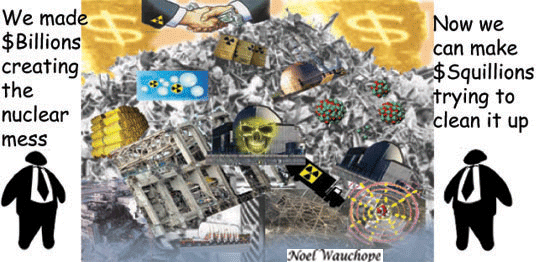 French and Russian nuclear utilities extend collaboration, World Nuclear News, 26 April 2016
French utility EDF has signed an agreement to extend its cooperation with Rosenergoatom, the operator of Russia’s civil nuclear power plants. The companies will cooperate in reactor operations, decommissioning and waste management…..
Through the agreement, EDF and Rosenergoatom intend to develop cooperation in areas such as the maintenance, modernization and operating period extension of nuclear power plants, as well as decommissioning and radioactive waste management http://www.world-nuclear-news.org/C-French-and-Russian-nuclear-utilities-extend-collaboration-2604164.html
Nuclear power workers protest in Ukraine
Ukrainian nuclear power workers to protest on 30th Chernobyl disaster anniversary Rt.com 25 Apr, 2016 Ukraine’s state nuclear energy giant says all employees of the country’s nuclear plants will stage a massive protest over its frozen assets in Kiev on Tuesday, as the world will be marking the 30th anniversary of the Chernobyl disaster.
Energoatom, the operator of Ukraine’s four functioning nuclear plants, saidon its website on Monday that its workers resorted to such “extreme measure” because of the “inaction” of the state in addressing the issue of “unjustified seizure” of the company’s assets.
The assets freeze led to Energoatom stopping payments for nuclear fuel, nuclear materials and removal of used nuclear fuel, it stressed.
“The payment arrears may result in the delay in the supply of nuclear fuel to Ukrainian nuclear power plants and therefore stoppage nuclear power units,” the company warned.
The wages of the employees are also under threat, the statement by state-owned Energoatom added.
The protests action was scheduled after attempts to resolve the issue “peacefully” by the nuclear worker’s union turned out unsuccessful, it said.
The Energoatom assets were arrested in March after the court ordered to collect 127.3 million hryvnia (around $5 million) of debt from the company.
The debt to Ukrelektrovat company “is not confirmed by any primary accounting documents, while the liability of 2.5 million hryvnia that had been present on Energoatom’s balance account was written off in 2004 due to the expiration of the statute of limitations,” it explained.
The amount of the debt was artificially increased after legal enquiry by an individual expert, whose conclusions were put in doubt by the Justice Ministry and led to the launch of a criminal case, Energoatom said.
In April, the company has sent an open letter to Justice Minister, Pavel Petrenko, urging him to interfere into the situation, but the plea was ignored by the official……..https://www.rt.com/news/340902-ukraine-chernobyl-nuclear-protest/
Further delay for UK Hinkley nuclear project, as EDF decides to consult unions

 Fresh setback for Hinkley Point as EDF consults French unions, Telegraph UK Alan Tovey 22 APRIL 2016 Plans by EDF to build the new Hinkley Point nuclear power station have been further delayed after the French energy company said it would consult with unions before announcing its final investment decision.
After a board meeting on Friday, the company said it had agreed a “significant” recapitalisation that would make it “possible for EDF to proceed with its strategic investment programme – including Hinkley Point C”.
However, the directors added they would go through a formal consultation process with unions over the decision. Although it will not be binding on the board, this statutory process would take 60 days, pushing it close to the June 23 referendum on whether or not Britain will remain in the UK.
Sources close to the French government – which is EDF’s majority shareholder with an 85pc stake – said administrative delays could easily push this consultation past the date of the Brexit vote.
Consulting the unions over the decision presents fresh hurdles to the muchdelayed plan to build the Hinkley Point power station, the first in a fleet of new nuclear power stations for the UK.
Ten years ago, EDF was predicting Hinkley would be supplying power by 2017.
Unions are sceptical about whether EDF can afford the investment – which the French firm is financing two thirds of, with the rest coming from Chinese investors – and have made public their opposition to the scheme.
Some senior staff at EDF are also against the power company’s involvement in such a huge project…….http://www.telegraph.co.uk/business/2016/04/24/fresh-setback-for-hinkley-point-as-edf-consults-french-unions/
Employee’s legal threat hangs over EDF’s U.K. Nuclear Project
 EDF Unions Threaten to Go to Court Over U.K. Nuclear Project, Bloomberg, Francois De Beaupuy April 22, 2016
-
Employee representatives ask to be consulted before decision
-
Trade unions say they’ll sue if not consulted in advance
-
Electricite de France SA’s unions are threatening to take the company to court if employees are not consulted in advance on a decision concerning a proposed 18 billion-pound ($25.8 billion) U.K. atomic plant project.
EDF’s workers committee, which includes representatives from the biggest unions, met near Paris and voted to take legal action should the company fail to consult employees on Hinkley Point, according to a statement Thursday. The project is key to EDF earnings and has prompted disagreements between management and unions, it said.
“We ask that the workers’ committee is consulted before any decision by management or the board,” the committee said. If that didn’t happen then “the committee would be forced to take legal action to have any decision linked to the Hinkley Point project suspended or annulled.”
The threat marks the latest attempt by workers to delay a decision, given concerns about EDF’s finances amid falling power prices across Europe. Union FO has already threatened to call for a strike. EAS, an association of EDF employees holding the company’s shares, is asking the stock market regulator to require that the French government, which owns 85 percent of EDF, repurchases shares at the initial public offering price…..http://www.bloomberg.com/news/articles/2016-04-21/edf-unions-threaten-to-go-to-court-over-u-k-nuclear-project
USA wind energy investment – over $128 Billion
 By staying on track to supply 20 percent of U.S. electricity by 2030, wind energy could support 380,000 well-paying jobs, according to the U.S. Department of Energy. That number could grow to 600,000 by supplying 35 percent by 2050
More Than $128 Billion Dollars Invested in U.S. Economy by New Wind Power Projects,Wind Systems, 25 Apr 16 Building new wind farms in the U.S. added $13 billion per year on average to the American economy over the past five years, according to information recently released by the American Wind Energy Association (AWEA).
“By building new wind farms across the country throughout the past decade, wind companies have invested $128 billion into the U.S. economy,” said Tom Kiernan, CEO of AWEA. “Over this time, wind has rapidly scaled-up. Now, there is enough wind power installed to reliably produce electricity for more than 19 million American homes. Continuing to invest in world-class wind resources here at home will help keep our lights on, grow state economies, and keep more money in the pockets of homeowners and businesses.”
Wind energy was the number-one source for new electric capacity additions in 2015 with 8,598 MW installed. That number translates to $14.7 billion dollars in wind project investments in one year — a 73-percent increase over the $8.5 billion invested in new projects in 2014 and a more than seven-fold increase over investments by wind in 2013……..
The new investment figures made by wind come shortly after a new accord that was announced by a bipartisan group of 17 governors who made the pledge to accelerate clean energy growth, including wind power, as a way to build “a new energy future.” The accord said that creating this new energy path will result in a “more durable and resilient infrastructure and [will] enable economic growth while protecting the health of our communities and natural resources.”
Wind power costs two-thirds less than it did six years ago because of American innovation and improved domestic manufacturing, with more than 500 factories across 43 states building wind turbine parts and materials, and those savings are being passed on to U.S. consumers. Wind power saved consumers $1 billion over just two days across the Great Lakes and Mid-Atlantic states during the 2014 Polar Vortex event.
Wind energy in the U.S. produces enough electricity for more than 19 million American homes, and American wind power supports 73,000 well-paying jobs across every state, including nearly 20,000 manufacturing jobs.
By staying on track to supply 20 percent of U.S. electricity by 2030, wind energy could support 380,000 well-paying jobs, according to the U.S. Department of Energy. That number could grow to 600,000 by supplying 35 percent by 2050. http://www.windsystemsmag.com/article/detail/1167/more-than-128-billion-dollars-invested-in-us-economy-by-new-wind-power-projects
French corporation EDF and its zombie nuclear reactors
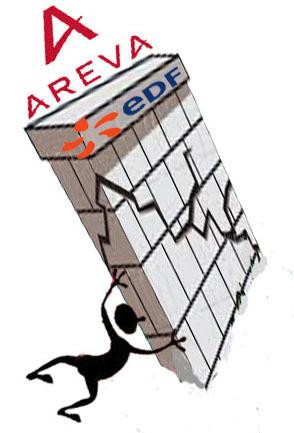 EdF: Living with its ZOMBIE REACTORS!, Jonathon Porritt, 24 Apr 16,
You seriously wouldn’t want to be a Director of EdF at the moment. The agenda for an average Board Meeting must be seriously gloomy on each and every occasion. Here’s how I imagine the key agenda items for their last meeting on 16th February – helpfullysummarised by EdF’s Company Secretary.
Item 1: Existing EPR construction projects
1.1 Olkiluoto (Finland)
Continuing, horrendous cost overruns, leading to ongoing legal stand-off with Finnish partners. Already delayed by seven years, but (hopefully!) could be finished by 2018.
1.2 Flamanville (France)
Continuing, horrendous cost overruns. Already delayed by nine years, but (hopefully!) could be finished by 2018.
1.3 Taishan (China)
Serious problems with both reactors under construction, but, this being China, everything’s shrouded in secrecy. WARNING: This could be much worse than we currently understand.
1.4 Pressure vessels
Still waiting for final safety assessment from French regulators. WARNING: There could be really serious problems here, despite our best efforts to ‘work with’ the regulator.
1.5 Deadlines/UK Treasury
These deadlines are now CRITICAL – as in EXISTENTIAL.
UK Treasury’s loan guarantees are linked to Flamanville operating successfully. And if it is not working properly by 2020, loan guarantee will be completely withdrawn.
Item 2: New reactors at Hinkley Point, Somerset………
Item 3: Extending the life of our UK reactors……
Item 4: Extending the life of our French reactors…….
Item 5: Energy Transition Law (France)…….
Item 6: Financial position…….
…..The implications of all this for the UK couldn’t possibly be more severe. Initially, HinkleyPoint was meant to be on stream by 2025, generating a whacking great 7% of total electricity supply. Earlier delays meant that this had already slipped to 2030. Now that the start date has slipped again, to 2019, AT THE EARLIEST, that 2030 date looks insanely optimistic…….http://www.jonathonporritt.com/blog/edf-living-its-zombie-reactors
World’s wind energy industry set to nearly double in next five years
 Global wind capacity to nearly double in next five years: GWEC, http://www.reuters.com/article/us-global-windpower-idUSKCN0XG1UA Nina Chestney, 19 Apr 16 Global wind energy capacity will nearly double in the next five years, largely led by further market growth in China, but also as a stronger industry emerges in the United States, the Global Wind Energy Council (GWEC) said on Tuesday.
 capacity was 433 gigawatts (GW) at the end of 2015, a 17 percent rise from the year before. to comply with emissions cut targets, prices continue to fall and policies to support wind power in the United States stabilize, the wind industry association said in the report.
In December last year in Paris, almost 200 countries agreed a landmark deal to cut greenhouse gas emissions from 2020 with the aim of limiting global average temperature rise to below 2 degrees Celsius.
“The Paris Agreement requires a fully decarbonized power system by 2050 if not before, if we are keeping temperatures below 2 C above pre-industrial levels,” Steve Sawyer, GWEC Secretary General, said in a statement.
New markets in Africa, Asia and Latin America are also emerging which will be sources of growth in the next decade.
Outside of China, the Asian market will be led by India but new markets in Indonesia, Vietnam, the Philippines, Pakistan and Mongolia are also developing quickly, the report said.
Uranium market continues its relentless downward plunge
 Uranium market is getting crushed Uranium price falls to lowest since May 2005 as bearishness overwhelms the sector, Mining.com 20 Apr 16 Iron ore is on an insane run, copper’s dug itself out of January’s seven-year trough, tin and zinc are in bull markets, coking coal is heading for triple digits and crude’s holding onto 60% gains since February’s low despite the Doha disaster.
Uranium?
It’s having the worst start to a year in a decade. U3O8 is down more than 25% in 2016 with the UxC broker average price sliding to $25.69 a pound on Friday. That’s the cheapest uranium has been since May 2, 2005.
Haywood Securities in a research note points out that the spot U3O8 price “saw three years of back-to-back double-digit percentage losses from 2011-13, but none worse than what we’ve seen thus far in 2016, and at no point since Fukushima, did the average weekly spot price dip below $28 a pound.” The long term price, where most uranium business is conducted, is languishing at around $44 a pound.
Uranium was actually the best performing commodity in 2015 by virtue of having declined in value only slightly over the course of the year. So what’s happening?
Vancouver-based Haywood attributes the decline to “a dearth of non-discretionary buying from utilities combined with an over-supplied market which continues to inflate global inventories, partially attributable to the continued shutdown of Japanese reactors and the ramp-up of production at selected uranium mines including Cigar Lake.”
Five years after the Japanese disaster only two of the country’s 50 nuclear reactors are back on line. In other developed markets nuclear power is also in retreat.
Top user France which relies on its 58 plants for more than three-quarters of its electricity needs, has begun a program to reduce that figure to 50%. Problems with next-generation plants developed by French state utility EDF and top supplier Areva are well-documented. Germany is phasing out the technology and the last new nuclear power station to enter service in the US was 20 years ago…….
Stockpiles at utilities were estimated at an already elevated 217,ooo tonnes uranium at the end of 2014. That translates into more than three years’ worth of feedstock for the world’s installed nuclear power capacity.
Special arrangements like top producer Kazakhstan’s uranium-sovereign debt deal with China leave little room for non-state players. ….http://www.mining.com/uranium-market-getting-crushed/
France committed to investing in Hinkley nuclear plant, even if it bankrupts EDF
 French ‘committed’ to investing in Hinkley C nuclear plant Plymouth Herald April 17, 2016 By Kate Langston The French government is “completely committed” to building the Westcountry’s new nuclear power plant at Hinkley, the country’s ministers have confirmed.
In an interview with the BBC, the French economy minister Emmanuel Macron stressed the £18 billion project is “very important” to the French state, which owns 85% of energy firm EDF.He added that backers still need to finalise some “technical and industrial” aspects of the Hinkley C deal, but should be in a position to sign in a “week or more”.
The assurances from Mr Macron come less than a week after he sparked fresh fears for the Somerset-based development by announcing he had “not yet made a decision” about the investment.
They also follow the publication of a letter from the main union representing EDF workers stating the firm is “on the edge of bankruptcy”, and should not be risking billions of pounds in the UK……..
The original date for the generator to come online has been pushed back from 20203 to 2025, and the estimated cost has soared from £16 billion to between £18 and £24.5 billion…….
Mr Macron told journalists that Hinkley is “important for [France’s] commitment to nuclear energy”. “We back Hinkley Point project, it’s very important for France, it’s very important for the nuclear sector and EDF,” he said.
“Now we have to finalise the work, and especially the technical and industrial work, very closely with EDF, with the British government, to be in a situation to sign in the coming week or more.”
The EDF board was due to meet to make a final decision on its investment in Hinkley in January, but this was postponed and is now expected to take place in May.
But John Sauven, director of environmental pressure group Greenpeace which is opposed to the new plant, has accused Mr Macron of saying one thing to a UK audience “and another to the French”.
“He has made it abundantly clear in French that no decision has been made,” he told the BBC. “The reasons are clear: the costs are rising, the problems are mounting, and the opposition in France is growing.
“The alternatives are looking increasingly attractive no matter which language you speak.”……….http://www.plymouthherald.co.uk/French-committed-investing-Hinkley-C-nuclear/story-29126276-detail/story.html
Nuclear Power Corporation of India Ltd (NPCIL) to announce convoluted new public liability insurance policy

 NPCIL to get nuclear liability policy soon: Official, Economic Times By IANS | 17 Apr, 201 CHENNAI: India’s atomic power company, Nuclear Power Corporation of India Ltd (NPCIL) is confident of getting the public liability insurance policy in 10-15 days time, said a senior official.
Once the policy is received, then the company can go ahead in full steam to start its project in Haryana, said the official, speaking to IANS on the condition of anonymity.
“The negotiations as to the risk coverage conditions with the insurers are over and issues have been sorted out. We are confident of getting the policy in 10-15 days time,” the official said.
While the official declined to comment on the premium to be paid to get the policy to cover public liability up to Rs.1,500 crore per year, per accident industry sources had earlier told IANS that it will be around Rs.70 crore.
The proposed policy would cover the liability towards public as a consequence of any nuclear accident in the plants covered under the policy and also the right of recourse of NPCIL against equipment suppliers.
The insurance coverage will be for all the NPCIL’s plants – like a floater cover.
When a nuclear accident happens and the Rs.1,500 crore cover is exhausted, then there will not be any insurance cover for subsequent accidents that might occur during that policy year. According to the NPCIL official if such a situation occurs, then the policy coverage will get automatically reinstated to Rs.1,500 crore on payment of premium. ………
The insurance pool was formed as a risk transfer mode for the suppliers and also NPCIL. ……..http://economictimes.indiatimes.com/industry/energy/power/npcil-to-get-nuclear-liability-policy-soon-official/articleshow/51867511.cms
As coal mines go bankrupt, tax-payers will be left with the cleanup costs
 After Bankruptcies, Coal’s Dirty Legacy Lives On, NYT By TOM SANZILLO and DAVID SCHLISSEL APRIL 14, 2016 THE bankruptcy filing on Wednesday by Peabody Energy, the world’s largest private- sector producer of coal, is the latest in a series of major coal company collapses that threaten to leave behind a costly legacy that will haunt taxpayers and consumers for years.
The abandonment of hundreds of mines over the years led Congress in 1977 to pass a law that requires coal companies to clean up after mining. Left untreated, these sites are more than eyesores: They create long-lingering problems including polluted drinking water.
And the problem is likely to become more pronounced in the wake of these bankruptcies. Mining companies are supposed to buy insurance to cover the cost of cleanups. But Congress has allowed some of the more financially secure coal producers to “self-bond,” promising to pay for cleanups themselves.

Perhaps the most glaring instance of self-bonding gone bad is Peabody Energy. Leading up to its bankruptcy, Peabody had been frantically trying to preserve its $1.47 billion in self-bonding agreements in states where they had been called into question by regulators.Two other major coal companies, Alpha Natural Resources and Arch Coal, recently filed for bankruptcy, leaving hundreds of millions in reclamation guarantees in limbo. A deal between Arch Coal and regulators in Wyoming suggests taxpayers will get stuck with the bulk of the cleanup costs. The company agreed toearmark at most $75 million to cover self-bonded reclamation liabilities of more than $450 million………
1 This Month




PLEASE OPPOSE HR 8255 AND S.3639 – bills would accelerate satellite deployment, with no environmental review or safeguards – https://ncstd5li.quorum.us/campaign/169331/
To see nuclear-related stories in greater depth and intensity – go to https://nuclearinformation.wordpress.com
-
Archives
- September 2026 (330)
- August 2026 (330)
- July 2026 (355)
- June 2026 (287)
- May 2026 (306)
- April 2026 (356)
- March 2026 (251)
- February 2026 (267)
- January 2026 (308)
- December 2025 (358)
- November 2025 (359)
- October 2025 (375)
-
Categories
- 1
- 1 NUCLEAR ISSUES
- business and costs
- climate change
- culture and arts
- ENERGY
- environment
- health
- history
- indigenous issues
- Legal
- marketing of nuclear
- media
- opposition to nuclear
- PERSONAL STORIES
- politics
- politics international
- Religion and ethics
- safety
- secrets,lies and civil liberties
- spinbuster
- technology
- Uranium
- wastes
- weapons and war
- Women
- 2 WORLD
- ACTION
- AFRICA
- Atrocities
- AUSTRALIA
- Christina's notes
- Christina's themes
- culture and arts
- Events
- Fuk 2022
- Fuk 2023
- Fukushima 2017
- Fukushima 2018
- fukushima 2019
- Fukushima 2020
- Fukushima 2021
- general
- global warming
- Humour (God we need it)
- Nuclear
- RARE EARTHS
- Reference
- resources – print
- Resources -audiovicual
- Weekly Newsletter
- World
- World Nuclear
- YouTube
-
RSS
Entries RSS
Comments RSS

