Russia plans for Africa to be its nuclear colony, starting with south Africa
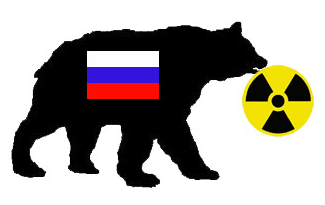
 How Russia Is Expanding Its Vast Nuclear Empire Into Africa, AFK Insider By Dana Sanchez May 19, 2016, Russia’s government-owned nuclear agency Rosatom hopes to use South Africa as a springboard into the rest Africa as it seeks to expand its influence on the continent by building nuclear power plants.
Rosatom plans to sign framework cooperation agreements with Kenya, Uganda and Zambia, adding to those already made with South Africa, Nigeria and Ghana, Reuters reported.
Right now, South Africa may be the best prospect. Nigeria looks less likely as its economy contracts in the global oil price plunge.
“Given the extremely bad economic situation in Nigeria today, it might take a bit longer. But the government and the new president are still determined to go nuclear,” said Viktor Polikarpov, Rosatom’s vice-president of sub-Saharan Africa.
South Africa in 2015 approved a plan to develop up to 600 megawatts of nuclear capacity by 2030 as part of a bigger plan to build 9,600 megawatts of nuclear power at up to nine new nuclear reactors……
Environmental activist group Greenpeace warned the ANC in 2015 to abandon nuclear build plans or face massive resistance, NuclearNews reported.
“The ANC needs to know that if it does go for the nuclear option as part of the (energy) mix, then they are on a collision course with the broader spectrum of the South African civil society,” said Greenpeace Director Kumi Naidoo said on Monday that the ANC should “take nuclear off the table.
Russia has competition to do the nuclear build from China, France and South Korea, Reuters reported. It’s already planning to seek more deals across the region that range from building power plants to supplying reactor fuel.
“What we are targeting is to build South Africa as a nuclear cluster of nuclear industries so that we can use our partners and our partnership for our expansion into Africa,” Polikarpov said in an interview Tuesday in Cape Town.
Rosatom can offer financing options, Polikarpov said, according to Bloomberg. These include a contract with a state-export credit offered to the government of South Africa, a buyer-owner operator agreement, a public-private partnership, or a combination of them…….
The allure of the turnkey nuclear power plant, built, owned and operated by Rosatom, allows governments across the world to embrace such projects. But for Russia they are much more than a major economic export. They are another geopolitical tool, allowing the Kremlin to tie up strategic governments into long-term cooperation. http://afkinsider.com/126032/how-russia-is-expanding-its-vast-nuclear-empire-into-africa/
Egypt goes into $25 billion nuclear debt to Russia
 Egypt gets $25 billion loan from Russia for nuclear plant http://www.theprovince.com/business/egypt+gets+billion+loan+from+russia+nuclear+plant/11930248/story.html BY THE ASSOCIATED PRESS MAY 19, 2016 CAIRO – Egypt has announced a $25 billion loan from Russia for the building of a nuclear power plant.
Thursday’s announcement came in a decree by President Abdel-Fattah el-Sissi. The Russian loan will cover 85 per cent of the expenses of the plant’s construction.
Egypt, which will cover the other 15 per cent, is to repay the loan over a 22-year period, starting in 2029, with a 3 per cent annual interest rate.
Egypt and Russia agreed in February 2015 to build the plant together and signed a memorandum of understanding on the project. But the relations between the two nations were badly impacted after the horrific Russian passenger plane crash in Sinai last October, when all 224 people on board were killed.
Egypt’s economy has plummeted amid a slump in the tourism sector.
Chinese nuclear companies planning to carve up nuclear exports between each other
 China’s CGN to Avoid Competing Abroad Against Nuclear Partner http://www.bloomberg.com/news/articles/2016-05-19/china-s-cgn-to-avoid-competing-abroad-against-nuclear-partner Aibing Guo Stephen Stapczynski sstapczynski
-
China General Nuclear Power Corp. to focus on European markets
-
Nuclear companies formed a JV to export co-developed reactor
-
China General Nuclear Power Corp. said it won’t compete with China National Nuclear Corp. for customers in the same overseas markets as the two companies aim to increase exports of their co-developed nuclear reactor.
China General Nuclear Power will target customers in Europe and avoid markets where CNNC is active, such as South America, according to Huang Xiaofei, spokesman for China General Nuclear Power. CNNC didn’t respond to requests for comment. While the companies have merged their nuclear technologies into the Hualong One reactor, the country’s main export model, they separately market the design overseas, Huang said.
The companies build similar, but not identical, versions of the Hualong One and will maintain much of their own supply chains, according to the World Nuclear Association.They also established a joint-venture in March to integrate the technology.
CGN and Electricite de France SA signed an accord in October to build three reactors in the U.K., including the Hinkley Point plant in southwest England and a Chinese-developed reactor at Bradwell. CGN has also signed a memorandum of understanding with the Kenyan government in September to possibly build a Hualong One reactor, while CNNC has its own projects in Argentina and Pakistan. -
Taishan
Separately, two Areva SA-designed nuclear reactors in Taishan are on track to start commercial operation in China in the first half of 2017, according to Huang. The cost overrun for the reactors, known as an EPR, was caused by labor costs and loan interest and were within a reasonable range, he said. The company also plans to deliver its first small modular reactor, which can be used offshore, by 2020, he said
The country plans to export about 30 nuclear units by 2030, CNNC chairman Sun Qin said in March, according to China Daily.
Solar energy jobs growing, as oil industry jobs decline
 There Will Be More New Jobs in Solar Than Oil by the End of the Year,Fortune by Jonathan Chew @sochews APRIL 20, 2016, Indeed just released this startling info on energy jobs.
The world’s biggest oil companies are slashing jobs to cope with decreasing revenues, and one knock-on effect has been the drop in oil job postings.
Conversely, however, if the current pace of postings hold, solar would become the largest market for energy jobs by the fourth quarter of 2016, according to numbers tabulated by Indeed, the world’s highest traffic job site…….
Tara Sinclair, chief economist at Indeed. “Whether or not solar overtakes oil on Indeed, energy workers would do well to position themselves for work in renewable fields such as solar, wind, and hydroelectricity.”
This corresponds with a recent report by The Solar Foundation that highlighted the rapid growth of the U.S. clean energy sector. By the end of this year, the solar sector should have 240,000 workers under its wings, and currently employs around 77% more workers than the coal mining industry……http://fortune.com/2016/04/20/solar-oil-jobs-indeed/
EDF hoping to extend life of nuclear reactors, postpone decommisson costs
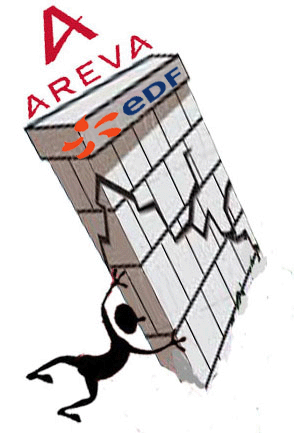 EDF sees French energy plan shaping nuclear depreciation schedule http://uk.reuters.com/article/uk-edf-nuclear-idUKKCN0YA211 PARIS | BY GEERT DE CLERCQ 19 May 16.The French government’s energy investment plan due in July will be a key indicator for whether and for how long EDF will extend the depreciation period of its nuclear plants, an executive said on Thursday.
EDF hopes to get nuclear energy regulator ASN’s authorisation to extend the lifespan of its nuclear plants to 50 years from 40, and already wants to extend the depreciation period on these assets, which would boost bottom-line profit.
Early this year ASN said it expects to give generic guidelines on French nuclear plant life extensions by 2018, but said extensions could not be taken for granted and that they would be decided reactor by reactor.
The government’s long-awaited multi-year energy investment plan (PPE) – implementing the August 2015 energy transition law – will not specify reactor lifespan, but should set targets for the share of nuclear in France‘s power mix.
President Francois Hollande has vowed to reduce that share from 75 percent to 50 by 2025, but has taken no concrete steps towards that goal.
“The PPE, and notably its nuclear chapter, expected early July, will figure largely in our decision about the accounting lifespan of our nuclear reactors,” EDF nuclear chief Dominique Miniere told reporters.
In 2003, EDF extended the depreciation schedule for its reactors in its accounts to 40 years from 30 – six years before the ASN authorised the move.
CEO Jean-Bernard Levy said in April EDF plans to extend the depreciation period by the closing of first-half results.
Miniere said the PPE should signal how many of EDF’s 58 reactors can keep operating, which will determine over what period reactors and related maintenance costs can be depreciated.
He said life extension would also impact EDF’s 23 billion euros (1 billion pounds) worth of decommissioning and nuclear waste provisions.
“Delaying reactor decommissioning also means delaying provisions,” he said. Miniere said 80 percent of EDF’s 58 reactors were built between 1980 and 1990. From 2020, many need to close or get approval operate another decade.
Miniere said every reactor has annual maintenance costs of about 50 million euros, or about 3 billion euros per year for EDF’s fleet.
Extending EDF’s reactors by 10 years and incorporating safety lessons learned from the Fukushima disaster will boost that to 4-4.2 billion euros per year in the 2014-2025 period, a total of just over 50 billion, after which costs will ease to 4.2-3 billion euros per year, he said. (Reporting by Geert De Clercq, editing by David Evans)
France’s President Hollande backs Hinkley nuclear project, despite near bankruptcy of EDF
 Hollande renews support for Hinkley Point nuclear reactors http://www.theguardian.com/uk-news/2016/may/17/hollande-renews-support-edf-hinkley-point-nuclear-reactors
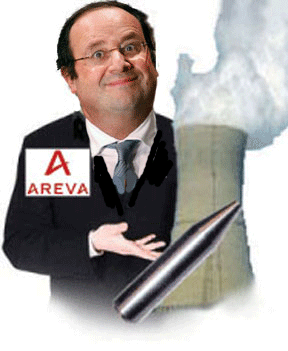
French president backs project despite fears that £18bn price tag could bankrupt EDF, which is 85% state-owned François Hollande has renewed his support for the controversial nuclear project planned by the French energy company EDF at Hinkley Point in Britain.
“I am in favour that this project goes ahead,” the French president told Europe 1 radio on Tuesday.
“It’s very important to understand that we need a high-performance, highly secure nuclear industry in France, and that we cannot let others take over terrain, including on exports, that has been French up to now,” he said.
A final decision on the plan to build two new-generation nuclear reactors at Hinkley Point in south-west England was due this month, but was delayed after unions at EDF demanded a review of the costs.
A joint project between EDF and China General Nuclear Power Corporation, it carries a projected price tag of £18bn ($26bn, €23bn) that will make it one of the world’s most expensive nuclear power plants.
Unions at EDF, which is 85% state-owned, fear it could bankrupt the company, which is already saddled with more than €37bn of debt.
Last month, the management agreed to consult the internal committee which has brought in outside experts to review the financial implications of the project.
Hollande said the review would be completed “in the coming weeks”.
There have been dissenting voices over Hinkley Point within the French government.
On Friday, France’s environment minister Ségolène Royal, who is also mother to Hollande’s children, told the Financial Times that she was worried about the “colossal sums” involved in the project and questioned whether it should go ahead
Ratings agencies Standard and Poor’s and Moody’s both lowered their forecasts for EDF last week, saying efforts to streamline the company were insufficient.
Hollande restated his vow to restructure and boost financing at EDF and rival energy giant Areva, “because they are the future”.
“The French nuclear industry has 200,000 employees. It represents our energy independence,” Hollande told Europe 1.
“EDF and Areva are public companies on which we should rely. But at the same time, we must give them new support.”
CGN, which is due to cover a third of the costs, said on Monday that it would not go ahead with the project if EDF pulls out.
Uranium industry finally acknowledging its dire situation
Uranium on the rocks http://onlineopinion.com.au/view.asp?article=18236&page=0

| By Jim Green , 17 May 2016 Indicative of the uranium industry’s worldwide malaise, mining giant Cameco recently announced the suspension of production at Rabbit Lake and reduced production at McArthur River/Key Lake in Canada. Cameco is also curtailing production at its two U.S. uranium mines. About 500 jobs will be lost at Rabbit Lake and 85 at the U.S. mines. A Cameco statement said that “with today’s oversupplied market and uncertainty as to how long these market conditions will persist, we need to focus our resources on our lowest cost assets and maintain a strong balance sheet.”Christopher Ecclestone, mining strategist at Hallgarten & Company, offered this glum assessment of the uranium market: “The long-held theory during the prolonged mining sector slump was that Uranium as an energy metal could potentially break away irrespective of the rest of the metals space. How true they were, but not in the way they intended, for just as the mining space has broken out of its swoon the Uranium price has not only been left behind but has gone into reverse. This is truly dismaying for the trigger for a uranium rebound was supposed to be the Japanese nuclear restart and yet it has had zero effect and indeed maybe has somehow (though the logic escapes us) resulted in a lower price.”Ecclestone adds that uranium has “made fools and liars of many in recent years, including ourselves” and that “uranium bulls know how Moses felt when he was destined to wander forty years in the desert and never get to see the Promised Land.” He states that uranium exploration “is for the birds” because “the market won’t fund it and investors won’t give credit for whatever you find”.
The Minerals Council of Australia launched a pro-uranium social media campaign last month. The twitter hashtag #untappedpotential was soon trending but – as an AAP piece noted – contributors were overwhelmingly critical. No doubt the Minerals Council anticipated the negative publicity but what it didn’t anticipate is the uranium price falling to an 11-year low. Mining.com noted in an April 20 article that the current low price hasn’t been seen since May 2005. The current price, under US26/lb, is well under half the price just before the 2011 Fukushima disaster, and under one-fifth of the 2007 peak of a bubble. Mining.com quotes a Haywood Securities research note which points out that the spot uranium price “saw three years of back-to-back double-digit percentage losses from 2011-13, but none worse than what we’ve seen thus far in 2016, and at no point since Fukushima, did the average weekly spot price dip below $28 a pound.” Haywood Securities notes that an over-supplied market continues to inflate global inventories. Mining.comnotes that five years after the Fukushima disaster, only two of Japan’s nuclear reactors are back online (and yet another permanent reactor closure was announced on May 15), and that in other developed markets nuclear power is also in retreat. The last reactor start-up in the U.S. was 20 years ago. The French Parliament legislated last year to reduce the country’s reliance on nuclear power by one-third. Germany is phasing out nuclear power, as are several other countries. The European Commission recently released a report predicting that the EU’s nuclear power retreat ‒ down 14% over the past decade ‒ will continue. China is a growth market but has amassed a “staggering” stockpile of yellowcake according to Macquarie Bank. India’s nuclear power program is in a “deep freeze” according to the Hindustan Times (unfortunately the same cannot be said about its nuclear weapons program), while India’s energy minister Piyush Goyal said on April 20 that India is not in a “tearing hurry” to expand nuclear power since there are unresolved questions about cost, safety and liability waivers sought by foreign companies. A decision on two planned reactors in the UK could be announced in the near future and the cost – A$48 billion for the two reactors – goes a long way to explaining nuclear power’s worldwide stagnation. If the project proceeds, the industry will be hoping it doesn’t go three times over budget and lag 5-9 years behind schedule, as reactor projects in France and Finland have. Even if all of Japan’s 42 reactors are included in the count, the number of power reactors operating worldwide is the same now as it was a decade ago. And there is little likelihood that nuclear power will break out of its long stagnation in the foreseeable future, with the ageing of the global reactor fleet a growing problem for the industry. As former World Nuclear Association executive Steve Kidd noted earlier this year: “The future is likely to repeat the experience of 2015 when 10 new reactors came into operation worldwide but 8 shut down. So as things stand, the industry is essentially running to stand still.” Australia’s uranium industry is also struggling just to stand still. The industry accounts for just 0.2 percent of national export revenue and less than 0.01 percent of all jobs in Australia. Those underwhelming figures are likely to become even less whelming with the end of mining and the winding down of processing at the Ranger mine in the NT. |
America’s Nuclear Regulatory Commission set to exempt nuclear corporations from safety costs and liabilities

 US nuclear industry’s plan thanks to NRC: let taxpayers carry the can for closed power plants, Ecologist Linda Pentz Gunter13th May 2016 With five reactors closed in the last three years, the US nuclear industry is in shutdown mode, writes Linda Pentz Gunter – and that means big spending on decommissioning. But now the nuclear regulator is set to exempt owners from safety and emergency costs at their closed plants – allowing them to walk away from the costs and liabilities, and palm them onto taxpayers.
Aging and dangerous nuclear power plants are closing. This should be cause for celebration. We will all be safer now, right? Well, not exactly.
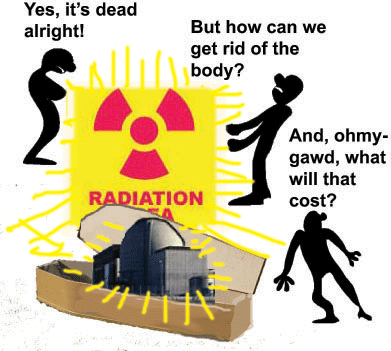 US nuclear power plant owners are currently pouring resources into efforts to circumvent the already virtually non-existent regulations for the dismantlement and decommissioning of permanently closed nuclear reactors.
And sad to say, many on the US Nuclear Regulatory Commission (NRC), the industry’s ever compliant lapdog, are trotting happily by their side.
There is an occasional lone critic. NRC Commissioner Jeff Baran, observed that the“NRC does not currently have regulations specifically tailored for this transition from operations to decommissioning. As a result, licensees with reactors transitioning to decommissioning routinely seek exemptions from many of the regulations applicable to operating reactors.”
The inevitable result is that reactor owners will successfully avoid spending money now on decommissioning as they seek to delay beginning the actual cleanup work for the next half century and maybe longer. Later, when it comes time to finish the job, the owners – and the money – could well be long gone.
US reactor owners rely on ‘decommissioning trust fund’ investments to pay for decommissioning activities. But these are failing to accrue adequate funds to do the job. Many of the trusts are incurring annual losses on their investments.
In fact, the US Government Accountability Office (GAO) has found the NRC’s financing formula for decommissioning trust funds to be fundamentally flawed, resulting in the utilities ability to accrue only 57% to 75% of the needed funds……..http://www.theecologist.org/News/news_analysis/2987679/us_nuclear_industrys_plan_thanks_to_nrc_let_taxpayers_carry_the_can_for_closed_power_plants.html
India to sell nuclear reactors to Bangladesh (But what if Bangladesh is under water before long?)

 India, Bangladesh power ties with 21st-century nuclear deal Times of India Indrani Bagchi| TNN | May 15, 2016, NEW DELHI: India has concluded a nuclear agreement with Bangladesh in a sign that the bilateral neighbourhood relationship is becoming special. …..The nuclear agreement is a three-document package that has been negotiated between the MEA and the Bangladesh department of science and technology over the past few months……
True costs of nuclear-generated electricity hidden for decades
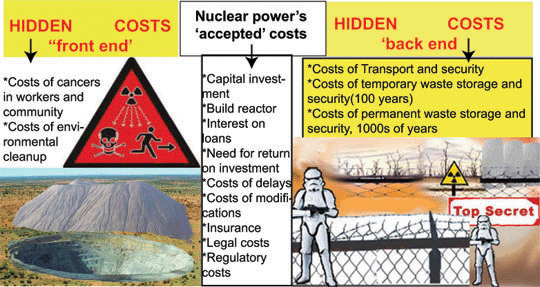
US nuclear industry’s plan thanks to NRC: let taxpayers carry the can for closed power plants, Ecologist Linda Pentz Gunter13th May 2016 “…….Using Vermont Yankee (a relatively small 620 MWe reactor) as an example, the decommissioning cost estimate in 2015 was $1.2 billion and rising. At the same time, Entergy, the plant’s owner, had just $625 million on hand.
In early May, Entergy was reprimanded (but not fined) by the NRC for violating “federal regulations last year when it prematurely took money out of the Vermont Yankee decommissioning trust fund to cover planning expenses associated with the handling of spent nuclear fuel at the closed reactor”, the Times Argus reported.
Another factor in the current struggle to pay for decommissioning is rooted in a decades-long practice by utilities of omitting the costs of decommissioning from electricity bills in order to artificially lower rates and stay competitive in the market.
Rather than preserve decommissioning trust funds for actual decommissioning work, utilities are now asking the NRC to let them raid the funds for activities outside the parameters of the reactor decommissioning process. These activities include the payment of taxes and the protracted management of orphaned nuclear waste left on site.
In addition, while at the same time delaying the start of decommissioning, the utilities have requested and received exemptions from the NRC that allow them to eliminate radiological emergency planning and drastically reduce on-site security around hundreds of tons high-level nuclear waste, all in the name of saving money.
“The Nuclear Regulatory Commission appears to be complicit in this process and is in fact providing a significant hidden subsidy to the nuclear industry when it looks the other way by allowing public trust funds to be raided in violation of the Code of Federal Regulations”, writes Arnie Gundersen of Fairewinds Associates in a document submitted to the NRC.
Gundersen, along with other groups including my own – Beyond Nuclear – have filed comments to the NRC as part of an arcane and convoluted process known as an ‘Advanced Notice of Proposed Rulemaking on Decommissioning.’ The public comment period closed on March 18, 2016.
A years long Rulemaking is underway because reactor owners are asking to streamline what were site-specific exemptions and have them issued generically instead, and across the board, without any opportunity for public review or comment. This essentially eliminates public transparency in the decommissioning process.
It further seeks to save the corporation from spending any of its electricity production profits on the costs of safety and security oversight the companies claim are no longer needed once the reactor stops power production and is defueled………..http://www.theecologist.org/News/news_analysis/2987679/us_nuclear_industrys_plan_thanks_to_nrc_let_taxpayers_carry_the_can_for_closed_power_plants.html
Russia joins the throng desperate to sell nuclear radioactive trash to Britain
 Russia’s state-owned nuclear group keen to break into UK market Rosatom understood to be hoping to revive plans to build reactors in Britain if EDF proposals for Hinkley Point C fail, Guardian, Terry Macalister, 14 May 16, A Russian nuclear group is hoping that the potential meltdown of French plans to build new European pressurised reactors at Hinkley Point could offer an opportunity to break into the British nuclear market.
Deeper concerns about the future of the Somerset scheme were raised by the French energy minister, Ségolène Royal, who warned of the “colossal” cost, which EDF admitted could be £18bn or even £21bn.
Recent talks have been held between state-owned Russian nuclear group Rosatom and the UK’s Nuclear Decommissioning Authority (NDA) despite the chilly political relations between London and Moscow over Ukraine, Moscow sources claimed.
These discussions centred on whether Russia could help Britain with removal of uranium from old reactors – but Rosatom is understood to have a wider agenda of trying to resuscitate earlier plans to build its own reactors in Britain.
“There is still an appetite to enter the UK market,” said a senior Russian nuclear industry source who claimed Rosatom’s London-based representatives still maintained contacts with the Department ofEnergy and Climate Change…….
The Russians accept that sanctions and other political considerations make it difficult for such a plan to progress, but they point out that Rosatom still supplies uranium to UK and US nuclear plants.
The NuDA confirmed that it had held a series of talks with Rosatom. “We have met with them. We are a recognised global authority and we meet with a lot of organisations,” said a spokesman……..
China wants to use Britain as a showcase for its Hualong technology and agreed to take a third share in EDF’s Hinkley scheme in return for being allowed to proceed with Chinese-owned technology at Bradwell……..
Those worries were given extra weight with Royal’s comments in an interview with the Financial Times in which she said: “I am wondering if we should go ahead with the project. The sums involved are colossal.”
And they added to fears about the future of the Somerset project earlier this week when the company’s management was pilloried by shareholders at its annual general meeting and credit agency Moody’s downgraded EDF debt.
John Sauven, Greenpeace’s executive director, said the downgrading was just “a long line of massive red flag warnings” the UK government had received over the Hinkley nuclear project. He added: “Hinkley power station must not become ‘too big to fail’ because of politicians’ egos that are too big to back down.” http://www.theguardian.com/uk-news/2016/may/13/russias-state-owned-nuclear-group-keen-to-break-into-uk-market
Sparks flew at Electricite de France’s AGM: EDF has €37 billion of debt
nuClear News No 85 May 16“…….Sparks were flying at EDF’s Annual General Meeting on 12th May as EDF employees were given a chance to air their views and grill the company’s board, which remains divided on whether to go-ahead with HPC. In the run up to the meeting EDF announced that the contingency needs of HPC could increase the cost by about £3bn to £21bn.Reasons NOT to back Britain’s Hinkley nuclear power project
 nuClear News No 85 May 16“…… there is anywhere between 4 and 18 months to develop the argument for an alternative to building HPC.
Unexpectedly, California Public Utilities Commission re-opens case of ratepayers funding Dan Onofre nuclear shutdown
 Public Utilities Commission reopens San Onofre case, Admits they “undermined public confidence in the agency”, San Diego reader By Don Bauder, May 9, 2016 In a surprise move, the California Public Utilities Commission today (May 9) reopened the 2014 agreement by which ratepayers got stuck with $3.3 billion of costs related to the sudden closing of the San Onofre nuclear plant. It became known as “the rape of the ratepayer” because management errors, such as those causing the San Onofre shutdown, should be charged to shareholders, not ratepayers.
The utilities regulator also banned all ex parte (one-sided) meetings with decision-makers or commissioners. As representatives of ratepayers expressed shock, past secret meetings between brass of Southern California Edison and commissioners came to light, clearly showing that the decision to plunk the burden of paying for San Onofre on ratepayers was reached through a series of clandestine, unreported meetings.
Up to now, ex parte meetings have been permitted as long as they were quickly revealed to all parties. The announcement today referred to the most infamous of those meetings — a Warsaw, Poland, huddle between former CPUC president Michael Peevey and Edison executive Stephen Pickett at which Peevey essentially sketched the strategy for fleecing ratepayers. The secret huddle was in 2013 and Edison did not report it until 2015. The commission in December noted eight such violations by Edison. This clandestine coziness “undermined public confidence in the agency,” said the commission today — a laughably euphemistic way of stating the situation…….http://www.sandiegoreader.com/news/2016/may/09/ticker-utilities-commission-reopen-san-onofre-case/#
Governments and individuals can prevent banks from investing in nuclear weapons
 Governments are talking about divestment, and it’s something you can do too.
If you have a bank account, find out if your bank invests in nuclear weapon producing companies. You can either look at our website and see if your bank is listed, or you can ask your bank directly. We found that a few people, asking the same bank about questionable investments, was enough to get that bank to adopt a policy preventing them from having any relationship with nuclear weapon producing companies.
Nuclear Weapons Are Scary — But We Can Do Something About Them, http://www.huffingtonpost.com/susi-snyder/nuclear-weapons-are-scary_b_9947542.html The World Post, Susi Snyder Nuclear Disarmament Programme Manager for Pax in the Netherlands 05/13/2016 Nuclear weapons are scary. The risk of use by accident, intention or terror. The climate consequences. The fact that they are designed and built to vaporize thousands of people with the push of a button. Scary. Fortunately, there is something we can do.
We know that nuclear weapons are scary, but we must be much louder in defining them as unacceptable, as illegitimate. By following the money, we can cut it off, and while this isn’t the only thing necessary to make nuclear weapons extinct, it will help.
That’s why we made Don’t Bank on the Bomb. Because we want to do something about nuclear weapons. Investments are not neutral. Financing and investing are active choices, based on a clear assessment of a company and its plans. Any financial service delivered to a company by a financial institution or other investor gives a tacit approval of their activities. To make nuclear weapons, you need money. Governments pay for a lot of things, but the companies most heavily involved in producing key components for nuclear warheads need additional investment — from banks, pension funds, and insurance companies — to sustain the working capital they need to maintain and modernize nuclear bombs.
We can steer these companies in a new direction. We can influence their decision making, by making sure our own investments don’t go anywhere near nuclear weapon producing companies. Continue reading
1 This Month




PLEASE OPPOSE HR 8255 AND S.3639 – bills would accelerate satellite deployment, with no environmental review or safeguards – https://ncstd5li.quorum.us/campaign/169331/
To see nuclear-related stories in greater depth and intensity – go to https://nuclearinformation.wordpress.com
-
Archives
- September 2026 (330)
- August 2026 (330)
- July 2026 (355)
- June 2026 (287)
- May 2026 (306)
- April 2026 (356)
- March 2026 (251)
- February 2026 (267)
- January 2026 (308)
- December 2025 (358)
- November 2025 (359)
- October 2025 (375)
-
Categories
- 1
- 1 NUCLEAR ISSUES
- business and costs
- climate change
- culture and arts
- ENERGY
- environment
- health
- history
- indigenous issues
- Legal
- marketing of nuclear
- media
- opposition to nuclear
- PERSONAL STORIES
- politics
- politics international
- Religion and ethics
- safety
- secrets,lies and civil liberties
- spinbuster
- technology
- Uranium
- wastes
- weapons and war
- Women
- 2 WORLD
- ACTION
- AFRICA
- Atrocities
- AUSTRALIA
- Christina's notes
- Christina's themes
- culture and arts
- Events
- Fuk 2022
- Fuk 2023
- Fukushima 2017
- Fukushima 2018
- fukushima 2019
- Fukushima 2020
- Fukushima 2021
- general
- global warming
- Humour (God we need it)
- Nuclear
- RARE EARTHS
- Reference
- resources – print
- Resources -audiovicual
- Weekly Newsletter
- World
- World Nuclear
- YouTube
-
RSS
Entries RSS
Comments RSS

