Actu Environnement 12th July 2017 The Nuclear Safety Authority (ASN) considers that the EDF file concerning the financing of its decommissioning costs “does not provide sufficient
information to enable it to take a position on the completeness of the
assessment”.
It would like the electrician to explain his calculations and
reconsider certain assumptions. It also considers it necessary for EDF to
present the reactor-to-reactor decommissioning assumptions, rather than an
overall cost estimate extrapolated from the study of a site.
This is themain conclusion of an ASN opinion on the financing of long-term nuclear
loads by French operators published on Wednesday 12 July. This opinion
comes as the level of provisions made up by EDF to cover the dismantling of
its reactors is questioned.
In February, a report from the NationalAssembly estimated that the dismantling costs calculated by EDF revealed a”plausible underestimation”. MEPs criticized among other things “the
optimistic assumptions [and] a number of heavy expenses neglected”.
Unlikemost operators of nuclear installations, EDF does not present an
installation-by-facility assessment. ASN can not therefore analyze the
electrician’s file accurately. For the time being, EDF is relying on the
“DA09” study, which assesses future loads by extrapolating a dismantling
scenario for the four 900-megawatt reactors at the Dampierre (Loiret)
plant. An audit requested by the ministry in charge of energy validated the
method in 2015.
However, the ASN refuses to rule on the accuracy of this
figure since it did not have access to study DA09 or to auditing. In this
case, the Nuclear Constable does not, as a matter of principle, oppose an
assessment to the entire fleet of an assessment based on the dismantling of
a reactor, but it wishes to have access to the documents before making a
decision. Before validating EDF’s estimates, ASN wants to study precisely
two points: the hypotheses considered for the dismantling of the Dampierre
reactor and the extrapolation method at each reactor. https://www.actu-environnement.com/ae/news/asn-refuse-valider-evaluation-finaniere-demantellement-edf-29383.php4
Russia offers India latest third-generation reactors for post-Kudankulam nuclear project, First Post , 11 July 17 Moscow: Russia has offered India the latest “Generation 3-plus” nuclear reactor —the VVER-1200 — powered by advanced fuel, to be set up at a yet-to-be designated site in parallel to the ongoing 6,000 MW Kudankulam project in Tamil Nadu……
Both countries have agreed on a second nuclear power project to follow Kudankulam, which envisages the construction of six reactors of the earlier generation VVER type of 1,000 MW capacity each. The VVER-1200 has 20 percent more capacity than the VVER-1000.
Both countries have agreed on a second nuclear power project to follow Kudankulam, which envisages the construction of six reactors of the earlier generation VVER type of 1,000 MW capacity each. The VVER-1200 has 20 percent more capacity than the VVER-1000.
“We are ready to enhance our cooperation for building the next six units of 1,200 MW capacity each at a second site in India with respective commitment for localisation and secured long-term fuel supply,” Evgeny Pakermanov, president of Rusatom Overseas, a subsidiary of the state atomic energy corporation Rosatom, which is constructing the Kudankulam Nuclear Power Plant (KNPP), told IANS…….
During Prime Minister Narendra Modi’s visit to Moscow in December 2015, India and Russia signed an agreement for the latter to construct 12 nuclear reactors at two sites in India, Kudankulam being one of them.
Following talks with Modi, Russian President Vladimir Putin had said in a statement: “We have agreed on India’s assigning another plot for the construction of Russian power units, where we intend to use the latest VVER-1200 reactors built with the application of the latest and safest technologies.”…….
The Russian said that with two fabrication plants and four enrichment units in the country, TVEL has the wherewithal to be a reliable fuel supplier globally.
“Today, our fuel assemblies are being supplied to 15 countries… and we undertake to supply end-to-end fuel,” he said.
Elaborating on this, he said: “When concluding separate contracts, customers have to search for suppliers of enriched uranium and fabrication and have to bear at least transactional costs.”
“We offer bundled supplies, which means we can be more flexible in commercial terms.”
The localisation of Russian-designed fabrication facilities in India is a priority for the company as per the commitments it has made, Grigoryev said.
Egypt to sign nuclear power plant deal with Russia| 2017-07-12 Editor: Mu Xuequan CAIRO, July 11 (Xinhua) –– Egypt intends to finalize a deal with Russia to build four nuclear power stations in Egypt “soon,” said Minister of Parliamentary Affairs Omar Marwan on Tuesday, state-run Ahram news reported.
“The government has no intention of backtracking the deal because it’s very important to Egypt,” said Marwan in a press conference.
“The government wanted to ensure that the safety measures will be in place before signing the deal, so the stations would cause no harmful radiation in the future,” he added.
Egypt and Russia signed an agreement in 2015 to build four nuclear power stations in Egypt by 2022.
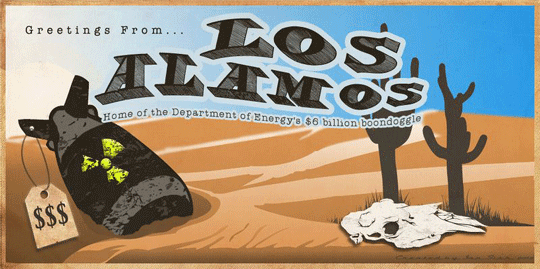
Dr. Strangelove and the Los Alamos Nuclear Fiasco, Farming out the nuclear arsenal turned out to be radioactive. The American Conservative , By KELLEY BEAUCAR VLAHOS • July 13, 2017 WASHINGTON — It’s no secret that federal bureaucracy can be inefficient, wasteful and dysfunctional, but when the cumulative effect of mistakes at a major nuclear weapons laboratory starts resembling a Three Stooges shtick, it’s anything but funny. It’s dangerous.
Despite being a major component (and birthplace) of the U.S. nuclear weapons program, the lab is not (mis)managed solely by the federal government. The longstanding problems at the New Mexico campus, which include enough safety and security lapses to make one’s hair curl, have taken place under the stewardship of a private global construction giant, Bechtel Corporation, which leads the public-private partnership called Los Alamos National Security LLC. This also includes the University of California, which botched its own 62-year management of the lab but was taken on as a partner anyway. Two other private contractors—BWX Technologies and Washington Group International (now AECOM)—form the rest of the enterprise, which beat out other major privateers, such as Lockheed Martin, for the $2.2 billion contract in 2006.
Bechtel, the largest civil engineering and construction contractor in the United States, brought in an annual revenue stream of $32.3 billion as of 2015. It raked in billions of military contracts during the Iraq and Afghanistan wars, scooping up a $680 million deal to “rebuild” only a month after the initial invasion of Iraq in 2003. Despite a long record of cost-overruns, mismanagement, environmental violations, and even fraud in its many war and domestic contracts, Bechtel has soared on to bigger and better things, today holding an unprecedented $10 billion contract to build Saudi Arabia’s first underground transportation system in Riyadh, and a planet full of other projects, including those involving the U.S. nuclear arsenal.
The Los Alamos partnership is destined to be just a footnote in the company’s 120-year history, however. In fact, Bechtel’s stewardship was so bad the consortium is losing its contract in 2018 and the National Nuclear Security Administration (NNSA), the semi-autonomous part of the Department of Energy that oversees the development and modernization of the nation’s nuclear warheads, officially started the bid process for the new contract in late June.
The question is if privatizing the industry proved less safe and more expensive than a government run operation, will another private contractor be any better? Furthermore, seeing how the DOE, NNSA—even the U.S. Congress—fell down in its oversight responsibilities, who can be confident that the government can turn this lab, or any other that has been farmed out to industry, around?
“The management problems at Los Alamos National Laboratory are so deep and structural, there’s a lot of blame to go around, and they won’t be fixed by picking one contractor over another. The entire contracting arrangements need to be completely rethought and congressional oversight committees need to do their duty,” says Greg Mello, director of the Los Alamos Study Group, an Albuquerque-based non-profit that since 1989 has been relentless in its pursuit to cast sunlight on the lab’s activities, including its contract and program boondoggles and security breaches.
“There has been little accountability for mistakes for literally hundreds of fiascos and goofball management decisions,” Mello told TAC last week. “We have to start with parsing the elements of the mission and the presumption that a lot of people can get rich while doing very little work at a federal nuclear weapons laboratory. The culture of Los Alamos is deeply arrogant and to bring back a culture of public service and intellectual integrity will require more institutional examination than has ever happened.”……..
But what about cost? The move toward privatization was supposed to save taxpayers money but as the watchdogs point out, it’s done anything but. As the Santa Fe New Mexican reported early this year, the management fee incurred by the government increased from $8 million in 2005 to $80 million by 2010, while the number of upper-level managers making more than $200,000 a year tripled.
Just as bad are the lab’s boondoggles. As TAC reported in 2011, a facility that was supposed to increase pit (the cores of a nuclear weapon) production to 80 pits a year (per congressional mandate) ballooned to $6 billion in projected costs and spent $500 million in the planning phase before it was cancelled amid widespread criticism. That didn’t stop the lab from embarking on a new plan, one that is expected to cost $3 billion despite all of the aforementioned safety problems that already exist and have yet to be fixed.
Lydia Dennett, an investigator with the Project on Government Oversight says she has little confidence a new contractor will do any better after the Bechtel gang leaves town. There are less than two dozen contractors in this field, and they have all worked together in some configuration or another, even on the current contract. The big ones have their lobbyists in Washington to help pull the strings. She points to Lockheed Martin, which got a mere ‘slap on the wrist’ for using federal funds to lobby Washington for no-bid contracts, which is illegal. It still manages the Sandia National Laboratory to the tune of $2.4 billion a year.
“I don’t see any of these concerns changing just because there is a changing of the guard,” she tells TAC. “What needs to happen is the DOE needs to get more engaged in its management and oversight role.” She said the lack of accountability has been appalling, taking nearly a decade before Bechtel was penalized. “They got a lot of leeway and a lot of chances before the government stepped in and said, ‘enough.’ How much are taxpayers paying for before the government says, ‘enough’’’?
Mello points out that without stronger government oversight, a change in the lazy, pass-the-buck culture, and a true ‘free market’ approach that breaks up the small number of contractors’ grip on the industry and makes them truly accountable, the status quo will remain.
“In the absence of such a profound self-examination the only conclusion we can make is that Los Alamos cannot be reformed, it’s just going to be a mess,” he said. “And it will be just a matter of time before there’s more accidents, more project management failures, hundreds if not billions wasted.”
New York Times 12th July 2017, A decision by South Korea’s new president to scrap plans for more domestic
nuclear power plants will make it harder for the country to sell reactors
to buyers overseas, experts warn.
State-run Korea Electric Power Corp (KEPCO) is building the first of four nuclear plants in the United Arab
Emirates in an $18.6 billion deal, and is scouting for more business in
Britain and other countries. But many nuclear experts doubt South Korea’s
ability to export a technology it is ditching at home after President Moon
Jae-in, who took office in May, said he would scrap plans to build new
domestic reactors.
South Korea is the world’s fifth-biggest user of nuclear energy and KEPCO, which has built more than 20 reactors at home, vies withthe likes of France’s EDF and Toshiba’s Westinghouse unit in the niche but
fiercely competitive nuclear export market. KEPCO’s international nuclear
project team is working to keep its export business alive. “We are
focussing on the UK market, but also on Saudi Arabia, South Africa and
Iran,” said Jong-hyuck Park, chief nuclear officer at KEPCO at a recent
industry event in London.
KEPCO is also in talks with Japan’s Toshiba to
buy a stake in Britain’s NuGen nuclear project, aiming to use its own
reactor design. “The company (KEPCO) aims to finish the due diligence
process by August or September…. and it will take more time to look into
South Africa,” said a source with direct knowledge of the matter who
declined to be identified as he was not authorised to speak to media.
NuGen, planned for Moorside in northwest England, was thrown into doubt
after Westinghouse declared bankruptcy and its partner in the project,
France’s Engie, pulled out. A KEPCO spokesman said the company is awaiting
government guidelines on nuclear exports. https://www.nytimes.com/reuters/2017/07/12/business/12reuters-southkorea-nuclear-exports.html
Japan vows to ramp up efforts to export renewable energy technology, July 13, 2017 (Mainichi Japan), TOKYO (Kyodo) — Foreign Minister Fumio Kishida pledged Thursday that Japan will aggressively pursue the export of renewable energy technologies to tap into growth spurred via the worldwide transition to clean energy sources necessitated by the onset of climate change.
Emphasizing that energy demand will only grow in China and Southeast Asia, Kishida noted in a message read to a symposium hosted by the ministry in Tokyo that “Japan’s environmental technologies will greatly contribute to Asian nations’ (transition).”
Calling climate change a “common challenge worldwide,” Kishida noted that Japan is a signatory to the Paris Agreement, the global effort to reduce greenhouse gas emissions through member nations setting voluntary targets. The accord entered into force in November 2016.
In Fukushima, Japan is currently pursuing the production of hydrogen from renewable sources for use in fuel cells, part of a broader plan to help the prefecture rebuild from the March 2011 quake-tsunami disaster and nuclear accident.
“We will develop Japan’s state-of-the-art technologies in energy-poor countries and regions and contribute to the improvement of energy security,” Kishida added.
However, some analysts have voiced concern that Japan has lagged behind China and the United States in the production of renewable energy, with Prime Minister Shinzo Abe’s government preferring to restart nuclear reactors under pressure from the business sector……https://mainichi.jp/english/articles/20170713/p2g/00m/0bu/078000c
This year will go down with 1979 (Three Mile Island), 1986 (Chernobyl) and 2011 (Fukushima) as one of the nuclear industry’s worst ever ‒ and there’s still another six months to go, writes Dr Jim Green.
Two of the industry’s worst-ever years have been in the past decade and there will be many more bad years ahead as the trickle of closures of ageing reactors becomes a flood ‒ the International Energy Agency expects almost 200 reactor closures between 2014 and 2040. The likelihood of reactor start-ups matching closures over that time period has become vanishingly small.
In January, the World Nuclear Association anticipated 18 power reactor start-ups this year. The projection has been revised down to 14 and even that seems more than a stretch. There has only been one reactor start-up in the first half of the year according to the IAEA’s Power Reactor Information System, and two permanent reactor closures.
Pro-nuclear journalist Fred Pearce wrote on May 15: “Is the nuclear power industry in its death throes? Even some nuclear enthusiasts believe so. With the exception of China, most nations are moving away from nuclear ‒ existing power plants across the United States are being shut early; new reactor designs are falling foul of regulators, and public support remains in free fall. Now come the bankruptcies…. The industry is in crisis. It looks ever more like a 20th century industrial dinosaur, unloved by investors, the public, and policymakers alike. The crisis could prove terminal.”
The most dramatic story this year has been the bankruptcy protection filing of US nuclear giant Westinghouse onMarch 29. Westinghouse’s parent company Toshiba states that there is “substantial doubt” about Toshiba’s “ability to continue as a going concern”. These nuclear industry giants have been brought to their knees by cost overruns ‒estimated at US$13 billion ‒ building four AP1000 power reactors in the U.S.
The nuclear debate in the US is firmly centred on attempts to extend the lifespan of ageing, uneconomic reactors with state bailouts. Financial bailouts by state governments in New York and Illinois are propping up ageing reactors, but a proposed bailout in Ohio is meeting stiff opposition. The fate of Westinghouse and its partially-built AP1000 reactors are much discussed, but there is no further discussion about new reactors ‒ other than to note that they won’t happen.
Six reactors have been shut down over the past five years in the US, and another handful will likely close in the next five years. How far and fast will nuclear fall? Exelon ‒ the leading nuclear power plant operator in the US ‒ claims that “economic and policy challenges threaten to close about half of America’s reactors” in the next two decades. According to pro-nuclear lobby group ‘Environmental Progress‘, almost one-quarter of US reactors are at high risk of closure by 2030, and almost three-quarters are at medium to high risk. In May, the US Energy Information Administration released an analysis projecting nuclear’s share of the nation’s electricity generating capacity will drop from 20 per cent to 11 per cent by 2050.
There are different views about how far and fast nuclear will fall in the US ‒ but fall it will. And there is no dispute that many plants are losing money. More than half in fact, racking up losses totalling about US$2.9 billion a year according to a recent analysis by Bloomberg New Energy Finance. And a separate Bloomberg report found that expanding state aid to money-losing reactors across the eastern US may leave consumers on the hook for as much as US$3.9 billion a year in higher power bills.
Japan
Fukushima clean-up and compensation cost estimates have doubled and doubled again and now stand at US$191 billion. An analysis by the Japan Institute for Economic Research estimates that the total costs for decommissioning, decontamination and compensation could be far higher at US$443‒620 billion.
Only five reactors are operating in Japan as of July 2017, compared to 54 before the March 2011 Fukushima disaster. The prospects for new reactors are bleak. Japan has given up on its Monju fast breeder reactor ‒ successive governments wasted US$10.6 billion on Monju and decommissioning will cost another US$2.7 billion.
As mentioned, Toshiba is facing an existential crisis due to the crippling debts of its subsidiary Westinghouse. Toshibaannounced on May 15 that it expects to report a consolidated net loss of US$8.4 billion for the 2016‒2017 financial year which ended March 31.
Hitachi is backing away from its plan to build two Advanced Boiling Water Reactors in Wylfa, Wales. Hitachi recentlysaid that if it cannot attract partners to invest in the project before construction is due to start in 2019, the project will be suspended.
Hitachi recently booked a massive loss on a failed investment in laser uranium enrichment technology in the US. A 12 May 2017 statement said the company had posted an impairment loss on affiliated companies’ common stock of US$1.66 billion for the fiscal year ended 31 March 2017, and “the major factor” was Hitachi’s exit from the laser enrichment project. Last year a commentator opined that “the way to make a small fortune in the uranium enrichment business in the US is to start with a large one.”
France
The French nuclear industry is in its “worst situation ever” according to former EDF director Gérard Magnin. France has 58 operable reactors and just one under construction.
French EPR reactors under construction in France and Finland are three times over budget ‒ the combined cost overruns for the two reactors amount to about US$14.5 billion.
Bloomberg noted in April 2015 that Areva’s EPR export ambitions are “in tatters“. Now Areva itself is in tatters and is in the process of a government-led restructure and another taxpayer-funded bailout. On March 1, Areva posted a €665 million net loss for 2016. Losses in the preceding five years exceeded €10 billion.
In February, EDF released its financial figures for 2016: earnings and income fell and EDF’s debt remained steady at €37.4 billion. EDF plans to sell €10 billion of assets by 2020 to rein in its debt, and to sack up to 7,000 staff. The French government provided EDF with €3 billion in extra capital in 2016 and will contribute €3 billion towards a €4 billioncapital raising this year. On March 8, shares in EDF hit an all-time low a day after the €4 billion capital raising was launched; the share price fell to €7.78, less than one-tenth of the high a decade ago.
Costs of between €50 billion and €100 billion will need to be spent by 2030 to meet new safety requirements for reactors in France and to extend their operating lives beyond 40 years.
EDF has set aside €23 billion to cover reactor decommissioning and waste management costs in France ‒ just over half of the €54 billion that EDF estimates will be required. A recent report by the French National Assembly’s Commission for Sustainable Development and Regional Development concluded that there is “obvious under-provisioning” and that decommissioning and waste management will take longer, be more challenging and cost much more than EDF anticipates.
In 2015, concerns about the integrity of some EPR pressure vessels were revealed, prompting investigations that are still ongoing. Last year, the scandal was magnified when the French Nuclear Safety Authority (ASN) announced that Areva had informed it of “irregularities in components produced at its Creusot Forge plant.” The problems concern documents attesting to the quality of parts manufactured at the site. At least 400 of the 10,000 quality documents reviewed by Areva contained anomalies. Work at the Creusot Forge foundry was suspended in the wake of the scandal and Areva is awaiting ASN approval to restart the foundry.
French environment and energy minister Nicolas Hulot said on June 12 that the government plans to close some nuclear reactors to reduce nuclear’s share of the country’s power mix. “We are going to close some nuclear reactors and it won’t be just a symbolic move,” he said.
India
Nuclear power accounts for just 3.4 percent of electricity supply in India and that figure will not rise significantly, if at all. In May, India’s Cabinet approved a plan to build 10 indigenous pressurized heavy water reactors (PHWR). That decision can be read as an acknowledgement that plans for six Westinghouse AP1000 reactors and six French EPR reactors are unlikely to eventuate.
The plan for 10 new PHWRs faces major challenges. Suvrat Raju and M.V. Ramana noted: “[N]uclear power will continue to be an expensive and relatively minor source of electricity for the foreseeable future…. The announcement about building 10 PHWRs fits a pattern, often seen with the current government, where it trumpets a routine decision to bolster its “bold” credentials. Most of the plants that were recently approved have been in the pipeline for years. Nevertheless, there is good reason to be sceptical of these plans given that similar plans to build large numbers of reactors have failed to meet their targets, often falling far short.”
South Africa
An extraordinary High Court judgement on April 26 ruled that much of South Africa’s nuclear new-build program is without legal foundation. The High Court set aside the Ministerial determination that South Africa required 9.6 gigawatts (GW) of new nuclear capacity, and found that numerous bilateral nuclear cooperation agreements were unconstitutional and unlawful. President Jacob Zuma is trying to revive the nuclear program, but it will most likely be shelved when Zuma leaves office in 2019 (if he isn’t removed earlier). Energy Minister Mmamoloko Kubayi said on June 21 that South Africa will review its nuclear plans as part of its response to economic recession.
South Korea
South Korea’s new President Moon Jae-in said on June 19 that his government will halt plans to build new nuclear power plants and will not extend the lifespan of existing plants beyond 40 years. President Moon said: “We will completely re-examine the existing policies on nuclear power. We will scrap the nuclear-centred polices and move toward a nuclear-free era. We will eliminate all plans to build new nuclear plants.”
Since the presidential election on May 9, the ageing Kori-1 reactor has been permanently shut down, work on two partially-built reactors (Shin Kori 5 and 6) has been suspended pending a review, and work on two planned reactors (Shin-Hanul 3 and 4) has been stopped.
Taiwan
Taiwan’s Cabinet reiterated on June 12 the government’s resolve to phase out nuclear power. The government remains committed to the goal of decommissioning the three operational nuclear power plants as scheduled and making Taiwan nuclear-free by 2025, Cabinet spokesperson Hsu Kuo-yung said.
UK
Tim Yeo, a former Conservative politician and now a nuclear industry lobbyist with New Nuclear Watch Europe, saidthe compounding problems facing nuclear developers in the UK “add up to something of a crisis for the UK’s nuclear new-build programme.”
The lobby group noted delays with the EPR reactor in Flamanville, France and the possibility that those delays would flow on to the two planned EPR reactors at Hinkley Point; the lack of investors for the proposed Advanced Boiling Water Reactors at Wylfa; the acknowledgement by the NuGen consortium that the plan for three AP1000 reactors at Moorside faces a “significant funding gap”; and the fact that the Hualong One technology which China General Nuclear Power Corporation hopes to deploy at Bradwell in Essex has yet to undergo its generic design assessment.
The only reactor project with any momentum in the UK is Hinkley Point, based on the French EPR reactor design. The head of one of Britain’s top utilities said on June 19 that Hinkley Point is likely to be the only nuclear project to go ahead in the UK. Alistair Phillips-Davies, chief executive officer of SSE, an energy supplier and former investor in new nuclear plants, said: “The bottom line in nuclear is that it looks like only Hinkley Point will get built and Flamanville needs to go well for that to happen.”
There is growing pressure for the obscenely expensive Hinkley Point project to be cancelled. The UK National Audit Office report released a damning report on June 23. The Audit Office said: “The Department for Business, Energy and Industrial Strategy’s deal for Hinkley Point C has locked consumers into a risky and expensive project with uncertain strategic and economic benefits… Today’s report finds that the Department has not sufficiently considered the costs and risks of its deal for consumers…. Delays have pushed back the nuclear power plant’s construction, and the expected cost of top-up payments under the Hinkley Point C’s contract for difference has increased from £6 billion to £30 billion.”
Writing in the Financial Times on May 26, Neil Collins said: “EDF, of course, is the contractor for that white elephant in the nuclear room, Hinkley Point. If this unproven design ever gets built and produces electricity, the UK consumer will be obliged to pay over twice the current market price for the output…. The UK’s energy market is in an unholy mess… Scrapping Hinkley Point would not solve all of [the problems], but it would be a start.”
EDF said on June 26 that it is conducting a “full review of the costs and schedule of the Hinkley Point C project” and the results will be disclosed “soon”. On July 3, EDF announced that the estimated cost of the two Hinkley reactors has risen by €2.5 billion (to €23.2 billion, or €30.4 billion including finance costs). In 2007, EDF was boasting that Britons would be using electricity from Hinkley to cook their Christmas turkeys in December 2017. But in its latestannouncement, EDF pushes back the 2025 start-up dates for the two Hinkley reactors by 9‒15 months.
Oliver Tickell and Ian Fairlie wrote an obituary for Britain’s nuclear renaissance in The Ecologist on May 18. Theyconcluded: “[T]he prospects for new nuclear power in the UK have never been gloomier. The only way new nuclear power stations will ever be built in the UK is with massive political and financial commitment from government. That commitment is clearly absent. So yes, this finally looks like the end of the UK’s ‘nuclear renaissance’.”
Switzerland
Voters in Switzerland supported a May 21 referendum on a package of energy policy measures including a ban on new nuclear power reactors. Thus Switzerland has opted for a gradual nuclear phase out and all reactors will probably be closed by the early 2030s, if not earlier.
Germany will close its last reactor much sooner than Switzerland, in 2022.
Sweden
Unit 1 of the Oskarshamn nuclear power plant in Sweden has been permanently shut down. Unit 2 at the same plant was permanently shut down in 2015. Ringhals 1 and 2 are expected to be shut down in 2019‒2020, after which Sweden will have just six operating power reactors. Switzerland, Germany and Taiwan have made deliberate decisions to phase out nuclear power; in Sweden, the phase out will be attritional.
Russia
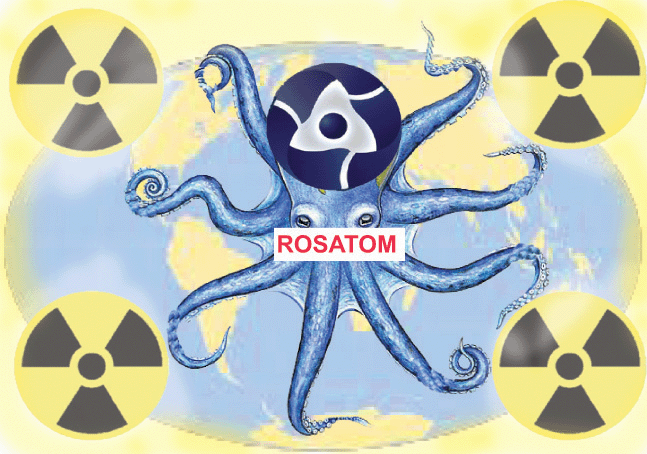
Rosatom deputy general director Vyacheslav Pershukov said in mid-June that the world market for the construction of new nuclear power plants is shrinking, and the possibilities for building new large reactors abroad are almost exhausted. He said Rosatom expects to be able to find customers for new reactors until 2020‒2025 but “it will be hard to continue.”
China
With 36 power reactors and another 22 under construction, China is the only country with a significant nuclear expansion program. However nuclear growth could take a big hit in the event of economic downturn. And nuclear growth could be derailed by a serious accident, which is all the more likely because of China’s inadequate nuclear safety standards, inadequate regulation, lack of transparency, repression of whistleblowers, world’s worst insurance and liability arrangements, security risks, and widespread corruption.
Dr Jim Green is the national nuclear campaigner with Friends of the Earth, Australia, and editor of the World Information Service on Energy’s Nuclear Monitor newsletter.
Russia signs MOU for Vietnam nuclear research centre,WNN, 04 July 2017 A memorandum of understanding (MOU) has been signed by Russian state nuclear corporation Rosatom and Vietnam’s Ministry of Science and Technology on the construction of a nuclear science and technology centre in Vietnam. An inter-governmental agreement to build the centre was signed between Russia and Vietnam in 2011.
The MOU was signed in Moscow on 29 June by Rosatom director general Alexey Likhachov and Vietnam’s deputy minister of science and technology Tran Dai Thanh. The signing was witnessed by Russian President Vladimir Putin and the President of Vietnam Tea Dan Quang.
Vietnam and Russia intend to promote further cooperation in the construction of the nuclear science and technology centre, in particular to work out the next steps once the Vietnamese government approves the project’s pre-feasibility study. The MOU also provides for consultation on the terms and conditions for financing the project. In addition, the two sides will develop a plan for further cooperation in the development of Vietnam’s nuclear infrastructure.
The nuclear science and technology centre will be equipped with Russian-designed research reactors, a multipurpose cyclotron, as well as research laboratories, an engineering complex, equipment and infrastructure to ensure the safe operation of the centre. It will be used for training staff for Vietnam’s nuclear power program………
The Ninh Thuan 2 plant at Vinh Hai, on Cam Ranh Bay about 20 kilometres northeast of Phouc Dinh, was to be developed under a partnership with Japan.
Russia makes new big cuts in Arctic spending The country’s Ministry of Economic Development wanted 209 billion rubles (€3.1 billion) for the new national Arctic Program. It might get only 12 billion (€177 million). Barents Observer, By Atle Staalesen July 05, 2017
The revised funding scheme for the Arctic program, which is to cover the period until year 2020, is 17 times lower than the original sum, RBC reports.
That is a serious blow to Russia’s ambitious development plans for the region. The Ministry of Economic Development originally wanted to include a number of grand investment projects in the program, among them the development of the new class of nuclear-powered icebreakers, the «Lider», as well as a fleet of vessels for Arctic environmental protection and shelf research. As much as 80 billion (€1.2 billion) was to be spent on the «Lider» alone.
None of that will come, for now. The increasingly strained Russian economy does not allow for the previously announced Arctic super-projects.
The key investment object in the revised program is the development and building of an ice-class drifting platform for Arctic research. The platform, which will get the name «North Pole», is to be used by the State Hydrometeorology Service for Arctic studies and ice measurements.
The platform has a preliminary price tag of seven billion rubles and will consequently consume more than half of the program budget.
The platform is increasingly needed by researchers as Arctic ice layers are getting thinner and traditional drifting ice stations can no longer be applied, the Russian Ministry of Natural Resources says.
Amid decreasing world demand for nuclear energy, Russia’s state nuclear corporation last week warned it would likely be receiving fewer requests to build nuclear power plants abroad. July 3, 2017 by Charles Digges, The announcement marks a sharp departure for the corporation, which until recently has posed its contracts with other countries as the bread and butter of its bottom line – as well as a potent tool for broadening Moscow’s sphere of political influence.
But there’s a silver lining to the nuclear monolith’s recent disillusionment with its traditional lifeblood: A possible, albeit modest, shift in the direction of renewable energy and battery technologies.
Speaking at last month’s Tekhnoprom-2017 conference, a technical conference in the Siberian city of Novosibirsk, Rosatom’s deputy director Vyacheslav Pershukov called the market for nuclear power stations abroad “exhausted.” “We see that the market is contracting, and for the sustainable growth of the corporation…we must make our money on something other than nuclear technology,” he said, according to the RBK news agency.
His remarks dovetail with a worldwide nuclear sag.
In the United States, renewable energy output eclipsed nuclear for the first time during March and April. Meanwhile, huge nuclear corporations are trying to stave off going broke. Exelon, the country’s biggest nuclear operator, has seen its share prices plummet by 60 percent since 2008.
Westinghouse, meanwhile filed for bankruptcy in March, and Toshiba, its parent company, is trying to sell of its computer divisions to cover the debt. France’s Areva was saved from financial peril by a huge taxpayer infusion into its owner EDF, but that bailout will only stop the bleed the company is experiencing thanks to huge cost overruns on an ambitious but delayed reactor build in Finland.
Pershukov told the Tekhnoprom conference that Rosatom would shift some of its efforts to providing nuclear power plant services abroad, primarily to those it’s in the process of building.
For the past several years, Rosatom has touted its VVER-1200 reactor packages to international capitols and has worked vigorously to sign up customers even – if not especially – those who can barely afford it. On paper, the company has $130 billion in outstanding “memoranda of understanding” and other handshake type deals with foreign countries.
But many of the counties Rosatom counts among its potential contracts – like Jordan, Algeria, Nigeria and Bolivia, and most recently Uganda and Ethiopia – won’t have infrastructure to support nuclear power for decades.
In other cases, like Hungary, the Rosatom-built Paks-2 plant has been approved, but will leave Budapest’s right wing-government heavily indebted to Moscow for the $10 billion plant.
Another similar deal would have indentured South Africa to Rosatom for $76 billion, but that country’s high court torpedoed the deal before it got off the ground.
Other countries where Rosatom builds are already underway – like India’s Kudankulam, Iran’s Bushehr, China’s Tianwan and Belarus’s Ostrovets – are already familiar with Rosatom’s typical cost overruns and delays.
The company can pay for these huge loans because of the generous state subsidies it receives, but taxpayer injections are slated to dry up by 2020.
Oskar Njaa, a nuclear adviser with Bellona said curtailing Rosatom’s international nuclear ambitions represents a humbling moment for the company, and a dampening of its political influence abroad. “This is an economic blow,” he said. “For Russia, reducing an ability to make other countries dependent on Moscow’s nuclear fuel and expertise for energy needs is a blow to its geopolitical interests as well.”
As such, Rosatom is casting a wide net for other avenues of influence and revenue. In May, the company appeared in Chile’s Lithium Call Roadshow, and is reportedly pursuing inroads with Santiago to become a player in cell phone and electric car batteries. Other reports say the company is making a foray into fiber-optics.
More optimistically, Njaa noted, the company also seems to have discovered a bent for the renewable energy sector. He noted Rosatom’s recent interest in small hydroelectric plants and wind energy.
EON’s Old Nuclear Money Spinners Are Now Just a Big Hassle, Bloomberg, By Weixin Zha and Tino Andresen, 4 July 2017,
Brokdorf reactor halt has cost more than 100 million euros
Utility awaiting regulatory approval after February outage
An EON SE nuclear plant that made billions for the German utility is now losing money.
Essen-based EON is battling repeated delays to production at its Brokdorf reactor that has cost the company more than 100 million euros ($114 million) since halting in February, the utility said by email. The unit is now scheduled to start July 19.
Brokdorf, a 1.4-gigawatt reactor capable of powering 2.8 million homes, is offline after regulators raised concerns about oxide layers on fuel rods discovered when the unit stopped for maintenance. EON has submitted its examination results to the regulator and is awaiting approval to restart.
EON, which last year separated its conventional power plant business into a new company called Uniper SE, still operates three atomic plants including the 31-year-old Brokdorf facility. EON had to keep the nuclear business after the government made plant operators permanently liable for decommissioning costs under the nation’s plan to exit atomic power.
“For the market, it will be an issue if Brokdorf still wasn’t available in the fall,” said Lueder Schumacher, an analyst at Societe Generale SA in London.
EON transferred on Monday its share of 24 billion euros that the government demanded from utilities into a fund that will pay for costs related to the final storage of radioactive waste.
Brokdorf’s outage contributed to a 20 percent drop in EON’s first quarteradjusted net income to 525 million euros, the utility said in May.
Paladin Energy enters administration, WNN, 03 July 2017Paladin Energy Ltd has today appointed administrators after it was unable to agree a delay to the repayment of $277 million it owes Electricité de France (EDF). The administrators will continue to operate the company on a business-as-usual basis until further
Western Australia-based Paladin in February announced plans for a balance sheet restructuring to enable it to meet debts due in April, after plans to sell a 24% stake in the Langer Heinrich uranium mine in Namibia to China’s CNNC Overseas Uranium Holdings failed to progress. The sale of a 30% stake in the Manyingee project in Western Australia to Avira Energy Ltd (formerly MGT Resources), announced at the same time as the CNNC sale in July 2016, also failed to complete.
CNNC, which already owns a 25% joint venture equity stake in the Namibian project, subsequently began a process that could lead to it exercising an option to acquire all of Paladin’s share of Langer Heinrich. This led to the proposal in May of an alternative restructuring plan by Paladin, as the original plan had assumed the company would retain an ongoing interest in its Namibian flagship project.
Paladin is due to pay EDF $277 million by 10 July under a long-term supply agreement signed in 2012. The company said it had approached EDF to grant a “standstill” agreement, which would allow time for the alternative restructure proposal to be implemented. Although terms had been negotiated they had not been signed.
Atomic Bellyflop: America’s 1st ’21st Century Nuclear Reactor’ Fails, Shuts Down After 5 Months bureauEnviroNews DC News Bureau ,byJulia Travers July 3, 2017
Energy Post 27th June 2017,The introduction of renewables auctions in Germany, replacing administratively set feed-in premiums, has led to considerably lower prices and very high realization rates. However, community participation was very low in the first solar PV auctions.
Now a new rule favouring community projects in onshore wind auctions turned out to be so attractive that most
bidders created community projects to profit from them. This is turning the
market upside down. Corinna Klessmann and Silvana Tiedemann of consultancy Ecofys, a Navigant company, look at the effects of auctions on the German renewables markets and make recommendations. http://energypost.eu/germanys-first-renewables-auctions-are-a-success-but-new-rules-are-upsetting-the-market/
“The Memorandum of understanding between Rosatom State Atomic Energy Corporation and the Ministry of Science and Technology of the Socialist Republic of Vietnam on a plan of the implementation of a project for construction Nuclear Science and Technologies Center in Vietnam”, the document reads.
The announcement came following a meeting of Russian President Vladimir Putin and President of Vietnam Tran Dai Quang.


 six reactors of the earlier generation VVER type of 1,000 MW capacity each. The VVER-1200 has 20 percent more capacity than the VVER-1000.