 UAE delays launch of first nuclear power reactor, REUTERS By Jane Chung and Geert De Clercq | SEOUL/PARIS, 4 May 17 The commercial start-up of the first of four nuclear reactors that South Korea’s KEPCO is building in United Arab Emirates is set to be delayed because the local operating company is not ready to run the reactors, a nuclear industry source said.
Barakah is one of the world’s few major nuclear newbuild contracts, which Korea Electric Power Corporation(KEPCO) won in 2009, beating a rival consortium led by more established French reactor maker Areva……
a source familiar with the situation said that Nawah – the joint venture between the Emirates Nuclear Energy Corporation (ENEC) and KEPCO that will operate the plant – is struggling to get an operating license, which could delay the start-up of the first plant by several months, possibly to the end of this year……
construction of Shin Kori No.3 reactor [in South Korea] was delayed three years due to a safety scandal in late 2012, and the reactor only became operational in December 2016.
A source with direct knowledge of the situation told Reuters that because of the delay on Shin Kori No.3, UAE nuclear regulator FANR was not ready to give Nawah its operating license and wanted to postpone this “regardless of the construction schedule.”…….
Low oil prices are also making the start-up of the plant less urgent from the UAE perspective, the source added.
ENEC and Nawah did not respond to several requests for comment. KEPCO declined to comment.
A second source in the nuclear industry who is not directly involved in the Barakah project, said nuclear fuel had been shipped to UAE but was not being loaded into the reactor as Nawah does not yet have a license.
For years, Nawah has been training staff in power plant operation, but to get an operating license it needs to demonstrate it has the necessary management skills and can master all the systems needed to operate the reactors.
“It is not a simple undertaking. There will be some Korean staff, but they can only be in the back seat, not the front seat. The reactor has to be operated by the licensee’s staff,” the industry source said.
For KEPCO, a delay of the project increases its indirect costs, as it will force it to keep its staff of about 21,000 in the UAE for longer, the first source said……..(Reporting by Jane Chung in Seoul, Geert De Clercq in Paris and Stanley Carvalho in Abu Dhabi; Writing by Geert De Clercq, editing by David Evans) http://www.reuters.com/article/us-kepco-emirates-nuclearpower-exclusive-idUSKBN1801ZD
May 5, 2017
Posted by Christina Macpherson |
business and costs, employment, United Arab Emirates |
Leave a comment
A New Era for Iran: Trade With EU Grows 79 Percent on Nuclear Deal Implementation http://www.albawaba.com/business/new-era-iran-trade-eu-grows-79-percent-nuclear-deal-implementation-970660 May 4th, 2017 Iran’s exports to the European Union have increased by over 300 percent after the implementation of the historic 2015 nuclear agreement between Iran and the P5+1 group of countries, European Climate Action and Energy Commissioner Miguel Arias Canete says.
Speaking at the first-ever Iran-EU Business Forum on Sustainable Energy in Tehran on Saturday, Canete added that trade between Iran and the union showed 79 percent boost following the implementation of the nuclear deal, known as the Joint Comprehensive Plan of Action (JCPOA), IRNA reported.
According to figures released by the European Union’s statistics agency Eurostat in February, Iran’s exports to the EU stood at €5.494 billion in 2016 as compared to €1.235 in 2015 due to the EU resuming oil imports from Iran following the nuclear deal.
Canete expressed the 28-nation bloc’s keenness to cooperate with Iran in the nuclear energy sector and said the JCPOA prepared the ground for the resumption of Iran-EU cooperation.
The commissioner reiterated the EU’s support for the nuclear agreement and said Iran and the union started to cooperate with each other in different sectors in 2016 and managed to sign many agreements.
He urged both sides to continue to upgrade their cooperation and expressed hope that the ongoing forum in Tehran would lay the ground for interaction in clean energy. He noted that he would help European firms make more investment in Iran.
Under the agreement, limits were put on Iran’s nuclear activities in exchange for, among other things, the removal of all nuclear-related bans against the Islamic Republic.
Following the conclusion and implementation of the JCPOA, Iran and EU member states launched cooperation and signed several agreements in various fields.
More than 50 European companies and business associations and some 40 Iranian energy companies are participating at the Tehran forum with the purpose of enabling business relations and partnerships between Iran and the EU and laying the ground for further cooperation and joint partnerships in the energy sector.
It will provide a platform for investors and businesses to look into investment opportunities for clean energy, renewable energy efficiency and energy conservation actions in Iran.
May 5, 2017
Posted by Christina Macpherson |
business and costs, EUROPE, Iran, politics international |
Leave a comment
 NIA sets out six priorities for Euratom exit, WNN03 May 2017 The UK government needs to work closely with industry to bring about replacement arrangements for the European Atomic Energy Community (Euratom) in a timely manner for the country’s nuclear industry, the Nuclear Industry Association (NIA) says in a position paper published today. The NIA represents more than 260 companies including nuclear power station operators, new build developers and vendors, those engaged in decommissioning, waste management, all aspects of the nuclear fuel cycle, supply chain and consultancy companies.
The NIA said its paper, Exiting Euratom, sets out the priority areas for negotiations with the European Commission as the UK ceases to be a full member of the Euratom community alongside the process to leave the European Union. It also sets out the steps the government needs to take “to avoid serious disruption to normal nuclear business” in the UK and across the EU…….
The NIA has listed six key steps it wants the government to take:
- agreeing a replacement Voluntary Offer Agreement with the International Atomic Energy Agency for a new UK safeguards regime;
- replacing the Nuclear Co-operation Agreements (NCA) with key nuclear markets – Australia, Canada, the Euratom Community, Kazakhstan, South Korea and the USA;
- clarifying the validation of the UK’s current bilateral NCAs with Japan and other nuclear states;
- setting out the process for the movement of nuclear material, goods, people and services;
- agreeing a new funding arrangement for the UK’s involvement in Fusion 4 Energy and wider EU nuclear R&D programs; and maintaining confidence in the industry and securing crucial investment.
The London-based trade association said addressing these priority areas will enable the nuclear sector to continue its work with other countries, both within and outside the continuing EU, as the UK ceases to be a member of the EU. Given the amount to be concluded within the next 22 months, however, there is a risk that new arrangements will not be in place, the NIA said……. http://www.world-nuclear-news.org/NP-NIA-sets-out-six-priorities-for-Euratom-exit-03051701.html
May 5, 2017
Posted by Christina Macpherson |
business and costs, UK |
Leave a comment

 With Renewables Surging, Nuclear And Petroleum Battle Over Subsidies, Forbes, Jeff McMahon , 4 May 17 If the petroleum industry continues to fight subsidies for nuclear power, the nuclear industry will go after petroleum-industry tax breaks, the president of the Nuclear Energy Institute said Tuesday.
“They might say, oh don’t subsidize this, but let me tell you, you open up the books and you might not call it a subsidy but I tell you there’s a lot of tax breaks that the American Petroleum Institute gets,” said Maria Korsnick, president and CEO of NEI, the leading nuclear industry lobbying group.
“If in fact that’s the playing field that we’re going to be set with, then you’re going to hear more about comparisons of subsidies vs. tax breaks in order to get all the information, if you will, out on the table.”The American Petroleum Institute, the largest lobbying group for oil and gas companies like ExxonMobile and Chevron, has lobbied against legislative efforts in several states to save aging nuclear plants that are struggling to compete against cheap natural gas and, in some places, cheap renewable energy.
In Ohio, for example API Ohio Executive Director Chris Zeigler sent a message to state legislators:
“Abundant natural gas has provided Ohio consumers with reliable and affordable energy and created countless jobs throughout the state without government subsidies,” Zeigler said. “Instead of subsidizing nuclear power companies, we should let the markets work to protect consumers.”
API accused the nuclear industry of misleading consumers about the consequences of closing nuclear plants, arguing that natural gas would continue to lower emissions even if two Ohio plants close.
The nuclear industry has won support in New York and Illinois, with Exelon and Entergy benefitting. Lest those victories set a trend, the oil industry is raising objections in Ohio, Pennsylvania, and Connecticut…..https://www.forbes.com/sites/jeffmcmahon/2017/05/04/with-renewables-surging-nuclear-and-petroleum-battle-over-subsidies/#27185f7d4b15
May 5, 2017
Posted by Christina Macpherson |
business and costs, politics, USA |
Leave a comment
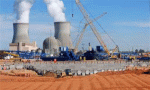 Southern Seeks $3.7 Billion From Toshiba for Georgia Nuclear Plant https://www.wsj.com/articles/southern-seeks-3-7-billion-from-toshiba-for-georgia-nuclear-plant-1493829606
Utility not sure it can finish Vogtle plant, which was being built by bankrupt Westinghouse Electric By Russell Gold May 3, 2017 The chief executive of Southern Co. on Wednesday said the utility will need $3.7 billion and cooperation from Toshiba Corp. to complete a nuclear power plant in Georgia that was being built by bankrupt Toshiba unit Westinghouse Electric Co.
But even if it obtains those commitments, Southern isn’t sure it can finish the half-built Georgia reactors, Thomas A. Fanning, Southern’s chairman and chief executive, said in an interview with… (subscribers only)
May 5, 2017
Posted by Christina Macpherson |
business and costs, USA |
Leave a comment
 How two cutting edge U.S. nuclear projects bankrupted Westinghouse, Reuters, By Tom Hals and Emily Flitter | WILMINGTON, DEL./NEW YORK, 2 May 17
In 2012, construction of a Georgia nuclear power plant stalled for eight months as engineers waited for the right signatures and paperwork needed to ship a section of the plant from a factory hundreds of miles away.
The delay, which a nuclear specialist monitoring the construction said was longer than the time required to make the section, was emblematic of the problems that plagued Westinghouse Electric Co as it tried an ambitious new approach to building nuclear power plants.
The approach – building pre-fabricated sections of the plants before sending them to the construction sites for assembly – was supposed to revolutionize the industry by making it cheaper and safer to build nuclear plants.
But Westinghouse miscalculated the time it would take, and the possible pitfalls involved, in rolling out its innovative AP1000 nuclear plants, according to a close examination by Reuters of the projects.
Those problems have led to an estimated $13 billion in cost overruns and left in doubt the future of the two plants, the one in Georgia and another in South Carolina.
Overwhelmed by the costs of construction, Westinghouse filed for bankruptcy on March 29, while its corporate parent, Japan’s Toshiba Corp, is close to financial ruin [L3N1HI4SD]. It has said that controls at Westinghouse were “insufficient.”
The miscalculations underscore the difficulties facing a global industry that aims to build about 160 reactors and is expected to generate around $740 billion in sales of equipment in services in the coming decade, according to nuclear industry trade groups.
The sector’s problems extend well beyond Westinghouse. France’s Areva is being restructured, in part due to delays and huge cost overruns at a nuclear plant the company is building in Finland………
the source of the biggest delays can be traced to the AP1000’s innovative design and the challenges created by the untested approach to manufacturing and building reactors, according to more than a dozen interviews with former and current Westinghouse employees, nuclear experts and regulators.
Unlike previous nuclear reactors, the AP1000 would be built from prefabricated parts; specialized workers at a factory would churn out sections of the reactor that would be shipped to the construction site for assembly. Westinghouse said in marketing materials this method would standardize nuclear plant construction..…..
By 2016 Westinghouse began to grasp the scope of its dilemma, according to a document filed in its bankruptcy: Finishing the two projects would require Westinghouse to spend billions of dollars on labor, abandoning them would mean billions in penalties.
Westinghouse determined it could not afford either option. http://www.reuters.com/article/us-toshiba-accounting-westinghouse-nucle-idUSKBN17Y0CQ
May 3, 2017
Posted by Christina Macpherson |
business and costs, technology, USA |
Leave a comment
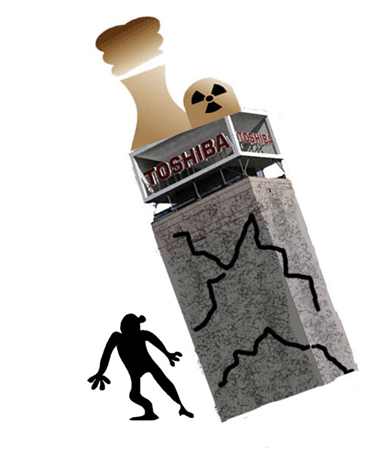 http://breakingenergy.com/2017/05/02/toshiba-to-split-into-four-subsidiaries/ By MICHAEL VINCIon May 02, 2017 Early this year, Toshiba made the strategic decision to divest from its Westinghouse nuclear power generator in America. Now, the Chinese company has decided that splitting into subsidiaries is the only way to protect its other businesses. The four subsidiaries will be (1) infrastructure (including water treatment and railways); (2) energy (including thermal and nuclear power); (3) electronics (including data storage); (4) information and communications.
With the exception of the new energy subsidiary, the rest of the spin-offs would come into being in July 2017. Energy is set to be in effect in October.
The significant of the bankruptcy of Westinghouse is still unclear – many are concerned that the shutdown will have an effect on the nuclear power sector. As the four new subsidiaries demonstrate, the ramifications of this bankruptcy are clearly having their way with Toshiba.
On the eve of the imminent bankruptcy, Moody’s Investors Service
changed their outlook on all five utility companies involved in the project. Each was given a negative outlook.
The measures taken by Moody’s apply to the Vogtle entities. That is, Georgia Power, Oglethorpe Power and the Municipal Electric Authority of Georgia. Also included are the entities of the Summer project. Specifically, SCANA Corp. and the South Carolina Electric and Gas Subsidiary, as well as to the South Caroline Public Service Authority.
Moody’s justifies the new outlook as being reflective of the increased credit and regulatory risk that will be a result of the bankruptcy. The depleted financial condition of Toshiba contributes to this risk. In February, the company took a $6.3 billion write-down associated with Westinghouse’s overrun costs at the two nuclear projects in America.
Now, the bankruptcy has left Toshiba with what can amount to billions of dollars in potential losses. This presents serious struggles for the nearly 150 year old conglomerate. After the bankruptcy was announced, Toshiba shares in Tokyo stumbled nearly 4%. Moreover, losses from last year left the company with $2.1 billion of negative shareholder equity, which threatens its position on the Tokyo Stock Exchange.
More immediate concerns for the company include the expiration of construction licenses, which are needed to sell equipment to the power industry. Unfortunately, the licenses have to be renewed every five years, but require that the company meet certain equity and capital targets. Toshiba’s weakened state jeopardizes the renewal process.
Some of Toshiba’s other revenue streams offer products such as turbines for gas, hydro, and geothermal plants. These power sector products are important to the company, and so the decision to create the subsidiaries is largely to protect those businesses from the potential fall out regarding the Westinghouse bankruptcy. Otherwise, the bankruptcy might end up being a roadblock to engaging in the power sector further.
With regards to the nuclear industry, the bankruptcy has the potential to threaten the completion of two current reactor projects in progress in the Southeast. Further, there is practically zero change that any new nuclear facility in the U.S. will be built in the foreseeable future.
Simply put, nuclear facilities are no longer cost effective. They were intended as an alternative to dirty fossil fuels and expensive green energy, but neither of those are as problematic as they used to be. It seems as if the industry has no prospects left.
May 3, 2017
Posted by Christina Macpherson |
business and costs, Japan |
Leave a comment
Utility’s mistakes might be ours to pay http://www.ajc.com/news/opinion/readers-write-may/rlDY9xschJoqXhxcIRO6LL/, DON MCADAM, SANDY SPRINGS, 2 May 17
Ratepayers in Georgia paid in advance for Georgia Power’s multibillion-dollar gamble on two new nuclear reactors at plant Vogtle. We were told at the time that it was in our best interest to pay up front. But much of the money we paid up front actually was realized as profit for shareholders. Maybe that helps explain why Southern Company’s stock price has risen about 60 percent since work began in 2009.
In December of last year, the Public Service Commission decided that ratepayers should pay for almost all of the accumulated overages. Those overcharges amounted to billions of dollars. And now, the entire project might be scrapped. The PSC’s Tim Echols jumps into action. According to Echols, someone other than Georgia Power should pay for Georgia Power’s mistakes. Ratepayers should never have had to pay for this fiasco. Maybe Echols finally realizes this. So now he’s begging for a bailout from our federal government.
May 3, 2017
Posted by Christina Macpherson |
business and costs, USA |
Leave a comment
Deadline dodged, Southern, SCANA weigh wresting nuclear plants from Westinghouse, Utility Dive, Gavin Bade@GavinBade Peter Maloney@TopFloorPower , 2 May 17
Dive Brief:
- Southern Company and SCANA reached interim agreements with nuclear developer Westinghouse on Friday to continue construction on two nuclear plants as the developer works through bankruptcy proceedings.
- SCANA and Santee Cooper, South Carolina’s state-owned utility, agreed to an extension of an interim agreement with Westinghouse that will see the contractor continue construction on the V.C. Summer nuclear plant through June 26.
- Southern Co. subsidiary Georgia Power also extended its construction agreement with Westinghouse on the Vogtle nuclear plant, but only until May 12. Both construction agreements were slated to expire at midnight on Friday, and the companies will use the extra time to evaluate if they should take control of construction from Westinghouse.
Dive Insight:
The utility teams building nuclear reactors in Georgia and South Carolina were scrambling Friday as they addressed the end of 30-day agreements with bankrupt Westinghouse Electric, the contractor for those plants.
Officials at SCANA and Santee Cooper, which are building two reactors at the V.C. Summer nuclear station in South Carolina, reportedly said they would use the time to evaluate whether to take control of the project from Westinghouse or abandon it……..
Westinghouse’s bankruptcy has raised deep doubts over the fate of the only two new nuclear plants to be built in the United States in 30 years. Both nuclear projects are years behind schedule and billions of dollars over budget, which helped push Westinghouse into bankruptcy at the end of March and prompted parent company Toshiba to plan a split into four separate subsidiaries.
Both projects are also working against a Dec. 31, 2020, in-service deadline to be eligible for a $0.018/kWh federal production tax credit. Last week, SCANA officials told analysts that extending the deadline for those incentives could be key to completing the projects. http://www.utilitydive.com/news/deadline-dodged-southern-scana-weigh-wresting-nuclear-plants-from-westing/441578/
May 3, 2017
Posted by Christina Macpherson |
business and costs, USA |
Leave a comment
 CSIR proposes excluding nuclear http://www.iol.co.za/business-report/energy/csir-proposes-excluding-nuclear-8920098
 2 May 2017 Johannesburg – For the latest Integrated Resource Plan for Electricity in South Africa, IRP 2016, the Council for Scientific and Industrial Research (CSIR) proposes a “Least Cost”, unconstrained scenario, or a “Decarbonised” scenario, both of which exclude nuclear power in the electricity mix to 2050.
This is the executive summary of the full submission and response by the CSIR to the Draft Integrated Resource Plan for Electricity (Draft IRP 2016) issued by the South African Department of Energy in November 2016, for comment and input from relevant stakeholders and the general public by end March 2017.
The CSIR is the national scientific and industrial research facility of South Africa, reporting to the South African Department of Science and Technology.
Click here to download the full CSIR response, study and report
Executive summary
by Jarrad G. Wright, Tobias Bischof-Niemz, Joanne Calitz, Crescent Mushwana, Robbie van Heerden and Mamahloko Senatla, CSIR
As defined in the Electricity Regulation Act, 2006; the Department of Energy (DoE), the system operator and the National Energy Regulator of South Africa (NERSA) are responsible for the development of the Integrated Resource Plan (IRP) as a plan for the electricity sector at the national level in South Africa. The IRP broadly includes input planning assumptions (on the supply and demand side), a modelling process and scenario planning following which a base plan is derived from the least-cost generation investment requirements within the electricity sector. The primary result from the IRP is the identification of the generation capacity required (per technology) and the requisite timing in the long-term based on a set of input assumptions and predefined constraints.
The most recent approved and gazetted version of the IRP is the IRP 2010-2030. The current revision of the IRP (the Draft IRP 2016) was published by the DoE for public comment in October 2016 and includes updated input assumptions including demand forecasts, existing plant performance, supply technology costs, decommissioning schedules and newly commissioned/under construction as well as preferred bidder power generators (as part of the Renewable Energy Independent Power Producer Programme (REIPPPP) and base-load coal Independent Power Producer (IPP) program). The time horizon for the draft IRP 2016 is up to the year 2050. The plan defined some preliminary results in the form of a proposed Base Case and two other selected scenarios.
As part of the IRP update process, the DoE engages in a multi-stage stakeholder engagement process (including public engagements) to ensure all affected stakeholders are consulted including national and local government, business, organised labour and civil society. This document contains the CSIR’s formal comments on the draft IRP 2016.
The CSIR determined the least cost, unconstrained electricity mix by 2050 as input into the IRP 2016 public consultation process. A conservative approach is always taken where pessimistic assumptions for new technologies and optimistic assumptions for established technologies are always made. More specifically; conventional technologies (coal, nuclear, gas CAPEX) were as per IRP 2016, stationary storage technologies (batteries) were as per IRP 2016, natural gas fuel costs were assumed slightly more expensive than IRP 2016, solar PV was aligned with original IRP 2010 cost assumptions while wind is kept constant into the future at the latest South African REIPPPP result (by 2030/2040/2050). Job numbers were also conservative (from McKinsey study commissioned by the DoE in the context of the Integrated Energy Plan (IEP)) but adjusting upwards for coal power generation
and coal mining.
The result of this is that it is least cost for any new investment in the power sector to be solar PV, wind or flexible power. Solar PV, wind and flexible power generators (e.g. gas, CSP, hydro, biogas) are the cheapest new-build mix. There is no technical limitation to solar PV and wind penetration over the planning horizon until 2050. A >70% renewable energy share by 2050 is cost optimal, replacing all plants that decommission over time and meeting new demand with the new optimal mix.
South Africa has the unique opportunity to decarbonise its electricity sector without pain. By this, the authors mean that clean and cheap are no longer trade-offs anymore. The Least Cost scenario run is the mix that is the cheapest, emits less CO2, consumes less water and creates more jobs in the electricity sector than both Draft IRP 2016 Base Case and Carbon Budget scenarios.
In this submission, deviations from Least Cost have been quantified to inform policy adjustments. Compared to the Least Cost:
The IRP 2016 Base Case is R70-billion/year more costly, emits twice as much CO2, two and a half times more water is consumed and provides 10% less jobs by 2050.
The IRP 2016 Carbon Budget scenarion is R60-billion/year more costly, emits 15% more CO2, consumes 20% more water and provides 20% less jobs by 2050.
The Decarbonised scenario is R50-billion/year more costly, 95% decarbonised, uses 30% less water and provides 5% more jobs by 2050.
Read also: #NuclearDeal: Full judgment
The Least Cost scenario is also adaptable and resilient to a range of input assumption changes relative to other scenarios and therefore more robust against unforeseen changes in demand and cost. In addition to the detailed study performed to determine the Least Cost energy mix for South Africa, this submission includes technical aspects of power system operations and planning including transmission network infrastructure requirements and system services.
The cost of ensuring system frequency stability (sufficient system inertia) has been quantified in this submission. Connecting conventional technologies (nuclear/coal/gas) via HVDC and/or solar PV/wind to the grid reduces system inertia. This reduces the inherent stabilising effect of synchronous inertia during contingency events. Many technical solutions to operate low-inertia systems are available but the CSIR assumed a worst case using state-of-the-art technology (very high costs, no further technology and/or cost advancements) nor further increase in engineering solutions to deal with low-inertia systems. In all scenarios, the worst-case cost are well below 1% of total cost of power generation by 2050 (some scenarios are much lower than 1%).
Transmission network infrastructure was costed at a high level for selected scenarios (Base Case, Carbon Budget and Least-Cost). The high-level cost estimates for shallow and deep grid connection costs for all scenarios showed that the Least Cost scenario scenario is also R20-30 billion/yr cheaper compared to the Draft IRP 2016 Base Case and Carbon Budget case on transmission network infrastructure requirements.
Click here to download the full CSIR response, study and report
May 3, 2017
Posted by Christina Macpherson |
business and costs, politics, South Africa |
Leave a comment
 Eskom confirms that Russians will continue nuclear bid, IOL, 30 April 2017, SIYABONGA MKHWANAZI
Cape Town – The Russians will continue to prepare to bid for the nuclear-build programme, despite the decision by the Western Cape High Court to halt it.
Eskom confirmed this and awaits further directives from the government.
Friday was the deadline for all bidding companies to submit Request for Information documentation to Eskom.The court decision has also affected the deadline for the issuing of the Request for Proposals in June.
Head of Rosatom in Southern Africa, Viktor Polikarpov, told Independent Media nothing had changed with their plans to bid for the nuclear programme.
He said they would not want to comment on the case because it was a matter involving government and civil society, who took the matter to court.
Energy Minister Mmamoloko Kubayi has said she is still studying the judgment, and would not comment on whether to appeal against the court decision or not.
Kubayi will appear before MPs on Tuesday, where she will face questions on the nuclear programme.
Polikarpov said the nuclear process was not in their hands, but in the hands of the government.“We are prepared on the bidding, but much will depend on the government, how it will sort out the court issue,” he said.
Eskom spokesperson Khulu Phasiwe said the court decision had effectively nullified the process……..
He said it was clear that everything had to be nullified and started from scratch if the government still wanted to continue with the nuclear programme.
The judgment found the process followed was unlawful and unconstitutional………http://www.iol.co.za/news/politics/eskom-confirms-that-russians-will-continue-nuclear-bid-8877208
May 1, 2017
Posted by Christina Macpherson |
marketing, Russia, South Africa |
Leave a comment
Lifeline for Nuclear Plants Is Threatening Wind and Solar Power, Bloomberg by Joe Ryan April 25, 2017,
The push to save U.S. nuclear plants for the sake of fighting climate change is threatening support for the bread and butter of clean power: wind and solar. New York and Illinois have already approved as much as $10 billion in subsidies to keep struggling reactors open for the next decade as part of a plan to limit fossil fuel consumption. Lawmakers in Ohio, Connecticut and New Jersey are debating whether to do the same…….
Many environmentalists remain leery of supporting nuclear power, citing terrorism risks, the problem of dealing with spent nuclear fuel, and more. Instead of propping up struggling reactors, states should promote energy efficiency and encourage development of wind, solar and power storage, said John Coequyt, the Sierra Club’s director of climate campaigns.
Nuclear’s economic woes comes as wind and solar are starting to show they’re cheap enough to compete with traditional generators, after years of help from subsidies. …..
There are key differences between wind and solar subsidies and those for nuclear, according to clean-energy developers. Renewable energy credits have spurred an emerging industry, whereas nuclear subsidies are to preserve aging plants. And while wind and solar developers compete against each other for subsidies, those for nuclear benefit a single technology.
Market Rules
“The renewables industry has been playing by competitive market rules that have helped to produce good prices,” Amy Francetic, an Invenergy senior vice president, said in an interview. “This is picking and winners and losers in a way that’s troubling.”
Propping up nuclear plans won’t be cheap. If every reactor across the northeast and mid-Atlantic wins subsidies at the same level as those New York, ratepayers would need to pay an additional $3.9 billion annually, according to Bloomberg Intelligence. The subsides are being challengedin federal court by power generators including Dynegy Inc. and NRG Energy.
“This has taken a lot of wind from the green economy’s sails,” Abraham Silverman, an attorney for NRG, said in an interview. “We see an enormous lost opportunity to invest in truly clean infrastructure.”…..https://www.bloomberg.com/news/articles/2017-04-24/lifeline-for-nuclear-in-u-s-states-seen-threatening-wind-solar
May 1, 2017
Posted by Christina Macpherson |
business and costs, politics, renewable, USA |
Leave a comment
 Time, money and taxes weigh on troubled SCANA nuclear project, http://www.bizjournals.com/charlotte/news/2017/04/28/time-money-and-taxes-weigh-on-troubled-scana.html Apr 28, 2017, SCANA Corp.’s 30-day agreement with Westinghouse Electric Co. that allows work to continue at the $16 billion V.C. Summer nuclear project expires today. But SCANA executives say they are confident that they can get a 60-day extension before time runs out.
Meanwhile, work at the site continues to go more slowly than expected, adding to the chronic delays that have driven up the project’s price tag. And SCANA (NYSE:SCG) says it is watching efforts in Congress to extend production tax credits for nuclear plants. SCANA concedes that if they are not extended, it would make it difficult to continue with the project.
Questions about the troubled expansion at Summer — plagued by cost overruns, delays and now Westinghouse’s filing for Chapter 11 protection from creditors— dominated SCANA’s earnings call Thursday. And with only a few answers available now, the questions are likely to continue for much of the coming 60 days.
As Westinghouse filed for Chapter 11 protection March 29, SCANA and Southern Co. (NYSE:SO) reached 30-day agreements with Westinghouse to keep construction work going at Summer and the Plant Vogtle nuclear project.
‘No impediments’
SCANA is using the time to determine whether it makes sense to take over construction management and try to complete the two nuclear reactors under construction, or abandon the project. During the review, SCANA is essentially paying all the contractors on the site — either directly or through disbursements to Westinghouse.
But SCANA officials did not expect to be able to complete the review by now. From the start, the company said it would need another 30 to 60 days.
Chief Operating Officer Steve Byrne expressed confidence that extension, for 60 days, is forthcoming.
“As of right now — and there are always a lot of last minute details to be taken care of — we don’t see any impediments … to having an agreement in place sometime by either later today or tomorrow,” he told analysts Thursday.
But no deal was announced yesterday, and the current agreement expires at midnight.
April 29, 2017
Posted by Christina Macpherson |
business and costs, USA |
1 Comment
 Solar juggernaut marches on as costs continue to fall http://reneweconomy.com.au/solar-juggernaut-marches-costs-continue-fall-47153/ [good graphs] By Sophie Vorrath on 24 April 2017 The global solar market looks set to continue on its trajectory of extraordinary growth, driven by further reductions in the costs of the technology, and a possible post-Trump “gold rush” that is brewing in the US.
The onward march of the solar juggernaut has been predicted by global investment group Deutsche Bank, whose latest report bumped up its 2017 estimate for total demand to 82GW, from a previous forecast of 74GW.
This has certainly been the pattern of recent decades, with dramatic growth rates of PV consistently beating – and sometimes smashing – analyst predictions. And while Deutsche Bank and other analysts continue to flag a slow-down in the market’s near future, it is not expected to happen this year, mainly due to stronger growth forecast for China.
“We are raising our 2017 global demand estimate from 74GW to 82GW, mainly due to expectations of stronger growth in China (from 17GW to 25GW),” the Deutsche Bank report says.
A similar adjustment was made earlier this month by US-based GTM Research, which replaced a projected -7 per cent global PV market contraction with a forecast of 9.4 per cent growth in its latest quarterly report, the Global Solar Demand Monitor.
GTM Research now projects that the annual global solar market’s size will reach 85 GW in 2017, slightly higher than Deutsche’s forecast – and more than double the installed capacity in 2014.
As Deutsche notes in its quarterly report, published on Friday, a good deal of this market momentum is being fuelled by falling PV technology costs, with some developers asking for less than 30c/W for solar modules in India in 2H17 and mid 20c/W in 2018.
Deutsche says this puts solar “at grid parity”, and while such low prices are not yet being offered by tier 1 Chinese suppliers, it believes a near 20 per cent reduction in poly-silicon prices will act as a catalyst for further price cuts for modules.
“Poly prices (down 17 per cent in the past seven weeks) have been declining faster than module prices as the supply chain in China has been focused on working down excess inventory,” the report says.
“We expect poly prices to approach $10-12/kg and module prices to decline to low 30c/W in 2H timeframe.”
Even in Australia, which gets no special mention in Deutsche Bank’s report, the cost of building large scale solar farms is falling to a fraction of the cost of new coal or gas plants. Indeed, according to the former head of Victoria’s Hazelwood brown coal generator, Tony Cancannon – who now heads up Reach Energy – the cost of large scale solar and storage is already competitive with gas-fired generation, and within a few years will be well below $100/MWh.
All the same, Deutsche still expects global solar demand to be “flattish” in 2018, but notes this could be countered by a final “gold rush” in the US – also driven by falling costs, from $60c/W to low $30c/W between Q3’16 and Q4’17.
“Our analysis suggests that project returns in the US could likely exceed the returns solar developers achieved in other markets during prior cycle peaks and these returns are unlikely to improve as incentives gradually decline or net metering phases out.
“As such, we expect the final “gold rush” in the US market to drive strong growth in US demand from 2018,” it says.
And as the table below illustrates [on original] , this view is supported by the strong pipeline of North American utility-scale solar projects, with roughly 8GW under development in Texas alone, and 31GW in the entire US.
But Deutsche also warns of possible speed-humps looming for global solar, such as a slow-down of growth in markets like India.
“Although declining solar module and system costs are driving significant improvement in downstream project economics in India, the pace of new solar project auctions has slowed down significantly,” the Deutsche report says.
According to the Bank’s data, project allocations in India have declined by 67 per cent to 2.9GW in FY17, while the SECI (Solar Energy Corporation of India) has also recently reduced a rooftop solar
tender from 1GW to 0.5GW.
The report puts the slow-down to difficulty securing PPAs in India, limited interest from developers, and tax increases.
“Beyond 2017, we expect overall growth in China to slow down and expect other emerging markets as well as the US to be the primary growth drivers,” the report says. “Our current estimates call for flattish demand in 2018.”
April 26, 2017
Posted by Christina Macpherson |
2 WORLD, business and costs, renewable |
Leave a comment
Most global investors recognise financial risk of climate change, report finds, Guardian, Paul Karp, 26 Apr 17, Global index reveals 60% of asset owners are now taking some action, but warns there is still ‘enormous resistance’ to managing climate risk For the first time a majority of global investor heavyweights recognise the financial risks of climate change, according to the results of a major global index rating how investors manage such risks.
But despite the advances, the Asset Owner Disclosure Project chairman, John Hewson, has warned there is still an “enormous resistance” to managing climate risk.
The AODP releases its fifth global index on Wednesday, ranking the world’s largest 500 asset owners and, for the first time, the 50 largest asset managers on their performance managing financial risks associated with climate change.
Asset owners and managers were scored on governance and strategy, portfolio carbon risk management and metrics and targets, and graded as leaders (A-AAA) rating), challengers (B-BBB), learners (C-CCC), bystanders (D-DDD) and laggards (X).
The index found that 40% of asset owners and just 6% of asset managers were classed as laggards, meaning they had a scored zero on the measures for managing and disclosing climate risks.
The report concluded that “the scales have tipped”, as 60% of asset owners are now taking some action.
Of the 500 asset owners, there are now 34 leaders, 34 challengers, 44 learners and 187 bystanders, an increase in all categories since the last year compared with laggards, which fell from 246 to 201 in number.
Australia and New Zealand were among the 10 best-performing countries, which were all in Oceania and Europe…..https://www.theguardian.com/environment/2017/apr/26/most-global-investors-recognise-financial-risk-of-climate-change-report-finds
April 26, 2017
Posted by Christina Macpherson |
2 WORLD, business and costs |
Leave a comment



 CSIR proposes excluding nuclear http://www.iol.co.za/business-report/energy/csir-proposes-excluding-nuclear-8920098 2 May 2017 Johannesburg – For the latest Integrated Resource Plan for Electricity in South Africa, IRP 2016, the Council for Scientific and Industrial Research (CSIR) proposes a “Least Cost”, unconstrained scenario, or a “Decarbonised” scenario, both of which exclude nuclear power in the electricity mix to 2050.
 nuclear-news