 Nuclear boondoggle http://www.connectsavannah.com/savannah/nuclear-boondoggle/Content?oid=4465661 Westinghouse bankrupty adds yet another setback to the already-problematic Plant Vogtle expansionBy Jim Morekisjim@connectsavannah.com
Instead, the project is still less than 40 percent complete.
Originally budgeted at about $14 billion, the expansion at Plant Vogtle is now by some estimations least $6 billion over budget and counting, with no real end in sight.
That much we already knew. But the big news last month was that the manufacturer of the reactor units themselves, Toshiba-owned Westinghouse, has put its North American operations into Chapter 11 bankruptcy.
That’s right — the company making nuclear reactors upstream of us is going bankrupt. Sweet dreams!
None of this stopped the chief executive of Georgia Power’s parent firm, Southern Company, from getting a 34 percent pay raise last week. Thomas A. Fanning is now up to $15.8 million a year.
In the meantime, since 2011 almost ten percent of your monthly power bill goes not just to pay for the Vogtle expansion, but to pay for the financing costs. That’s thanks to special legislation, the Nuclear Financing Act, passed by the state legislature and then-Gov. Sonny Perdue in 2009.
See the line on your bill that says, “Nuclear Construction Cost Recovery?” That’s what you’ve been paying to finance the Vogtle expansion in advance.
(It comes to 9.7 percent of your billed kilowatt usage, not your whole monthly charge. In South Carolina they’ve got it even worse — a planned expansion of the V.C. Summer plant north of Columbia is costing each SCE&G customer more than double what we pay each month, and they don’t even get an itemized bill.)
The Nuclear Financing Act essentially stripped rate increase oversight of this project from elected regulators at the Public Service Commission (PSC). And customers are relieving Georgia Power of virtually all financial risk of its $6.1 billion share of the project cost, including interest on borrowed funds.
It’s quite a sweetheart deal for the subsidiary of Atlanta-based Southern Co., the nation’s second-largest utility.
It gets sweeter: As we reported back in 2010, the legislation has no cap for cost overruns, and doesn’t even have a way to refund customers if the project doesn’t even get completed at all.
What the hell is going on? Sadly, not much that wasn’t predicted over ten years ago when all this began.
“Most all the concerns previously brought to the Public Service Commission are now playing out in real time,” says Stephen Smith, executive director of Southern Alliance for Clean Energy (SACE). “The utilities have totally lost credibility and now we need regulators to do their jobs.”
In 2006, Southern Co. began seeking approval to double the number of reactors at Plant Vogtle. (The first duo, Units 1 and 2, was online by the late ‘80s.)
It was to be the first expansion of nuclear energy since the Three Mile Island nuclear disaster in 1979.
By 2009 the expansion plan had received approval from the PSC. If completed, the Vogtle expansion would make it the largest nuclear plant in the United States.
In 2012 — just a year after the nuclear disaster at Fukushima, Japan — the federal Nuclear Regulatory Council approved the planned use of two Westinghouse AP1000 reactors, a design the parent company says has greater safety parameters than the General Electric reactors at Fukushima.
As of this writing, not a single AP1000 has gone online yet; the first is set to go live at a Chinese plant later this year.
Project and reactor construction delays, and Westinghouse’s financial woes, are slowing new projects in China as well.
Since the Vogtle expansion was approved, the project has experienced one setback after another, all of them underwritten by Georgia Power customers, and almost all of them predicted by environmental watchdogs and media outlets such as this one.
In a grimly symbolic incident, in 2012 a reactor vessel set to contain one of the AP1000s literally fell off a train on the way to Burke County.
News of the accident, which involved no radioactive materials, didn’t reach the public until about a month later.
“Once again PSC staff time after time predicted delays well in advance of Southern Company admitting to them,” says Sara Barczak, High Risk Energy Choices Program Director for SACE.
“Once again there are revised commercial operation dates that represent another delay in the project.”
Originally, Unit 3 was supposed to be online April 2016. Then it was moved to July 2019. Completion for Unit 3 is now estimated to be Dec. 2019. Unit 4 was supposed to be online April 1, 2017. Then it was moved to July 2019. Completion for Unit 4 is now estimated to be to Dec. 2019.
The extreme delay, combined with a complicated pending litigation issue, prompted a new settlement agreement in the closing days of 2016, to reflect the new economic reality of the ballooning financing cost to ratepayers.
“There’s been a slight change in the financing situation because of the settlement reached at the end of the year,” explains Barczak.
“Interest is still going to be collected. But once the certified capital cost is reached, instead of being collected in advance it will go into a different type of accounting process,” she says.
“But customers will still be paying for financing costs far longer than expected, and ultimately will pay far more.”
Because of the huge delay, “Financing costs ended up representing the largest cost increases,” says Barczak.
“It’s like the longer you have a credit card not paid off, the higher the interest is. The interest ends up being what kills you.”
That’s why Barczak and other environmental watchdogs are frustrated with the settlement.
“Ratepayers are just going to pay for financing longer,” she says. “Because by 2017 both reactors were supposed to be operating by now, that advance payment will not be collected. There are no capital costs in the legislation.”
The 2016 settlement now targets a completed project date of Dec. 31 2020, but few observers have much trust in that target.
“This represents a 45-month delay. PSC public interest advocacy staff testified that even using a 45 month delay date, it was unlikely the new completion date can be achieved. It would require a threefold increase in productivity,” Barczak says.
“This forces customers to continue to pay for a facility where the utility cannot accurately predict the cost, and when or even if the facility will be completed, adds Stephen Smith of SACE.
Georgia Power originally said the financing plan would save customers over $300 million in the long run. But that was based on the original, now-obsolete timeline. Any savings realized are now more than outweighed by the cost overrun.
The Westinghouse bankruptcy adds yet another, and potentially very serious, layer of uncertainty to an already very uncertain project.
“Toshiba purchased Westinghouse in 2005-2006. They had developed a reactor design that most facilities across the country decided to go with,” Barczak explains.
“What panned out just recently is that Toshiba started losing big on these projects. They lost $6.3 billion on two projects combined,” she says.
“This bankruptcy has created a worst case scenario for electric power customers in Georgia and South Carolina. There are more questions than answers at this point,” says Smith.
“We see no path forward without some additional financial pain for customers.”
The bankruptcy is particularly tricky, says Tom Clements, executive director of SRS Watch.
“The loan guarantees for the Vogtle expansion run through Southern Co., not Westinghouse. Southern is not directly related to the bankruptcy,” says Clements.
“Once the bankruptcy court starts shifting costs around, you can’t predict what will happen,” he says.
Adding a twist is the fact that most of Westinghouse’s overseas operations aren’t included in the bankruptcy proceeding — raising suspicions that they are looking for a way to back out of the Vogtle deal.
“It’s pretty clear from their filings that they’re looking to us to take over this project,” said SCANA CEO Kevin Marsh, whose company is also contracting with Westinghouse for AP1000 reactors.
All of this is a far cry from the so-called “Nuclear Renaissance” at the turn of the 21st Century, when advances in technology were supposed to relieve the world of what at the time were high fossil fuel costs and an assumption of severe future scarcity.
With the Energy Policy Act of 2005 — a Bush-era initiative enthusiastically endorsed and enhanced during the Obama administration through generous loan guarantees — the future of U.S. energy looked to be a heavily nuclear one.
“After the Energy Policy Act of 2005 passed, over 30 new reactors were proposed, more than half in the Southeast,” Barczak says.
Then came the great recession of 2008, followed by a little thing called fracking.
Seemingly all of a sudden, the fossil fuel industry experienced a huge boom, both financially and in projected availability.
“We’ve seen the demise of the so-called nuclear renaissance,” says Barczak. “A lot of license applications for new nuclear plants were withdrawn.”
But not at Plant Vogtle.
At the time, the Congressional Budget Office was prophetic in its assessment of the state of the nuclear industry.
“If construction costs for new nuclear power plants proved to be as high as the average cost of nuclear plants built in the 1970s and 1980s or if natural gas prices fell back to the levels seen in the 1990s, then new nuclear capacity would not be competitive, regardless of the incentives provided by Energy Policy Act,” said a CBO report from 2008.
“Every single thing we said might happen did happen,” says Barczak. “Then Fukushima happened.”
The tsunami-induced failure of a reactor at the Fukushima Daichi plant, a disaster of such scope that its impacts aren’t fully measured six years later, wasn’t even a speed bump for the Vogtle expansion.
“We are committed to the project and completing the units on schedule and on budget,” said Southern Nuclear Co. spokesperson Beth Thomas at the time. “We’re certainly monitoring the events in Japan and our thoughts and prayers are with the people there.”
A lot of this momentum, Barczak says, it due to the unique situation of a utility building nuclear power plants with all the regulatory burden on the government, and most of the financial risk on ratepayers.
The Southeast, she says, “is in a weird situation in that we’re a regulated market but very weak on consumer protections. States like Georgia, Florida, and South Carolina all had legislators passing legislation to put extra burdens on consumers.”
The nuclear power industry, Barczak says, “isn’t exactly what you’d call a nimble industry. It can’t react to changes that sometimes happen very quickly. It’s based on the old model of, ‘OK you’re gonna have more people, so build a bigger power plant,’” she says.
“For the Southeast, if the coal paradigm seems to be going by the wayside, then we’re still in the nuclear paradigm.”
Noboby knows what happens next, though all eyes are on the bankruptcy court. With the precedent set for ratepayers to stay on the hook regardless of how much sunk cost is going into the Vogtle expansion, there is vanishing hope of a win/win solution for ratepayers.
April 12, 2017
Posted by Christina Macpherson |
business and costs, USA |
1 Comment
As noted by the Palmer Report, Trump owns stock in Raytheon, which was reported by Business Insider in 2015.
According to Trump’s financial disclosure reports filed with the FEC in 2015, his stock portfolio includes investments in technology firms, financial institutions and defense firms, including Raytheon.
On Thursday, Trump launched an attack on the al-Shayrat military airfield, used by both Syrian and Russian military forces, hitting it with 59 Tomahawk missiles manufactured by Raytheon. Trump’s attack on Syria was reportedly in response to a deadly gas attack launched by Syrian President Bashar al-Assad against his own people earlier in the week.
While the Tomahawk attack did little damage to the airfield — with the Syrian air force continuing to launch assaults from the same base on Friday — investors, sensing an increasing escalation in tensions between two countries and the possibility of war , pushed Raytheon stock up.
Since taking office, Trump has refused to divulge all of his financial information — including his income taxes — and refused to place his business and financial holdings in a blind trust allowing Trump and his family to move money and investments around as they see fit.
April 10, 2017
Posted by Christina Macpherson |
business and costs, politics, secrets,lies and civil liberties, USA |
Leave a comment
 ‘R1 trillion nuclear deal will guarantee SA junk status’ http://www.iol.co.za/news/politics/r1-trillion-nuclear-deal-will-guarantee-sa-junk-status-8565844 9 April 2017 ANA Reporter Cape Town
 – It is an undeniable fact that South Africa cannot afford, and does not need, government’s planned nuclear energy deal, the Democratic Alliance said on Sunday.
Media reports on Sunday that the nuclear deal was going full-steam ahead were extremely concerning and would essentially guarantee that South Africa would be downgraded by more ratings agencies and make recovering from this status even more difficult, DA spokeswoman Natasha Mazzone said.
Fitch Ratings stated in no uncertain terms on Friday that a key driver behind the decision to downgrade SA’s long-term foreign currency debt and long-term local currency debt to “BB+”, or “junk status”, was that “Eskom has already issued a request for information for nuclear suppliers and is expected to issue a request for proposals for nuclear power stations later this year.
The Treasury under its previous leadership had said that Eskom could not absorb the nuclear programme with its current approved guarantees, so the Treasury will likely have to substantially increase guarantees to Eskom”.
Just days before, S&P Global also downgraded South Africa to sub-investment level – “junk status”. Mazzone said the DA would ask public enterprises portfolio committee chairwoman Dipuo Letsatsi-Dub for an urgent meeting of the committee to ensure that Parliament, as a key oversight body, would fully interrogate all aspects related to the nuclear deal.
“The undeniable fact is that South Africa cannot afford, and does not need, the nuclear deal. Indeed, international ratings agencies agree and this deal has been repeatedly cited as a cause for great concern and a key factor in downgrades not only for Eskom, but the country as a whole.
“These downgrades have already and will continue to have a devastating effect on our economy. Jobs will be lost and the cost of living will increase, which will hurt the poor,” Mazzone said.
Earlier on Sunday, City Press reported that a confidential document reveals that South Africa’s nuclear-build programme kicks off in earnest in June when Eskom issues a formal request for proposals from companies bidding for the estimated R1 trillion contract.
The nuclear deal – for which Russian company Rosatom was widely considered to be the front runner – was, according to senior National Treasury officials, “directly related” to President Jacob Zuma’s axing of finance minister Pravin Gordhan and his deputy Mcebisi Jonas, the newspaper reported.
“It is well known that Gordhan was against the project as he said the country couldn’t afford it.Eskom will be issuing a request for proposals in June and that really is the beginning of procurement. Gordhan had to go because he was going to block it again,” a senior official reportedly said.
The internal Eskom document dated three days before Gordhan and Jonas were axed revealed a tight timeline for the programme that would see four plants built to provide 9600 megawatts of electricity to the country.
After the request for proposals was issued in June, the deadline for bids was September, for evaluation in December. The winning bidder would be decided in March 2018 and the contract signed between December next year and March 2019, City Press reported.
The document also revealed that most of the major nuclear contracts would be implemented through “turnkey” procurement, which Treasury officials were concerned about.
“While Treasury allows for turnkey procurement, we know that it is often used to hide corruption. Companies that are asked to deliver turnkey projects are accountable to themselves. They appoint whoever they like, however they like,” a senior official reportedly said.
Turnkey projects were when a single company was appointed to manage and deliver an entire project. The management company became responsible for appointing all contractors and service providers. This was different from an open tender that was spread over a range of different contractors appointed by the state, City Press reported.
April 10, 2017
Posted by Christina Macpherson |
business and costs, politics, South Africa |
Leave a comment
 Nuclear plant owners expand search for financial rescue, http://www.pennlive.com/news/2017/04/nuclear_plant_owners_expand_se.html By Marc Levy | The Associated Press April 09, 2017 HARRISBURG, Pa. (AP) — The natural gas boom that has hammered coal mines and driven down utility bills is hitting nuclear power plants, sending multi-billion-dollar energy companies in search of a financial rescue in states where competitive electricity markets have compounded the effect.
Fresh off victories in Illinois and New York, the nuclear power industry is now pressing lawmakers in Connecticut, New Jersey, Ohio and Pennsylvania for action. Lobbying efforts are bubbling up into proposals, even as court battles in Illinois and New York crank up over the billions of dollars that ratepayers will otherwise foot in the coming decade to keep nuclear plants open longer.
Perhaps nuclear power’s biggest nemesis is the cheap natural gas flooding the market from the northeast’s Marcellus Shale reservoir, the nation’s most prolific gas field. Meanwhile, electricity consumption hit a wall after the recession, while states have emphasized renewable energies and efficiency.
“You put all of this together and it’s a perfect storm,” said John Keeley, a spokesman for the Nuclear Energy Institute, an industry group.
Opposition to a so-called nuclear bailout is uniting rivals and the natural gas exploration industry. The potential for a hit to utility bills is drawing pushback from the AARP and manufacturers.
Subsidizing nuclear power could chill investment in lower-cost energy sources and erode competitive markets, critics say, and, with natural gas prices expected to stay low for some time, shutting down nuclear plants may have no impact on electricity bills.
For steel companies, paper companies, food processors and pharmaceutical makers whose electric bill might be their biggest expense, “a mil of an increase in a kilowatt hour turns into a lot of money,” said David Kleppinger of the Industrial Energy Consumers of Pennsylvania.
In Pennsylvania, the nation’s No. 2 nuclear power state after Illinois, it could mean propping up five nuclear plants to help feed the sprawling mid-Atlantic power grid that stretches from New Jersey to Illinois.
The owners of the 11 nuclear plants in Connecticut, New Jersey, Ohio and Pennsylvania are no small potatoes: Exelon, PSEG, FirstEnergy and Dominion, among them.
The plant owners’ strategy is similar to that in Illinois and New York: give nuclear power megawatts the kind of preferential treatment and premium payments that are given to renewable energies, such as wind and solar.
The industry’s pitch is part economic, part environmental. A plant shutting down would devastate a local economy, they say. And, nuclear waste and water consumption issues aside, zero-carbon nuclear plants are better suited than natural gas or coal to fight climate change, they say.
The claim to environmental credentials has drawn jeers from nuclear power’s traditional critics.
“When did highly carcinogenic toxic waste become green?” said Eric Epstein, a longtime nuclear power watchdog in Pennsylvania.
The most vulnerable nuclear plants are those with just one unit — such as Exelon’s Three Mile Island in Pennsylvania, where a second unit was destroyed in a partial meltdown in 1979 — or those in need of expensive upgrades, analysts say.
FirstEnergy says it could decide next year to sell or close its three nuclear plants — Davis-Besse and Perry in Ohio and Beaver Valley in Pennsylvania — unless states make them more competitive.
Exelon is warning that it could close Three Mile Island and PSEG says it won’t operate nuclear plants — it owns all or parts of all three in New Jersey and part of Peach Bottom station in Pennsylvania — that are long-term money losers.
Should nuclear power disappear, it can be replaced.
“The question is, at what cost and whether or not you can find other resources that have the same emission characteristics,” said Joe Dominguez, an Exelon executive vice president.
In the mid-Atlantic grid, it likely would be natural gas. Some 190 natural gas power projects comprising roughly 59,000 megawatts are being studied or built, according to PJM Interconnection, the grid operator. That dwarfs the grid’s nuclear capacity.
April 10, 2017
Posted by Christina Macpherson |
business and costs, politics, USA |
Leave a comment

 Ohio lawmakers weigh bailout for FirstEnergy nuclear plants, by Associated Press April 9, 2017 TOLEDO, Ohio (AP) – A bailout proposed for Ohio’s two nuclear plants would keep alive a big source of jobs and tax money but end up increasing electricity rates for FirstEnergy Corp.’s customers in the state.
It will be up to the legislature and Republican Gov. John Kasich whether to approve what would amount to a huge subsidy for the plants.
While it’s not known how much FirstEnergy’s rates could go up, the increases would be capped at 5 percent.
Exactly how much the plan would generate for the nuclear plants isn’t clear yet because it’s based on a complex formula that involves plant emissions.
Both New York and Illinois recently approved multibillion-dollar subsidies to stop unprofitable nuclear plants from closing prematurely.
Akron-based FirstEnergy says the subsidies are needed to save the Davis-Besse and Perry plants that sit along Lake Erie and make 14 percent of the state’s electricity. The company has said both might be sold even if the subsidies are approved………http://nbc4i.com/2017/04/09/ohio-lawmakers-weigh-bailout-for-firstenergy-nuclear-plants/
April 10, 2017
Posted by Christina Macpherson |
business and costs, politics, USA |
Leave a comment
Climate change action is good for the economy – and Britain is the proof, Guardian, Michael Howard,10 Apr 17 When John Major set up our global warming strategy, the doom-mongers said it would ruin living standards. New research shows how wrong they were.
Just before the Rio Earth summit 25 years ago, John Major, in whose cabinet I then served as environment secretary, made a bold prediction: reducing Britain’s carbon emissions in line with recommendations of climate science would not, he said, harm our economy: “Our initial measures … will bring a worthwhile economic payoff to the country, to business and to ordinary people.”
This was a controversial statement at a time when solar energy, for example, was a costly technology better suited to spacecraft than British rooftops. And indeed the argument can still be heard that reducing greenhouse gas emissions will ruin our economies – even that it will return us to a pre-industrial living standard.
A quarter of a century later, the approach that we took has been richly vindicated. As research published on Monday by the Energy and Climate Intelligence Unitdemonstrates, in that period the average Briton has grown richer faster than citizens of any other G7 nation; at the same time, his or her carbon footprint has fallen faster than in any other G7 nation. While it would be stretching reality to argue that Britain’s economic success has been driven by its climate change policies, no one can seriously argue any more that our climate policies have generated economic harm……..
Since 1992 science has shown us ever more clearly what “dangerous” climate change looks like. Meanwhile, evidence has been growing that a transition to a low-carbon economy is economically feasible, and will bring added benefits such as cleaner air in major cities. These two factors drove all governments to conclude the Paris agreement in 2015.
Globally, carbon emissions have remained flat for the past three years, even as the world economy has grown by 7.5%. China and India are fast reversing their previous policies of building greater fleets of coal-fired power stations. Replacing our own use of coal with gas and renewable energy has brought UK carbon emissions down to a level last seen during the general strike of 1926.
Yet neither these remarkable developments nor the Paris agreement will secure a stable climate. The latest science tells us that greenhouse gas emissions need to start declining by 2020 at the latest in order to give reasonable confidence that global warming will stay well below the 2C limit, the target governments adopted in Paris. So, having halted the once unstoppable tide, the next logical step is to reverse it – and quickly. This is the mission on which a new initiative launched by Christiana Figueres, until recently the UN’s top climate official, will embark this coming week.
Figueres is to be commended for her vision. The rationale remains exactly that which the British government put forward 25 years ago: thatunchecked, climate change presents unacceptable risks for the future. Fortunately these are not risks that we have to take. Britain has proved the doom-mongers wrong: economies can thrive while emissions fall. Now let us put our collective weight behind the Figueres initiative, and finish the job. https://www.theguardian.com/commentisfree/2017/apr/09/climate-change-good-for-economy-britain-john-major-global-warming
April 10, 2017
Posted by Christina Macpherson |
business and costs, climate change, UK |
Leave a comment
 With Westinghouse Bankruptcy, the Nuclear Energy Story Nearly Over The much touted nuclear renaissance is now over. News Click Prabir Purkayastha 07 Apr 2017
“…………The Westinghouse story is no different. Under the Bush administration, the US government declared certain subsidies for new nuclear plants. This was continued by Obama, It was to kick-start the US nuclear industry’s revival, and help GE and Westinghouse sell their “advanced” reactors. The GE had developed its ESBWR and Westinghouse its AP1000 that they claimed were 3rd generation designs. Utilising the government subsidies, two sets of plants were ordered from Westinghouse, two units in South Carolina, and two units in Georgia, at an estimated cost of $14 billion and $10 billion respectively.
Westinghouse faced enormous problems right from the beginning. A huge number of modifications had to be done, a number of vital pieces of equipment were found to be faulty, all of which led to serious cost and time over runs. This picture is no different from the other two sets of orders that Westinghouse was executing in China. It had secured two orders of two units each for AP1000 reactors for Sanmen and Haiyang plants. While the impact of the rework for the four AP1000 units in China are not known, the time overruns are clear. Instead of 2013 and 2014, these units are now scheduled for commissioning in 2018.
The two US utilities ordering the Westinghouse reactors had observed one caution. Given the nuclear industry’s history of inability to control its prices, they had signed fixed price contracts with Westinghouse. With a fixed price contract, Westinghouse could not pass on the cost of faulty equipment and its rectification to the utilities. Toshiba, which had bought a majority share in Westinghouse, was forced to take huge losses, leading finally to its withdrawal and Westinghouse filing for bankruptcy.
Westinghouse’s bankruptcy means that the utilities have now to see how these projects can be completed. They have already sunk too much money to scrap the plants. If they want to commission the plants, they will have to start absorbing the increase in costs. The utilities are already paying huge amounts for capital that has been locked up during construction and the interest charges for the loans they have taken. With the projects taking almost twice the time that Westinghouse had promised, these add up significantly in what finally the consumers have to pay for the cost of electricity…….http://www.newsclick.in/westinghouse-bankruptcy-nuclear-energy-story-nearly-over
April 8, 2017
Posted by Christina Macpherson |
business and costs, USA |
Leave a comment
While this might mean huge losses for taxpayers, the real tragedy is that financial entanglement with the project could have been avoided altogether. It’s not clear what the Department of Energy can do now to mitigate the potential for losses. In the end, the Vogtle mishap could be a very expensive way to learn what we should have known all along – the federal government cannot ignore risk when taxpayers’ money is on the lin
 The High Cost of Ignoring Risk https://www.usnews.com/opinion/economic-intelligence/articles/2017-04-06/westinghouse-bankruptcy-shows-cost-of-energy-department-ignoring-risk
The bankruptcy of a company in the midst of building two nuclear reactors could leave taxpayers on the hook. By Ryan Alexander |April 6, 2017, Last week, Westinghouse Electric Co. announced that it will be filing for bankruptcy. Westinghouse, a subdivision of Toshiba Corporation, is in the process of building two AP1000 nuclear reactors for a power plant known as Plant Vogtle in Georgia. In fact, Westinghouse is bankrupt largely because of Vogtle. The project is a mess, and thanks to the $8.3 billion worth of loan-guarantees federal taxpayers have put into the project, courtesy of the Department of Energy, we are the ones who are going to take the hit if the whole things goes belly up.
In 2008, when the project originally applied for a federally backed loan guarantee, it was estimated that the two reactors under construction would begin commercial operation in April 2016 and 2017, respectively, and cost $14.3 billion. Instead of being completed this month, the project is less than halfway done, more than 39 months behind schedule, and at least $3.3 billion over budget. Now this.
The Title XVII program at the Energy Department provides broad authority for it to guarantee loans for early commercial use of advanced technologies if there is a “reasonable” prospect of repayment by the borrower. Loan guarantees are like cosigning a loan. The government (taxpayers) are on the hook for repayment of the loans if the borrower defaults. Building a nuclear reactor – two nuclear reactors – is expensive and risky.
The amount of risk represented by a particular loan guarantee is measured in the project’s “
subsidy cost.” The higher the risk, the higher the cost that gets assigned to the guarantee. You would think a loan guarantee for a nuclear power plant – the riskiest project of all – would be assessed a pretty high price. It should have been. But the Energy Department guaranteed at least $6.5 billion of the $8.3 billion total
at a cost of $0. That is, it recorded
no potential liabilities for its guarantee of more than $6 billion in loans for the construction of two nuclear power plants.
What is even more maddening is that the inexplicable decision to pretend like there was no risk in the Vogtle project was made knowing that for years the project has been beset by problems. From mispoured cement in one of the reactor’s foundation to poorly constructed reactor parts, the project began hitting snag after snag. Deadlines were missed and costs mounted. The three major credit ratings agencies eventually downgraded the creditworthiness of all of the project partners. If taxpayers end up forking over billions of dollars to pay off Westinghouse’s loans, we can’t say we didn’t see it coming.
While this might mean huge losses for taxpayers, the real tragedy is that financial entanglement with the project could have been avoided altogether. It’s not clear what the Department of Energy can do now to mitigate the potential for losses. In the end, the Vogtle mishap could be a very expensive way to learn what we should have known all along – the federal government cannot ignore risk when taxpayers’ money is on the line.
April 8, 2017
Posted by Christina Macpherson |
business and costs, politics, USA |
Leave a comment
Another month in UK’s failing new nuclear programme nuClear News No.94 April 2017 The ongoing collapse of the Moorside nuclear project has hit the headlines. But the French nuclear industry continues to be mired in scandal as EDF starts pouring nuclear safety critical concrete at Hinkley. And now we learn that the chief executive of Wylfa Newydd developer Horizon Nuclear Power says he needs to raise cash or the Anglesey project will not go-ahead.
Moorside Collapse On 29th March 2017, Westinghouse Electric Company, a subsidiary of Japanese company Toshiba and the largest historic builder of nuclear power plants in the world, filed for Chapter 11 bankruptcy protection in the U.S. Bankruptcy Court in New York. (1)

Toshiba owns 60% of the NuGen consortium which is planning to build 3 AP1000 reactors at Moorside next to Sellafield in Cumbria. Senior figures in the UK nuclear industry told the Financial Times that Westinghouse’s bankruptcy has crystallised doubts about the project. There is now considerable doubt about whether NuGen will be able to find a new source of funding. (2)
As we reported last month the owner of 40% of the NuGen Moorside consortium, French company Engie (33% owned by the French Government) declared last December that it would like to abandon the project. (3) Now the Company has exercised its right under the NuGen consortium agreement to sell all of its shares to Toshiba in the “event of a default”. Toshiba’s decision to place Westinghouse – into bankruptcy protection qualifies as such an event. Toshiba said it would pay around $138.7m for Engie’s stake. Under its agreement with the French utility, it is required to pay at least the amount that Engie invested to acquire the stake. (4)…….
Engie is the seventh international energy utility to give up on UK new nuclear build. Over the past decade, on top of Toshiba, E-on (Wylfa), RWE Npower (Wylfa), Iberdrola (Moorside), SSE (Moorside), and Centrica (Hinkley Point) have all pulled out of developing new nuclear reactors in the UK. (6)
This leaves a very limited field of companies for the UK to approach in its hunt for a new partner for the Moorside scheme. South Korea’s KEPCO remains the most likely suitor, but Reuters reports that the giant utility won’t be rushed. It is one of few utilities remaining with global nuclear ambitions, but despite the fact that the AP1000 reactor has now received approval from the Office for Nuclear Regulation and the Environment Agency, may still want to use its own technology – the APR1400. This would delay the development by a further four to five years No2NuclearPower nuClear news No.94, April 2017 3 whilst the South Korean reactor is put through its Generic Design Assessment by UK Regulators. Greg Clark, the Business Secretary, was in Seoul for talks at the beginning of April, but offered no evidence of concrete progress in the negotiations. (7)
KEPCO would also want to know more about the causes of the problems with two new nuclear projects in the US, involving AP1000 reactor designs which brought Westinghouse to its knees. Were the problems specific to the AP1000 reactor or a classic big project issue of not having done your homework before you start digging? (8)…….
KEPCO is unlikely to be tempted into taking over the troubled Moorside nuclear project without some sort of public financing, says former energy minister and chairman of New Nuclear Watch Europe, Tim Yeo. He says they will also be hesitant to step in and save the development unless it can use its own reactor technology. “I’ve been arguing for some time that we should look at providing during the construction phase some government finance.” Yeo said this would have to be on the basis of repayments beginning as soon as the plant is generating. (10) http://www.no2nuclearpower.org.uk/nuclearnews/NuClearNewsNo94.pdf
April 8, 2017
Posted by Christina Macpherson |
business and costs, politics, politics international, UK |
Leave a comment
 Another month in UK’s failing new nuclear programme nuClear News No.94 April 2017 Who will put up the cash for Wylfa? Hitachi Ltd, the owner of Horizon nuclear, which is proposing to build two Advanced Boiling Water Reactors (ABWRs) with a total capacity of 2.7MW at Wylfa on Anglesey, is set to lose tens of billions of yen this financial year after withdrawing from a uranium enrichment joint venture in the US.
Hitachi is expected to report a 70 billion yen ($620 million) non-operating loss by the time books were closed at the end of March. The deficit is largely attributed to the joint venture GE Hitachi Nuclear Energy Inc. withdrawing from the uranium enrichment project. Hitachi no longer expects any profits from the North Carolina-based company, of which it owns 40% and the rest by General Electric. Hitachi and GE were expecting more nuclear power plants to be built when they launched the joint fuel enrichment business, but orders have been sluggish across the globe, forcing the project to be shelved. Nevertheless, Hitachi says it will be sticking with its nuclear power business and plans to proceed with its project to build Wylfa by ensuring costs are thoroughly managed. (22)
The chief executive of Horizon Nuclear, Duncan Hawthorne, says funding is the key issue to ensure the nuclear plant gets built. Wylfa Newydd would be the “showcase plant” for Horizon and Hitachi and important for the UK and Japanese Governments, which means there is huge resolve to get the project done successfully. But without the private investment and Government support the £14bn project would not happen. He said the deal that was struck for Hinkley Point would not work for Wylfa Newydd due to the fact they are private investors. Hinkley is supported by state backed Chinese and French enterprises. Hitachi are funding the project to the ‘Final Investment Decision’, with around £2.5bn of cash. He said he was very aware of the need to keep the Anglesey community behind the project, showing them what benefits the scheme could bring: “Without community support we can’t do anything.” (23)
Meanwhile Horizon has taken another major step towards delivering The Wylfa Newydd power station with the submission of its application for a nuclear site licence. A site licence is one of the main permissions Horizon will need as it looks to build and operate two ABWRs on Anglesey. Receipt of the application by the Office for Nuclear Regulation (ONR) now triggers a rigorous 19-month programme of assessment and intervention to establish whether Horizon can demonstrate it will be in control of all safety related activities on its site. (24) http://www.no2nuclearpower.org.uk/nuclearnews/NuClearNewsNo94.pdf
April 8, 2017
Posted by Christina Macpherson |
business and costs, politics, UK |
Leave a comment
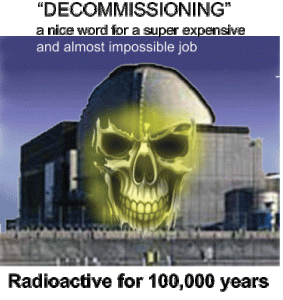 Another month in UK’s failing new nuclear programme nuClear News No.94 April 2017 EDF Finances A French Parliamentary report from the National Assembly’s Commission for Sustainable Development and Regional Development says the clean-up of French reactors will take longer, be more challenging and cost much more than French nuclear operator EDF anticipates. Whereas Germany has set aside €38 billion to decommission 17 nuclear reactors, and the UK Nuclear Decommissioning Authority estimates that clean-up of UK’s 17 nuclear sites will cost between €109‒250 billion over the next 120 years, France has set aside only €23 billion to decommissioning its 58 reactors. In other words France estimates it will cost €300 million per gigawatt (GW) of generating capacity to decommission a nuclear reactor, Germany estimates €1.4 billion per GW and the UK estimates €2.7 billion per GW.
EDF says it wants to set aside a €23 billion fund to cover decommissioning and waste storage for an estimated €54 billion final bill ‒ and the difference between these two figures will be closed through the appreciating value of its equities, bonds and investments ‒ in other words, ‘discounting’. Unfortunately, recent experience has taught us that markets can go up and down over time ‒ especially the very long-time periods involved in radioactive waste management. But for a company that has huge borrowings and an enormous debt of €37 billion, €23 billion is a large sum of money to find. Any significant change in the cost of decommissioning would have an immediate and disastrous impact on EDFs credit rating ‒ something that the debt-ridden corporation can simply not afford. EDF is already in financial trouble. Along with bailing out collapsing AREVA, EDF also has to bear the huge financial burden of the failing reactor newbuild at Flamanville. It will also have to pay for extending the life of France’s existing nuclear power stations (to 2025), at a cost of €55 billion.
On top of all this the French authority tasked with disposal of all the countries vast and increasing waste burden (Andra) has recently ramped up the estimated cost for the planned national nuclear waste repository at Cigéo, to €25 billion ‒ and EDF must pay for most of Cigéo’s construction. Although €5 billion more than EDF anticipated, it still seems a gross underestimation, and the costs are likely to rise considerably. (21) http://www.no2nuclearpower.org.uk/nuclearnews/NuClearNewsNo94.pdf
April 8, 2017
Posted by Christina Macpherson |
business and costs, decommission reactor, France, politics |
Leave a comment
Another month in UK’s failing new nuclear programme nuClear News No.94 April 2017 French nuclear scandal
EDF, Areva and the French nuclear regulator ASN have known since at least 2005 that Areva’s Creusot Forge factory was not capable of producing nuclear safety compliant components. Yet the factory has been allowed to continue manufacturing components which have now been found to contain anomalies, including the bottom and lid for the reactor pressure vessel (RPV) for the EPR at Flamanville. (12)
The French Radio Station which broke the news commented that:
“Never before has the French nuclear industry suffered such a scandal. And this case challenges the entire chain of control of a sector already shaken by the Fukushima disaster.” (13)
The Creusot Forge is under investigation by ASN after it was discovered to have produced potentially defective parts and substandard safety reports for reactors around the world. But the letters from 2005 and 2006 – obtained by France Inter – show that EDF and Areva were told by the ASN about “numerous incidents” at the facility, including “discrepancies during inspections”. This will raise serious concerns about EDF and Areva’s new nuclear project at Hinkley Point. (14)
In December 2005 ASN sent a letter to EDF alerting it to the deplorable condition of the Le Creusot plant, which was experiencing major malfunctions. Yet the lid and bottom for the RPV for the Flamanville EPR were manufactured by the Creusot Forge, in Burgundy, between September 2006 and December 2007. In August 2006 ASN asked Areva to demonstrate that the steel for these two parts was homogeneous. For seven years letters were exchanged between ASN and Areva, but no analysis was carried out. On 24th January 2014 the RPV arrived at Flamanville, and was placed in the reactor building. Nine months later Areva finally did some tests and discovered that the bottom and the lid had abnormalities. “The steel should normally contain 0.2% carbon,” explains Yves Marignac, of WISE Paris, but the concentration was 0.3%, enough to modify the mechanical properties of the steel and, in particular, to influence the temperature at which it becomes less supple and more brittle. (15)
The regulator – ASN – has been seriously at fault, according to the Observatoir du Nucleaire, since it has said nothing for many years about the criminal practices at Le Creusot. It says ASN is no less guilty than Areva and EDF because, although it was fully aware of the serious problems, it authorized EDF to install the pressure vessel in the EPR at Flamanville in December 2013. It is clear, says the website, that ASN is not able to withstand pressure from EDF and politicians who accuse them of seriously harming the industry if they enforce safety regulations. (16)
Following the discovery of manufacturing irregularities and the falsification of documents at Areva’s Creusot Forge foundry last year, French nuclear regulator ASN and several other international regulators inspected the site in early December. ASN said Le Creusot is not up to the job and did not have the right equipment to produce the parts for the nuclear reactors. “Creusot Forge is at the limit of its technical capacity. The tools at its disposal are not adequate to manufacture such huge components. In such a situation, errors are made.” (17) No2NuclearPower nuClear news No.94, April 2017 5
EDF’s oversight of AREVA, which will supply the Hinkley Point C reactors was questioned in an internal document by the UK Office for Nuclear Regulation (ONR). In an ONR report about the visit dated 16th December disclosed under a Freedom of Information request ONR said the nuclear safety culture at Creusot fell short of expectations and warned about the implications for Hinkley Point C. ONR said it has since decided to implement a series of additional inspections of EDF and its supply chain to ensure all components are manufactured to the required standard. The ONR report said after an inspection in late 2016, that an international team from France, Canada, the United States, China, Finland and Britain had concluded that the nuclear safety culture at Le Creusot Forge foundry fell short of what regulators expect from a major supplier of nuclear equipment. It added that improvement measures ordered by ASN were not yet effective and said despite the prohibition of the use of correction fluid on documents at the foundry, the inspectors found evidence of its continued use. (18)……… http://www.no2nuclearpower.org.uk/nuclearnews/NuClearNewsNo94.pdf
April 8, 2017
Posted by Christina Macpherson |
business and costs, France, secrets,lies and civil liberties |
Leave a comment
Another month in UK’s failing new nuclear programme nuClear News No.94 April 2017 The Trump administration is working to find a new owner for Westinghouse, but doesn’t want the Company to fall under Chinese control. The administration is “keenly aware” of the national security implications attached to the sale of the company, and is trying to pre-empt any possible blocking of a deal by making clear at an early stage that the US government would take a tough stance on any significant Chinese role. A US-led deal for even the profitable operations of Westinghouse could be tricky to arrange though. The only US company with substantial nuclear engineering operations is General Electric, through its joint venture with Hitachi, but its technology is different from Westinghouse’s. Westinghouse has close links to China, where it has four of its AP1000 reactors under construction. As part of the deal for those projects, Westinghouse agreed to transfer intellectual property relating to the plants. More than 75,000 No2NuclearPower nuClear news No.94, April 2017 4 documents were handed over to its Chinese customers in 2010 in the first stage of implementing that agreement. (11) http://www.no2nuclearpower.org.uk/nuclearnews/NuClearNewsNo94.pdf
April 8, 2017
Posted by Christina Macpherson |
business and costs, politics international, USA |
Leave a comment
With Westinghouse Bankruptcy, the Nuclear Energy Story Nearly Over The much touted nuclear renaissance is now over. News Click Prabir Purkayastha 07 Apr 2017 With Westinghouse announcing its bankruptcy, India’s pledge to buy at least 10,000 MW as a part of the India US Nuclear Deal and reiterated by Modi last year, should be given a decent burial. Any agreement with Westinghouse now means that India would be bailing out Westinghouse and the US nuclear industry with Indian peoples’ money.
This also draws to a close all talk about a nuclear renaissance. The three major reactor manufacturers – Toshiba-Westinghouse, GE-Hitachi and Areva, France – are all in major financial difficulties. Only a fool will still believe their promise that the 3rd generation reactors they are developing – none of which have been successfully commissioned as yet – are either safe or cheap.
The Left’s position during the India US 123 Deal was that it neither served India’s strategic interest, nor made sense in energy terms. It also meant abandoning India’s self-reliant nuclear reactor industry for importing costly and unproven US reactors. Though it failed to stop the 123 Agreement in Parliament, the Left successfully led the struggle to modify India’s Nuclear Liability Act, ensuring that nuclear suppliers, like in any other hazardous industry, should be liable for their faulty equipment.
The Fukushima disaster has shown that a nuclear accident can cost up to $200 billion . Even this could be a conservative estimate. The Indian liability law caps operator and suppliers’ liability to just $ 407 million (300 million SDR’s). Though cost of a reactor is in billions of dollars, even this small liability, only a fraction of its cost, was perceived to be too “dangerous” and unacceptable to the US suppliers.
Last year, Modi, announced during one of his US visits that not only would India buy US reactors, a continuation of the assurance given by Shivshankar Menon, the Foreign Secretary under Manmohan Singh (Letter September 10th, 2008 ), but would also assume the liabilities of the US suppliers in case of of a nuclear accident. India offered Mithi Virdi in Gujarat to Westinghouse and Kovvada in Andhra to GE as the two sites. Subsequently on GE’s failure to show any successful contract combined with local resistance in Mithi Virdi, GE’s project was considered cancelled, and its Andhra site offered to Westinghouse.
Fortunately for India, Modi’s assurances have come too late for the US nuclear industry. The much touted nuclear renaissance is now over. In OECD countries, only 7 new reactors are being built with varying degrees of state support. With huge cost and time overruns, the curse of the nuclear industry, all of them are in deep trouble. GE, unsuccessful in selling even one of its so-called advanced design, has virtually pulled out of the nuclear business. After huge and continuing losses, Areva, the French reactor supplier, is being taken over by EdF, the French state-owned energy utility. EdF has already scrapped the new Areva EPR design, with which the Finnish Olkiluoto and French Flamanville plants were being built. This is also the design Areva is trying to sell for the Jaitapur project in Maharashtra.
The major objections of the Left regarding imported reactors have been proven correct. The untried and untested designs have meant numerous changes and difficulties in construction, leading to significant delays and sharp increase in costs. The cost of the two Areva plants of Euro 3 billion each originally, have increased by almost three times .
The Westinghouse story is no different………
In the exchanges between the UPA and the Left during Manmohan Singh’s government, the cost of new nuclear plants from French or US suppliers had come up. The UPA had presented figures for capital cost per KW of $1,500 and the price of power to be Rs. 1.49 paise per unit from imported nuclear plants. The Left had given figures from Olkiluoto and the US, showing that the capital cost would be at least $4,000 per KW and the price of electricity from such plants around Rs. 5 per unit.
The figures from the US and French projects now show that the capital cost per KW for such plants is in the range of $6,000-7,000, and therefore the price per unit of electricity from such plants will not be less than Rs. 8-10 per unit.
Why did the UPA claim such absurdly low figures for nuclear energy? They were either figments of their imagination or took these figures straight from the promotional material of the nuclear suppliers. To claim nuclear energy to be competitive, the nuclear suppliers took a 60-year life of the plant, left out the interest on capital during construction as a component of the cost, and claimed their new designs had much lower capital costs. They then did what are called levellised cost calculations – the cost of electricity over the lifetime of the plant. By this sleight of hand, they reached figures for the cost of nuclear power to be competitive with coal and gas.
Of course, the actual capital costs are much higher than what the nuclear industry was claiming. The regulators and utilities that price the electricity, have also to look at all the cost components including cost of capital, interest on loans, etc., and fix the price that of electricity. What matters to consumers and utilities (distribution companies or state electricity boards) is not the levellised cost of electricity, but the entry cost of nuclear power to the grid. This is what needs to be competitive to other sources. Any such calculations shows that nuclear energy is simply not competitive.
The collapse of Westinghouse, which has either built or licensed its designs to almost half the world’s reactors, shows that the nuclear story is nearly over. The reality is that with the cost of renewables – solar photovoltaics and wind – dropping sharply, the economics are increasingly against nuclear energy. This is apart from danger of catastrophic accidents or danger from long-term storage of radioactive nuclear wastes. It may still sustain itself for some time in countries, where there is a strong indigenous nuclear industry, such as India, China, Korea and Russia. But its days are now clearly numbered. http://www.newsclick.in/westinghouse-bankruptcy-nuclear-energy-story-nearly-over
April 8, 2017
Posted by Christina Macpherson |
business and costs, India, politics, politics international, USA |
Leave a comment
 UK’s Moorside nuclear project in turmoil as Toshiba’s French partner backs out, Guardian, 5 Apr 17,
Troubled tech giant forced to take sole ownership of NuGen after Engie sells stake, adding to uncertainty over plan for three reactors Toshiba has been forced to buy out the French utility Engie from a project to build three nuclear reactors in Moorside, northwest England, further straining the Japanese company’s finances and adding to uncertainty over the project.
Engie said on Tuesday it was exercising its right to sell its 40% stake in the NuGen venture to Toshiba following the bankruptcy of the Japanese firm’s Westinghouse nuclear power plant business. Toshiba will pay 15.3 billion yen ($138.5m) for the stake.
Toshiba is now the sole owner of NuGen, but has said it is looking for more investors to join the $15-20bn project or to sell out altogether…..
EDF’s £18bn Hinkley Point C nuclear project in Somerset got the final go-ahead in 2016 after several years of delay, but only after securing backing from the French government.
The British government has been working to attract new investors to NuGen, and some analysts said Engie’s departure might make it easier for Toshiba to sell NuGen as a whole.
Korea Electric Power Corp (Kepco) is a potential investor: its chief executive said last month it was in talks to buy a stake in NuGen.
Britain’s energy minister is currently in South Korea for talks on future collaboration between the two countries, including nuclear projects, a government spokeswoman said…….https://www.theguardian.com/business/2017/apr/04/toshiba-moorside-nuclear-nugen-engie-reactor
April 7, 2017
Posted by Christina Macpherson |
business and costs, technology, UK |
Leave a comment


 ‘R1 trillion nuclear deal will guarantee SA junk status’ http://www.iol.co.za/news/politics/r1-trillion-nuclear-deal-will-guarantee-sa-junk-status-8565844 9 April 2017 ANA Reporter Cape Town – It is an undeniable fact that South Africa cannot afford, and does not need, government’s planned nuclear energy deal, the Democratic Alliance said on Sunday.




 nuclear-news