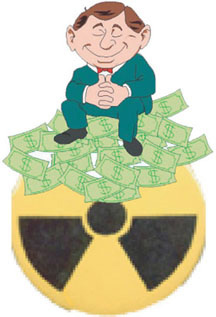
Nuclear industry urged to address business case, 16TH MAY 2018 ,BY: REBECCA CAMPBELL CREAMER MEDIA SENIOR DEPUTY EDITOR Decisions on the future energy mix for South Africa need to be forward looking, not backward looking. So affirmed EE Publishers MD Chris Yelland in his keynote address to the National Nuclear Regulator’s second Nuclear Regulatory Information Conference on Wednesday.
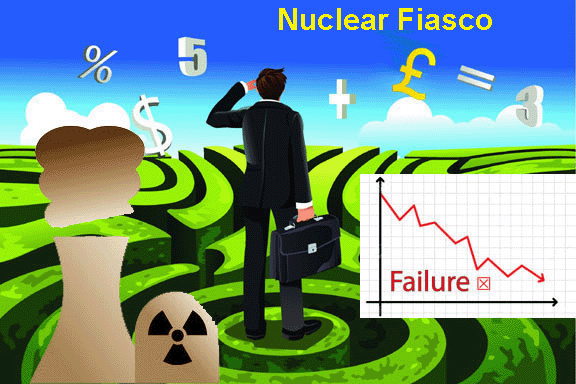
…………”The nuclear sector needs to address the real elephants in the room,” he asserted. “In my view the biggest elephant in the room is not the technology, but the business case.” There is great uncertainty about the future demand for grid electricity. Megaprojects have high costs and risks. Nuclear power plants also have long construction periods and high up-front costs. There are serious financing issues, both with the public and private sectors in South Africa (local institutions were unwilling to invest in nuclear projects). Nuclear power plants had to be run constantly at a high output level for maximum efficiency.
The risk associated with
nuclear power was not low. While the risk of technological failure was low, when such failures did happen, the consequences were very serious. The crisis at the Fukushima
nuclear power station in
Japan had very severe
financial consequences. Consequently, the private sector was reluctant to insure
nuclear power plants, leaving that to governments.
May 18, 2018
Posted by Christina Macpherson |
2 WORLD, business and costs |
Leave a comment
 China to help Uganda build nuclear power plants, Reuters Staff, 17 May 18 KAMPALA (Reuters) – China will help Uganda build and operate nuclear power plants under a deal signed last week.
Uganda has some uranium deposits and President Yoweri Museveni has said his government was keen to exploit them for potential nuclear energy development.
Eight potential sites have been identified in the country’s central, southwest and northern regions that could potentially host nuclear power plants, the government said on Thursday. It signed a deal with Russia last year to cooperate on nuclear power.
China is already a major investor in Ugandan infrastructure projects and China National Nuclear Corporation (CNNC) signed a memorandum of understanding on May 11 to help Uganda build capacity “in the use of atomic energy for peaceful purposes”, Uganda’s energy ministry said in a statement issued on Thursday……
Co-operation between CNNC and Uganda will involve the development of nuclear power infrastructure including the design, construction and operation of nuclear power plants.
In June last year Uganda signed a similar memorandum of understanding with Russian State Atomic Energy Cooperation (ROSATOM) to facilitate the two countries’ cooperation on nuclear power.
Reporting by Elias Biryabarema; Editing by Susan Fenton https://www.reuters.com/article/us-uganda-energy/china-to-help-uganda-build-nuclear-power-plants-idUSKCN1II219
May 18, 2018
Posted by Christina Macpherson |
AFRICA, China, marketing |
Leave a comment
 World Nuclear News 16th May 2018 Rosatom, the Russian state nuclear corporation, yesterday signed a series of agreements with overseas companies during the Atomexpo conference and exhibition being held this week in Sochi, Russia. The agreements, with Chile, China, Cuba, Finland, Hungary, Iran, Italy, Kazakhstan, Saudi
Arabia, Serbia, Spain and Zambia, include the engineering and medical
sectors, among others.
http://www.world-nuclear-news.org/C-Rosatom-expands-overseas-links-with-new-agreements-16051801.html
May 18, 2018
Posted by Christina Macpherson |
marketing, Russia |
Leave a comment

Small Modular Nuclear Reactors Will Soon Face a Moment of Reckoning, NuScale is bringing small nuclear alive. But will the concept survive? GreenTech Media , JASON DEIGN MAY 14, 2018
Last month’s first-ever small modular reactor design approval could usher in a new era for nuclear power, provided the technology can live up to the hype.
The U.S. Nuclear Regulatory Commission (NRC) phase 1 review approval of a small nuclear reactor (SMR) design from Portland, Oregon-based NuScale Power means the technology now has a realistic chance of being up and running within a decade.
In a press release, NuScale said its first operational products, for Utah Associated Municipal Power Systems (UAMPS), could be hooked up to the grid “by the mid-2020s,” while Bloomberg reported that the company was aiming for commercial operations in 2026.
The reactor developer next has to get NRC design certification application approval and customer UAMPS needs a combined construction and operating license, NuScale’s director of communications, Mariam Nabizad, told GTM. …….
When it goes live, the UAMPS plant could be the definitive test of whether nuclear has a future in many Western economies. In Europe and the U.S. the industry is on the wane, mounting a rearguard PR campaign to claw back fans and betting heavily on SMRs to regain credibility.
That means the UAMPS project, which is set to have a dozen 50-megawatt NuScale SMR modules, will have to buck recent nuclear new-build trends by coming in on time and on budget.
And, critically, it will have to be competitive with other generation sources being built eight years from now. Nabizad said that the estimated overnight cost for the UAMPS project was $2.9 billion, and its target levelized cost of energy was $65 per megawatt-hour.
For comparison, the International Renewable Energy Agency predicts that by 2020, more than half a decade ahead of the UAMPS project going live, onshore wind will be hitting an LCOE of $50 per megawatt-hour and solar will be at $60 per megawatt-hour.
……… with wind- or solar-tied storage plummeting in cost, it is unclear to what extent intermittency will be an issue for intermittent renewables eight years from now. All these factors could fuel concerns that SMRs may never be a viable technology. ……. even if NuScale and its brethren can reignite interest in nuclear across the U.S. and Europe, it may still face a threat from within its own industry.
While the NRC’s experience with NuScale is expected to streamline the permitting of other SMR designs, it will be at least a decade until U.S. SMRs start hitting the ground in any meaningful numbers……..https://www.greentechmedia.com/articles/read/small-modular-nuclear-reactors-moment-of-reckoning#gs.ydvNBns
May 16, 2018
Posted by Christina Macpherson |
business and costs, Small Modular Nuclear Reactors |
Leave a comment
Renewables Investment Nudges Out Fossil Fuel And Nuclear, Forbes, Felicia Jackson Contributor, May 15, 2018, The global clean energy transition is gaining pace as it becomes a mainstream investment option.
The global clean energy transition is gaining pace as it becomes a mainstream investment option. According to the latest research from CERES on progress to a ‘Clean Trillion’ it is also one that far outstripped fossil fuels and nuclear in 2017.
In 2017 the clean energy industry reached a critical turning point. Growth and cost reductions across the sector have far outperformed expectations based on policy frameworks alone. Dramatic reductions in cost, increases in scale, and technology improvements have fundamentally changed the dynamics of the clean energy market. Energy market
dynamics have shifted in favor of clean energy technologies such as wind and solar, which increasingly out-compete new fossil fuel and nuclear power sources.
Within In Sight of the Clean Trillion: Update on an Expanding Landscape of Investor Opportunities, Ceres says that what it calls the ‘Clean Trillion’ – the goal of an additional $1 trillion investment in clean energy per year through 2050 – is increasingly feasible as the market matures.
……..Overall, the combination of lower cost, lower regulatory risks, improved technology and rapid growth and uptake of clean energy creates a very different clean energy investment future and significant, scaled investment opportunities as compared to what we have historically seen. Fulton says, ‘We see a pathway to a post-subsidy world as clean energy increasingly out-competes fossil fuels and nuclear power’.For forward thinking investors, it seems as if fossil fuel weighting in investment portfolios is due another look.
https://www.forbes.com/sites/feliciajackson/2018/05/15/renewables-investment-nudges-out-fossil-fuel-and-nuclear/#58038b5e3752
May 16, 2018
Posted by Christina Macpherson |
2 WORLD, business and costs |
Leave a comment
Reuters 12th May 2018 , Bulgaria’s government will ask parliament to give it the authority to
negotiate with investors to build the Belene nuclear power project on the
Danube River, the prime minister said on Saturday.
The Black Sea state initially canceled the project, estimated to cost about 10 billion euros,
in 2012 after failing to find foreign investors and bowing to U.S. and
European Union pressure to limit the country’s energy dependence on
Russia, which would have supplied some equipment.
The current government of Prime Minister Boyko Borissov, however, is renewing the search for private
investors to build the plant after an arbitration court ruled in 2016 that
Bulgaria must pay more than 600 million euros ($717 million) in
compensation to Russian state nuclear company Rosatom due to the
cancellation.
https://www.reuters.com/article/us-bulgaria-nuclear-belene/bulgarian-government-to-seek-mandate-for-talks-with-investors-over-nuclear-plant-idUSKCN1ID0TE
May 16, 2018
Posted by Christina Macpherson |
Bulgaria, business and costs, politics |
Leave a comment

 A nuclear deal with the Saudis is a good thing, says former GOP leader Eric Cantor
- Saudi Arabia has been in negotiations with the U.S. and other countries for several years in pursuit of a nuclear energy partnership, with the stated aim of diversifying its energy base.
- Riyadh has found a willing partner in the Trump administration, which has signaled far greater support for a deal than its predecessors.
- Months of escalating tensions between the kingdom and its regional arch-rival Iran have raised the stakes for any future nuclear plans.
Natasha Turak | ………For around five years now, the Saudis have been in informal negotiations with the U.S. and other countries that could sell it nuclear reactors, with the stated aim of diversifying its energy base. In February, the kingdom
recruited an American lobbying firm as an advisor on the legal issues surrounding developing a commercial nuclear program.
But what’s made many observers nervous is Riyadh’s refusal to accept a deal that would forbid it from enriching uranium and reprocessing plutonium — the mechanisms necessary not for nuclear energy, but for developing a weapon.
Saudis find support from Trump
Opposition from U.S. lawmakers on both sides of the political aisle has historically impeded the kingdom’s aims — Section 123 of the U.S. Atomic Energy Act of 1954 mandates that Congress review any sharing of nuclear technology with a foreign country.
Now, however, the Saudis have found a friendlier partner in the Trump administration, which has signaled far greater willingness to strike a deal than its predecessors.
A U.S. trade delegation visited the kingdom in April, led by the Washington-based Nuclear Energy Institute (NEI) and in partnership with the U.S. Departments of Commerce, Energy, and State. It brought with it 20 companies from across the U.S. nuclear supply chain, to promote “the strong interest of U.S. industry to partner in Saudi Arabia’s ambitious nuclear energy program,” according to the delegation’s press release.
……..Months of escalating tensions between Iran and its arch-rival Saudi Arabia raise the stakes for any future nuclear plans. In March, Saudi Crown Prince Mohammed bin Salman told CNBC news that if Tehran was to build a nuclear bomb, so would Riyadh.
U.S. lawmakers and non-proliferation experts have expressed their concern over dual-use technology, and Bin Salman’s unpredictable and aggressive foreign policy has not helped his country’s case……https://www.cnbc.com/2018/05/13/former-gop-leader-eric-cantor-supports-nuclear-deal-with-saudi-arabia.html
May 14, 2018
Posted by Christina Macpherson |
business and costs, politics, USA |
Leave a comment
 Dave Toke’s Blog 10th May 2018, A fake price for the faltering proposed Wylfa nuclear plant will obscure
the fact that the project, backed by Hitachi, will be even more expensive than Hinkley C. Negotiators for the Wylfa project are clamouring for the Government to use taxpayers money and a commitment to pay at least some of
the risks of construction cost overruns to massage the price of the deal
 down compared to Hinkley Point C.
If this is done, then the combined support for Hinkley C and Wylfa projects through loan guarantees, equity
support and risk underwriting could rival the size of bill the UK has to pay the EU for Brexit.
But a carefully contrived fake price produced by giving a massive taxpayer funded handout to the project will obscure this terrible consequence. Hinkley Point C (HPC), scheduled to be built by EDF, is now said to cost around £20 billion, almost exactly the same as the cost of the Hitachi-led Wylfa project.
In fact both of these figures do not appear to include interest charges, and so will be underestimates of the
total mount of money needed to be paid out before the plant is even built. But the interesting thing is that whilst the Hinkley C project is 3.2GW, the Wylfa project is smaller, at around 2.9 GW, which actually makes the Hitachi project even more expensive!
http://realfeed-intariffs.blogspot.co.uk/2018/05/hitachis-wylfa-project-is-even-more.html
May 12, 2018
Posted by Christina Macpherson |
business and costs, politics, UK |
Leave a comment
Nikkei Asian Review 11th May 2018 The British government has proposed to arrange all 2 trillion yen ($18.2
billion) in lending that Hitachi says is needed to build a nuclear power
plant in Wales, as the Japanese side seeks to reduce its risk and encourage
the U.K. to put more skin in the game.
London had previously suggested that it guarantee 1 trillion yen in lending, but to get the project moving it
changed its offer to include approaches such as direct financing in order
to reduce Hitachi’s financial exposure.
The plan also calls for a totalinvestment of 900 billion yen, with Hitachi as well as Japanese and British
public-private interests each taking a one-third stake, and guarantees for
corporate loans. The total cost of the plant, to be built on the Isle of
Anglesey, is expected to swell to 3 trillion yen.
Hitachi Chairman Hiroaki Nakanishi met with Prime Minister Theresa May in London last Thursday to
ask for greater backing. The original plan called for the loans to be
provided by private lending institutions from both countries and guaranteed
equally by each government. State funding would come at a lower cost than
borrowing from private institutions and would demonstrate the U.K.’s
increased involvement as a backer of Hitachi’s nuclear power business,
which would ease raising funds and help secure investors.
The offer reflects the U.K.’s strong desire to proceed with the project, since
bankruptcy could place a burden on British taxpayers. The U.K. government
will submit a formal proposal to the Japanese side soon. Hitachi will then
make a final decision on whether to continue with the project at a board
meeting at the end of the month.
Some at Hitachi and in Tokyo have expressed concern about Japanese interests retaining leadership of the
project with two-thirds control. Hitachi and the U.K. are thought to be
discussing ways to prevent Hitachi’s exposure risk from rising, such as by
raising London’s stake or issuing dual class shares. But the British
Parliament is likely to oppose expanding the government’s stake, which
could throw a wrench in the project’s final shareholding structure or
allocation of costs. Hitachi is also requesting that the electricity’s
purchase price be raised, but the U.K. is opposed. It hopes to satisfy
Hitachi by covering all loans and raising its stake in the project.
https://asia.nikkei.com/Business/Business-Deals/London-offers-18bn-in-loans-for-Hitachi-s-UK-nuclear-plant
May 12, 2018
Posted by Christina Macpherson |
business and costs, politics, UK |
Leave a comment
US engineering giant sees ‘tremendous opportunity’ in Saudi nuclear energy plans https://www.cnbc.com/2018/05/10/bechtel-executive-us-firms-should-be-involved-in- saudi-nuclear-plans.html –Saheli Roy Choudhury
- A senior executive at engineering giant Bechtel told CNBC on Thursday that U.S. businesses should be involved in Saudi Arabia’s civilian nuclear energy ambitions.
- The presence of American firms would likely be welcomed by the Saudis and should also be welcomed by the U.S. government, according to Stuart Jones, regional president for Europe and Middle East at Bechtel.
- Saudi Arabia has plans to construct 16 nuclear power reactors over the next 20 to 25 years, costing more than $80 billion.
May 11, 2018
Posted by Christina Macpherson |
business and costs, marketing, Saudi Arabia, USA |
1 Comment
 South Carolina’s state utility paid bonuses to private execs WP, By Christina L. Myers and Jeffrey Collins | AP May 9 2018 COLUMBIA, S.C. — South Carolina’s state owned utility paid $9 million in performance bonuses to executives of a private utility for two nuclear reactors that were never finished, according to the public utility and emails turned over to state and federal investigators.
SCANA Corp. even billed taxpayer-supported Santee Cooper $3.2 million for bonuses in August, a month after the utilities abandoned 10 years of construction and planning for the reactors, according to the emails released by Gov. Henry McMaster’s office on Wednesday.
Santee Cooper refused to pay, utility spokeswoman Mollie Gore said.
“I will not approve this invoice,” Senior Vice President for Nuclear Energy Michael Crosby wrote in one email. “I may get over-ridden … but if SCANA cares to push this … CFOs & CEOs will need to get involved.”
Crosby also suggested letting SCANA CEO Jimmy Addison know his company was still seeking performance bonuses after the reactors were abandoned, and suggested that other executives “man-up and ask if he wants to push this,” according to the emails……..
The invoices indicated at least $5 million of bonuses paid to SCANA executives, but Gore said Santee Cooper’s records showed the public utility paid $8.9 million to the executives at the private firm.
The governor also sent the emails to legislative leaders, asking senators to confirm his nominee to run the Santee Cooper board as soon as possible.
“Santee Cooper’s customers, including individuals and the electric cooperatives of our state, deserve to know how their hard earned money is being spent by the utility, and now, we know that much of it was going to pay SCANA executives’ bonuses related to the failed reactors,” Symmes said in a statement.
……. Also on Wednesday, South Carolina lawmakers made a last-minute push to pass several bills to give ratepayers temporary relief and pass regulations to prevent anything like this from happening again.A committee of House members and senators could not reach a compromise on how much to cut a charge that customers of South Carolina Electric & Gas — a SCANA subsidiary — pay for the abandoned reactors.
……. The Senate tentatively approved repealing the Base Load Review Act which allowed utilities to charge ratepayers for the nuclear plants before they ever generated a watt of power. Nine different rate increases were passed during the 10 years of planning and construction on the reactors…… https://www.washingtonpost.com/national/south-carolinas-state-utility-paid-bonuses-to-private-execs/2018/05/09/c91148a4-53e6-11e8-a6d4-ca1d035642ce_story.html?noredirect=on&utm_term=.491
May 11, 2018
Posted by Christina Macpherson |
business and costs, politics, USA |
Leave a comment

https://e360.yale.edu/digest/renewable-energy-now-employs-10-3-million-people-globally – 10 May 18The renewable energy industry employs 10.3 million people worldwide, according to new data from the International Renewable Energy Agency (IRENA). And the sector is growing rapidly, adding more than 500,000 jobs last year alone, an increase of 5.3 percent from 2016, PV Magazine reported.
The solar industry accounts for the largest share of jobs in renewable energy, with nearly 3.4 million people employed in research, production, installation and maintenance of solar panels — an increase of 9 percent from 2016. The solar sector is followed by liquid biofuels, with 1.9 million jobs, and hydropower, with 1.5 million. The IRENA report finds that employment in the global wind industry decreased slightly from 2016 to 2017, shrinking to 1.15 million. China is home to 65 percent of the world’s solar jobs, and 43 percent of all renewable energy jobs. Due to the region’s robust manufacturing sector, four-fifths of all renewable energy jobs are located in Asia.
“The data underscores an increasingly regionalized picture, highlighting that in countries where attractive policies exist, the economic, social and environmental benefits of renewable energy are most evident,” said Adnan Z. Amin, director general of IRENA.
May 11, 2018
Posted by Christina Macpherson |
2 WORLD, employment, renewable |
Leave a comment
Cracks in nuclear reactor will hit EDF Energy with £120m bill, Guardian, Adam Vaughan , 7 May 18 Problems at Hunterston B in Scotland trigger doubts over six other 1970s and 80s plants
The six month closure of one of Britain’s oldest nuclear reactors will burn a £120m hole in the revenues of owner EDF Energy and has raised questions over the reliability of the country’s ageing nuclear fleet.
EDF said this week that it was taking reactor 3 of Hunterston B in Scotland offline for half a year, after inspections found more cracks than expected in the graphite bricks at the reactor’s core.
cracks EDF maintains that the prospect of more old reactors having a sustained outage is highly unlikely, but experts said it would pose a significant challenge to power supplies if they did…….https://www.theguardian.com/environment/2018/may/06/cracks-nuclear-reactor-threaten-uk-energy-policy-hunsterston
May 9, 2018
Posted by Christina Macpherson |
business and costs, safety |
Leave a comment
 Radiation Detection, Monitoring & Safety Market Worth 2.26 Billion USD by 2022 PUNE, India, May 8, 2018 /PRNewswire/ —
According to a new market research report “Radiation Detection, Monitoring, & Safety Market by Product (Detection & Monitoring, Safety), Composition (Gas-filled detectors, Scintillator, Solid-state detector), Application (Healthcare, Homeland Security & Defence, Industrial) – Global Forecast to 2022“, published by MarketsandMarkets™, the global market is expected to reach USD 2.26 Billion by 2022 from USD 1.71 Billion in 2017, at a CAGR of 5.7% during the forecast period (2017-2022).
The key factors propelling the growth of Radiation Detection, Monitoring and Safety Market are growing security threats, growing prevalence of cancer worldwide, increasing safety awareness among people working in radiation-prone environments, growing safety concerns post the Fukushima disaster, growing security budgets of global sporting events, growth in the number of PET/CT scans, increasing usage of nuclear medicine and radiation therapy for diagnosis and treatment, and use of drones for radiation monitoring.
….The healthcare segment dominated the market on the basis of applications in 2017
The Radiation Detection, Monitoring and Safety Market is segmented on the basis of applications into healthcare, homeland security and defense, industrial applications, nuclear power plants, and other applications (environmental monitoring and academic research). In 2017, the healthcare segment accounted for the largest share of the global market. Factors such as the growth in the number of PET/CT scans and increasing usage of nuclear medicine and radiation therapy for diagnosis and treatment, increasing research activities, and growing incidence of cancer are driving the growth of this segment.
North America held the largest share of the market in 2017
In 2017, North America accounted for the largest share of the Radiation Detection, Monitoring and Safety Market, followed by Europe. Factors such as favorable government initiatives, increasing number of nuclear power plants, rising prevalence of cancer, and increasing awareness of radiation safety are contributing to the large share of this geographical segment………https://www.prnewswire.com/news-releases/radiation-detection-monitoring–safety-market-worth-226-billion-usd-by-2022-682063101.html
May 9, 2018
Posted by Christina Macpherson |
business and costs, radiation |
Leave a comment
 Times 6th May 2018 , The entire £15bn-plus cost of Hitachi’s nuclear power station on Anglesey
could land on the government’s balance sheet, even though taxpayers are expected to hold only a minority stake. The Japanese industrial giant has warned it will walk away from the 2.7 gigawatt plant at Wylfa unless it
secures UK state support.
Hiroaki Nakanishi, the chairman of Hitachi, met Theresa May and the chancellor, Philip Hammond, last week to urge progress on the project after more than two years of talks.
The final deal may see taxpayers take an equity stake in the Horizon plant, possibly as much as
33%, alongside Hitachi and the Japanese government. Direct state exposure to the construction of a nuclear plant has faced stiff resistance from the Treasury because of fears about cost overruns and the impact on government
debt.
Industry insiders said a minority taxpayer stake could result in the entire liability landing on the state’s books, despite the Japanese partners, because official statisticians now take a more conservative approach to accounting for risk where the government is concerned. In 2014, Network Rail’s debt burden of £34bn was reclassified as national debt
after an EU decree. Any state stake in Horizon would be sold on once construction was completed.
https://www.thetimes.co.uk/edition/business/taxpayers-on-the-hook-for-15bn-hitachi-nuclear-plant-qnbx0s9xm
May 7, 2018
Posted by Christina Macpherson |
business and costs, politics, UK |
Leave a comment