Regulators terminate Duke Energy’s Levy County nuclear licenses, Malena Carollo, Tampa Bay Times staff writer, 4 May 18
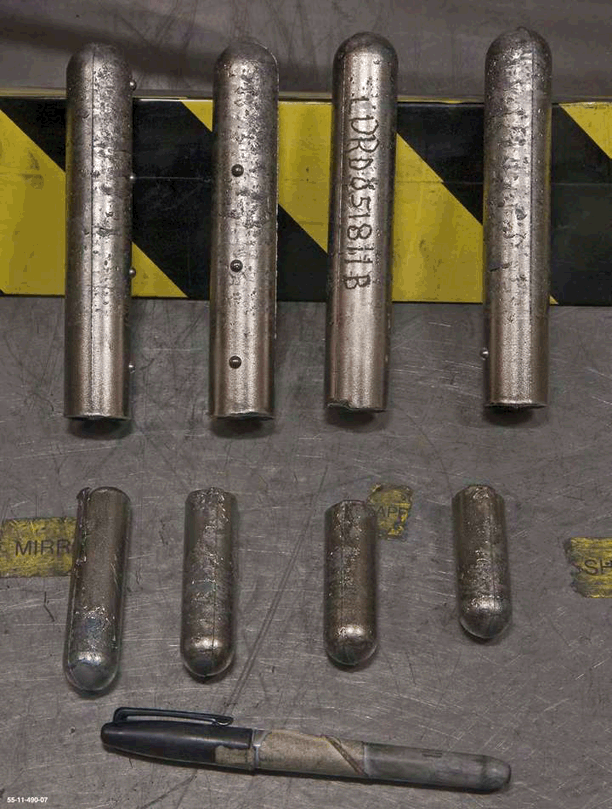
ST. PETERSBURG — Regulators have finally closed the books on the Levy County nuclear project that never was. The Nuclear Regulatory Commission terminated Duke Energy Florida’s licenses last week for the proposed nuclear reactors at the utility’s request — more than a decade after the project was first proposed.
“Southern Alliance for Clean Energy applauds Duke Energy Florida for formally terminating the licenses for the Levy site,” said Sara Barczak, regional advocacy director for the alliance, in a statement.
The action comes nine months after Duke announced it would no longer make customers pay for the nuclear facility. Duke customers had already paid $800 million on the plant that was never built. The St. Petersburg utility decided to shoulder the remaining $150 million for the project instead of passing it on to customers, saving rate payers about $2.50 on their monthly bills.
Instead of nuclear, the utility will turn its focus to solar and natural gas
We anticipate an increase in solar energy in Florida and have included plans for the addition of over 700 megawatts of solar capacity in the next 10 years,” Ana Gibbs, spokesperson for Duke, said in an email. …..Progress Energy had asked customers to pay up front for the facility, promising the plant would reduce energy costs down the line. But after nearly $1 billion was sunk into the nuclear project, it was never built. In 2013, the venture was canned.
FoE Japan 2nd May 2018, Urgent Joint Statement: Hitachi’s nuclear export transfers risks to both Japanese and British people while companies get profits. Hitachi’s
Chairman Nakanishi is reportedly going to visit British Prime Minister
Teresa May on 3rd May to ask the U.K. government to take a direct stake in
Wylfa Newydd nuclear power project in Anglesey, Wales.
Hitachi’s struggle just shows the risks of the nuclear power project is simply huge. While
putting huge risks and cost onto both Japanese and British people, it is
unacceptable that companies and banks take profit. Friends of the Earth
Japan jointly with People Against Wylfa B released an urgent statement.
The report says Hitachi is going to ask not only for direct investment but also
an assurance for a power purchase agreement. Hitachi’s struggle just
shows the risks of the nuclear power project is simply huge. In February,
Mr. Nakanishi already expressed the view that the project would not happen
without government commitment and stated “Both UK and Japanese
governments understand that the project would not go on without the
commitment by the governments”.
To reduce the risk of the project, the project is said to be insured by Nippon Export and Investment Insurance
(NEXI), 100 percent Japanese government owned export credit agency. In
addition to huge construction cost, nuclear projects are associated with
various risks such as accidents, increased cost for tougher regulations,
opposition from local people, radioactive waste management and so on.
Risks are too huge to manage. Thus, it is clear that companies should decide to
retreat from the project. While transferring risks of the project to
people, it is unacceptable that the companies and banks take profits.
The Spokesperson from People Against Wylfa B, Dylan Morgan says; “Don’t pour
good money in to the bottomless black hole of nuclear power. This is an old
fashioned, dirty, dangerous and extortionately expensive technology. The
Fukushima triple explosions and meltdowns has and will continue to cost the
people of Japan greatly. There is no end in sight for this continuing
tragedy, which means that no new nuclear reactors are going to be built in
Japan. It is unacceptable that Japan wish to export this deadly technology
to another state in order to keep Japan in the nuclear club.”
Climate Change Turns Coastal Property Into a Junk Bond, The returns can be great, unless the investment winds up under water. Bloomberg, By Noah Smith, May 3, 2018 “……… Even in the worst-case scenario, sea level rise will be moderate by 2050 — perhaps 1 or 2 feet along most U.S. east coast locations. And there’s a good chance it will be much less.
A rise of that magnitude doesn’t sound like a lot. But it would inundate a number of low-lying coastal areas. The National Oceanic and Atmospheric Administration’s sea level rise viewer app lets you play around with the data and look at maps. Even a moderately bad climate-change scenario could swamp some pieces of coastal real estate within a few decades.
But sea level rise isn’t a gradual, steady thing. The ocean is not a still bowl of water, but a roiling mass tossed around by winds and tides. Long before coastal areas are permanently underwater, they’ll experience increased risk of catastrophic flooding. Hurricane Harvey, which last year flooded much of the city of Houston and became the second most expensive natural disaster in U.S. history (behind another wind-induced coastal flood, 2005’s Hurricane Katrina), is probably a harbinger of more frequent storm-driven disasters.
So for the next few decades, climate change probably won’t send coastal real estate prices crashing, but it does create a tail risk for buyers. Increased probability of coastal flooding makes waterfront real estate a bit like a junk bond — something that will probably go up in value, but has a small to moderate chance of going to zero. Junk bonds generally don’t have a value of zero, but the risk of devastation definitely does depress their selling price.
Recent research confirms that the climate threat is already showing up in prices. Economists Asaf Bernstein, Matthew Gustafson and Ryan Lewis have a recent paper showing that houses exposed to sea-level rise of between 0 and 6 feet have been selling at a 7 percent discount relative to houses a similar distance from the beach that aren’t exposed. The time period they look at is 2007-2016 — before the damage from Harvey. They also confirm that the discount is higher in locations where people report more worry about climate change.
Another recent study, by environmental researchers Jesse Keenan Thomas Hill and Anurag Gumber, shows something similar. Focusing on Miami-Dade County, they show that higher-elevation locations have risen in price faster than similar locations at low elevations. That’s consistent with the theory that wealthy buyers pay a premium to escape flooding risk. High-elevation areas could also have other benefits, of course, such as increased safety from crime — but with crime down dramatically in Miami, this is a less convincing explanation of the increased elevation premium.
In fact, the price differences these economists find may be understating people’s worries about climate change, because of flood insurance. The U.S. government insures many coastal properties against floods, mostly in Texas and Florida. The National Flood Insurance Program charges below-market premiums to many of the riskiest houses, effectively subsidizing owners of the properties most vulnerable to coastal flooding.
Daily Record 30th April 2018, Dozens of elite gun cops tasked with protecting Britain’s nuclear weapons
at Faslane and other military sites are too unfit to carry firearms, it
emerged yesterday. A shocking report into the Ministry of Defence Police
reveals “concern” at the growing number who have been sidelined. The
crisis has emerged after tougher fitness tests equal to those taken by
other armed officers were introduced. Some MoD police – whose jobs include
guarding the nuclear submarine fleet at Faslane, SAS headquarters in
Hereford and GCHQ’s Cheltenham base – have failed the new tests. Others
have simply refused to take part, the Mail on Sunday reported. https://www.dailyrecord.co.uk/news/scottish-news/gun-cops-faslane-too-unfit-12451711
Times 29th April 2018, New nuclear power plants are likely to blow their budgets and arrive late unless their designs are completed before construction starts, a report has warned. Ministers, wary of cost hikes and delays, are wrestling with how to financially support replacements for ageing coal-fired and nuclear plants across the UK.
Hitachi is trying to strike a deal with ministers to build a £10bn-plus plant at Wylfa on Anglesey, where taxpayers are likely to take a stake.
Researchers at Energy Technologies Institute found that most high-cost projects had started construction with incomplete designs, whereas work on low-cost plants had begun only once design and planning had been finalised.
Amsterdam, Netherlands – The “Akademik Lomonosov”, the world’s first floating nuclear power plant, has this morning left St. Petersburg and will be towed through Estonian, Danish, Swedish and Norwegian waters towards Murmansk, warned Greenpeace.
The floating nuclear power plant was initially supposed to be loaded with nuclear fuel and tested on site in the centre of St. Petersburg. However, due to pressure from the Baltic states and a successful petition organised by Greenpeace Russia, Rosatom, the state-controlled nuclear giant that owns and operates the floating nuclear power plant, decided on 21 July 2017 to move loading and testing to Murmansk.
“To test a nuclear reactor in a densely populated area like the centre of St. Petersburg is irresponsible to say the least. However, moving the testing of this ‘nuclear Titanic’ away from the public eye will not make it less so: Nuclear reactors bobbing around the Arctic Ocean will pose a shockingly obvious threat to a fragile environment which is already under enormous pressure from climate change,” said Jan Haverkamp, nuclear expert for Greenpeace Central and Eastern Europe.
Having reached Murmansk, a city of 300,000, the “Akademik Lomonosov” — first in a series of floating nuclear plants planned — will be fuelled, tested and, in 2019, towed 5,000 km through the Northern Sea Route and put to use near Pevek, in the Chukotka Region.
According to Russian media, Rosatom is currently planning a production line, which will be capable of mass producing floating nuclear reactors. Backed by its owner, the Russian State, the company has already been in talks with potential buyers in Africa, Latin America and South East Asia.
“This hazardous venture is not just a threat to the Arctic, but, potentially, to other densely populated or vulnerable natural regions too,” said Jan Haverkamp.
There are indications that 15 countries, including China, Algeria, Indonesia, Malaysia and Argentina, have shown an interest in hiring floating nuclear plants. Among other purposes, the floating nuclear plant is intended to provide power for oil and gas exploration.
“The floating nuclear power plants will typically be put to use near coastlines and shallow water. Contrary to claims regarding safety, the flat-bottomed hull and the floating nuclear power plant’s lack of self-propulsion makes it particularly vulnerable to tsunamis and cyclones,” said Jan Haverkamp.
TOKYO — Hitachi will ask the U.K. government to take a direct stake in the company that is to build and operate a nuclear power plant in Wales which is now 100% owned by the Japanese industrial company. Hitachi expects the U.K. government will invite private British companies to participate and hopes to reduce its own stake to less than 50%.
Nikkei has learned that Hitachi Chairman Hiroaki Nakanishi will shortly travel to the U.K. to discuss the ownership issue and other project terms with British Prime Minister Theresa May.
Hitachi has recently concluded that the risk of proceeding with the Anglesey project, at an estimated cost of more than 3 trillion yen ($27.5 billion), is too great to manage on its own as a private company. It plans to withdraw from the project if restructuring negotiations fall through. Such a move would have significant repercussions for nuclear power policy for both Britain and Japan.
Hitachi acquired complete ownership of the U.K.’s Horizon Nuclear Power in 2012 for 89 billion yen as part of its plan to expand its nuclear business from Japan to foreign markets. It has spent about 200 billion yen preparing for Horizon’s first project, the construction of a plant on the Isle of Anglesey in Wales.
Hitachi hopes to lower its stake in Horizon to less than 50% before construction begins at Anglesey. It has requested that the British government take a direct stake in Horizon and then invite local enterprises to invest.
In response to Hitachi’s concerns, the British government earlier this month proposed that U.K. interests and Japanese public and private interests join with Hitachi to move Anglesey forward. The three sets of shareholders would each put 300 billion yen into the project, giving each a one-third stake. According to sources, the company and the Japanese government see it as too risky for Japanese interests to retain a majority shareholding and hope that British interests will acquire a controlling stake.
London has been leery up to now of taking a direct stake in any new nuclear construction. Hitachi will likely seek in direct talks a commitment to U.K. government investment as well as to additional support that may be necessary to sustain the operation.
Other key project terms also remain unsettled, including the degree to which London would guarantee the 2 trillion yen in loans Hitachi sees as needed to finance the Anglesey development and the price to be paid to Hitachi for the electricity from the plant. London’s proposed price is 20% lower than what Hitachi has requested. The Japanese government plans to guarantee the project’s loans.
The U.K. in December approved the design of the reactor that Hitachi plans to use in Anglesey. The project is now in its final pre-construction phase. The company has targeted to begin construction next year.
With its domestic nuclear industry still crippled by the legacy of the 2011 Fukushima nuclear accident, Japan has been eager to promote nuclear exports. The drive for overseas orders however has struggled as many governments reconsider nuclear power’s merits.
Uranium industry slumps, nuclear power dead in the water, Chain Reaction magazine, Dr Jim Green, April 2018
Very few mines could operate at a profit at current prices. Some mines are profitable because earlier contracts stipulated higher prices, while many mines are operating at a loss. Many companies have been loathe to close operating mines, or to put them into care-and-maintenance, even if the only other option is operating at a loss. They have been playing chicken, hoping that other companies and mines will fold first and that the resultant loss of production will drive up prices. “We have to recognise that we over-produce, and we are responsible for this fall in the price,” said Areva executive Jacques Peythieu in April 2017.
Current prices would need to more than double to encourage new mines ‒ a long-term contract price of about US$70–$80 is typically cited as being required to encourage the development of new mines.
The patterns outlined above were repeated in 2017. It was another miserable year for the uranium industry. A great year for those of us living in uranium producing countries who don’t want to see new mines open and who look forward to the closure of existing mines. And a great year for the nuclear power industry ‒ in the narrow sense that the plentiful availability of cheap uranium allows the industry to focus on other problems.
Cut-backs announced
The patterns that have prevailed over the past five years or so might be changed by decisions taken by Cameco and Kazatomprom (Kazakhstan) in late 2017 to significantly reduce production. Canada closed McArthur River in Canada in January and plans to keep it closed for around 10 months ‒ it had been producing more uranium than any other mine in the world. Kazakhstan has been producing almost 40% of world supply in recent years and plans to reduce production by 20% from 2018‒2020.
Previous cut-backs in Canada and Kazakhstan have had little or no effect, and so far the late-2017 announcements have had no effect. But the cut-backs are significant and their impact might yet be felt.
A late-2017 report by Cantor Fitzgerald equity research argued that the decisions by Cameco and Kazatomprom could result in a “step change” for uranium prices. But Warwick Grigor from Far East Capital was downbeat about Cameco’s announcement. “I don’t see this as a turnaround for the uranium price; at best they will stay where they are, but it doesn’t signal a boom in price,” he said in November 2017.
BHP marketing vice-president Vicky Binns said in December 2017 that uranium markets would remain oversupplied for close to a decade, with downward pressure remaining on uranium prices despite Cameco’s production cuts. She said that demand for uranium could outstrip supply by the late 2020s but that could change if developed nations close their nuclear reactors earlier than expected, or if renewables take a larger than expected market share.
Equally downbeat comments have been made by other industry insiders and analysts in recent years. Former Paladin Energy chief executive John Borshoff said in 2013 that the uranium industry “is definitely in crisis” and “is showing all the symptoms of a mid-term paralysis”. Former World Nuclear Association executive Steve Kidd in May 2014 predicted “a long period of relatively low prices”. Nick Carter from Ux Consulting said in April 2016 that he did not see a supply deficit in the market until “the late 2020s”.
Perhaps a uranium price increase is on the way but it will do little to salvage Australia’s uranium industry. Apart from BHP’s Olympic Dam mine in SA, the only other operating uranium mine in Australia is Beverley Four Mile in SA. At Ranger in the NT, mining has ceased, stockpiles of ore are being processed, and ERA is planning a $500 million project to decommission and rehabilitate the mine site.
And with the cost of a single power reactor climbing to as much as $20 billion, proposals to introduce nuclear power to Australia seem more and more quixotic and are now largely limited to the far right ‒ in particular, Australians Conservatives’ luminary Senator Cory Bernardi and the Minerals Council of Australia.
Even Dr Ziggy Switkowski ‒ who used to be nuclear power’s head cheerleader in Australia and was appointed to lead the Howard government’s review of nuclear power ‒ recently said that “the window for gigawatt-scale nuclear has closed”. He said nuclear power is no longer cheaper than renewables and the levelised cost of electricity is rapidly diverging in favour of renewables. https://www.foe.org.au/uranium_industry_slumps
Jim Green is the national nuclear campaigner with Friends of the Earth Australia and editor of the Nuclear Monitor newsletter produced by the World Information Service on Energy and the Nuclear Information & Resource Service.
Published in Chain Reaction #132, April 2018. National magazine of Friends of the Earth Australia. www.foe.org.au/chain_reaction_132
FT 23rd April 2018 , Nick Butler: In the rapidly changing global energy environment nothing is
sacred, no business model is beyond challenge and no company is safe. The
latest business being forced to rethink and restructure is the French state
group Electricité de France.
EDF has become a symbol of technical weakness
and French decline. But, as with so much else in France since the arrival
of an ambitious president who feels no need to defend decisions of the
past, change is becoming possible.
For all its problems the company could be reborn as a successful player in the new energy economy. But where would
that leave nuclear power? The continuing transformation of the global
energy market is not just about climate change and the move to a lower
carbon economy. It is also about the advance of new technology, the
changing geography of the energy market in favour of Asia and, above all,
the move from a time of scarcity and energy insecurity to an age of plenty.
Nuclear costs remain too high, private investors sensibly run away from the
construction risks involved and, crucially, there are alternatives. Wind
and solar costs have fallen dramatically. In many markets they are now half
the cost per megawatt hour of large-scale new nuclear.
The prospect of commercially viable techniques of grid-level storage opens the way for an
even bigger shift. If the challenges of intermittency can be overcome and
the need for subsidies removed or much reduced, wind and solar can become
the natural economic choice for energy supply.
At last, EDF appears to be recognising reality. There is much discussion of the company being divided
in two, with the legacy nuclear assets held by the French government and
the rest of the business, including a major new division called EDF
Energies Nouvelle, being allowed to operate on proper commercial terms in
the open market, under new management.
The company is also pulling back from further investment in new nuclear. UK chief executive Simone Rossi has
for the first time talked about the possibility of the company dropping its
interest in the next prospective nuclear venture at Sizewell in Suffolk. To
go ahead, he said, would require a new financial deal.
In the absence of enthusiastic private investors that can only mean funding from the French
or British governments – and Mr Rossi should not hold his breath for that
given the state of public finances in both countries. If EDF steps out of
the new nuclear business, it will be the end of European involvement in the
sector. With nuclear power in the US also in real trouble that leaves
Japan, Korea and China as the main players. Such is the tough logic of
globalisation. https://www.ft.com/content/39f30854-4001-11e8-803a-295c97e6fd0b
Japanese trading house Itochu is pulling out of a nuclear power plant project in Turkey due to a surge in safety-related costs, casting uncertainty over the plant’s future as well as the Japanese government’s infrastructure export ambitions, as reported by Nikkei on April 24.
The project was agreed on by the Japanese and Turkish governments in 2013. A consortium including Itochu and Mitsubishi Heavy Industries had been conducting a feasibility study until March for the construction of a 4,500-megawatt plant in the city of Sinop in Turkey’s Black Sea region.
But costs related to safety measures surged after the Fukushima Daiichi nuclear disaster in 2011, and the estimated costs for the project ballooned to more than five trillion yen ($46.2 billion) from two trillion yen in 2013, according to the report.
Itochu, which was jointly conducting the feasibility study with its consortium partners, is expected to avoid involvement in the project. Mitsubishi Heavy and other investors in the consortium have already extended the feasibility study until this summer.
Initially, 30 percent of the project’s cost was planned to be covered by the consortium and 70 percent by loans from the Japan Bank for International Cooperation and other lenders.
The consortium was expected to be 51 percent owned by Mitsubishi Heavy, Itochu and French electric utility Engie, and 49 percent by others entities, including the Turkish Electricity Generation Corporation.
The departure of deep-pocketed Itochu will make the project more risky for Mitsubishi Heavy, which is requesting the Turkish government to change the ownership structure of the consortium.
Westinghouse CEO opens up about collapse of 2000s ‘nuclear renaissance’, (Mainichi Japan) WASHINGTON— The CEO of the U.S. nuclear power firm Westinghouse Electric Co. — which used to be under the Toshiba Corp. umbrella and which filed for bankruptcy in March 2017 — has told the Mainichi Shimbun that the “nuclear renaissance” in the 2000s “was not realistic.”……..
Westinghouse Electric was acquired by Toshiba in 2006. At the time, nuclear power was gaining attention as a countermeasure to tackle global warming, with a spate of power plant construction projects emerging across the world, particularly in the U.S.
However, after a drop in demand for electricity caused by the global financial crisis triggered by the collapse of Lehman Brothers, as well as the Fukushima No. 1 nuclear power plant disaster in 2011, demand for new nuclear power plants has plunged worldwide.
Looking back at this time, Gutierrez acknowledges that the nuclear renaissance, whereby firms would build plants, never actually happened, and says that Westinghouse Electric senior management’s bold plans to build dozens of new plants across the world was not realistic…….
Dave Toke’s Blog 20th April 2018,This week’s story about problems with pipe welding at the French nuclear
plant being built at Flamanville could spell the end for the Hinkley C
nuclear project.
Treasury backed loan guarantees to build Hinkley C have
been linked to a target date for commissioning of the Flamanville plant of
the end of 2020. Yet the current target date of completion by the end of
2019 has been thrown in doubt by the freshly announced problems.
The main focus of attention of this problem for Hinkley has simply been that the
design of the Flamanville plant – the European Pressurised Reactor (EPR) –
is the same as that to be built at Hinkley C and that the engineering
problems bode ill for the British scheme.
That is right, but it is rather worse than this. The commercial issue is that if the French plant is not
commercially operating by the end of 2020 then it seems the Treasury will
not be able to give loan guarantees for the scheme.
According to the analyst Professor Steve Thomas, the rules agreed between the European
Commission and the British Government stipulate that ”until Flamanville 3
was in commercial service, there would be a cap on the guaranteed loans
effectively meaning funding would be primarily through equity’. http://realfeed-intariffs.blogspot.co.uk/2018/04/problems-with-french-nuclear-plant.html
Reuters 20th April 2018, In a sprawling plant near Amarillo, Texas, rows of workers perform by hand
one of the most dangerous jobs in American industry. Contract workers at
the U.S. Department of Energy’s Pantex facility gingerly remove the
plutonium cores from retired nuclear warheads. Although many safety rules
are in place, a slip of the hand could mean disaster.