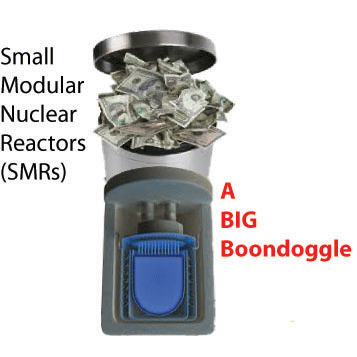
The Small Modular Nuclear Reactor dream could be over for Rolls Royce
Nucnet 23rd July 2018 , Rolls-Royce is preparing to shut down its project to develop small modularnuclear reactors if the government does not make a long-term commitment to the technology, including financial support, in the coming months, the Financial Times reported. According to the UK-based newspaper, the UK aero-engine maker has scaled back investment significantly, from several millions to simply paying for “a handful of salaries”. Warren East, Rolls-Royce chief executive, told the Financial Times:
However, David Orr, executive vice-president of Rolls-Royce’s SMR programme, said that without comfort from the government on two fronts the project “will not fly. We are coming to crunch time.”
Rolls-Royce is one of several consortia to have bid in a government-sponsored competition launched in 2015 to find the most viable technology for a new generation of SMRs. https://www.nucnet.org/all-the-news/2018/07/23/rolls-royce-planning-to-shut-down-smr-project-without-government-support
Who Wants to Buy a Pair of Half-Built Nuclear Reactors? Nobody
https://www.bloomberg.com/news/articles/2018-07-23/who-wants-to-buy-a-pair-of-half-built-nuclear-reactors-nobody, By Brian Eckhouse,
Nobody seems keen to buy the partially built V.C. Summer nuclear plant in South Carolina, so now the state’s biggest power provider is trying to sell off the equipment.
“No other utilities have shown interest in purchasing part or all of the Summer construction project,” Jim Brogdon, interim chief executive officer of Santee Cooper, said in an emailed statement Monday. The board declared the equipment as “surplus property” and authorized the state-owned utility to pursue a sale.
Santee Cooper and its partner Scana Corp. pulled the plugon the project about a year ago after costs ballooned to more than $20 billion and put the two half-done reactors on the block.
China General Nuclear Power Corporation (CGN) acquires 75% stake in Swedish wind power project
Reuters 18th July 2018 , China General Nuclear Power Corporation (CGN) has acquired a 75 percent
stake in a Swedish wind power project from Australia’s Macquarie Group
and GE Energy Financial Services, state news agency Xinhua reported on
Wednesday. The North Pole wind power project, located in Pitea, Sweden, is
expected to be operational by the end of 2019 with a capacity of 650,000
kilowatts, making it the single largest onshore wind power park in Europe,
Xinhua said.
https://uk.reuters.com/article/us-cgn-sweden/chinas-cgn-acquires-75-percent-of-swedish-wind-farm-xinhua-idUSKBN1K81IC?rpc=401&
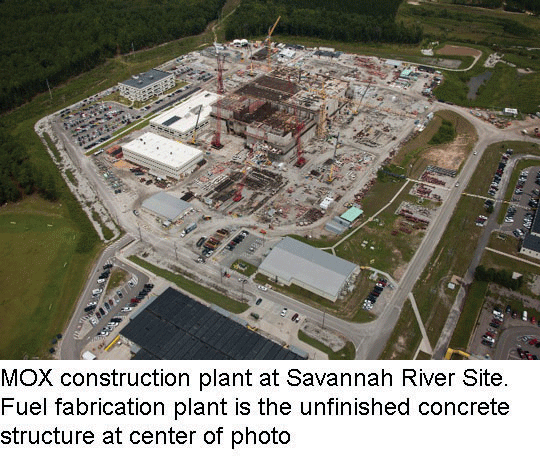
South Carolina Fights U.S. Plan to Abandon Nuclear Project Costing $1.2 Million a Day.
Wall Street Journal 18th July 2018, South Carolina Fights U.S. Plan to Abandon Nuclear Project Costing $1.2
Million a Day. Department of Energy is spending over a million dollars a
day on facility designed to dispose of surplus weapons-grade plutonium.
https://www.wsj.com/articles/south-carolina-fights-u-s-plan-to-abandon-nuclear-project-employing-1-800-1531906201
Big decline in investment in new nuclear reactors
Investment in new nuclear declines to five-year low, WNN 17 July 2018 Global energy investment fell for the third consecutive year in 2017, according to the International Energy Agency (IEA). Investment in nuclear power declined by nearly 45% last year to USD17 billion. Although spending on new reactors reached the lowest level in five years, investment on upgrades of existing units increased………
Of the four new reactors commissioned last year, three were in China. More than 5 GWe of nuclear generating capacity was retired, leading to a net reduction of about 2 GWe in total nuclear capacity worldwide. Capacity was still about 10 GW higher than in 2007. While around 60 GWe of nuclear power remains under construction worldwide, new construction starts totalled just over 3 GWe.
Modernisations and upgrades of existing reactors represented about half of total nuclear investment last year. “Large investments have recently been made in OECD countries to extend lifetime operation and power uprates of the existing nuclear fleet,” the IEA said. “In general, spending on existing plants yields more output per dollar invested.”
……… Access to both direct and indirect government finance remains vital for investments in nuclear power, the report says. “Most investment in new nuclear capacity has occurred in markets where the government retains full ownership or a majority stake in most of the utilities.” Investment in nuclear power also remains highly dependent on government involvement in various areas, including market structure, price regulation and financing………http://www.world-nuclear-news.org/NP-Investment-in-new-nuclear-declines-to-five-year-low-1707185.html
British residents will be locked into very high electricity costs, as govt takes a £16 billion stake in Wylfa nuclear station
London Economic 4th July 2018 After weeks of discussions over the risks of investing in large-scale
energy projects, the British government proposed to become an equal
investment partner in the new Wylfa Newydd nuclear plant. Under a
tripartite financing structure, London is going to take a £16 billion
stake in the plant, signalling that it has learned its lessons from past
failures. Both in Wales and further east in Europe, a public stake plays a
critical role in facilitating large-scale, low carbon energy projects.
Any discussion of the planned Wylfa Newydd project is obliged to give a cursory
nod to Hinkley Point C, the first and only nuclear power station to be
built in the UK since 1995. When complete, Hinkley Point will produce the
most expensive electricity compared to all power stations bar none.
Globally.
The irony is that this is largely due not to the installation
costs (admittedly somewhat higher than competition) but to its financing
model. The House of Commons Committee of Public Accounts frets that with
“estimated costs to the consumer having risen five-fold” since the
project’s go-ahead, the deal struck on Hinkley Point locks Brits into
footing the bill for the government’s lack of nous when negotiating the
‘strike price’ for electricity produced at the facility.
https://www.thelondoneconomic.com/opinion/splitting-the-financial-atom-how-public-backing-produces-cheaper-nuclear-power/04/07/
How can the UK govt fund the Hinkley c nuclear power project?
DieterHelm 12th June 2018 Dieter Helm: If the government decides to invest in further nuclear power
station projects, it should obviously try to do so at minimum cost. The
Secretary of State, Greg Clark, has suggested that one option might be to
develop a Regulated Asset Base (RAB) model. Is this concept fit for the
nuclear purposes? How does it compare with the other two options currently
under consideration – direct investment and financial guarantees, and the
Hinkley-style CfD approach. (No assumption is made here as to whether
nuclear projects should be proceeded with: it is about the best means, not
the end).
The RAB approach is in a first best world probably inferior to
the direct procurement route, but the latter is ruled out by the Treasury
imposed constraints. The RAB model is a second best, but much better than
the Hinkley style contract.
None of these approaches leads to the conclusion that nuclear is either necessary or desirable to meet the twin
objectives of security of supply and decarbonisation, though it would
contribute to both. No smart contracting and regulating framework can magic
away the deep challenges that nuclear faces, notably: the possibility that
in the next 60 years much cheaper new low carbon technologies may become
available, possibly including new nuclear ones too; the very large upfront
and sunk costs; the risk and the safety regulation; and the challenges of
getting rid of the waste. It is for society to decide whether it wants new
nuclear or not. The market cannot decide. If that decision is to proceed,
the RAB model is both plausible and preferable to the Hinkley model.
http://www.dieterhelm.co.uk/energy/energy/the-nuclear-rab-model/
Developing countries should not fall victim to civil nuclear energy and indebtedness to China
Why the Civil Nuclear Trap Is Part and Parcel of the Belt and Road Strategy
Civil nuclear energy presents grave pitfalls in terms of cost, innovation and security that BRI countries cannot and should not afford. The Diplomat By Sam Reynolds July 05, 2018
USA’s B61-12 gravity bomb of limited usefulness, but enormous cost.
Air Force conducts flight testing on new nuclear bomb — but do they need it? SOFREP News, BY 07.04.2018 Late last week, the National Nuclear Security Administration (NNSA) and the U.S. Air Force announced two successful “end to end” non-nuclear system qualification flight tests aboard B-2 Spirits for the newest nuclear bomb to enter into the American arsenal, the B61-12 gravity bomb.
These tests are intended to determine how effectively the bombs can be loaded onto aircraft and deployed using existing methodologies and procedures. Incorporating this new bomb design into existing processes is important for multiple reasons: specialized training for specific weapons systems would dramatically increase the overall cost of the platform’s introduction, and because the B61-12 gravity bomb is slated to slowly replace America’s existing stockpile of B61 nuclear bomb variants, it’s important that the new bombs blend seamlessly into the force. It will take time to transition the old platforms into new ones, and in the meantime, the whole family of B61 bombs needs to be able to play well with one another.
……… Despite rising concerns about the growing expense related to the B61-12 program, these new platforms are expected to enter service within the next two years, phasing out existing B61-3, -4, -7, and -10 bombs by 2025. The last legacy bombs to remain in the arsenal will be the B83-1 and B61-11 gravity bomb, both of which possess superior penetration capabilities intended to access and destroy bunkers and other underground facilities.
…….. Unlike nuclear missiles, the B61 family of bombs are simply dropped over their targets the old-fashioned way, using a tail section for stability and offering no further propulsion or navigation.
With America looking to maintain its reliance on the B-52 Stratofortress as integral to the airborne portion of the nuclear triad, it’s hard to imagine a conflict that could see these bombs being dropped from the aging platform at all. The Air Force acknowledges that the B-52 is too slow and lacks the stealth to fly into contested airspace (where such a bomb would almost certainly be used), and the B-2 is currently slated for retirement once the new B-21 Raider enters service. ……..https://sofrep.com/105418/air-force-conducts-flight-testing-on-new-nuclear-bomb-but-do-they-need-it/
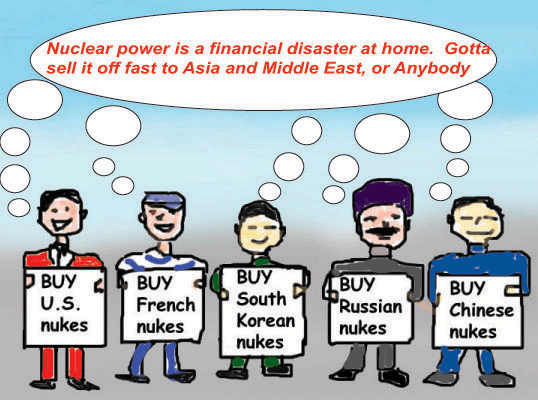
In the race to sell off nuclear power to Saudi Arabia, South Korea looks like the winner
South Korea’s KEPCO shortlisted to bid for Saudi nuclear project https://uk.reuters.com/article/uk-southkorea-nuclear-saudi/south-koreas-kepco-shortlisted-to-bid-for-saudi-nuclear-project-idUKKBN1JR1G4, Reuters Staff, 1
July 18 SEOUL – State-run utility Korea Electric Power Corp (015760.KS) (KEPCO) had been shortlisted to bid for a nuclear project in Saudi Arabia along with the United States, France, China and Russia, South Korea’s energy ministry said on Sunday.
“We were informed by our Saudi counterpart, King Abdullah City for Atomic and Renewable Energy, that KEPCO was shortlisted for a nuclear project in Saudi Arabia,” the ministry said in a statement.
The statement said the winner of the tender was expected to be chosen in 2019. Saudi Arabia, the world’s top oil producer, plans to build two nuclear plants to diversify its energy supply and has been in talks with companies from South Korea, the United States, Russia and China for the tender.
In May, Saudi Arabian Energy Minister Khalid al-Falih met South Korean Energy Minister Paik Un-gyu in Seoul. Falih told reporters on the sidelines of an industry event that he was “optimistic” about South Korea being on the tender shortlist.
South Korea, the world’s fifth-biggest nuclear power user, is seeking to export its nuclear reactors abroad.
In 2009, a South Korean consortium led by KEPCO won an $18.6 billion (14.08 billion pounds) deal to construct four nuclear plants in the United Arab Emirates, the country’s ever nuclear export success.
KEPCO was also selected as a preferred bidder in December last year for Toshiba’s NuGen nuclear project in Britain and the Korean company planned to talk with Toshiba to buy a stake in the project.
Reporting By Jane Chung and Cynthia Kim. Editing by Jane Merriman
UK Public Accounting for Costs of the Defence Nuclear Enterprise – seriously underscrutinised
Parliament 19th June 2018 Neglected Large-Scale Value for Money Issues in Public Accounting for Costs
of the Defence Nuclear Enterprise :Written evidence a review of issues that
are of direct relevance to the core topic of the National Audit Office
(NAO) report of 2018 concerning ‘the Defence Nuclear Enterprise’
(henceforth ‘NAO Report’). The material summarized here supplements and
updates evidence published by the PAC Inquiry of October 2017. The authors
believe on grounds of many years of research at the Science Policy Research
Unit at the University of Sussex that the matters documented here raise
large-scale, long-run value for money issues of pressing national
importance, which remain seriously neglected in work to date either by the
NAO, the PAC or any other official bodies – and which are therefore
gravely under-scrutinized by Parliament or wider UK policy debates
Germany’s biggest utility E.ON to merge with its biggest competitor RWE
Energy Post 26th June 2018 , It came as a great surprise to me some weeks back that Germany’s biggest
utility E.ON reached an “agreement in principle” with its biggest
competitor RWE to acquire its grid and retail business Innogy via a
wide-ranging “exchange of assets,” including RWE taking over the
renewables and other power generation businesses of E.ON.
The result, if the various competition authorities and regulators allow the deal to take
place, will be the biggest European grid company and energy retailer in the
form of E.ON, with RWE becoming the second biggest power generator in
Europe and third biggest owner of renewable assets. In addition, as part of
the deal, RWE will keep a minority stake in E.ON which ties the companies
together.
http://energypost.eu/trying-to-make-sense-of-the-rwe-eon-utility-deal/
Vermont Yankee nuclear power station water cost: $6M and counting
Vermont Yankee water cost: $6M and counting, VT Digger, By Mike FaherJul 1 2018,
Nuclear energy on the decline, especially in developed countries
Modern Diplomacy 29th June 2018 ,For more than 40 years, nuclear energy has been an important contributor in
several countries to energy security and a key source of zero-emissions
generation.
But the future of nuclear energy is facing growing challenges,
increased competition with renewables and gas and, in some cases, public
opposition. With the aim of identifying the key issues and exploring the
future of nuclear power, the International Energy Agency (IEA) held a
high-level meeting in Paris yesterday titled “Nuclear Energy: Today and
Tomorrow.”
The sessions highlighted how, under current policy frameworks,
and with limited investment in new plants, the contribution of nuclear to
the power mix in mature markets is set to decline significantly. Most new
construction is in Asia, with China and India accounting for over half of
the new reactors under construction. In IEA’s World Energy Outlook New
Policies Scenario, nuclear power production grows with two countries, China
and India, responsible for over 90 percent of net growth to 2040.
By contrast, outside of Japan, nuclear power generation in developed economies
is set to decline 20 percent by 2040. The meeting also heard about new
initiatives to advance innovative nuclear power technologies, including
those that can address better the need for greater power systems
flexibility, spurred by the rise of generation from variable renewables.
https://moderndiplomacy.eu/2018/06/29/iea-holds-high-level-meeting-on-the-future-of-nuclear-power/
Halden nuclear reactor shut down not just for safety reasons, more because it lost so much money
Halden Reactor to be decommissioned, WNN, 28 June 2018
“In conjunction with the licence renewal process for the Halden Reactor, IFE has over the last year carried out a strategic review of reactor operations, including a financial and operational risk assessment. Based on this review, IFE’s Board concluded that operation of the reactor beyond the current licence period is not viable, as this would imply business risks in excess of what IFE is capable of handling on its own,” IFE said.
Over the past seven years, IFE has lost more than EUR18 million on its nuclear operation and has this year relied on extraordinary funding from the Norwegian government. As a self-owning foundation, IFE said it is not able to manage the financial risk of operating the reactor. ……
-
Archives
- May 2026 (25)
- April 2026 (356)
- March 2026 (251)
- February 2026 (268)
- January 2026 (308)
- December 2025 (358)
- November 2025 (359)
- October 2025 (376)
- September 2025 (257)
- August 2025 (319)
- July 2025 (230)
- June 2025 (348)
-
Categories
- 1
- 1 NUCLEAR ISSUES
- business and costs
- climate change
- culture and arts
- ENERGY
- environment
- health
- history
- indigenous issues
- Legal
- marketing of nuclear
- media
- opposition to nuclear
- PERSONAL STORIES
- politics
- politics international
- Religion and ethics
- safety
- secrets,lies and civil liberties
- spinbuster
- technology
- Uranium
- wastes
- weapons and war
- Women
- 2 WORLD
- ACTION
- AFRICA
- Atrocities
- AUSTRALIA
- Christina's notes
- Christina's themes
- culture and arts
- Events
- Fuk 2022
- Fuk 2023
- Fukushima 2017
- Fukushima 2018
- fukushima 2019
- Fukushima 2020
- Fukushima 2021
- general
- global warming
- Humour (God we need it)
- Nuclear
- RARE EARTHS
- Reference
- resources – print
- Resources -audiovicual
- Weekly Newsletter
- World
- World Nuclear
- YouTube
-
RSS
Entries RSS
Comments RSS