Dominion company wants license to run Virginia nuclear reactors for 80 years!
Dominion seeks new 20-year Licensing for Surry Nuclear Reactors Power Engineering 10/17/2018, By Rod Walton Dominion Energy has filed an application with federal regulators asking to keep its Surry nuclear power station licensed for additional 20-year terms.
Surry Units 1 and 2 were commissioned in 1972 and 1973, respectively. Dominion has previously said it believes the nuclear plant along the James River in Virginia could be safely operational through 2053.
Its current licensing allows Units 1 and 2 to provide power through 2032 and 2033. If approved, it would be one of the first 80-year plants in the U.S. Exelon Corp. has also applied for additional 20-year license for its Peach Bottom nuclear generation facility in Pennsylvania. https://www.power-eng.com/articles/2018/10/dominion-seeks-new-20-year-licensing-for-surry-nuclear-reactors.html
Australian company Berkeley Energia’s bid to open uranium mine is knocked back by Spain
 Spain to block Berkeley uranium mine project – sources, CNBC , Belén Carreño, 16 Oct 2018 The Spanish government has decided not to deliver the permits necessary to open the European Union’s only open-cast uranium mine near Salamanca, dealing a serious blow to Australian mining company Berkeley Energia’s plans.
Many South Carolina residents are unaware that they’re paying for $9 billion nuclear debacle
 A lot of SC power customers don’t know they’re paying for $9 billion nuclear debacle, Greenville News
In a statewide poll of electric ratepayers, 40 percent of those surveyed said they were not familiar with the collapse of the V.C. Summer expansion project in Fairfield County.
The joint project by the state-owned Santee Cooper utility and SCE&G, a subsidiary of Cayce-based SCANA, collapsed in July 2017, leaving power customers holding the bag for some $9 billion spent on the now-abandoned project.
The project’s failure has roiled both companies, sparked investigations and prompted action from the Legislature.
But the controversy has passed many South Carolinians by.
Slightly less than half of the S.C. residents surveyed, 48 percent, reported being familiar with the project’s collapse. Another 12 percent weren’t sure.
Part of the reason could be that not all S.C. residents get their electricity from SCE&G or Santee Cooper.
Duke Energy’s S.C. customers made up 25 percent of those surveyed, while 29 percent get their power from SCE&G and 12 percent from Santee Cooper. Another 21 percent are members of electric co-ops — that get their power indirectly from Santee Cooper — and another 13 percent get their energy from some other source or were unsure.
Only 46 percent of Santee Cooper and electric co-op customers reported being familiar with the V.C. Summer debacle.
The poll by Clout Research was conducted for the S.C. Club for Growth, a conservative free-markets advocacy group, to gauge public opinion on the potential sale of state-owned Santee Cooper. But among S.C. residents who are not Santee Cooper customers, 50 percent told pollsters they were unfamiliar with the state-backed utility.
Russia’s ROSATOM uses the “medical” propaganda to market nuclear technology to Philippines
 Russian firm offers expertise in nuclear research to Philippines
The decline of nuclear power, as renewables rise
Likening nuclear power to that of a living organism, however, Mycle Schneider, the lead author of the World Nuclear Industry Status Report, told World Finance the industry was like a “dying species” due to the obvious reduction in new nuclear project launches in recent years.
This is seen clearly in the International Energy Agency’s (IEA) annual World Energy Investment report, updated in July, which found that nuclear investment is falling fast.
Nuclear power continues its decline as renewable alternatives steam ahead, World Finance, Author: Courtney Goldsmith, October 15, 2018
Once thought of as the primary answer to the globe’s renewable energy requirements, nuclear energy is now viewed unfavourably in comparison to solar and wind alternatives.
Last year, the largest nuclear power builder in history went bankrupt. Japanese conglomerate Toshiba’s prolific subsidiary Westinghouse filed for bankruptcy after revealing billions of dollars of cost overruns on its US construction projects. At the start of 2018, Toshiba agreed to sell the business for $4.6bn
The high-profile sale followed the French Government’s €5.3bn ($6.2bn) bailout of state-owned nuclear company Areva, which went technically bankrupt after a cumulative six-year
loss of $12.3bn.
These distress signals were noted in the 2017 World Nuclear Industry Status Report, which claimed the debate on nuclear power is over. “Nuclear power has been eclipsed by the sun and the wind,” the report’s forward read. “These renewable, free-fuel sources are no longer a dream or a projection – they are a reality [and] are replacing nuclear as the preferred choice for new power plants worldwide.”
But even while confidence in the industry erodes, strident nuclear advocates still insist the technology is a fundamental ingredient in the global energy mix, providing vital zero-emission, base-load power.
Powering down
The nuclear industry has been shaped in many ways by its biggest disasters: the catastrophic Chernobyl tragedy in Ukraine is considered to be the worst nuclear accident in history, in terms of both cost and casualties. In 1986, four nuclear reactors at the power station exploded, spewing radioactive material into the atmosphere. Decades later, there is still no accurate measure of how many people have indirectly died from the exposure.
Then, in 2011, a 9.0-magnitude earthquake off the coast of Japan triggered a 46-foot tsunami that hit the Fukushima nuclear plant. The event led to the leakage of radioactive materials, and the plant was shut down. Six years later, the total official cost estimate for the catastrophe has reached $200bn, though it could rise to as much as $630bn according to independent estimates.
These incidents have cast a shadow over the sector. In the years since, new nuclear designs have aimed to improve safety features while maintaining low costs. But despite this, the frequency with which cost overruns and delays occur means nuclear projects are still often deemed too risky for private investors.
Construction delays are a big factor behind rising costs. According to the 2017 World Nuclear Industry Status Report, 37 of the 53 reactors under construction in mid-2017 were behind schedule. Eight of those projects have been in progress for a decade or more, and three of those have been under construction for more than 30 years.
As recently as July, Électricité de France’s (EDF’s) flagship nuclear project in Flamanville, which is already seven years behind schedule, was set back by another year over piping weld issues. The ‘quality deviations’ found in 33 welds at the European Pressurised Reactor (EPR) would also cause costs to swell by a further €400m ($465m). The cost of the project now sits at a grand total of €10.9bn ($12.7bn), more than three times the original budget.
Flamanville is one of three new EPRs currently being built in Western Europe. The region’s first new nuclear power station in 15 years, Finland’s Olkiluoto 3, was supposed to be completed in 2009. After numerous delays, it is now expected to be finished in May 2019. Meanwhile, the 3.2GW Hinkley Point C reactor in Somerset is expected to become the UK’s first new nuclear power plant in more than 20 years. It is already expected to be around £1.5bn ($2bn) over budget and more than a year behind schedule.
Yves Desbazeille, Director General of FORATOM, the trade organisation for Europe’s nuclear power producers, told World Finance that delays in major construction projects “are relatively common and difficult to predict”, whether in the nuclear sector or elsewhere.
“Nevertheless, we believe that lessons learned from the projects which are currently being developed in Europe will allow us to avoid these risks in the future,” Desbazeille added.
Likening nuclear power to that of a living organism, however, Mycle Schneider, the lead author of the World Nuclear Industry Status Report, told World Finance the industry was like a “dying species” due to the obvious reduction in new nuclear project launches in recent years.
This is seen clearly in the International Energy Agency’s (IEA) annual World Energy Investment report, updated in July, which found that nuclear investment is falling fast. The amount of money funnelled into nuclear power nearly halved in 2017, dropping by 45 percent as fewer new plants came online. New nuclear capacity was hit particularly hard, falling by around 70 percent to the lowest in five years as a growing slice of investment was put towards upgrades for existing reactors. Moreover, the growing popularity of renewable energy must be considered, according to Schneider: “To nuclear power, it’s like an invading species to the living organism.”
Renewables charge ahead
The economics of renewable power generation has transformed in the past five years, with costs plummeting to record lows due to the technology’s exceptional ‘learning rate’. A learning rate is the drop in the initial cost of construction as technology improves over time. The quick decline in the cost of renewables took the industry by “total surprise”, Schneider said.
For power generated by a solar photovoltaic (PV) system, that means real prices have plunged by 90 percent between 2009 and 2016. The real price of wind power, meanwhile, fell by 50 percent.
At the same time, nuclear power has presented a negative learning rate: despite technological advances and years of study, the cost of nuclear power tends to increase due to the high price of taking care of ageing reactors.
Politicians can’t pretend new nuclear projects are a viable economic option, Schneider said: “There is no market anymore in the world where new-build [nuclear reactors are] economic under market economy terms.
Renewable energy is not only threatening new nuclear projects; even existing nuclear power, which costs an average of $35.50 per MWh, was higher than recent renewable energy auctions in a number of countries, where prices have fallen to all-time lows of below $30 per MWh.
But Desbazeille said the issue of comparing costs was more complex. Citing a recent report by the OECD’s Nuclear Energy Agency titled The Full Costs of Electricity Provision, he said the price of electricity in today’s market does not include all the costs that must be taken into account when comparing different energy sources, such as grid-level costs, land-use charges, security of energy and electricity supply, or employment generated in the electricity sector.
Whatever the cost comparison, it appears adding solar and wind power to the grid is more common at the moment. In 2016, global nuclear capacity increased by just 9GW, while solar capacity jumped by 75GW and wind notched a 55GW increase.
Comparing the data since 2000 presents an even starker image. In the 16 years measured by the World Nuclear Industry Status Report, countries around the world added 451GW of wind energy and 301GW of solar energy to power grids, dwarfing an increase of just 36GW for nuclear.
The emissions race
Although the 126 nuclear reactors operating in 14 EU member states generate more than a quarter of all electricity in the EU, and nuclear sources still accounted for close to 30 percent of all electricity production in the eurozone as recently as 2015 (see Fig 1), many governments are beginning to turn their backs on nuclear power.
In March, Belgium agreed to shut down the country’s seven nuclear reactors by 2025, and Germany has been working since 2011 to phase out its nuclear reactors by 2022. In a referendum in 2017, Switzerland also voted to gradually eliminate its nuclear reactors.
The change is even occurring in France, which is the second-biggest user of nuclear power after the US. President Emmanuel Macron’s election campaign in 2017 included a promise to cut nuclear power generation from more than 70 percent of the country’s energy mix to 50 percent………
https://www.worldfinance.com/markets/nuclear-power-continues-its-decline-as-renewable-alternatives-steam-ahead
Trump restricting U.S. nuclear power exports to China could hurt America’s nuclear industry
 Trump’s Latest China Salvo Could Hurt U.S. Nuke Industry, Administration says Beijing is diverting U.S. nuclear technology for military use. BY KEITH JOHNSON, FP.COM OCTOBER 12, 2018, The Trump administration is increasing its economic pressure on China by restricting U.S. nuclear power exports, a move that could end up hurting an American industry desperate to compete in the world’s fastest-growing market for nuclear energy.
Senior administration officials say Beijing is stealing U.S. nuclear technology to gain a competitive edge and is also diverting U.S. nuclear technology toward military uses, such as propulsion systems for submarines and aircraft carriers. In response, after almost a year of review, the administration decided Thursday to restrict the export of some U.S. nuclear technology and components to China.
“The United States cannot ignore the national security implications of China’s efforts to obtain nuclear technology outside of established processes of U.S.-China civil nuclear cooperation,” U.S. Energy Secretary Rick Perry said in a statement.
The restrictions essentially prohibit any new technology transfers, as well as the export of advanced reactor technologies, including small, modular reactors that are seen by many as the industry’s future. Additionally, the U.S. government is essentially banning any and all U.S. exports to China General Nuclear Power Group, one of the country’s two big nuclear energy developers. China General Nuclear was indicted in 2016 for organizing an espionage campaign to acquire U.S. nuclear know-how.
But the new restrictions won’t apparently affect some of the highest-profile U.S. projects in China, such as the construction of new nuclear power plants using the state-of-the-art Westinghouse AP1000 reactor. Chinese utilities are currently building four Westinghouse reactors at two locations; the first just became operational.
For the U.S. nuclear power industry, further restrictions on its ability to compete overseas come as a blow. For a year, export licenses to China have been held up by the government’s review, and nuclear industry advocates have repeatedly warned U.S. officials of the economic harms of being locked out of the world’s one real growth market, potentially worth tens of billions of dollars in future sales……..https://foreignpolicy.com/2018/10/12/trumps-latest-china-salvo-could-hurt-u-s-nuke-industry/
China losing enthusiasm for nuclear power
Nuclear power continues its decline as renewable alternatives steam ahead, World Finance, Author: Courtney Goldsmith, October 15, 2018“…………
 China’s waning nuclear interest
By a wide margin, China is currently the global leader in the construction of new nuclear plants. In fact, for three years in a row, global electricity generation from nuclear power would have decreased if China were removed from the picture. By 2030, the IEA expects the country to overtake the US as the world’s top generator of nuclear power.
Of the 10 reactors that started up globally in 2016, half were located in China. Meanwhile, nearly 40 percent of the total reactors currently in construction are Chinese. However, China has not launched a new construction of a commercial reactor since December 2016.
The country had planned for 58GW of total nuclear capacity to be in place by 2020, but having failed to get 30GW of new plants under construction by 2018, China’s lead in the field of nuclear power may be slipping.
What’s more, even in this hub of nuclear activity, renewable generation is moving even faster. As of July 2017, China had 37 operating nuclear reactors with a total net capacity of around 32GW. In 2017, however, the country added a whopping 53GW of solar power.
“To illustrate the speed with which things change, and [which] the invading species is taking over, if you only go back five years in 2012, Germany was the world record holder in the addition of [solar PV] with 7.5GW,” Schneider said. “Now it’s China with [53GW] five years later. The speed is just unbelievable.”
The return of small reactors
One often-cited glimmer of hope for the nuclear industry is in small modular reactors (SMRs). These shrunken-down nuclear reactors generate electrical output of between 50MW and 300MW on average, compared with the generation of 1,000MW or more from a conventional reactor, but it is unlikely they will be commercially available before 2030.
Proponents say SMRs will be cheaper and safer than conventional nuclear plants, and will be capable of competing with solar and wind power. Desbazeille said SMRs were a “game changer” that could put Europe back at the forefront of nuclear technology…….
But while SMRs are purported to be the key to transforming the nuclear sector, history has painted a troubling picture: SMR designs have been in the works for decades, but none have reached commercial success. In fact, Westinghouse worked on an SMR design for about a decade, but the project was abandoned in 2014. At the time, then-CEO Danny Roderick said: “The problem I have with SMRs is not the technology, it’s not the deployment – it’s that there’s no customers.”
A number of companies continue to work on new designs, however. US firm NuScale Power plans to develop an SMR to re-establish the country’s leadership in nuclear technology. The design is currently under review for approval by US regulators. While NuScale is seen as one of the firms closest to commercialisation, it may be too late by the time the arduous process of securing approvals is completed.
Therefore, by the time SMRs are ready for mass deployment, the energy debate may already be over. “Look at what happened over the past five years,” Schneider said. “But can you imagine what will happen in the next 10 years? This is going to be a completely different world.”…
Although SMRs have been talked about for decades, the progress made so far has been tiny. New technologies in the nuclear sector take a huge amount of time to develop – just look at the struggle to build EPRs in Europe. Plus, opting for a small design cuts out the economies of scale, or the cost advantages that come about due to increasing the size of a project. This is something nuclear projects often rely on.
A report by researchers at Harvard University, Carnegie Mellon University and the University of California, San Diego concluded that in the absence of a “dramatic change in the [US] policy environment”, a convincing case for a domestic market for SMRs is difficult to make.
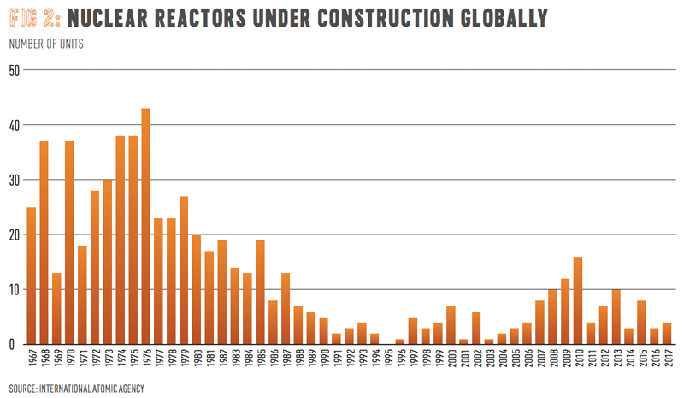
Much of the nuclear debate is powered by opinions and estimates, but looking at the hard data, it’s strikingly clear that the industry is in a slow and inevitable decline. China’s plans to become a nuclear powerhouse have been overshadowed by its huge investments in renewable energy – in fact, the number of new construction starts (see Fig 2) has fallen around the world as stubbornly high costs and complex designs make new nuclear a hard sell.
Even in spite of nuclear power’s role in reducing carbon emissions, the potential safety issues and environmental impact of a meltdown are too big to ignore. With the cost of renewable and battery technologies expected to continue falling, wind and solar power appear to be the next golden opportunity. https://www.worldfinance.com/markets/nuclear-power-continues-its-decline-as-renewable-alternatives-steam-ahead
New delay in sight for Flamanville EPR.
 Le Monde 11th Oct 2018 Flamanville** [Machine Translation] New delay in sight for Flamanville EPR. According to
the Nuclear Safety Authority, “important technical work” remains to be done
to correct the anomalies identified on certain welds. The “battle of the
welds” probably did not finish to delay the construction of the EPR of
Flamanville (Channel). In a note sent to EDF and made public on 3 October, the president of the Nuclear Safety Authority (ASN) has severely reframed the public electrician, worrying about a “monitoring failure” on the Normandy nuclear site .
“It’s the whole chain of surveillance that has
malfunctioned,” says ASN. Pierre-Franck Chevet also indicated that
“important technical work remains to be done” to correct anomalies
identified on certain welds. To understand the vivacity of the reaction of
the nuclear policeman, we must return to the origin of the case. In
February, EDF discovered problems on 38 secondary circuit welds. This water
circuit serves to evacuate the steam towards the turbine. It consists of
four loops, associated with four steam generators. At first, the group
explains that these pipes comply with the regulations but that they should
have corresponded to the “high quality” standard, which is more demanding.
Specifically, EDF had defined this new standard for the construction of the
EPR and was unable to enforce it by its own subcontractors. And things got
complicated a few weeks later. The extensive examination of the welds
reveals that a large part of them do not comply with the standard required
by EDF, or even the regulations required for pressurized nuclear equipment.
Result: the group has to take back fifty-three welds, knowing that a single
weld represents at least eight additional weeks of work.
https://www.lemonde.fr/energies/article/2018/10/11/nouveau-retard-en-vue-pour-l-epr-de-flamanville_5367969_1653054.html
Community unsure about merger of companies, after failure of V.C. Summer nuclear project

Opinions mixed during hearing about failed nuclear power project, Aiken Standard, By Dede Biles dbiles@aikenstandard.com, Oct 11, 2018 Not many people had something they wanted to say about an abandoned nuclear construction project in Fairfield County during the S.C. Public Service Commission’s hearing Monday.
More than 80 people showed up at the Aiken County Government Center, but only 12 testified before the panel, which is considering whether to approve a pending merger between Virginia-based Dominion Energy and SCANA, which is the parent company of SCE&G.
The commission also is trying to decide how much, if anything, SCE&G customers can be charged in the future to help pay for the failed venture’s billions of dollars in cost.
SCE&G and state-owned Santee Cooper were building a new generation of nuclear reactors at the V.C. Summer facility.
Monday’s hearing lasted less than an hour, and the opinions expressed were mixed about the merger.
“I’m kind of against the merger,” said Eric Savage of Aiken. “We hear all the things that Dominion says about how they are going to provide (an average refund of) $1,000 to customers and better things for our community, but what about the money that people have already lost (because of rate increases)? We want to know who is standing behind the South Carolina residents who have already paid out so much? Some of them are on fixed incomes.”……..
Chris Hall of Aiken described the situation with the abandoned nuclear project as “a fiscal nightmare.” He also complained that “rate payers have been asked to bear the burden (through rate hikes)” while SCE&G’s “senior-level executives have gone on with their highly-compensated bonuses and salaries.”……..
The Public Service Commission also held a hearing about the abandoned nuclear power project Monday in Columbia and another is scheduled for North Charleston on Oct. 15 https://www.aikenstandard.com/news/opinions-mixed-during-hearing-about-failed-nuclear-power-project/article_18d0e472-ca79-11e8-8482-0b530859c42f.html
Nuclear weapons proliferation risks in China’s push to export nuclear reactors
|
China’s Nuclear Diplomacy in the Middle East
China will have to balance its nuclear ‘going out’ with nonproliferation concerns. The Diplomat , By Samuel Hickey, October 09, 2018 On September 21, China’s Ministry of Justice published its draft Atomic Energy Law, which urges its vast nuclear industry to go forth into the world and secure a portion of the nuclear export market. Unlike the “Gold Standard” interpretation of the “1+2+3” agreement in the U.S. Atomic Energy Act of 1954, China will not officially limit a partner country’s access to the full nuclear fuel cycle in exchange for nuclear cooperation. |
|
|
$2.4 Trillion Fossil Fuel Shift – better than climate apocalypse
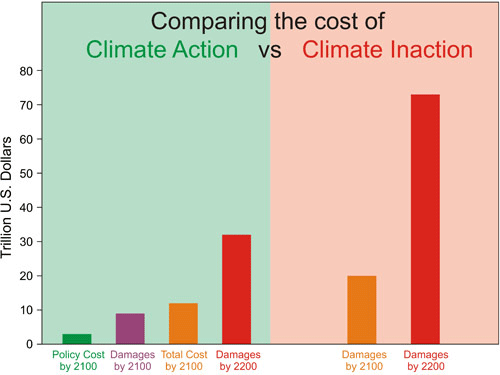
THE IPCC REPORT ALSO RECOMMENDED THAT BY 2050:
Coal’s share of electricity supply should be cut to 2 percent or less.
Renewables should supply 70 percent to 85 percent of power generation.
| Climate Crisis Spurs UN Call for $2.4 Trillion Fossil Fuel Shift https://www.bloomberg.com/news/articles/2018-10-08/scientists-call-for-2-4-trillion-shift-from-coal-to-renewables?srnd=climate-changed, By Reed Landberg, Chisaki Watanabe, and Heesu Lee, October 8, 2018, World on track to warm 3 degrees, overshooting 2015 Paris goal
·UN panel releases report on capping warming at 1.5 degrees The world must invest $2.4 trillion in clean energy every year through 2035 and cut the use of coal-fired power to almost nothing by 2050 to avoid catastrophic damage from climate change, according to scientists convened by the United Nations. Continue reading |
Despite its anti-nuclear ordinance, Oakland City Council to increase a contract with nuclear weapons maker AECOM
Nuclear Weapons Maker to Receive Extra $420,600 to Help Repair Oakland Bridge https://www.eastbayexpress.com/SevenDays/archives/2018/10/08/nuclear-weapons-maker-to-receive-extra-420600-to-help-repair-oakland-bridge
In addition to managing US nuclear labs, AECOM does billions in business building overseas military bases and maintaining Air Force drones.
The Oakland City Council is considering increasing an existing contract by $420,600 for a total of $1.25 million to repair the 23rd Avenue Bridge, but the modified contract is with AECOM, an engineering company that has been involved in designing and manufacturing nuclear weapons components, and in the past, helped manage a desert test site where nuclear weapons experiments were conducted.
Oakland has an anti-nuclear ordinance that usually bars companies involved in designing and building nukes from doing business with the city. But city staffers are recommending that the council waive the prohibition for AECOM due to the fact that the company, and its URS subsidiary, have been involved with the 23rd Avenue Bridge project since 2003 and finding another firm to do the technical work would be difficult.
AECOM bought URS in 2014 and as a result became a partner in the nuclear labs’ management company. Three months ago, the federal government selected a new team to manage the Los Alamos lab, dropping AECOM as one of the firms involved there. But AECOM is still part of the Livermore Lab group.
Prior to this, AECOM helped manage the Nevada National Security Site where nuclear weapons are tested in “subcritical” experiments that don’t result in fission or fusion explosions.
AECOM has billions of dollars worth of other contracts with the U.S. military, doing everything from building overseas bases to maintaining drone weapons systems. As a result of its nuclear weapons contracts, AECOM was one of several companies that Norway’s sovereign fund put on an investment blacklist last January.
Georgia’s utility customers – worms who may be turning against paying for the Vogtle nuclear boondoggle
We understand bringing jobs to the state has been the governor’s chief priority and achievement, and it is one economic benefit of the project. But utility customers should only have to pay for their electric power, not a jobs program without end or limits on how much is spent.

 Nuclear power play keeps Vogtle project alive https://www.gainesvilletimes.com/opinion/editorial-nuclear-power-play-keeps-vogtle-project-alive/ Plan moves ahead with changes, but customers’ patience is wearing thin The Times Editorial Board letters@gainesvilletimes.com Oct. 6, 2018, For years, Georgia Power customers, nuclear power opponents and some politicians have been arguing that construction of the two new reactors at the Plant Vogtle nuclear power plant near Waynesboro is the state’s all-time white elephant.
The project, the nation’s only nuclear plant construction still ongoing, is already a year overdue, nowhere near finished and $1 billion overbudget. final cost is expected to reach near $27 billion, more than twice the original $13 billion price tag. Last year’s bankruptcy filing of the project’s lead contractor, Westinghouse, set the deadline back even further.
Yet late last year, the Georgia Public Service Commission fended off pressure from ratepayers and anti-nuclear advocates and voted to back Georgia Power’s request to continue the work.
But now, after years of seemingly exhaustive support for an enterprise with no limits, some are finally fed up enough to say no.
The most recent and crucial rebellion came recently from one of the project’s partner utilities. Oglethorpe Power threatened to pull out of the reactor construction if some effort wasn’t made to ease its financial commitment. Oglethorpe is one of three smaller electric membership corporations that serve as junior partners in the project along with Georgia Power and its parent, the Southern Company.
But though Georgia Power is a for-profit with shareholders to help shoulder the costs, smaller EMCs don’t have that flexibility and must make their customers bear the funding burden.
Oglethorpe balked at reaffirming its partnership and argued its case to lawmakers for relief. They seemed to find sympathetic ears, with 20 legislators, including Hall County Sen. Butch Miller and other influential leaders, urging the partners to consider a cap on the project’s costs before more losses are passed on to consumers.
The new deal doesn’t exactly do that, but it does to ensure that further cost overruns will be shared more equitably among Georgia Power and the owners of the project — Georgia Power, Oglethorpe Power, the Municipal Electric Authority of Georgia and Dalton Utilities. Specifically Georgia Power must take on a greater portion of future deficits.
Yet even with a somewhat more reasonable deal for the owners, it could still leave ratepayers on the hook for the extra costs as the project wobbles toward the finish line.
“We’re very concerned about today’s announcement because it’s clear the Plant Vogtle nuclear project is in serious trouble if this much arm twisting is necessary to keep all four partners at the table,” Stephen Smith, executive director of Southern Alliance for Clean Energy said in an emailed statement.
Liz Coyle, executive director of consumer advocate Georgia Watch, said it “appears the owners have decided to plow ahead with a project that holds continued uncertainty and certainly clear risk of major cost increases and very little, if any true protections for Georgia’s electric customers.”
It’s worth noting that in addition to those who see the reactor construction as an endless money pit, others object over the viability and safety of nuclear power as a long-term solution to ease off carbon-based fuels.
Defenders of the Vogtle reactors argue that the jobs it creates in that part of the state justify its support. Among them is Gov. Nathan Deal, who urged Oglethorpe to stay with construction plans “before walking away from 7,000 Georgia jobs.”
We understand bringing jobs to the state has been the governor’s chief priority and achievement, and it is one economic benefit of the project. But utility customers should only have to pay for their electric power, not a jobs program without end or limits on how much is spent.
Oglethorpe’s resistance to continuing without some guarantees was timely and needed, but it’s only the first step. The only way to ensure customers won’t have to keep paying more is if legislators insist on the cost caps they suggested. Perhaps that would accomplish what the Public Service Commission has thus far been unwilling or unable to do to rein in cost overruns.
Remember, that five-member board voted unanimously last year to allow the utilities to keep charging customers for its boondoggle. It fits the profile of a state agency that over the years has seldom met a rate hike it wouldn’t rubber-stamp for utilities, many of which provide campaign donations to its members.
Yet Georgians do get a say in how this plays out. There’s a statewide election in less than a month and two PSC seats are on the ballot. Perhaps if commissioners got a message from voters making it clear they’re tired of footing the bill, the board wouldn’t be as eager to keep signing off on this and other costly ventures.
Customers of Georgia Power and its partner EMCs already have paid more than their fair share to get the reactors on line. Even if the plant is finished and begins turning out electrical power, it will take years to recoup what has been invested. It’s time to unplug ratepayers from the burden and let the big corporation’s shareholders take that responsibility.
Even the strongest advocates for nuclear power as a replacement for carbon-based energy have to understand there isn’t an endless supply of construction money in the pockets of Georgia utility consumers.
Yet more delays for Finland’s troubled Olkiluoto nuclear power project
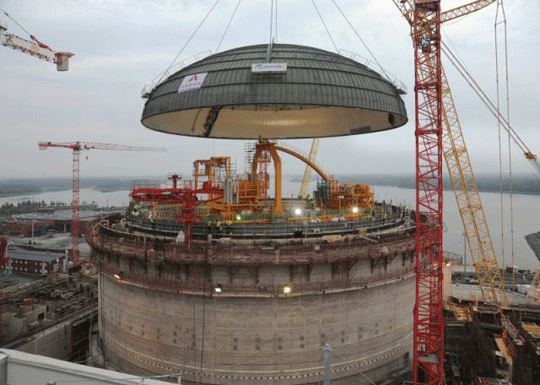 Finnish Olkiluoto-3 nuclear unit tests slipping behind schedule: TVO https://www.spglobal.com/platts/en/market-insights/latest-news/electric-power/100418-finnish-olkiluoto-3-nuclear-unit-tests-slipping-behind-schedule-tvo, Elaine Hiruo –Jonathan Dart
HIGHLIGHTS
New final phase schedule due in December
Too early to say if first power tests delayed
Output schedule ‘available ahead of commercial op’
London — Areva-Siemens is to provide a new schedule in December for the final phases of the 1.6-GW Finnish Olkiluoto-3 nuclear reactor after slippage in its commissioning tests, owner operator TVO confirmed Thursday.
This could potentially push back first delivery of power in tests currently scheduled from May 2019, “but we won’t know this until December,” TVO spokesman Pasi Tuohimaa told S&P Global Platts.
Previously TVO has said test production over a roughly five-month period could account for 10%-15% of Finland’s annual electricity needs ahead of full commercial operation, or 2-4 TWh.
Such is the potential volume at risk that TVO is to put up a schedule of Olkiluoto-3’s production tests six months before commercial operation, Tuohimaa said. He stressed that at this stage it was impossible to assess accurately how much electricity would be produced during testing.
“The completion of the commissioning tests has not been progressing according to the updated schedule for commissioning by the plant supplier Areva-Siemens Consortium,” TVO said in a statement late Wednesday.
The operator could not say whether “rebaselining” of the final phase schedule would affect the current September target for the start of commercial operation at the plant, which is already almost 10 years behind the original schedule and three times over the original Eur3.2 billion budget.
Neither could TVO say whether test production of electricity at varying power levels from May 2019 would be affected by the re-scheduling.
In June 2017, TVO said Olkiluoto-3 would begin commercial operation in September 2019, rather than in May of that year as expected. Hot testing had taken longer than expected, it said.
Q2 2019 Nordic baseload power on the NASDAQ futures exchange traded Thursday 0900 GMT at Eur36.40/MWh, down 30 euro cent from two trades earlier in the European morning.
elaine.hiruo@spglobal.com– jonathan.dart@spglobal.com
New Jersey’s electrical utilities lobbying for nuclear subsidies
 UTILITIES SUBMIT PROPOSALS FOR NUCLEAR SUBSIDIES, NJ Spotlight TOM JOHNSON | OCTOBER 3, 2018
While some residential customers may end up paying $30 more annually, large energy users may see their bills rise by $1 million a year.
It will be months before the state decides whether customers need to subsidize nuclear power, but New Jersey’s four electric utilities are already proposing how they will recover those costs.
In filings with the Board of Public Utilities, each of the utilities submitted tariffs disclosing how they will recoup the cost of buying Zero Emission Certificates (ZECs), the potential $300 million annual subsidy aimed at propping up the state’s supply of nuclear power.
The proposals are the latest in a series of filings that could boost bills to customers by billions of dollars if approved by the regulatory agency, most stemming from two bills signed into law this spring that will transform energy policy in New Jersey.
PSEG threatened to shut down units in South Jersey
The most contentious bill involved proposed subsidies to avert the closing of the three remaining nuclear power plants in New Jersey. Without financial incentives, Public Service Enterprise Group threatened to shut down the units it operates in South Jersey……
Is it a done deal?
“It gives the appearance of being a fait accompli,’’ said Doug O’Malley, director of Environment New Jersey, part of a coalition that opposed the nuclear bill. “The ZEC tariffs give the appearance that it is a done deal.’’
The board must still approve the tariffs, as well as any application by a nuclear-plant owner for the subsidy.
The proposed surcharge is established by the bill signed by Gov. Phil Murphy, but the tariffs submitted to the BPU vary on how much customers will pay depending on what customer class they’re in……..
Stefanie Brand: ‘It all adds up’
“The numbers appear small, but in fact they are quite large,’’ said Steve Goldenberg, an attorney representing large energy users. When you multiply the change by a whole lot of kilowatt hours, you derive a very large number.’’
The annual costs for some large energy users will exceed $1 million, Goldenberg said. “The lowest I’ve heard is $300,000.’’
Others worry the potential subsidies, when added to other costs that are pending before the BPU, or recently approved, will be a huge hit to ratepayers.
“It all adds up,’’ said Stefanie Brand, director of the Division of Rate Counsel. PSE&G has more than $10 billion in proposed rate increases pending before the BPU, if a recent $1.9 billion gas modernization program is included, Brand said.
Those cases include $2.5 billion to improve the resilience of its electric and gas distribution system; a $4 billion clean-energy initiative filed last Friday, and the proposed nuclear subsidy.
“The fact is there is no way to spend $10 billion and not have it be very expensive to ratepayers,’’ Brand said…….https://www.njspotlight.com/stories/18/10/02/utilities-submit-proposals-for-nuclear-subsidies/
1 This Month
26 September – International Day for the Total Elimination of Nuclear Weapons





PLEASE OPPOSE HR 8255 AND S.3639 – bills would accelerate satellite deployment, with no environmental review or safeguards – https://ncstd5li.quorum.us/campaign/169331/
To see nuclear-related stories in greater depth and intensity – go to https://nuclearinformation.wordpress.com
-
Archives
- September 2026 (291)
- August 2026 (330)
- July 2026 (355)
- June 2026 (287)
- May 2026 (306)
- April 2026 (356)
- March 2026 (251)
- February 2026 (267)
- January 2026 (308)
- December 2025 (358)
- November 2025 (359)
- October 2025 (375)
-
Categories
- 1
- 1 NUCLEAR ISSUES
- business and costs
- climate change
- culture and arts
- ENERGY
- environment
- health
- history
- indigenous issues
- Legal
- marketing of nuclear
- media
- opposition to nuclear
- PERSONAL STORIES
- politics
- politics international
- Religion and ethics
- safety
- secrets,lies and civil liberties
- spinbuster
- technology
- Uranium
- wastes
- weapons and war
- Women
- 2 WORLD
- ACTION
- AFRICA
- Atrocities
- AUSTRALIA
- Christina's notes
- Christina's themes
- culture and arts
- Events
- Fuk 2022
- Fuk 2023
- Fukushima 2017
- Fukushima 2018
- fukushima 2019
- Fukushima 2020
- Fukushima 2021
- general
- global warming
- Humour (God we need it)
- Nuclear
- RARE EARTHS
- Reference
- resources – print
- Resources -audiovicual
- Weekly Newsletter
- World
- World Nuclear
- YouTube
-
RSS
Entries RSS
Comments RSS

