Nuclear power station contest winners announced – after project is axed, Architects Journal UK, 21 NOVEMBER, 2018 BY MERLIN FULCHERReiach and Hall Architects and K2 Architects have been named winners of the RIBA’s Moorside contest to provide a visitor centre and workers accommodation for the Cumbrian nuclear power station that was cancelled earlier this month
The contest, launched by the RIBA almost three years ago, sought proposals for the 200ha site’s visitor centre and for a workers’ accommodation campus nearby.
On Monday (19 November) NuGen finally announced Reiach and Hall Architects had won the contest for the workers’ accommodation campus while K2 Architects had been chosen for the visitor centre. Neither project will go-ahead.
A shortlist was revealed in May 2016 but the announcement of winners was postponed. Last year the troubled £10 billion project was placed under review after joint-funder ENGIE withdrew and the reactor manufacturer Westinghouse filed for bankruptcy.
Earlier this month, the project’s sole remaining backer Toshiba announced it had failed to bring its preferred bidder Korea Electric Power Corporation on board and would be winding up its subsidiary NuGen, which had been tasked with delivering the ambitious scheme.
In a statement, NuGen said: ‘Though prizes for the competition itself have been awarded, NuGen had hoped to be able to announce the intention to work with winning entrants, regrettably though as NuGen is the process of being wound up, there will not be the opportunity.
‘NuGen thanks all entrants to the competitions and wishes them the best of success in their future projects.’
………. A separate competition, organised by the Landscape Institute, was also launched in January 2016 to find ‘creative and sustainable’ proposals for the facility’s surroundings but no winner has been announced…
……The two competitions together had a £20,000 prize fund, with the winning architect and landscape architect receiving £5,000 each and a chance to bid for work on the scheme.
Nuclear Advocates Set Sights on Advanced Reactors for Puerto Rico
With big push of meetings with key officials, nuclear industry hopes to be part of Puerto Rico’s energy future, Morning ConsultBY JACQUELINE TOTH November 19, 2018
Supporters are highlighting the energy, climate and safety benefits of advanced reactor concepts.
Puerto Rico’s House of Representatives passed a resolution to study nuclear energy.
Details are sparse this early in the discussions, and Puerto Rico has no concrete plans for nuclear, instead focusing on other sources.
Nuclear industry professionals have launched a long-term bid to convince Puerto Rico they may have the solution for the island’s energy woes. ………
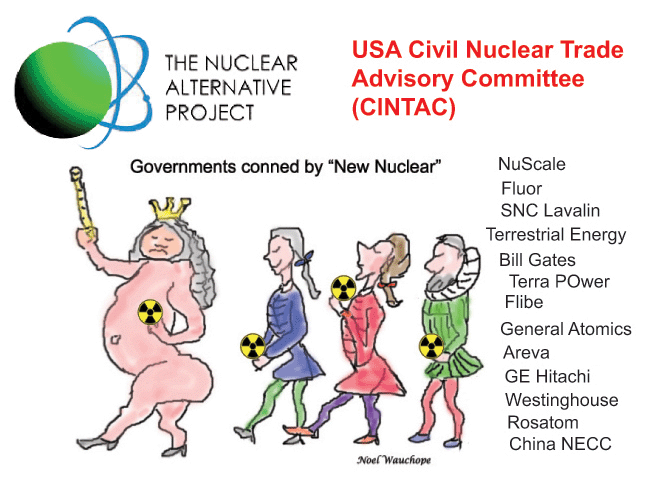
A group of nuclear industry professionals, who have formed The Nuclear Alternative Project nonprofit organization, recently hosted a group of nuclear executives to meet with Puerto Rican lawmakers and officials to discuss new nuclear concepts.
“We were in Puerto Rico for four days, and we were able to take the conversation from, ‘You guys are nuts,’” to something Puerto Ricans would consider if it would lower their energy bills, said Jesabel Rivera, the nonprofit’s community impact and engagement consultant.
But a host of questions over when, where, how and at what cost these reactors would be deployed and operated in Puerto Rico remains unanswered at this early stage. Some groups have also raised environmental concerns.
Officials from companies that included small modular reactor and micro-reactor developers NuScale Power LLC, X-Energy LLC, Westinghouse Electric Co. and GE-Hitachi Nuclear Energy Inc., attended the meetings on the island.
“A lot of folks didn’t know anything about nuclear other than what they had kind of seen in movies,” said Jose Reyes, chief technology officer of NuScale, who attended the trip. “One person mentioned Homer Simpson.”
Another participant was Donald Hoffman, president and chief executive of nuclear consultancy EXCEL Services Corp., founder of the United Nuclear Industry Alliance, a former adviser to now-President Donald Trump and a member of the Commerce Department’s Civil Nuclear Trade Advisory Committee.
Several of the recent tour’s other participants are CINTAC members.
After the tour, Puerto Rico’s House of Representatives on Nov. 7 approved a resolution that calls on the House Government Commission to investigate the need for nuclear energy reactors on the island and report back within 180 days.
SMRs are billed as faster-to-construct, safer technologies with longer refueling cycles compared to older nuclear reactors, though no U.S. designs have yet undergone construction. The U.S. SMR furthest along in the Nuclear Regulatory Commission licensing process is NuScale, which has completed phase one of design review……
But discussions are at a nascent stage.
“There’s not enough detail yet. There’s no site,” design or cost determination for nuclear in Puerto Rico, Carlos Fernández-Lugo, chairman of the environmental, energy and land use practice group at law firm McConnell Valdés LLC, said during an Oct. 30 public panel discussion on nuclear energy held at the Mayagüez campus of the University of Puerto Rico.
It also remains unclear whether the customer for a nuclear plant would be the Puerto Rico Electric Power Authority, the struggling government-owned utility that is undergoing restructuring.
The Nuclear Alternative Project is looking for funding to move forward with a feasibility study, Rivera said.
On Friday, however, a spokeswoman from the Department of Energy said the department does not have plans for a study on advanced nuclear in Puerto Rico at this time.
Puerto Rico does not currently have any operating nuclear reactors, but it once had the Boiling Nuclear Superheater Reactor Facility, an experimental reactor in Rincón, which operated at full power in 1965 but stopped about three years later due to technical difficulties and the resulting expensive changes that would be required. It was decommissioned, and decontamination work continued into the early 2000s. https://morningconsult.com/2018/11/19/nuclear-advocates-set-sights-advanced-reactors-puerto-rico/
International Panel on Fissile Materials 18th Nov 2018 Martin Forwood: The UK government announced on 14 November 2018 that the THORP reprocessing plant at Sellafield has started its planned shutdown. A
Sellafield Stakeholder committee was told that by 11 November 2018, THORP would have chopped up (sheared) its last batch of spent fuel, bringing to an end almost a quarter century of operation.
Based on the officially published ‘annual throughput’ figures (tons reprocessed per year) collated
by the environmental group Cumbrians Opposed to a Radioactive Environment (CORE) since the plant opened in 1994, THORP has failed to meet its operational targets and schedules by a large margin. Just 5,045 tons were
reprocessed in the first 10 years of operation–the 7,000 tons only being completed on 4 December 4 2012–over nine years late. Not once during the Baseload period (1994-2003) was the nominal throughput rate of 1,000 tons
per year achieved. http://fissilematerials.org/blog/2018/11/sellafields_thorp_reproce.html
15th Nov 2018 On the morning after the Financial Times has called on the UK Government to reassess its long-term energy plans following the demise of Toshiba’sMoorside nuclear project, the Stop Hinkley Campaign has published a briefing about lessons we can learn from the Sellafield Thermal Oxide Reprocessing Plant which is in the process of closing after only 24 years of operation and a very chequered performance.
The “Lessons for Hinkley from Sellafield” briefing says: The cost of building THORP increased from
£300m in 1977 to £1.8bn on completion in 1992. With the additional cost of associated facilities this figure rose to £2.8bn. Originally expected to reprocess 7,000 tonnes of spent fuel in its first ten years, it has managed only around 9,300 in 24 years.
The original rationale for THORP ended with the closure of the UK’s fast reactor programme in 1994. The new rationale – to produce plutonium fuel for ordinary reactors – was a disaster costing the taxpayer £2.2bn.
Stop Hinkley Spokesperson Roy Pumfrey said: “The rationale for building the THORP plant at Sellafield had disappeared before it even opened. The lesson for 2018 is that we should scrap Hinkley C now before costs escalate. The cancellation costs are small relative to the £50billion extra we’ll have to pay for Hinkley’s electricity, if it ever generates any. If we wait any longer to scrap it,
we risk heading for another Sellafield-scale financial disaster.” http://www.stophinkley.org/PressReleases/pr181115.pdf
Utility consultant: SCE&G ignored ‘stop signs’ about failed nuclear project, Greenville News,Tom Barton, The State Nov. 13, 2018SCE&G ignored numerous warning signs before walking away from a failed $9 billion nuclear expansion project, an industry consultant told the S.C. Public Service Commission on Monday.
“Let me be blunt: You have a utility that bet the farm and lost,” Scott Rubin, an independent utility consultant and attorney from Pennsylvania, testified Monday on behalf of AARP South Carolina. “By the end of this year, customers will have paid $2.2 billion for absolutely nothing — not a single watt of electricity.”
Rubin’s testimony came on the eighth day of PSC hearings into the failed effort by SCE&G, a SCANA subsidiary, to build two nuclear reactors in Fairfield County. The commission also is considering SCE&G’s future electric rates and a proposal by Richmond-based Dominion Energy to buy its parent, Cayce-based SCANA.
Nuclear fallout: $15.5 billion in compensation and counting
They built our atomic bombs; now they’re dying of cancer
Nearly 33,500 former nuclear site workers died due to radiation exposure- report
Nuclear Fallout: This story produced in partnership with ProPublica and the Santa Fe New Mexican. (Richly illustrated with photographs, videos, charts, documents interactive map) Wave 3, By Jamie Grey and Lee Zurik|November 12, 2018 LOS ALAMOS, NEW MEXICO (InvestigateTV)– Clear, plastic water bottles, with the caps all slightly twisted open, fill a small refrigerator under Gilbert Mondragon’s kitchen counter. The lids all loosened by his 4- and 6-year old daughters because, at just 38, Mondragon suffers from limited mobility and strength. He blames his conditions on years of exposure to chemicals and radiation at the facility that produced the world’s first atomic bomb: Los Alamos National Laboratory.
Gilbert Mondragon, 38, pulls the cap off a plastic water bottle that had been twisted open by his young daughters. He hasn’t the strength for those simple tasks anymore and blames his 20-year career at the Los Alamos National Lab. He quit this year because of his serious lung issues, which he suspects were caused by exposures at the nuclear facility. (InvestigateTV/Andy Miller)
Mondragon is hardly alone in his thinking; there are thousands more nuclear weapons workers who are sick or dead. The government too recognizes that workers have been harmed; the Department of Labor administers programs to compensate “the men and women who sacrificed so much for our country’s national security.”
But InvestigateTV found workers with medical issues struggling to get compensated from a program that has ballooned ten times original cost estimates. More than 6,000 workers from Los Alamos alone have filed to get money for their medical problems, with around 53 percent of claims approved.
The Los Alamos lab, the top-secret site for bomb design in 1943, has had numerous safety violations and evidence of improper monitoring, federal inspection reports show. Continue reading →
WYG points finger at government for Toshiba nuclear decision, Building UK, By Dave Rogers12 November 2018 Consultant forced to take £3m loss on business it bought for Moorside development. Consultant WYG has criticised the government for not being clear enough in its support to build a nuclear power station in Cumbria.
Publishing its annual results in June, WYG said it was forced to book a £3.2m cost on closing a business that it bought because of the work it expected to be carried out at the Moorside plant.
Land and property firm North Associates was snapped up in 2015 but delays on the plant forced the firm to shut the Carlisle-based business in March.
Last week Toshiba said it would wind-up its NuGen business which had been slated to carry out work building the plant at Moorside……….
Toshiba spent 18 months trying to sell NuGen but failed to find a firm willing to invest in the nuclear project. It said winding up the company would cost it £125m.
Engie walked away from NuGen, leaving Toshiba to try and sell the vehicle after posting a $8.4bn (£6.4bn) loss for the year ending 31 March 2017.
Dave Toke’s Blog 11th Nov 2018 ,Greg Clark looks likely to go down in history as the Minister who signs off
on a nuclear construction deal with Hitachi for the proposed Wylfa power plant that led to a stupendous loss for the taxpayer. That loss might be £20 billion or more.
Clark has apparently put no discernable effort into the objective of securing ‘subsidy’ free contracts for onshore wind and solar. However, he has been spending a lot of time concocting a plan to finance the Wylfa nuclear power plant that will, on the basis of past performance, generate huge losses for the public purse years down the line.
All the talk from BEIS (the energy ministry) is of the new ‘Regulated Asset Base’ (RAB) financing of nuclear power plant. Except that what’s really happening is not really an RAB model at all. It’s a piece of brownwash to obscure the reality of Government blank cheque to cover whatever it costs to build the nuclear plant. That’s because the whole plan hinges on the constructors being able to pass on cost-overruns onto the Government.
And that’s the point. Nuclear power stations being built in the west have almost always tended to have large cost overruns. Recent ones have ALL suffered horrendous cost overruns – in the USA (4), France (1) and Finland (1).
Yet, some otherwise sensible, financial analysts seem to ignore this fact as they extol the virtues of RAB financing. They implicitly assume that Wylfa will proceed precisely on target, in which case, they say the Government will deliver the project at a ‘cheaper’ price than Hinkley C through the provision of Government loans with low interest rates.
Times 10th Nov 2018 Consumers face a multimillion-pound bill for work carried out in preparation for the proposed Cumbrian nuclear plant that may never be built.
National Grid said that it had spent tens of millions of pounds planning the 100-mile power line to connect Nugen’s Moorside plant to the electricity transmission network. Much of the cost is expected to be recovered from households and businesses via levies on their energy bills for decades to come. John Pettigrew, chief executive, said that work on the Moorside line had cost “tens of millions” of pounds and that there was a “regulatory process” to recover the costs.
Nugen is obliged to cover some of the cost, but one industry source said that it was on the hook for a little more than £10 million, while National Grid’s expenditure was thought to be in the high double digits. National Grid is expected to submit a claim to Ofgem, the energy regulator, to recoup the rest from consumers.
The regulator can refuse to allow expenditure it deems inefficient, but the rules are thought likely to allow the company to recover at least half of its costs. The eventual £2.8 billion proposal included £1.9 billion of “measures to reduce its impact on people, places and the environment”, including burying the lines through a 14-mile stretch of the Lake District and a 13-mile tunnel under MorecambeBay. https://www.thetimes.co.uk/article/f1630fa6-e458-11e8-9838-efa7e96cbe2b
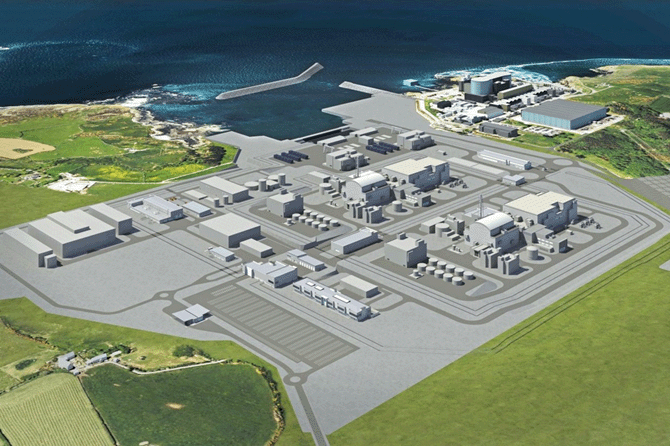
Times 11th Nov 2018 The business secretary Greg Clark held a crunch meeting with Hitachi in Tokyo last week over its planned £15bn Welsh nuclear power station, as a rival Japanese project collapsed. Toshiba killed off its NuGen power station plan in Cumbria last week after the ailing industrial giant struggled to find a buyer – denting Britain and Japan’s nuclear ambitions.
Toshiba’s exit leaves Britain’s nuclear power renaissance reliant on France’s EDF and Japan’s Hitachi. Clark is understood to have attended a dinner with the Hitachi chairman Hiroaki Nakanishi during a visit to Japan, where they discussed sealing a deal on Hitachi’s Horizon power station on Anglesey by Easter.
The British and Japanese governments are expected to take equal equity stakes in Horizon alongside Hitachi. Whitehall is also expected to provide all the debt for the 2.7 gigawatt project, which would be sold once it has started generating power. Clark agreed to help bankroll the Horizon project in June, marking a departure from previous policy.
Ministers want Horizon and Hinkley to replace a string of ageing coal and nuclear power plants that are due to close over the next decade. Under pressure from ministers, Hitachi is considering using a different form of financing – a regulated asset base – for future reactors on Anglesey and in Gloucestershire.
Guardian,9 Nov 18 , Phillip Inman As Cumbria reactor plan stalls, it is clear that huge resources are needed for such projects. If the government was keen to boost Britain’s nuclear industry, it was always clear that the private market would struggle to deliver.
Hinkley was a deal that appeared to be with a private company but the really meaningful talks were between Whitehall officials and their counterparts in the French government, EDF’s controlling shareholder. It took years of agonising brinkmanship to conclude the talks, much of them conducted on the French side by the then economy minister, Emmanuel Macron.
Toshiba, on the other hand, is a private company struggling on its own to navigate the complex politics surrounding nuclear power in the wake of the Fukushima disaster.
In 2006 it bought the US nuclear business Westinghouse, part of British Nuclear Fuels and home to much of the UK’s nuclear power industry. With climate change creeping to the top of the agenda and demand for new nuclear plants around the world growing, it seemed like a good idea.
However, the 2011 Fukushima disaster changed all that. Governments in Japan and other countries halted the development of new nuclear plants. Last year, cost overruns on building the first new US nuclear power plants in three decades pushed Westinghouse into bankruptcy and Toshiba into financial meltdown. The future of the Cumbrian nuclear plant has been in doubt ever since.
Earlier this year Toshiba sold Westinghouse to a private equity outfit as a services provider for existing nuclear plants. The construction of new reactors was not on the agenda. To no one’s surprise, Toshiba has now confirmed it has abandoned building any new plants in the UK.
Without entering the argument about whether nuclear is a good option – and the government advisory body, the National Infrastructure Commission, is unequivocal that renewables such as wind and solar were going to be a safer, cheaper option – it is clear huge commitments of time, resources and political capital are necessary for infrastructure projects of this scale to get off the ground and through to completion.https://www.theguardian.com/business/2018/nov/08/toshibas-failure-shows-business-cant-deliver-a-nuclear-future
UK nuclear power station plans scrapped as Toshiba pulls out, Guardian, Adam Vaughan@adamvaughan_uk, 8 Nov 2018 Firm’s nuclear arm to wind up next year and scrap Cumbria plant leaving big hole in UK energy plans Plans for a new nuclear power station in Cumbria have been scrapped after the Japanese conglomerate Toshiba announced it was winding up the UK unit behind the project.
Toshiba said it would take a 18.8bn Japanese yen (£125m) hit from closing its NuGeneration subsidiary, which had already been cut to a skeleton staff,after it failed to find a buyer for the scheme.
The decision represents a major blow to the government’s ambitions for new nuclear and leaves a huge hole in energy policy. The plant would have provided about 7% of UK electricity.
“This is a huge disappointment and a crushing blow to hopes of a revival of the UK nuclear energy industry,” said Tim Yeo, the chair of pro-nuclear lobby group New Nuclear Watch Institute and a former Tory MP.
Greenpeace UK’s executive director, John Sauven, said: “The end of the Moorside plan represents a failure of the government’s nuclear gamble.”
After a board meeting of Toshiba on Thursday, the company said it was winding up NuGeneration because of its inability to find a buyer and the ongoing costs it was incurring. The firm has already spent more than £400m on the project.
“Toshiba recognises that the economically rational decision is to withdraw from the UK nuclear power plant construction project, and has resolved to take steps to wind-up NuGen,” the firm said in a statement………
Some industry watchers said the collapse of the scheme should be seen as an opportunity rather than a risk, for the UK to prioritise renewables instead.
Jonathan Marshall, an analyst at the ECIU thinktank, said: “Shifting away from expensive, complicated technology towards cheaper and easier to build renewables gives the UK the opportunity to build an electricity system that will keep bills for homes and businesses down for years to come.”
Toshiba Ditches UK Nuclear Business, U.S. LNG Operations, Oil Price.com By Irina Slav – Nov 08, 2018 Toshiba has decided to liquidate a nuclear power subsidiary in charge of a power plant project in the UK as well as its U.S. LNG operations, the company said in a statement, citing its inability to continue operating the business and its failure to find buyers for it.Toshiba will also liquidate another nuclear subsidiary in the UK, Advance Energy UK Limited. The loss that the company will book from the wind-ups will come in at US$130 million (15 billion yen) and will be booked in its 2018/19 results………
Earlier this year, Toshiba sold its U.S. nuclear power business, Westinghouse, for US$4.6 billion to a group of investment companies led by Brookfield Asset Management. The deal puts an end to a major headache for the Japanese conglomerate, which last year warned that it might have trouble surviving if it didn’t find a buyer for the nuclear power plant constructor, which it acquired in 2006 for US$5 billion.