nuclear-news

The News That Matters about the Nuclear Industry Fukushima Chernobyl Mayak Three Mile Island Atomic Testing Radiation Isotope

  • Home
  • 1 This Month
  • ACTION !
  • Disclaimer
  • Links
  • PAGES on NUCLEAR ISSUES

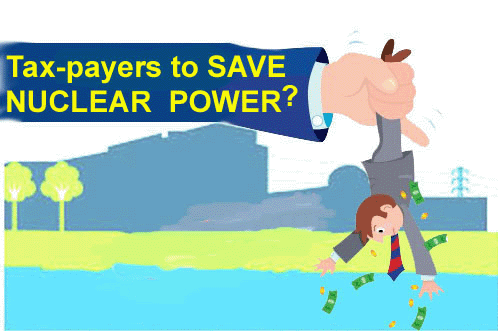
Rapidly climbing costs to USA tax-payers for nuclear waste cleanup – rose by $100 billion in one year!

America’s Chernobyl’: Inside The Most Toxic Place In The Nation | TODAY


Cost to taxpayers to clean up nuclear waste jumps $100 billion in a year https://www.nbcnews.com/news/all/cost-taxpayers-clean-nuclear-waste-jumps-100-billion-year-n963586 , 30 Jan 19, An Energy Department report shows the projected cost for long-term nuclear waste cleanup overseen by DOE jumped $100 billion in just one year.  Jan. 29, 2019, By Laura Strickler, WASHINGTON — The estimated cost of cleaning up America’s nuclear waste has jumped more than $100 billion in just one year, according to a DOE report — and a watchdog warns the cost may climb still higher.

The Energy Department’s projected cost for cleanup jumped from $383.78 billion in 2017 to $493.96 billion in a financial report issued in December 2018.

A government watchdog and DOE expert said the new total may still underestimate the full cost of cleanup, which is expected to last another 50 years. “We believe the number is growing and we believe the number is understated,” said David Trimble, director of the Government Accountability Office’s Natural Resources and Environment team.

The cost was calculated by the accounting firm KPMG under contract to DOE.

Eighty percent of the increase comes from new projections of the costs of cleaning up radioactive waste and hazardous chemicals at the Hanford site in southeastern Washington.

The 586-square-mile site, home to nine former production reactors and processing facilities, produced plutonium for America’s nuclear arsenal during the Cold War.

Cleaning up Hanford has already cost taxpayers $170 billion over 30 years, but government auditors say the most challenging parts of the clean-up work are yet to be done.

Still not cleaned up are 56 million gallons of what the DOE’s inspector general has described as “hazardous and highly radioactive waste.” The rise in projected cost is due to updated estimates for building and running a waste treatment plant, including “operating costs, tank farm retrieval and closure costs” at the site, according to the report. The report also refers to changes in “technical approach or scope” and “updated estimates of projected waste volumes.”

Trimble of the GAO believes the Energy Department “does not have a coherent strategic plan on how to address its cleanup mission.”

A spokesperson for the Energy Department said in an emailed statement that the office that oversees the cleanup is “committed to making progress on the ground at Hanford, and mitigating the years of escalating liabilities at the site.”

The spokesperson said DOE expects more cost increases “and is working with regulators and stakeholders on best options to treat and dispose of radioactive waste.”

Energy Secretary Rick Perry has proposed a reclassification of the radioactive waste at Hanford to make its disposal less expensive, a suggestion opposed by environmental groups in the Pacific Northwest.

In mid-December, DOE issued a financial report with a signed letter from U.S. Energy Department Secretary Rick Perry on the fourth page. Perry’s letter lists the agency’s accomplishments and describes the agency’s environmental cleanup activities. He cited the completion of an underground project at Hanford, but does not mention the projected increase in costs to taxpayers.

“PLAGUED WITH MISMANAGEMENT”

For decades, government auditors have raised serious concerns about the lack of clear goals for the site and long term problems with the cleanup.

A 2018 report from the DOE’s inspector general rolled up 38 investigations the IG had conducted on the environmental management efforts at Hanford.

The IG concluded Hanford has been “plagued with mismanagement, poor internal controls, and fraudulent activities, resulting in monetary impacts totalling hundreds of millions of dollars by the various contractors at the site.”

Bechtel, one of the large government contractors that manages site cleanup, was part of a group of contractors that paid a $125 million settlement in 2016, the largest settlement ever obtained by the agency’s inspector general.

The U.S. had alleged Bechtel improperly used federal taxpayer dollars to fund a multi-year lobbying effort in Congress to continue the funding of its contract.

Under the final settlement agreement, Bechtel National Inc. admitted no wrongdoing.

In response to the recent Energy Department report Bechtel spokesperson Fred deSousa notes that the waste treatment plant they are building in Hanford is “the most complex project of its kind in the world.” DeSousa also told NBC in his statement that the project has gone through multiple independent reviews resulting in changes to its contract. “Today the project is bigger, more robust, and has more stringent operating and safety margins,” he said.

The new Democratic chair of the House Energy and Commerce Committee says the committee will increase its oversight of Hanford.

“It is essential that DOE better manage and oversee its contractors to ensure that taxpayers, workers and the environment are being protected” said Rep. Frank Pallone, Jr., D-N.J. “The Committee will continue to have questions for DOE as to whether cleanup efforts at Hanford and other sites are being properly managed.”

January 31, 2019 Posted by Christina Macpherson | business and costs, USA, wastes | 2 Comments

Nuclear propaganda keeps spinning, despite the gloomy reality of the industry

Nuclear power down for the count, Jim Green, Online Opinion, 31 January 2019, http://onlineopinion.com.au/view.asp?article=20138&page=0  

Last year was a “positive year for nuclear power” according to the World Nuclear Association (WNA). And indeed it was, compared to 2017, which was one of the industry’s worst-ever years.

The WNA cited nuclear power’s net gain in 2018 (nine reactor grid connections compared to six permanent shutdowns). A superficial look at the numbers suggests some more good news for the industry. The number of reactor grid connections (start-ups) over the past five years (38) almost doubled the number in the five years before that (21). If the number doubled again, the much-hyped nuclear renaissance would be upon us.

A casual observer might also be impressed by the fact that the number of reactor grid connections (59) and construction starts (71) over the past decade exceeded the number of permanent reactor shutdowns (50).

And some more good news for the industry: according to the WNA, 41 reactors will enter commercial operation in the four years from 2019-22. But after that, the pre-Fukushima mini-renaissance (38 reactor construction starts from 2008-2010) slows dramatically with an estimated total of just nine reactor start-ups in the following four years.

Ominously for the industry, the 22 construction starts from 2014-18 was less than half the number (49) from 2009-13.

The (independent) World Nuclear Industry Status Report (WNISR) noted in early January that 49 reactors are under construction worldwide ‒ the first time the number has fallen below 50 in a decade, down 19 since 2013, and the number has decreased for five years in a row.

If all these contradictory good-news, bad-news figures seem a little … contradictory, that’s because nuclear power currently reflects two opposing dynamics: the mini-renaissance is evident but will subside by the mid-2020s, and the Era of Nuclear Decommissioning (discussed later) has begun and will be in sharp focus by the mid-2020s.

By contrast, renewable power generation continues to expand rapidly and costs continue to fall dramatically. Renewables accounted for 26.5 percent of global electricity generation in 2017 compared to nuclear power’s 10.3 percent.

Ageing reactor fleet

The industry faces severe problems, not least the ageing of the global reactor fleet. The average age of the fleet continues to rise and reached 30 years in mid-2018. A reasonable estimate is that the average lifespan of the current reactor fleet will be about 40 years.

There will likely be an average of 8-11 permanent reactor shutdowns annually over the next few decades:

·         The International Energy Agency expects a “wave of retirements of ageing nuclear reactors” and an “unprecedented rate of decommissioning” ‒ almost 200 reactor shutdowns between 2014 and 2040.

·         The International Atomic Energy Agency (IAEA) anticipates 320 gigawatts (GW) of retirements from 2017 to 2050 (that’s about 80 percent of the current worldwide reactor fleet).

·         Another IAEA report estimates up to 139 GW of permanent shutdowns from 2018-2030 and up to 186 GW of further shutdowns from 2030-2050.

·         The reference scenario in the 2017 edition of the WNA’s Nuclear Fuel Report has 140 reactors closing by 2035.

·         A 2017 Nuclear Energy Insider article estimates up to 200 permanent shutdowns over the next two decades.

So an average of 8-11 construction starts and grid connections will be required to maintain current nuclear generation. Yet construction starts have averaged just 4.5 over the past five years.

Grim prospects

For the first time in many years, perhaps ever, the IAEA was up-front about the grim prospects for nuclear power in a September 2018 report. The IAEA said:

“Nuclear power’s electricity generating capacity risks shrinking in the coming decades as ageing reactors are retired and the industry struggles with reduced competitiveness … Over the short term, the low price of natural gas, the impact of renewable energy sources on electricity prices, and national nuclear policies in several countries following the accident at Japan’s Fukushima Daiichi Nuclear Power Plant in 2011 are expected to continue weighing on nuclear power’s growth prospects … In addition, the nuclear power industry faces increased construction times and costs due to heightened safety requirements, challenges in deploying advanced technologies and other factors.”

The IAEA’s low and high projections for global nuclear power capacity in 2030 are both 36 percent lower than the same projections in 2010, the year before the Fukushima disaster.

Former World Nuclear Association executive Steve Kidd noted in an August 2018 article:

“The current upward spike in reactor commissioning certainly looks impressive (at least compared with the recent past) but there are few signs that here will be a further uplift in the 2020s. What we see today is largely the result of rapid growth in the Chinese industry, which has now seemingly ended. … In Asia, the sharp downturn in Chinese interest in nuclear is unlikely to be replaced by India or by a combination of the other populous counties there. It is clear that without a strong lead from the established nuclear countries, a worldwide uplift in reactor construction is not going to happen.”

And therein lies a fundamental problem for the nuclear industry: it is in a frightful mess in the three countries that accounted for 56 percent of global nuclear power capacity just before the Fukushima disaster: the US, France and Japan. A 2017 EnergyPostWeekly article said “the EU, the US and Japan are busy committing nuclear suicide.”

Spin

Bright New World, an Australian pro-nuclear lobby group (that accepts secret corporate donations) listed these wins in 2018:

1. Taiwanese voters voiced support for overturning legislation to eliminate nuclear power.

2. Poland announced plans for a 6-9 GW nuclear sector.

3. China connected the world’s first AP1000 and EPR reactors to the electrical grid.

4. Some progress with Generation IV R&D projects (Terrestrial Energy, NuScale, Moltex), and the passing of the US Nuclear Energy Innovation Capabilities Act which aims to speed up the development of advanced reactors.

Those are modest and pyrrhic wins. To take each in turn:

1. Taiwan’s government remains committed to phasing out nuclear power although the 2025 deadline has been abandoned following a referendum in November 2018.

2. Poland might join the club of countries producing nuclear power ‒ or it might not. Currently it is a member of a group of countries that failed to complete partially-built power reactors and have never generated nuclear power, along with Austria, Cuba, the Philippines, and North Korea.

3. China’s nuclear power program has stalled ‒ the country has not opened a new construction site for a commercial reactor since December 2016. The most likely outcome over the next decade is that a small number of new reactor projects will be approved each year, well short of previous projections and not enough to match the decline in the rest of the world.

4. Generation IV fantasies are as fantastical as ever. David Elliot ‒ author of the 2017 book Nuclear Power: Past, Present and Future ‒ notes that many Generation IV concepts “are in fact old ideas that were looked at in the early days and mostly abandoned. There were certainly problems with some of these early experimental reactors, some of them quite dramatic.”

One example of the gap between Generation IV rhetoric and reality was Transatomic Power’s decision to give up on its molten salt reactor R&D project in the US in September 2018 ‒ just weeks before the public release of the New Fire propaganda film that heavily promotes the young entrepreneurs who founded Transatomic. The company tried but failed to raise a modest US$15 million for the next phase of its R&D project.

An article by four current and former researchers from Carnegie Mellon University’s Department of Engineering and Public Policy, published in the Proceedings of the National Academy of Science in July 2018, argues that no US advanced reactor design will be commercialised before mid-century.

Further, the Carnegie authors systematically investigated how a domestic market could develop to support a small modular reactor industry in the US over the next few decades ‒ including using them to back up wind and solar, desalinate water, produce heat for industrial processes, or serve military bases ‒ and were unable to make a convincing case.

Long-time energy journalist Kennedy Maize recently argued in POWER magazine that Generation IV R&D projects are “longshots” and that the “highest profile of the LWR apostates is TerraPower … backed by Microsoft founder and multi-billionaire Bill Gates. Founded in 2006, TerraPower is working on a liquid-sodium-cooled breeder-burner machine that can run on uranium waste, while it generates power and plutonium, with the plutonium used to generate more power, all in a continuous process.”

TerraPower recently abandoned its plan for a prototype reactor in China due to new restrictions placed on nuclear trade with China by the Trump administration.

Cost blowouts

The Bright New World lobby group might have cited some other pyrrhic wins in 2018. The French government abandoned previous plans to reduce nuclear power to 50 percent of total electricity generation by 2035 (compared to 71.6 percent currently) but still plans to shut 14 reactors by 2035. Cost estimates for two French-built reactors ‒ one in France and the other in Finland ‒ have increased by a factor of 2.5‒3and the reactors are the best part of a decade behind schedule.

The Vogtle reactor project in the US state of Georgia came close to being abandoned last year but it was rescued despite multi-year delays and monumental cost overruns (the estimate for two AP1000 reactors has doubled from US$14 billion to US$28 billion).

The current cost estimate for Vogtle reactors #3 and #4 is an order of magnitude greater than Westinghouse’s 2006 estimate of US$1.4-$1.9 billion to build one AP1000 reactor. To find another blowout of that magnitude you’d need to go back to … Vogtle #1 and #2! Built in the 1970s and 1980s, the cost of the first Vogtle twin-reactor project skyrocketed 13-fold, from US$660 million to US$8.7 billion (around US$18 billion in today’s money).

The only other reactor construction project in the US ‒ a twin-reactor AP1000 project in South Carolina ‒ was abandoned in 2017 after the expenditure of US$9‒10.4 billion. That disaster bankrupted Westinghouse and almost bankrupted its parent company Toshiba. So much for the nuclear renaissance.

The Era of Nuclear Decommissioning

In many countries with nuclear power, the prospects for new reactors are bleak and rear-guard battles are being fought to extend the lifespans of ageing reactors that are approaching or past their design date. A new era is approaching ‒ the Era of Nuclear Decommissioning ‒ following on from nuclear power’s growth spurt from the 1970s to the 1990s then 20 years of stagnation.

The Era of Nuclear Decommissioning will entail:

·         A decline in the number of operating reactors.

·         An increasingly unreliable and accident-prone reactor fleet as ageing sets in.

·         Countless battles over lifespan extensions for ageing reactors.

·         An internationalisation of anti-nuclear opposition as neighbouring countries object to the continued operation of ageing reactors (international opposition to Belgium’s ageing reactors is a case in point and there are numerous other examples).

·         Battles over and problems with decommissioning projects (e.g. the UK government’s £100+ million settlement over a botched decommissioning tendering process).

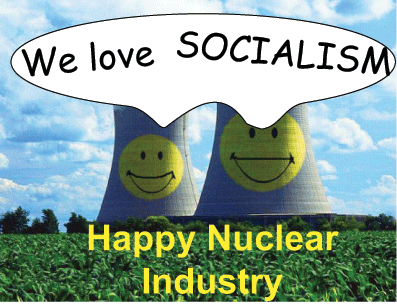
·         Battles over taxpayer bailout proposals for companies and utilities that haven’t set aside adequate funds for decommissioning and nuclear waste management and disposal. (According to Nuclear Energy Insider, European nuclear utilities face “significant and urgent challenges” with over a third of the continent’s nuclear plants to be shut down by 2025, and utilities facing a €118 billion shortfall in decommissioning and waste management funds.)

·         Battles over proposals to impose nuclear waste repositories and stores on unwilling or divided communities.

January 31, 2019 Posted by Christina Macpherson | 2 WORLD, business and costs, spinbuster | Leave a comment

Oh goody! It’s a rosy time coming for investors, (such as Donald Trump) in nuclear weapons!

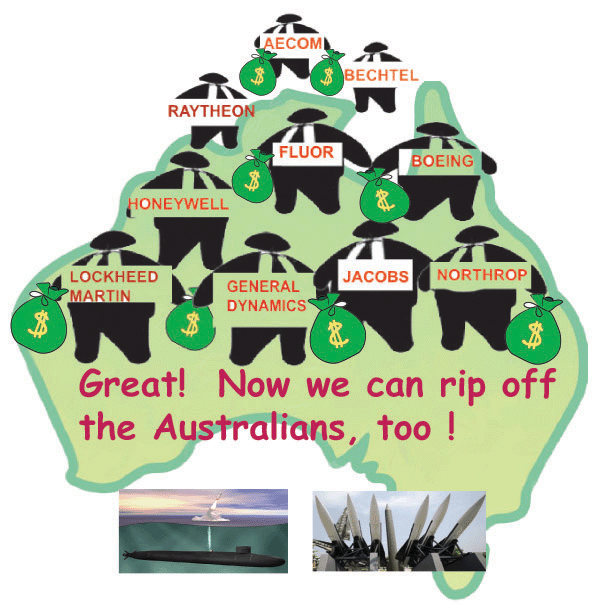
What It Would Cost to Modernize the U.S. Nuclear Arsenal — and Who Would Benefit, Yahoo Finance Lou Whiteman, The Motley Fool, Motley Fool, January 28, 2019  The United States would have to spend $494 billion over the next decade to enact its plan to modernize its nuclear arsenal, a figure that highlights the opportunity before contractors as the Pentagon seeks ways to pay for one of its top priorities. The total, which comes from a biannual report put out by the Congressional Budget Office (CBO), is 23% higher than the $400 billion price tag in the 2017 estimate. It comes at a delicate time for the Pentagon, which, after enjoying two years of steady budget increases, is facing a much less certain fiscal 2020 allocation.

……..Here’s who stands to benefit from the push to renew the nuclear triad.

Next-generation bombers

Northrop Grumman (NYSE: NOC) in late 2015 beat a team including Boeing (NYSE: BA) and Lockheed Martin to design and build a new long-range bomber. The Pentagon is expected to purchase at least 100 aircraft, with deliveries expected to begin in the mid-2020s and extend for a decade.

The plane, now known as the B-21, has been a near-casualty of Congressional budget battles in recent years, but the Pentagon continues to spend upwards of $2 billion per year on development. Overall, the CBO expects the Pentagon to spend $49 billion on bomber acquisition between now and 2028, which would easily make the B-21 Northrop’s most important platform……….

America’s most important deterrent

The Columbia-class submarine, designed to take over for the Ohio-class ballistic missile sub and house the nation’s stockpile of Trident sub-launched ballistic missiles, features a stealth electric drive propulsion system and improved maneuverability. The sub, to be built by General Dynamics’ (NYSE: GD) Electric Boat subsidiary with support from Huntington Ingalls (NYSE: HII), is due to be operational by 2028 to ensure second-strike capability should the U.S. be hit by a catastrophic attack………

A new rocket competition

The only major piece of the triad renewal still up for grabs is the task of replacing the nation’s arsenal of intercontinental ballistic missiles. …….In August 2017, the Air Force awarded Boeing and Northrop Grumman $349 million and $329 million, respectively, to develop competing new designs, with a goal of selecting a winner next year. The government is expected to spend more than $60 billion on ICBMs over the next decade, meaning the award would be a needle-mover for the eventual winner.

The stakes are also high for the two potential manufacturers of the solid-propellant rocket engines that will be used to power the missiles. Northrop brought one of the two contenders in-house last year with its $9.2 billion deal for Orbital ATK. The other, Aerojet Rocketdyne (NYSE: AJRD), has warned the Air Force and lawmakers it needs to win at least part of this procurement to remain a viable supplier.

Given the Pentagon’s priority to nurture a healthy and competitive supply base, it would not be a surprise to see both Aerojet and the former Orbital business split the ICBM engine award.

How to invest

…….for long-term investors who have seen defense holdings battered by near-term budget concerns, the longer timeline should provide some peace of mind. https://finance.yahoo.com/news/cost-modernize-u-nuclear-arsenal-163400604.html

January 29, 2019 Posted by Christina Macpherson | business and costs, USA, weapons and war | 1 Comment

USA hoping to profit from nuclear power, by exporting waste clean-up technology

US to Offer Nuclear Waste Technology to Other Countries https://learningenglish.voanews.com/a/us-to-offer-nuclear-waste-technology-to-other-countries/4758652.html  Susan Shand.  The U.S. Department of Energy’s nuclear security office is developing a project to help other countries deal with nuclear waste. The information comes from two sources who spoke to the Reuters news agency. They asked not to be named because of the sensitivity of the issue.The sources say the plan aims to keep the United States competitive against other countries that are developing their own waste technology. For example, both Russia and France offer services to take care of nuclear waste.

Dov Schwartz is the spokesman for the National Nuclear Security Administration. He confirmed the group is thinking about how to help other countries reduce nuclear waste. However, Schwartz did not give details.

The NNSA also declined a Reuters request for an interview with Brent Park, who is leading the effort.

What would the technology do?

The unnamed sources say the technology could involve crushing, heating or sending an electric current through nuclear waste to reduce its size.

The machinery to do so would be put in a “black box” the size of a shipping container. It would be sent to other countries with nuclear energy programs; however, it would remain owned and operated by the United States, the sources said.

The sources did not name countries to which the service would be offered. They also did not say where the waste would be stored after it is run through the equipment. But they said they were worried the processes could increase the risk of dangerous materials reaching militant groups or nations unfriendly to the United States.

Former U.S. President Jimmy Carter banned nuclear waste reprocessing in 1977. The reprocessing opens pure amounts of uranium and plutonium, both of which could be used to make nuclear bombs.

NNSA spokesperson Dov Schwartz said the plans under consideration do not involve reprocessing. But he did not say what technologies could be used.

Concerns

The government of U.S. President Donald Trump has made promoting nuclear technology abroad a high priority. The U.S. Energy Secretary, Rick Perry, visited Saudi Arabia this month for talks on a nuclear energy deal with the kingdom. And the American business Westinghouse hopes to sell nuclear power technology to countries from Saudi Arabia to India.

But a top arms control officer during the Obama administration questions the direction of the Trump government. Thomas Countryman said the U.S. should improve its ability to get rid of its own nuclear waste before helping other countries.

A nuclear expert at the Union of Concerned Scientists also expressed some doubt about the NNSA plan. Edwin Lyman said NNSA should not be focused so much on reducing the size of nuclear waste. Instead, it should be concerned about the dangers of nuclear waste that make it hard to store.

Lyman said even a small amount of nuclear waste gives off radioactivity and heat. It “remains dangerous for hundreds of thousands of years,” he said.

January 29, 2019 Posted by Christina Macpherson | business and costs, USA, wastes | Leave a comment

French nuclear company EDF considering retreating from operations in UK

Telegraph 26th Jan 2019 The developer of the Hinkley Point C nuclear plant is exploring a ­retreat from the UK as government ­energy policies take a toll on the industry’s largest players. Cash-strapped French utility EDF is weighing a range of options to distance itself from the British energy market.
The Sunday Telegraph understands from multiple industry sources that they include a potential spin-off of its energy-supply business in a merger with a fast-growing start-up. The move has been “on the table for at least a
year”, according to one senior figure, but it is being approached with caution by EDF’s Paris head office amid concern over the political implications.
A retreat by EDF would be likely to anger the Government. Ministers agreed to fund the Hinkley Point C nuclear plant in a complex deal which is likely to cost energy bill payers about £50bn over the lifetime of the project. EDF has remained committed to supplying gas and power to about 5m UK customers despite making losses for almost a decade, according to ­official figures.
Its place as one of the Big Six energy incumbents is considered politically important as it pushes ahead plans for
another two nuclear power projects with support from China. EDF is locked in negotiations with the Government over plans to fund its plans for a reactor at Sizewell C. Discussions about a step back from the energy-supply
market began after the departure of long-serving boss Vincent De Rivaz in 2017.
The radical proposal came as EDF faced mounting pressure from the Government’s energy price cap, and rising competition from the flood of start-ups into the market. Energy bosses are up in arms over the Government’s conflicting energy policies which demand companies keep bills low while paying higher costs for clean energy and the roll-out of smart meters.
EDF’s challenges are further complicated by its ageing portfolio of existing nuclear plants, where profits are falling due to low market prices for electricity and the weak pound. It is considering the sale of a minority stake in the reactors, which supply a fifth of the UK’s electricity, alongside its partner Centrica. The parent company of British
Gas has confirmed plans to sell its 20pc stake in the reactors and industry sources say EDF hopes to sell another 29pc from its share within the same transaction. The deal is understood to have caught the eye of a consortium
of ­pension funds which would hold a ­minority share of the business while EDF remains the operator of the ­nuclear reactors.
https://www.telegraph.co.uk/business/2019/01/26/edf-weighing-retreat-energy-market-uk/

January 28, 2019 Posted by Christina Macpherson | business and costs, France, UK | Leave a comment

Shares slump for Europe’s biggest publicly traded power company, due to Czech Republic’s PM’s nuclear power dream

A Billionaire Prime Minister’s Nuclear Dream Is Spooking CEZ Investors Bloomberg,  By Krystof Chamonikolas and Peter Laca January 25, 2019,

  • Government is revamping panel discussing reactor financing
  •  
    Analysts say state is unlikely to force CEZ to foot the bill
  • Billionaire Prime Minister Andrej Babis’s ambition to build new nuclear reactors in the Czech Republic is denting CEZ AS’s shares well in advance of any deal actually being struck.

    That’s particularly unfortunate for the investors in eastern Europe’s biggest publicly traded power company, who should under normal circumstances be benefiting from a rally in electricity prices to near a seven-year high.  CEZ is lagging peers because politicians keep dragging their feet about deciding who’ll pick up the multibillion-dollar bill for new reactors that would be unprofitable even at today’s prices

    This protracted saga is yet another example of how nuclear energy once seen as the main low-carbon alternative to fossil fuels is struggling to get off the ground because of mounting costs. Only last week, Japanese conglomerate Hitachi Ltd. took a $2.8 billion charge after scrapping a U.K. project even though the U.K. government put its most generous offer yet on the table to help fund the Wylfa plant in Wales. ……..

    The unfavorable math forced CEZ to cancel a tender for new reactors in 2014, after years of price negotiations and legal disputes with potential suppliers.

    With the cost of renewable technologies plummeting, making wind and solar plants even more attractive to nations phasing out fossil fuels, the surge in costs from contracts to completion for new nuclear plants in Finland and France is evidence of how the technology is falling behind competitors. https://www.bloomberg.com/news/articles/2019-01-25/nuclear-dream-of-billionaire-premier-is-spooking-cez-investors

  •  

January 26, 2019 Posted by Christina Macpherson | business and costs, EUROPE | Leave a comment

Hungary’s problems in financing new nuclear power plant

Hungary working to modify funding for Russian-built nuclear plant, Marton Dunai, BUDAPEST (Reuters) 26 Jan 19- Hungary is working to modify financing for a nuclear plant being built by Russia so it only starts repaying the loan once the two reactors begin supplying power, a Hungarian minister said, after an EU review of the plans contributed to delays in the project.

……..Hungary awarded Russia’s state-owned Rosatom a contract to build a similar-sized plant to replace the existing one, but construction has faced long delays, partly because of a European Union review of the project, including the way it was funded.

“Once we know the deadlines for the technical contract, we will modify this (financing) contract,” said Janos Suli, the minister in charge of the project, adding that this would meet procedures set by the EU executive……….https://www.reuters.com/article/us-hungary-nuclearpower-financing/hungary-working-to-modify-funding-for-russian-built-nuclear-plant-idUSKCN1PJ153

January 26, 2019 Posted by Christina Macpherson | business and costs, EUROPE | Leave a comment

5 countries scramble to sell nuclear reactors to Saudi Arabia

Saudi Arabia Receives Offers from 5 Countries to Build 2 Nuclear Reactors 23 January, 2019 Riyadh – Asharq Al-Awsat

Five countries have submitted their requests for the establishment of two nuclear reactors in Saudi Arabia on the Arabian Gulf coast.

The bid was made after the peaceful Saudi nuclear project met the requirements of the International Atomic Energy Agency (IAEA).

The oil-rich Kingdom launched a tender to define specifications of sites that will host the two reactors, said Chairman of King Abdullah City for Atomic and Renewable Energy (KACARE) Khalid al-Sultan.

He added that KACARE asked the services providers in the US, Russia, France, South Korea and China to present their preliminary offers……. https://aawsat.com/english/home/article/1558606/saudi-arabia-receives-offers-5-countries-build-2-nuclear-reactors

January 24, 2019 Posted by Christina Macpherson | marketing, Saudi Arabia | Leave a comment

Rolls Royce involvement in Bradwell nuclear project is supposed to allay concerns about Chinese control

Rolls-Royce in talks to supply Chinese nuclear plant in Essex, CGN hopes involvement of UK engineering group will allay security concerns concerns  Jonathan Ford in London, Ft.com, 21 Jan 19 

China’s largest state-backed nuclear company is in talks with Rolls-Royce about supplying equipment for the power plant it hopes to build in Essex as it seeks to allay national security concerns about the project. CGN is in discussions with the British engineering group over providing the control systems for the Hualong HPR1000 reactors the Chinese group plans to install at Bradwell on the Essex coast. Regarded as the central nervous system of a nuclear power plant, this technology not only drives the operation of the reactor, but allows it to be safely shut down should problems occur.

Using the British group’s equipment would be a significant concession by CGN. The Chinese group has developed its own control systems which it hopes to export along with its reactor technology. But the move is seen as a necessary sop to ease concerns about Chinese companies building critical national infrastructure in the UK. Britain’s nuclear programme is in disarray following Hitachi’s decision last week to shelve plans for a £20bn power station at Wylfa in Anglesey after financing plans for the scheme unravelled. That came two months after Toshiba pulled out of another project in Cumbria. The latest withdrawal leaves just EDF and CGN as potential bidders for new nuclear projects. The two companies are linked. The French group is building the Hinkley Point station in Somerset with financial backing from CGN.
Theresa May’s government has been less enthusiastic about Chinese investment than her predecessors, and Washington has raised concerns about Beijing taking civilian nuclear technology and transferring it to military uses. Various countries have barred Chinese suppliers from telecoms and energy markets over fears that “backdoors” could give the Chinese government access to data or control over the equipment.  …….
Peter Atherton, an industry expert at consultancy Cornwall Energy, said the lack of bidders left the government with a dilemma. “On the one hand they want Chinese nuclear investment in order to provide competition to the French but on the other hand there are very obvious security issues,” he said. “If the government doesn’t trust China to build mobile telecom networks how on earth can they trust them to build nuclear power stations?”
CGN has appointed senior figures from the contracting and nuclear industry to its UK subsidiary. Its British advisory board is chaired by Sir Terry Morgan, the former chairman of Crossrail and the HS2 high speed rail project. He was dismissed from both roles after serious delays and overruns at the state-run Crossrail project. ………https://www.ft.com/content/4d2f2814-1b41-11e9-9e64-d150b3105d21

January 22, 2019 Posted by Christina Macpherson | business and costs, politics, UK | 1 Comment

A dose of nuclear financial realism – is badly needed in Britain

Britain badly needs a dose of nuclear realism. If it remains a strategic necessity, the UK must find a way to win more bang for its buck, Ft.com , JONATHAN FORD  , 21 Jan 19

One thing British politicians have never lacked when making nuclear policy is optimism. When it comes to atomic energy, they leave Dr Pangloss in the shade. Take the last big nuclear programme back in the 1960s, whose purpose was to meet a fifth of the UK’s electricity needs. Rather than using proven (if US made) reactor technology, the government bet instead on a homegrown gas-cooled type. The minister of power, Fred Lee, confidently predicted the experimental design would be a world beater. Britain had “hit the jackpot”, he declared. The UK certainly hit something. But it wasn’t pay dirt. The AGR programme dragged on for more than two decades and was, in the words of the man who commissioned it, Arthur Hawkins of the Central Electricity Generating Board, “a catastrophe that must not be repeated”.  ………
 Once again, there is plenty of wishful thinking. Indeed, policy has been driven largely by a series of optimistic guesses. These include not just the cost of new reactors, but also the willingness of private capital to fund them without assistance from the state.  …….
again there are multiple reactor types. Repurposing often almost untested equipment for UK safety rules means that each starts from scratch with its own prototype, learning as it goes along. Add the need to fund these “first of type” schemes with private capital and it’s not surprising that projects have been falling by the wayside. Toshiba pulled out in November and, last week, Hitachi shelved plans to install its boiling water reactor technology at a promising site in Anglesey, having spent £2bn just getting to the start line.
The result is that a decade in, Britain has just one project under way — at Hinkley Point in Somerset — for which the government has struck an eye-wateringly expensive contract. The owner, EDF of France, is now saying it could do subsequent projects cheaper, because it will have the Hinkley experience to draw on. But given the absence of competition (the only other participant left in is CGN of China, EDF’s partner at Hinkley), the government faces the unpalatable prospect of a series of potentially disadvantageous bilateral deals. The UK originally set a target of about 18GW of electricity coming from nuclear by the 2030s. This has since been reduced to about 12GW. With only Hinkley and an ageing Sizewell B likely to be in operation, just 4.4GW of that target is likely to be met.  ……….
Removing complexity (and wishful thinking) doesn’t come without cost. The government would have to acquire the necessary sites and assist bidders to get them to the start line. (Abu Dhabi cut some corners the UK might balk at, such as accepting the supplier’s home country safety accreditation). It means the government acting as owner, committing to fund construction itself rather than going through complex contortions to attract just a sliver of risk-bearing equity. There may not be the political willpower.
 Of course, Britain does not have to go ahead with nuclear. It can run the risk of relying on other zero-carbon technologies, such as renewables, and other countries by building interconnectors. It can legislate to change the carbon targets it has set itself. But if nuclear power remains a strategic necessity, the UK needs a realistic programme to meet it. Otherwise the country will end up building vanishingly little new capacity, and doing so only at extortionate cost.  https://www.ft.com/content/5bc23eec-1caa-11e9-b2f7-97e4dbd3580d

January 22, 2019 Posted by Christina Macpherson | business and costs, politics, UK | Leave a comment

Rolls-Royce vies for UK nuclear role

 https://www.bbc.com/news/business-46950292

By Theo Leggett, Business correspondent, BBC News, 21 January 2019

Rolls-Royce has confirmed it is in talks with Chinese state-run firm China General Nuclear (CGN) over providing essential systems for a new power station in the UK.

The UK engineering company makes instrumentation and control systems for nuclear reactors.

The plant will be based at Bradwell, on the River Blackwater in Essex.

The project is one of three new nuclear schemes in this country in which CGN is centrally involved.

Rolls-Royce already has an agreement with CGN’s subsidiary, CTEC, to develop and sell reactor control systems for selected projects in China and on international markets.

Nuclear strategy

The planned new “Bradwell B” power station is a major component of the government’s nuclear strategy. The country’s existing reactors are ageing and all of them are due to shut down by 2035.

The Essex site is already home to an obsolete nuclear power station, which closed in 2002.

Its replacement was one of six new nuclear plants which were lined up in recent years to help meet energy needs in decades to come.

However, three of those projects have since fallen by the wayside.

January 22, 2019 Posted by Christina Macpherson | business and costs, UK | Leave a comment

Japan’s plans to sell nuclear plants overseas have been derailed

Plans to sell nuclear plants overseas derailed, Japan Times, 20 Jan 19, With the decision by Hitachi Ltd. to “freeze” its plan to build two nuclear power reactors in the United Kingdom, all of the overseas nuclear power plant projects pursued by Japanese firms — with the backing of the government seeking to promote export of nuclear power technology as a key pillar of its efforts to boost infrastructure sales in overseas markets — have now effectively been derailed.

……… Prime Minister Shinzo Abe has long taken the initiative to promote the overseas sale of Japanese nuclear power plants through top-level diplomacy. However, the nuclear power plant business cannot be a part of the nation’s growth strategy if its business feasibility is in doubt. The government and related industries need to face up to the situation surrounding the nuclear power business — which continues to face difficulties domestically as well — and reassess the way forward.

The Fukushima nuclear disaster, triggered by the March 2011 Great East Japan Earthquake and tsunami, has radically changed the global nuclear power market landscape. The cost of nuclear power, which had been promoted as a relatively inexpensive and “clean” source of energy that does not emit carbon dioxide, spiked as additional safety investments inflated plant expenses.

The cost of Hitachi’s project to build the two reactors in Anglesey, Wales, which began in 2012, has ballooned from the initial estimate of ¥2 trillion to ¥3 trillion. Another project pursued by Mitsubishi Heavy Industries Ltd. to build four reactors in Turkey has also been hampered by the swelling cost — which reportedly shot up from an initially estimated ¥2.1 trillion to ¥5 trillion. Toshiba Corp. has pulled out from the overseas nuclear power business after the huge losses incurred by its subsidiary Westinghouse Electric Co. in its nuclear power plant projects in the United States.

Even with a spike in plant construction costs, the nuclear power business would make economic sense if the expected earnings surpass the investments. But Hitachi reportedly decided to halt the U.K. project after it became clear that even with public support from the British government it could not possibly realize profits………

Behind the government’s drive to promote the sale of nuclear power plants overseas has been the domestic market’s bleak business prospects. While the government and the power industry have pushed for restarting the nation’s nuclear power plants idled in the wake of the Fukushima disaster, once they have cleared the tightened plant safety standards, only nine reactors at five plants have been put back online. The additional costs of safety investments required under the new Nuclear Regulation Authority standards to make the plants more resilient to natural disasters such as earthquakes and tsunami — estimated to range from ¥100 billion to ¥200 billion for each reactor — have prompted power companies to decide to decommission 23 aging reactors so far (including the six at Tepco’s Fukushima No. 1 plant).

As popular opposition in Japan remains strong against reactivating the idled plants, there is no prospect that the construction of new plants will be approved in the foreseeable future. The drive to promote the export of nuclear power plants may have been intended to make up for the loss of demand in the domestic market. But earlier plans for Japanese makers to build plants in Lithuania and Vietnam were canceled, while a civil nuclear cooperation pact signed with India in 2016 — which was aimed at paving the way for Japanese nuclear plant exports to the country — has not resulted in any deal. Along with Hitachi’s decision to halt the U.K. project, Mitsubishi Heavy Industries is reportedly set to abandon its plan in Turkey.

Even without construction of new plants, there will be demand for maintaining Japan’s existing nuclear power plants, and for decommissioning its aging plants. What to do with the spent nuclear fuel and the high-level radioactive wastes from the plants will also be among the challenges that confront Japan’s nuclear power business. There will be plenty of work for the industry, and it will be crucial to develop and maintain the technology and manpower to deal with the tasks. https://www.japantimes.co.jp/opinion/2019/01/20/editorials/plans-sell-nuclear-plants-overseas-derailed/#.XETUVtIzbGg

January 21, 2019 Posted by Christina Macpherson | business and costs, Japan, politics | Leave a comment

Hiroaki Nakanishi, chairman of the Japan Business Federation gave a gloomy view of nuclear power’s future

Hitachi chief’s remarks on nuclear industry spark debate, Japan Times, BY PHILIP BRASOR , 20 Jan 19, On Jan. 1, Hiroaki Nakanishi, chairman of the Japan Business Federation (Keidanren), held press interviews on the outlook of the business community and, at one point, the discussion turned to nuclear energy.

Nakanishi is also the chairman of Hitachi Ltd., a major supplier of nuclear technology, and he said that the commercial possibilities for nuclear energy in Japan, for both “clients,” meaning power companies, and “vendors,” meaning plant manufacturers such as Hitachi, were increasingly limited. If clients can’t make a profit, then neither can vendors, and that will continue to be the case as long as the public is opposed to nuclear energy. The industry can’t force nuclear power on the citizens of a democracy.

Major media were presumably represented at the interviews, but only one outlet, All-Nippon News Network (ANN), reported Nakanishi’s nuclear-related comments. Jan. 1 was a newspaper holiday, which means that no newspapers were published on Jan. 2, but there was still no other mention of his remarks on Jan. 3. On Jan. 5, journalist Hajime Takano commented on this lack of interest to former Prime Minister Yukio Hatoyama on the latter’s web channel for his East Asian Community Institute. The head of Hitachi, a key company in nuclear technology, had said that the business of nuclear energy is impossible without public support. Since nuclear energy is national policy, the ramifications are huge, Takano said, and yet no other major media had covered the remarks or ANN’s report. Were they afraid of upsetting the government?

As Takano pointed out, the Tokyo Shimbun, which as a regional newspaper doesn’t qualify as “major media” and tends to question the government’s nuclear policy, did mention Nakanishi’s remarks on its front page on Jan. 5, suggesting that the Hitachi chairman was no longer aligned with the administration on nuclear energy. Almost eight years after the disaster at the Fukushima No. 1 nuclear power plant, no nuclear plants in eastern Japan have resumed operation and, without an economic rationale for nuclear power, the policy is pointless.

But the Tokyo Shimbun also reported that Nakanishi said Japan does not have the right environment for renewable energy. This qualification seemed to imply that nuclear power was still preferable, but only if the public could be persuaded to accept it. So while part of Nakanishi’s remarks might give the impression that Japan’s nuclear power industry is throwing in the towel, they need to be contextualized within the larger picture of Hitachi’s business.

……… Ever since Japanese nuclear plant expansion ground to a halt after the Fukushima disaster, the government has promoted overseas nuclear development as a growth strategy, with Prime Minister Shinzo Abe as the lead international salesman. However, proposed projects in Vietnam, Taiwan and other places have stalled one after another. The collapse of the British project, which was formally announced Thursday, may be the final nail in the coffin.

In that light, Nakanishi’s new year remarks sound fatalistic, but pundits hear something different. Nikkan Gendai interviewed former trade ministry official Shigeaki Koga, who pointed out that Japan’s nuclear energy players are dependent on the government. Without support, there was no way private power companies or vendors could have made money on nuclear energy. They essentially stuck with it because it was national policy. Nakanishi’s remarks, Koga said, were really veiled threats directed at the government: If you don’t help us financially and legally, then we will have no choice but to get out of the nuclear business. If you want us to continue, he added, it’s your job to convince the public that nuclear energy is worth it………. https://www.japantimes.co.jp/news/2019/01/19/national/media-national/hitachi-chiefs-remarks-nuclear-industry-spark-debate/#.XETXadIzbGg

January 21, 2019 Posted by Christina Macpherson | business and costs, Japan | Leave a comment

Costly saga of Hitachi nuclear power project in North Wales comes to an end

Hitachi to Cease Work on Nuclear Power Plant in North Wales, NYT,   Stanley Reed, Jan. 17, 2019, Hitachi said on Thursday that it was suspending work on a 15 billion pound, or $19.3 billion, nuclear power project in North Wales after failing to agree on financial terms with the British and Japanese governments.

“The decision was made from the viewpoint of Hitachi’s economic rationality as a private enterprise,” the company, based in Japan, said.

Ben Russell, a spokesman for Hitachi’s British venture, Horizon Nuclear Power, said that discussions with the governments would continue but that its staff, currently around 300 people, would be cut to “a minimal handful.”

Hitachi will also stop planning work on a second project, in Oldbury, England. The company said it planned to take a write-off of 300 billion yen, or $2.75 billion, on the projects.

The decision by Hitachi is a blow to the British government, which is betting heavily on nuclear installations to help meet the country’s electric power needs in the coming decades.

The big question is whether Hitachi’s move will be a death knell for Britain’s campaign to build nuclear plants, which so far has resulted in only one project under construction.

While there are signs that the government is rethinking its energy policy, it was willing to go a long way toward trying to keep Hitachi on board.

In a statement to Parliament on Thursday, Greg Clark, the secretary of state for business and energy, said the government had been willing to consider providing one-third of the equity financing for the project and to take on all of the construction debt. When Hitachi continued to balk, Mr. Clark said, “I was not prepared to ask the taxpayer to take on a larger share.”

…….For Hitachi, though, the announcement could mark the end of a long and expensive saga. The company acquired the Horizon sites from two German utilities in 2012 for £697 million, or about $900 million, and wound up spending around £2 billion in total on design approvals, staff and other matters. It has been hiring apprentices, who have been training at a technical college on the island and going to Spain and Japan for work experience. At times in recent months more than 100 archaeologists were on the site, excavating and recording ancient structures that the construction would have destroyed.

Hitachi hoped Britain would prove to be an international showcase for its reactor designs. Ultimately, the company lost patience with the high level of spending required to land such a project there.

Hitachi had sought to arrive at a financial arrangement that would attract long-term investors like pension funds to the project and reduce its own exposure. But the offers of support from both the British and the Japanese sides were not enough………https://www.nytimes.com/2019/01/17/business/energy-environment/hitachi-horizon-wales-nuclear-plant.html

January 19, 2019 Posted by Christina Macpherson | business and costs, politics, UK | Leave a comment

Russia’s Rosatom signs up Serbia for a nuclear science centre

Russia, Serbia sign agreement on nuclear cooperation, Agreement includes construction of center of nuclear science, technology and innovation, Yeni Safak  January 18, 2019   Anadolu Agency Russia and Serbia signed a strategic cooperation document for the peaceful use of nuclear energy, Russian State Atomic Energy Corporation Rosatom said on Thursday.

The agreement, signed during Russian President Vladimir Putin’s visit to Serbia, includes the construction of a center of nuclear science, technology and innovation, according to the company’s statement.

“In particular, the implementation of the project to build the center of nuclear science, technology and innovation will not only give a powerful impetus to bilateral cooperation between Russia and Serbia in a number of innovative areas, including medicine, industry and agriculture, but will also serve as a platform for cooperation at the level of the entire Central European region,” Likhachev said………

Alexey Likhachev, director general of Rosatom signed the documents on Russia’s behalf, while Nenad Popovich, Serbia’s minister in charge of innovation and technological development, signed them on Serbia’s behalf.

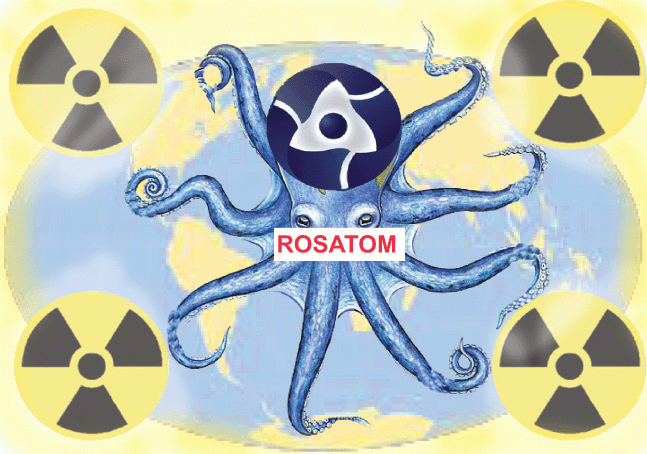
The Russian company has 36 nuclear reactor construction projects in different countries, including Bangladesh, Belarus, China, Egypt, Finland, Hungary, India, Iran and Turkey.

According to the company, its package of foreign orders in 2018 exceeded $130 billion. https://www.yenisafak.com/en/world/russia-serbia-sign-agreement-on-nuclear-cooperation-3472195

January 19, 2019 Posted by Christina Macpherson | EUROPE, marketing, Russia | Leave a comment

« Previous Entries     Next Entries »

1 This Month

26 April – Chernobyl: Inside the Meltdown airs on National Geographic on Sunday 26th April from 4pm

29 April –  Nuclear Expert Webinar #1 – Radiation Impacts on Families with Mary Olson and Cindy Folkers

  •  12:15 PM MT – 1:45 PM MT
  • Location: Virtual – REGISTER TODAY

4 May -West Suburban Peace Coalition to discuss Iran war at May Educational Forum

Monday, May 4, 7:00 – 8:00 PM Central Standard Time

Title: : How Trump’s Narrative Tries to Shape the Reality of the War on Iran.

Contact Walt Zlotow, zlotow@hotmail.com   630 442 3045 for further information 

14 May – online event From Bombs to Data Centres: the Face of Nuclear Colonialism

Pine Ridge Uranium is the real threat, not Tehran- Tell Burgum: Stop the Extraction.

Chernobyl: The Lost Tapes – A good documentary on Chernobyl on SBS available On Demand for the next 3 weeks– https://www.sbs.com.au/ondemand/tv-program/chernobyl-the-lost-tapes/2352741955560

​To see nuclear-related stories in greater depth and intensity – go to https://nuclearinformation.wordpress.com

  • Categories

    • 1
      • Arclight's Vision
    • 1 NUCLEAR ISSUES
      • business and costs
        • employment
        • marketing
      • climate change
      • culture and arts
      • ENERGY
        • renewable
          • decentralised
          • energy storage
      • environment
        • oceans
        • water
      • health
        • children
        • psychology – mental health
        • radiation
        • social effects
        • women
      • history
      • indigenous issues
      • Legal
        • deaths by radiation
        • legal
      • marketing of nuclear
      • media
        • investigative journalism
        • Wikileaks
      • opposition to nuclear
      • PERSONAL STORIES
      • politics
        • psychology and culture
          • Trump – personality
        • public opinion
        • USA election 2024
        • USA elections 2016
      • politics international
      • Religion and ethics
      • safety
        • incidents
      • secrets,lies and civil liberties
        • civil liberties
      • spinbuster
        • Education
      • technology
        • reprocessing
        • Small Modular Nuclear Reactors
        • space travel
      • Uranium
      • wastes
        • – plutonium
        • decommission reactor
      • weapons and war
        • Atrocities
        • depleted uranium
      • Women
    • 2 WORLD
      • ANTARCTICA
      • ARCTIC
      • ASIA
        • Burma
        • China
        • India
        • Indonesia
        • Japan
          • – Fukushima 2011
          • Fukushima 2012
          • Fukushima 2013
          • Fukushima 2014
          • Fukushima 2015
          • Fukushima 2016
          • Fukushima continuing
        • Malaysia
        • Mongolia
        • North Korea
        • Pakistan
        • South Korea
        • Taiwan
        • Turkey
        • Vietnam
      • EUROPE
        • Belarus
        • Bulgaria
        • Denmark
        • Finland
        • France
        • Germany
        • Greece
        • Ireland
        • Italy
        • Kazakhstan
        • Kyrgyzstan
        • Russia
        • Spain
        • Sweden
        • Switzerland
        • UK
        • Ukraine
      • MIDDLE EAST
        • Afghanistan
        • Egypt
        • Gaza
        • Iran
        • Iraq
        • Israel
        • Jordan
        • Libya
        • Saudi Arabia
        • Syria
        • Turkey
        • United Arab Emirates
      • NORTH AMERICA
        • Canada
        • USA
          • election USA 2020
      • OCEANIA
        • New Zealand
        • Philippines
      • SOUTH AMERICA
        • Brazil
    • ACTION
    • AFRICA
      • Kenya
      • Malawi
      • Mali
      • Namibia
      • Niger
      • Nigeria
      • Somalia
      • South Africa
    • Atrocities
    • AUSTRALIA
    • Christina's notes
    • Christina's themes
    • culture and arts
    • Events
    • Fuk 2022
    • Fuk 2023
    • Fukushima 2017
    • Fukushima 2018
    • fukushima 2019
    • Fukushima 2020
    • Fukushima 2021
    • general
    • global warming
    • Humour (God we need it)
    • Nuclear
    • RARE EARTHS
      • thorium
    • Reference
      • Reference archives
    • resources – print
    • Resources -audiovicual
    • Weekly Newsletter
    • World
    • World Nuclear
    • YouTube
  • Pages

    • 1 This Month
    • ACTION !
    • Disclaimer
    • Links
    • PAGES on NUCLEAR ISSUES
      • audio-visual news
      • Anti Nuclear, Clean Energy Movement
        • Anti Nuclear movement – a success story
          • – 2013 – the struggle for a nuclear-free, liveable world
          • – 2013: the battle to expose nuclear lies about ionising radiation
            • Speakers at Fukushima Symposium March 2013
            • Symposium 2013 Ian Fairlie
      • Civil Liberties
        • – Civil liberties – China and USA
      • Climate change
      • Climate Change
      • Economics
        • – Employment
        • – Marketing nuclear power
        • – Marketing Nuclear Power Internationally
        • nuclear ‘renaissance’?
        • Nuclear energy – the sick man of the corporate world
      • Energy
        • – Solar energy
      • Environment
        • – Nuclear Power and the Tragedy of the Commons
        • – Water
      • Health
        • Birth Defects in the Chernobyl Radiation Affected Region.
      • History
        • Nuclear History – the forgotten disasters
      • Indigenous issues
      • Ionising radiation
        • – Ionising radiation – medical
        • Fukushima FACT SHEET
      • Media
        • Nuclear Power and Media 2012
      • Nuclear Power and the Consumer Society – theme for December 2012
      • Peace and nuclear disarmament
        • Peace on a Nuclear Free Earth
      • Politics
        • – Politics USA
      • Public opinion
      • Religion and ethics
        • -Ethics of nuclear power
      • Resources – print
      • Safety
      • Secrets and lies
        • – NUCLEAR LIES – theme for January 2012
        • – Nuclear Secrets and Lies
      • Spinbuster
        • 2013 nuclear spin – all about FEAR -theme for June
        • Spinbuster 1
      • Technology
        • TECHNOLOGY Challenges
      • Wastes
        • NUCLEAR WASTES – theme for October 2012
        • – Plutonium
      • Weapons and war
      • Women
  • Archives

    • May 2026 (12)
    • April 2026 (356)
    • March 2026 (251)
    • February 2026 (268)
    • January 2026 (308)
    • December 2025 (358)
    • November 2025 (359)
    • October 2025 (376)
    • September 2025 (257)
    • August 2025 (319)
    • July 2025 (230)
    • June 2025 (348)
  • Categories

    • 1
      • Arclight's Vision
    • 1 NUCLEAR ISSUES
      • business and costs
        • employment
        • marketing
      • climate change
      • culture and arts
      • ENERGY
        • renewable
          • decentralised
          • energy storage
      • environment
        • oceans
        • water
      • health
        • children
        • psychology – mental health
        • radiation
        • social effects
        • women
      • history
      • indigenous issues
      • Legal
        • deaths by radiation
        • legal
      • marketing of nuclear
      • media
        • investigative journalism
        • Wikileaks
      • opposition to nuclear
      • PERSONAL STORIES
      • politics
        • psychology and culture
          • Trump – personality
        • public opinion
        • USA election 2024
        • USA elections 2016
      • politics international
      • Religion and ethics
      • safety
        • incidents
      • secrets,lies and civil liberties
        • civil liberties
      • spinbuster
        • Education
      • technology
        • reprocessing
        • Small Modular Nuclear Reactors
        • space travel
      • Uranium
      • wastes
        • – plutonium
        • decommission reactor
      • weapons and war
        • Atrocities
        • depleted uranium
      • Women
    • 2 WORLD
      • ANTARCTICA
      • ARCTIC
      • ASIA
        • Burma
        • China
        • India
        • Indonesia
        • Japan
          • – Fukushima 2011
          • Fukushima 2012
          • Fukushima 2013
          • Fukushima 2014
          • Fukushima 2015
          • Fukushima 2016
          • Fukushima continuing
        • Malaysia
        • Mongolia
        • North Korea
        • Pakistan
        • South Korea
        • Taiwan
        • Turkey
        • Vietnam
      • EUROPE
        • Belarus
        • Bulgaria
        • Denmark
        • Finland
        • France
        • Germany
        • Greece
        • Ireland
        • Italy
        • Kazakhstan
        • Kyrgyzstan
        • Russia
        • Spain
        • Sweden
        • Switzerland
        • UK
        • Ukraine
      • MIDDLE EAST
        • Afghanistan
        • Egypt
        • Gaza
        • Iran
        • Iraq
        • Israel
        • Jordan
        • Libya
        • Saudi Arabia
        • Syria
        • Turkey
        • United Arab Emirates
      • NORTH AMERICA
        • Canada
        • USA
          • election USA 2020
      • OCEANIA
        • New Zealand
        • Philippines
      • SOUTH AMERICA
        • Brazil
    • ACTION
    • AFRICA
      • Kenya
      • Malawi
      • Mali
      • Namibia
      • Niger
      • Nigeria
      • Somalia
      • South Africa
    • Atrocities
    • AUSTRALIA
    • Christina's notes
    • Christina's themes
    • culture and arts
    • Events
    • Fuk 2022
    • Fuk 2023
    • Fukushima 2017
    • Fukushima 2018
    • fukushima 2019
    • Fukushima 2020
    • Fukushima 2021
    • general
    • global warming
    • Humour (God we need it)
    • Nuclear
    • RARE EARTHS
      • thorium
    • Reference
      • Reference archives
    • resources – print
    • Resources -audiovicual
    • Weekly Newsletter
    • World
    • World Nuclear
    • YouTube
  • RSS

    Entries RSS
    Comments RSS

Site info

nuclear-news
Create a free website or blog at WordPress.com.
Privacy & Cookies: This site uses cookies. By continuing to use this website, you agree to their use.
To find out more, including how to control cookies, see here: Cookie Policy
  • Subscribe Subscribed
    • nuclear-news
    • Join 2,102 other subscribers
    • Already have a WordPress.com account? Log in now.
    • nuclear-news
    • Subscribe Subscribed
    • Sign up
    • Log in
    • Report this content
    • View site in Reader
    • Manage subscriptions
    • Collapse this bar

Loading Comments...