Times 30th July 2019 New nuclear power plants should be funded through general taxation instead of piling the costs on to consumers, a leading union has said. The GMB said
that the government’s proposed regulated asset base funding model for
further reactors was “acceptable”, but that the costs should be paid “from
a progressive general taxation system”. Last week The Times reported leaked
government analysis that up to 40 gigawatts of either nuclear power or
carbon capture and storage plants was needed by 2050 to meet “net zero”
emissions targets. That equates to 12 Hinkley Point plants. Under the
regulated asset base model, developers would receive a regulated return
while the plant was under construction, cutting their financing costs. It
would still be funded on bills, exposing consumers to cost overruns.
https://www.thetimes.co.uk/article/a80b0ffa-b23b-11e9-9df9-ac98825b867a
August 1, 2019
Posted by Christina Macpherson |
business and costs, UK |
Leave a comment
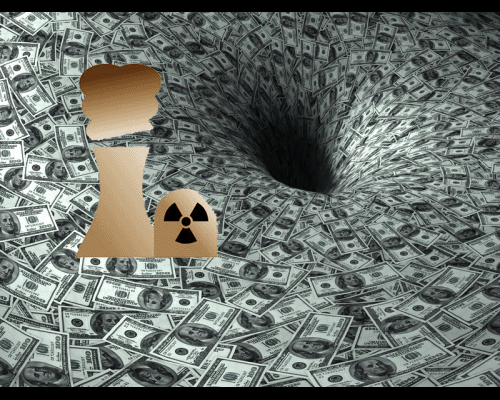
Nuclear power ‘seven decades of economic ruin’, says new report https://www.pressenza.com/2019/07/nuclear-power-seven-decades-of-economic-ruin-says-new-report/ 29.07.2019 – London, United Kingdom – Campaign for Nuclear Disarmament New research has found that almost all nuclear power plants built since the nuclear industry’s inception have generated large financial losses.
The report by the German Institute for Economic Research examines 674 nuclear power plants built since 1951. Its authors found that typical nuclear power plants averaged 4.8 billion euros in losses.
The report authors argue that new technology for nuclear plants won’t solve the underlying economic difficulties: “Those in favor of nuclear energy like to point out the ongoing technological developments that could lead to it growing more efficient in the future.
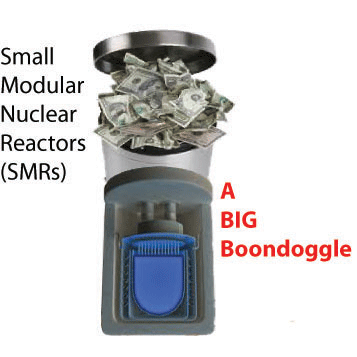
“They include ‘fourth generation’ nuclear power plants and mini-nuclear power plants (small modular reactors, SMRs). Anything but new, both concepts have their roots in the early phase of nuclear power in the 1950s. Then as now, there was no hope that the technologies would become economical and established.”
Kate Hudson, CND general secretary, said:
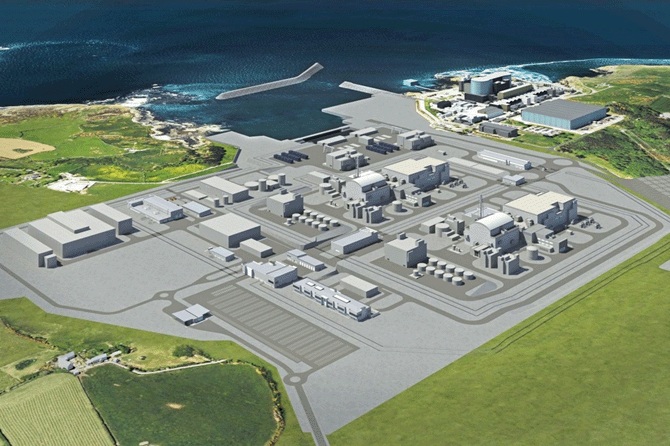
“The history of nuclear power is seven decades of economic ruin and environmental catastrophe. Toshiba’s decision last year to abandon plans to build a reactor at Moorside in Cumbria and Hitachi’s suspension of work this year on the Wylfa Newydd plant in Anglesey simply reflect the economic reality that this report sets out.
“Nuclear power isn’t only expensive, it creates an unsolvable waste problem, and as the TV drama Chernobyl so graphically reveals, nuclear accidents create human misery and environmental destruction.
“Our new Prime Minister should learn these lessons and adopt a fresh approach to energy that centres on clean and economically viable renewable technology.”
July 30, 2019
Posted by Christina Macpherson |
2 WORLD, business and costs |
Leave a comment
Govt prohibits mining of atomic minerals by private entities https://www.thehindubusinessline.com/economy/govt-prohibits-mining-of-atomic-minerals-by-private-entities/article28732945.ece July 27, 2019
Atomic minerals zirconium, monazite and thorium are found in abundance along several beaches of the country
The government has prohibited mining of atomic minerals by private entities and will grant operating rights to only state-run companies to “safeguard” strategic interest of the country, according to a gazette notification issued on Saturday.
Atomic minerals zirconium, monazite and thorium are found in abundance along several beaches of the country.
Zircon have potential applications in the strategic, defence and hi-tech sectors as it contains an important strategic element, called hafnium, which is used in the field of atomic energy.
Monazite is a mineral of thorium, uranium and rare earths and it has a high percentage of neodymium which has several hi-tech applications.
Zirconium, hafnium and thorium are very important strategic elements used in different stages of the country’s nuclear power programme, and since monazite and zircon occur in beach sand minerals, any loss or pilferage of these minerals at any stage of mineral handling or processing “shall affect the larger national interest”, the notification said.
“In offshore areas and their strategic importance, it is imperative that the mineral concessions in offshore areas be brought at par with the onshore areas in their treatment and therefore, in order to safeguard the strategic interest of the nation, it is expedient in larger national interest to prohibit the grant of operating rights in terms of any reconnaissance permit, exploration license or production lease of atomic minerals” in any offshore areas to anyone, except a government owned or controlled company, it stated.
“The central government hereby prohibits grant of operating rights in respect of atomic minerals in any offshore areas in the country…to any person, except the government or a government company or a corporation owned or controlled by the government, under the Offshore Areas Mineral (Development and Regulation) Act, 2002,” it said.
The government also “rescinded” any action taken by it earlier in this regard.
July 29, 2019
Posted by Christina Macpherson |
business and costs, India, RARE EARTHS |
Leave a comment
|
 Dave Toke’s green energy blog, https://realfeed-intariffs.blogspot.com/2019/07/a-laymans-guide-to-regulated-asset-base.html, 23 July 2019 Dave Toke’s green energy blog, https://realfeed-intariffs.blogspot.com/2019/07/a-laymans-guide-to-regulated-asset-base.html, 23 July 2019
The Government’s proposed new ‘Regulated Asset Base’ (RAB) means of funding nuclear has just been published, and it is living as far down to its expectations as could be expected. I’ve ploughed through the sometimes (deliberately?) convoluted description of the scheme and translated a few key passages to help you understand it all.
The Government failed to learn from the days when nuclear power were constructed from the 1950s to the 1990s. In those days nuclear power was very expensive, but the Government was able to con the public into believing that it was cheap. They did this by making sure the public could not understand the vaguaries of nuclear power funding and by putting all of the cost overruns that building the power stations involved onto consumer bills without them noticing. Basically, we are reurning to these days when the public was kept in the dark about the cost of building nuclear power plant and the same public will be paying for the cost overruns resulting from the project. The Government made the mistake of giving a contract price for Hinkley C. Although it featherbedded the developers EDF by giving an ultra long premium price contract (35 years) and the promise of Government lending to cover the bulk of the costs, the contract (CfD) allowed some sort of comparison to be made with competitior sources. Solar and wind power’s costs have fallen well below the price given to Hinkley C (£92.50 in 2012 prices).
So now the Government, having learned this mistake, has produced the RAB. This will allow the Government, though an appointed ‘Regulator’ to launder electricity consumer’s money to pay for the inevitable cost overruns, whilst the Regulator assures the public that this all represents ‘value for money’. The project that is earmarked for RAB funding is Sizewll C, involving the same reactor type (EPR) as is being constructed at Hinkley C.
What some key passages mean:
1. ‘Despite the progress at HPC, the challenges facing the global nuclear industry have meant that replicating a CfD model for further new nuclear projects has proved very challenging. Few project developers have a balance sheet that can accommodate the £15-20bn cost of delivering a new nuclear project, and financial investors have been unwilling to invest during the construction phase given the long construction period and risk of cost increases and delays. We are therefore looking to work with the sector to develop an alternative funding model for new nuclear projects that can attract private finance at a cost that represents value for money to consumers and are considering its wider applicability to other firm low carbon technologies’ (page 9)
Translation: The Hinkley C contract (CfD) was a big boobie by the UK Government since it showed just how expensive nuclear power could be even if we believe the developers own (French Government backed) hopes that the project works out as planned. The nuclear industry around the world has tanked – all the projects in the West this century have been monumental disasters and even the French EPR model built in China took twice as long to build as planned. (As a rule of thumb the cost is more or less directly proportional to its construction time). So no private investor in their right minds would invest in nuclear power. So, essentially, we’ve got to give the next nuclear project a state-backed blank cheque and cover this up by having a Regulator publish a lot of accountancy jargon that will fool the public into thinking they’re getting a reasonable deal
2. ‘A large-scale new nuclear project bears some similarities with the Thames Tideway Tunnel (TTT) project, in that it is a complex single asset construction project with a significant upfront capital expenditure requirement, long construction period and a long asset life. In developing a potential nuclear RAB model, we have taken the model used for TTT, which was also developed under a RAB, as a starting point, whilst recognising that new nuclear projects are greater in scale and face specific challenges that were not relevant to TTT’ (page 11)
Translation: Nuclear power stations are not real power plant, but rather they are giant civil engineering projects involving lots of radiation when they get switched on, and thus complex measures to protect the public. However, this great complexity means they are much more prone to cost overruns compared to projects like the TTT, so we have to make sure that the consumer picks up the tab for the cost overruns, whilst pretending that this is a normal well run civil engineering project, which it isn’t of course.
3. ‘A target total construction cost would be set for the project company which would be used as the Baseline for incentivisation and risk sharing. If construction costs increased above the Baseline, a portion of the additional costs would be added to the RAB, such that the impact would be shared between investors and suppliers (and through them, their consumers) (page 14)…(this approach will) ‘provide clarity and certainty to investors, suppliers and consumers, which is particularly important for a large single-asset project with a complex and relatively long construction period’ (page 15)
Translation: The Regulator will produce lots of impenetrable accountancy jargon based on hilariously optimistic projections about construction times and costs which the regulator will swallow whole. When the inevitable happens and costs overrun the investors will still get a reasonable rate of return on their investments and the electricity consumers will pay for most of the cost overruns.
4. ‘Role of the Regulator
We currently consider that the Regulator should have responsibility for protecting the interests of consumers, whilst having regard to the ability of the project company to finance the project i.e. construction and operation of the plant’ (page 19)
Translation: The Regulator will have no choice but to adopt the ridiculously optimistic cost projections and construction time estimates made by the developers (EDF). They will declare the whole project great value for money for the consumer, whilst in practice allowing the developer to run up whatever bills they want and pass most of them onto the consumer. A facade of an auditing system will be set up, but since EDF have all the information anyway, the Regulator will not be able to make more than token adjustments even if they wanted to.When the time comes for the consumer to shell out for cost overruns the Regulator will not want to point this out too much as they will get the blame.
‘The EPR technology has now started commercial operations in China’ (pages 8-9)
Translation: So far the constructions of the EPR have been disastrous in all cases, in Finland, France and even in China. The last one is a bit of a shocker. It took twice as long as planned to get the first reactor at Taishan generating electricity – that’s despite the fact that the Chinese have a massive reserve of workers and engineers compared to us, and, as our Office for Nuclear Regulation has put it, a different approach to health and safety compared to what is practiced in the UK. Of course EDF are announcing a ‘triumph’ of early construction at Hinkley C – yet they have only just started seriously constructing the project in March this year having spent a lot of money since 2013 acheving remarkably little. But EDF have the French Government to rely upon to fund its own (French state owned) reactor model at Hinkley. In the case of Sizewell C, through the aegis of the so-called RAB mechanism, it will be the British electricity consumer who will be paying for the cost overruns.
|
|
July 25, 2019
Posted by Christina Macpherson |
business and costs, politics, UK |
Leave a comment
 Guardian 23rd July 2019 Let’s face it: nuclear power is hideously dear and far from ideal. The
government should be backing renewables, not tying itself to an expensive
nuclear future. That bill-payers got stuffed in the deal that brought the
Hinkley Point C project into existence is beyond dispute these days.
Even government ministers barely quibble with the National Audit Office’s
assessment that consumers will be paying through the nose for 35 years.
Instead, the defence has tended to run along these lines: don’t worry,
we’ve triggered a “resurgence” in the nuclear industry in the UK and
the next reactors will be relative bargains.
Now here’s the government’s latest effort to resurrect the show – “an innovative
funding model”. Of course, it’s not really innovative. The “regulated
asset base” (RAB) approach, which could be used at Sizewell B in Suffolk,
and is intended to copy the design of Hinkley, is common in other parts of
the utility world.
Aside from exposing consumers to the cost of overruns,
RAB in effect also requires them to provide financing at zero interest, a
point made by the National Infrastructure Commission last year. Little
wonder, then, that the juice should be cheaper than Hinkley’s – some of
the costs will be hidden from view.
The same NIC report said: “There is limited experience of using the RAB model for anything as complex and risky as nuclear.” Second, no financing model can disguise the core truth about
nuclear – the technology is hideously expensive. Even after recognising
the need to have secure “baseload” supplies, it recommended
commissioning only one more nuclear plant, on top of Hinkley, before 2025.
That remains a commonsense analysis. Renewables are winning the price race.
Let us pray, then, that a love-in with RAB does not reignite ministerial
fantasies about a “resurgence” in nuclear. We don’t want a
resurgence. We want to build as few new reactors as possible.
https://www.theguardian.com/business/nils-pratley-on-finance/2019/jul/23/lets-face-it-nuclear-power-is-hideously-dear-and-far-from-ideal
July 25, 2019
Posted by Christina Macpherson |
business and costs, politics, UK |
Leave a comment
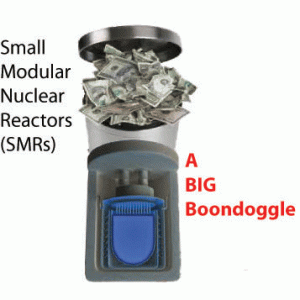 Rolls-Royce gets government commitment for mini nuclear reactors UK aero-engine maker seeks to spearhead development of export-led industry https://www.ft.com/content/32ee2100-ad43-11e9-8030-530adfa879c2 Sylvia Pfeifer in London, 24 July 19,
Although the initial commitment is just £18m, it will allow the consortium to mature the design of the reactors. The move, which is subject to a final sign-off, would still require significant levels of additional investment before the reactors can become a commercial reality. The UK aero-engine maker has long argued that its technology in this sphere should be regarded as a “national endeavour” to develop nuclear skills that can be used to create an export-led industry.
A consortium spokesperson said on Tuesday that the £18m investment would be used to “mature the design, address the considerable manufacturing technology requirements and to progress the regulatory licensing process”. He added: “We believe with early co-investment by the government, this power station design is a compelling commercial opportunity.”
Rolls-Royce and its team, which includes Laing O’Rourke and Arup, was one of several consortiums that bid in an initial government-sponsored competition launched in 2015 to find the most viable technology for a new generation of small nuclear modular reactors (SMRs). Most of these will not be commercial until the 2030s
Supporters argue that they can deliver nuclear power at lower cost and reduced risk. They will draw on modular manufacturing techniques that will reduce construction risk, which has plagued larger-scale projects. However, when a nuclear sector deal was finally unveiled last June, the government allocated funding only for more advanced modular reactors.
MRs, which typically use water-cooled reactors similar to existing nuclear power stations, were omitted from funding even though they were closer to becoming commercial. Rolls-Royce threatened last summer that it would shut down the project if there was no meaningful support from the government.
Ministers have in recent months scrambled to recast Britain’s energy policy after the collapse of plans to build several large reactors and on Monday evening published proposals to finance new nuclear plants by having taxpayers pay upfront through their energy bills. The government added that, as part of its plans to fund advanced nuclear technologies, it would make an “initial award” of up to £18m under the industrial strategy challenge fund to the Rolls-Royce-led consortium in the autumn. The consortium has said any government funding will be matched in part by contributions from the companies as well as by raising funds from third-party organisations.
July 25, 2019
Posted by Christina Macpherson |
business and costs, politics, Small Modular Nuclear Reactors, UK |
Leave a comment
Guardian 23rd July 2019 The government has confirmed plans for consumers to begin paying for new nuclear reactors before they are built, and for taxpayers to pay a share of
any cost overruns or construction delays. In a consultation document
launched on Monday night, officials said the model is “essential” to
attract private investors to back the UK’s new nuclear ambitions at a
price that is affordable for bill payers. The public purse would also
compensate nuclear investors if the project was scrapped. The new funding
structure could be used to prop up EDF Energy’s £16bn plans for a new
nuclear reactor at Sizewell B in Suffolk, which was left in doubt after
fierce criticism of the costs surrounding the Hinkley Point C project in
Somerset.
https://www.theguardian.com/business/2019/jul/23/new-uk-nuclear-plants-government-cost
July 25, 2019
Posted by Christina Macpherson |
business and costs, politics, UK |
Leave a comment
 Nuclear funding proposal ‘essential’ for restarting Wylfa, BBC, 23 July 2019
July 25, 2019
Posted by Christina Macpherson |
business and costs, politics, UK |
Leave a comment
 Consumers on hook for cost overruns at nuclear plants, Emily Gosden, Times 23rd July 2019
 ,Energy consumers and taxpayers could have to pay for cost overruns at new nuclear plants after the government backed a funding model proposed by EDF.
The business department said last night it believed the “regulated asset
base” model that the French energy giant wants for its proposed Sizewell
plant in Suffolk could reduce consumer bills compared with the subsidy
contract used to back the £20 billion Hinkley Point plant EDF is building
in Somerset.
A consultation document published last night confirms that
consumers would, however, be asked to start paying for the plants on energy
bills while they were still under construction and to share in the risks of
cost overruns.
In the case of an extreme overrun, the government –
effectively the taxpayer – could either have to step in and pay the extra
cost or scrap the project and pay compensation to investors. Under the
regulated asset base model, the developer would receive a regulated price
to give it a return on its investment expenditure, including during the
construction period, and this would be levied on energy bills.
https://www.thetimes.co.uk/article/17cbe1b8-acbd-11e9-b657-11944f524f2a
July 25, 2019
Posted by Christina Macpherson |
business and costs, politics, UK |
Leave a comment
New UK nuclear plants could be paid for upfront through energy bills, Consumers face financial burden of future projects even before they are built Ft.com, David Sheppard and Harry Dempsey, 22 July 19,
The UK government has thrown its backing behind proposals to finance new nuclear plants by having taxpayers pay upfront through their energy bills as it looks to reinvigorate a sector beset by cancellations and high costs. The consultation on the new financing model, which aims to lower overall costs by having consumers fund future nuclear projects before they are built, comes as the government targets cutting carbon emissions to net zero by 2050.
Half of all new nuclear projects planned in the UK have collapsed in the past year after failing to secure the necessary private financing, including Hitachi’s decision to suspend the £20bn Wylfa plant in north Wales and Toshiba’s cancellation of its development in Moorside, Cumbria. Seven of the UK’s eight existing nuclear plants are set to close by 2030.
But the proposal is likely to face criticism for loading risks on to consumers and the government at a time when renewable alternatives to nuclear like wind and solar are rapidly becoming cheaper. Boris Johnson, who is widely expected to become prime minister later this week, has in the past supported nuclear projects but also criticised their high costs.
The Department for Business, Energy and Industrial Strategy, which is launching a three-month consultation on the proposals, said it believed the new financing model had the “potential to reduce the cost of raising private finance . . . thereby reducing consumer bills”.
France’s state-backed EDF Energy has been a vocal champion for the proposed model, known as Regulated Asset Base or RAB, after the cost of its Hinkley Point project in Somerset was heavily criticised for its cost to consumers.
BEIS said using an RAB model for future projects was suitable as companies such as EDF would look to replicate the Hinkley Point design in future plants. EDF said on Monday that its proposed Sizewell C plant would be a “near replica” and therefore “cheaper to construct and finance”. …..
Greenpeace UK’s chief scientist Doug Parr criticised the proposal saying it would shift liabilities from private investors to taxpayers. “The nuclear industry has gone in just 10 years from saying they need no subsidies to asking bill payers to fork out for expensive power plants that don’t even exist yet, and may never,” Mr Parr said.
The government is expected to release its highly anticipated energy white paper in summer, which will indicate future electricity generation plans, with the UK’s 2013 energy strategy widely seen as defunct due to the faltering nuclear projects. https://www.ft.com/content/e2cf07ae-acaa-11e9-8030-530adfa879c2
July 23, 2019
Posted by Christina Macpherson |
business and costs, politics, UK |
Leave a comment
 Advanced US nukes need a boost; is the Pentagon the answer? As proponents for the fuel seek to establish a commercial domestic market, federal PPAs are seen as key to unlocking private investments. Utility Dive By Catherine Morehouse July 19, 2019 “…… the large-scale reactors that are the norm across the U.S. don’t fit in with the growing trend toward smaller, decentralized power.
Small, advanced nuclear reactors better fit that mold, but have yet to enter the market. So the key question, say stakeholders, is how to spur that initial investment and establish a commercial domestic market, with a loftier goal of establishing the U.S. as a nuclear power export leader.
“……..you really are going to need to have that public involvement to persuade the private sector to roll along,” – Daniel Poneman, former U.S. Deputy Secretary of Energy, and current president and CEO of nuclear developer Centrus
One potential solution floated at the conference was federal power purchase agreements between the Department of Defense (DOD) and the Department of Energy (DOE).
A public-private partnership
“I think that the Department of Defense is a logical first customer for these reactors, especially micro reactors that are under development that can be deployed in remote regions,” Sen. Lisa Murkowski, R-Alaska, who chairs the Committee on Energy and Natural Resources, told the New Nuclear Capital audience on Tuesday……..
DOD’s ability to purchase in bulk and “underwrite an investment that may not have an immediate commercial appeal,” makes it an ideal first customer, said Poneman. And that initial investment is key.
It “really helps to have that, frankly, that initial investment from an investor that is looking at their returns not in quarterly earning statements but in the long-term security payoffs,” said Poneman. “Then when they make that initial major investment, it’s the cost of the very first one that’s always very, very high. And sometimes you find a cost curve that declines really quite steeply as you make more.”
Currently, a lot of capital being invested in the nuclear space comes from “eccentric billionaires who want to save the world,” Managing Director of Private Equity at Growth Capital Services James Magowan said at the conference. This poses a problem when trying to bring in “real venture capitalists,” whose first question is “Who’s your customer? Do you have a customer?”
To that end, “the suggestion that the DOD could step up and be a customer is a great one, I think that solves an initial customer problem,” he said. But in order to establish a domestic market, more players need to be involved.
The DOD has shown interest in advanced nuclear technology, Murkowski told reporters, making them a “likely candidate” for investment. DOD did not respond to multiple requests for comment.
Building a domestic market
Many in the nuclear industry argue that establishing the U.S. as a nuclear export leader is essential to both national security as well as global decarbonization. While the Pentagon can get things rolling for small-scale nuclear, utilities will be essential to building out the market as buyers.
“I think you see utilities, particularly in Canada, stepping up with the Canadian government to take on that market-making role and we look forward to similar discussions here in the U.S.,” Donald Wolf, president and CEO of Advanced Reactor Concepts, a U.S.-based developer, said at the New Nuclear Capital Conference. “Before we, in effect, push these new designs on foreign countries, it really helps to say we built it here first. We’ve improved it at home, and it’s safe for us.”
And some developers are moving to establish those markets for small reactors with municipal power systems, which make for more attractive first customers than IOUs, according to Colbert. Municipal power systems have access to a lower weighted cost of capital, around 3%-4%, compared to IOUs’ approximately 8%-10%.
NuScale has jointly pursued both DOD and the Utah Associated Municipal Power Association (UAMP) as first customers. ……
“If you look at nuclear, the market for energy … is pretty well known,” said Chris Colbert, Chief Strategy Officer at nuclear developer NuScale . “What’s not so well known is how do you get through the nuclear regulatory process, the [Nuclear Regulatory Commission] process.”
While safety remains a paramount concern for nuclear power, many in the industry say they no longer view public perception as a major problem.
“How do we tell the masses the progress we’re making? …….https://www.utilitydive.com/news/advanced-us-nukes-need-a-boost-is-the-pentagon-the-answer/559088/
July 23, 2019
Posted by Christina Macpherson |
marketing, USA |
Leave a comment
Canadian Press Biz @CdnPress_Biz 22 Jul 19 SNC-Lavalin Group Inc. warns its 2019 results could be significantly lower than anticipated, largely due to cost overruns at some construction projects and says it will undergo a reorganization to exit or section off its poorer performing segments. More coming.
July 23, 2019
Posted by Christina Macpherson |
business and costs, Canada |
Leave a comment

 There’s still time to say no to Ohio’s costly nuclear bailout https://www.crainscleveland.com/opinion/personal-view-theres-still-time-say-no-ohios-costly-nuclear-bailout Jeff Barge 21 July 19, There may have been a case once for Ohio to subsidize FirstEnergy Solutions’ two nuclear plants in Ohio. But the company’s deceit and dishonesty in providing false and misleading information to the state legislature and the public now make that virtually impossible. That may be why the bailout failed to pass as scheduled on July 17 by one vote and may not be brought up again until Aug. 1.
FirstEnergy Solutions has been claiming for more than a year that it needs $150 million a year from the state because its Davis-Besse and Perry nuclear power plants, now in federal bankruptcy court in Akron, are running at a loss.
But is this really true?
“It wouldn’t be in bankruptcy court if it wasn’t in the red, correct?” responded Ohio GOP Senate spokesman John Fortney when asked that question.
But that may be the misconception that is keeping the whole boat afloat. That so-called “fact” may not be true after all.
FirstEnergy Solutions actually has five businesses involved in its ongoing bankruptcy case, and the two nuclear subsidiaries, known through the acronyms “FENG” and “FENOC,” are profitable.
That has been firmly established by copies of a monthly operating report filed with the bankruptcy court by FirstEnergy Solutions in May of this year. According to Senate testimony by the Ohio Consumers’ Counsel that presented these documents as evidence, the two nuclear plants have had a profitable operating margin of almost $50 million since the company filed for bankruptcy in May 2018. According to these documents, FENG had an operating profit of $18.4 million in May 2019 alone.
As if it were needed, a second study also proved the two plants are profitable. This one is by Paul Sotkiewicz, former chief economist for PJM Interconnection LLC, the largest U.S. power grid operator in the country. That study, which was commissioned by oil and gas group API-Ohio, said the Davis-Besse and Perry nuclear plants generated annual profits of $28 million and $44 million, respectively, and are “among the most profitable of their kind in the nation.” Arie Peskoe, director of the Electricity Law Initiative at Harvard Law School, said Sotkiewicz is a “credible” expert.
And let’s face it — is it even reasonable anymore to believe that FirstEnergy Solutions is acting in good faith? Not if you look at its most recent history.
In April, for example, federal authorities accusedFirstEnergy Solutions and its former parent company, FirstEnergy, with concocting a “scheme” that was “an abuse of the bankruptcy system,” and filed legal papers in bankruptcy court in Akron to that effect. That’s because FirstEnergy Solutions’ initial bankruptcy filing, which was rejected by U.S. Bankruptcy Judge Alan Koschik, sought to absolve FirstEnergy of any future responsibility for costly power plant closings and cleanup estimated in the billions.
The public would have been on the hook for this cleanup. Nice try, FirstEnergy.
On another front, the Ohio Supreme Court in June struck down a sweetheart deal in which the Public Utilities Commission of Ohio had given FirstEnergy $600 million in a “distribution modernization rider” that allowed it to tack a fee on to customers’ bills for modernization of its energy grid. Problem is, FirstEnergy didn’t modernize its energy grid. According to testimony by the Ohio Consumers’ Counsel, the company used the money to increase dividends to its investor/owners from $152 million to $375 million a year. This again shows a lack of good faith. It diverted the fixup funds to Wall Street.
And that’s where the Ohio bailout money would go — straight from Columbus to Wall Street. As a July 8 headline in The Bond Buyer crowed: “FirstEnergy nuclear bailout would be a win for bondholders” — some of whom may have bought the bonds for pennies on the dollar after FirstEnergy’s bankruptcy.
Several state senators who spoke to me before the scheduled vote noted other valid reasons not to give FirstEnergy Solutions a bailout. In an email, state Sen. Andrew Brenner, a Republican member of the Senate energy committee that heard testimony on the bill, said that FirstEnergy Solutions’ controller was evasive on the stand and “avoided answering my questions” in Senate hearings.
Democrat state Sen. Nickie Antonio said her problem was FirstEnergy Solutions refused to provide her with any “math” to show they really needed the subsidy. That is, she said, they wanted the money but refused to prove they needed it.
Tom Becker of FirstEnergy Solutions explained it to the Plain Dealer this way: “The company is operating under several non-disclosure agreements as part of the bankruptcy and is precluded from disclosing non-public information.” But bankruptcy attorneys contacted for this article said that was patently false.
FirstEnergy Solutions even seems to be lying about the cost of its nuclear fuel. It said in June it needed $52 million immediately to order new fuel or it would have to begin the process of shutting down its plants. But the price of uranium has dropped precipitously from $48 a pound to $22 a pound, making that statement, too, dubious. Sotkiewicz, chief economist for PJM Interconnection LLC, calls that deadline phony.
It’s hard to imagine a company making a worse case for a subsidy than FirstEnergy Solutions has. A “dark money” statewide TV ad campaign costing as much as $7 million and paid for by a shadow group called “Generation Now” insults the public further by featuring kids playing T-ball and eating ice cream cones in support of the sought-after $1.5 billion subsidy.
The people who named FirstEnergy “Solutions” when it went into bankruptcy — almost immediately after being spun off from its parent — must have had a good laugh at the time. Spinning off all your debt into another corporation that immediately declares bankruptcy and reneging on your debts and business contracts must have indeed have seemed the ideal “solution.” Nancy Pelosi would have clapped.
But Ohioans have paid $10 billion in subsidies to First Energy in the past, and it’s far past time to pull the plug. The House should vote no on the Ohio nuclear bailout when it reconvenes on Aug. 1.
July 22, 2019
Posted by Christina Macpherson |
business and costs, Legal, secrets,lies and civil liberties, USA |
Leave a comment
TEPCO to decommission Fukushima Daini nuclear plant, https://english.kyodonews.net/news/2019/07/4fe439832736-tepco-to-decommission-fukushima-daini-nuclear-plant.html KYODO NEWS – 20 July 19 Tokyo, Tokyo Electric Power Company Holdings Inc. will formally decide to decommission the Fukushima Daini nuclear plant after informing the prefecture’s governor of its policy as early as this month, a company source said Friday.Excluding the nearby Daiichi, crippled by the March 2011 earthquake and tsunami disaster, it is the first time that the utility, also known as TEPCO, has decided to decommission a nuclear plant.
The decommissioning of all four nuclear reactors at Daini will likely require more than 40 years and some 280 billion yen ($2.6 billion) in costs, the source said. If realized, all 10 nuclear reactors in Fukushima Prefecture will be scrapped.
Closure of the Daiichi plant, which suffered core meltdowns at three of its six reactors, has already been decided.
After telling Fukushima Gov. Masao Uchibori about the policy, it may be formally approved at a TEPCO board meeting, scheduled at the end of this month, the source said.
The Daini complex was also hit by tsunami waves in the 2011 disaster and temporarily lost reactor cooling functions. But unlike the Daiichi plant, it escaped meltdowns.
Since the disaster, the decommissioning in Japan of 21 nuclear reactors, including those at Daini, has been decided.
For the Tokyo-headquartered power company, the Kashiwazaki-Kariwa plant in Niigata Prefecture will be its only nuclear complex.
In June last year, TEPCO President Tomoaki Kobayakawa told the governor that the company is leaning toward scrapping all four reactors at the Daini plant. A project team was later formed at the utility and looked into whether that is possible, according to the source.
The prefecture has demanded the utility scrap the reactors, saying their existence would hamper its reconstruction efforts.
July 20, 2019
Posted by Christina Macpherson |
business and costs, Japan |
Leave a comment
Ohio Delays Bill to Bail Out Nuclear and Coal Plants, Gut Renewable Spending
A setback for House Bill 6, with House and Senate versions at odds. But FirstEnergy’s threat to shutter plants without state support could force final passage next month. GreenTech Media, JEFF ST. JOHN JULY 18, 2019 Ohio lawmakers have delayed a critical vote on a controversial energy bill that would charge the state’s utility customers hundreds of millions of dollars to subsidize two nuclear power plants that their owner, bankrupt utility FirstEnergy Solutions, has threatened to close without financial support.On Wednesday, the Ohio House of Representatives failed to bring to a vote House Bill 6, forcing the legislature to put off consideration of the bill until it reconvenes in August. House Speaker Larry Householder said the late-night decision was due to the absence of four representatives who planned to vote yes on the bill, adding that the House would “tentatively” take it up again on Aug. 1. ……
Other states, including New York, Illinois and New Jersey, have given financially struggling nuclear power plants incentives to keep their carbon-free generation capacity running, as part of a broader policy push toward decarbonizing their energy sectors.
An outlier among state nuclear bailout plans
But Ohio’s bill is different, opponents say, because it also guts the state’s energy efficiency spending and renewable energy mandates — something that Ohio’s Republican legislators have been trying to do for years.
HB 6 would also shift the costs of some of the country’s oldest coal-fired power plants from utilities to ratepayers for a decade to come. The result, opponents say, will be higher electric bills, more pollution and reduced investment and innovation in modern energy infrastructure for the state.
The bill would replace today’s monthly surcharges on utility customers’ bills, which now pay for the state’s energy efficiency and renewable energy mandates, with a new set of lower surcharges. These will pay for FirstEnergy’s two nuclear power plants, as well as two coal-fired power plants operated by Ohio Valley Electric Corp. (OVEC) and jointly owned by the state’s investor-owned utilities. …….
as opponents including the Union of Concerned Scientists, The Sierra Club and the Natural Resources Defense Council have pointed out, monthly payments for energy efficiency and renewable energy represent investments in lower bills and cleaner energy for Ohio ratepayers. HB 6 ends those investments, in exchange for monthly payments that at their best support out-of-market payments for nuclear power plants, and at their worst help keep some of the state’s worst-performing and polluting coal plants running far past their logical retirement date.
Efficiency, renewables, natural gas and consumers groups are opposed
The Senate version of HB 6 differs from the original House bill’s approach to moving utility funding away from efficiency and renewable energy and toward nuclear and coal subsidies, Neil Waggoner, Ohio campaign representative for the Sierra Club, said in a Tuesday interview.
For example, the House version of the bill would have entirely eliminated Ohio’s current 12.5-percent-by-2026 RPS and cut all the monthly surcharges paying for energy efficiency and demand-reduction programs, which have saved Ohio customers $5.1 billion from 2009 to 2017, according to the Midwest Energy Efficiency Alliance.
But the version passed by the Senate opts for changing the targets for both programs in ways that will effectively end further investment, he said. For the efficiency standard, the bill will reduce today’s top energy-efficiency targets for utilities from 22.2 percent to 17.2 percent — a measure that many of the state’s utilities have likely already achieved — while expanding options for large industrial customers to opt out of paying. …..
HB 6 is being opposed by groups representing residential ratepayers and commercial-industrial energy users that worry it will increase energy prices and undermine free-market energy competition. Competing natural-gas-fired power plant owners are also crying foul, with one, LS Power, threatening this week to end a planned 500-megawatt expansion of its Troy, Ohio facility if HB 6 is passed.
HB 6 does provide $20 million a year, amounting to a total of $140 million through 2026, to support utility-scale solar development, including six solar farms already being built that might have lost funding under previous versions of the bill. And the Senate stripped a House amendment that would have allowed county residents to block wind farm projects on unincorporated land via referendum, even if construction had already begun.
As for the argument that HB 6 was necessary to keep FirstEnergy’s carbon-free nuclear plants up and running, “if we want to have a conversation about keeping carbon emissions in Ohio low, we need to talk about how we replace these nuclear plants with clean energy,” Waggoner said. “The legislature isn’t asking that question. They have never had that question in mind. Their only concern from day one has been how…[to] increase these customer bills to bail out these plants.”
Rains noted that another amendment to HB 6 added this week would weaken the Public Utilities Commission of Ohio’s oversight of how FirstEnergy, as the company to receive the “clean air credits” to be created by HB 6, spends its money.
“Language supporting annual audits for recipients from the clean air credits program was dropped in favor of much more flexible disclosures by qualifying firms to the commission on an annual basis,” he wrote. https://www.greentechmedia.com/articles/read/ohio-delays-bill-to-bail-out-nuclear-and-coal-plants-gut-efficiency-and-ren#gs.qa5wl6
July 20, 2019
Posted by Christina Macpherson |
business and costs, politics, USA |
Leave a comment