France wants EDF to sell more nuclear power to rivals, price could increase, Bate Felix, PARIS (Reuters) 24 19,- The French government plans to increase the amount of nuclear energy utility EDF is forced to sell to its competitors by 50 percent to 150 terawatt hours and is in talks with the European Commission to potentially raise the fixed price.The government aims to have both measures ready before the November auction window of the so-called ARENH market mechanism, under which EDF’s rivals bid for wholesale nuclear electricity for the year ahead, the energy ministry said.
“If we want power prices to be contained in 2020, we need to increase the ceiling and it is the wish of the government to move quickly on those two measure before the November auction window,” an official of the energy ministry told journalists.
“There would likely be a slight increase in the fixed price”, the official added.
The EU’s executive arm, which regulates market competition in the bloc would have to approve any change in the fixed wholesale nuclear price……..https://www.reuters.com/article/us-france-electricity/france-wants-edf-to-sell-more-nuclear-power-to-rivals-price-could-increase-idUSK
June 25, 2019
Posted by Christina Macpherson |
business and costs, France, politics |
Leave a comment
Insurer Looks at Ending Cover for Gambling, Arms, Nuclear Power
By Ruben Munsterman and Will Hadfield June 24, 2019
- ASR Nederland may refuse to sell insurance to 243 companies
- Allianz says engaging with ‘black sheep’ will do more good
June 25, 2019
Posted by Christina Macpherson |
business and costs, EUROPE |
Leave a comment
 The 7 reasons why nuclear energy is not the answer to solve climate
  change, https://www.leonardodicaprio.org/the-7-reasons-why-nuclear-energy-is-not-the-answer-to-solve-climate-change/, Mark Z. Jacobson , Professor of Civil and Environmental Engineering, Director, Atmosphere/Energy Program, Stanford University, 21 June 19
There is a small group of scientists that have proposed replacing 100% of the world’s fossil fuel power plants with nuclear reactors as a way to solve climate change. Many others propose nuclear grow to satisfy up to 20 percent of all our energy (not just electricity) needs. They advocate that nuclear is a “clean” carbon-free source of power, but they don’t look at the human impacts of these scenarios. Let’s do the math…
One nuclear power plant takes on average about 14-1/2 years to build, from the planning phase all the way to operation. According to the World Health Organization, about 7.1 million people die from air pollution each year, with more than 90% of these deaths from energy-related combustion. So switching out our energy system to nuclear would result in about 93 million people dying, as we wait for all the new nuclear plants to be built in the all-nuclear scenario.
Utility-scale wind and solar farms, on the other hand, take on average only 2 to 5 years, from the planning phase to operation. Rooftop solar PV projects are down to only a 6-month timeline. So transitioning to 100% renewables as soon as possible would result in tens of millions fewer deaths.
This illustrates a major problem with nuclear power and why renewable energy — in particular Wind, Water, and Solar (WWS)– avoids this problem. Nuclear, though, doesn’t just have one problem. It has seven. Here are the seven major problems with nuclear energy:
1. Long Time Lag Between Planning and Operation
The time lag between planning and operation of a nuclear reactor includes the times to identify a site, obtain a site permit, purchase or lease the land, obtain a construction permit, obtain financing and insurance for construction, install transmission, negotiate a power purchase agreement, obtain permits, build the plant, connect it to transmission, and obtain a final operating license.
The planning-to-operation (PTO) times of all nuclear plants ever built have been 10-19 years or more. For example, the Olkiluoto 3 reactor in Finland was proposed to the Finnish cabinet in December 2000 to be added to an existing nuclear power plant. Its latest estimated completion date is 2020, giving it a PTO time of 20 years.
The Hinkley Point nuclear plant was planned to start in 2008. It has an estimated completion year of 2025 to 2027, giving it a PTO time of 17 to 19 years. The Vogtle 3 and 4 reactors in Georgia were first proposed in August 2006 to be added to an existing site. The anticipated completion dates are November 2021 and November 2022, respectively, given them PTO times of 15 and 16 years, respectively.
The Haiyang 1 and 2 reactors in China were planned to start in 2005. Haiyang 1 began commercial operation on October 22, 2018. Haiyang 2 began operation on January 9, 2019, giving them PTO times of 13 and 14 years, respectively. The Taishan 1 and 2 reactors in China were bid in 2006. Taishan 1 began commercial operation on December 13, 2018. Taishan 2 is not expected to be connected until 2019, giving them PTO times of 12 and 13 years, respectively. Planning and procurement for four reactors in Ringhals, Sweden started in 1965. One took 10 years, the second took 11 years, the third took 16 years, and the fourth took 18 years to complete.
Many claim that France’s 1974 Messmer plan resulted in the building of its 58 reactors in 15 years. This is not true. The planning for several of these nuclear reactors began long before. For example, the Fessenheim reactor obtained its construction permit in 1967 and was planned starting years before. In addition, 10 of the reactors were completed between 1991-2000. As such, the whole planning-to-operation time for these reactors was at least 32 years, not 15. That of any individual reactor was 10 to 19 years.
2. Cost
The levelized cost of energy (LCOE) for a new nuclear plant in 2018, based on Lazard, is $151 (112 to 189)/MWh. This compares with $43 (29 to 56)/MWh for onshore wind and $41 (36 to 46)/MWh for utility-scale solar PV from the same source.
This nuclear LCOE is an underestimate for several reasons. First, Lazard assumes a construction time for nuclear of 5.75 years. However, the Vogtle 3 and 4 reactors, though will take at least 8.5 to 9 years to finish construction. This additional delay alone results in an estimated LCOE for nuclear of about $172 (128 to 215)/MWh, or a cost 2.3 to 7.4 times that of an onshore wind farm (or utility PV farm).
Next, the LCOE does not include the cost of the major nuclear meltdowns in history. For example, the estimated cost to clean up the damage from three Fukushima Dai-ichi nuclear reactor core meltdowns was $460 to $640 billion. This is $1.2 billion, or 10 to 18.5 percent of the capital cost, of every nuclear reactor worldwide.
In addition, the LCOE does not include the cost of storing nuclear waste for hundreds of thousands of years. In the U.S. alone, about $500 million is spent yearly to safeguard nuclear waste from about 100 civilian nuclear energy plants. This amount will only increase as waste continues to accumulate. After the plants retire, the spending must continue for hundreds of thousands of years with no revenue stream from electricity sales to pay for the storage.
3. Weapons Proliferation Risk
The growth of nuclear energy has historically increased the ability of nations to obtain or harvest plutonium or enrich uranium to manufacture nuclear weapons. The Intergovernmental Panel on Climate Change (IPCC) recognizes this fact. They concluded in the Executive Summary of their 2014 report on energy, with “robust evidence and high agreement” that nuclear weapons proliferation concern is a barrier and risk to the increasing development of nuclear energy:
Barriers to and risks associated with an increasing use of nuclear energy include operational risks and the associated safety concerns, uranium mining risks, financial and regulatory risks, unresolved waste management issues, nuclear weapons proliferation concerns, and adverse public opinion.The building of a nuclear reactor for energy in a country that does not currently have a reactor allows the country to import uranium for use in the nuclear energy facility. If the country so chooses, it can secretly enrich the uranium to create weapons grade uranium and harvest plutonium from uranium fuel rods for use in nuclear weapons. This does not mean any or every country will do this, but historically some have and the risk is high, as noted by IPCC. The building and spreading of Small Modular Reactors (SMRs) may increase this risk further.
4. Meltdown Risk
To date, 1.5% of all nuclear power plants ever built have melted down to some degree. Meltdowns have been either catastrophic (Chernobyl, Russia in 1986; three reactors at Fukushima Dai-ichi, Japan in 2011) or damaging (Three-Mile Island, Pennsylvania in 1979; Saint-Laurent France in 1980). The nuclear industry has proposed new reactor designs that they suggest are safer. However, these designs are generally untested, and there is no guarantee that the reactors will be designed, built and operated correctly or that a natural disaster or act of terrorism, such as an airplane flown into a reactor, will not cause the reactor to fail, resulting in a major disaster.
5. Mining Lung Cancer Risk
Uranium mining causes lung cancer in large numbers of miners because uranium mines contain natural radon gas, some of whose decay products are carcinogenic. A study https://www.cdc.gov/niosh/pgms/worknotify/uranium.html of 4,000 uranium miners between 1950 and 2000 found that 405 (10 percent) died of lung cancer, a rate six times that expected based on smoking rates alone. 61 others died of mining related lung diseases. Clean, renewable energy does not have this risk because (a) it does not require the continuous mining of any material, only one-time mining to produce the energy generators; and (b) the mining does not carry the same lung cancer risk that uranium mining does.
6. Carbon-Equivalent Emissions and Air Pollution
There is no such thing as a zero- or close-to-zero emission nuclear power plant. Even existing plants emit due to the continuous mining and refining of uranium needed for the plant. Emissions from new nuclear are 78 to 178 g-CO2/kWh, not close to 0. Of this, 64 to 102 g-CO2/kWh over 100 years are emissions from the background grid while consumers wait 10 to 19 years for nuclear to come online or be refurbished, relative to 2 to 5 years for wind or solar. In addition, all nuclear plants emit 4.4 g-CO2e/kWh from the water vapor and heat they release. This contrasts with solar panels and wind turbines, which reduce heat or water vapor fluxes to the air by about 2.2 g-CO2e/kWh for a net difference from this factor alone of 6.6 g-CO2e/kWh.
In fact, China’s investment in nuclear plants that take so long between planning and operation instead of wind or solar resulted in China’s CO2 emissions increasing 1.3 percent from 2016 to 2017 rather than declining by an estimated average of 3 percent. The resulting difference in air pollution emissions may have caused 69,000 additional air pollution deaths in China in 2016 alone, with additional deaths in years prior and since.
7. Waste Risk
Last but not least, consumed fuel rods from nuclear plants are radioactive waste. Most fuel rods are stored at the same site as the reactor that consumed them. This has given rise to hundreds of radioactive waste sites in many countries that must be maintained and funded for at least 200,000 years, far beyond the lifetimes of any nuclear power plant. The more nuclear waste that accumulates, the greater the risk of radioactive leaks, which can damage water supply, crops, animals, and humans.
Summary
To recap, new nuclear power costs about 5 times more than onshore wind power
per kWh (between 2.3 to 7.4 times depending upon location and integration issues). Nuclear takes 5 to 17 years longer between planning and operation and produces on average 23 times the emissions per unit electricity generated (between 9 to 37 times depending upon plant size and construction schedule). In addition, it creates risk and cost associated with weapons proliferation, meltdown, mining lung cancer, and waste risks. Clean, renewables avoid all such risks.
Nuclear advocates claim nuclear is still needed because renewables are intermittent and need natural gas for backup. However, nuclear itself never matches power demand so it needs backup. Even in France with one of the most advanced nuclear energy programs, the maximum ramp rate is 1 to 5 % per minute, which means they need natural gas, hydropower, or batteries, which ramp up 5 to 100 times faster, to meet peaks in demand. Today, in fact, batteries are beating natural gas for wind and solar backup needs throughout the world. A dozen independent scientific groups have further found that it is possible to match intermittent power demand with clean, renewable energy supply and storage, without nuclear, at low cost. Finally, many existing nuclear plants are so costly that their owners are demanding subsidies to stay open. For example, in 2016, three existing upstate New York nuclear plants requested and received subsidies to stay open using the argument that the plants were needed to keep emissions low. However, subsidizing such plants may increase carbon emissions and costs relative to replacing the plants with wind or solar as soon as possible. Thus, subsidizing nuclear would result in higher emissions and costs over the long term than replacing nuclear with renewables.
Derivations and sources of the numbers provided herein can be found here – https://web.stanford.edu/group/efmh/jacobson/Articles/I/NuclearVsWWS.pdf
June 24, 2019
Posted by Christina Macpherson |
2 WORLD, business and costs, climate change, health, Reference, weapons and war |
Leave a comment
 Sizewell budget meltdown could hit taxpayers under EDF proposals, Rachel Millard, June 23 2019, The Sunday Times, Taxpayers could end up on the hook for cost overruns if a new £20bn nuclear power station in Suffolk blows its budget by more than 30%, under plans proposed by French energy giant EDF.
June 24, 2019
Posted by Christina Macpherson |
business and costs, UK |
Leave a comment

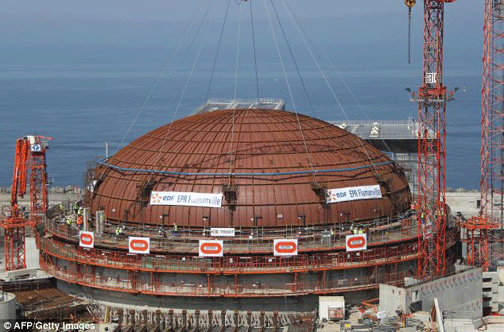
French energy group EDF reviews costs of delayed nuclear project https://www.ft.com/content/c6bc1884-9343-11e9-b7ea-60e35ef678d2 Flamanville plant’s faulty weldings must be fixed, says watchdog David Keohane in Paris JUNE 20, 2019
French energy group EDF says it is reviewing the start-up schedule and costs of its flagship Flamanville nuclear project after the regulator said it would have to fix faulty weldings, which have already delayed the project.
ASN, the nuclear watchdog, said on Wednesday that nuclear-focused EDF needs to repair eight of the joins at Flamanville in northern France.
“EDF is currently analysing the impact of this decision on the Flamanville EPR [nuclear reactor] schedule and cost, and, in the upcoming weeks, it will give a detailed update on the next steps in the project,” said the company in a statement on Thursday.
“This is negative news but it does not come as a surprise,” said analysts at Société Générale, since EDF had already flagged the likelihood of a delay. EDF’s shares fell 1.8 per cent by midday in Paris.
The ASN said in October that the weldings were being reviewed. While, in July, EDF said there would be further delays and cost overruns due to problems with the connections. It pushed back the loading of nuclear fuel and the target construction costs at the late and over-budget plant.
EDF had said the loading of nuclear fuel was scheduled for the end of 2019 with commercial activity starting in 2020 and costs revised up again from €10.5bn to €10.9bn. Initially, Flamanville was expected to cost €3.3bn and start operations in 2012. ASN suggested in its communication to EDF that the plant would not be operational before 2022.
The Flamanville plant in France is one of three being built in Europe using the next-generation European Pressurised Reactor technology. The other two projects are the Olkiluoto project in Finland, which is more than a decade late, and the UK’s Hinkley Point, which is mired in controversy over the high cost of the project.
More broadly, EDF is expected to brief trade unions on Thursday about plans to reorganise the company. The plan, codenamed Hercules, say people familiar with the matter, would involve a holding company 100 per cent-owned by the state and two subsidiaries sitting beneath it. EDF Bleu, or EDF Blue, would house all nuclear and hydroelectric assets and EDF Vert, or EDF Green, would hold the renewables, services and network assets.
EDF Vert would then be floated to raise funds.
The company will also propose a regulated pricing mechanism for 100 per cent of France’s nuclear production to replace the current mechanism, said analysts at Bernstein. The plan to split the company stems from this move since, as Bernstein add, a “100 per cent regulated price for nuclear production in France would likely be considered state aid by the EU”.
The plan thus still has to clear the European Commission as well as probable public pushback to higher regulated prices and heavy union opposition. French trade unions remain particularly powerful within EDF and has used threats of power cuts in the past.
In a joint statement this week, the unions said they “oppose a strictly financial reorganisation that would lose sight of the industrial project, the social ambition and the general interest” of the group.
June 22, 2019
Posted by Christina Macpherson |
business and costs, France, safety |
Leave a comment
NRC approves transfer of NJ nuclear plant to Holtec International, which will dismantle it https://www.inquirer.com/ business/nrc-approves-reactor-transfer-exelon-oyster-creek-nuclear-holtec-decommission-20190620.html
The Nuclear Regulatory Commission approved the transfer of the reactor’s license from Exelon Generation Co. to a subsidiary of Holtec International Inc., a nuclear services provider with headquarters in Camden. Holtec has developed a specialty in handling spent nuclear fuel and dismantling retired reactors.
The decommissioning will largely be concentrated in 2019 through 2025, but completed by 2035, according to a schedule submitted to the NRC. Under law, the owner could have taken up to 60 years to dismantle the plant and restore the site. ……
Holtec is hiring 200 of 600 Oyster Creek employees to work on the decommissioning. In addition, the other experts will be hired to assist in the project at various stages, Pierre Oneid, Holtec senior vice president and chief nuclear officer, said in a statement.
The company will pay the decommissioning costs from a $848 million trust fund that built up from payments collected from customers during 49 years of operations. The owner anticipates the fund, conservatively invested, will generate $46 million in interest income in the coming years that will also go toward decommissioning.
Exelon secured a license renewal through to 2029, but announced in 2010 that it planned to shut down the reactor by 2019 rather than install a costly cooling tower required under new environmental standards to reduce the temperature of the water it discharges into Barnegat Bay.
June 22, 2019
Posted by Christina Macpherson |
business and costs, politics, USA, wastes |
Leave a comment
 Environmental group says new nuclear power plant too pricey for Utah’s municipal utilities, KSL.com By Lisa Riley Roche, Jun 21st, 2019 SALT LAKE CITY — A group opposed to a new type of nuclear plant being developed said Thursday the price of power produced there would be more than other carbon-free energy sources, making it a bad investment for Utah’s municipal utilities.
“We feel the numbers are independent and speak for themselves,” Michael Shea, a senior policy associate for the Healthy Environmental Alliance of Utah, told reporters at a news conference discussing the findings in a new study.
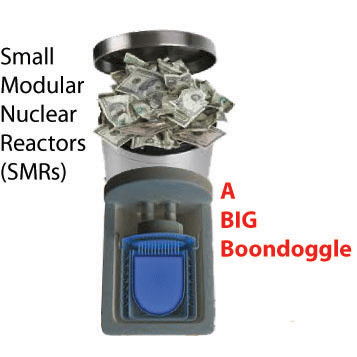
The study, by Salt Lake City-based Energy Strategies, found power produced by the small modular nuclear reactors to be built in Idaho would cost more than $66 per megawatt hour, compared to as low as just over $38 for wind and solar power.
“It does not make economic sense from a market perspective for a group like (the Utah Associated Municipal Power Systems) to be investing in what is essentially a subsidized science project that has not ever been proven,” Shea said…….
Longtime consumer protection watchdog Claire Geddes spoke at the news conference about her confidence in the study and her concerns about the impact of higher costs on the public.
Geddes, who said she has worked on utility issues since 1992, suggested the local governments supervising municipal utilities don’t have the resources to adequately vet the project.
“It’s really not fair to the public,” she said. “I would stress that these cities understand, before they go into it, what the risks are to their citizens and their businesses.”
Both the environmental alliance and Geddes called for further study by the municipal power system before local governments make a final decision next year on what would be a 40-year contract. ……
Besides the cost concerns, Williams said the new type of nuclear plant can’t be presumed to be safe and would still produce at least as much nuclear waste as a traditional plant.
The intent is for the municipal power system to purchase all 12 modular reactors at the plant being built by an Oregon-based company, NuScale Power, system spokesman LaVarr Webb said.
The power generated would be used by the 46 members, mostly municipalities, in Utah and other states, Webb said, and would sold to other users including the federal government for use by the Idaho National Laboratory and the Department of Energy……..https://www.ksl.com/article/46578424/environmental-group-says-new-nuclear-power-plant-too-pricey-for-utahs-municipal-utilities
June 22, 2019
Posted by Christina Macpherson |
business and costs, Small Modular Nuclear Reactors |
Leave a comment
 Investors see huge profits from old nuclear plants, but it could cost taxpayers https://www.lohud.com/story/news/watchdog/2019/06/19/nuclear-plant-decommissioning-holtec-other-firms-see-profit/1456809001/
INVESTORS ARE SCRAMBLING TO BUY OLD NUCLEAR PLANTS. THEY SAY THEY CAN CLEAN THEM FOR PROFIT. IF THEY FAIL, EXPERTS WORRY TAXPAYERS MAY BE ON THE HOOK.
Christopher Maag, North Jersey Record, June 19, 2019 Shutting down nuclear plants is set to become a multi-billion dollar business. If that business fails, critics say, your tax dollars – and possibly your safety – could be on the line. Learn more in our USA TODAY NETWORK Northeast project, The Nuclear Option.
Some of the nation’s richest investors are betting they see profit where no one else does: tearing down America’s aging nuclear reactors.
Among them is one of the most recognized names from the Reagan Administration, former Secretary of the Navy John Lehman.
Lehman’s plans are shrouded in secrecy. The hedge fund that bears his name does not disclose basic information about its finances.
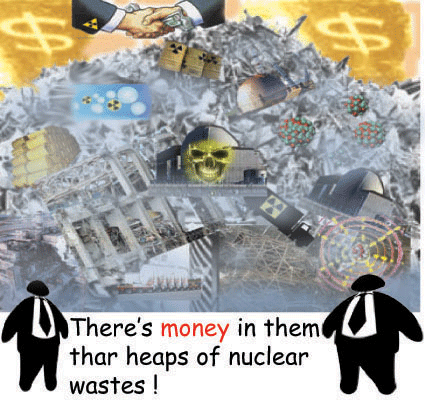
But an examination of deals made by the hedge fund since 2017 to raise money and acquire firms, makes it clear the company sees a pot of gold for the taking — some $60 billion accumulating in trust funds owned by nuclear power plants — all of it bankrolled by ratepayers.
“We believe that the profitability potential remains high,” said Daryl Walcroft, a lead adviser at the accounting firm PwC, which recently released a 20-page report titled “Ready, set…shut down!” to lure new investors.
If they succeed, investors will control a brand-new industry. If they fail, as some independent experts predict, those investors — including public employee pension funds for teachers, police and firefighters — could lose hundreds of millions of dollars.
Past projects blew their budgets by up to half a billion dollars, forcing ratepayers to cover the costs. Current projects may be even riskier, as companies saddle the trust funds with new cleanup costs that federal rules never envisioned, and do not allow.
Such deals may enable big investors like Lehman to take their profit and walk away, leaving “taxpayers to bear the financial burden and responsibility for finishing the work,” Massachusetts Attorney General Maura Healey said in a petition to federal regulators.
For years, power companies supervised reactor cleanup themselves. Nearly every project was a financial failure. In some cases the cost approached $1 billion, double the original estimate.
“I would say all of the early projects went over budget,” said Scott State, CEO of NorthStar Group, a company that deconstructs buildings.
Industry leaders like State believe they can decommission a nuclear plant faster and cheaper, and share the savings with their investors as profit.
“They’re taking on a big risk that they can do a big job,” said Tom LaGuardia, an engineer widely regarded as the world’s top expert on decommissioning costs.
The New Model
TO INVESTORS, EACH REACTOR IS A POT OF GOLD
To some people, a closed nuclear plant is a dangerous place contaminated with radioactive waste.
To investors, each reactor is a pot of gold.
Federal law requires electricity companies to save money in trust funds for the eventual closure and cleanup of nuclear reactors. Fund totals ranged from $286.6 million for Beaver Valley reactor 1 in Pennsylvania to $1.5 billion for Diablo Canyon reactor 2 in California, according to 2016 tallies from the Nuclear Regulatory Commission, the latest available.
Nationwide, trust fund balances topped $60 billion in 2016, the NRC found. They grew to $70 billion by 2018, according to The Callan Institute, which advises fund managers. And the total may soon rise to $90 billion, according to PwC, a major accounting firm formerly known as PriceWaterhouseCoopers.
And unlike virtually every other big construction project, companies decommissioning nuclear plants get paid upfront, before work even starts.
“Having pre-funded work is very good,” said State, of NorthStar.
Powerhouses including the PwC accounting firm also see profit opportunity in teardown deals.
“(T)he growth of this market is accelerating more quickly than predicted,” according to the company’s recent report. “Already, we are seeing qualified decommissioning specialists and institutional investors clamoring through various deals to own” decommissioning companies.
Here’s what that clamor looks like. After serving as President Ronald Reagan’s Secretary of the Navy, John Lehman founded J.F. Lehman & Co., a hedge fund that invested $1.9 billion primarily in defense and aerospace industries, according to the company’s website.
In 2016, J.F. Lehman & Co. sought to raise $700 million. It attracted more than 48 investors, including “leading public and private pension funds” who together invested $883 million, more than 25 percent above Lehman’s original plan, according to a Lehman press release.
Investments included $40 million from the Teachers’ Retirement System of Oklahoma. Another $36.5 million came from three public employee retirement funds in Connecticut. The public employee retirement fund in Montgomery County, Maryland invested $23 million, the Arkansas Teacher Retirement System invested $14.6 million, and the retirement system for municipal police in Louisiana invested $12.5 million, according to the funds’ annual reports, for a total of at least $126.6 million. Together, these funds own $75.9 billion in assets.
Three months after Lehman announced it had beaten its fundraising goal, in June 2017, it gained a foothold in the decommissioning industry by acquiring NorthStar. The following month, it announced a partnership with a company now called Orano, which specializes in nuclear teardowns. In January 2018 Lehman bought Waste Control Specialists, which owns radioactive waste disposal sites in Texas.
The deals allow Lehman’s companies to save money at every step of decommissioning, said State, who is CEO of both NorthStar and Waste Control Specialists.
“We own and control everything we need to do this work,” State said.
Important details about Lehman’s companies remain unknown, including how much cash each keeps for emergencies. Even less is known about Holtec’s decommissioning venture Comprehensive Decommissioning International, which is co-owned with SNC-Lavalin, a large Canadian engineering firm.
The company is secretive about its finances, refusing to disclose basic information about its revenue, assets or ability to handle contingencies. “Both Holtec and SNC-Lavalin supplied the capital for establishing CDI,” Joe Delmar, a Holtec spokesman, said by email.
Potential pitfalls
HOLTEC AND NORTHSTAR HAVE REQUESTED EXEMPTIONS FROM THE NRC’S TRUST FUND FORMULA
The financial success or failure of decommissioning a nuclear reactor hinges on one thing: the size of its trust fund.
“The most unique risk in this market has to do with the health of the trust fund,” said Walcroft, lead adviser on American infrastructure projects for PwC.
In Holtec’s application to buy Pilgrim nuclear power plant in Massachusetts, and in NorthStar’s application to buy the Vermont Yankee plant, both companies said they expect each reactor’s trust fund to pay for the entire project.
“I am telling you they will get it done with the trust fund because they’re really good,” said Rod McCullum, senior director of used fuel and decommissioning at the Nuclear Energy Institute, the industry’s powerful trade group.
Consultants, financial experts and three federal agencies are not so confident. Plant owners must prove their trust funds meet the Nuclear Regulatory Commission’s minimum formula, which the commission estimates will generate enough money to clean up a nuclear plant’s radioactive contamination.
But the commission’s own Office of Inspector General, as well as the Government Accountability Office and Pacific Northwest National Laboratory, together published four reports since 2011 finding the formula — created in the early 1980s — is so old that it consistently underestimates the amount of money needed.
“The NRC estimate is still low,” said LaGuardia, who said he has completed cost estimates on 90 percent of all decommissioning projects in North America.
Moreover, Holtec and NorthStar plan to use trust funds in ways the NRC never envisioned. According to federal rules, trust money may be used only to clean up nuclear contamination. Other jobs, like managing spent reactor fuel and removing asbestos or lead, must use other money.
“It comes from their own money, their own profits,” said Richard Turtil, a senior financial analyst for the NRC.
That’s not what NorthStar and Holtec have in mind. At Pilgrim, Holtec requested an exemption allowing the trust fund to cover $541 million in spent fuel management and site restoration costs. NorthStar requested a similar exemption at Vermont Yankee for $425 million. Both companies stated the funds will have sufficient money to cover the additional work, and provide them with profits.
“This very substantial amount — over a billion dollars — in Pilgrim’s [trust fund] will be sufficient to cover the estimated cost of decommissioning and spent fuel management, as well as site restoration,” Holtec said in a filing to the NRC.
Some current and former regulators disagree. If granted, the exemption “poses a significant risk that insufficient funds will exist” to clean the site, Massachusetts Attorney General Maura Healey told the NRC.
“Certainly, I think the funds are sufficient to cover the cost of the cleanup,” Gregory Jaczko, former chairman of the Nuclear Regulatory Commission, said in May at a Congressional briefing. “But I’m not sure that they’re sufficient to cover the costs of the cleanup and a very nice level of leftover benefit for the company.”
Blowing budgets?
THE BIGGEST DRIVER OF COST INCREASES IS FINDING POCKETS OF PREVIOUSLY UNKNOWN CONTAMINATION
Finally, there’s the question of cost overruns. The cost to decommission Yankee Rowe nuclear plant in Massachusetts was estimated at $370 million in 1994. By the time it was finished in 2003, costs rose by an extra $266 million, according to book co-authored by LaGuardia. At Connecticut Yankee the final bill was $931 million, more than double original estimates.
“Almost invariably in the work I’ve done, the costs were greater than expected,” said Julia Moriarty, senior vice president of The , which advises nuclear fund managers.
Work accidents and changing government rules caused many projects to run over-budget, LaGuardia said, but the biggest driver of cost increases is finding pockets of previously unknown contamination.
Companies learned from these mistakes, State and Delmar said. Teardown experts now perform more intensive site studies; avoid cutting apart reactors with tools like grit sanders that spread contamination around a site; and often control the final disposition of nuclear waste. This means they can simply “rip and pitch” waste into trucks or trains bound for disposal sites, State said, rather than spend valuable workers’ time decontaminating materials on-site.
“They’re getting smarter now, and they’re doing site characterization first,” LaGuardia said. “They know the risks. If they’re not comfortable with their cost estimating method, they’re not going to be in this business.”
Site studies remain imperfect, however.
“Site conditions are never known with absolute precision,” Warren K. Brewer, a decommissioning expert, told the Vermont Public Utilities Commission.
All construction companies build cushions into their plans to cover unexpected costs. At Vermont Yankee, NorthStar set aside 10 percent of the trust fund’s $500 million for contingency and profits, far below standard industry practice, according to Brewer and Gregory Maret, another expert hired by the state.
Even small changes in site conditions or state regulations could increase costs by up to $200 million, Brewer found, enough to overwhelm the contingency fund.
“That’s a very risky business play,” LaGuardia said of NorthStar’s plan.
Eventually NorthStar and its partners committed $200 million in additional financial assurances, said Dan Dane, a financial expert involved in the negotiations.
Holtec’s contingency at Pilgrim is even smaller. The company will set aside 17 percent of Pilgrim’s projected $1.3 billion trust fund for surprises, it told the NRC.
But as Healey found, Holtec plans to spend all but $3.6 million of the $1.3 billion in its trust fund on basic decommissioning work.
“In other words, its contingency allowance covers costs it expects to incur,” Healey wrote in her petition. “Holtec’s attempt to account for contingencies and uncertainty risk is woefully deficient.”
The buck stops where?
IF EVEN A HANDFUL OF PROJECTS GO BROKE, RETIREES IN AT LEAST FIVE STATES STAND TO LOSE $126.6 MILLION
Leaders of decommissioning companies are confident they can avoid the failures of the past.
“Does that mean every project will go perfectly? No,” State said. “But I don’t lose any sleep thinking we aren’t going to be able to do these projects in precisely the way we say we expect we can.”
Consultants think failure is an option, however.
“I think the vast majority will do just fine,” said Moriarty, who has monitored nuclear funds for 20 years. “I think there will be cases where they run into problems.”
If even a handful of decommissioning projects goes broke, current and future public employees in at least five states stand to lose $126.6 million in investments. In its report, PwC advised investors to consider, “Do I have the financial capability to manage the nuclear decommissioning trust fund as required by the NRC — or to make up the difference if it falls short?”
If investors can’t step up, some worry it will fall to “taxpayers to bear the financial burden and responsibility for finishing the work,” Healey told the NRC.
“If they go bankrupt,” Moriarty said, “I assume the taxpayers are on the hook.”
Email: maag@northjersey.com
Data reportreFrank Esposito contributed to this report.
June 20, 2019
Posted by Christina Macpherson |
business and costs, USA, wastes |
Leave a comment

What’s more chilling: watching Chernobyl or cogitating on the cost of going nuclear? Michael West Investigative Journalism Jun 20, 2019, The sudden push by the Murdoch media and Coalition right-wingers to overturn Australia’s nuclear power ban ignores the chilling economic cost — huge public subsidies, storing radioactive waste for thousands of years, the heavy costs of decommissioning and, potentially, radiation-related health costs. Veteran nuclear writer Noel Wauchope reports on the popular TV series, Chernobyl, and the economics of nuclear power.
THE frightening TV miniseries “Chernobyl” could put a few Australians off the idea of nuclear power but nuclear economics might turn out to be the bigger scare.
It is bad news for the Minerals Council of Australia and nuclear lobbyists, that Chernobyl has now arrived on some Australian TV screens, but pro-nuclear advocates are continuing to push their campaign anyway.
The miniseries “Chernobyl” has just finished in Europe and USA, outdoing “Game of Thrones” in popularity. HBO’s Chernobyl topped film and TV database IMDB’s list of the greatest 250 TV shows of all time. The first episode was screened on 12 June, 2019 in Australia, on Foxtel.
The series has had a big impact. It was highly praised by numerous reviewers but criticised by pro-nuclear lobbyists, and infuriated some Russian politicians. ………
The Liberal Coalition’s renewed push for nuclear power……
Prime Minister Scott Morrison said he is open to considering nuclear power if it can stand on its own two feet. Energy Minister Angus Taylor told The Guardianon 12 June 2019 he wouldn’t rule out revising Australia’s nuclear ban “when there is a very clear business case which shows the economics of this can work”. Two days later, Environment Minister Sussan Ley also told TheGuardian she was open to the review considering a removal of the ban.
But — are the economics of nuclear power viable for Australia?
When even Australia’s former top nuclear promoter has doubts, it doesn’t look promising……….
How viable is nuclear power elsewhere?
Nuclear economics in America is really a tale of woe. You hardly know where to start, in trying to assess how much this industry is costing communities and tax-payers. There are the attempts to save the nuclear industry via subsidies. There are the continuing and ever-increasing costs of radioactive wastes. There are the compensation payments to workers with radiation-caused illnesses, $15.5 billion and counting, and the legal battles over where to put the wastes. Needless to say, really, America is not initiating any new nuclear “big build”. The much touted “Small Modular Nuclear Reactors” are turning out to have no market and little prospect of being economically viable……
The UK nuclear industry is in the doldrums with repeated postponement of new projects – Hinkley Point C, Wylfa Newydd, Moorside, Sizewell C, Oldbury B and Bradwell B……The 2018 forecast for future clean-up of Britain’s aging 17 nuclear power stations has blown out to £121 billion which has had to be spread across the next 120 years……
France’s Flamanville nuclear project is taking years, remains bogged down with costly problems. Electricite de France (EDF) has financial woes but hopes to save itself by switching from nuclear to renewables. France’s former nuclear giant AREVA went bankrupt and has changed its name to Orano and Framatome — and French tax-payers are still caught up in Areva/Orano costly legal corruption scandals.
Canada is up for increasing costs for managing its nuclear wastes. Interestingly, Canada abandoned its nuclear project for producing medical radioisotopes and now leads in non nuclear production of these isotopes.
India had grand plans for nuclear power, but has cut these back, and recently cancelled 57 reactors. It continues to have problems and many outages, at its huge Kudankulam nuclear station. ….
Russia keeps offering “generous” funding to the buyer countries. But will those countries end up with big debts? Reuters reports that in China, “No new approvals have been granted for the past three years, amid spiralling costs” ………. https://www.michaelwest.com.au/whats-more-chilling-watching-chernobyl-or-cogitating-the-cost-of-going-nuclear/
June 20, 2019
Posted by Christina Macpherson |
AUSTRALIA, business and costs |
Leave a comment
|
 French Nuclear Power Producer EDF Plans a Turnaround, CFO Xavier Girre is selling assets and trailing new financing tools ahead of a potential reorganization of the company. WSJ By Nina Trentmann June 14, 2019 French Nuclear Power Producer EDF Plans a Turnaround, CFO Xavier Girre is selling assets and trailing new financing tools ahead of a potential reorganization of the company. WSJ By Nina Trentmann June 14, 2019
Aging nuclear reactors, soaring debt and large capital-spending commitments that generate are just some of the problems facing Xavier Girre, the chief financial officer of French electricity supplier Electricité de France SA .
The room to maneuver is limited: Key operating decisions must be taken in conjunction with the French government, EDF’s largest shareholder.
“We are not the decision makers,” Mr. Girre told CFO Journal. “With regards to regulation, the state is.”……..
France’s largest energy producer has also sold assets worth €10 billion ($11.24 billion), and assets worth a further €2 billion to €3 billion are to be divested by 2021. The government recently allowed EDF to give shareholders new shares instead of a cash dividend
A planned restructuring of the company’s assets and a new pricing structure for the French energy market could help Mr. Girre make further improvements, said Claire Mauduit-Le Clercq, analyst at S&P Global Inc.
The plan could allow EDF to separate its nuclear plants—it currently operates 58—from the rest of the business, a move that would enable the company to focus on investments in renewable energy. A large part of the company’s energy production comes from nuclear reactors…….
Analysts say the challenge for EDF will be to fund the turnaround given its hefty debt load. EDF’s net debt—a measure of total loans and financial liabilities less cash and liquid assets—was €33.38 billion at the end of 2018, up from €33.01 billion at the end of 2017.
Further complicating the picture is EDF’s large capital spending program. The company committed in 2014 to spending up to €45 billion by 2025 to extend the lifespan of its nuclear reactors fleet from around 40 to 50 years. The average age of an EDF nuclear power plant currently stands at 33 years.
New plants under construction, for example in Britain’s Hinkley Point, are adding to that cost burden. Total capital expenditures were about €14 billion in 2018. “EDF would not have to sell business after business to fund new investments if this was a viable business model,” AB Bernstein’s Ms. Becker said.
Meanwhile, the company’s net income slumped to €1.17 billion in 2018 from €3.17 billion a year earlier. Fluctuating energy prices, mean “the company lacks visibility into its future earnings,” said Ms. Mauduit-Le Clercq.
“You have a company that faces major investment needs, that has a negative cash flow equation and that has high debt levels—this creates tension in the balance sheet,” she said.
But the company’s financial standing is more vulnerable when other obligations, such as pension liabilities, future obligations to retire certain assets and costs for managing nuclear waste, are factored in. Adjusted net debt was €70 billion at the end of 2018, S&P Global said. https://www.wsj.com/articles/french-nuclear-power-producer-edf-plans-a-turnaround-11560526991
|
|
June 17, 2019
Posted by Christina Macpherson |
business and costs, France, politics, renewable |
Leave a comment

 WASHINGTON ,WATCH: IS TRUMP HELPING THE SAUDIS GO NUCLEAR? https://www.jpost.com/Opinion/Washington-Watch-Is-Trump-helping-the-Saudis-go-nuclear-592310,BY DOUGLAS BLOOMFIELD, JUNE 12, 2019
US President Donald Trump recently took another step toward bringing Saudi Arabia into the nuclear club. While Israeli-Saudi ties have warmed in recent years, helping the desert kingdom go nuclear – with its ongoing support for the most extreme Islamic radicals in the world – can hardly be good for the Jewish state.
Secret negotiations with the US Energy Department over many months have led Washington to “transfer highly sensitive US nuclear technology, a potential violation of federal law,” to Saudi Arabia, according to House Oversight Committee sources cited by The Washington Post.
Sen. Tim Kaine (D-Virginia) revealed last week that at least two transfers were approved since the assassination of Washington Post journalist Jamal Khashoggi.
The Saudis say they want to begin building their own nuclear power plants with their own enriched uranium, even though it could be purchased elsewhere more cheaply. That raises suspicions that their real goal isn’t producing electricity. By enriching their own uranium, they could begin diverting it to highly enriched weapons grade, especially if they bar international inspectors, as they’ve insisted.
Given its record of obeisance to Saudi demands for top technology and weapons, it is unlikely the Trump administration would object, but instead continue helping to conceal the kingdom’s plans. Crown Prince Muhammad bin Salman, the de facto ruler, has said that the kingdom would build nuclear weapons if the Iranians did. He may have taken encouragement from a speech in the UAE last month by Trump’s national security adviser, John Bolton.
The Iranians are threatening to leave the nuclear pact with the major powers – the Joint Comprehensive Plan of Action (JCPOA) – in the wake of the Trump administration’s unilateral exit last year and imposition of sanctions to tighten the economic screws on Tehran.
There’s “no reason” for Iran to walk away from JCPOA, “unless it is to reduce the breakout time to nuclear weapons,” said Bolton, a decades-long advocate of regime change in Iran. Bolton offered no evidence to back his claim.
That should give MBS the rationale he seeks to develop his version of the bomb.
When he turns to Trump for help, he will remind the president that if America won’t sell it to him, there are others who will. Trump is a sucker for that pitch.
North Korea would be a good place to go shopping, since they tried helping Syria build nukes until the Israeli Air Force stopped the plan, something it had done earlier in Iraq. Then there’s Pakistan, which is believed to have built its own nuclear weapons stockpile with Saudi financial help.
THERE MIGHT BE some resistance on Capitol Hill, where Saudi support is low and sinking, but Trump has shown himself more responsive to the wishes of the Saudis than the US Congress.
Republicans like Sen. Lindsey Graham of South Carolina may moan and groan and make threatening sounds toward Riyadh, but he and majority leader Mitch McConnell are Trump’s poodles, and will make sure the president gets what he wants.
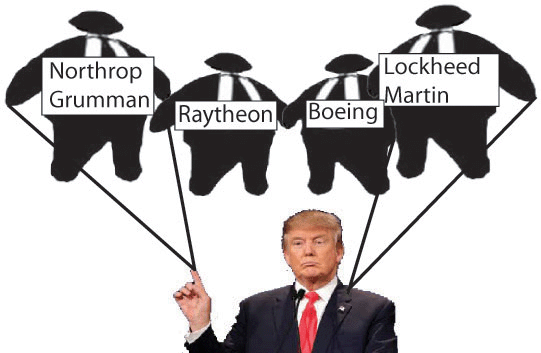
All US administrations – Republican and Democratic – have indulged the Saudi appetite for top technology and weapons. They’ve been driven by pressure from industry and its friends in the Pentagon to sell, sell, sell – and an inexplicable attitude that we need the Saudis far more than they need us. Trump has just raised this to a new level.
Trump’s latest selling spree includes 120,000 conversion kits to produce smart bombs. It is part of an $8.1 billion package that Trump labeled “emergency” to bypass Congressional review.
Most alarming is the Trump administration’s approval for the transfer of highly sensitive weapons technology and equipment to Saudi Arabia so the kingdom can produce electronic guidance systems for Paveway precision-guided bombs, according to congressional sources cited by The New York Times.
The administration assured Congress that it is confident in the Saudi ability to protect the technology, that the need is urgent and that it won’t alter the balance of power in the region – which is exactly what it is intended to do.
Look for Trump to justify massive sales to the Saudis and the UAE as also helping protect Israel from Iran. Historically, all administrations have justified arms sales around the Middle East as harmless to Israel’s qualitative military edge. But they aren’t. Especially when the US is selling the Arabs the same planes, missiles and technology it sells Israel. Trump values his oil-rich customer so much that he has rejected the findings of his own CIA that the crown prince was complicit in Khashoggi’s murder.
Saudi Arabia is the Pentagon’s favorite cash cow. Arms sales are a lucrative business for the US Defense Department, which charges commissions and other fees, and gets economies of scale for its own purchases while selling off old inventory to help pay for replacements. Military attachés around the world are top salesmen for defense contractors as they lay the groundwork for post-uniform careers. Then there are the former – and possibly future – defense industry executives at the highest levels of the Pentagon, starting with the Secretary of Defense.
Sen. Chris Murphy (D-Connecticut) said the administration “has effectively given a blank check to the Saudis – turning a blind eye to the brutal murder of Jamal Khashoggi and allowing their ballistic missile program to expand.”
The United States is not allowed to sell ballistic missiles, so the Saudis have turned to China. CNN reported last week that American intelligence believes Beijing is helping enhance the kingdom’s strategic missile program. In the 1980s, it secretly bought Chinese DF-3 missiles and based them within range of Israel. It bought more advanced missiles in 2007 with the approval of then-president George W. Bush. Unconfirmed published reports suggest they also bought other missiles from Pakistan, which produces a version of the North Korean Nodong missile.
If the Saudis decide to pursue nuclear weapons, they can turn to Trump’s dear friend Kim Jong Un, whose cash-strapped regime has developed its own and the missiles to deliver them.
With Trump looking for business that will create jobs he can claim credit for – and with John Bolton rattling sabers and B-52s, and calling for regime change in Iran – can Saudi Arabia be knocking on an open door to the nuclear club?
June 13, 2019
Posted by Christina Macpherson |
business and costs, politics, politics international, Saudi Arabia, USA |
Leave a comment
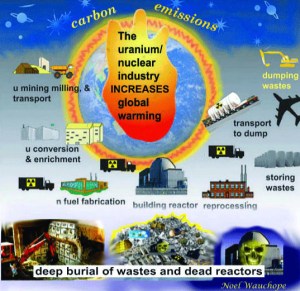
 Once again, the media here mindlessly regurgitates nuclear lobby propaganda that nuclear power is “zero carbon”. It’s not. Even the reactor’s operation emits a timy amount of carbon 14. But, more importantly, the entire fuel chain, and all its transport, from uranium mining through to the disposal of wastes and of the dead reactor – is highly carbon emitting.
Even if nuclear power were low carbon (which it’s not), it would require thousands of reactors to be built very very quickly, in order to have any effect on global warming.
Meanwhile, funds, and energy are being diverted from genuinely useful measures, in renewable energy, and above all, in energy conservation.
*************************************************************************
China eyes Argentina in global nuclear roll out, China Dialogue, Lili Pike, Fermín Koop, 04.06.2019 “……. Costs, emissions and safety at stake as Argentina and China look set to seal a nuclear power ……… With China looking to increase its nuclear power exports and countries seeking low-carbon electricity, the project in Argentina could be the beginning of a China-led renaissance. However, concerns over the cost and safety of nuclear power continue to plague the technology…….
The Atucha III project is part of an agreement signed in 2015 by former president Cristina Fernández de Kirchner, which approved two nuclear plants: one using Canadian technology in Argentina’s existing plants, and one using Chinese technology.
Macri scrutinised the deal on taking office, amid doubts over whether nuclear was a sufficiently economical energy source. He eventually approved construction, but Argentina’s economic crisis led one of the plants to be shelved to reduce the size of the loan.
“Argentina is going through an economic crisis and money is tight. Investing in nuclear requires a long-term commitment, but China can offer subsidised capital to its foreign customers,” said Mark Hibbs, senior fellow at Carnegie’s Nuclear Policy Program.
“This gives China an advantage over other nuclear exporting countries.” …….
Backlash
The nuclear deal attracted criticism from a group of former energy secretaries, who claimed in a November press release that it would be cheaper to develop solar and wind projects.
“Any future energy projects have to be part of a national and long-term energy plan, which now doesn’t exist. All new projects should be economically competitive and should be in line with the country’s mitigation commitments,” said Jorge Lapeña, a former energy secretary.
Environmental organisations that prioritise wind and solar proliferation agree.
“We don’t consider nuclear as renewable energy, it has many risks regarding the functioning of the reactors and waste. It’s not suitable for Argentina,” said Andrés Nápoli, head of Fundación Ambiente y Recursos Naturales (FARN).
He added: “A new nuclear plant would require risk and impact studies and we haven’t seen any.”……….
The Argentina deal is one of the first success stories for Chinese nuclear overseas. Since 2000, Russia has dominated overseas nuclear power, supplying 45% of total capacity. China is the fifth largest exporter, supplying just 9%. So far, the only Chinese reactors constructed overseas are in Pakistan.
Beyond the Argentina and Pakistan deals, it is unclear whether China’s nuclear power reactors will find other markets.
“After the Fukushima accident, global demand for nuclear power hasn’t been strong, and the US, Germany, South Korea and others are phasing it out,” said Zhang Hua, a senior engineer at the State Power Investment Corporation’s Institute of Science and Technology.
“Demand from South Africa, Turkey, Argentina and other countries is also not as high as expected. The current outlook for China’s nuclear power exports is not optimistic,” Zhang added……….
Weighing risks
Even as the climate crisis deepens, countries may reject nuclear because of concerns over safety and cost.
While Generation III reactors are safer, nuclear power still
poses myriad risks. These include radiation exposure from uranium mining, meltdowns like Fukushima and using the technology to produce nuclear weapons………..
Geopolitical tensions could also stymie China’s export ambitions. In the UK, where the utility China General Nuclear Power has gained a foothold through investment in nuclear plants and plans to build a Hualong One, critics have raised concerns over China’s involvement in sensitive infrastructure.
In markets new to nuclear power, researchers also warn that the regulatory environment may not be mature enough to assess and safely manage new Chinese plants.
In Argentina, several civil society groups oppose nuclear. Rio Negro province has already passed a law banning it………..
https://www.chinadialogue.net/article/show/single/en/11293-China-eyes-Argentina-in-global-nuclear-roll-out
June 10, 2019
Posted by Christina Macpherson |
China, marketing, SOUTH AMERICA |
1 Comment

McClatchy reports: 33,480 Americans dead after 70 years of atomic weaponry
“….. The number of deaths has never been disclosed by federal officials. It’s more than four times the number of American casualties in the wars in Afghanistan and Iraq. And it looms large as the nation prepares for its second nuclear age, with a $1 trillion plan to modernize its nuclear weapons over the next 30 years…..
A total of 107,394 workers have been diagnosed with cancers and other diseases after building the nation’s nuclear stockpile over the last seven decades. The project includes an interactive database that offers details on all 107,394 workers.
McClatchy’s yearlong investigation, set in 10 states, puts readers in the living rooms of sick workers in South Carolina, on a picket line in Texas and at a cemetery in Tennessee…..
— Federal officials greatly underestimated how sick the U.S. nuclear workforce would become. At first, the government predicted the compensation program would serve only 3,000 people at an annual cost of $120 million. Fourteen years later, taxpayers have spent sevenfold that estimate, $12 billion.
— Even though costs have ballooned, federal records show that fewer than half of those workers who sought help had their claims approved by the U.S. Department of Labor.
— Despite the cancers and other illnesses among nuclear works, the government now wants to save money by cutting current employees’ health plans, retirement benefits and sick leave….. … https://www.mcclatchydc.com/news/nation-world/national/article49216310.html (photo: Ralph and Jodi Stanton)
Disastrous health effects of uranium mining, on the people of Jharkhand, India
the financial benefits are meaningless when weighed against what his group says is an alarming rise in stillbirths, birth defects, and adults and children diagnosed with cancer, kidney disease, and tuberculosis.
report showed a far greater incidence of congenital abnormality, sterility, and cancer among people living within 2.5 kilometres (1.5 miles) of the mines than those living 35 kilometres away. Mothers in villages close to the mine sites were also twice as likely to have a child with congenital deformities, …. us”…http://www.google.com/hostednews/afp/article/ALeqM5i1G4YWJkajit3t0xD2ddl4UXwN7g?docId=CNG.5b3137d37ca033f82d1946db0c21911c.951
June 8, 2019
Posted by Christina Macpherson |
Christina's themes, employment |
8 Comments
 Top Uranium Producer Is Gloomy About Nuclear Power, for Now, Bloomberg, By Will Wade, June 7, 2019, Don’t expect an upswing in the global uranium market anytime soon.
“In our models, we don’t get excited on the demand side,” said Galymzhan Pirmatov, chief executive officer of Kazatomprom, Kazakhstan’s state-owned mining company that’s the world’s biggest supplier.
With construction of nuclear power plants at a 10-year low, uranium demand remains weak. That’s holding prices so low that mining companies have been wary of increasing production. Kazatomprom’s output will increase about 5% this year, to as much as 22,800 tons, and then will be flat in 2020, Pirmatov said Wednesday in an interview in New York. While he hasn’t yet made a decision on 2021, he doesn’t see much to get excited about, at least in the short term.
“I do believe prices are too low,” he said. Uranium has slumped 15% this year to $24.35 a pound as of Wednesday. Kazakhstan controls about 40% of the world’s supply of the metal, and Kazatomprom accounts for half of that, making it the biggest producer………
U.S. Closings
In the U.S., flush with abundant and cheap natural gas, utilities are closing nuclear plants. The U.S. is also considering whether to impose tariffs on uranium, after two small domestic mining companies filed a trade case last year, arguing that imports are a threat to national security. The Commerce Department concluded its investigation in April, but the results haven’t been made public……..https://www.bloomberg.com/news/articles/2019-06-05/top-uranium-producer-is-gloomy-about-nuclear-power-for-now
June 8, 2019
Posted by Christina Macpherson |
2 WORLD, business and costs, Uranium |
Leave a comment
|
Germany’s env min and plant operators dismiss call for nuclear lifetime extensions,Clean Energy Wire
Germany’s env min and plant operators dismiss call for nuclear lifetime extensions, Germany certainly does not need to return to nuclear energy and should push through with its energy transition instead, according to environment minister Svenja Schulze. Following isolated calls to extend the lifetime of the country’s nuclear plants, Schulze said the technology is very expensive, on closer inspection not CO₂-neutral, and always carries the risk of an accident. Germany’s remaining nuclear power plant operators RWE, E.ON and EnBW also rejected the idea to upend the country’s societal consensus to phase out nuclear power by the end of 2022.
Germany’s environment minister Svenja Schulze has dismissed recent isolated calls for a postponement of the country’s nuclear exit to protect the climate. “We certainly don’t need a return to nuclear power. That would cause nothing but problems,” Schulze told energy managers at utility association BDEW’s annual conference.
The technology is very expensive, on closer inspection not CO2-neutral, and always carries the risk of an accident, according to Schulze, whose ministry is also in charge of nuclear security……
Opposition to nuclear power has been particularly strong in Germany, and there is a broad societal consensus to phase it out as part of Germany’s landmark Energiewende (energy transition). While the country struggles with aspects of the phase out – such as what to do with the waste – one issue that isn’t a problem is public consent. The vast majority of Germans want to see nuclear power gone sooner rather than later. ……
With reference to Germany’s unsolved challenges of dealing with nuclear waste, Schulze said the country had used nuclear power for only three generations, and now left radioactive waste for thousands of following generations to deal with. Schulze also said nuclear power stations would not fit into Germany’s future electricity system. “Nuclear power would only block the grid. We don’t need more inflexible large power stations in a decentralised flexible system.”……
Plant operators have repeatedly said nuclear power will come to an end by the end of 2022 as planned and utility association BDEW said that reaching climate targets in the energy sector does not require a longer operating life for nuclear power plants. “It doesn’t make sense at all to start a discussion about lifetime extensions shortly before reaching the finishing line,” BDEW head Stepan Kapferer said at the conference, adding the operators had already clearly rejected the idea anyway. Nuclear power in Germany “is finished”, plant operators E.ON, RWE and EnBW told Jakob Schlandt for an article in Tagesspiegel Background. “This chapter is over,” said a RWEspokesperson……
The BDEW expressed confidence that its companies can benefit hugely from the energy transition. The Energiewende offered “huge opportunities for growth”, said BDEW head Stefan Kapferer in his opening remarks with reference to renewables and the charging infrastructure for electric mobility. He repeated his association’s call for a CO2 price for heating and transport. “It’s a joke that electricity, as the greenest available form of energy, is also the most expensive,” Kapferer said. https://www.cleanenergywire.org/news/germanys-env-min-and-plant-operators-dismiss-call-nuclear-lifetime-extensions
|
|
June 6, 2019
Posted by Christina Macpherson |
business and costs, Germany, politics |
Leave a comment