Government-owned Chinese company wants to build Sizewell nuclear plant
 State-owned Chinese company bids to build second UK nuclear plant, SMH, By Latika Bourke May 27, 2020 —A Chinese state-owned company blacklisted in the United States has applied to build a second nuclear plant in Britain amid growing concern in the UK government’s ranks about Chinese investment in critical infrastructure.China General Nuclear Power Group’s application creates a new headache for UK Prime Minister Boris Johnson, who is already facing a backbench revolt over his approval of Chinese firm Huawei to supply Britain’s 5G networks. State-owned Chinese company bids to build second UK nuclear plant, SMH, By Latika Bourke May 27, 2020 —A Chinese state-owned company blacklisted in the United States has applied to build a second nuclear plant in Britain amid growing concern in the UK government’s ranks about Chinese investment in critical infrastructure.China General Nuclear Power Group’s application creates a new headache for UK Prime Minister Boris Johnson, who is already facing a backbench revolt over his approval of Chinese firm Huawei to supply Britain’s 5G networks.
The UK does not have an investment review process like Australia’s Foreign Investment Review Board. However, Johnson has flagged a tightening of foreign investment rules in the wake of the pandemic and subsequent alarm about dependence on China. CGN, on Wednesday, submitted its planning application to build the Sizewell reactor in Suffolk, England with its French partner EDF. The project, estimated to cost at least £20 billion ($A37 billion) would be financed through private investment and construction would begin by the end of 2021 if approvals are given. CGN’s initial stake in the project would be 20 per cent compared to EDF’s 80 per cent. The same consortium was approved to build Britain’s Hinkley Point power station in 2016. The then prime minister Theresa May temporarily halted the project over concerns about Chinese investment in critical infrastructure but eventually gave the project the go-ahead. However, in August last year the Trump Administration placed CGN on the US entity list accusing it of acting contrary to the United States’ national security. The US has accused the Chinese company of stealing US nuclear technology for military use.
Sizewell’s approval process is expected to take at least 18 months at the same time as the government is being urged to tighten foreign investment rules. Former Conservative party leader and backbench MP Iain Duncan Smith told The Sydney Morning Herald and The Age that China must not be allowed to make any further inroads into the UK’s critical infrastructure. “We simply cannot go further down the road of becoming more dependant on China,” he said…….. https://www.smh.com.au/world/europe/state-owned-chinese-company-bids-to-build-second-uk-nuclear-plant-20200527-p54x37.html |
|
Court set-back to France’s EDF nuclear supply contracts
|
France’s EDF suffers second setback over nuclear supply contracts, https://af.reuters.com/article/energyOilNews/idAFL8N2D93OF PARIS, May 27 (Reuters) – A French court ruling on Wednesday ordered state-controlled utility EDF to accept Gazel Energy’s suspension of supply contracts under a force majeure clause prompted by the coronavirus pandemic.In the decision, seen by Reuters, the president of the Paris commercial court said conditions for force majeure in ARENH nuclear power contracts between the two companies were “evidently met”.
The verdict followed a similar ruling last week that ordered EDF to accept Total’s suspension of supply contracts. Total and Gazel Energy have sought to invoke the force majeure clause in contracts after the pandemic cut electricity demand by around 20% and pushed prices far below that specified in their existing agreements. (Reporting by Benjamin Mallet; writing by Matthieu Protard; editing by Jason Neely) |
|
Soaring costs of UK’s Hinkley Point C nuclear project, and other nuclear plans, while renewables get cheaper
 Business Green 27th May 2020, significant concerns surround the high costs associated with new nuclear power, particularly in the wake of the controversial Hinkley Point Business Green 27th May 2020, significant concerns surround the high costs associated with new nuclear power, particularly in the wake of the controversial Hinkley PointC project in Somerset, which has soared £2.9bn over budget so far and is running 15 months behind schedule. EDF said Sizewell C would use the same
design as Hinkely Point C, and would therefore benefit from “significantly reduced construction costs and lower risk”. Financing could also help reduce costs even further, it added. Chinese state-owned firm CGN also holds a 20 per cent stake in the development phase of Sizewell C. The same company also holds a 33 per cent stake in Hinkley Point C. But many green
groups argue renewable power sources coupled with battery storage and grid flexibility technologies offer a far cheaper and more reliable, zero carbon source of electricity for the UK grid. A report last year by think tank ECIU argued the UK should look to scale up wind and solar rather than nuclear energy capacity going forward. Greenpeace UK chief scientist Doug
Parr said EDF’s decision to push for new nuclear power in the face of “cheaper, safer, faster and far more popular alternatives” being pursued elsewhere in the world was “difficult to explain”. “For half a century Britain was overly-optimistic about the technology, but we don’t have to keep making the same mistake,” he said. “All it would take to knock billions off our future energy bills is for the government to admit they are backing the wrong horse. Energy technologies and economics have changed enormously over the past five years, and energy policy needs to change with them.” |
|
UK’s new nuclear plants – nearly all parts are sourced and/or funded from China and France
David Lowry’s Blog 24th May 2020, Letter from David Lowry to The Times: Your important revelation follows Johnson’s assertion to MPs on Wednesday that he is pursuing “measures
to protect our technological base.” The initiative, “Project Defend,”
is aimed at creating a new national resilience framework, which, The Times
reports, will address the current over-reliance on China for “medical and
other strategic imports.”
One such strategic import is civil nuclear
technology, on which UK is 100 per cent reliant on foreign suppliers for
the critical core reactor infrastructure, with the Hinkley C nuclear plant
under construction by French state generator, Electricite de France ( EdF)
using French technology, supported by French and Chinese capital
investment.
The next new nuclear plant in line for construction, at
Sizewell C in Suffolk, will have 20per cent of its costs paid for by
Chinese state company China General Nuclear.
The third new plant, at
Bradwell in Essex, is planned to entirely built using 100 per cent Chinese/
French designed technology, mostly imported, and backed by 62 per cent
Chinese funding. It would also be operated by a primarily Chinese technical
team. Only smaller parts for these new plants will be sourced from the UK
supply chain.
http://drdavidlowry.blogspot.com/2020/05/uk-china-nuclear-relations-need-reset.html
Britain will have to decide whether it wants nuclear power stations funded — and powered — by China.
|
Times 24th May 2020, The great China dilemma: Caught between two superpowers, Britain faces difficult decisions on everything from nuclear power to medicine. On the picturesque Suffolk coast, a battle is intensifying that will help define Britain’s relationship with China. In one corner is a group of celebrities and locals, including the Love Actually actor Bill Nighy, and Andy Wood, chief executive of Adnams brewery in Southwold. In the other are two nuclear power giants, Electricité de France (EDF) and China General Nuclear (CGN).
China and France want to build Sizewell C, a nuclear power station capable of supplying 7% of the UK’s electricity. The Stop Sizewell C campaigners share one concern with some politicians, notably the hard right of the Conservative Party: why is Britain relying on China to
supply its electricity? “China is adept at cyber-attacks,” said Alison Downes of Stop Sizewell C. “I would doubt whether there could be a 100% cast-iron guarantee that operating systems were immune to that. Even if you set aside security concerns, you’ve got real vulnerabilities with a government that is prepared to use economic sanctions.” Sizewell is just a part of the communist state’s Belt and Road initiative to dominate the world with cash, technology and influence. It plans to use the UK as a showcase for its nuclear technology, with state-owned CGN providing 20% of the funds for Sizewell.
China is also helping bankroll the delayed and over-budget Hinkley Point C power station in Somerset. However, the bigger prize lies on the Essex coast at Bradwell. There, 40 miles east of London, CGN wants to install its homegrown HPR1000 nuclear reactors. CGN will be the two-thirds owner of the Bradwell plant, EDF the junior partner.
EDF and CGN claim that the power stations will be impervious to cyber attack. In
Britain, a new China-sceptic organisation, the China Research Group, has been formed by Tory MPs led by Tom Tugendhat, chairman of the foreign affairs select committee. It is a far cry from the “golden era” in Sino-British relations promised by David Cameron in 2015, when Chinese
president Xi Jinping visited the UK and the pair drank pints in a pub. At CGN, concern is growing about the rising tide of Sinophobia and its investment in the UK. As the Chinese embassy in London pumps out defensive statements about China’s role in tackling Covid-19, Britain will have to decide whether it wants nuclear power stations funded — and powered — by China. CGN’s UK chief executive, Zheng Dongshan, is understood to have
pressed energy minister Nadhim Zahawi for clarity around the UK’s intentions on new nuclear. https://www.thetimes.co.uk/edition/business/the-great-china-dilemma-6rdmhw3wl |
USA’s Plan to spend Russia and China ‘into oblivion’ in arms race will bankrupt only America
|
Scott Ritter is a former US Marine Corps intelligence officer. He served in the Soviet Union as an inspector implementing the INF Treaty, in General Schwarzkopf’s staff during the Gulf War, and from 1991-1998 as a UN weapons inspector. Follow him on Twitter @RealScottRitter In a stunning display of arrogance, ignorance, and hubris, President Trump’s new arms control czar threatens to spend America’s adversaries into “oblivion” in any new arms race. But the joke is on him.
Trump’s newly appointed Special Presidential Envoy for Arms Control Marshall Billingslea has breathed new life into an historical interpretation that holds the United States won the Cold War with the Soviet Union by escalating an arms race that turned out to be unsustainable for Moscow, bankrupting the Soviet economy and accelerating the collapse of the Soviet Union as a political entity. In remarks made to the Hudson Institute, a conservative think tank, Billingslea noted that the threat of a new arms race would be enough to bring both China and Russia to the negotiating table for the purpose of crafting a new trilateral arms control treaty that would replace the current bilateral New START treaty, scheduled to expire in February 2021. We intend to establish a new arms control regime now, precisely to prevent a full-blown arms race,” Billingslea said. If, however, either Russia or China (or both) decided to forego negotiations and continue to pursue new strategic nuclear weapons, then President Trump “has made clear that we have a tried and true practice here”.
|
|

Doubts on the funding of Britain’s £18bn Sizewell nuclear plan
Times 24th May 2020, EDF submits £18bn nuclear plan. Energy giant EDF is poised to submit plans for an £18bn nuclear power station on the Suffolk coast, stoking tensions
over China’s role in Britain’s critical infrastructure. EDF is expected
to submit a development consent order (DCO) to the planning inspectorate on
Wednesday — a crucial stage in building Sizewell C, which will supply 7%
of the country’s electricity. China General Nuclear (CGN) is funding 20%
of the Sizewell development, with the French state power company
shouldering the rest of the cost, although sources said CGN may opt not to
fund its construction.
https://www.thetimes.co.uk/article/edf-submits-18bn-nuclear-plan-lsc3q8378
Bruce Power and the Ontario Government ordered come clean on the cost of nuclear power
 Bruce Power ordered to reveal prices https://www.cleanairalliance.org/bcost/ –
 Angela Bischoff, Director, 23 May 20 The Ontario Information and Privacy Commissioner has ruled that Bruce Power and the Ontario Government must come clean on the cost of power from rebuilt reactors noting that “the public has a right to know what the electricity cost will be from the multi-billion Bruce NGS [Nuclear Generating Station] project as they are paying for it and will be locked into paying for it for almost 50 years.”
In her response to an appeal by Bruce Power of an earlier decision, Adjudicator Diane Smith acknowledged that the Independent Electricity System Operator (IESO) has the power to suppress this information, but ruled that the public right to know trumped this authority.
In ruling that the pricing information should be released, the Adjudicator reasoned that “the annual price of the Bruce NGS electricity options… would allow the public to assess and potentially advocate for alternative energy sources, such as conservation, demand response, hydro power imports from Quebec, renewable generation, and energy storage. Environmental advocates need the annual price of the nuclear option as soon as possible to advocate for alternatives that may take up to 10 years to implement.”
Further, the Adjudicator found the IESO and Bruce Power rationale for suppressing information about the price of power from rebuilt Bruce reactors to be without substance. She noted that contrary to the IESO’s assertions, “I find that the amount of information already disclosed is not adequate to address the public interest considerations.” She also found Bruce Power’s assertion that disclosing the information would somehow raise electricity prices rather baffling, noting “neither the IESO nor Bruce Power provided particulars that support their concerns about this.”
It’s important to note that pricing information for all renewable energy projects in Ontario is fully public and there is no need for citizens or environmental organizations to undertake long and costly Freedom of Information appeals to see this information. Similarly, Ontario Power Generation must publicly disclose all its costing information through the Ontario Energy Board. Only Bruce Power has had the special privilege of keeping all its pricing information firmly under wraps – until now.
Thanks to the Privacy Commissioner we are optimistic we will soon see just what kind of deal Bruce Power is really offering the people of Ontario. The nuclear industry loves to talk about how it supplies “low cost power” though the numbers tell a very different tale.
This matter should never have required a multi-year effort by an environmental NGO. If the Ontario government was serious about reducing hydro costs, it would have long since ordered this information be made public to allow a real comparison of the cost of different energy options. We cannot have an informed debate about the best options for Ontario when one powerful entity and our electricity system manager cling to secrecy.
Bosses at Hinkley Point C have slashed 80 roles after employees worked throughout the coronavirus lockdown
named, said the news came as a ‘bitter pill’ after he risked his own health
to still work at the construction site during the last few months. The
worker was made “redundant with immediate effect” on Friday afternoon (May
15). He said: “We have struggled every day during this pandemic and the way
EDF has managed the outbreak. This has made the risk we have being taking
coming to site every day one bitter sweet pill to swallow.”
https://www.bristolpost.co.uk/news/local-news/hinkley-point-c-cuts-80-4147171
Sellafield’s safety dilemma- risk of coronavirus versus risk of nuclear accident


|
Sellafield work must resume despite coronavirus lockdown in case of ‘nuclear incident’, says boss LancsLive By Steve Robson, Ian Molyneaux, 12 MAY 2020The boss of Sellafield has said decommissioning work needs to resume despite the coronavirus lockdown in case there is a ‘nuclear incident’.
The site near Seascale has been running at less than a fifth of normal operations for several weeks due to the Covid-19 pandemic, with around 1,500 key staff in work. Normally, Sellafield would have up to 8,000 people on site every day. At the beginning of May, a further 120 people came back to work, mainly attending off-site offices in Warrington to access specialist equipment and software. The company says it is making its way through a “cautious, limited, phased restart of work over the coming weeks”. Now Chief executive Martin Chown admitted he is faced with a difficult decision, but said it is vital Sellafield restarts some work. It is understood this refers to the decommissioning of old facilities that have the potential to cause a nuclear hazard if left to mothball…….. It is understood that a broad set of principles for restarting work at Sellafield have been agreed including a maximum of 3,500 people working on any one site at any given time, a maximum of 25per cent of staff working at off-site facilities, and work on construction sites only approved on the basis staff do not interact with the rest of the site. …. https://www.lancs.live/news/local-news/sellafield-work-must-resume-despite-18234403 |
The leaning tower of Vogtle nuclear reactor: yes it’s literally sinking,-and also further into debt

Georgia Nuclear: Vogtle Unit 3 Is Sinking! [BREDL Petition] https://www.fairewinds.org/demystify/georgia-nuclear-vogtle-unit-3-is-sinking-bredl-petition 18 May 2020, You can find the Fairewinds Associates expert report and BREDL’s legal filing here and under the reports section of this Fairewinds site. You also may read BREDL’s legal filing and the other documents filed on BREDL’s home site, where you will also see the breadth and depth of the environmental work conducted by the Blue Ridge Environmental Defense League and its associated chapters in many states. What Does the Leaning Tower of Pisa Have In Common with the Vogtle Nuclear Reactor?
By The Fairewinds Crew
The famous tower in Pisa, Italy was designed to stand straight up, and like Vogtle, it began to lean during construction. During the ensuing years after construction, the Pisa tower continued to sink into the ground due to the inability of the failing foundation to sustain the tower’s heavy weight. It became known as the Leaning Tower of Pisa. Similarly, the Vogtle Unit 3 nuclear power plant was designed to be straight on its firm ‘basemat foundation’, which is designed with extra rebar and mathematical calculations to assure that the foundation can support an atomic reactor as heavy as the unique design of the AP1000 with 8-million-pounds of emergency cooling water sitting on top of the containment.
Last month, Vogtle’s owner, Sothern Nuclear Operating Company (SNC), tried to amend its operating license with information that had been kept secret from the public. When that now leaning wall was first built five years ago, SNC established a program to monitor the lack of stability in the foundation.
Honestly, truth is stranger than fiction – you can’t make this stuff up! Now we learn that the Vogtle Unit 3 atomic power reactor is sinking into the red Georgia clay causing an inner wall to tilt! Yes, this is the same Vogtle Unit 3 that is already billions of dollars over budget and at least 5-years behind schedule.
On Tuesday, May 12, 2020, the Blue Ridge Environmental Defense League [BREDL] announced that part of the Vogtle Unit 3 nuclear power plant currently under construction in Waynesboro, Georgia, is sinking. According to BREDL’s press release, “In a legal action filed Monday with the Nuclear Regulatory Commission (NRC), the group called on regulators to revoke the plant’s license for false statements made by its owners, Southern Nuclear Operating Company. On May 11, BREDL filed a nineteen-page legal petition requesting a hearing before the Atomic Safety and Licensing Board on a License Amendment for Plant Vogtle’s Unit 3. The petition is supported by detailed, specific expert opinion. Under rules of procedure, Southern Company has 25 days to respond.”
Fairewinds Associates, Inc Chief Engineer Arnie Gundersen wrote an expert witness report submitted by BREDL to the NRC in which he said that Southern Nuclear Operating Company (SNC) chose not to disclose that the Vogtle Unit 3 foundation was sinking faster in the middle than at the edges, in the shape of a dish, causing internal walls to lean. From our point of view, leaning walls may have created a tourist destination for the Tower in Pisa, however, a leaning tower and failing foundation at a nuke plant is a meltdown waiting to happen.
BREDL has informed the NRC that there must be an entire reevaluation of the seismic/structural integrity of the entire nuclear plant. This means that a completely new licensing review and full analysis of all new stress conditions placed on other components that are no longer level needs to be conducted and receive an independent engineering review as well, since SCE has not publicized this fact to the people of Georgia.
Vogtle Units 3 & 4 are notoriously over budget, and their construction has been delayed for years. Now with the Covid-19 Pandemic, and these newly uncovered flaws, the construction will slow further as a complete safety review must be conducted to ascertain whether the ‘basemat foundation’ meets the foundation integrity demanded for a nuclear island (NI). The Vogtle Unit 3 nuclear island underlies the strange heavy design of the AP1000 with its donut-shaped 8-million-pound water tank at the apex of the entire containment system that is meant to protect us from a meltdown.
Let’s look more closely at the history of Vogtle and the so-called nuclear renaissance that never happened. Complicit in this financial boondoggle is the Georgia Public Service Commission (GPSC) whose members have greenlighted all these cost overruns in return for campaign contributions from the nuclear industry. That’s why we wrote The Night The Lights Went Out in Georgia. At Vogtle, all the extensive cost overruns have been shifted to Georgia taxpayers and ratepayers, and originally these plants were built with federal loan guarantees – that is our money folks, and a story for another time in the Vogtle saga.
During the past decade Fairewinds joined with other nuclear risk and environmental advocacy groups to raise awareness about the numerous safety flaws and operational issues associated with the AP1000 reactor design. You can read more about those problems and issues here.
In its legal brief, based on this Fairewinds Associates report, BREDL asked for a formal investigation of the Southern Nuclear Operating Company for making “materially false statements” to the NRC by claiming that the leaning walls were caused by construction tolerance measurements when the real reason the walls have moved is that the ‘basemat foundation’ of the Vogtle nuclear island (NI) is sinking.
You can find the Fairewinds Associates expert report and BREDL’s legal filing here and under the reports section of this Fairewinds site. You also may read BREDL’s legal filing and the other documents filed on BREDL’s home site, where you will also see the breadth and depth of the environmental work conducted by the Blue Ridge Environmental Defense League and its associated chapters in many states.
NuScam’s “small nuclear reactor” project runs into yet more trouble

core cooling system that NuScale plans to submit to the NRC on May 20. Instead of resolving the steam generator design issue ahead of design certification, the NRC is deferring to the plant operator Energy Northwest
to resolve the issue during the licensing process, after construction.http://www.energyintel.com/pages/eig_article.aspx?DocId=1072564
The absolutely UNAFFORDABLE NUCLEAR industry – theme for June 2020
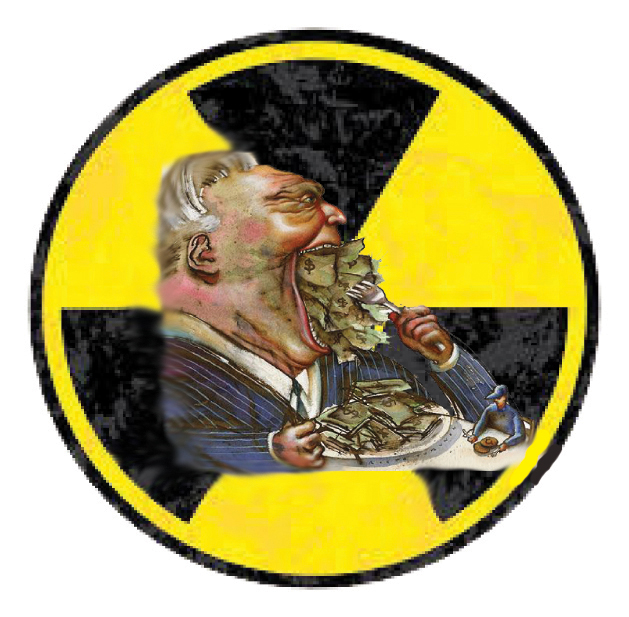
How many $trillions is the American government putting into the nuclear industry, especially nuclear weapons? With the USA essentially bankrupt, and the pandemic ushering it into an even more dire financial state – it’s a joke! Or, it would be a joke, if not for the hardship, suffering, poverty, brought upon its people, by this foolish financial extravaganza on behalf of a corrupt, dangerous and useless industry.
Russia, China, UK France, and soon Middle Eastern nations mindlessly follow this suicidal nuclear path.
The banking industry and other financial institutions join in the frenzy to feed this rapacioua evil of the nuclear industry.
Sadly so many jobs and community “benefits” are attached to it. It is going to take an enormous effort of brains, integrity, some sacrifice – to unravel the nuclear financial mess,.
But the world had better start unravelling it. Even without the worst outcome – nuclear war, this foul nuclear industry is going to devastate the finances of nations. and prevent action to stall global heating.
In this Covid-19 pandemic era, it is absolutely time to phase nuclear out, and help populations to transition to a cleaner world, where public money is spent on the things that people really need.
Profiteering from the pandemic, the Pentagon and nuclear industry exploit the situation

Beware the Pentagon’s Pandemic Profiteers, Hasn’t the Military-Industrial Complex Taken
 enough of Our Money? POGO, BY MANDY SMITHBERGER | FILED UNDER ANALYSIS | MAY 04, 2020 This piece originally appeared on TomDispatch.com.
At this moment of unprecedented crisis, you might think that those not overcome by the economic and mortal consequences of the coronavirus would be asking, “What can we do to help?” A few companies have indeed pivoted to making masks and ventilators for an overwhelmed medical establishment. Unfortunately, when it comes to the top officials of the Pentagon and the CEOs running a large part of the arms industry, examples abound of them asking what they can do to help themselves.
It’s important to grasp just how staggeringly well the defense industry has done in these last nearly 19 years since 9/11. Its companies (filled with ex-military and defense officials) have received trillions of dollars in government contracts, which they’ve largely used to feather their own nests. Data compiled by the New York Times showed that the chief executive officers of the top five military-industrial contractors received nearly $90 million in compensation in 2017. An investigation that same year by the Providence Journal discovered that, from 2005 to the first half of 2017, the top five defense contractors spent more than $114 billion repurchasing their own company stocks and so boosting their value at the expense of new investment.
To put this in perspective in the midst of a pandemic, the co-directors of the Costs of War Project at Brown University recently pointed out that allocations for the Food and Drug Administration, the Centers for Disease Control and Prevention, and the National Institutes of Health for 2020 amounted to less than 1% of what the U.S. government has spent on the wars in Iraq and Afghanistan alone since 9/11. While just about every imaginable government agency and industry has been impacted by the still-spreading coronavirus, the role of the defense industry and the military in responding to it has, in truth, been limited indeed. The highly publicized use of military hospital ships in New York City and Los Angeles, for example, not only had relatively little impact on the crises in those cities but came to serve as a symbol of just how dysfunctional the military response has truly been.
Bailing Out the Military-Industrial Complex in the COVID-19 Moment
Demands to use the Defense Production Act to direct firms to produce equipment needed to combat COVID-19 have sputtered, provoking strong resistance from industries worried first and foremost about their own profits. Even conservative Washington Post columnist Max Boot, a longtime supporter of increased Pentagon spending, has recently recanted, noting how just such budget priorities have weakened the ability of the United States to keep Americans safe from the virus. “It never made any sense, as Trump’s 2021 budget had initially proposed, to increase spending on nuclear weapons by $7 billion while cutting Centers for Disease Control and Prevention funding by $1.2 billion,” he wrote. “Or to create an unnecessary Space Force out of the U.S. Air Force while eliminating the vitally important directorate of global health by folding it into another office within the National Security Council.”
In fact, continuing to prioritize the U.S. military will only further weaken the country’s public health system. ……..
How Not to Deal With COVID-19
Along with those military-industrial bailouts came the fleecing of American taxpayers. While many Americans were anxiously awaiting their $1,200 payments from that congressional aid and relief package, the Department of Defense was expediting contract payments to the arms industry. Shay Assad, a former senior Pentagon official, accurately called it a “taxpayer rip-off” that industries with so many resources, not to speak of the ability to borrow money at incredibly low interest rates, were being so richly and quickly rewarded in tough times. Giving defense giants such funding at this moment was like giving a housing contractor 90% of upfront costs for renovations when it was unclear whether you could even afford your next mortgage payment.
Right now, the defense industry is having similar success in persuading the Pentagon that basic accountability should be tossed out the window. ……..
Unfortunately, as COVID-19 spread on the aircraft carrier the USS Theodore Roosevelt, that ship became emblematic of how ill-prepared the current Pentagon leadership proved to be in combatting the virus. Despite at least 100 cases being reported on board—955 crewmembers would, in the end, test positive for the disease and Chief Petty Officer Charles Robert Thacker Jr. would die of it—senior Navy leaders were slow to respond. Instead, they kept those sailors at close quarters and in an untenable situation of increasing risk. When an emailed letter expressing the concerns of the ship’s commander, Captain Brett Crozier, was leaked to the press he was quickly removed from command. But while his bosses may not have appreciated his efforts for his crew, his sailors did. He left the ship to a hero’s farewell. ……… https://www.pogo.org/analysis/2020/05/beware-the-pentagons-pandemic-profiteers/
Covid-19 highlights risks of doing nothing on global heating
 ‘Green Swan’ Virus Shock Proves Need for Joint Climate Action, Bloomberg Law
- Covid-19 highlights risks of doing nothing on global warming
- BIS urges global cooperation in rethinking old routines
The coronavirus pandemic that’s sent the global economy into a tailspin highlights the need for international collaboration to tackle crises posing severe threats to human lives, chief among them climate change, according to the Bank for International Settlements.
Much like global warming, the disease outbreak meets the criteria for being a “Green Swan,” according to the Basel, Switzerland-based institution, which adapted Nassim Nicholas Taleb’s “Black Swan” concept for high-impact adverse events outside the scope of regular expectations to describe risks that are highly likely to materialize but too complex to fully understand…….
Central banks have already begun to consider climate change as a factor in their assessment of financial and economic risks, and the BIS highlighted the possibility of further multidisciplinary efforts to absorb large shocks. …..
With the global economy in the throes of its deepest dive since the 1930s, the pandemic may jolt decision makers into action to address global warming, according to the BIS.
“Covid-19 might have presented a vivid image of what the future might look like if nothing is done to reduce greenhouse gases, inflicting similar stoppages worldwide after some tipping-point is reached,” it said. “It may also have raised awareness of the fragility of some of our systems and therefore of the need for improved efficiency and greater resilience.”
To contact the reporter on this story:
Catherine Bosley in Zurich at cbosley1@bloomberg.net
To contact the editors responsible for this story:
Fergal O’Brien at fobrien@bloomberg.net https://news.bloomberglaw.com/banking-law/green-swan-virus-shock-proves-need-for-joint-climate-action
1 This Month
26 September – International Day for the Total Elimination of Nuclear Weapons





PLEASE OPPOSE HR 8255 AND S.3639 – bills would accelerate satellite deployment, with no environmental review or safeguards – https://ncstd5li.quorum.us/campaign/169331/
To see nuclear-related stories in greater depth and intensity – go to https://nuclearinformation.wordpress.com
-
Archives
- September 2026 (281)
- August 2026 (330)
- July 2026 (355)
- June 2026 (287)
- May 2026 (306)
- April 2026 (356)
- March 2026 (251)
- February 2026 (267)
- January 2026 (308)
- December 2025 (358)
- November 2025 (359)
- October 2025 (375)
-
Categories
- 1
- 1 NUCLEAR ISSUES
- business and costs
- climate change
- culture and arts
- ENERGY
- environment
- health
- history
- indigenous issues
- Legal
- marketing of nuclear
- media
- opposition to nuclear
- PERSONAL STORIES
- politics
- politics international
- Religion and ethics
- safety
- secrets,lies and civil liberties
- spinbuster
- technology
- Uranium
- wastes
- weapons and war
- Women
- 2 WORLD
- ACTION
- AFRICA
- Atrocities
- AUSTRALIA
- Christina's notes
- Christina's themes
- culture and arts
- Events
- Fuk 2022
- Fuk 2023
- Fukushima 2017
- Fukushima 2018
- fukushima 2019
- Fukushima 2020
- Fukushima 2021
- general
- global warming
- Humour (God we need it)
- Nuclear
- RARE EARTHS
- Reference
- resources – print
- Resources -audiovicual
- Weekly Newsletter
- World
- World Nuclear
- YouTube
-
RSS
Entries RSS
Comments RSS

