Czech Fiscal Council warns on the long-term risk of financing a new nuclear reactor

Even the World Nuclear News, voice of the global nuclear industry, admits that nuclear reactors are just too costly
Czech budget council warns of Dukovany cost https://www.world-nuclear-news.org/Articles/Czech-budget-council-warns-of-Dukovany-cost 05 June 2020
 The Czech Fiscal Council, Národní rozpočtová rada (NRR), has warned that financing a new nuclear power unit could have a long-term impact on the country’s budget and could be “a lot higher” than current estimates.
Czech Prime Minister Andrej Babiš said last week that the government will provide a loan to ČEZ to cover 70% of the cost of building a new unit at the Dukovany nuclear power plant, with the majority state-owned utility funding the remaining 30%. The project cost is estimated to be about EUR6.0 billion (USD6.7 billion).
In its latest quarterly report, published on 3 June, the NRR said it was outside its remit to comment on the country’s choice of energy mix, but that it considered it necessary to comment on aspects of policy that significantly affect public budgets.
“In May 2020, the government presented a proposal to provide a loan to ČEZ covering up to 70% of the funds needed for the completion of the Dukovany nuclear power plant, while the costs of project implementation are expected to be around CZK160 billion. It’s obvious that such an amount would have to be secured by the state on the capital markets and thus the share of public debt in GDP would increase,” it said.
v”In addition, experience from the construction of nuclear power plants abroad in recent years has shown that the budgeted amounts are generally significantly exceeded. In the end, the fiscal costs of completing a nuclear power plant may be significantly higher than current estimates. Decisions of similar importance should therefore, in the NRR’s view, be taken on the basis of careful analysis and after a more detailed discussion.”
ČEZ applied to the State Office for Nuclear Safety on 25 March to construct two new reactors at its Dukovany nuclear power plant. Four VVER-440 units are currently in operation at the site, in Vysočina Region.
Most UK pension providers are investing in nuclear weapons companies
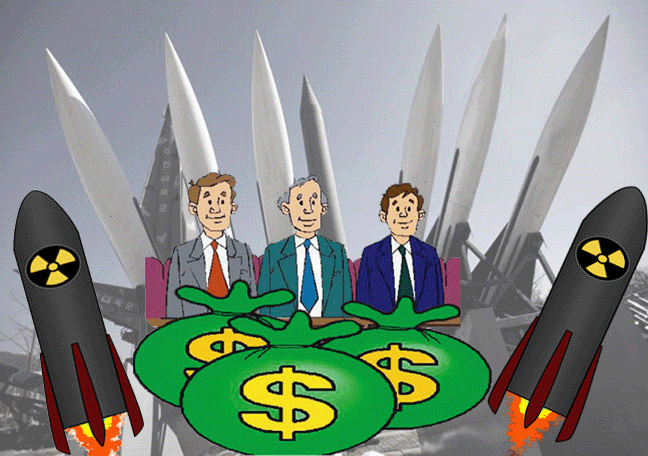
“The UN Treaty on the Prohibition of Nuclear Weapons (TPNW) was agreed in 2017.
“Once this is ratified by 50 states and comes into effect as a new piece of international law, the implications will be significant for nuclear armed states and financial institutions alike.
“The biggest banking corporations have a global reach and cannot disregard international law.”
|
Concerns raised over pension investments in nuclear weapons,
https://www.pensionsage.com/pa/Most-pension-providers-investing-in-nuclear-weapons.php By Sophie Smith 03/6/20 A report by the UK Nuclear Weapons Financing Research Group has raised concerns about the number of pension providers investing in companies that are producing nuclear weapons.
The report, Banks, Pensions and Nuclear Weapons: Investing in Change, found that among pension providers, policy on restricting investment in nuclear weapons is generally limited to ethical funds. Continue reading |
U.S. taxpayers bearing the crushing cost of nuclear waste
 The Crushing Cost Of Nuclear Waste Is Weighing On Taxpayers, Oil Price,
 By Haley Zaremba – Jun 19, 2019 The Maine Yankee nuclear power plant hasn’t produced a single watt of energy in more than two decades, but it cost U.S. taxpayers about $35 million this year.” So begins a powerful report this week about the crushing cost of nuclear waste storage by the Los Angeles Times……..In the United States, where the nuclear industry is ailing, this is particularly bad news. More plants are shutting down than are going online, and many of the nuclear plants that are continuing to function are able to do so in large part thanks to government subsidies at the state level, which is to say, even more taxpayer dollars.
The Trump administration, for its part, has made efforts to combat the rising prices of nuclear waste storage–albeit extremely controversial ones. Just this month, “in a move that will roll back safety standards that have been observed for decades” says not-for-profit news organization Truthout, “the Trump administration reportedly has plans to reclassify nuclear waste previously listed as “high-level” radioactive to a lower level, in the interest of saving money and time when disposing of the material.”
While this may be a quick fix for the massive amounts of money flowing out of taxpayer pockets and into the nuclear energy industry, it’s certainly not a sustainable solution for what could easily become a national health crisis if mismanaged. ……https://oilprice.com/Alternative-Energy/Nuclear-Power/The-Crushing-Cost-Of-Nuclear-Waste-Is-Weighing-On-Taxpayers.html
UK’s Sizewell nuclear plan in doubt, due to cost and China’s involvement?
Plan for new UK nuclear plant under intense scrutiny, Proposal for reactor attracts attention because of Chinese role as well as cost Ft.com Nathalie Thomas in Edinburgh and Jim Pickard in London, JUNE 2 2020
Environmentalists insist cheaper, green technologies such as wind, solar and batteries should take precedence over nuclear. ……….Nuclear just isn’t cost-effective,” said Doug Parr, chief scientist for campaign group Greenpeace.
https://www.ft.com/content/4e3221ef-ac1e-43cc-8d68-e1397ca0637f Against this backdrop, the government last year launched a consultation on a possible new funding model for new nuclear plants. The so-called regulated asset base model is attractive to developers because it would cut the cost of capital for a new nuclear plant, reflecting how consumers would pay upfront for the project through their energy bills. These consumers could be left picking up the tab for cost overruns.
Please use the sharing tools found via the share button at the top or side of articles. Copying articles to share with others is a breach of FT.com T&Cs and Copyright Policy. Email licensing@ft.com to buy additional rights. Subscribers may share up to 10 or 20 articles per month using the gift article service. More information can be found here.
https://www.ft.com/content/4e3221ef-ac1e-43cc-8d68-e1397ca0637f
EDF terminates nuclear electricity supply contracts,
EDF terminates nuclear electricity supply contracts, WNN ,03 June 2020 French utility EDF has notified three energy suppliers – Alpiq, Gazel Energie and Total Direct Energie – of the termination of their contracts under a mechanism that allows rival suppliers to buy electricity produced by EDF’s nuclear power plants. The suppliers had sought to invoke the force majeure clause in their supply contracts with EDF…….
EDF announced today that it had terminated the ARENH contracts it has with Alpiq, Gazel and Total Direct Energie, as provided for in the contracts when an interruption occurs for a period of over two months.
“The COVID-19 health crisis and the emergency measures introduced by public authorities on 17 March 2020 led to a decline in electricity consumption by non-residential clients, impacting all market players, including EDF,” the company said. “Faced with this decline in electricity consumption, some suppliers decided to revoke their contractual commitments citing force majeure to reduce the volumes bought last November as part of the ARENH contract.”…… https://www.world-nuclear-news.org/Articles/EDF-terminates-nuclear-electricity-supply-contract
Exhumed AREVA – now “Framatome” acquires BWX Technologies’ US nuclear services business
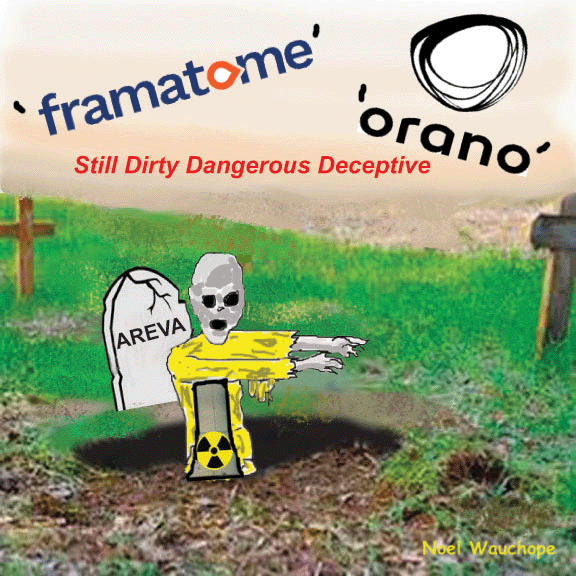 Framatome acquires BWX Technologies’ US nuclear services business 3 June 2020 3 June 2020 Framatome has completed its acquisition of BWX Technologies’ US commercial nuclear services business. With this transaction, Framatome expands its portfolio of equipment and tooling for nuclear power plant inspections and maintenance, a statement said. …..https://www.neimagazine.com/news/newsframatome-acquires-bwx-technologies-us-nuclear-services-business-7954409
Now with the pandemic, it is a free-for-all for the nuclear operators
COVID Infects World Nuclear Plants, May 27, 2020, by Alex Smith, Radio Ecoshock, “……….During this pandemic, the nuclear industry is another disaster not just waiting to happen, but already dancing with it. Some reactors have been shut down due to the pandemic. But most atomic companies demanded to stay open.
They call themselves essential services, despite a glut of electricity priced well below what the nuclear industry can match. In many countries, taxpayers are paying billions for mal-investments in nuclear power. In America, the private operators and their investors demanded the federal government top up user bills in order to compete with electricity from cheap wind and natural gas. They want safety regulations cut back, inspections and rules developed after major nuclear accidents to be relaxed.
In America, the Trump Administration is ready to help. Three of the 5 commissioners of the Nuclear Regulatory Commission were nominated by President Trump. Along with other environmental protection rules, the Trump Administration has been dropping safety requirements at nuclear plants. Now with the pandemic, it is a free-for-all for the nuclear operators – as they struggle to avoid painful bankruptcies across the nation.
In just one small example, the former on-site nuclear plant inspectors, found in all nuclear power plants by law, are now making their “inspections” over the phone. There is fear of massive absenteeism of nuclear employees as the pandemic infects workers and their families or contacts. In Georgia, 120 nuclear plant workers had to quarantine. American companies admit they have plans to keep emergency staff, thousands of them, at the reactors in a 24/7 lock down, sleeping on cots. But they won’t say if that is already happening or where. During this pandemic, a nuclear reactor in the United States is sunk down in ground flooded in Michigan. You probably did not hear about that. We will ask big questions about nuclear safety during the pandemic with our guest Grant Smith, Senior Energy Policy Advisor with EWG, the Environmental Working Group.
But it is not just America. The international scene is just as scary. Many companies said they had pandemic plans, but few did, or no plan on this scale. A few reactors in the UK and France were closed down because they could not be operated safely during a pandemic. Almost all the rest stay on, full power, despite workers getting infected, and essential supply chains in doubt. The Russian state atomic company Rosatom brags “Nuclear Is Not Afraid of COVID-19”. Construction on the first nuclear power plant in impoverished Bangladesh is continuing, they say, even though a few hundred Russian nuclear construction experts were called home during the pandemic. I guess it is up to the Bangladeshis to build it completely safely. Rosatom reports construction of new reactors in Egypt and Turkey continues through the pandemic.
Russian nuclear operators have been infected with this virus. Probably every country with a reactor or nuclear weapon has these infections and risks, without reporting it. What could go wrong? I summarize carefully worded reports that explain so much. A nuclear accident during a pandemic would be a dire twist in history. Maybe with a bit of sunlight and public voice, we can avoid that?
The industry reports terrorists threatened to attack nuclear facilities during this plague. Experts point to spikes in attempts to hack nuclear control systems, even while some reactor employees work from home computers. I hope they are not using Windows 10 with botched and hackable updates.. In all countries, from Finland to Canada to Australia, the problems or policies meant to cope with nuclear-sized risks during this pandemic are shrouded in secrecy.
A watchdog group reports major decisions approved by the U.S. Nuclear Regulatory Commission require, by law, public consultation and information. The pandemic has excused all that, the brakes are off, the deregulators are not regulating. The NRC claims it rules the operation of nuclear plants, but not worker health. The NRC has not provided a public plan for nuclear plants during COVID-19. Other national governments are distracted. They are already politically and financially enmeshed in the nuclear game. That leaves safety up to nuclear plant owners and investors, the unseen wealthy and their CEOs, the ones already facing oblivion as dangerous aging reactors shut down one after another, and wind power blows them away.
I’m Alex Smith. This is Radio Ecoshock. Before I cover the convergence of a pandemic, climate change, and grave nuclear risks in many countries, let’s start out with our guest in America. …… https://www.ecoshock.org/2020/05/covid-infects-world-nuclear-plants.html
Oleg Bodrov on the status of the Russian nuclear industry
Oleg Bodrov: Rosatom has agreements to build 36 nuclear power plants outside of Russia https://www.pressenza.com/2020/05/oleg-bodrov-rosatom-has-agreements-to-build-36-nuclear-power-plants-outside-of-russia/ 31.05.2020 – St Petersburg, Russia – Abolition 2000, On the 23rd of May, 2020, the Abolition 2000 Global Network to Eliminate Nuclear Weapons held its Annual General Meeting online for the first time due to the coronavirus pandemic. A large part of the meeting was dedicated to reflecting on the implications of covid-19 on the work of nuclear abolition. Oleg Bodrov of Public Council of the South Coast of the Gulf of Finland, near St Petersburg, Russia shared his views in a pre-recorded interview. We share it here for readers of Pressenza.
Transcript below
Dear colleagues, my name is Oleg Bodrov, I am a physicist, ecologist and peace movement activist from the south coast of the Gulf of Finland, in the Eastern Part of the Baltic Sea Region, close to St. Petersburg, Russia. I am the Chairman of the Public Council of the South Coast of the Gulf of Finland.
I worked in the Russian nuclear industry for 17 years but left it after the Chernobyl disaster. For the past 30 years, I have been working on issues of environmental protection, nuclear safety and the prohibition of nuclear weapons. I live on the border of the confrontation between NATO and Russia, on the southern coast of the Gulf of Finland.
So, the point which I will present just now, will be based on my personal experience and activities in the last years.
First of all I’d like to say something about the status of the Russian nuclear industry in the context of nuclear weapons and the export of “civil nuclear technologies” before the NPT Review Conference.First of all Russia, according to the official doctrine, could be the first to use nuclear weapons. It is a very important message. The Ministry of Foreign Affairs of the Russian Federation declared that: “The prohibition of nuclear weapons is contrary to our national interests”. And the president of the Russian Federation has demonstrated his psychological readiness to use nuclear weapons. He has personally launched four transcontinental missiles from submarines, air and ground-based facilities. Last but not least, the Russian state corporation, Rosatom, has agreements to build 36 nuclear power plants outside of Russia in different countries. Consumers of the nuclear electricity from these nuclear power plants outside of Russia may be investors in Russian military programs.
So the top level of Russian politicians are already ready to use nuclear weapons and develop the nuclear infrastructure outside of Russia which is possible to support Russian military programmes. This is number 1 of my message to my colleagues.
Some lessons after the pandemic Covid-19.
All countries, including nuclear weapons countries, have been powerless against the new virus.
Covid19 has stimulated the development of the economic crisis, and leaders of nuclear countries are using the crisis to find enemies outside of their counties. Thus, instead of joining forces against the virus, the political confrontation between countries deepens. What can we do, our international peace movement?
First of all I’d like to say that we have a SICK planet and we have no planet B! So now we need to not only protect our planet from nuclear weapons, but also reduce greenhouse gas emissions, stop “civil nuclear” expansion, which is part of military nuclear industry. We need to provide safe decommissioning of the more 400 nuclear power plants on our planet, and we need to promote sustainable development of our countries.
I think, first of all, we need to develop cooperation with our colleagues from non-governmental organisations working in the field of protection of traditional lifestyles of indigenous peoples, NGOs against climate change, and NGOs against the export of nuclear power plants.
It is reasonable to stimulate transboundary cooperation between NGOs, municipal and regional authorities close to the border between NATO and non-NATO countries.
I think that the politicians of NATO and Russia are trying to make us enemies 75 years after the Second World War. I think let’s hold hands, friends, in Russia, Europe, China and USA. We are friends and not enemies!
Estimated costs of Uk’s nuclear power projects – Sizewell C £18 billion ($22bn), Hinkley Point C £22.5bn
 Nuclear Engineering International 28th May 2020, The cost of Sizewell C is put at £18 billion ($22bn), while the estimated cost of Hinkley Point C is between £21.5bn and £22.5bn. The application for a Development Consent Order for Sizewell C follows four rounds of public consultation which began in 2012. More than 10,000 residents and organisations in Suffolk contributed their views.
Ex-president Kravchuk estimates compensation for Ukraine’s nuclear weapons at US$250 bln.
Ex-president Kravchuk estimates compensation for Ukraine’s nuclear weapons at US$250 bln. UNIAN Information Agency 30 May 20 No negotiations were held with the United States on the compensation.Leonid Kravchuk, the first president of independent Ukraine, estimates compensation for scrapping the country’s nuclear weapons after signing the Budapest memorandum at US$250 billion. “The nuclear weapons were tactical, they also went to Russia. There were Backfire carriers, these are legendary aircraft. They also were transferred to Russia. If one counts everything – it’s somewhere about US$250 billion,” Kravchuk told Ukrainian TV host and journalist Alesia Batsman during the Batsman program.
Here’s a supremely unaffordable nuclear fantasy – reactors on the moon and Mars
 NASA Wants to Go Nuclear on the Moon and Mars for Astronaut Settlement, SciTech Daily By AMERICAN CHEMICAL SOCIETY MAY 31, 2020 m It might sound like science fiction, but scientists are preparing to build colonies on the moon and, eventually, Mars. With NASA planning its next human mission to the moon in 2024, researchers are looking for options to power settlements on the lunar surface. According to a new article in Chemical & Engineering News, the weekly newsmagazine of the American Chemical Society, nuclear fission reactors have emerged as top candidates to generate electricity in space.
Huge dead nuclear reactor is a tough haul on Nevada’s roads
Decommissioned nuclear reactor heavy haul for Nevada roads, https://www.thenewstribune.com/news/business/article243115931.html, BY MARVIN CLEMONS LAS VEGAS REVIEW-JOURNAL MAY 30, 2020 A nuclear reactor vessel from Southern California’s decommissioned San Onofre Nuclear Generating Station made its way through Las Vegas by rail this week, headed to a transfer site and placement on a truck to become the heaviest object ever moved on a Nevada highway.
“By far, the biggest object ever moved on a road in the state,” Nevada Department of Transportation spokesman Tony Illia told the Las Vegas Review-Journal . “Our people have been scratching their heads for months to figure out a route that could work.”
The vessel is bound for burial at Clive, Utah, a remote site about 75 miles (121 kilometers) west of Salt Lake City. Movers and Nevada transportation crews were working to ensure it won’t damage state roads on the way.
The 770-ton nuclear reactor vessel was at the Apex Industrial Park in North Las Vegas, a transportation department heavy transport site adjacent to Interstate 15, where Illia said it will take a couple of weeks for cranes to lift it from the train car and deposit it on a 45-axle, 180-tire trailer for the trip toward Wendover, Utah.
The 300-foot-long (91.4-meter) shipment will also consist of two tractors to pull and another two tractors to push the more than 1.5-million pound load some 400 miles (643.7 kilometers) at no more than 10 mph (16.1 kph) .
It won’t move until the transportation department issues a permit 24 hours before hitting the highway, Illia said.
Sizewell C nuclear project now becoming prohibitively expensive?
NS Energy 27th May 2020, EDF has predicted the  cost of Sizewell C will be 20% lower than Hinkley Point C – which is set to cost about £20bn ($26bn) – because of the similarities between the stations and established infrastructure. But in an interview with The Times in April 2018, the company’s UK chief executive Simone Rossi questioned whether the project would remain “feasible” without faster progress being made at the Hinkley Point C site – which has suffered from rising costs and delays – and a government guarantee.
The firm is still talking with the government about workable funding models that can convince it to stay at the table. Speaking about the possibility of no functional funding model appearing, Mr Rossi said: “This is the year where we need to understand whether this whole thing is really
feasible or not. “If we were to conclude that maybe it’s not feasible, then at that point maybe we say we are not in a position to continue the project.” In January 2020, it was reported that EDF was running out of time to secure a funding deal before the project became prohibitively expensive.
https://www.nsenergybusiness.com/features/sizewell-c-nuclear-power-station/
Is it in the national interest? Chinese nuclear reactors for Bradwell, UK

BANNG 26th May 2020, The ‘golden era’ in relations between Britain and China which gave
birth to the prospect of a Chinese nuclear power station on the Blackwater
appears to be foundering less than five years after its triumphant
proclamation at the State Visit of the Chinese President Xi Jinping, in
October 2015.
The Blackwater Against New Nuclear Group (BANNG) has long
voiced its concerns about the potential security risks from Chinese control
of strategic UK infrastructure, such as the proposed Bradwell B nuclear
power station. These fears have been echoed by Dr. Robert Ford, the US
State Department’s Assistant Secretary for Non-Proliferation and
International Security, who has warned that the Chinese developer, China
General Nuclear Power Corporation, (CGN), ‘is closely linked to the
Communist regime’s military’ and urged Britain not to hand China
control of its electricity (Daily Mail, 16 May, 2020).
It is worth noting that the United states, with whom the UK is seeking a free trade deal, is
opposed to issuing a nuclear license to ‘an alien or any other
entity……it knows or has reason to believe is owned, controlled or
dominated by an alien, a foreign corporation, or a foreign government’
(Statement from US Nuclear Regulatory Commission).
Meanwhile, in the UK,
the ‘golden relationship’ is being questioned by Tory MPs, the Labour
Party and the Foreign Affairs and Defence Select Committees of MPs. Moves
are being made to toughen up company takeover laws, to strengthen security
and to assert the UK’s strategic independence. The Government has
recently set up ‘Project Defend’ to ‘identify, the country’s main
economic vulnerabilities to potentially hostile foreign governments as part
of a broader approach to national security’ (Reuters, 22 May, 2020).
BANNG’s Chair, Andy Blowers, has written to Nadhim Zahawi, the Energy
Minister, pointing to concerns about the Chinese threat to British
industry, trade and security and urging him to consider whether having
Chinese-designed and built reactors on a vulnerable site in Eastern England
is in the national interest.
Bankrupt French company AREVA, now resuscitated as Framatome to engineer UK’s nuclear fleet
Framatome to provide engineering services to UK nuclear fleet, 29 May 2020 French company Framatome has signed a framework agreement with EDF in the UK to provide engineering services to support ongoing nuclear power plant operations…… EDF in the UK operates a fleet of eight nuclear power stations: Sizewell B, Hinkley Point B, Dungeness B, Hartlepool, Heysham 1 and 2, Hunterston, and Torness. https://www.neimagazine.com/news/newsframatome-to-provide-engineering-services-to-uk-nuclear-fleet-7944809
1 This Month
26 September – International Day for the Total Elimination of Nuclear Weapons





PLEASE OPPOSE HR 8255 AND S.3639 – bills would accelerate satellite deployment, with no environmental review or safeguards – https://ncstd5li.quorum.us/campaign/169331/
To see nuclear-related stories in greater depth and intensity – go to https://nuclearinformation.wordpress.com
-
Archives
- September 2026 (281)
- August 2026 (330)
- July 2026 (355)
- June 2026 (287)
- May 2026 (306)
- April 2026 (356)
- March 2026 (251)
- February 2026 (267)
- January 2026 (308)
- December 2025 (358)
- November 2025 (359)
- October 2025 (375)
-
Categories
- 1
- 1 NUCLEAR ISSUES
- business and costs
- climate change
- culture and arts
- ENERGY
- environment
- health
- history
- indigenous issues
- Legal
- marketing of nuclear
- media
- opposition to nuclear
- PERSONAL STORIES
- politics
- politics international
- Religion and ethics
- safety
- secrets,lies and civil liberties
- spinbuster
- technology
- Uranium
- wastes
- weapons and war
- Women
- 2 WORLD
- ACTION
- AFRICA
- Atrocities
- AUSTRALIA
- Christina's notes
- Christina's themes
- culture and arts
- Events
- Fuk 2022
- Fuk 2023
- Fukushima 2017
- Fukushima 2018
- fukushima 2019
- Fukushima 2020
- Fukushima 2021
- general
- global warming
- Humour (God we need it)
- Nuclear
- RARE EARTHS
- Reference
- resources – print
- Resources -audiovicual
- Weekly Newsletter
- World
- World Nuclear
- YouTube
-
RSS
Entries RSS
Comments RSS

