$73 billion world spent in 2019 on nuclear weapons, half of it by USA
 World nuclear arms spending hit $73bn last year – half of it by US https://www.theguardian.com/world/2020/may/13/nuclear-weapons-world-record-spending
-
- Spending by nine nuclear-armed states rose 10%
- Trump boosted nuclear funding but cut pandemic prevention Julian Borger in Washington
-
-
- The world’s nuclear-armed nations spent a record $73bn on their weapons last year, with the US spending almost as much as the eight other states combined, according to a
-
- .
-
The new spending figures, reflecting the highest expenditure on nuclear arms since the height of the cold war, have been estimated by the International Campaign to Abolish Nuclear Weapons (Ican), which argues that the coronavirus pandemic underlines the wastefulness of the nuclear arms race.
The nine nuclear weapons states spent a total of $72.9bn in 2019, a 10% increase on the year before. Of that, $35.4bn was spent by the Trump administration, which accelerated the modernisation of the US arsenal in its first three years while cutting expenditure on pandemic prevention.
“It’s clear now more than ever that nuclear weapons do not provide security for the world in the midst of a global pandemic, and not even for the nine countries that have nuclear weapons, particularly when there are documented deficits of healthcare supplies and exhausted medical professionals,” Alicia Sanders-Zakre, the lead author of the report, said.
The report comes at a time when arms control is at a low ebb, with the last major treaty limiting US and Russian strategic nuclear weapons, New Start, due to expire in nine months with no agreement so far to extend it.
Russia, which has announced the development of an array of new weapons – including nuclear-powered, long-distance cruise missiles, underwater long-distance nuclear torpedoes and a new heavy intercontinental ballistic missile – spent $8.5bn on its arsenal in 2019, according to Ican’s estimates. China, which has a much smaller nuclear force than the US and Russia but is seeking to expand, spent $10.4bn.
Those expenditures were far overshadowed by the US nuclear weapons budget, which is part of a major upgrade also involving new weapons, including a low-yield submarine-launched missile, which has already been deployed.
According to the Congressional Budget Office, the cost of the US programme over the coming decade will be $500bn, an increase of nearly $100bn, about 23%, over projections from the end of the Obama administration.
Congressional Democrats failed in an attempt to curb the administration’s nuclear ambitions, but Kingston Reif, the director for disarmament and threat reduction policy at the Arms Control Association, said budgetary constraints in a coronavirus-induced recession, could succeed where political opposition failed.
“There’s going to be significant pressure on federal spending moving forward, including defense spending,” Reif said. “So, the cost and opportunity cost of maintaining and modernizing the arsenal, which were already punishing, will become even more so.”
USA’s record $3.7 trillion budget gap threatens Pentagon’s costly nuclear plans
 Huge federal deficits may threaten Pentagon nuclear modernization program Market Watch May 12, 2020, By Associated Press
The deficit may lead to a lack of big defense spending on projects like rebuilding the nation’s nuclear arsenal. WASHINGTON (AP) — The government’s $3 trillion effort to rescue the economy from the coronavirus crisis is stirring worry at the Pentagon. Bulging federal deficits may force a reversal of years of big defense spending gains and threaten prized projects like the rebuilding of the nation’s arsenal of nuclear weapons.
Defense Secretary Mark Esper says the sudden burst of deficit spending to prop up a damaged economy is bringing the Pentagon closer to a point where it will have to shed older weapons faster and tighten its belt.
“It has accelerated this day of reckoning,” Esper said in an Associated Press interview.
It also sets up confrontations with Congress over how that reckoning will be achieved. Past efforts to eliminate older weapons and to make other cost-saving moves like closing under-used military bases met resistance. This being a presidential election year, much of this struggle may slip to 2021. If presumptive Democratic nominee Joe Biden wins, the pace of defense cuts could speed up, if he follows the traditional Democratic path to put less emphasis on defense buildups.
After Congress passed four programs to sustain the economy through the virus shock, the budget deficit — the gap between what the government spends and what it collects in taxes — will hit a record $3.7 trillion this year, according to the Congressional Budget Office. By the time the budget year ends in September, the government’s debt — its accumulated annual deficits — will equal 101% of the U.S. gross domestic product.
Rep. Ken Calvert of California, the ranking Republican on the House Appropriations defense subcommittee, says defense budgets were strained even before this year’s unplanned burst of deficit spending…….. https://www.marketwatch.com/story/huge-federal-deficits-may-threaten-pentagon-nuclear-modernization-program-2020-05-12
Ukraine’s Energy ministry limits operations of nuclear power plants
Energy ministry limits operations of nuclear power plants UNIAN Information Agency 9 May 20 Ukraine “…..This week, the issue of a nuclear power units’ shutdown widely reverberated in a public discourse. From May 5, only 10 of 15 nuclear power units have been operating in Ukraine (four were put on scheduled repairs and one was put into reserve mode). According to the operating schedule for 2020, nine nuclear power units will operate at limited capacities. The government decided to take such a step in connection with the drop in electricity consumption caused by quarantine and record generation from renewables.
Pandemic may force USA to cut back on bloated spending on nuclear weapons
|
Pandemic spending will force US defense budget cuts—some of which should come from nuclear weapons programs https://thebulletin.org/2020/05/pandemic-spending-will-force-us-defense-budget-cuts-some-of-which-should-come-in-nuclear-weapons-programs/#
By Lawrence J. Korb, May 8, 2020 Even supporters of increased US defense budgets expect that, because the US government will likely spend trillions of dollars trying to rescue the economy from the effects of the COVID-19 pandemic, military spending in the United States is likely to decline significantly over the next couple of years. Those predicting such a decline include experts at the Stockholm International Peace Research Institute (SIPRI), the Center for Strategic and International Studies, (CSIS), American Enterprise Institute (AEI), the Center for Strategic and Budgetary Analysis, the RAND Corporation, and retired generals like David Barno and Hawk Carlisle. According to SIPRI’s latest report, global defense spending has grown for five straight years and in 2019 amounted to almost $2 trillion. US defense spending has also grown significantly over this period. Since President Trump took office, the annual defense budget—which, at $740 billion, consumes more than half of federal discretionary spending—has increased by almost $100 billion compared to Obama’s last budget, and during the Trump presidency, total US defense spending has amounted to almost $3 trillion. As a result, the US alone now accounts for about 40 percent of the world’s total military expenditures and spends more than the next 10 highest defense spenders combined (seven of whom are our allies). In real terms—that is, taking inflation into account—the US defense budget is higher than it was during the Reagan military buildup or the wars in Korea and Vietnam. In 2019, the combined budget of our two primary strategic competitors, Russia and China, was $326 billion—less than half of the Pentagon’s annual spending. Continue reading |
Big drop in France’s nuclear power generation.
The fall in output is “due to a drop in demand and prolonged (nuclear reactor) outages linked in particular to the health crisis,” EDF said.
Electricity consumption has plunged across Europe due to shutdown measures ordered by governments to halt the spread of the virus.
The utility added that its nuclear generation in Britain fell 18.7% year-on-year in April to 3.7 TWh, while total output since January was at 15.6 TWh, down 5.3% compared with the same period in 2019.
EDF’s subsidiary in Britain, EDF Energy has been asked to temporarily reduce output at its Sizewell B nuclear plant in the east of England to help balance the grid and prevent blackouts, due to the fall in energy demand, EDF and grid operator National Grid said separately on Wednesday. (Reporting by Bate Felix; Editing by GV De Clercq and Elaine Hardcastle) AT TOP https://af.reuters.com/article/commoditiesNews/idAFL8N2CO843
Workers at ‘most toxic place in America’ – Hanford nuclear site – in fear of coronavirus
|
A nuclear waste site where the biggest fear isn’t radiation, but coronavirus
Workers at ‘most toxic place in America’ are terrified to return to a site where there has been very little protection from the outbreak, Guardian, Hallie Golden in Seattle, 4 May, 20 For more than a month, coronavirus has brought cleanup of a 586-square-mile decommissioned nuclear production complex in south-eastern Washington state to a near standstill. Most of the more than 11,000 employees at the Hanford site were sent home in late March, with only essential workers remaining to make sure the “most toxic place in America” stays safe and secure. Now with signs that Washington has turned a corner with the virus and the state’s governor slowly starting to relax some safety measures, Hanford workers are looking at the very real possibility of returning to work. But after facing those initial few weeks of Washington’s coronavirus crisis on-site at Hanford, workers say they received little information and even fewer safety measures from leadership, and some employees are terrified by the prospect. “When you come back to work, what’s the expectation [for protections]?” asked a maintenance and operations worker at Hanford, who asked not to be identified by the Guardian to protect his job. “There are none.”…….. After Washington health officials reported the first US death associated with coronavirus in late February and then, with each passing week, were documenting the most cases in the country, employees say it remained business as usual at Hanford, where the cleanup project is run by the federal Department of Energy, with work completed through contractors. During those first few weeks, workers recall receiving little guidance on site-specific coronavirus safety measures. They say information from Hanford officials tended to be overly broad, focusing on the nationwide situation rather than the unique needs of workers in a state that was at that time at the center of the US coronavirus crisis. A radiological control technician, who has worked at Hanford for more than 15 years, said trailers continued to be shared by as many as 50 people and each Monday morning 200 employees would come together for a meeting in a single room. When workers finished at one of the many contaminated areas of Hanford, they needed to be checked for radiation before leaving. Technicians would stand next to them, without a mask on, running a handheld device over their body – being sure to stay within a quarter of an inch of their skin to ensure accurate readings. In a single hour, one of these radiological control technicians, may have surveyed as many as 30 people. “There’s no way to keep that social distancing. You’re right up in somebody’s face, they’re breathing on you, they’re sweaty,” said the technician, who asked to remain anonymous for fear of retaliation at work. Tom Carpenter, executive director of the Hanford Challenge, a not-for-profit watchdog organization in Seattle, said he received at least 10 emails and phone calls in two weeks in March from employees worried about Hanford not providing face masks or gloves or requiring social distancing to protect them from coronavirus. “Workers were highly distressed about their own health and safety, and felt that management was not taking this issue seriously,” he said. “Stop works”, a protocol at Hanford in which an employee notices something is unsafe or hazardous and work is halted until officials can fix the problem, became so frequent on issues related to coronavirus, said the radiological control technician, that little work was actually getting done. …….. It wasn’t until 25 March – after Governor Jay Inslee’s stay-at-home mandate, which involved the closure of all non-essential companies (Hanford is considered essential) – that the site switched to a state of essential mission-critical operations. The site will remain functioning in this capacity through at least Friday. It’s unclear whether this will be renewed beyond then. Carpenter said the concern over the lack of protection is about more than keeping workers safe from coronavirus. He said if the virus were to get passed throughout Hanford, it could put the highly sensitive work being done there in jeopardy. …… Carpenter said Hanford officials have reported that two workers have been diagnosed with coronavirus, but he said, “there’s almost assuredly more”….. https://www.theguardian.com/us-news/2020/may/04/hanford-nuclear-waste-site-coronavirus-washington Mon 4 May 2020 20.00 AESTLast modified on Tue 5 May 2020 02.36 AEST |
|
Workers at Connecticut’s nuclear power plant worried about coronavirus precautions
Nuclear plant workers cite lack of precautions around virus, myrecordjournal. 4 May 20, HARTFORD, Conn. (AP) — Workers at Connecticut’s only nuclear power plant worry that managers are not taking enough precautions against the coronavirus after 750 temporary employees were brought in to help refuel one of the two active reactors.
Ten employees at the Millstone Power Station in Waterford have tested positive for the virus, and the arrival of the temporary workers alarms some of the permanent employees, The Day newspaper reported Sunday.
“Speaking specifically for the guard force, there’s a lot of frustration, there’s a lot of concern, and I would say there’s anger,” said Millstone security officer Jim Foley.
Foley, vice president of the local chapter of the United Government Security Officers of America, said security personnel have had to fight for personal protective equipment and for partitions at access points to separate staff from security.
Foley also has filed a complaint with the Occupational Safety and Health Administration saying Millstone staff are using ineffective cleaning materials and citing a lack of cleaning and sanitizing. Cleaning activity was not scheduled during three weekends in April, he said.
Officials at Millstone, owned by Dominion Energy, have not heard internal criticism about the plant’s virus precautions, Millstone spokesman Kenneth Holt said……..
Millstone recently increased cleaning staff on the weekends, Holt said, and there is regular disinfecting at the plant. …….
The deaths of nearly 2,500 Connecticut residents have been linked to COVID-19, the disease caused by the virus. More than 29,000 state residents have tested positive. As of Sunday, hospitalizations had declined for 11 consecutive days, to over 1,480……. https://www.myrecordjournal.com/News/State/Nuclear-plant-workers-cite-lack-of-precautions-around-virus.html
Wind and solar power thriving in pandemic, but nuclear power going down the drain
 Nuclear is Getting Hammered by Green Power and the Pandemic, Plant operators are forced to switch uneconomic units off because of low prices and slumping demand. Bloomberg Green, May 4, 2020, “………Nations around the world have set tough targets to reduce greenhouse gases with the help of clean energy to meet commitments set out in the 2015 Paris Agreement.
In China, the coronavirus caused reduced output at CGN Power Co.’s atomic plants after the Lunar New Year holiday. Without taking into account the two reactors that came into operation in 2019, output at the remaining 22 units fell 4.7% in the first quarter from a year earlier, the company said.
After correcting for weather effects, full lockdowns reduced daily electricity demand by at least 15% in France, India, Italy, Spain, the U.K. and northwest U.S., the International Energy Agency said in a report on April 30. Global power consumption will decline as much as 5% this year, or the most since the Great Depression, according to the group advising the richest nations.
That will hurt all power sources, although use of renewables will still post a 1% gain this year, IEA said. Nuclear could drop by 3% from 2019 due to lower demand and delays to planned maintenance and construction of several projects, IEA said.
For example, EDF’s U.K. unit is undertaking more work than usual at its reactors, with five out of 15 units halted for long-term repairs. Output is below normal for the time of year. The company declined to comment on whether it was altering production due to rising renewables.
……. At Vattenfall, workers will permanently shut another old reactor at Ringhals by the end of the year, just after one unit was closed down in December. It would have been too costly to make the investments needed to keep them running any longer, the company has said.
And Hall, the boss, has a clear vision. While 5 billion kronor ($510 million) will be invested to secure safe operations at its nuclear and hydro plants this year and next, as much as 25 billion kronor will go to wind.
“We want to build more fossil-free generation and that is predominantly wind.” https://www.bloomberg.com/news/articles/2020-05-04/nuclear-is-getting-hammered-by-green-power-and-the-pandemic
16 Japanese Financial institutions won’t invest in companies involved in nuclear weapons
 Many Japanese lenders refuse to invest in companies linked to nuclear arms https://www.japantimes.co.jp/news/2020/05/03/business/corporate-business/many-japanese-lenders-refuse-invest-companies-linked-nuclear-arms/#.Xq8zaqgzbIU
KYODO Sixteen Japanese financial institutions say they refrain from investing in and extending loans to companies involved in the manufacturing of nuclear weapons and delivery systems, according to a Kyodo News survey released Sunday.
The survey found the lenders set guidelines for such issues in an effort to avert international criticism against conducting business with nuclear-related companies amid growing public perceptions about the inhumane nature of nuclear weapons and other weapons of mass destruction.
The 16 lenders include three megabanks — MUFG Bank under Mitsubishi UFJ Financial Group Inc., Mizuho Bank under Mizuho Financial Group Inc., and Sumitomo Mitsui Banking Corp. under Sumitomo Mitsui Financial Group Inc. — as well as Japan Post Bank Co. and Resona Bank under Resona Holdings Inc.
Kyodo sent a written questionnaire to a total of 119 city banks, regional banks and online banks from late February to early March. Of those, 35 responded.
About 70 percent of the total did not answer because they said they have never discussed the issue.
A Resona Bank official said the Osaka-based lender drew up written rules in March 2018 that it will not invest in nuclear, anti-personnel mines and other such fields due to rising international criticism against conducting businesses with companies involved in the manufacturing and development of weapons of mass destruction.
Eleven other lenders possessing such guidelines are Saitama Resona Bank in Saitama Prefecture, Aozora Bank in Tokyo, SBI Sumishin Net Bank, Hokkaido Bank and North Pacific Bank in Hokkaido, Tohoku Bank in Iwate Prefecture, Ogaki Kyoritsu Bank in Gifu Prefecture, Kansai Mirai Bank in Osaka Prefecture, Minato Bank in Hyogo Prefecture, Higo Bank in Kumamoto Prefecture and Kagoshima Bank in Kagoshima Prefecture.
According to the survey, nine respondents including Hokkaido Bank, the Bank of Kochi in Kochi Prefecture and Oita Bank in Oita Prefecture said they backed the Treaty on the Prohibition of Nuclear Weapons.
Of 20 lenders expressing reservation about the 2017 U.N. nuclear ban treaty, five questioned the Japanese government’s reluctance to sign it.
Japan does not possess nuclear weapons but remains under the nuclear umbrella of the United States.
Twelve respondents including Tohoku Bank, Higo Bank and the Bank of Toyama in Toyama Prefecture said they think the adoption of the U.N. pact would generate risks in the future to investment in nuclear-related companies.
None of the 35 respondents said they have provided funds to companies developing intercontinental ballistic missiles, bombers capable of loading nuclear weapons and other nuclear weapons-linked infrastructure.
However, the three megabanks declined to disclose their investments in nuclear-related companies.
 While welcoming the 16 lenders for supporting such guidelines, the International Campaign to Abolish Nuclear Weapons, or ICAN, a nongovernmental organization and the 2017 Nobel Peace Prize laureate, said it suspects some still continue to invest in nuclear-related businesses.
“Companies that manufacture nuclear weapons conduct businesses in other areas,” said Akira Kawasaki, a member of the International Steering Group of ICAN. “We see it as a perception gap between us and some banks that claim they abstain from investing in nuclear weapons manufacturing businesses.”
ICAN wants those banks to disclose details about their guidelines, Kawasaki said.
Offshore wind is General Electric’s great opportunity, not dodgy Small Nuclear Reactors
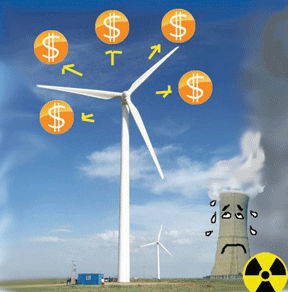 GE Power Plays: Wind Might Blow Coal, Gas And Nuclear Away, Seeking Alpha, Apr. 29, 2020 Keith Williams
GE offshore wind: massive offshore turbine Haliade-X 12MW looks like a winner.
GE-Hitachi Nuclear Energy may be a receding opportunity.
GE might sell its steam power business and rationalise its fossil fuel interests.
The power and renewables businesses are important in considering investment in GE.
………. Nuclear Small Modular Reactors : GE-Hitachi BWRX-300
There is a lot of talk in the nuclear industry and also in political circles from groups who are opposed to solar PV and wind developments, yet who acknowledge the need for low emissions technologies. The World Nuclear Association (WNA) has an excellent summary of many proposed developments in the area of Small Modular Nuclear Reactors (SMRs). The list of projects is long but many (most) seem to be struggling. A key point from the WNA report is the following : “Licensing is potentially a challenge for SMRs, as design certification, construction and operation licence costs are not necessarily less than for large reactors.” This is a huge red flag for any SMR project.
A second objection is cost of nuclear power versus solar PV/wind plus storage. There is a lot of information about these relative costs, including well into the future. I am not aware of any studies that suggest that any nuclear technology will be able to compete with renewables and storage on price. A recent study (December 2019) by the Australian Energy Market Operator (AEMO) and CSIRO concluded that SMR nuclear reactors will generate power costing ~8x that of rooftop or solar PV and wind, with solar and wind costs of power generation being similar.
……. With Small Modular Reactors the poster child of nuclear power supporters, it is clear that there is a lot riding on this potential saviour for the nuclear industry after Fukushima and recent delays and cost blowouts in the European (especially UK, French and Finnish) nuclear industries.
With current focus on emissions reductions and the climate emergency, this is an excellent time for low emissions technologies. However, the need is now and renewables (solar PV and wind) plus storage (pumped hydro and batteries) are making a lot of progress in addressing the needs. My question is whether the cost structure and long lead times mean that nuclear technology is too expensive and late to play a part.
A recent summary of the current state of the nuclear industry as a whole is depressing reading for someone who is enthusiastic about the nuclear industry’s prospects. A lot has to happen in the next decade and SMR technology isn’t ready yet. Is GE investing a lot in a technology that can’t compete with the dramatic advances in solar PV, wind and battery storage?……
GE’s adventures in nuclear developments seem like the kind of speculative play GE could happily fund when it was one of the world’s biggest and most powerful engineering companies. It doesn’t have that status anymore and my take is that it needs to cut its cloth and focus on projects that will have more immediate commercial outcomes. Of course, that is asking for a big rethink about how GE sees itself, but does it really have a choice if it wants to survive?
Offshore wind business
While there is some apprehension in the wind industry, especially in the US and China, as changes in regulations come into force next year, and 2020 has been messed up by COVID-19, there is a long-term future for wind power; offshore wind prospects look huge………
GE Renewable Energy is a major wind turbine supplier, with more than 42,000 of its turbines (mostly onshore) installed. Its role in the wind industry is extensive, from manufacture, digital optimization, operations and maintenance. Its onshore turbines range in size from 1MW to 5MW. GE installed ~50% of onshore turbines in the US last year, a 40% increase compared with the number of onshore turbines it installed in the US in 2018.
The offshore market is still emerging, with turbines substantially bigger than those used onshore. ….. The area that looks to me as if it could become a big winner is in offshore wind turbine developments, ….
A lot of investors have GE in their portfolios and a lot more are probably reflecting on whether GE might once again become a secure safe-haven investment. My biggest issue with GE is that it seems to me it is yet to understand that it is no longer the huge and dominant business that can afford to make big bets that burn a lot of cash. The current SMR nuclear programs in GE seem to be in this category. They have a very low chance of success but require major resources. I’d prefer not to have these distractions in a company I invest in….. https://seekingalpha.com/article/4340805-ge-power-plays-wind-might-blow-coal-gas-and-nuclear-away
Low Oil Prices May Kill Off The Next Nuclear Boom Before It Begins
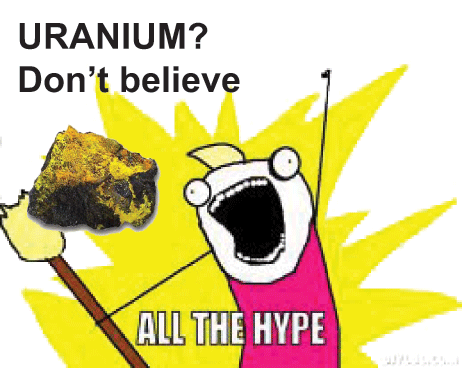 Low Oil Prices May Kill Off The Next Nuclear Boom Before It Begins, Oil Price, By Alex Kimani – Apr 27, 2020
Opening up the West
On Thursday, the Nuclear Fuel Working Group (NFWG) made recommendations to the U.S. Administration to open up ~1,500 acres outside the Grand Canyon for uranium production, arguing that the country needs to beef up domestic production to avoid an over-reliance on foreign sources.
The organization has recommended spending $1.5 billion over ten years buying uranium from American producers to create a uranium stockpile that would necessitate buying about 10 million pounds a year.
The working group’s report claims that the United States also needs more uranium for two other purposes:
– Low-enriched uranium for the production of tritium for nuclear weapons through the 2040s, and
– Highly enriched uranium to be used as fuel for Navy nuclear reactors through the 2050s
The slow and painful demise of the American uranium mining industry can be chalked up to the fact that the country is not endowed with the most abundant and most accessible uranium deposits, with resources in Canada and Australia boasting significantly higher uranium content and a lower production cost per unit.
American miners have had trouble making a profit from their operations even at the best of times. Consequently, the industry has historically had to rely heavily on government largesse.
During the golden age of American uranium that spanned from 1955-1980, the U.S. government offered fat uranium bonuses in a bid to shore up its stockpiles during the Cold War. These included 10-year price guarantees for certain kinds of ore as well as $10,000 discovery and production bonuses for new sources, which pencils out to nearly $100K in today’s dollars. The incentives set off a mad gold rush in the nation’s vast Western region as every man with a jeep and a Geiger counter set out to make the next significant discovery.
The program was a resounding success: U.S. uranium stockpiles skyrocketed so much that the government stopped paying out the bonuses sometime in the 1960s…….
By 1987, the tables had turned completely, with the country importing nearly 15 million pounds of uranium while domestic production clocked in at just 13 million.
Growing competition weighed heavily on domestic production while the country’s love affair with nuclear energy got its first dose of the harsh reality of nuclear technology thanks to the Three Mile Island nuclear disaster in 1979 as well as the Chernobyl reactor meltdown of 1986 that turned an entire Ukrainian city into a ghost town. Meanwhile, utilities began to grow weary of the time and cost of building reactors, which further depressed demand.
The result: U.S. uranium production had sunk to a 35-year low by the time the last wave of reactors came online in 1990…….
Brief Renaissance
The U.S. uranium industry enjoyed a renaissance in the early 2000s as falling global stockpiles, and booming economies in China and India drove new demand.
Unfortunately, this, too, was not to last as the financial crisis of 2008 destroyed demand, while the Fukushima nuclear disaster of 2011 led to another severe backlash that set off a new round of reactor closures while Germany set to phase out the technology by 2022.
The third nuclear gold rush is starting off on very shaky grounds, too.
First off, the world’s strategic uranium reserves are not in any immediate danger of running out. In 2016, the International Atomic Energy Agency said that the global nuclear fleet has enough stockpiles for 130 years, more than enough for the markets to respond to any shortfalls rapidly as they have done in the past. …..
But more importantly, trying to open up the west for uranium mining is bound to be met with stiff resistance and widespread public uproar.
For all its setbacks over the years, nuclear power has remained broadly popular in the United States. However, the turning point came in 2016 when the majority of people turned against the technology.
The latest poll last year revealed that American public opinion remains split over nuclear power, with 49 percent of U.S. adults either strongly favor (17 percent) or somewhat favor (32 percent) it in power generation while 49 percent either strongly oppose (21 percent) or somewhat oppose (28 percent) its use……
The funny thing is that Gallup has found that American opinion on nuclear power does not have much to do with radiation or safety concerns; rather, it is driven by prevailing fuel prices. …..
a 2020 Colorado College Conservation in the West Poll found that 71 percent of voters in the Mountain West and 77 percent of Arizona voters oppose the development of new uranium mines on public lands adjacent to the Grand Canyon. It’s the kind of backlash that no president wants to deal with, whether they are seeking re-election or not. https://oilprice.com/Energy/Energy-General/Low-Oil-Prices-May-Kill-Off-The-Next-Nuclear-Boom-Before-It-Begins.html
U.S. govt disregards nuclear diseconomics, pushes new nuclear power to support nuclear weapons
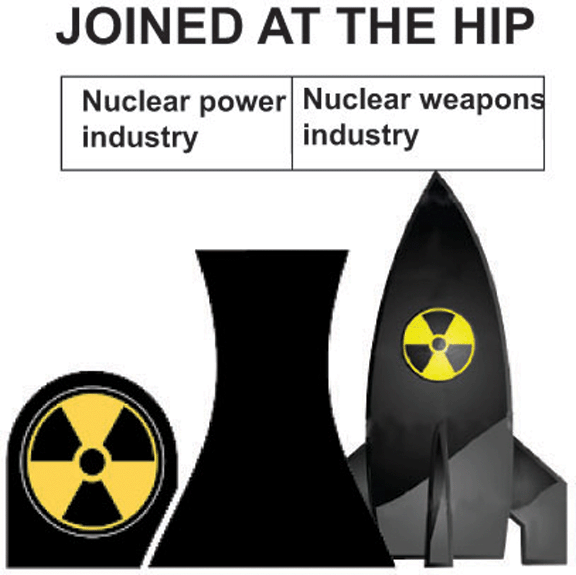 On April 23 the strongly pro-nuclear results of the Nuclear Fuel Working Group (NFWG) were made public by the US Department of Energy (DoE)
Energy Secretary Dan Brouillette announced the NFWG’s results and urged:
- Taking immediate and bold action to strengthen the uranium mining and conversion industries and restore the viability of the entire front-end of the nuclear fuel cycle.
• Utilizing American technological innovation and advanced nuclear RD&D investments to consolidate technical advances and strengthen American leadership in the next generation of nuclear energy technologies.
• Ensuring that there will be a healthy and growing nuclear energy sector to which uranium miners, fuel cycle providers, and reactor vendors can sell their products and services.
• Taking a whole-of-government approach to supporting the U.S. nuclear energy industry in exporting civil nuclear technology in competition with state-owned enterprises.”
Brouillette’s announcement also undermines the long-cultivated narrative that ‘peaceful / civil use’ and military application of nuclear power would be separate – instead, it explicitly references the connection between the civil and military nuclear sectors:
“The United States currently has two well-defined future defense needs for domestic uranium supply: low-enriched uranium needed to produce tritium required for nuclear weapons in the 2040s, and highly-enriched uranium needed to fuel Navy nuclear reactors in the 2050s.
The Strategy also recognizes that U.S. national security is truly integrated with the health of the front-end of the nuclear fuel cycle – the United States needs a strong civil nuclear industry to enable national defense.” (underlining not in the original)
US DoE at the same date published a NFWG Factsheet: Strategy to Restore American Nuclear Energy Leadership
France’s nuclear company EDF in spiralling debt crisis
|
New York Times 22nd April 2020, Plummeting electricity demand and falling power prices during the coronavirus outbreak could leave EDF in need of a capital injection by the
end of 2020 to avoid a spiralling debt crisis, a source close to the French firm and analysts said. The state-controlled utility, which operates the
world’s largest nuclear fleet, has long been weighed down by a 41.1 billion-euro debt pile. Shrinking income due to the health crisis and likely delays in reforming France’s electricity market, which could have boosted the firm’s earnings power, are now adding to its challenges and pressuring its financial ratios. A source close to EDF’s management said
the company may need a capital injection towards the end of the year to cushion the shock, with one analyst putting the size of any rights issue at several billion euros. |
|
Latest delay in Olkiluoto nuclear fuel loadings leads to Fitch revising outlook to negative
|
Fitch 20th April 2020, Fitch Ratings has revised Teollisuuden Voima Oyj’s (TVO) Outlook to
Negative from Stable and affirmed the Long-Term Issuer Default Rating (IDR) at ‘BBB-‘. The Negative Outlook reflects the latest announced delay of fuel
loading, a critical milestone, at the third 1,600 MW nuclear plant Olkiluoto 3 (OL3) project caused by overall slow progress of works as well as disruption due to the coronavirus outbreak. There is a risk that the settlement agreement signed with the supplier consortium (Areva NP, Areva GmbH, Siemens AG (A/Stable) and Areva Group’s parent Areva SA) in March
2018 would not protect TVO from financial impacts should the start of power production be delayed beyond June 2021, because the consortium has not yet assigned a new date for the fuel loading. After this date, TVO would not be entitled to penalty payments from the supplier consortium under the settlement agreement anymore. |
|
U.S. Environmental and Labor Groups Team Up to Demand COVID-19 Relief
 Environmental and Labor Groups Team Up to Demand COVID-19 Relief, Candice Bernd,
 Truthout, 22Apr 20
This story is published as part of Covering Climate Now, a global journalism collaboration strengthening coverage of the climate story.
As the COVID-19 pandemic continues to devastate the U.S. economy, national environmental organizations are stepping up to support labor unions and frontline workers across the country in their push for personal protective equipment, sick and hazard pay, safe working conditions, and other forms of relief as the crisis intensifies.
The Labor Network for Sustainability (LNS), which partners labor and environmental groups, is facilitating a loose coalition of more than 100 unions and environmental organizations working to pressure the Trump administration to do more to protect frontline workers. The groups are also supporting nine days of action from Earth Day to May Day to demonstrate the interconnection of climate justice and worker justice……… This story is published as part of Covering Climate Now, a global journalism collaboration strengthening coverage of the climate story.
As the COVID-19 pandemic continues to devastate the U.S. economy, national environmental organizations are stepping up to support labor unions and frontline workers across the country in their push for personal protective equipment, sick and hazard pay, safe working conditions, and other forms of relief as the crisis intensifies.
The Labor Network for Sustainability (LNS), which partners labor and environmental groups, is facilitating a loose coalition of more than 100 unions and environmental organizations working to pressure the Trump administration to do more to protect frontline workers. The groups are also supporting nine days of action from Earth Day to May Day to demonstrate the interconnection of climate justice and worker justice…… https://truthout.org/articles/environmental-and-labor-groups-team-up-to-demand-covid-19-relief/?eType=EmailBlastContent&eId=de9b2e7e-e70c-405a-830f-e0ea3203ca88
1 This Month
26 September – International Day for the Total Elimination of Nuclear Weapons





PLEASE OPPOSE HR 8255 AND S.3639 – bills would accelerate satellite deployment, with no environmental review or safeguards – https://ncstd5li.quorum.us/campaign/169331/
To see nuclear-related stories in greater depth and intensity – go to https://nuclearinformation.wordpress.com
-
Archives
- September 2026 (281)
- August 2026 (330)
- July 2026 (355)
- June 2026 (287)
- May 2026 (306)
- April 2026 (356)
- March 2026 (251)
- February 2026 (267)
- January 2026 (308)
- December 2025 (358)
- November 2025 (359)
- October 2025 (375)
-
Categories
- 1
- 1 NUCLEAR ISSUES
- business and costs
- climate change
- culture and arts
- ENERGY
- environment
- health
- history
- indigenous issues
- Legal
- marketing of nuclear
- media
- opposition to nuclear
- PERSONAL STORIES
- politics
- politics international
- Religion and ethics
- safety
- secrets,lies and civil liberties
- spinbuster
- technology
- Uranium
- wastes
- weapons and war
- Women
- 2 WORLD
- ACTION
- AFRICA
- Atrocities
- AUSTRALIA
- Christina's notes
- Christina's themes
- culture and arts
- Events
- Fuk 2022
- Fuk 2023
- Fukushima 2017
- Fukushima 2018
- fukushima 2019
- Fukushima 2020
- Fukushima 2021
- general
- global warming
- Humour (God we need it)
- Nuclear
- RARE EARTHS
- Reference
- resources – print
- Resources -audiovicual
- Weekly Newsletter
- World
- World Nuclear
- YouTube
-
RSS
Entries RSS
Comments RSS

